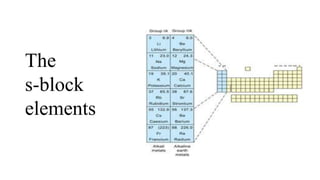
The
s-block
elements
SOME IMPORTANT COMPOUNDS OF SODIUM
Sodium Carbonate (Washing Soda), Na2CO3·10H2O
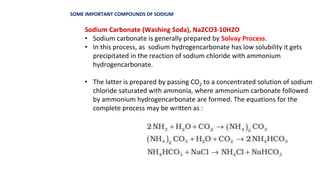
• Sodium carbonate is generally prepared by Solvay Process.
• In this process, as sodium hydrogencarbonate has low solubility it gets
precipitated in the reaction of sodium chloride with ammonium
hydrogencarbonate.
• The latter is prepared by passing CO2 to a concentrated solution of sodium
chloride saturated with ammonia, where ammonium carbonate followed
by ammonium hydrogencarbonate are formed. The equations for the
complete process may be written as :
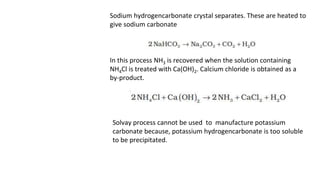
Sodium hydrogencarbonate crystal separates. These are heated to
give sodium carbonate
In this process NH3 is recovered when the solution containing
NH4Cl is treated with Ca(OH)2. Calcium chloride is obtained as a
by-product.
Solvay process cannot be used to manufacture potassium
carbonate because, potassium hydrogencarbonate is too soluble
to be precipitated.
Properties :
• Sodium carbonate is a white crystalline solid which exists as a decahydrate,
Na2CO3·10H2O.
• This is also called washing soda.
• It is readily soluble in water.
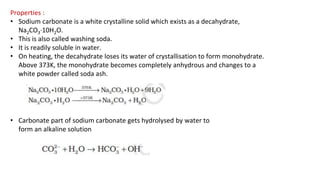
• On heating, the decahydrate loses its water of crystallisation to form monohydrate.
Above 373K, the monohydrate becomes completely anhydrous and changes to a
white powder called soda ash.
• Carbonate part of sodium carbonate gets hydrolysed by water to
form an alkaline solution
Uses:
(i) It is used in water softening, laundering and cleaning.
(ii) It is used in the manufacture of glass, soap, borax and caustic soda.
(iii) It is used in paper, paints and textile industries.
(iv) It is an important laboratory reagent both in qualitative and
quantitative analysis.
Sodium Chloride, NaCl
• The most abundant source of sodium chloride is sea water which
contains 2.7 to 2.9% by mass of the salt.
• In tropical countries like India, common salt is generally obtained by
evaporation of sea water. Approximately 50 lakh tons of salt are
produced annually in India by solar evaporation.
• Crude sodium chloride, generally obtained by crystallization of brine
solution, contains sodium sulphate, calcium sulphate, calcium chloride
and magnesium chloride as impurities
• Calcium chloride and magnesium chloride, are impurities because they
are deliquescent (absorb moisture easily from the atmosphere).
• To obtain pure sodium chloride, the crude salt is dissolved in minimum
amount of water and filtered to remove insoluble impurities.
• Sodium chloride melts at 1081K.
• It has a solubility of 36.0 g in 100 g of water at 273 K.
• The solubility does not increase appreciably with
increase in temperature.
Uses :
(i) It is used as a common salt or table salt for domestic
purpose.
(ii) It is used for the preparation of Na2O2, NaOH and Na2CO3.
• The solution is then saturated with hydrogen chloride
gas. Crystals of pure sodium chloride separate out.
• Calcium and magnesium chloride, being more soluble
than sodium chloride, remain in solution.
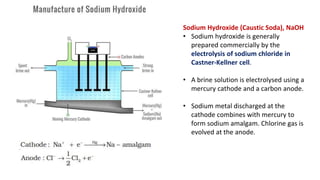
Sodium Hydroxide (Caustic Soda), NaOH
• Sodium hydroxide is generally
prepared commercially by the
electrolysis of sodium chloride in
Castner-Kellner cell.
• A brine solution is electrolysed using a
mercury cathode and a carbon anode.
• Sodium metal discharged at the
cathode combines with mercury to
form sodium amalgam. Chlorine gas is
evolved at the anode.
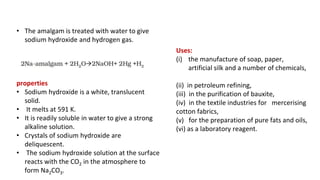
• The amalgam is treated with water to give
sodium hydroxide and hydrogen gas.
properties
• Sodium hydroxide is a white, translucent
solid.
• It melts at 591 K.
• It is readily soluble in water to give a strong
alkaline solution.
• Crystals of sodium hydroxide are
deliquescent.
• The sodium hydroxide solution at the surface
reacts with the CO2 in the atmosphere to
form Na2CO3.
Uses:
(i) the manufacture of soap, paper,
artificial silk and a number of chemicals,
(ii) in petroleum refining,
(iii) in the purification of bauxite,
(iv) in the textile industries for mercerising
cotton fabrics,
(v) for the preparation of pure fats and oils,
(vi) as a laboratory reagent.

s block elements part 6.pptx

  • 2.
  • 3.
    SOME IMPORTANT COMPOUNDSOF SODIUM Sodium Carbonate (Washing Soda), Na2CO3·10H2O • Sodium carbonate is generally prepared by Solvay Process. • In this process, as sodium hydrogencarbonate has low solubility it gets precipitated in the reaction of sodium chloride with ammonium hydrogencarbonate. • The latter is prepared by passing CO2 to a concentrated solution of sodium chloride saturated with ammonia, where ammonium carbonate followed by ammonium hydrogencarbonate are formed. The equations for the complete process may be written as :
  • 4.
    Sodium hydrogencarbonate crystalseparates. These are heated to give sodium carbonate In this process NH3 is recovered when the solution containing NH4Cl is treated with Ca(OH)2. Calcium chloride is obtained as a by-product. Solvay process cannot be used to manufacture potassium carbonate because, potassium hydrogencarbonate is too soluble to be precipitated.
  • 5.
    Properties : • Sodiumcarbonate is a white crystalline solid which exists as a decahydrate, Na2CO3·10H2O. • This is also called washing soda. • It is readily soluble in water. • On heating, the decahydrate loses its water of crystallisation to form monohydrate. Above 373K, the monohydrate becomes completely anhydrous and changes to a white powder called soda ash. • Carbonate part of sodium carbonate gets hydrolysed by water to form an alkaline solution
  • 6.
    Uses: (i) It isused in water softening, laundering and cleaning. (ii) It is used in the manufacture of glass, soap, borax and caustic soda. (iii) It is used in paper, paints and textile industries. (iv) It is an important laboratory reagent both in qualitative and quantitative analysis.
  • 7.
    Sodium Chloride, NaCl •The most abundant source of sodium chloride is sea water which contains 2.7 to 2.9% by mass of the salt. • In tropical countries like India, common salt is generally obtained by evaporation of sea water. Approximately 50 lakh tons of salt are produced annually in India by solar evaporation. • Crude sodium chloride, generally obtained by crystallization of brine solution, contains sodium sulphate, calcium sulphate, calcium chloride and magnesium chloride as impurities • Calcium chloride and magnesium chloride, are impurities because they are deliquescent (absorb moisture easily from the atmosphere). • To obtain pure sodium chloride, the crude salt is dissolved in minimum amount of water and filtered to remove insoluble impurities.
  • 8.
    • Sodium chloridemelts at 1081K. • It has a solubility of 36.0 g in 100 g of water at 273 K. • The solubility does not increase appreciably with increase in temperature. Uses : (i) It is used as a common salt or table salt for domestic purpose. (ii) It is used for the preparation of Na2O2, NaOH and Na2CO3. • The solution is then saturated with hydrogen chloride gas. Crystals of pure sodium chloride separate out. • Calcium and magnesium chloride, being more soluble than sodium chloride, remain in solution.
  • 9.
    Sodium Hydroxide (CausticSoda), NaOH • Sodium hydroxide is generally prepared commercially by the electrolysis of sodium chloride in Castner-Kellner cell. • A brine solution is electrolysed using a mercury cathode and a carbon anode. • Sodium metal discharged at the cathode combines with mercury to form sodium amalgam. Chlorine gas is evolved at the anode.
  • 10.
    • The amalgamis treated with water to give sodium hydroxide and hydrogen gas. properties • Sodium hydroxide is a white, translucent solid. • It melts at 591 K. • It is readily soluble in water to give a strong alkaline solution. • Crystals of sodium hydroxide are deliquescent. • The sodium hydroxide solution at the surface reacts with the CO2 in the atmosphere to form Na2CO3. Uses: (i) the manufacture of soap, paper, artificial silk and a number of chemicals, (ii) in petroleum refining, (iii) in the purification of bauxite, (iv) in the textile industries for mercerising cotton fabrics, (v) for the preparation of pure fats and oils, (vi) as a laboratory reagent.