Section B
                                     Study the information given below.
                                          SODIUM CHLORIDE

Molecular formula            *NaCl


Properties                   *Colourless, odourless, white crystalline solid


Production                   *Evaporation of seawater
                             *Seawater is boiled under reduced pressure
                             *Mining of salt


Common uses                  *Food additive
                             *Household uses
                             *Setting dyes in textile and fabric
                             *Production of soap, detergents and other bath products
                             *Production of other chemical products


Potential hazards            *High intake can lead to hypertension
                             *Salt in fresh water could harm aquatic plants and animals.

Write a report on sodium chloride.

In your report, you must:

* use all the information given
* elaborate by giving relevant information
* provide any other additional information
Your report should not be less than 200 words.
~~~~~~~~~~~~~~~~~~~~~~~~~~~~~~~~~~~~~~~~~~~~~~~~~~~~~~~~~~~~~~~~~~~~~~~~~~
Suggested elaborations and additional information

                                                  SODIUM CHLORIDE
               1. Sodium chloride, also known as common salt or table salt,
Introduction   2. It occurs as the mineral halite (rock salt) and in natural brines and sea water
               3.It is highly soluble in water and is the salt most responsible for the salinity of the ocean and of the
               4. extracellular fluid of many multicellular organisms.
               5.As the main ingredient in edible salt,
               6. it has long been used as a food seasoning and preservative.
               7. It is currently available quite inexpensively and in large quantities.
               8. Historically, however, it was difficult to obtain and was a highly valued trade item. Until the
               1900s, it was one of the prime movers of national economies and wars. It was controlled by
               governments and taxed as far back as the twentieth century B.C.E. in China.
P1 *NaCl
Molecular      1. NaCl is made up of sodium and chloride ions
formula        2.Sodium chloride forms crystals with cubic symmetry.
               3.chloride ions, are arranged in a cubic close-packing,
               4.the smaller sodium ions, fill the octahedral gaps between them.
               5.The ions are held together with ionic bonds.
               6.T he arrangement of ion is known as cubic clode packed crystal system
               P2*Colourless, odourless, white crystalline solid
Properties     1. Freely soluble in water; practically insoluble in ethanol.
               2. Melting point is 801 °C (1074 K)
               3.Boiling point is 1465 °C (1738 K)
               4.Soluble in glycerol, ethylene glycol, formic acid
               5.insoluble in HCl
               P3*Evaporation of seawater
Production 1.In tropical countries (one for which the ratio of evaporation to rainfall is suitably high)

             2.it is possible to use solar evaporation of sea water to produce salt.
             3.Brine is evaporated in a linked set of ponds
             4.until the solution is sufficiently concentrated
             5.that the salt crystallizes on the pond’s floor.
              6.By evaporation in multiple stages, the different kinds of salts, like sodium, magnesium and calcium
              salts, are separated,
              7. a process called refining. .
              P4*Seawater is boiled under reduced pressure
              1.The open pan salt works has effectively been replaced with a closed pan system
              2.where the brine solution is evaporated under reduced vacuum
              3. Brine would be pumped into the pans,
              4.and concentrated by the heat of the fire burning underneath.
              5.As crystals of salt formed these would be raked out and more brine added.
              P5*Mining of salt
              1.Today there are two different ways of underground salt mining.
              2.The first is mechanical mining by creating huge caverns and tunnels inside the salt, big enough to
              drive trucks inside.
              3.Salt is scratched off the walls by huge machines and
              4. transported to the surface in its solid form, on conveyor belts or heavy trucks.
              5.This works very well if the salt is either found in massive layers And of course if the salt is very
              pure.
              6.The mined salt is actually unrefined salt,
              7.which means it contains various different salts . It is called rock salt or halite.
              8.The second method is solutional mining.
              9.The salt is mined in the form of brine and the water then evaporated.
              10 Sometimes natural brine springs are used, but mostly fresh water is pumped into salt bearing
              layers and pumped back to the surface after it is saturated with salt.
              11.To clean the salt it is always important to solute it in water and filter it, which removes the
              unsoluble solids like clay.
              12.The treatment with chemicals follows, which precipitate most impurities.
              P6*Food additive
Common        1. This salt improves the flavor of food items such as breads and cheeses, and
uses          2. Salt promotes the natural development of color in some meat products and hot dogs and.
              3. In the form of iodized salt, it is a carrier of iodine. (Iodine is necessary for the synthesis of our
              thyroid hormones which influence growth, development and metabolic rates).A
              4. Without NaCl food would be tasteless
              P7*Household uses
              1.For household uses, it is an important preservative in meat,
              2.dairy products,
              3.margarine and other items,
              4.because it retards the growth of microorganisms.
5.enhances the tenderness of cured meat by causing them to absorb water
             6.It is spread over roads to melt ice by lowering the melting point of the ice.(de-icing)
             7. Sodium chloride has a large and diverse range of household uses.
              8.The salt has an important role in the regulation of body fluids.
             9.It is used in medicines such as mild antiseptic for minor cuts and livestock feed
             10. Salt water is also uses for gargling or as a mouthwash.
             P8*Setting dyes in textile and fabric
             1. Salt is used to fix dyes and to standardize dye batches
             2. Sodium chloride is used to manufacture sodium sulfate which is widely used in textile industry.
             3.sodium sulfate is used in producing dark colours which requires more dyeing.
             4.The textile industry has tedious routine requirements like sourcing colours and dyes,
             5.managing inventory and records for different manufacturers and clients, search, sourcing and
             selection of coloured items (fabric, thread, buttons, zippers, lace)
             P9*Production of soap, detergents and other bath products
             1.The raw materials for making household bleach are chlorine, caustic soda, and water.
             2.The chlorine and caustic soda are produced by putting direct current electricity through a sodium
             chloride salt solution
             3.in a process called electrolysis.
             4.researchers found that injecting salt water with electrical current broke down the salt (sodium
             chloride) molecules and produced a compound called sodium hypochlorite.
             5.This discovery enabled the mass production of sodium hypochlorite, or chlorine, bleach.
             6.The kettle method of making soap is still used today by small soap manufacturing companies. This
             process takes from four to eleven days to complete, and the quality of each batch is inconsistent
             7.more efficient manufacturing process, called the continuous process.
             8.This procedure is employed by large soap manufacturing companies all around the world today.
             Exactly as the name states, in the continuous process soap is produced continuously, rather than
             one batch at a time.
             P10*Production of other chemical products
             1.The chemical industry uses large amounts of sodium chloride salt to produce other chemicals.
             2.Chlorine and sodium hydroxide are electrolically produced from brine.
             3. Chlorine products are used in metal cleaners, paper bleach, plastics and water treatment.
             4.The chemical soda ash, which contains sodium, is used to manufacture glass, soaps, paper, and
             water softeners.
             5.Chemicals produced as a result of sodium chloride reactions are used in ceramic
             glazes, metallurgy, curing of hides, and photography.
             P11*High intake can lead to hypertension
Potential   1it is often ingested well in excess of the required intake.
hazards
            2.This leads to elevated levels of blood pressure (hypertension)
            3. which in turn is associated with increased risks of heart attack and stroke.
            4. Consuming salt in excess can also dehydrate the human body.
            5.Physiological and endocrinological systems that control sodium retention are extremely crucial to
            the maintenance of blood pressure.
             6.In summary and in general, disorders of electrolyte balance result in chronic hypertension (and
             then hypertensive vascular disease), which leads to further cardiovascular disease.

             P12*Salt in fresh water could harm aquatic plants and animals.

             1.Chloride in water adversely affects some species of plankton at concentrations as low as 12 mg/l.
             2.Lakes are affected by road salt in the process of meromixis. -the runoff road salt enters the water
             3.As a result, deep water organisms to struggle as well as die off in some cases
             4. because they are not capable of adapting to the new chemical make-up of the water.
              5.Autotrophs, such as algae and terrestrial plants are in particular danger of road salt.
             6.The presence of increased sodium chloride in an aquatic environment brings about an
             opportunity for invasive cyanobacteria to enter and dominate the inhabiting species.
              7.The cyanobacteria are capable of withstanding the severe conditions and they flourish
             accordingly,
             8.out-competing the other algae and smothering other organisms within the aquatic ecosystem.
Elaborations for NaCI

Elaborations for NaCI

  • 1.
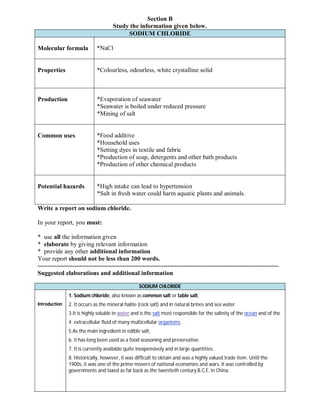
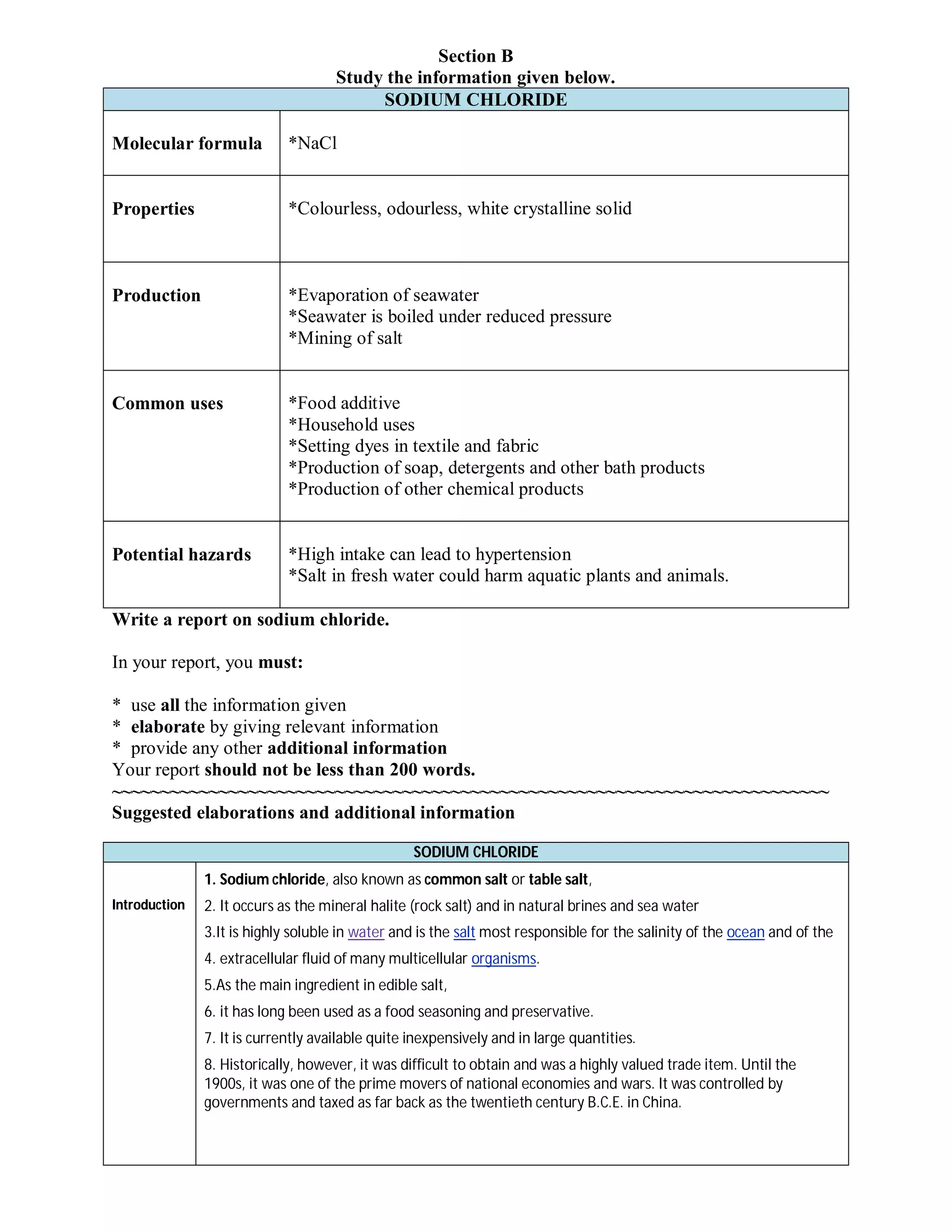
    Section B Study the information given below. SODIUM CHLORIDE Molecular formula *NaCl Properties *Colourless, odourless, white crystalline solid Production *Evaporation of seawater *Seawater is boiled under reduced pressure *Mining of salt Common uses *Food additive *Household uses *Setting dyes in textile and fabric *Production of soap, detergents and other bath products *Production of other chemical products Potential hazards *High intake can lead to hypertension *Salt in fresh water could harm aquatic plants and animals. Write a report on sodium chloride. In your report, you must: * use all the information given * elaborate by giving relevant information * provide any other additional information Your report should not be less than 200 words. ~~~~~~~~~~~~~~~~~~~~~~~~~~~~~~~~~~~~~~~~~~~~~~~~~~~~~~~~~~~~~~~~~~~~~~~~~~ Suggested elaborations and additional information SODIUM CHLORIDE 1. Sodium chloride, also known as common salt or table salt, Introduction 2. It occurs as the mineral halite (rock salt) and in natural brines and sea water 3.It is highly soluble in water and is the salt most responsible for the salinity of the ocean and of the 4. extracellular fluid of many multicellular organisms. 5.As the main ingredient in edible salt, 6. it has long been used as a food seasoning and preservative. 7. It is currently available quite inexpensively and in large quantities. 8. Historically, however, it was difficult to obtain and was a highly valued trade item. Until the 1900s, it was one of the prime movers of national economies and wars. It was controlled by governments and taxed as far back as the twentieth century B.C.E. in China.
  • 2.
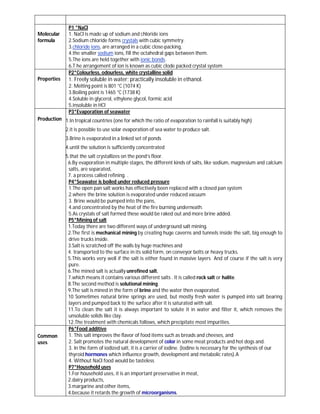
    P1 *NaCl Molecular 1. NaCl is made up of sodium and chloride ions formula 2.Sodium chloride forms crystals with cubic symmetry. 3.chloride ions, are arranged in a cubic close-packing, 4.the smaller sodium ions, fill the octahedral gaps between them. 5.The ions are held together with ionic bonds. 6.T he arrangement of ion is known as cubic clode packed crystal system P2*Colourless, odourless, white crystalline solid Properties 1. Freely soluble in water; practically insoluble in ethanol. 2. Melting point is 801 °C (1074 K) 3.Boiling point is 1465 °C (1738 K) 4.Soluble in glycerol, ethylene glycol, formic acid 5.insoluble in HCl P3*Evaporation of seawater Production 1.In tropical countries (one for which the ratio of evaporation to rainfall is suitably high) 2.it is possible to use solar evaporation of sea water to produce salt. 3.Brine is evaporated in a linked set of ponds 4.until the solution is sufficiently concentrated 5.that the salt crystallizes on the pond’s floor. 6.By evaporation in multiple stages, the different kinds of salts, like sodium, magnesium and calcium salts, are separated, 7. a process called refining. . P4*Seawater is boiled under reduced pressure 1.The open pan salt works has effectively been replaced with a closed pan system 2.where the brine solution is evaporated under reduced vacuum 3. Brine would be pumped into the pans, 4.and concentrated by the heat of the fire burning underneath. 5.As crystals of salt formed these would be raked out and more brine added. P5*Mining of salt 1.Today there are two different ways of underground salt mining. 2.The first is mechanical mining by creating huge caverns and tunnels inside the salt, big enough to drive trucks inside. 3.Salt is scratched off the walls by huge machines and 4. transported to the surface in its solid form, on conveyor belts or heavy trucks. 5.This works very well if the salt is either found in massive layers And of course if the salt is very pure. 6.The mined salt is actually unrefined salt, 7.which means it contains various different salts . It is called rock salt or halite. 8.The second method is solutional mining. 9.The salt is mined in the form of brine and the water then evaporated. 10 Sometimes natural brine springs are used, but mostly fresh water is pumped into salt bearing layers and pumped back to the surface after it is saturated with salt. 11.To clean the salt it is always important to solute it in water and filter it, which removes the unsoluble solids like clay. 12.The treatment with chemicals follows, which precipitate most impurities. P6*Food additive Common 1. This salt improves the flavor of food items such as breads and cheeses, and uses 2. Salt promotes the natural development of color in some meat products and hot dogs and. 3. In the form of iodized salt, it is a carrier of iodine. (Iodine is necessary for the synthesis of our thyroid hormones which influence growth, development and metabolic rates).A 4. Without NaCl food would be tasteless P7*Household uses 1.For household uses, it is an important preservative in meat, 2.dairy products, 3.margarine and other items, 4.because it retards the growth of microorganisms.
  • 3.
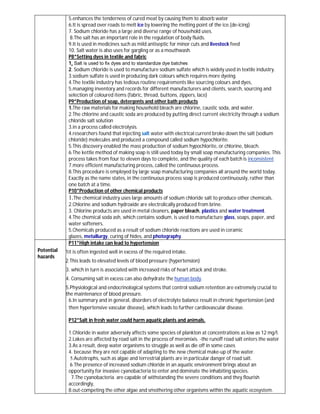
    5.enhances the tendernessof cured meat by causing them to absorb water 6.It is spread over roads to melt ice by lowering the melting point of the ice.(de-icing) 7. Sodium chloride has a large and diverse range of household uses. 8.The salt has an important role in the regulation of body fluids. 9.It is used in medicines such as mild antiseptic for minor cuts and livestock feed 10. Salt water is also uses for gargling or as a mouthwash. P8*Setting dyes in textile and fabric 1. Salt is used to fix dyes and to standardize dye batches 2. Sodium chloride is used to manufacture sodium sulfate which is widely used in textile industry. 3.sodium sulfate is used in producing dark colours which requires more dyeing. 4.The textile industry has tedious routine requirements like sourcing colours and dyes, 5.managing inventory and records for different manufacturers and clients, search, sourcing and selection of coloured items (fabric, thread, buttons, zippers, lace) P9*Production of soap, detergents and other bath products 1.The raw materials for making household bleach are chlorine, caustic soda, and water. 2.The chlorine and caustic soda are produced by putting direct current electricity through a sodium chloride salt solution 3.in a process called electrolysis. 4.researchers found that injecting salt water with electrical current broke down the salt (sodium chloride) molecules and produced a compound called sodium hypochlorite. 5.This discovery enabled the mass production of sodium hypochlorite, or chlorine, bleach. 6.The kettle method of making soap is still used today by small soap manufacturing companies. This process takes from four to eleven days to complete, and the quality of each batch is inconsistent 7.more efficient manufacturing process, called the continuous process. 8.This procedure is employed by large soap manufacturing companies all around the world today. Exactly as the name states, in the continuous process soap is produced continuously, rather than one batch at a time. P10*Production of other chemical products 1.The chemical industry uses large amounts of sodium chloride salt to produce other chemicals. 2.Chlorine and sodium hydroxide are electrolically produced from brine. 3. Chlorine products are used in metal cleaners, paper bleach, plastics and water treatment. 4.The chemical soda ash, which contains sodium, is used to manufacture glass, soaps, paper, and water softeners. 5.Chemicals produced as a result of sodium chloride reactions are used in ceramic glazes, metallurgy, curing of hides, and photography. P11*High intake can lead to hypertension Potential 1it is often ingested well in excess of the required intake. hazards 2.This leads to elevated levels of blood pressure (hypertension) 3. which in turn is associated with increased risks of heart attack and stroke. 4. Consuming salt in excess can also dehydrate the human body. 5.Physiological and endocrinological systems that control sodium retention are extremely crucial to the maintenance of blood pressure. 6.In summary and in general, disorders of electrolyte balance result in chronic hypertension (and then hypertensive vascular disease), which leads to further cardiovascular disease. P12*Salt in fresh water could harm aquatic plants and animals. 1.Chloride in water adversely affects some species of plankton at concentrations as low as 12 mg/l. 2.Lakes are affected by road salt in the process of meromixis. -the runoff road salt enters the water 3.As a result, deep water organisms to struggle as well as die off in some cases 4. because they are not capable of adapting to the new chemical make-up of the water. 5.Autotrophs, such as algae and terrestrial plants are in particular danger of road salt. 6.The presence of increased sodium chloride in an aquatic environment brings about an opportunity for invasive cyanobacteria to enter and dominate the inhabiting species. 7.The cyanobacteria are capable of withstanding the severe conditions and they flourish accordingly, 8.out-competing the other algae and smothering other organisms within the aquatic ecosystem.