
This project has received funding from the European Union’s Horizon 2020
research and innovation programme under grant agreement No 869993.
Crystal growth
Crystal growth theories
• After a stable nucleus has formed, it begins to grow
into crystal by the addition of solute particles of
the supersaturated solution. There are many
theories about crystal growth, such as diffusion
theories, surface energy theory and adsorption
layer theories and they all have several
modifications.
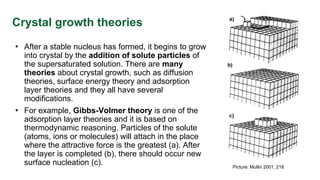
• For example, Gibbs-Volmer theory is one of the
adsorption layer theories and it is based on
thermodynamic reasoning. Particles of the solute
(atoms, ions or molecules) will attach in the place
where the attractive force is the greatest (a). After
the layer is completed (b), there should occur new
surface nucleation (c). Picture: Mullin 2001, 218
Two stages of crystal growth
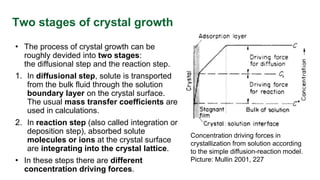
• The process of crystal growth can be
roughly devided into two stages:
the diffusional step and the reaction step.
1. In diffusional step, solute is transported
from the bulk fluid through the solution
boundary layer on the crystal surface.
The usual mass transfer coefficients are
used in calculations.
2. In reaction step (also called integration or
deposition step), absorbed solute
molecules or ions at the crystal surface
are integrating into the crystal lattice.
• In these steps there are different
concentration driving forces.
Concentration driving forces in
crystallization from solution according
to the simple diffusion-reaction model.
Picture: Mullin 2001, 227
Rate of crystal growth
• The rate of crystal growth depends on many
things, like supersaturation, temperature, crystal
habit and size and the turbulence on system.
• The thickness of the boundary layer has a
significant role.
• Greater supersaturation increases the rate of
crystal growth. At the range of crystal size from
200 μm to 2 mm, the bigger the crystal size the
greater the rate of growth.
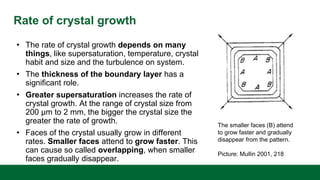
• Faces of the crystal usually grow in different
rates. Smaller faces attend to grow faster. This
can cause so called overlapping, when smaller
faces gradually disappear.
The smaller faces (B) attend
to grow faster and gradually
disappear from the pattern.
Picture: Mullin 2001, 218
Expressions for the growth rate
• The growth rate can be expressed as a linear growth rate (length per unit
time) or as a mass change of crystals.
• Linear growth rate can be used as a measurement of the growth of a
particular face or the overall growth of a crystal. The face growth is
measured in the direction of normal to face. To measure the overall growth of
a crystal a characteristic dimension is used. With sphere it is the diameter and
with other shapes usually the second longest dimension.
• One of the simpliest method to measure the mass change of crystals is
to weigh the seed crystal at te beginning and then weigh the product
crystal at the end of the experiment.
• In industrial processes, we are not usually so interested in the growth rate of
individual crystals. Population methods are used to provide information for
crystallizer design.
Effects of crystal growth rate
• Crystal growth rate also has a significant influence on crystal habit and
product purity. In practice, the lower the rate of crystal growth, the purer
are the formed crystals.
• Conditions in the nucleation process and during crystal growth
affect the crystal size distribution, which has a significant role for the
usage of the end product. There are several methods and equipment to
measure the crystal size distribution.
• To achieve the required level of purity and crystal size distribution, it might
be necessary to redissolve the crystals and recrystallize the product.
• The presence of too many nuclei makes the
supersaturation lower and decreases the growth rate of individual
crystals.
This project has received funding from the European Union’s Horizon 2020
research and innovation programme under grant agreement No 869993.
References
• Hipple, J. 2017. Chemical Engineering for Non‐Chemical Engineers. John Wiley & Sons, Inc, pp.
215-219.
• McCabe, W. L., Smith, J. C. & Harriott, P. 2005. Unit operations of chemical engineering. 7th ed.
Boston: McGraw-Hill, pp. 948-956.
• Mullin, J. W. 2001. Crystallization. Oxford: Elsevier Science & Technology. pp. 216-269.
• Myerson, A. 2001. Handbook of Industrial Crystallization. Oxford: Elsevier Science &
Technology. pp. 53-62.
Videos:
• Crystals growing while under the microscope, from 1958: https://youtu.be/Wp6bN9vN6e4
• Deep overview of crystallization: https://youtu.be/SHu_P-YRNuQ

Crystal growth

  • 1.
    This project hasreceived funding from the European Union’s Horizon 2020 research and innovation programme under grant agreement No 869993. Crystal growth
  • 2.
    Crystal growth theories •After a stable nucleus has formed, it begins to grow into crystal by the addition of solute particles of the supersaturated solution. There are many theories about crystal growth, such as diffusion theories, surface energy theory and adsorption layer theories and they all have several modifications. • For example, Gibbs-Volmer theory is one of the adsorption layer theories and it is based on thermodynamic reasoning. Particles of the solute (atoms, ions or molecules) will attach in the place where the attractive force is the greatest (a). After the layer is completed (b), there should occur new surface nucleation (c). Picture: Mullin 2001, 218
  • 3.
    Two stages ofcrystal growth • The process of crystal growth can be roughly devided into two stages: the diffusional step and the reaction step. 1. In diffusional step, solute is transported from the bulk fluid through the solution boundary layer on the crystal surface. The usual mass transfer coefficients are used in calculations. 2. In reaction step (also called integration or deposition step), absorbed solute molecules or ions at the crystal surface are integrating into the crystal lattice. • In these steps there are different concentration driving forces. Concentration driving forces in crystallization from solution according to the simple diffusion-reaction model. Picture: Mullin 2001, 227
  • 4.
    Rate of crystalgrowth • The rate of crystal growth depends on many things, like supersaturation, temperature, crystal habit and size and the turbulence on system. • The thickness of the boundary layer has a significant role. • Greater supersaturation increases the rate of crystal growth. At the range of crystal size from 200 μm to 2 mm, the bigger the crystal size the greater the rate of growth. • Faces of the crystal usually grow in different rates. Smaller faces attend to grow faster. This can cause so called overlapping, when smaller faces gradually disappear. The smaller faces (B) attend to grow faster and gradually disappear from the pattern. Picture: Mullin 2001, 218
  • 5.
    Expressions for thegrowth rate • The growth rate can be expressed as a linear growth rate (length per unit time) or as a mass change of crystals. • Linear growth rate can be used as a measurement of the growth of a particular face or the overall growth of a crystal. The face growth is measured in the direction of normal to face. To measure the overall growth of a crystal a characteristic dimension is used. With sphere it is the diameter and with other shapes usually the second longest dimension. • One of the simpliest method to measure the mass change of crystals is to weigh the seed crystal at te beginning and then weigh the product crystal at the end of the experiment. • In industrial processes, we are not usually so interested in the growth rate of individual crystals. Population methods are used to provide information for crystallizer design.
  • 6.
    Effects of crystalgrowth rate • Crystal growth rate also has a significant influence on crystal habit and product purity. In practice, the lower the rate of crystal growth, the purer are the formed crystals. • Conditions in the nucleation process and during crystal growth affect the crystal size distribution, which has a significant role for the usage of the end product. There are several methods and equipment to measure the crystal size distribution. • To achieve the required level of purity and crystal size distribution, it might be necessary to redissolve the crystals and recrystallize the product. • The presence of too many nuclei makes the supersaturation lower and decreases the growth rate of individual crystals.
  • 7.
    This project hasreceived funding from the European Union’s Horizon 2020 research and innovation programme under grant agreement No 869993. References • Hipple, J. 2017. Chemical Engineering for Non‐Chemical Engineers. John Wiley & Sons, Inc, pp. 215-219. • McCabe, W. L., Smith, J. C. & Harriott, P. 2005. Unit operations of chemical engineering. 7th ed. Boston: McGraw-Hill, pp. 948-956. • Mullin, J. W. 2001. Crystallization. Oxford: Elsevier Science & Technology. pp. 216-269. • Myerson, A. 2001. Handbook of Industrial Crystallization. Oxford: Elsevier Science & Technology. pp. 53-62. Videos: • Crystals growing while under the microscope, from 1958: https://youtu.be/Wp6bN9vN6e4 • Deep overview of crystallization: https://youtu.be/SHu_P-YRNuQ