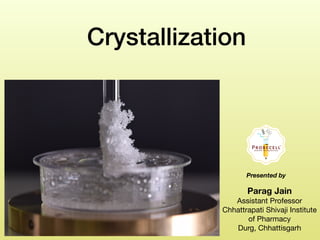
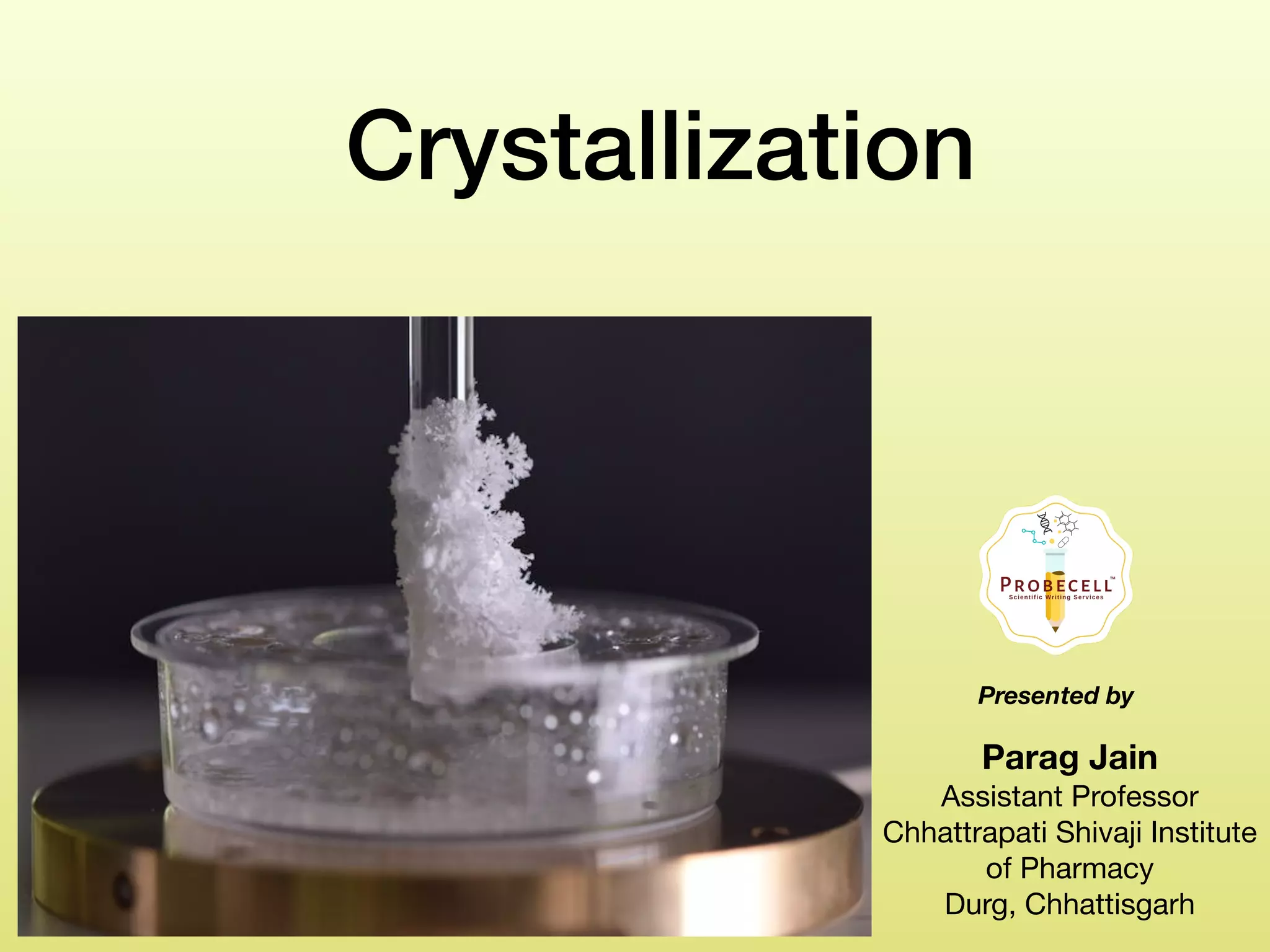
Crystallization
Parag Jain
Assistant Professor 

Chhattrapati Shivaji Institute
of Pharmacy

Durg, Chhattisgarh
Presented by
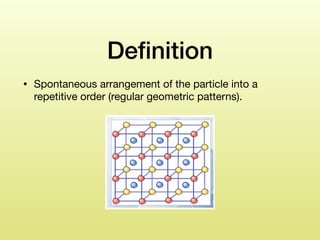
Definition
• Spontaneous arrangement of the particle into a
repetitive order (regular geometric patterns).
Objectives and Application
1. Purification of Drugs

2. Better processing characteristics 3. Ease of handling

4. Better chemical stability

5. Improved physical stability

6. Improved bioavailability

7. Sustained release formulation

8. Miscellaneous
Theories or mechanism of crystallization
The formation of crystal from solution involves three
steps 

• Supersaturation

• Nucleus formation 

• Crystal Growth
Supersaturation
• When the concentration of a compound in its solution
is greater than the saturation solubility of that
compound in that solvent the condition is known as
supersaturation. 

• This is an unstable state. From this supersaturates
solution the excess compound may be precipitated out
or crystallize.
Supersaturation can be achieved by the following
methods:

• 1. Evaporation of solvent from the solution.

• 2. Cooling of the solution. 

• 3.Formation of new solute molecule as a result of
chemical reaction 

• 4.Addition of a substance, which is more soluble in
solvent than the solid to be crystallized.
Nucleation

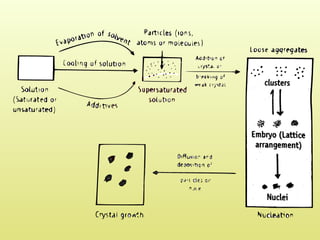
Nucleation refers to the birth of very small bodies of
molecules from which the crystal forms. 

• In solution, solute molecules, ions or atoms remain in
constant random motion. This is due thermodynamic
energy of the solution system. 

• When the solute particles (molecules, atoms or ions)
moves and collide over each other they may form
aggregates.
• This aggregates are called clusters. These are loose
aggregates, which usually disappear quickly. 

• Some clusters may become so big that they may
arrange themselves 

in lattice arrangement. These bodies of aggregates are
called embryo. 

• However, embryos are unstable and they may break into
clusters again. 

• Some embryo may grow to such a size that it remains in 

thermodynamic equilibrium with the solution. They do
not revert back to clusters. These bodies are called
nucleus (plural is nuclei).
Crystal growth
• Crystal growth is a diffusion process and a surface
phenomenon. Every crystal is surrounded by a layer of
liquid known as stagnant layer. From the bulk solution
a solute particle (molecule, atom or ion) diffuse through
this stagnant layer and then reaches the surface of the
crystal. 

• This particles then organize themselves in the crystal
lattice. This phenomenon continues at the surface at a
slow rate. This process will happen if the bulk solution
is supersaturated.
Importance of crystallization
• Crystallization from solution is important industrially
because of the variety of materials that are marketed in
the crystalline form. 

• Crystallization affords a practical method of obtaining
pure chemical substances in a satisfactory condition
for packaging and storing. A crystal formed from an
impure solution is itself pure (unless mixed crystals
occur). 

• A drug may remain in different crystalline forms, some
are stable, and rests are metastable. 

• The metastable forms have greater solubility in water,
thus have better bioavailability. By controlling the
conditions during crystallization, the quantity of
metastable to stable forms may be controlled. 

• After crystallization water or solvent molecules may be
entrapped within the crystal structure and thus form
hydrates or solvates which have different physical
properties that may be utilized in various
pharmaceutical purpose. 

• Particles with various micromeritic properties,
compressibility and wettability can be prepared by
controlling the crystallization process.
Caking of crystals
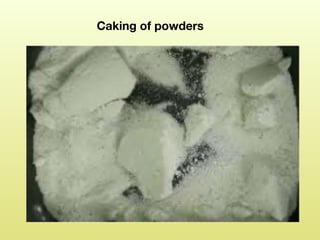
• Caking can be defined as a process of formation of
clumps or cakes when crystals are improperly stored. 

• After crystallization, the crystals are required to be
stored in bulk either for use or for transportation or for
the formation of dosage forms. 

• The crystals must retain good flow properties during
storage.
• Critical humidity is the humidity above which crystals
absorb moisture and below which they do not absorb
moisture. 

• When a crystal is placed in contact with air , whose
humidity is below the critical humidity , the crystal
remains dry. 

• On the other hand , if the air contains more moisture
than critical humidity , the crystals absorbs moisture. 

Caking of powders
Factors affecting caking
• Size of the crystals

• Shape of the crystals

• Humidity

• Time of exposure 

• Impurities in crystals

• Melting point of crystals

• Temperature fluctuations
Prevention of caking
• Crystals must be more spherical , with least point of
contacts. 

• Crystals must be larger in size with more void and must
be of a narrow size distribution. 

• Crystals must have highest possible critical humidity 

• Crystals must be coated with powdery inert material to
prevent absorption of moisture. 

• For example;- table salt is coated with magnesia or
tricalcium phosphate.
Swenson Walker Crystallizer
• Swenson Walker Crystallizer is a continuous type
crystallizer designed to make the large, uniform
crystals .This operation involves both heat and mass
transfer. It works on principle of super saturation by
cooling.
• Swenson Walker Crystallizer is a continuous type
crystallizer. This operation involves both heat and mass
transfer. 

• Crystallization is the formation of solid particles within
a homogeneous phase. It may occur as the formation
of solid particles in a vapor, as in snow; as solidification
from a liquid melt, as in the manufacture of large single
crystals; or as crystallization form liquid solution. 

• In the formation of crystals two steps are required: 

• Nucleation: i.e. the birth of a new solute particle 

• Crystal growth: i.e. the growth of the nucleus to
macroscopic size.
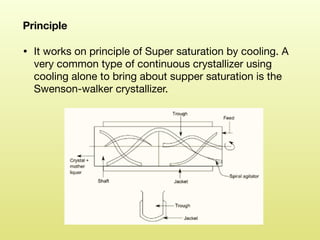
Principle 

• It works on principle of Super saturation by cooling. A
very common type of continuous crystallizer using
cooling alone to bring about supper saturation is the
Swenson-walker crystallizer.
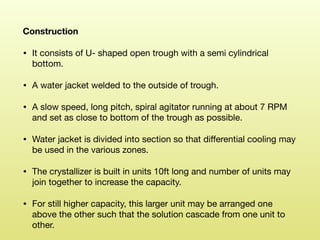
Construction
• It consists of U- shaped open trough with a semi cylindrical
bottom. 

• A water jacket welded to the outside of trough. 

• A slow speed, long pitch, spiral agitator running at about 7 RPM
and set as close to bottom of the trough as possible. 

• Water jacket is divided into section so that differential cooling may
be used in the various zones. 

• The crystallizer is built in units 10ft long and number of units may
join together to increase the capacity. 

• For still higher capacity, this larger unit may be arranged one
above the other such that the solution cascade from one unit to
other.
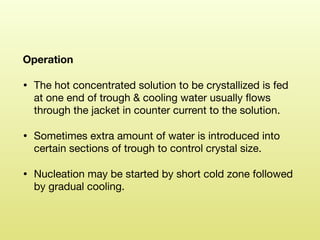
Operation
• The hot concentrated solution to be crystallized is fed
at one end of trough & cooling water usually flows
through the jacket in counter current to the solution. 

• Sometimes extra amount of water is introduced into
certain sections of trough to control crystal size. 

• Nucleation may be started by short cold zone followed
by gradual cooling.
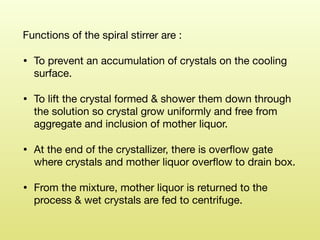
Functions of the spiral stirrer are : 

• To prevent an accumulation of crystals on the cooling
surface. 

• To lift the crystal formed & shower them down through
the solution so crystal grow uniformly and free from
aggregate and inclusion of mother liquor. 

• At the end of the crystallizer, there is overflow gate
where crystals and mother liquor overflow to drain box. 

• From the mixture, mother liquor is returned to the
process & wet crystals are fed to centrifuge.
Advantages: 

• Less floor space is required 

• Saving labor 

• Continuous process 

• Crystal of uniform size, free from inclusions/aggregates 

Disadvantages : 

• 1. Scrapper may break crystal to the little extent due to
agitation.
Website: www.probecell.com Email: probecellinfo@gmail.com
Ph: 7415211131
Office: Smriti Nagar, Bhilai, Chhattisgarh - 490020
https://youtube.com/c/ParagJainthunderpassionate https://www.facebook.com/thesisresearchwriting
Research article Review article Thesis Synopsis PhD Title Research guidance

Pharmaceutical Engineering: Crystallization

  • 1.
    Crystallization Parag Jain Assistant Professor Chhattrapati Shivaji Institute of Pharmacy Durg, Chhattisgarh Presented by
  • 2.
    Definition • Spontaneous arrangementof the particle into a repetitive order (regular geometric patterns).
  • 3.
    Objectives and Application 1.Purification of Drugs
 2. Better processing characteristics 3. Ease of handling
 4. Better chemical stability
 5. Improved physical stability
 6. Improved bioavailability
 7. Sustained release formulation
 8. Miscellaneous
  • 4.
    Theories or mechanismof crystallization The formation of crystal from solution involves three steps • Supersaturation • Nucleus formation • Crystal Growth
  • 6.
    Supersaturation • When theconcentration of a compound in its solution is greater than the saturation solubility of that compound in that solvent the condition is known as supersaturation. • This is an unstable state. From this supersaturates solution the excess compound may be precipitated out or crystallize.
  • 7.
    Supersaturation can beachieved by the following methods: • 1. Evaporation of solvent from the solution. • 2. Cooling of the solution. • 3.Formation of new solute molecule as a result of chemical reaction • 4.Addition of a substance, which is more soluble in solvent than the solid to be crystallized.
  • 8.
    Nucleation
 Nucleation refers tothe birth of very small bodies of molecules from which the crystal forms. • In solution, solute molecules, ions or atoms remain in constant random motion. This is due thermodynamic energy of the solution system. • When the solute particles (molecules, atoms or ions) moves and collide over each other they may form aggregates.
  • 9.
    • This aggregatesare called clusters. These are loose aggregates, which usually disappear quickly. • Some clusters may become so big that they may arrange themselves 
 in lattice arrangement. These bodies of aggregates are called embryo. • However, embryos are unstable and they may break into clusters again. • Some embryo may grow to such a size that it remains in 
 thermodynamic equilibrium with the solution. They do not revert back to clusters. These bodies are called nucleus (plural is nuclei).
  • 10.
    Crystal growth • Crystalgrowth is a diffusion process and a surface phenomenon. Every crystal is surrounded by a layer of liquid known as stagnant layer. From the bulk solution a solute particle (molecule, atom or ion) diffuse through this stagnant layer and then reaches the surface of the crystal. • This particles then organize themselves in the crystal lattice. This phenomenon continues at the surface at a slow rate. This process will happen if the bulk solution is supersaturated.
  • 11.
    Importance of crystallization •Crystallization from solution is important industrially because of the variety of materials that are marketed in the crystalline form. • Crystallization affords a practical method of obtaining pure chemical substances in a satisfactory condition for packaging and storing. A crystal formed from an impure solution is itself pure (unless mixed crystals occur). • A drug may remain in different crystalline forms, some are stable, and rests are metastable. 

  • 12.
    • The metastableforms have greater solubility in water, thus have better bioavailability. By controlling the conditions during crystallization, the quantity of metastable to stable forms may be controlled. • After crystallization water or solvent molecules may be entrapped within the crystal structure and thus form hydrates or solvates which have different physical properties that may be utilized in various pharmaceutical purpose. • Particles with various micromeritic properties, compressibility and wettability can be prepared by controlling the crystallization process.
  • 13.
    Caking of crystals •Caking can be defined as a process of formation of clumps or cakes when crystals are improperly stored. • After crystallization, the crystals are required to be stored in bulk either for use or for transportation or for the formation of dosage forms. • The crystals must retain good flow properties during storage.
  • 14.
    • Critical humidityis the humidity above which crystals absorb moisture and below which they do not absorb moisture. • When a crystal is placed in contact with air , whose humidity is below the critical humidity , the crystal remains dry. • On the other hand , if the air contains more moisture than critical humidity , the crystals absorbs moisture. 

  • 15.
  • 16.
    Factors affecting caking •Size of the crystals • Shape of the crystals • Humidity • Time of exposure • Impurities in crystals • Melting point of crystals • Temperature fluctuations
  • 17.
    Prevention of caking •Crystals must be more spherical , with least point of contacts. • Crystals must be larger in size with more void and must be of a narrow size distribution. • Crystals must have highest possible critical humidity • Crystals must be coated with powdery inert material to prevent absorption of moisture. • For example;- table salt is coated with magnesia or tricalcium phosphate.
  • 18.
    Swenson Walker Crystallizer •Swenson Walker Crystallizer is a continuous type crystallizer designed to make the large, uniform crystals .This operation involves both heat and mass transfer. It works on principle of super saturation by cooling.
  • 19.
    • Swenson WalkerCrystallizer is a continuous type crystallizer. This operation involves both heat and mass transfer. • Crystallization is the formation of solid particles within a homogeneous phase. It may occur as the formation of solid particles in a vapor, as in snow; as solidification from a liquid melt, as in the manufacture of large single crystals; or as crystallization form liquid solution. • In the formation of crystals two steps are required: • Nucleation: i.e. the birth of a new solute particle • Crystal growth: i.e. the growth of the nucleus to macroscopic size.
  • 20.
    Principle • Itworks on principle of Super saturation by cooling. A very common type of continuous crystallizer using cooling alone to bring about supper saturation is the Swenson-walker crystallizer.
  • 21.
    Construction • It consistsof U- shaped open trough with a semi cylindrical bottom. • A water jacket welded to the outside of trough. • A slow speed, long pitch, spiral agitator running at about 7 RPM and set as close to bottom of the trough as possible. • Water jacket is divided into section so that differential cooling may be used in the various zones. • The crystallizer is built in units 10ft long and number of units may join together to increase the capacity. • For still higher capacity, this larger unit may be arranged one above the other such that the solution cascade from one unit to other.
  • 22.
    Operation • The hotconcentrated solution to be crystallized is fed at one end of trough & cooling water usually flows through the jacket in counter current to the solution. • Sometimes extra amount of water is introduced into certain sections of trough to control crystal size. • Nucleation may be started by short cold zone followed by gradual cooling.
  • 23.
    Functions of thespiral stirrer are : • To prevent an accumulation of crystals on the cooling surface. • To lift the crystal formed & shower them down through the solution so crystal grow uniformly and free from aggregate and inclusion of mother liquor. • At the end of the crystallizer, there is overflow gate where crystals and mother liquor overflow to drain box. • From the mixture, mother liquor is returned to the process & wet crystals are fed to centrifuge.
  • 24.
    Advantages: • Lessfloor space is required • Saving labor • Continuous process • Crystal of uniform size, free from inclusions/aggregates Disadvantages : • 1. Scrapper may break crystal to the little extent due to agitation.
  • 25.
    Website: www.probecell.com Email:probecellinfo@gmail.com Ph: 7415211131 Office: Smriti Nagar, Bhilai, Chhattisgarh - 490020 https://youtube.com/c/ParagJainthunderpassionate https://www.facebook.com/thesisresearchwriting Research article Review article Thesis Synopsis PhD Title Research guidance