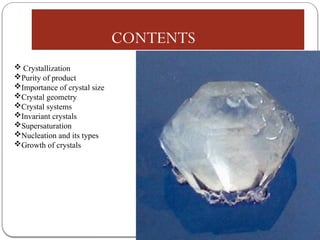
CONTENTS
Crystallization
Purity ofproduct
Importance of crystal size
Crystal geometry
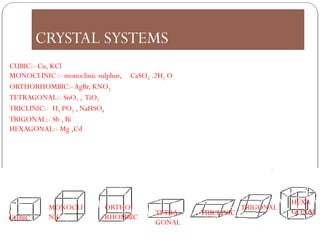
Crystal systems
Invariant crystals
Supersaturation
Nucleation and its types
Growth of crystals
3.
CRYSTALLIZATION
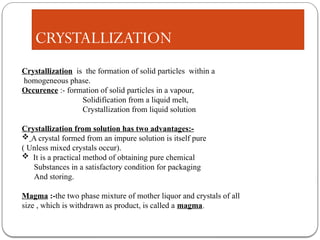
Crystallization is theformation of solid particles within a
homogeneous phase.
Occurence :- formation of solid particles in a vapour,
Solidification from a liquid melt,
Crystallization from liquid solution
Crystallization from solution has two advantages:-
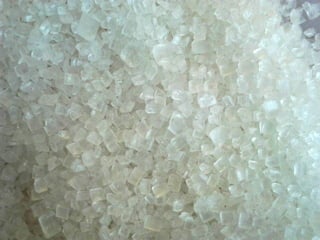
A crystal formed from an impure solution is itself pure
( Unless mixed crystals occur).
It is a practical method of obtaining pure chemical
Substances in a satisfactory condition for packaging
And storing.
Magma :-the two phase mixture of mother liquor and crystals of all
size , which is withdrawn as product, is called a magma.
5.
PURITY OF PRODUCT
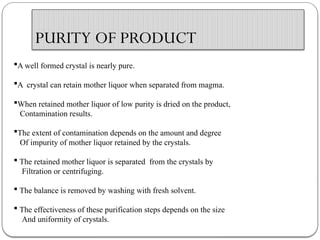
Awell formed crystal is nearly pure.
A crystal can retain mother liquor when separated from magma.
When retained mother liquor of low purity is dried on the product,
Contamination results.
The extent of contamination depends on the amount and degree
Of impurity of mother liquor retained by the crystals.
The retained mother liquor is separated from the crystals by
Filtration or centrifuging.
The balance is removed by washing with fresh solvent.
The effectiveness of these purification steps depends on the size
And uniformity of crystals.
6.
IMPORTANCE OF CRYSTALSIZE
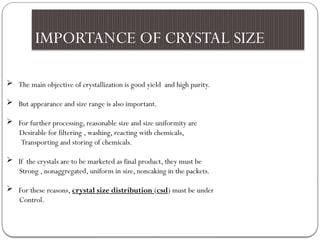
The main objective of crystallization is good yield and high purity.
But appearance and size range is also important.
For further processing, reasonable size and size uniformity are
Desirable for filtering , washing, reacting with chemicals,
Transporting and storing of chemicals.
If the crystals are to be marketed as final product, they must be
Strong , nonaggregated, uniform in size, noncaking in the packets.
For these reasons, crystal size distribution (csd) must be under
Control.
8.
CRYSTAL GEOMETRY
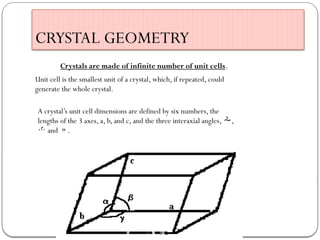
Crystals aremade of infinite number of unit cells.
Unit cell is the smallest unit of a crystal, which, if repeated, could
generate the whole crystal.
A crystal’s unit cell dimensions are defined by six numbers, the
lengths of the 3 axes, a, b, and c, and the three interaxial angles, ,
and .
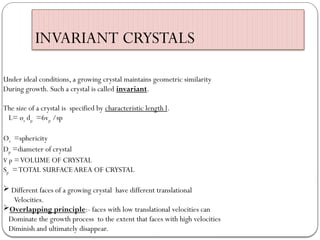
INVARIANT CRYSTALS
Under idealconditions, a growing crystal maintains geometric similarity
During growth. Such a crystal is called invariant.
The size of a crystal is specified by characteristic length l.
L= øs dp =6vp /sp
Øs =sphericity
Dp =diameter of crystal
V p =VOLUME OF CRYSTAL
Sp =TOTAL SURFACEAREA OF CRYSTAL
Different faces of a growing crystal have different translational
Velocities.
Overlapping principle:- faces with low translational velocities can
Dominate the growth process to the extent that faces with high velocities
Diminish and ultimately disappear.
11.
SUPERSATURATION
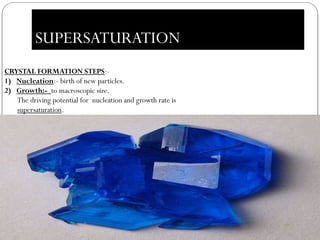
CRYSTAL FORMATION STEPS:-
1)Nucleation:- birth of new particles.
2) Growth:- to macroscopic size.
The driving potential for nucleation and growth rate is
supersaturation.
12.
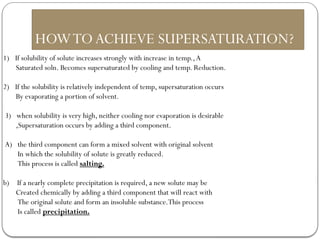
HOWTOACHIEVE SUPERSATURATION?
1) Ifsolubility of solute increases strongly with increase in temp.,A
Saturated soln. Becomes supersaturated by cooling and temp. Reduction.
2) If the solubility is relatively independent of temp, supersaturation occurs
By evaporating a portion of solvent.
3) when solubility is very high, neither cooling nor evaporation is desirable
,Supersaturation occurs by adding a third component.
A) the third component can form a mixed solvent with original solvent
In which the solubility of solute is greatly reduced.
This process is called salting.
b) If a nearly complete precipitation is required, a new solute may be
Created chemically by adding a third component that will react with
The original solute and form an insoluble substance.This process
Is called precipitation.
13.
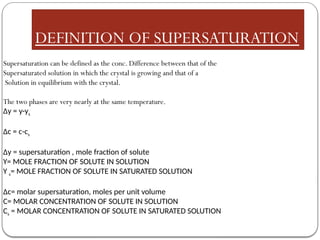
DEFINITION OF SUPERSATURATION
Supersaturationcan be defined as the conc. Difference between that of the
Supersaturated solution in which the crystal is growing and that of a
Solution in equilibrium with the crystal.
The two phases are very nearly at the same temperature.
Δy = y-ys
Δc = c-cs
Δy = supersaturation , mole fraction of solute
Y= MOLE FRACTION OF SOLUTE IN SOLUTION
Y s= MOLE FRACTION OF SOLUTE IN SATURATED SOLUTION
Δc= molar supersaturation, moles per unit volume
C= MOLAR CONCENTRATION OF SOLUTE IN SOLUTION
Cs = MOLAR CONCENTRATION OF SOLUTE IN SATURATED SOLUTION
14.
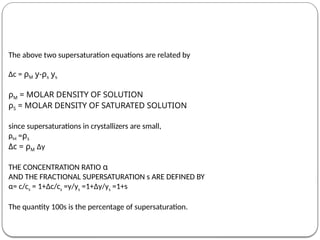
The above twosupersaturation equations are related by
Δc = ρM y-ρs ys
ρM = MOLAR DENSITY OF SOLUTION
ρS = MOLAR DENSITY OF SATURATED SOLUTION
since supersaturations in crystallizers are small,
ρM =ρs
Δc = ρM Δy
THE CONCENTRATION RATIO α
AND THE FRACTIONAL SUPERSATURATION s ARE DEFINED BY
α= c/cs = 1+Δc/cs =y/ys =1+Δy/ys =1+s
The quantity 100s is the percentage of supersaturation.
15.
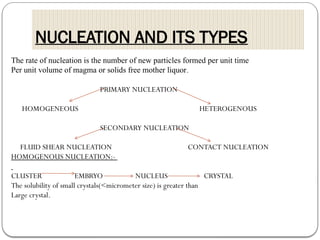
NUCLEATION AND ITSTYPES
The rate of nucleation is the number of new particles formed per unit time
Per unit volume of magma or solids free mother liquor.
PRIMARY NUCLEATION
HOMOGENEOUS HETEROGENOUS
SECONDARY NUCLEATION
FLUID SHEAR NUCLEATION CONTACT NUCLEATION
HOMOGENOUS NUCLEATION:-
CLUSTER EMBRYO NUCLEUS CRYSTAL
The solubility of small crystals(<micrometer size) is greater than
Large crystal.
16.
KELVIN EQUATION :-THE SOLUBILITY OF A SUBSTANCE IS RELATEDTO ITS PARTICLE
SIZEAS
ln α = 4VM σ/ν RTL
RATE OF NUCLEATION:-
B°= C exp[-(16 π σ3
(VM )2
Na)/3ν2
(RT)3
(ln α)2
]
L= CRYSTAL SIZE
α= RATIO OF CONCENTRATIONS OF SUPERSATURATED AND SATURATED
SOLUTIONS
VM = MOLAR VOLUME OF CRYSTAL
σ = AVERAGE INTERFACIAL TENSION BETWEEN SOLID AND LIQUID
ν= NO OF IONS PER MOLECULE OF SOLUTE
B°= NUCLEATION RATE, number/cm3
s
C= frequency factor
Na= AVOGADRO’S NUMBER
R= GAS CONSTANT, 8.3143*107 ergs/
g mol. k
17.
HETEROGENEOUS NUCLEATION :-When solid particles of foreign substances
Do influence the nucleation process by catalyzing an increase of nucleation
Rate at a given supersaturation or giving a finite rate at a supersaturation
Where homogeneous nucleation would occur only after a vast time.
RATE OF NUCLEATION:-
B°= 1025
exp[-(16 π σa
3
(VM )2
Na)/3 (RT)3
( νs)2
]
σa = apparent interfacial tension
SECONDARY NUCLEATION:-The formation of nuclei attributable to the
Influence of the existing macroscopic crystals in the magma is called
Secondary nucleation.
A) FLUID SHEAR NUCLEATION :- EX:- SUCROSE, MgSO4 .H2 O
B) CONTACT NUCLEATION :- Most common type of nucleation in industrial
Crystallizers.
1) Occurs at low supersaturations where the growth rate of crystals
Is optimum for good quality.
B° = B SS+BE +BC
BSS = RATE OF HOMOGENEOUS NUCLEATION DUETO SUPERSATURATION
BE = NUCLEATION RATE FROM CONTACT OF CRYSTALSWITH IMPELLER
BC = NUCLEATION RATE FROM CRYSTAL- CRYSTAL CONTACT
18.
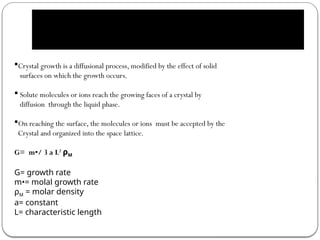
GROWTH OF CRYSTALS
Crystalgrowth is a diffusional process, modified by the effect of solid
surfaces on which the growth occurs.
Solute molecules or ions reach the growing faces of a crystal by
diffusion through the liquid phase.
On reaching the surface, the molecules or ions must be accepted by the
Crystal and organized into the space lattice.
G= m•/ 3 a L2
ρM
G= growth rate
m•= molal growth rate
ρM = molar density
a= constant
L= characteristic length
19.
SUMMARY
Understand the processof crystallization
Know the purity of product and importance of crystal size
Know the crystal geometry and crystal systems
Understand the invariant crystals
Made aware of concept of supersaturation , nucleation and its
Types, and growth of crystals.


![KELVIN EQUATION :- THE SOLUBILITY OF A SUBSTANCE IS RELATEDTO ITS PARTICLE
SIZEAS
ln α = 4VM σ/ν RTL
RATE OF NUCLEATION:-
B°= C exp[-(16 π σ3
(VM )2
Na)/3ν2
(RT)3
(ln α)2
]
L= CRYSTAL SIZE
α= RATIO OF CONCENTRATIONS OF SUPERSATURATED AND SATURATED
SOLUTIONS
VM = MOLAR VOLUME OF CRYSTAL
σ = AVERAGE INTERFACIAL TENSION BETWEEN SOLID AND LIQUID
ν= NO OF IONS PER MOLECULE OF SOLUTE
B°= NUCLEATION RATE, number/cm3
s
C= frequency factor
Na= AVOGADRO’S NUMBER
R= GAS CONSTANT, 8.3143*107 ergs/
g mol. k](https://image.slidesharecdn.com/crystallization-260118030353-e3be4c18/85/Crystallization-in-chemical-industries-pptx-16-320.jpg)
![HETEROGENEOUS NUCLEATION :- When solid particles of foreign substances
Do influence the nucleation process by catalyzing an increase of nucleation
Rate at a given supersaturation or giving a finite rate at a supersaturation
Where homogeneous nucleation would occur only after a vast time.
RATE OF NUCLEATION:-
B°= 1025
exp[-(16 π σa
3
(VM )2
Na)/3 (RT)3
( νs)2
]
σa = apparent interfacial tension
SECONDARY NUCLEATION:-The formation of nuclei attributable to the
Influence of the existing macroscopic crystals in the magma is called
Secondary nucleation.
A) FLUID SHEAR NUCLEATION :- EX:- SUCROSE, MgSO4 .H2 O
B) CONTACT NUCLEATION :- Most common type of nucleation in industrial
Crystallizers.
1) Occurs at low supersaturations where the growth rate of crystals
Is optimum for good quality.
B° = B SS+BE +BC
BSS = RATE OF HOMOGENEOUS NUCLEATION DUETO SUPERSATURATION
BE = NUCLEATION RATE FROM CONTACT OF CRYSTALSWITH IMPELLER
BC = NUCLEATION RATE FROM CRYSTAL- CRYSTAL CONTACT](https://image.slidesharecdn.com/crystallization-260118030353-e3be4c18/85/Crystallization-in-chemical-industries-pptx-17-320.jpg)