

CryptographyMade by:-Shray Jali
CryptographyCryptology is the science of secure communications
Formed from the Greek words kryptós, "hidden", and logos, "word".
Cryptography is a framework of methodologies used to ensure the CIA triad for our information C –Confidentiality I –Integrity A -AuthenticityCryptography was known anciently as Encryption which means: Hiding the information from unauthorized entities.
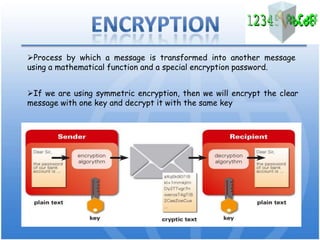
It could be implemented manually, mechanically or even electronically encryptionProcess by which a message is transformed into another message using a mathematical function and a special encryption password.
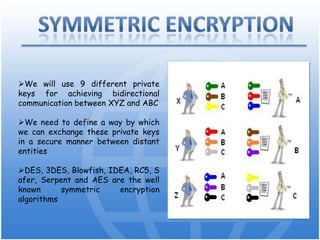
If we are using symmetric encryption, then we will encrypt the clear message with one key and decrypt it with the same keysymmetric encryptionWe will use 9 different private keys for achieving bidirectional communication between XYZ and ABC
We need to define a way by which we can exchange these private keys in a secure manner between distant entities
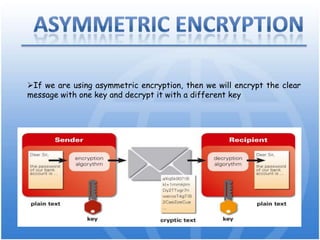
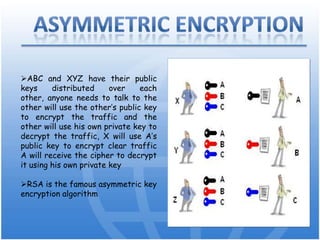
DES, 3DES, Blowfish, IDEA, RC5, Safer, Serpent and AES are the well known symmetric encryption algorithmsasymmetric encryptionIf we are using asymmetric encryption, then we will encrypt the clear message with one key and decrypt it with a different keyasymmetric encryptionABC and XYZ have their public keys distributed over each other, anyone needs to talk to the other will use the other’s public key to encrypt the traffic and the other will use his own private key to decrypt the traffic, X will use A’s public key to encrypt clear traffic A will receive the cipher to decrypt it using his own private key
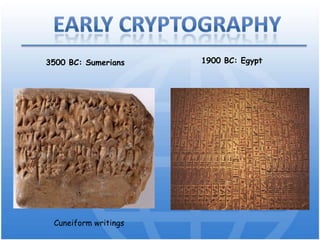
RSA is the famous asymmetric key encryption algorithmEarly Cryptography3500 BC: SumeriansCuneiform writings
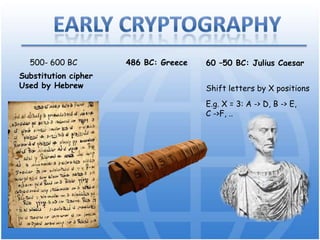
Early Cryptography500- 600 BC486 BC: Greece60 –50 BC: JuliusCaesarSubstitution cipherUsed by HebrewShift letters by X positions E.g. X = 3: A -> D, B -> E, C ->F, ..
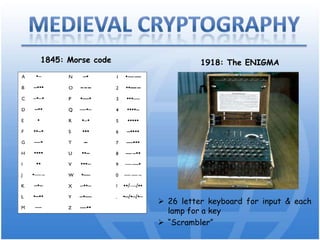
Medieval Cryptography1845: Morse code1918: The ENIGMA26 letter keyboard forinput & each lamp for a key
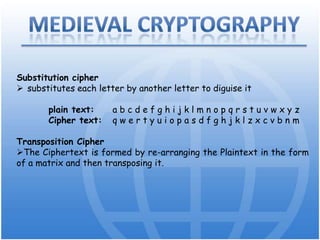
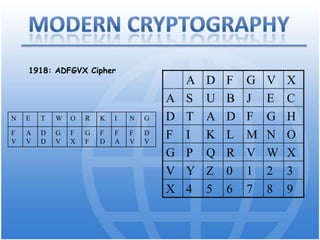
“Scrambler”Medieval CryptographySubstitution ciphersubstitutes each letter by another letter to diguise it	plain text: 	a b c d e f g h i j k l m n o p q r s t u v w x y z	Cipher text: 	q w e r t y u i o p a s d f g h j k l z x c v b n mTransposition CipherThe Ciphertext is formed by re-arranging the Plaintext in the form of a matrix and then transposing it.modern Cryptography1918: ADFGVX Cipher
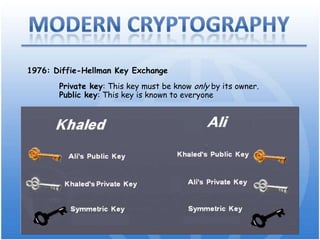
modern Cryptography1976: Diffie-Hellman Key ExchangePrivate key: This key must be know only by its owner.Public key: This key is known to everyone
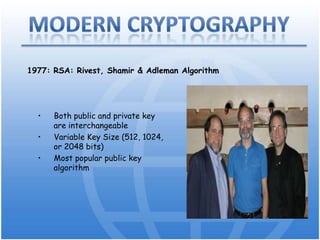
modern Cryptography1977: RSA: Rivest, Shamir & Adleman AlgorithmBoth public and private key are interchangeable
Variable Key Size (512, 1024, or 2048 bits)
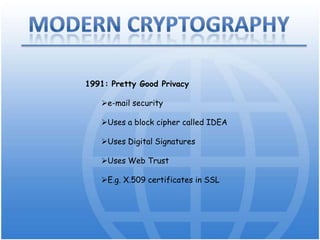
Most popular public key algorithmmodern Cryptography1991: Pretty Good Privacye-mail security
Uses a block cipher called IDEA
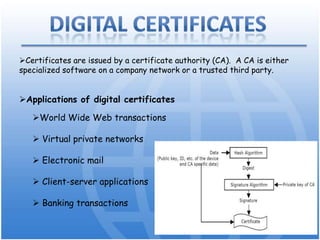
Uses Digital Signatures
Uses Web Trust
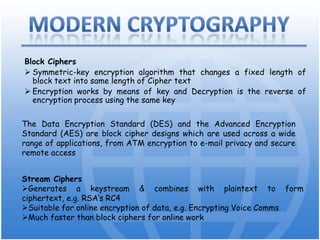
E.g. X.509 certificates in SSL modern CryptographyBlock CiphersSymmetric-key encryption algorithm that changes a fixed length of block text into same length of Cipher text
Encryption works by means of key and Decryption is the reverse of encryption process using the same keyThe Data Encryption Standard (DES) and the Advanced Encryption Standard (AES) are block cipher designs which are used across a wide range of applications, from ATM encryption to e-mail privacy and secure remote accessStream CiphersGenerates a keystream & combines with plaintext to form ciphertext, e.g. RSA’s RC4
Suitable for online encryption of data, e.g. Encrypting Voice Comms
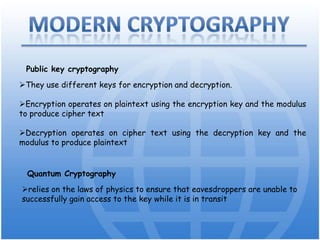
Much faster than block ciphers for online workmodern CryptographyPublic key cryptographyThey use different keys for encryption and decryption.
Encryption operates on plaintext using the encryption key and the modulus to produce cipher text

Cryptography

  • 1.
  • 2.
    CryptographyCryptology is thescience of secure communications
  • 3.
    Formed from theGreek words kryptós, "hidden", and logos, "word".
  • 4.
    Cryptography is aframework of methodologies used to ensure the CIA triad for our information C –Confidentiality I –Integrity A -AuthenticityCryptography was known anciently as Encryption which means: Hiding the information from unauthorized entities.
  • 5.
    It could beimplemented manually, mechanically or even electronically encryptionProcess by which a message is transformed into another message using a mathematical function and a special encryption password.
  • 6.
    If we areusing symmetric encryption, then we will encrypt the clear message with one key and decrypt it with the same keysymmetric encryptionWe will use 9 different private keys for achieving bidirectional communication between XYZ and ABC
  • 7.
    We need todefine a way by which we can exchange these private keys in a secure manner between distant entities
  • 8.
    DES, 3DES, Blowfish,IDEA, RC5, Safer, Serpent and AES are the well known symmetric encryption algorithmsasymmetric encryptionIf we are using asymmetric encryption, then we will encrypt the clear message with one key and decrypt it with a different keyasymmetric encryptionABC and XYZ have their public keys distributed over each other, anyone needs to talk to the other will use the other’s public key to encrypt the traffic and the other will use his own private key to decrypt the traffic, X will use A’s public key to encrypt clear traffic A will receive the cipher to decrypt it using his own private key
  • 9.
    RSA is thefamous asymmetric key encryption algorithmEarly Cryptography3500 BC: SumeriansCuneiform writings
  • 10.
    Early Cryptography500- 600BC486 BC: Greece60 –50 BC: JuliusCaesarSubstitution cipherUsed by HebrewShift letters by X positions E.g. X = 3: A -> D, B -> E, C ->F, ..
  • 11.
    Medieval Cryptography1845: Morsecode1918: The ENIGMA26 letter keyboard forinput & each lamp for a key
  • 12.
    “Scrambler”Medieval CryptographySubstitution ciphersubstituteseach letter by another letter to diguise it plain text: a b c d e f g h i j k l m n o p q r s t u v w x y z Cipher text: q w e r t y u i o p a s d f g h j k l z x c v b n mTransposition CipherThe Ciphertext is formed by re-arranging the Plaintext in the form of a matrix and then transposing it.modern Cryptography1918: ADFGVX Cipher
  • 13.
    modern Cryptography1976: Diffie-HellmanKey ExchangePrivate key: This key must be know only by its owner.Public key: This key is known to everyone
  • 14.
    modern Cryptography1977: RSA:Rivest, Shamir & Adleman AlgorithmBoth public and private key are interchangeable
  • 15.
    Variable Key Size(512, 1024, or 2048 bits)
  • 16.
    Most popular publickey algorithmmodern Cryptography1991: Pretty Good Privacye-mail security
  • 17.
    Uses a blockcipher called IDEA
  • 18.
  • 19.
  • 20.
    E.g. X.509 certificatesin SSL modern CryptographyBlock CiphersSymmetric-key encryption algorithm that changes a fixed length of block text into same length of Cipher text
  • 21.
    Encryption works bymeans of key and Decryption is the reverse of encryption process using the same keyThe Data Encryption Standard (DES) and the Advanced Encryption Standard (AES) are block cipher designs which are used across a wide range of applications, from ATM encryption to e-mail privacy and secure remote accessStream CiphersGenerates a keystream & combines with plaintext to form ciphertext, e.g. RSA’s RC4
  • 22.
    Suitable for onlineencryption of data, e.g. Encrypting Voice Comms
  • 23.
    Much faster thanblock ciphers for online workmodern CryptographyPublic key cryptographyThey use different keys for encryption and decryption.
  • 24.
    Encryption operates onplaintext using the encryption key and the modulus to produce cipher text