KALYANI GOVERNMENT ENGINEERING COLLEGE
CRYPTOGRAPHY : OVERVIEW &
TECHNIQUES
Presented by
NILANJANA SAHA &
SHINJINI GHOSH
INFORMATION TECHNOLOGY DEPARTMENT
1ST YEAR
SESSION: EVEN SEMESTER ,2021
CONTENTS
 WHAT IS CRYPTOGRAPHY ?
 HISTORY OF CRYPTOGRAPHY
 BASIC TERMS
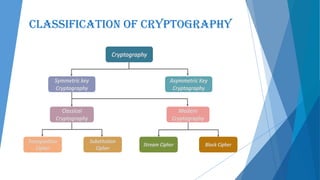
 CLASSIFICATION OF CRYPTOGRAPHY
 COMPARISON
 CIPHERS
 CRYPTOGRAPHY TECHNIQUES
 ADVANTAGES & DISADVANTAGES
 APPLICATIONS
 CONCLUSION
 REFERENCES
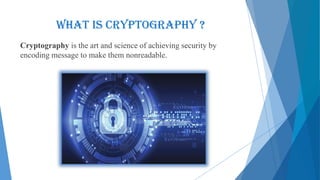
WHAT IS CRYPTOGRAPHY ?
Cryptography is the art and science of achieving security by
encoding message to make them nonreadable.
HISTORY OF CRYPTOGRAPHY
The art of cryptography is considered to be born along with the art of writing. As civilizations
evolved, human beings got organized in tribes, groups, and kingdoms. This led to the emergence of
ideas such as power, battles, supremacy, and politics. These ideas further fuelled the natural need of
people to communicate secretly with selective recipient which in turn ensured the continuous
evolution of cryptography as well.
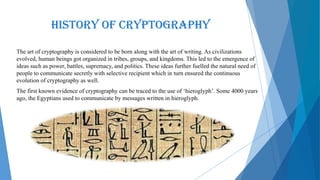
The first known evidence of cryptography can be traced to the use of ‘hieroglyph’. Some 4000 years
ago, the Egyptians used to communicate by messages written in hieroglyph.
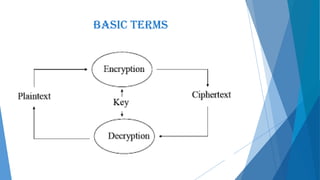
Basic Terms
Classification of Cryptography
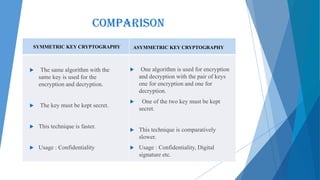
SYMMETRIC KEY CRYPTOGRAPHY ASYMMETRIC KEY CRYPTOGRAPHY
 The same algorithm with the
same key is used for the
encryption and decryption.
 The key must be kept secret.
 This technique is faster.
 Usage : Confidentiality
 One algorithm is used for encryption
and decryption with the pair of keys
one for encryption and one for
decryption.
 One of the two key must be kept
secret.
 This technique is comparatively
slower.
 Usage : Confidentiality, Digital
signature etc.
COMPARISON
TRANSPOSITION CIPHER
In cryptography, a transposition cipher is a method of encryption by which the positions
held by units of plaintext (which are commonly characters or groups of characters) are
shifted according to a regular system, so that the ciphertext constitutes a permutation of the
plaintext.
The Rail Fence cipher is a form of transposition cipher that gets its name from the way in
which it is encoded. In the rail fence cipher, the plaintext is written downwards and
diagonally on successive "rails" of an imaginary fence, then moving up when we get to the
bottom. The message is then read off in rows. For example, using three "rails" and a
message of 'WE ARE DISCOVERED FLEE AT ONCE', the cipherer writes out:
Then reads off:
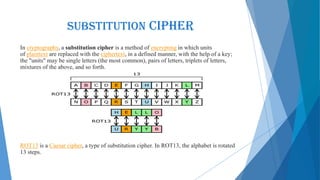
SUBSTITUTION CIPHER
In cryptography, a substitution cipher is a method of encrypting in which units
of plaintext are replaced with the ciphertext, in a defined manner, with the help of a key;
the "units" may be single letters (the most common), pairs of letters, triplets of letters,
mixtures of the above, and so forth.
ROT13 is a Caesar cipher, a type of substitution cipher. In ROT13, the alphabet is rotated
13 steps.
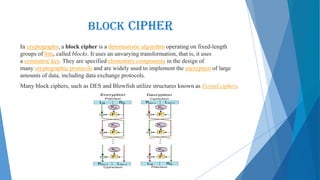
BLOCK CIPHER
In cryptography, a block cipher is a deterministic algorithm operating on fixed-length
groups of bits, called blocks. It uses an unvarying transformation, that is, it uses
a symmetric key. They are specified elementary components in the design of
many cryptographic protocols and are widely used to implement the encryption of large
amounts of data, including data exchange protocols.
Many block ciphers, such as DES and Blowfish utilize structures known as Feistel ciphers.
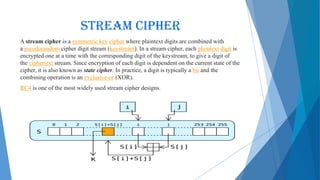
STREAM CIPHER
A stream cipher is a symmetric key cipher where plaintext digits are combined with
a pseudorandom cipher digit stream (keystream). In a stream cipher, each plaintext digit is
encrypted one at a time with the corresponding digit of the keystream, to give a digit of
the ciphertext stream. Since encryption of each digit is dependent on the current state of the
cipher, it is also known as state cipher. In practice, a digit is typically a bit and the
combining operation is an exclusive-or (XOR).
RC4 is one of the most widely used stream cipher designs.
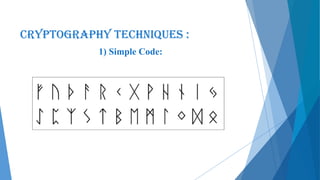
CRYPTOGRAPHY Techniques :
1) Simple Code:
CRYPTOGRAPHY Techniques
(contd.):
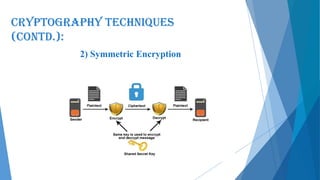
2) Symmetric Encryption
CRYPTOGRAPHY Techniques
(contd.):
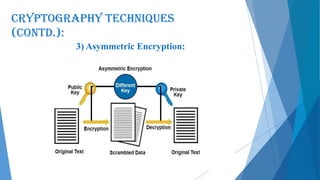
3) Asymmetric Encryption:
CRYPTOGRAPHY Techniques
(contd.):
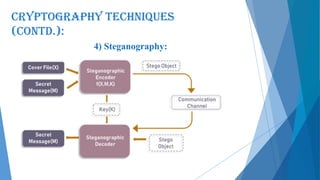
4) Steganography:
CRYPTOGRAPHY Techniques
(contd.):
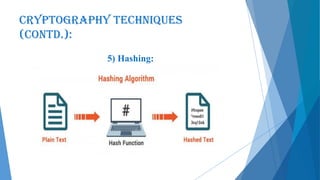
5) Hashing:
ADVANTAGES
 Confidentiality − Encryption technique can guard the information and
communication from unauthorized revelation and access of information.
 Authentication − The cryptographic techniques such as MAC and digital
signatures can protect information against spoofing and forgeries.
 Data Integrity − The cryptographic hash functions are playing vital role in
assuring the users about the data integrity.
 Non-repudiation − The digital signature provides the non-repudiation service
to guard against the dispute that may arise due to denial of passing message by
the sender.
DISADVANTAGES
 A strongly encrypted, authentic, and digitally signed information can be difficult to
access even for a legitimate user at a crucial time of decision-making. The network or
the computer system can be attacked and rendered non-functional by an intruder.
 High availability, one of the fundamental aspects of information security, cannot be
ensured through the use of cryptography. Other methods are needed to guard against the
threats such as denial of service or complete breakdown of information system.
 Another fundamental need of information security of selective access control also cannot
be realized through the use of cryptography. Administrative controls and procedures are
required to be exercised for the same.
 Cryptography does not guard against the vulnerabilities and threats that emerge from
the poor design of systems, protocols, and procedures. These need to be fixed through
proper design and setting up of a defensive infrastructure.
 The security of cryptographic technique is based on the computational difficulty of
mathematical problems. Any breakthrough in solving such mathematical problems or
increasing the computing power can render a cryptographic technique vulnerable.
 Defence service
 E – commerce
 Business transactions
 Internet payment system
 User identification system
 Access control
 Data Security
Applications
 Cryptography, being an art of encrypting and decrypting
confidential information and private messages, should be
implemented in the network security to prevent any leakage and
threat.
 It can be done by using any of these techniques discussed above
for fortifying the personal data transmission as well as for secure
transaction.
conclusion
 Yang, Sarah (14 September 2005), "Researchers recover typed
text using audio recording of keystrokes", UC Berkeley News.
 Adi Shamir & Eran Tromer. "Acoustic cryptanalysis". Blavatnik
School of Computer Science, Tel Aviv University. Retrieved 1
November 2011.
 http://en.wikipedia.org/wiki/Cryptography
 https://www.coursera.org/course/cryptography
 https://www.educba.com/cryptography-techniques
 https://www.tutorialspoint.com/cryptography/origin_of_crypt
ography.htm
 https://www.tutorialspoint.com/cryptography/benefitsanddra
wbacks.htm
References
Cryptography

Cryptography

  • 1.
    KALYANI GOVERNMENT ENGINEERINGCOLLEGE CRYPTOGRAPHY : OVERVIEW & TECHNIQUES Presented by NILANJANA SAHA & SHINJINI GHOSH INFORMATION TECHNOLOGY DEPARTMENT 1ST YEAR SESSION: EVEN SEMESTER ,2021
  • 2.
    CONTENTS  WHAT ISCRYPTOGRAPHY ?  HISTORY OF CRYPTOGRAPHY  BASIC TERMS  CLASSIFICATION OF CRYPTOGRAPHY  COMPARISON  CIPHERS  CRYPTOGRAPHY TECHNIQUES  ADVANTAGES & DISADVANTAGES  APPLICATIONS  CONCLUSION  REFERENCES
  • 3.
    WHAT IS CRYPTOGRAPHY? Cryptography is the art and science of achieving security by encoding message to make them nonreadable.
  • 4.
    HISTORY OF CRYPTOGRAPHY Theart of cryptography is considered to be born along with the art of writing. As civilizations evolved, human beings got organized in tribes, groups, and kingdoms. This led to the emergence of ideas such as power, battles, supremacy, and politics. These ideas further fuelled the natural need of people to communicate secretly with selective recipient which in turn ensured the continuous evolution of cryptography as well. The first known evidence of cryptography can be traced to the use of ‘hieroglyph’. Some 4000 years ago, the Egyptians used to communicate by messages written in hieroglyph.
  • 5.
  • 6.
  • 7.
    SYMMETRIC KEY CRYPTOGRAPHYASYMMETRIC KEY CRYPTOGRAPHY  The same algorithm with the same key is used for the encryption and decryption.  The key must be kept secret.  This technique is faster.  Usage : Confidentiality  One algorithm is used for encryption and decryption with the pair of keys one for encryption and one for decryption.  One of the two key must be kept secret.  This technique is comparatively slower.  Usage : Confidentiality, Digital signature etc. COMPARISON
  • 8.
    TRANSPOSITION CIPHER In cryptography,a transposition cipher is a method of encryption by which the positions held by units of plaintext (which are commonly characters or groups of characters) are shifted according to a regular system, so that the ciphertext constitutes a permutation of the plaintext. The Rail Fence cipher is a form of transposition cipher that gets its name from the way in which it is encoded. In the rail fence cipher, the plaintext is written downwards and diagonally on successive "rails" of an imaginary fence, then moving up when we get to the bottom. The message is then read off in rows. For example, using three "rails" and a message of 'WE ARE DISCOVERED FLEE AT ONCE', the cipherer writes out: Then reads off:
  • 9.
    SUBSTITUTION CIPHER In cryptography,a substitution cipher is a method of encrypting in which units of plaintext are replaced with the ciphertext, in a defined manner, with the help of a key; the "units" may be single letters (the most common), pairs of letters, triplets of letters, mixtures of the above, and so forth. ROT13 is a Caesar cipher, a type of substitution cipher. In ROT13, the alphabet is rotated 13 steps.
  • 10.
    BLOCK CIPHER In cryptography,a block cipher is a deterministic algorithm operating on fixed-length groups of bits, called blocks. It uses an unvarying transformation, that is, it uses a symmetric key. They are specified elementary components in the design of many cryptographic protocols and are widely used to implement the encryption of large amounts of data, including data exchange protocols. Many block ciphers, such as DES and Blowfish utilize structures known as Feistel ciphers.
  • 11.
    STREAM CIPHER A streamcipher is a symmetric key cipher where plaintext digits are combined with a pseudorandom cipher digit stream (keystream). In a stream cipher, each plaintext digit is encrypted one at a time with the corresponding digit of the keystream, to give a digit of the ciphertext stream. Since encryption of each digit is dependent on the current state of the cipher, it is also known as state cipher. In practice, a digit is typically a bit and the combining operation is an exclusive-or (XOR). RC4 is one of the most widely used stream cipher designs.
  • 12.
  • 13.
  • 14.
  • 15.
  • 16.
  • 17.
    ADVANTAGES  Confidentiality −Encryption technique can guard the information and communication from unauthorized revelation and access of information.  Authentication − The cryptographic techniques such as MAC and digital signatures can protect information against spoofing and forgeries.  Data Integrity − The cryptographic hash functions are playing vital role in assuring the users about the data integrity.  Non-repudiation − The digital signature provides the non-repudiation service to guard against the dispute that may arise due to denial of passing message by the sender.
  • 18.
    DISADVANTAGES  A stronglyencrypted, authentic, and digitally signed information can be difficult to access even for a legitimate user at a crucial time of decision-making. The network or the computer system can be attacked and rendered non-functional by an intruder.  High availability, one of the fundamental aspects of information security, cannot be ensured through the use of cryptography. Other methods are needed to guard against the threats such as denial of service or complete breakdown of information system.  Another fundamental need of information security of selective access control also cannot be realized through the use of cryptography. Administrative controls and procedures are required to be exercised for the same.  Cryptography does not guard against the vulnerabilities and threats that emerge from the poor design of systems, protocols, and procedures. These need to be fixed through proper design and setting up of a defensive infrastructure.  The security of cryptographic technique is based on the computational difficulty of mathematical problems. Any breakthrough in solving such mathematical problems or increasing the computing power can render a cryptographic technique vulnerable.
  • 19.
     Defence service E – commerce  Business transactions  Internet payment system  User identification system  Access control  Data Security Applications
  • 20.
     Cryptography, beingan art of encrypting and decrypting confidential information and private messages, should be implemented in the network security to prevent any leakage and threat.  It can be done by using any of these techniques discussed above for fortifying the personal data transmission as well as for secure transaction. conclusion
  • 21.
     Yang, Sarah(14 September 2005), "Researchers recover typed text using audio recording of keystrokes", UC Berkeley News.  Adi Shamir & Eran Tromer. "Acoustic cryptanalysis". Blavatnik School of Computer Science, Tel Aviv University. Retrieved 1 November 2011.  http://en.wikipedia.org/wiki/Cryptography  https://www.coursera.org/course/cryptography  https://www.educba.com/cryptography-techniques  https://www.tutorialspoint.com/cryptography/origin_of_crypt ography.htm  https://www.tutorialspoint.com/cryptography/benefitsanddra wbacks.htm References