‘’ The Science of encrypTion ’’
•   What is cryptography ?


•   Why cryptography is important ?
Contents
•   The purpose of cryptography
•   History of cryptography and cryptanalysis
•   Modern cryptography(Types of Algorithms)
     - Secret Key Cryptography
     - Hash Functions
     - Public Key Cryptography
     - Why Three Encryption Techniques?
     - The Significance of Passwords & Password Security
•   Conclusion
THE PURPOSE OF CRYPTOGRAPHY
Specific security requirements for communication:
  Data transfer and telecommunication
  Science of communications code
  Computer writing in secret

 Authentication:
 Privacy/confidentiality:
 Integrity:
 Non-repudiation:
HISTORY OF CRYPTOGRAPHY
The history of cryptography can be divided into two
parts:

(1) From ancient civilizations to the 19th century and the
first part of the 20th century,


(2) Use of encrypting electro-mechanical
machines, around the period of the WW II.
HISTORY OF CRYPTOGRAPHY
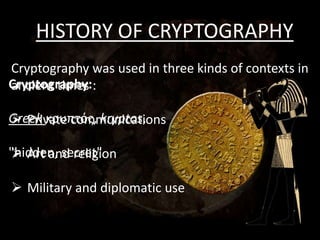
Cryptography was used in three kinds of contexts in
Cryptography::
ancient times

 Private communications
Greek κρυπτός, kryptos,

 Art and religion
"hidden, secret"

 Military and diplomatic use
MODERN CRYPTOGHRAPHY
Here we have three types of algorithms that we can
talk about:

 Secret Key Cryptography

 Hash Functions

 Public Key Cryptography
MODERN CRYPTOGHRAPHY
SECRET KEY CRYPTOGHRAPHY


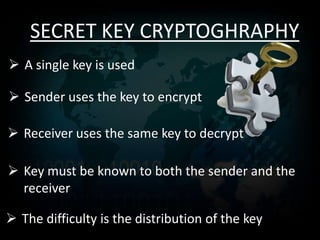
 Secret Key(Symmetric) Cryptography uses a single
  key for both encryption and decryption.
SECRET KEY CRYPTOGHRAPHY
 A single key is used

 Sender uses the key to encrypt

 Receiver uses the same key to decrypt

 Key must be known to both the sender and the
  receiver

 The difficulty is the distribution of the key
SECRET KEY CRYPTOGHRAPHY
Secret key cryptography algorithms that are in use
today :
 Data Encryption Standard (DES):

 Advanced Encryption Standard (AES):


 International Data Encryption Algorithm (IDEA):
SECRET KEY SUMMARY
HASH FUNCTIONS


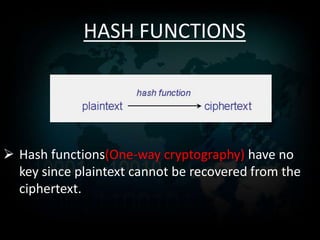
 Hash functions(One-way cryptography) have no
  key since plaintext cannot be recovered from the
  ciphertext.
HASH FUNCTIONS
 Called message compiler and one-way encryption

 No key is used

 Digital fingerprint

 Provide the integrity
HASH FUNCTIONS

Hash algorithms that are in common use today:

 Message Digest (MD) algorithms:

 HAVAL (Hash of Variable Length):


 Tiger:
PUBLIC KEY CRYPTOGHRAPHY


 Public Key(Asymmetric) Cryptography. Two keys are
  used. One for encryption, one for decryption.
PUBLIC KEY CRYPTOGHRAPHY
 Developed in the last 300-400 years.

 Martin Hellman and graduate student Whitfield
  Diffie
 A two-key crypto system

 Mathematical functions
PUBLIC KEY CRYPTOGHRAPHY
Mathematical Functions :

 Multiplication vs. factorization:


 Exponentiation vs. logarithms:
PUBLIC KEY CRYPTOGHRAPHY
PUBLIC KEY SUMMARY
Why Three Encryption Techniques?

 Why are there so many different types of
  cryptographic schemes?


 Why can't we do everything we need with just
  one ?
THE SIGNIFICANCE OF PASSWORDS

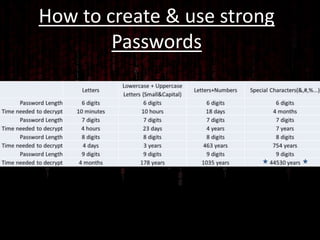
 Every password can be decyrpted.

 In cryptography, size does matter.
How to create & use strong
        Passwords
How to create & use strong
           Passwords
 Use lengthy passwords.
         THANK YOU symbols.
 Combine letters, numbers, and
 FOR LISTENING TO US (:
 Use words and phrases.

Cryptography

  • 1.
    ‘’ The Scienceof encrypTion ’’
  • 2.
    What is cryptography ? • Why cryptography is important ?
  • 3.
    Contents • The purpose of cryptography • History of cryptography and cryptanalysis • Modern cryptography(Types of Algorithms) - Secret Key Cryptography - Hash Functions - Public Key Cryptography - Why Three Encryption Techniques? - The Significance of Passwords & Password Security • Conclusion
  • 4.
    THE PURPOSE OFCRYPTOGRAPHY Specific security requirements for communication: Data transfer and telecommunication Science of communications code Computer writing in secret  Authentication:  Privacy/confidentiality:  Integrity:  Non-repudiation:
  • 5.
    HISTORY OF CRYPTOGRAPHY Thehistory of cryptography can be divided into two parts: (1) From ancient civilizations to the 19th century and the first part of the 20th century, (2) Use of encrypting electro-mechanical machines, around the period of the WW II.
  • 6.
    HISTORY OF CRYPTOGRAPHY Cryptographywas used in three kinds of contexts in Cryptography:: ancient times  Private communications Greek κρυπτός, kryptos,  Art and religion "hidden, secret"  Military and diplomatic use
  • 7.
    MODERN CRYPTOGHRAPHY Here wehave three types of algorithms that we can talk about:  Secret Key Cryptography  Hash Functions  Public Key Cryptography
  • 8.
  • 9.
    SECRET KEY CRYPTOGHRAPHY Secret Key(Symmetric) Cryptography uses a single key for both encryption and decryption.
  • 10.
    SECRET KEY CRYPTOGHRAPHY A single key is used  Sender uses the key to encrypt  Receiver uses the same key to decrypt  Key must be known to both the sender and the receiver  The difficulty is the distribution of the key
  • 11.
    SECRET KEY CRYPTOGHRAPHY Secretkey cryptography algorithms that are in use today :  Data Encryption Standard (DES):  Advanced Encryption Standard (AES):  International Data Encryption Algorithm (IDEA):
  • 12.
  • 13.
    HASH FUNCTIONS  Hashfunctions(One-way cryptography) have no key since plaintext cannot be recovered from the ciphertext.
  • 14.
    HASH FUNCTIONS  Calledmessage compiler and one-way encryption  No key is used  Digital fingerprint  Provide the integrity
  • 15.
    HASH FUNCTIONS Hash algorithmsthat are in common use today:  Message Digest (MD) algorithms:  HAVAL (Hash of Variable Length):  Tiger:
  • 16.
    PUBLIC KEY CRYPTOGHRAPHY Public Key(Asymmetric) Cryptography. Two keys are used. One for encryption, one for decryption.
  • 17.
    PUBLIC KEY CRYPTOGHRAPHY Developed in the last 300-400 years.  Martin Hellman and graduate student Whitfield Diffie  A two-key crypto system  Mathematical functions
  • 18.
    PUBLIC KEY CRYPTOGHRAPHY MathematicalFunctions :  Multiplication vs. factorization:  Exponentiation vs. logarithms:
  • 19.
  • 20.
  • 21.
    Why Three EncryptionTechniques?  Why are there so many different types of cryptographic schemes?  Why can't we do everything we need with just one ?
  • 22.
    THE SIGNIFICANCE OFPASSWORDS  Every password can be decyrpted.  In cryptography, size does matter.
  • 23.
    How to create& use strong Passwords
  • 24.
    How to create& use strong Passwords  Use lengthy passwords. THANK YOU symbols.  Combine letters, numbers, and FOR LISTENING TO US (:  Use words and phrases.