SCI. PRINCE WILL
CSL
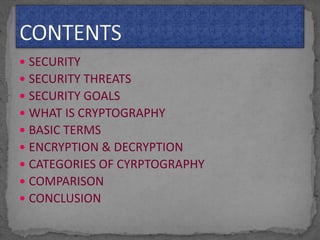
 SECURITY
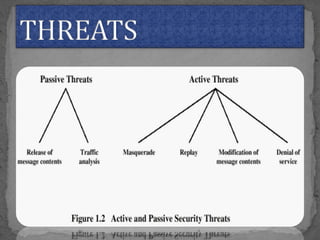
 SECURITY THREATS
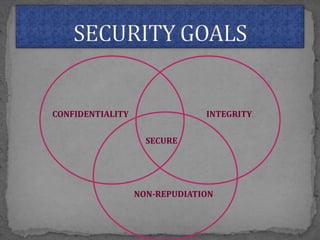
 SECURITY GOALS
 WHAT IS CRYPTOGRAPHY
 BASIC TERMS
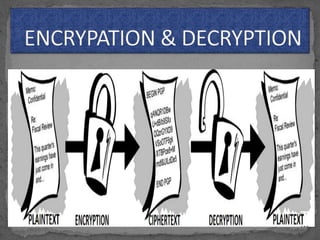
 ENCRYPTION & DECRYPTION
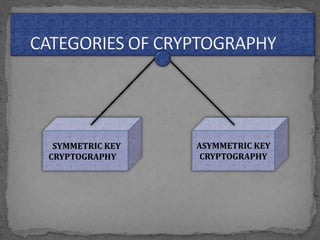
 CATEGORIES OF CYRPTOGRAPHY
 COMPARISON
 CONCLUSION
SECURITY???
CONFIDENTIALITY INTEGRITY
SECURE
NON-REPUDIATION
• Cryptography is the
science and art of
transforming messages
to make them secure
and immune to attack.
 PLAIN TEXT
 CIPHER TEXT
 CIPHER
 ENCRYPTION & DECRYPTION
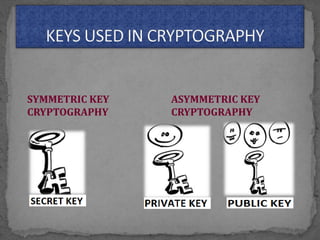
 KEYS
ASYMMETRIC KEY
CRYPTOGRAPHY
SYMMETRIC KEY
CRYPTOGRAPHY
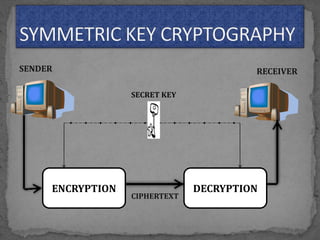
• Also known as secret key. Sender & receiver
uses same key & an encryption/decryption
algorithm to encrypt/decrypt data. i.e. the key
is shared.
ENCRYPTION DECRYPTION
CIPHERTEXT
SENDER RECEIVER
SECRET KEY
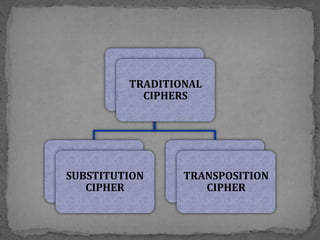
TRADITIONAL
CIPHERS
SUBSTITUTION
CIPHER
TRANSPOSITION
CIPHER
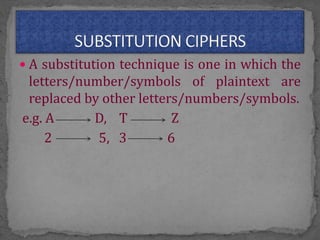
 A substitution technique is one in which the
letters/number/symbols of plaintext are
replaced by other letters/numbers/symbols.
e.g. A D, T Z
2 5, 3 6
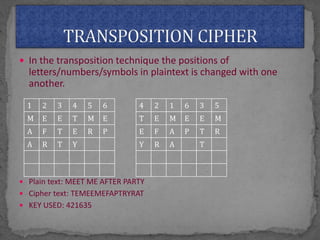
 In the transposition technique the positions of
letters/numbers/symbols in plaintext is changed with one
another.
 Plain text: MEET ME AFTER PARTY
 Cipher text: TEMEEMEFAPTRYRAT
 KEY USED: 421635
1 2 3 4 5 6
M E E T M E
A F T E R P
A R T Y
4 2 1 6 3 5
T E M E E M
E F A P T R
Y R A T
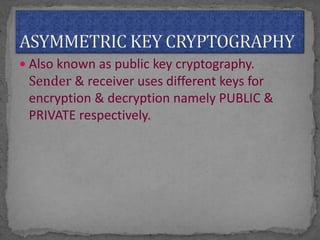
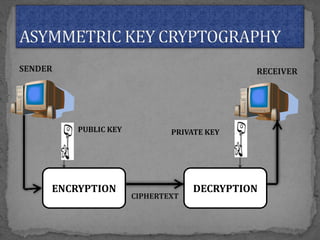
 Also known as public key cryptography.
Sender & receiver uses different keys for
encryption & decryption namely PUBLIC &
PRIVATE respectively.
ENCRYPTION DECRYPTION
CIPHERTEXT
SENDER RECEIVER
PUBLIC KEY PRIVATE KEY
SYMMETRIC KEY
CRYPTOGRAPHY
ASYMMETRIC KEY
CRYPTOGRAPHY
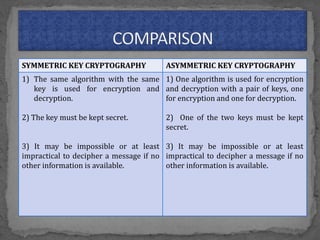
SYMMETRIC KEY CRYPTOGRAPHY ASYMMETRIC KEY CRYPTOGRAPHY
1) The same algorithm with the same
key is used for encryption and
decryption.
2) The key must be kept secret.
3) It may be impossible or at least
impractical to decipher a message if no
other information is available.
1) One algorithm is used for encryption
and decryption with a pair of keys, one
for encryption and one for decryption.
2) One of the two keys must be kept
secret.
3) It may be impossible or at least
impractical to decipher a message if no
other information is available.
 Defense services
 Secure data manipulation
 E –commerce
 Business transactions
 Internet payment systems
 User identification systems
 Access control
 Data security
 By using of encryption techniques a fair unit of
confidentiality, authentication, integrity, access control
and availability of data is maintained.
An algorithm (pronounced AL-go-rith-um) is a
procedure or formula for solving a problem. The word
derives from the name of the mathematician,
Mohammed ibn-Musa al-Khwarizmi, who was part of the
royal court in Baghdad and who lived from about 780 to
850. Al-Khwarizmi's work is the likely source for the
word algebra as well. A computer program can be
viewed as an elaborate algorithm. In mathematics and
computer science, an algorithm usually means a small
procedure that solves a recurrent problem.
A mathematical procedure for performing encryption
on data. Through the use of an algorithm, information is
made into meaningless cipher text and requires the use
of a key to transform the data back into its original form.
Blowfish, AES RC4, RC5, and RC6 are examples of
encryption algorithms. The moment the algorithm
behind an encryption is known then it can be broken
with the use of the same algorithm.
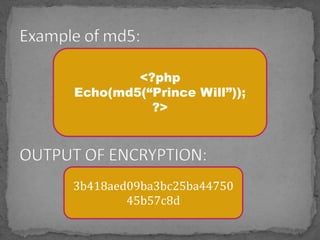
The MD5 algorithm is a widely used hash function producing
a 128-bit hash value. 128-bit encryption is a data/file
encryption technique that uses a 128-bit key to encrypt and
decrypt data or files. It is one of the most secure encryption
methods used in most modern encryption algorithms and
technologies. 128-bit encryption is considered to be logically
unbreakable. 128-bit encryption primarily refers to the length
of the encryption or decryption key. It is considered secure
because it would take massive computation and virtually
thousands of years to be cracked. For example, it would take
2128 different combinations to break the encryption key,
which is out of reach for even the most powerful computers.
128-bit encryption is implemented in most
network/Internet communications technologies such as
in web browsers and websites. The Advanced Encryption
Standard (AES) is a popular encryption algorithm that
supports 128-bit encryption. Although 128-bit
encryption is considered unbreakable, some
computational models and theories are expected to
break or compete it in years to come.
<?php
Echo(md5(“Prince Will”));
?>
3b418aed09ba3bc25ba44750
45b57c8d
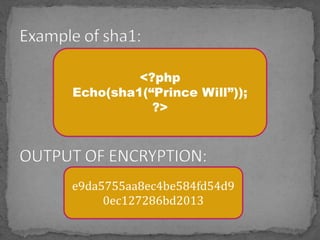
SHA-1 (Secure Hash Algorithm 1) is a set of cryptographic
hash functions designed by the National Security Agency
(NSA).[3] SHA stands for Secure Hash Algorithm.
Cryptographic hash functions are mathematical operations
run on digital data; by comparing the computed "hash" (the
output from execution of the algorithm) to a known and
expected hash value, a person can determine the data's
integrity. For example, computing the hash of a downloaded
file and comparing the result to a previously published hash
result can show whether the download has been modified or
tampered with.[4] A key aspect of cryptographic hash
functions is their collision resistance: nobody should be able
to find two different input values that result in the same hash
output.
<?php
Echo(sha1(“Prince Will”));
?>
e9da5755aa8ec4be584fd54d9
0ec127286bd2013
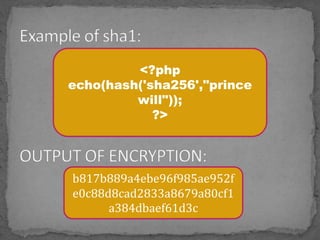
SHA-256 is a variation of SHA-2 (Secure Hash Algorithm
2) which is a set of cryptographic hash functions designed by
the National Security Agency (NSA).[3] SHA stands for Secure
Hash Algorithm. Cryptographic hash functions are
mathematical operations run on digital data; by comparing
the computed "hash" (the output from execution of the
algorithm) to a known and expected hash value, a person can
determine the data's integrity. For example, computing the
hash of a downloaded file and comparing the result to a
previously published hash result can show whether the
download has been modified or tampered with.[4] A key
aspect of cryptographic hash functions is their collision
resistance: nobody should be able to find two different input
values that result in the same hash output.
<?php
echo(hash('sha256',"prince
will"));
?>
b817b889a4ebe96f985ae952f
e0c88d8cad2833a8679a80cf1
a384dbaef61d3c
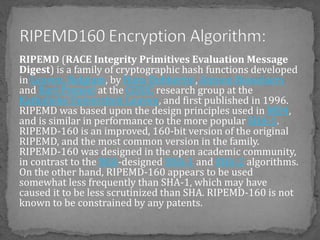
RIPEMD (RACE Integrity Primitives Evaluation Message
Digest) is a family of cryptographic hash functions developed
in Leuven, Belgium, by Hans Dobbertin, Antoon Bosselaers
and Bart Preneel at the COSIC research group at the
Katholieke Universiteit Leuven, and first published in 1996.
RIPEMD was based upon the design principles used in MD4,
and is similar in performance to the more popular SHA-1.
RIPEMD-160 is an improved, 160-bit version of the original
RIPEMD, and the most common version in the family.
RIPEMD-160 was designed in the open academic community,
in contrast to the NSA-designed SHA-1 and SHA-2 algorithms.
On the other hand, RIPEMD-160 appears to be used
somewhat less frequently than SHA-1, which may have
caused it to be less scrutinized than SHA. RIPEMD-160 is not
known to be constrained by any patents.
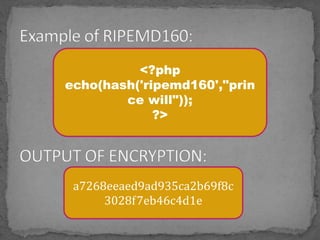
<?php
echo(hash('ripemd160',"prin
ce will"));
?>
a7268eeaed9ad935ca2b69f8c
3028f7eb46c4d1e
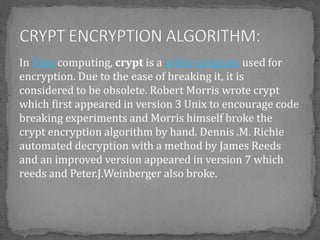
In Unix computing, crypt is a utility program used for
encryption. Due to the ease of breaking it, it is
considered to be obsolete. Robert Morris wrote crypt
which first appeared in version 3 Unix to encourage code
breaking experiments and Morris himself broke the
crypt encryption algorithm by hand. Dennis .M. Richie
automated decryption with a method by James Reeds
and an improved version appeared in version 7 which
reeds and Peter.J.Weinberger also broke.
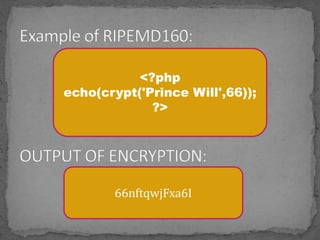
<?php
echo(crypt('Prince Will',66));
?>
66nftqwjFxa6I
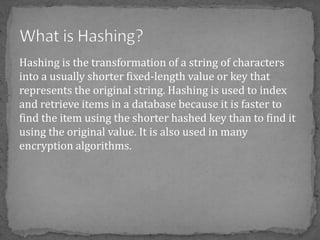
Hashing is the transformation of a string of characters
into a usually shorter fixed-length value or key that
represents the original string. Hashing is used to index
and retrieve items in a database because it is faster to
find the item using the shorter hashed key than to find it
using the original value. It is also used in many
encryption algorithms.

Cryptography

  • 1.
  • 2.
     SECURITY  SECURITYTHREATS  SECURITY GOALS  WHAT IS CRYPTOGRAPHY  BASIC TERMS  ENCRYPTION & DECRYPTION  CATEGORIES OF CYRPTOGRAPHY  COMPARISON  CONCLUSION
  • 3.
  • 5.
  • 6.
    • Cryptography isthe science and art of transforming messages to make them secure and immune to attack.
  • 7.
     PLAIN TEXT CIPHER TEXT  CIPHER  ENCRYPTION & DECRYPTION  KEYS
  • 9.
  • 10.
    • Also knownas secret key. Sender & receiver uses same key & an encryption/decryption algorithm to encrypt/decrypt data. i.e. the key is shared.
  • 11.
  • 12.
  • 13.
     A substitutiontechnique is one in which the letters/number/symbols of plaintext are replaced by other letters/numbers/symbols. e.g. A D, T Z 2 5, 3 6
  • 14.
     In thetransposition technique the positions of letters/numbers/symbols in plaintext is changed with one another.  Plain text: MEET ME AFTER PARTY  Cipher text: TEMEEMEFAPTRYRAT  KEY USED: 421635 1 2 3 4 5 6 M E E T M E A F T E R P A R T Y 4 2 1 6 3 5 T E M E E M E F A P T R Y R A T
  • 15.
     Also knownas public key cryptography. Sender & receiver uses different keys for encryption & decryption namely PUBLIC & PRIVATE respectively.
  • 16.
  • 17.
  • 18.
    SYMMETRIC KEY CRYPTOGRAPHYASYMMETRIC KEY CRYPTOGRAPHY 1) The same algorithm with the same key is used for encryption and decryption. 2) The key must be kept secret. 3) It may be impossible or at least impractical to decipher a message if no other information is available. 1) One algorithm is used for encryption and decryption with a pair of keys, one for encryption and one for decryption. 2) One of the two keys must be kept secret. 3) It may be impossible or at least impractical to decipher a message if no other information is available.
  • 19.
     Defense services Secure data manipulation  E –commerce  Business transactions  Internet payment systems  User identification systems  Access control  Data security
  • 20.
     By usingof encryption techniques a fair unit of confidentiality, authentication, integrity, access control and availability of data is maintained.
  • 22.
    An algorithm (pronouncedAL-go-rith-um) is a procedure or formula for solving a problem. The word derives from the name of the mathematician, Mohammed ibn-Musa al-Khwarizmi, who was part of the royal court in Baghdad and who lived from about 780 to 850. Al-Khwarizmi's work is the likely source for the word algebra as well. A computer program can be viewed as an elaborate algorithm. In mathematics and computer science, an algorithm usually means a small procedure that solves a recurrent problem.
  • 23.
    A mathematical procedurefor performing encryption on data. Through the use of an algorithm, information is made into meaningless cipher text and requires the use of a key to transform the data back into its original form. Blowfish, AES RC4, RC5, and RC6 are examples of encryption algorithms. The moment the algorithm behind an encryption is known then it can be broken with the use of the same algorithm.
  • 25.
    The MD5 algorithmis a widely used hash function producing a 128-bit hash value. 128-bit encryption is a data/file encryption technique that uses a 128-bit key to encrypt and decrypt data or files. It is one of the most secure encryption methods used in most modern encryption algorithms and technologies. 128-bit encryption is considered to be logically unbreakable. 128-bit encryption primarily refers to the length of the encryption or decryption key. It is considered secure because it would take massive computation and virtually thousands of years to be cracked. For example, it would take 2128 different combinations to break the encryption key, which is out of reach for even the most powerful computers.
  • 26.
    128-bit encryption isimplemented in most network/Internet communications technologies such as in web browsers and websites. The Advanced Encryption Standard (AES) is a popular encryption algorithm that supports 128-bit encryption. Although 128-bit encryption is considered unbreakable, some computational models and theories are expected to break or compete it in years to come.
  • 27.
  • 28.
    SHA-1 (Secure HashAlgorithm 1) is a set of cryptographic hash functions designed by the National Security Agency (NSA).[3] SHA stands for Secure Hash Algorithm. Cryptographic hash functions are mathematical operations run on digital data; by comparing the computed "hash" (the output from execution of the algorithm) to a known and expected hash value, a person can determine the data's integrity. For example, computing the hash of a downloaded file and comparing the result to a previously published hash result can show whether the download has been modified or tampered with.[4] A key aspect of cryptographic hash functions is their collision resistance: nobody should be able to find two different input values that result in the same hash output.
  • 29.
  • 30.
    SHA-256 is avariation of SHA-2 (Secure Hash Algorithm 2) which is a set of cryptographic hash functions designed by the National Security Agency (NSA).[3] SHA stands for Secure Hash Algorithm. Cryptographic hash functions are mathematical operations run on digital data; by comparing the computed "hash" (the output from execution of the algorithm) to a known and expected hash value, a person can determine the data's integrity. For example, computing the hash of a downloaded file and comparing the result to a previously published hash result can show whether the download has been modified or tampered with.[4] A key aspect of cryptographic hash functions is their collision resistance: nobody should be able to find two different input values that result in the same hash output.
  • 31.
  • 32.
    RIPEMD (RACE IntegrityPrimitives Evaluation Message Digest) is a family of cryptographic hash functions developed in Leuven, Belgium, by Hans Dobbertin, Antoon Bosselaers and Bart Preneel at the COSIC research group at the Katholieke Universiteit Leuven, and first published in 1996. RIPEMD was based upon the design principles used in MD4, and is similar in performance to the more popular SHA-1. RIPEMD-160 is an improved, 160-bit version of the original RIPEMD, and the most common version in the family. RIPEMD-160 was designed in the open academic community, in contrast to the NSA-designed SHA-1 and SHA-2 algorithms. On the other hand, RIPEMD-160 appears to be used somewhat less frequently than SHA-1, which may have caused it to be less scrutinized than SHA. RIPEMD-160 is not known to be constrained by any patents.
  • 33.
  • 34.
    In Unix computing,crypt is a utility program used for encryption. Due to the ease of breaking it, it is considered to be obsolete. Robert Morris wrote crypt which first appeared in version 3 Unix to encourage code breaking experiments and Morris himself broke the crypt encryption algorithm by hand. Dennis .M. Richie automated decryption with a method by James Reeds and an improved version appeared in version 7 which reeds and Peter.J.Weinberger also broke.
  • 35.
  • 36.
    Hashing is thetransformation of a string of characters into a usually shorter fixed-length value or key that represents the original string. Hashing is used to index and retrieve items in a database because it is faster to find the item using the shorter hashed key than to find it using the original value. It is also used in many encryption algorithms.