Welcome  to the World of Secret Communication
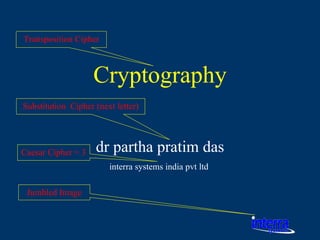
yhpargotpyrC es qbsuib qsbujn ebt lqwhuud vbvwhpv lqgld syw owg
Cryptography es qbsuib qsbujn ebt lqwhuud vbvwhpv lqgld syw owg  Transposition Cipher
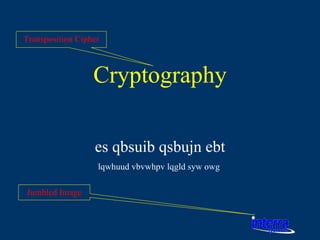
Cryptography es qbsuib qsbujn ebt lqwhuud vbvwhpv lqgld syw owg  Transposition Cipher Jumbled Image
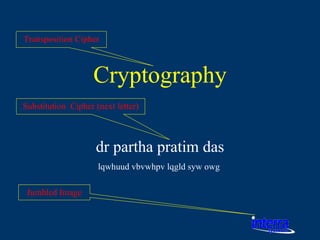
Cryptography dr partha pratim das lqwhuud vbvwhpv lqgld syw owg  Transposition Cipher Jumbled Image Substitution  Cipher (next letter)
Cryptography dr partha pratim das interra systems india pvt ltd  Transposition Cipher Jumbled Image Substitution  Cipher (next letter) Caesar Cipher = 3
Cryptography Dr Partha Pratim Das Interra Systems India Pvt Ltd   Title Case Restored
December 12, 2008 Cryptography – An Overview Madhubanti Dasgupta & Partha Pratim Das Interra Systems (India) Pvt. Ltd.
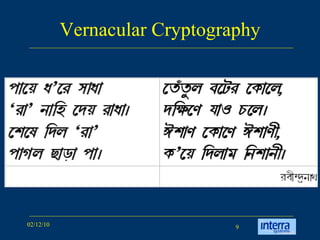
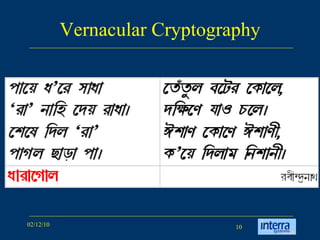
Vernacular Cryptography
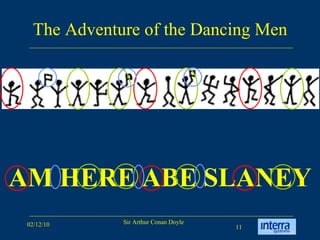
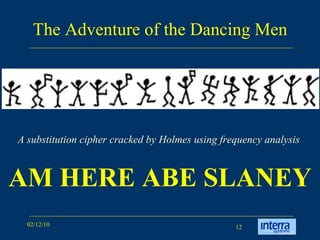
The Adventure of the Dancing Men AM HERE ABE SLANEY
The Adventure of the Dancing Men AM HERE ABE SLANEY A substitution cipher cracked by Holmes using frequency analysis
Agenda Cryptography – What & Why? Basic Cryptography Modern Cryptography Secret-Key (Symmetric) Cryptography Public-Key (Asymmetric) Cryptography Hash Function (One-way) Cryptography How do Credit Cards work?
Cryptography – What & Why? Basic Notion
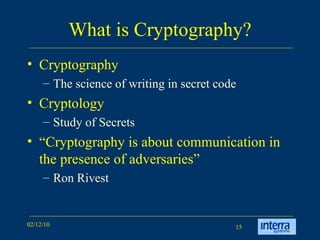
What is Cryptography? Cryptography  The science of writing in secret code  Cryptology Study of Secrets “ Cryptography is about communication in the presence of adversaries” Ron Rivest
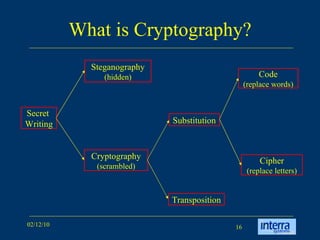
What is Cryptography? Secret  Writing Steganography (hidden) Cryptography (scrambled) Substitution Transposition Code (replace words) Cipher (replace letters)
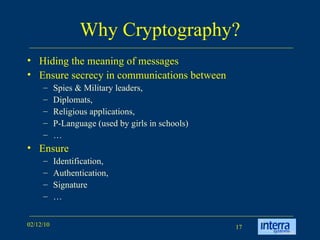
Why Cryptography? Hiding the meaning of messages Ensure secrecy in communications between Spies & Military leaders,  Diplomats,  Religious applications,  P-Language (used by girls in schools) …  Ensure Identification,  Authentication,  Signature  …
Basic Cryptography Notions, Terms,  Examples & Techniques
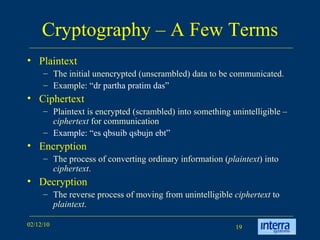
Cryptography – A Few Terms Plaintext The initial unencrypted (unscrambled) data to be communicated. Example: “ dr partha pratim das” Ciphertext Plaintext is encrypted (scrambled) into something unintelligible –  ciphertext  for communication Example: “es qbsuib qsbujn ebt” Encryption  The process of converting ordinary information ( plaintext ) into  ciphertext .  Decryption  The reverse process of moving from unintelligible  ciphertext  to  plaintext .
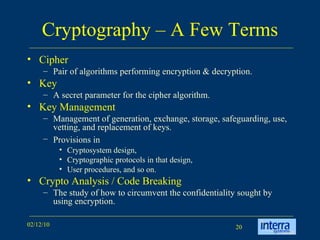
Cryptography – A Few Terms Cipher  Pair of algorithms performing encryption & decryption.  Key A secret parameter for the cipher algorithm.  Key Management Management of generation, exchange, storage, safeguarding, use, vetting, and replacement of keys.  Provisions in   Cryptosystem design,  Cryptographic protocols in that design,  User procedures, and so on. Crypto Analysis / Code Breaking The study of how to circumvent the confidentiality sought by using encryption.
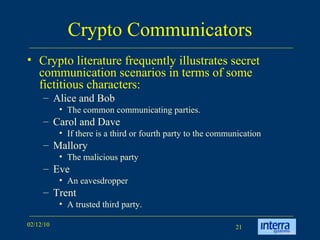
Crypto Communicators Crypto literature frequently illustrates secret communication scenarios in terms of some fictitious characters: Alice and Bob The common communicating parties.  Carol and Dave  If there is a third or fourth party to the communication Mallory  The malicious party Eve  An eavesdropper Trent  A trusted third party.
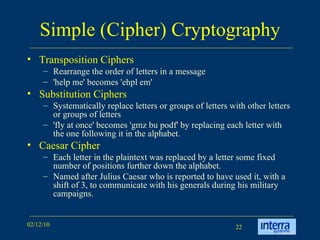
Simple (Cipher) Cryptography Transposition Ciphers Rearrange the order of letters in a message  'help me' becomes 'ehpl em'  Substitution Ciphers Systematically replace letters or groups of letters with other letters or groups of letters  'fly at once' becomes 'gmz bu podf' by replacing each letter with the one following it in the alphabet.  Caesar Cipher Each letter in the plaintext was replaced by a letter some fixed number of positions further down the alphabet.  Named after Julius Caesar who is reported to have used it, with a shift of 3, to communicate with his generals during his military campaigns.
Modern Cryptography Techniques, Standards and Applications
Issues in Modern Cryptography Privacy/Confidentiality:   Ensuring that no one can read the message except the intended receiver.  Authentication:   The process of proving one's identity.  Integrity:   Assuring the receiver that the received message has not been altered in any way from the original.  Non-repudiation:   A mechanism to prove that the sender really sent this message.
Cryptography in Modern Living Secure Communications  Document / Data / Email Encryption  VPN Identification and Authentication  Secret Sharing  Electronic Commerce and Payments  ATMs / Credit Cards Net Banking / Web Shopping Certification Digital Signature (NOT  Digitized  Signature) Key Recovery Remote Access Secure ID
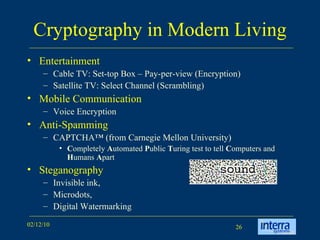
Cryptography in Modern Living Entertainment Cable TV: Set-top Box – Pay-per-view (Encryption) Satellite TV: Select Channel (Scrambling) Mobile Communication Voice Encryption Anti-Spamming CAPTCHA™ (from Carnegie Mellon University) C ompletely  A utomated  P ublic  T uring test to tell  C omputers and  H umans  A part Steganography Invisible ink,  Microdots,  Digital Watermarking
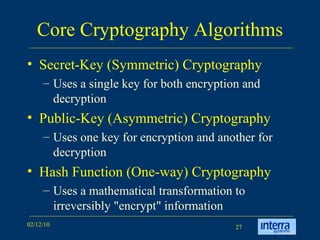
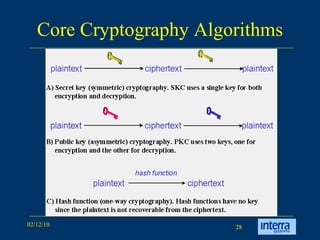
Core Cryptography Algorithms Secret-Key (Symmetric) Cryptography Uses a single key for both encryption and decryption  Public-Key (Asymmetric) Cryptography Uses one key for encryption and another for decryption  Hash Function (One-way) Cryptography Uses a mathematical transformation to irreversibly "encrypt" information
Core Cryptography Algorithms
Secret-Key Cryptography An Overview
Secret-Key Cryptography Single key used for both encryption & decryption.  Sender uses the key (or some set of rules) to encrypt the plaintext and sends the ciphertext to the receiver.  Receiver applies the same key (or ruleset) to decrypt the message and recover the plaintext.  Also called  symmetric encryption . The key must be known to sender & receiver both. Popular:  Data Encryption Standard  ( DES )   Drawback Distribution of the key. Advantage Very fast in encryption / decryption
Secret-Key Cryptography Secret key cryptography schemes  Stream Ciphers Encrypt the bits of the message one at a time Block Ciphers Take a number of bits and encrypt them as a single unit.  Blocks of 64 bits have been commonly used;  Advanced Encryption Standard (AES)  128-bit blocks.  Approved by NIST in December 2001.
Public-Key Cryptography An Overview
Public-Key Cryptography A crypto system for secure communication over a non-secure communications channel without having to share a secret key. Usually, a two-key system Public Key Private Key One key (public / private) is used to encrypt while the other (public / private) is used to decrypt . The most significant new development in cryptography in the last 300-400 years.
Public-Key Cryptography Applications: Encryption Digital Signature Key Distribution for Symmetric Algorithm Popular:  RSA public-key cryptosystem   Diffie-Hellman public-key cryptosystem   In modern cryptosystem designs, both asymmetric (public key) and symmetric algorithms are used to take advantage of the virtues of both.
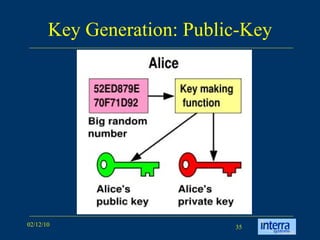
Key Generation: Public-Key
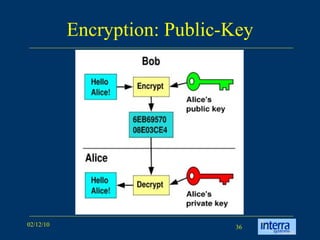
Encryption: Public-Key
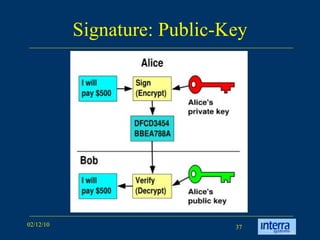
Signature: Public-Key
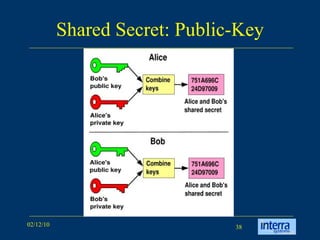
Shared Secret: Public-Key
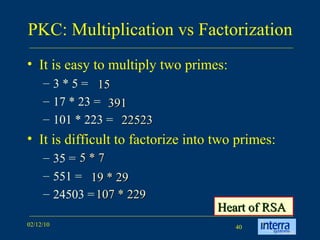
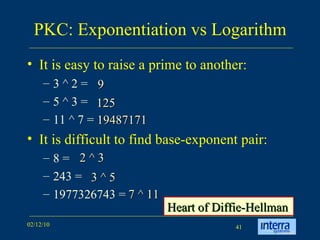
Public-Key Cryptography Based upon  one-way trapdoor functions Mathematical functions that are easy to compute whereas their inverse function is relatively difficult to compute.  Multiplication vs. factorization Exponentiation vs. logarithms Has a  trap door  in the one-way function so that the inverse calculation becomes easy given knowledge of some item of information.
PKC: Multiplication vs Factorization It is easy to multiply two primes: 3 * 5 = 17 * 23 = 101 * 223 = It is difficult to factorize into two primes: 35 =  551 =  24503 =  5 * 7 15 391 22523 19 * 29 107 * 229 Heart of RSA
PKC: Exponentiation vs Logarithm It is easy to raise a prime to another: 3 ^ 2 = 5 ^ 3 = 11 ^ 7 = It is difficult to find base-exponent pair: 8 =  243 =  1977326743 =  2 ^ 3 9 125 19487171 3 ^ 5 7 ^ 11 Heart of Diffie-Hellman
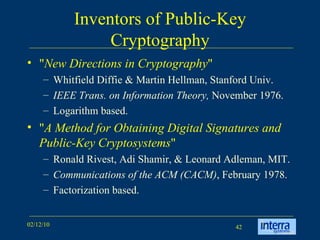
Inventors of Public-Key Cryptography " New Directions in Cryptography "  Whitfield Diffie & Martin Hellman, Stanford Univ.  IEEE Trans. on Information Theory,  November 1976.  Logarithm based. " A Method for Obtaining Digital Signatures and Public-Key Cryptosystems "  Ronald Rivest, Adi Shamir, & Leonard Adleman, MIT.  Communications of the ACM (CACM) , February 1978. Factorization based.
Hash Function Cryptography An Overview
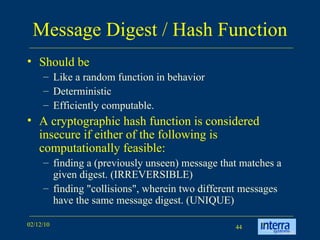
Message Digest / Hash Function Should be Like a random function in behavior Deterministic  Efficiently computable. A cryptographic hash function is considered insecure if either of the following is computationally feasible: finding a (previously unseen) message that matches a given digest. (IRREVERSIBLE)  finding "collisions", wherein two different messages have the same message digest. (UNIQUE)
Message Digest / Hash Function Applications: Message Identity Identical Files Password Authentication Popular:  MD5 :   Message Digest Algorithm   SH-1 : Secure Hash Algorithm
How do Credit Cards work? Impact of Cryptography on Civilization
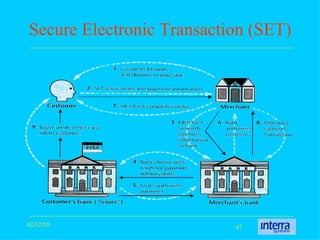
Secure Electronic Transaction (SET)
Dual Signature Concept:   Link Two Messages Intended for Two Different Receivers: Order Information (OI):  Customer to Merchant Payment Information (PI):  Customer to Bank Goal:   Limit Information to A “Need-to-Know” Basis: Merchant does not need credit card number. Bank does not need details of customer order. Afford the customer extra protection in terms of privacy by keeping these items separate. This link is needed to prove that payment is intended for this order and not some other one.
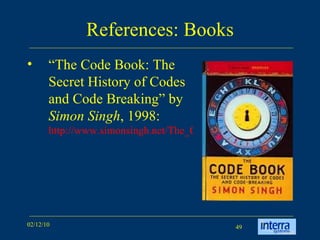
References: Books “ The Code Book:  The Secret History of Codes and Code Breaking” by  Simon Singh , 1998:  http://www.simonsingh.net/The_Code_Book.html
References: Papers / URL “An Overview of Cryptography” by  Gary C. Kessler , May 1998 (Revised 1 August 2006):  http://www.garykessler.net/library/crypto.html   “Cryptography” on Wikipedia:   http://en.wikipedia.org/wiki/Cryptography   “Crypto FAQ” on RSA Security:  http://www.rsasecurity.com/rsalabs/node.asp?id=2152
Thank You

Cryptography - An Overview

  • 1.
    Welcome tothe World of Secret Communication
  • 2.
    yhpargotpyrC es qbsuibqsbujn ebt lqwhuud vbvwhpv lqgld syw owg
  • 3.
    Cryptography es qbsuibqsbujn ebt lqwhuud vbvwhpv lqgld syw owg Transposition Cipher
  • 4.
    Cryptography es qbsuibqsbujn ebt lqwhuud vbvwhpv lqgld syw owg Transposition Cipher Jumbled Image
  • 5.
    Cryptography dr parthapratim das lqwhuud vbvwhpv lqgld syw owg Transposition Cipher Jumbled Image Substitution Cipher (next letter)
  • 6.
    Cryptography dr parthapratim das interra systems india pvt ltd Transposition Cipher Jumbled Image Substitution Cipher (next letter) Caesar Cipher = 3
  • 7.
    Cryptography Dr ParthaPratim Das Interra Systems India Pvt Ltd Title Case Restored
  • 8.
    December 12, 2008Cryptography – An Overview Madhubanti Dasgupta & Partha Pratim Das Interra Systems (India) Pvt. Ltd.
  • 9.
  • 10.
  • 11.
    The Adventure ofthe Dancing Men AM HERE ABE SLANEY
  • 12.
    The Adventure ofthe Dancing Men AM HERE ABE SLANEY A substitution cipher cracked by Holmes using frequency analysis
  • 13.
    Agenda Cryptography –What & Why? Basic Cryptography Modern Cryptography Secret-Key (Symmetric) Cryptography Public-Key (Asymmetric) Cryptography Hash Function (One-way) Cryptography How do Credit Cards work?
  • 14.
    Cryptography – What& Why? Basic Notion
  • 15.
    What is Cryptography?Cryptography The science of writing in secret code Cryptology Study of Secrets “ Cryptography is about communication in the presence of adversaries” Ron Rivest
  • 16.
    What is Cryptography?Secret Writing Steganography (hidden) Cryptography (scrambled) Substitution Transposition Code (replace words) Cipher (replace letters)
  • 17.
    Why Cryptography? Hidingthe meaning of messages Ensure secrecy in communications between Spies & Military leaders, Diplomats, Religious applications, P-Language (used by girls in schools) … Ensure Identification, Authentication, Signature …
  • 18.
    Basic Cryptography Notions,Terms, Examples & Techniques
  • 19.
    Cryptography – AFew Terms Plaintext The initial unencrypted (unscrambled) data to be communicated. Example: “ dr partha pratim das” Ciphertext Plaintext is encrypted (scrambled) into something unintelligible – ciphertext for communication Example: “es qbsuib qsbujn ebt” Encryption The process of converting ordinary information ( plaintext ) into ciphertext . Decryption The reverse process of moving from unintelligible ciphertext to plaintext .
  • 20.
    Cryptography – AFew Terms Cipher Pair of algorithms performing encryption & decryption. Key A secret parameter for the cipher algorithm. Key Management Management of generation, exchange, storage, safeguarding, use, vetting, and replacement of keys. Provisions in Cryptosystem design, Cryptographic protocols in that design, User procedures, and so on. Crypto Analysis / Code Breaking The study of how to circumvent the confidentiality sought by using encryption.
  • 21.
    Crypto Communicators Cryptoliterature frequently illustrates secret communication scenarios in terms of some fictitious characters: Alice and Bob The common communicating parties. Carol and Dave If there is a third or fourth party to the communication Mallory The malicious party Eve An eavesdropper Trent A trusted third party.
  • 22.
    Simple (Cipher) CryptographyTransposition Ciphers Rearrange the order of letters in a message 'help me' becomes 'ehpl em' Substitution Ciphers Systematically replace letters or groups of letters with other letters or groups of letters 'fly at once' becomes 'gmz bu podf' by replacing each letter with the one following it in the alphabet. Caesar Cipher Each letter in the plaintext was replaced by a letter some fixed number of positions further down the alphabet. Named after Julius Caesar who is reported to have used it, with a shift of 3, to communicate with his generals during his military campaigns.
  • 23.
    Modern Cryptography Techniques,Standards and Applications
  • 24.
    Issues in ModernCryptography Privacy/Confidentiality: Ensuring that no one can read the message except the intended receiver. Authentication: The process of proving one's identity. Integrity: Assuring the receiver that the received message has not been altered in any way from the original. Non-repudiation: A mechanism to prove that the sender really sent this message.
  • 25.
    Cryptography in ModernLiving Secure Communications Document / Data / Email Encryption VPN Identification and Authentication Secret Sharing Electronic Commerce and Payments ATMs / Credit Cards Net Banking / Web Shopping Certification Digital Signature (NOT Digitized Signature) Key Recovery Remote Access Secure ID
  • 26.
    Cryptography in ModernLiving Entertainment Cable TV: Set-top Box – Pay-per-view (Encryption) Satellite TV: Select Channel (Scrambling) Mobile Communication Voice Encryption Anti-Spamming CAPTCHA™ (from Carnegie Mellon University) C ompletely A utomated P ublic T uring test to tell C omputers and H umans A part Steganography Invisible ink, Microdots, Digital Watermarking
  • 27.
    Core Cryptography AlgorithmsSecret-Key (Symmetric) Cryptography Uses a single key for both encryption and decryption Public-Key (Asymmetric) Cryptography Uses one key for encryption and another for decryption Hash Function (One-way) Cryptography Uses a mathematical transformation to irreversibly "encrypt" information
  • 28.
  • 29.
  • 30.
    Secret-Key Cryptography Singlekey used for both encryption & decryption. Sender uses the key (or some set of rules) to encrypt the plaintext and sends the ciphertext to the receiver. Receiver applies the same key (or ruleset) to decrypt the message and recover the plaintext. Also called symmetric encryption . The key must be known to sender & receiver both. Popular: Data Encryption Standard ( DES )  Drawback Distribution of the key. Advantage Very fast in encryption / decryption
  • 31.
    Secret-Key Cryptography Secretkey cryptography schemes Stream Ciphers Encrypt the bits of the message one at a time Block Ciphers Take a number of bits and encrypt them as a single unit. Blocks of 64 bits have been commonly used; Advanced Encryption Standard (AES) 128-bit blocks. Approved by NIST in December 2001.
  • 32.
  • 33.
    Public-Key Cryptography Acrypto system for secure communication over a non-secure communications channel without having to share a secret key. Usually, a two-key system Public Key Private Key One key (public / private) is used to encrypt while the other (public / private) is used to decrypt . The most significant new development in cryptography in the last 300-400 years.
  • 34.
    Public-Key Cryptography Applications:Encryption Digital Signature Key Distribution for Symmetric Algorithm Popular: RSA public-key cryptosystem Diffie-Hellman public-key cryptosystem In modern cryptosystem designs, both asymmetric (public key) and symmetric algorithms are used to take advantage of the virtues of both.
  • 35.
  • 36.
  • 37.
  • 38.
  • 39.
    Public-Key Cryptography Basedupon one-way trapdoor functions Mathematical functions that are easy to compute whereas their inverse function is relatively difficult to compute. Multiplication vs. factorization Exponentiation vs. logarithms Has a trap door in the one-way function so that the inverse calculation becomes easy given knowledge of some item of information.
  • 40.
    PKC: Multiplication vsFactorization It is easy to multiply two primes: 3 * 5 = 17 * 23 = 101 * 223 = It is difficult to factorize into two primes: 35 = 551 = 24503 = 5 * 7 15 391 22523 19 * 29 107 * 229 Heart of RSA
  • 41.
    PKC: Exponentiation vsLogarithm It is easy to raise a prime to another: 3 ^ 2 = 5 ^ 3 = 11 ^ 7 = It is difficult to find base-exponent pair: 8 = 243 = 1977326743 = 2 ^ 3 9 125 19487171 3 ^ 5 7 ^ 11 Heart of Diffie-Hellman
  • 42.
    Inventors of Public-KeyCryptography " New Directions in Cryptography " Whitfield Diffie & Martin Hellman, Stanford Univ. IEEE Trans. on Information Theory, November 1976. Logarithm based. " A Method for Obtaining Digital Signatures and Public-Key Cryptosystems " Ronald Rivest, Adi Shamir, & Leonard Adleman, MIT. Communications of the ACM (CACM) , February 1978. Factorization based.
  • 43.
  • 44.
    Message Digest /Hash Function Should be Like a random function in behavior Deterministic Efficiently computable. A cryptographic hash function is considered insecure if either of the following is computationally feasible: finding a (previously unseen) message that matches a given digest. (IRREVERSIBLE) finding "collisions", wherein two different messages have the same message digest. (UNIQUE)
  • 45.
    Message Digest /Hash Function Applications: Message Identity Identical Files Password Authentication Popular: MD5 : Message Digest Algorithm SH-1 : Secure Hash Algorithm
  • 46.
    How do CreditCards work? Impact of Cryptography on Civilization
  • 47.
  • 48.
    Dual Signature Concept: Link Two Messages Intended for Two Different Receivers: Order Information (OI): Customer to Merchant Payment Information (PI): Customer to Bank Goal: Limit Information to A “Need-to-Know” Basis: Merchant does not need credit card number. Bank does not need details of customer order. Afford the customer extra protection in terms of privacy by keeping these items separate. This link is needed to prove that payment is intended for this order and not some other one.
  • 49.
    References: Books “The Code Book: The Secret History of Codes and Code Breaking” by Simon Singh , 1998: http://www.simonsingh.net/The_Code_Book.html
  • 50.
    References: Papers /URL “An Overview of Cryptography” by Gary C. Kessler , May 1998 (Revised 1 August 2006): http://www.garykessler.net/library/crypto.html “Cryptography” on Wikipedia: http://en.wikipedia.org/wiki/Cryptography “Crypto FAQ” on RSA Security: http://www.rsasecurity.com/rsalabs/node.asp?id=2152
  • 51.

Editor's Notes

  • #17 NOTE: Cryptography does not hide the existence of messages. Steganography hides even the existence of a message. Herodotus concealed a message - a tattoo on a slave's shaved head – by re-grown hair.
  • #20 The term is often used to refer to the field as a whole, as is cryptology ("the study of secrets"). The study of how to circumvent the confidentiality sought by using encryption is called cryptanalysis or, more loosely, "codebreaking." The field is a rich source of jargon , some of it humorous. Until modern times, cryptography referred almost exclusively to encryption , the process of converting ordinary information ( plaintext ) into something unintelligible; this is a ciphertext . Decryption is the reverse, moving from unintelligible ciphertext to plaintext . A cipher (or cypher ) is a pair of algorithms which perform this encryption and the reversing decryption. The detailed operation of a cipher is controlled both by the algorithm and, in each instance, by a key . This is a secret parameter (known only to the communicants) for the cipher algorithm. Keys are important as ciphers without variable keys are trivially breakable and so rather less than useful. Historically, ciphers were often used directly for encryption or decryption without additional procedures. In colloquial use, the term " code " is often used to mean any method of encryption or concealment of meaning. However, within cryptography, code has a more specific meaning; it means the replacement of a unit of plaintext (i.e., a meaningful word or phrase) with a code word (for example, apple pie replaces attack at dawn). Codes are no longer used in serious cryptography—except incidentally for such things as unit designations (eg, 'Bronco Flight')—since properly chosen ciphers are both more practical and more secure than even the best codes, and better adapted to computers as well. Some use the English terms cryptography and cryptology interchangeably, while others use cryptography to refer to the use and practice of cryptographic techniques, and cryptology to refer to the subject as a field of study. In this respect, English usage is more tolerant of overlapping meanings than are several European languages.
  • #21 The term is often used to refer to the field as a whole, as is cryptology ("the study of secrets"). The study of how to circumvent the confidentiality sought by using encryption is called cryptanalysis or, more loosely, "codebreaking." The field is a rich source of jargon , some of it humorous. Until modern times, cryptography referred almost exclusively to encryption , the process of converting ordinary information ( plaintext ) into something unintelligible; this is a ciphertext . Decryption is the reverse, moving from unintelligible ciphertext to plaintext . A cipher (or cypher ) is a pair of algorithms which perform this encryption and the reversing decryption. The detailed operation of a cipher is controlled both by the algorithm and, in each instance, by a key . This is a secret parameter (known only to the communicants) for the cipher algorithm. Keys are important as ciphers without variable keys are trivially breakable and so rather less than useful. Historically, ciphers were often used directly for encryption or decryption without additional procedures. In colloquial use, the term " code " is often used to mean any method of encryption or concealment of meaning. However, within cryptography, code has a more specific meaning; it means the replacement of a unit of plaintext (i.e., a meaningful word or phrase) with a code word (for example, apple pie replaces attack at dawn). Codes are no longer used in serious cryptography—except incidentally for such things as unit designations (eg, 'Bronco Flight')—since properly chosen ciphers are both more practical and more secure than even the best codes, and better adapted to computers as well. Some use the English terms cryptography and cryptology interchangeably, while others use cryptography to refer to the use and practice of cryptographic techniques, and cryptology to refer to the subject as a field of study. In this respect, English usage is more tolerant of overlapping meanings than are several European languages.
  • #22 In many of the descriptions below, two communicating parties will be referred to as Alice and Bob; this is the common nomenclature in the crypto field and literature to make it easier to identify the communicating parties. If there is a third or fourth party to the communication, they will be referred to as Carol and Dave. Mallory is a malicious party, Eve is an eavesdropper, and Trent is a trusted third party.
  • #23 The earliest forms of secret writing required little more than pen and paper. The main classical cipher types are transposition ciphers , which rearrange the order of letters in a message (e.g. 'help me' becomes 'ehpl em' in a trivially simple rearrangement scheme); and substitution ciphers , which systematically replace letters or groups of letters with other letters or groups of letters (e.g., 'fly at once' becomes 'gmz bu podf' by replacing each letter with the one following it in the alphabet). Simple versions of either offered little confidentiality, and still don't. An early substitution cipher was the Caesar cipher , in which each letter in the plaintext was replaced by a letter some fixed number of positions further down the alphabet. It was named after Julius Caesar who is reported to have used it, with a shift of 3, to communicate with his generals during his military campaigns.
  • #26 Secret Sharing Another application of cryptography, called secret sharing, allows the trust of a secret to be distributed among a group of people. For example, in a ( k , n )-threshold scheme, information about a secret is distributed in such a way that any k out of the n people ( k ÂŁ n ) have enough information to determine the secret, but any set of k -1 people do not. In any secret sharing scheme, there are designated sets of people whose cumulative information suffices to determine the secret. In some implementations of secret sharing schemes, each participant receives the secret after it has been generated. In other implementations, the actual secret is never made visible to the participants, although the purpose for which they sought the secret (for example, access to a building or permission to execute a process) is allowed. See Question 2.1.9 for more information on secret sharing.
  • #36 A big random number is used to make a public-key pair.
  • #37 Anyone can encrypt using the public key, but only the private key can decrypt. Secrecy depends on the security of the private key.
  • #38 Using a private key to encrypt (thus signing) a message; anyone can check the signature using the public key. Validity depends on private key security.
  • #39 By combining your own private key with the other users public key you can calculate a shared secret that only the two of you know. The shared secret can be used as the key for a symmetric cipher .