By,
Name : Aiyesha.A
Roll No:02
IB - sem I
Discipline or techniques employed in
protecting integrity or secrecy of electronic
messages by converting them into
unreadable (cipher text ) form . Only the
use of a secret key can convert the cipher
text back to human readable (clear text)
form . Cryptography software and / or
hardware devices use mathematical
formulas (algorithms) to change text from
one form to another
Classical Cryptography:
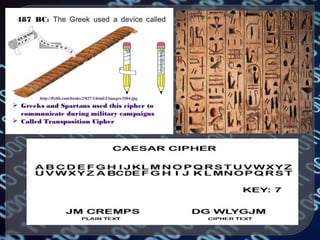
 1900 BC – Tomb of Khnumhotep II in Egypt –
Unusual Hieroglyphs carved into the monuments.
 Arthshashtra by Kautalya – classic work on
statecraft – describes espionage service in India
by writing secret codes to the spies.
 100 BC – Julius Caesar – used encryption to
convey secret messages to his army generals in
war front – this substitution cipher is also known as
caesar cipher
 487 BC The ancient Greeks used the Scytale
transposition cipher – Spartan Military
Medieval Cryptography:
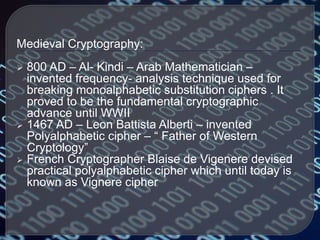
 800 AD – Al- Kindi – Arab Mathematician –
invented frequency- analysis technique used for
breaking monoalphabetic substitution ciphers . It
proved to be the fundamental cryptographic
advance until WWII
 1467 AD – Leon Battista Alberti – invented
Polyalphabetic cipher – “ Father of Western
Cryptology”
 French Cryptographer Blaise de Vigenere devised
practical polyalphabetic cipher which until today is
known as Vignere cipher
 1917 – Gilbert Vernman – Teleprinter Cipher –
led to development of electromechanical
devices as cipher machines.
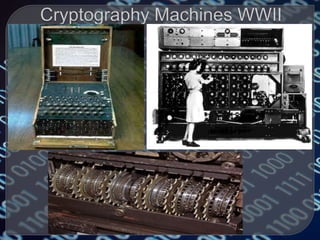
 The Enigma Machine invented by German
Engineer Arthur Scherbius – an
electromechanical rotor machine was used
extensively by the Nazi Germans and The
Enigmas Cipher was cracked by
Mathematician Marian Rejewski from
Poland’s Cipher Bureau which proved to be
Ultra intelligence to the allied nations.
1990’s – Use of internet for commercial
purposes required widespread standard for
encryption.
Claude E.Shannon – considered to be the
father of mathematical cryptography.
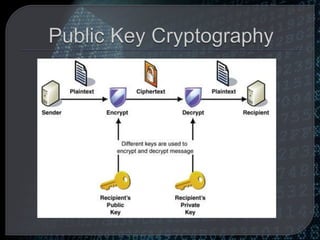
Later by the influence of Shannon’s work –
M.E.Hellman and W.Diffie created public-
key cryptography
 Authentication / Digital Signatures :
Signatures are very important application of public – key
cryptography. The only requirement is that public keys are
associated with their users by a trusted manner, for example a
trusted directory. To address this weakness, the standards
community has invented an object called a certificate. A
certificate contains, the certificate issuer's name, the name of
the subject for whom the certificate is being issued, the public
key of the subject, and some time stamps. You know the
public key is good, because the certificate issuer has a
certificate too.
Pretty good Privacy(PGP) – Developed by Zimmerman –
provides encryption and authentication for e-mail and file
storage applications.
 Time Stamping :
Time stamping is a technique that can certify that a
certain electronic document or communication
existed or was delivered at a certain time. Time
stamping uses an encryption model called a blind
signature scheme. Blind signature schemes allow
the sender to get a message receipted by another
party without revealing any information about the
message to the other party.
Applications : Patent applications , copyright
archives and contracts.
Electronic Money :
The definition of electronic money (also
called electronic cash or digital cash) is a
term that is still evolving. It includes
transactions carried out electronically with
a net transfer of funds from one party to
another, which may be either debit or
credit and can be either anonymous or
identified.
Softwares used : DigiEcash and CyberCash
 Secure Network Communications :
Secure Socket Layer (SSL) – Provides data security
layered between applications protocols (such as HTTP
, Telnet , NNTP or FTP) . SSL supports data encryption
, server authentication , message integrity and client
authentication for TCP/IP connections.
 Kerberos –
Kerberos is an authentication service developed by
MIT which uses secret-key ciphers for encryption and
authentication. Kerberos was designed to authenticate
requests for network resources and does not
authenticate authorship of documents.
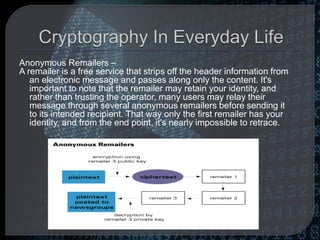
Anonymous Remailers –
A remailer is a free service that strips off the header information from
an electronic message and passes along only the content. It's
important to note that the remailer may retain your identity, and
rather than trusting the operator, many users may relay their
message through several anonymous remailers before sending it
to its intended recipient. That way only the first remailer has your
identity, and from the end point, it's nearly impossible to retrace.
Disk Encryption -
Disk encryption programs encrypt your
entire hard disk so that you don't have to
worry about leaving any traces of the
unencrypted data on your disk.
 The widespread availability of unbreakable encryption coupled with
anonymous services could lead to a situation where practically all
communications are immune from lawful interception (wiretaps) and
documents from lawful search and seizure, and where all electronic
transactions are beyond the reach of any government regulation or
oversight. The consequences of this to public safety and social and
economic stability could be devastating. With the government
essentially locked out, computers and telecommunications systems
would become safe havens for criminal activity.
 It is acknowledged that crypto anarchy provides a means for tax
evasion, money laundering, espionage (with digital dead drops),
contract killings, and implementation of data havens for storing and
marketing illegal or controversial material.
 Encryption also threatens national security by interfering with foreign
intelligence operations. The United States, along with many other
countries, imposes export controls on encryption technology to
lessen this threat.
 Cryptography poses a threat to organizations and
individuals too. With encryption, an employee of a
company can sell proprietary electronic information to
a competitor without the need to photocopy and handle
physical documents.
 Electronic information can be bought and sold on
"black networks" such as Black-Net [1] with complete
secrecy and anonymity -- a safe harbor for engaging in
both corporate and government espionage.
 The keys that unlock a corporation's files may be lost,
corrupted, or held hostage for ransom, thus rendering
valuable information inaccessible.
Cryptography

Cryptography

  • 1.
    By, Name : Aiyesha.A RollNo:02 IB - sem I
  • 2.
    Discipline or techniquesemployed in protecting integrity or secrecy of electronic messages by converting them into unreadable (cipher text ) form . Only the use of a secret key can convert the cipher text back to human readable (clear text) form . Cryptography software and / or hardware devices use mathematical formulas (algorithms) to change text from one form to another
  • 3.
    Classical Cryptography:  1900BC – Tomb of Khnumhotep II in Egypt – Unusual Hieroglyphs carved into the monuments.  Arthshashtra by Kautalya – classic work on statecraft – describes espionage service in India by writing secret codes to the spies.  100 BC – Julius Caesar – used encryption to convey secret messages to his army generals in war front – this substitution cipher is also known as caesar cipher  487 BC The ancient Greeks used the Scytale transposition cipher – Spartan Military
  • 5.
    Medieval Cryptography:  800AD – Al- Kindi – Arab Mathematician – invented frequency- analysis technique used for breaking monoalphabetic substitution ciphers . It proved to be the fundamental cryptographic advance until WWII  1467 AD – Leon Battista Alberti – invented Polyalphabetic cipher – “ Father of Western Cryptology”  French Cryptographer Blaise de Vigenere devised practical polyalphabetic cipher which until today is known as Vignere cipher
  • 6.
     1917 –Gilbert Vernman – Teleprinter Cipher – led to development of electromechanical devices as cipher machines.  The Enigma Machine invented by German Engineer Arthur Scherbius – an electromechanical rotor machine was used extensively by the Nazi Germans and The Enigmas Cipher was cracked by Mathematician Marian Rejewski from Poland’s Cipher Bureau which proved to be Ultra intelligence to the allied nations.
  • 8.
    1990’s – Useof internet for commercial purposes required widespread standard for encryption. Claude E.Shannon – considered to be the father of mathematical cryptography. Later by the influence of Shannon’s work – M.E.Hellman and W.Diffie created public- key cryptography
  • 10.
     Authentication /Digital Signatures : Signatures are very important application of public – key cryptography. The only requirement is that public keys are associated with their users by a trusted manner, for example a trusted directory. To address this weakness, the standards community has invented an object called a certificate. A certificate contains, the certificate issuer's name, the name of the subject for whom the certificate is being issued, the public key of the subject, and some time stamps. You know the public key is good, because the certificate issuer has a certificate too. Pretty good Privacy(PGP) – Developed by Zimmerman – provides encryption and authentication for e-mail and file storage applications.
  • 11.
     Time Stamping: Time stamping is a technique that can certify that a certain electronic document or communication existed or was delivered at a certain time. Time stamping uses an encryption model called a blind signature scheme. Blind signature schemes allow the sender to get a message receipted by another party without revealing any information about the message to the other party. Applications : Patent applications , copyright archives and contracts.
  • 12.
    Electronic Money : Thedefinition of electronic money (also called electronic cash or digital cash) is a term that is still evolving. It includes transactions carried out electronically with a net transfer of funds from one party to another, which may be either debit or credit and can be either anonymous or identified. Softwares used : DigiEcash and CyberCash
  • 13.
     Secure NetworkCommunications : Secure Socket Layer (SSL) – Provides data security layered between applications protocols (such as HTTP , Telnet , NNTP or FTP) . SSL supports data encryption , server authentication , message integrity and client authentication for TCP/IP connections.  Kerberos – Kerberos is an authentication service developed by MIT which uses secret-key ciphers for encryption and authentication. Kerberos was designed to authenticate requests for network resources and does not authenticate authorship of documents.
  • 14.
    Anonymous Remailers – Aremailer is a free service that strips off the header information from an electronic message and passes along only the content. It's important to note that the remailer may retain your identity, and rather than trusting the operator, many users may relay their message through several anonymous remailers before sending it to its intended recipient. That way only the first remailer has your identity, and from the end point, it's nearly impossible to retrace.
  • 15.
    Disk Encryption - Diskencryption programs encrypt your entire hard disk so that you don't have to worry about leaving any traces of the unencrypted data on your disk.
  • 16.
     The widespreadavailability of unbreakable encryption coupled with anonymous services could lead to a situation where practically all communications are immune from lawful interception (wiretaps) and documents from lawful search and seizure, and where all electronic transactions are beyond the reach of any government regulation or oversight. The consequences of this to public safety and social and economic stability could be devastating. With the government essentially locked out, computers and telecommunications systems would become safe havens for criminal activity.  It is acknowledged that crypto anarchy provides a means for tax evasion, money laundering, espionage (with digital dead drops), contract killings, and implementation of data havens for storing and marketing illegal or controversial material.  Encryption also threatens national security by interfering with foreign intelligence operations. The United States, along with many other countries, imposes export controls on encryption technology to lessen this threat.
  • 17.
     Cryptography posesa threat to organizations and individuals too. With encryption, an employee of a company can sell proprietary electronic information to a competitor without the need to photocopy and handle physical documents.  Electronic information can be bought and sold on "black networks" such as Black-Net [1] with complete secrecy and anonymity -- a safe harbor for engaging in both corporate and government espionage.  The keys that unlock a corporation's files may be lost, corrupted, or held hostage for ransom, thus rendering valuable information inaccessible.