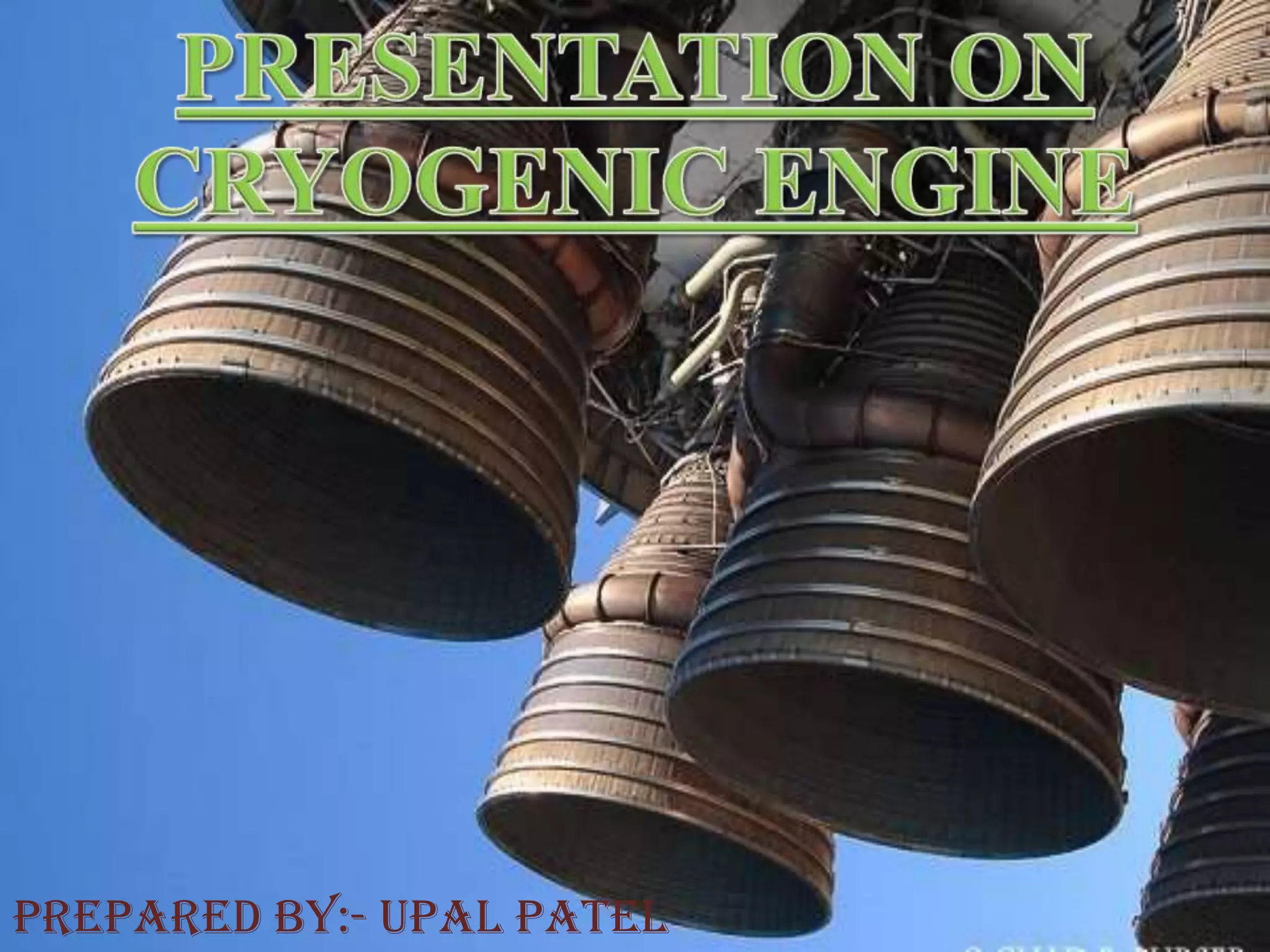
PREPARED BY:- UPAL PATEL
 The word cryogenics comes from Greek word
kryos and means “the production of freezing
cold” the term is used today as a synonym for
the low-temperature state.
 In physics, cryogenics is the study of the
production of very low temperature
(below −150 °C, −238 °F or 123 K) and the
behavior of materials at those temperatures .
 A cryogenic rocket engine is a rocket engine that
uses a cryogenic fuel and oxidizer, that are the gases
which are liquefied and stored at very low
temperatures.
 Rocket engines need high mass flow rate of both
oxidizer and fuel to generate a sufficient thrust.
 Generally oxygen and low molecular weight
hydrocarbons are used as oxidizer and fuel pair.
 The combination of liquid oxygen and liquid hydrogen
offers the highest energy efficiency for rocket engines
that need to produce large amounts of thrust.
The Russians were the first to reach into space.
Solid-fuel rocket engines were the first engines created by man.
All the current Rockets run on Liquid-propellant.
The United States was the first country to develop cryogenic rocket
engines.
They register their first successful flight in 1963 with RL-10 engine
and is still used on the Atlas V rocket.
Then The Japanese LE-5 engine flew in 1977 ,French HM-7 in 1979 ,
Chinese YF-73 in 1984 .
The Russians who put a first satellite and later a human in space,
successfully launched a rocket with a cryogenic engine in 1987.
India successfully launched cryogenic engine on 5th January 2014.
BRIEF HISTORY OF CRYOGENIC ENGINE
Classification Of Space Propulsion
System
cooling and compressing gases into liquids, we can vastly
increase their density and make it possible to store them in
large quantities in smaller tanks.
super cooled gases are stored at the temperature lower
than their freezing point.
Nitrogen, hydrogen, oxygen, helium argon, neon, etc,
Liquid oxygen being the oxidizer and liquid hydrogen being
the fuel.
Liquid oxygen boils at 297oF and liquid hydrogen boils at
423oF.
CRYOGENIC FUEL
Thrust chamber or combustion chamber
Igniter
Fuel injector
Fuel turbo-pumps
Valves
Regulators
Fuel tanks
Rocket engine
Nozzle
Among them, the combustion chamber & the nozzle
are the main components of the rocket engine.
Components Of Cryogenic Rocket
Engine
DIFFERENT TYPES OF ROCKET
ENGINE POWER CYCLES
1. Gas Pressure Feed System
2. Gas – Generator cycle
3. Staged Combustion Cycle
1. Gas Pressure Feed System
2. Gas – Generator cycle
3. Staged Combustion Cycle
Diagram of Combustion Chamber
Injector Plate
Different Types of Fuel Injector
Different Types Of Cryogenic Engine
VULCAIN ENGINE
HM-7B Cryogenic
Engine
RL 10 Cryogenic
Engine
CE 20 Cryogenic
Engine
300 N Cryogenic
Engine
VINCI Cryogenic
Engine
Production & Manufacturing
 The Indian cryogenic engine is produced by Godrej
and the Hyderabad-based MTAR Technologies
working together as a consortium.
 Instead of ISRO first mastering the technology and
transferring it to industry, the two companies were
involved from the start and even the early prototypes
were built by them.
Advantages
 High Energy per unit mass:
Propellants like oxygen and hydrogen in liquid form
give very high amounts of energy per unit mass due to
which the amount of fuel to be carried aboard the rockets
decreases.
 Clean Fuels
Hydrogen and oxygen are extremely clean fuels. When
they combine, they give out only water. This water is thrown
out of the nozzle in form of very hot vapour. Thus the rocket is
nothing but a high burning steam engine
 Economical
Use of oxygen and hydrogen as fuels is very
economical, as liquid oxygen costs less than gasoline.
Disadvantages
• Highly reactive gases
• Leakage
• Hydrogen Embrittlement
• Zero Gravity Condition
The next generation of the Rocket Engines
 All rocket engines burn their fuel to generate thrust . If any other
engine can generate enough thrust, that can also be used as a
rocket engine
 There are a lot of plans for new engines that the NASA scientists
are still working with. One of them is the “ Xenon ion Engine”.
This engine accelerate ions or atomic particles to extremely high
speeds to create thrust more efficiently. NASA's Deep Space-1
spacecraft will be the first to use ion engines for propulsion.
 There are some alternative solutions like Nuclear thermal rocket
engines, Solar thermal rockets, the electric rocket etc.
 We are looking forward that in the near future there will be
some good technology to take us into space
CRYOGENIC ROCKET ENGINE

CRYOGENIC ROCKET ENGINE

  • 1.
  • 2.
     The wordcryogenics comes from Greek word kryos and means “the production of freezing cold” the term is used today as a synonym for the low-temperature state.  In physics, cryogenics is the study of the production of very low temperature (below −150 °C, −238 °F or 123 K) and the behavior of materials at those temperatures .
  • 3.
     A cryogenicrocket engine is a rocket engine that uses a cryogenic fuel and oxidizer, that are the gases which are liquefied and stored at very low temperatures.  Rocket engines need high mass flow rate of both oxidizer and fuel to generate a sufficient thrust.  Generally oxygen and low molecular weight hydrocarbons are used as oxidizer and fuel pair.  The combination of liquid oxygen and liquid hydrogen offers the highest energy efficiency for rocket engines that need to produce large amounts of thrust.
  • 4.
    The Russians werethe first to reach into space. Solid-fuel rocket engines were the first engines created by man. All the current Rockets run on Liquid-propellant. The United States was the first country to develop cryogenic rocket engines. They register their first successful flight in 1963 with RL-10 engine and is still used on the Atlas V rocket. Then The Japanese LE-5 engine flew in 1977 ,French HM-7 in 1979 , Chinese YF-73 in 1984 . The Russians who put a first satellite and later a human in space, successfully launched a rocket with a cryogenic engine in 1987. India successfully launched cryogenic engine on 5th January 2014. BRIEF HISTORY OF CRYOGENIC ENGINE
  • 5.
    Classification Of SpacePropulsion System
  • 6.
    cooling and compressinggases into liquids, we can vastly increase their density and make it possible to store them in large quantities in smaller tanks. super cooled gases are stored at the temperature lower than their freezing point. Nitrogen, hydrogen, oxygen, helium argon, neon, etc, Liquid oxygen being the oxidizer and liquid hydrogen being the fuel. Liquid oxygen boils at 297oF and liquid hydrogen boils at 423oF. CRYOGENIC FUEL
  • 7.
    Thrust chamber orcombustion chamber Igniter Fuel injector Fuel turbo-pumps Valves Regulators Fuel tanks Rocket engine Nozzle Among them, the combustion chamber & the nozzle are the main components of the rocket engine. Components Of Cryogenic Rocket Engine
  • 8.
    DIFFERENT TYPES OFROCKET ENGINE POWER CYCLES 1. Gas Pressure Feed System 2. Gas – Generator cycle 3. Staged Combustion Cycle
  • 9.
    1. Gas PressureFeed System
  • 10.
    2. Gas –Generator cycle
  • 11.
  • 12.
  • 13.
  • 14.
    Different Types ofFuel Injector
  • 15.
    Different Types OfCryogenic Engine VULCAIN ENGINE HM-7B Cryogenic Engine
  • 16.
    RL 10 Cryogenic Engine CE20 Cryogenic Engine
  • 17.
  • 18.
    Production & Manufacturing The Indian cryogenic engine is produced by Godrej and the Hyderabad-based MTAR Technologies working together as a consortium.  Instead of ISRO first mastering the technology and transferring it to industry, the two companies were involved from the start and even the early prototypes were built by them.
  • 19.
    Advantages  High Energyper unit mass: Propellants like oxygen and hydrogen in liquid form give very high amounts of energy per unit mass due to which the amount of fuel to be carried aboard the rockets decreases.  Clean Fuels Hydrogen and oxygen are extremely clean fuels. When they combine, they give out only water. This water is thrown out of the nozzle in form of very hot vapour. Thus the rocket is nothing but a high burning steam engine  Economical Use of oxygen and hydrogen as fuels is very economical, as liquid oxygen costs less than gasoline.
  • 20.
    Disadvantages • Highly reactivegases • Leakage • Hydrogen Embrittlement • Zero Gravity Condition
  • 21.
    The next generationof the Rocket Engines  All rocket engines burn their fuel to generate thrust . If any other engine can generate enough thrust, that can also be used as a rocket engine  There are a lot of plans for new engines that the NASA scientists are still working with. One of them is the “ Xenon ion Engine”. This engine accelerate ions or atomic particles to extremely high speeds to create thrust more efficiently. NASA's Deep Space-1 spacecraft will be the first to use ion engines for propulsion.  There are some alternative solutions like Nuclear thermal rocket engines, Solar thermal rockets, the electric rocket etc.  We are looking forward that in the near future there will be some good technology to take us into space