BY- Gaurav
EN 3rd year
1.CRYOGENIC ?
2.INTRODUCTION
3.HISTORY OF CRE
4.CONSTRUCTION
5.WORKING
6.APPLICATIONS
7.REFERENCES
 The word ‘cryogenic’ is derived from Greek,
meaning “production of freezing cold”.
 Cryogenicsisthestudyoftheproductionand
behaviourofmaterialsatverylowtemperature
(below−150°C,−238°For123K).
 Oxygen liquifies at -183c(90k)
 Hydrogen liquifies at -253c(20k)
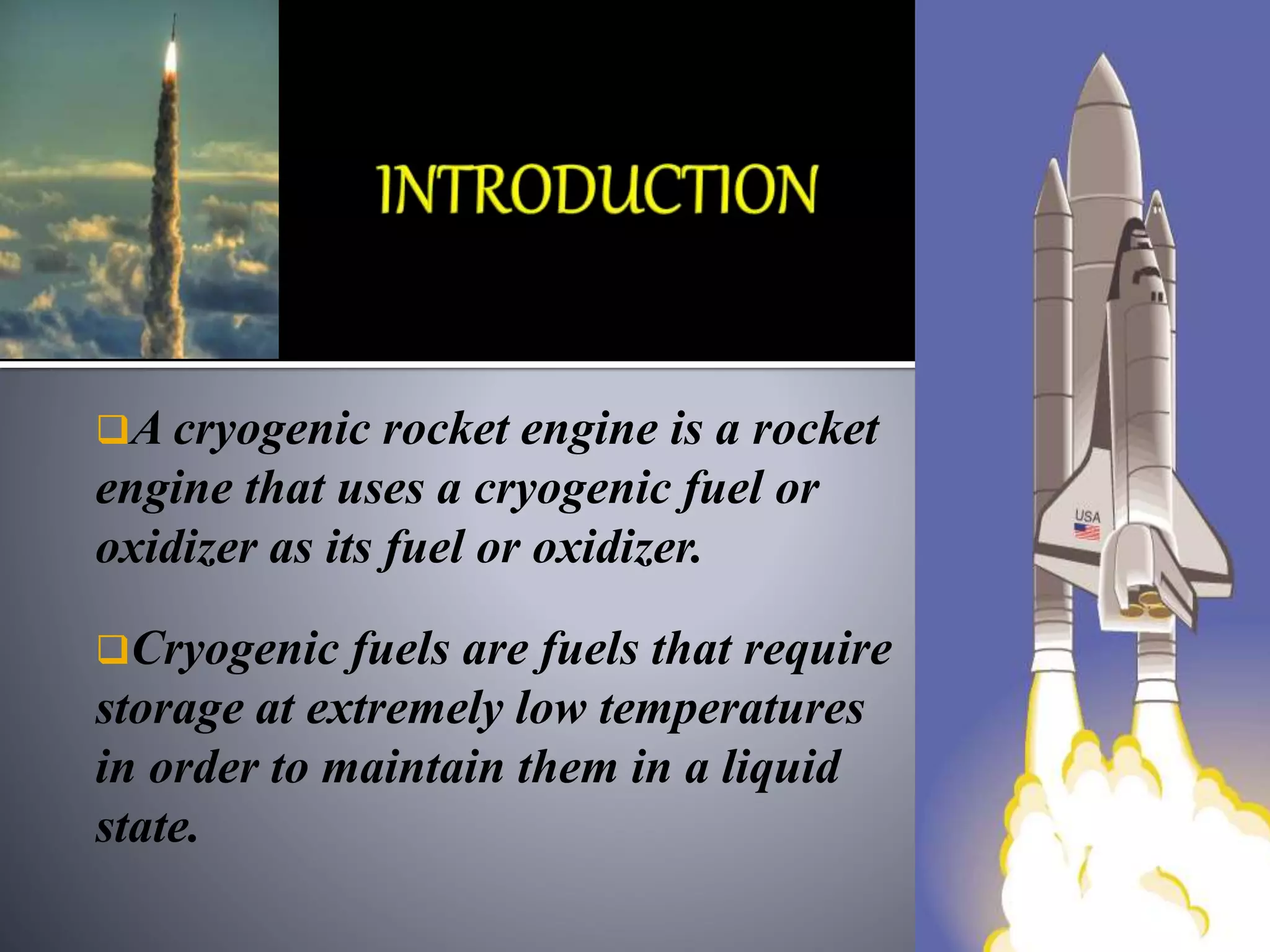
A cryogenic rocket engine is a rocket
engine that uses a cryogenic fuel or
oxidizer as its fuel or oxidizer.
Cryogenic fuels are fuels that require
storage at extremely low temperatures
in order to maintain them in a liquid
state.
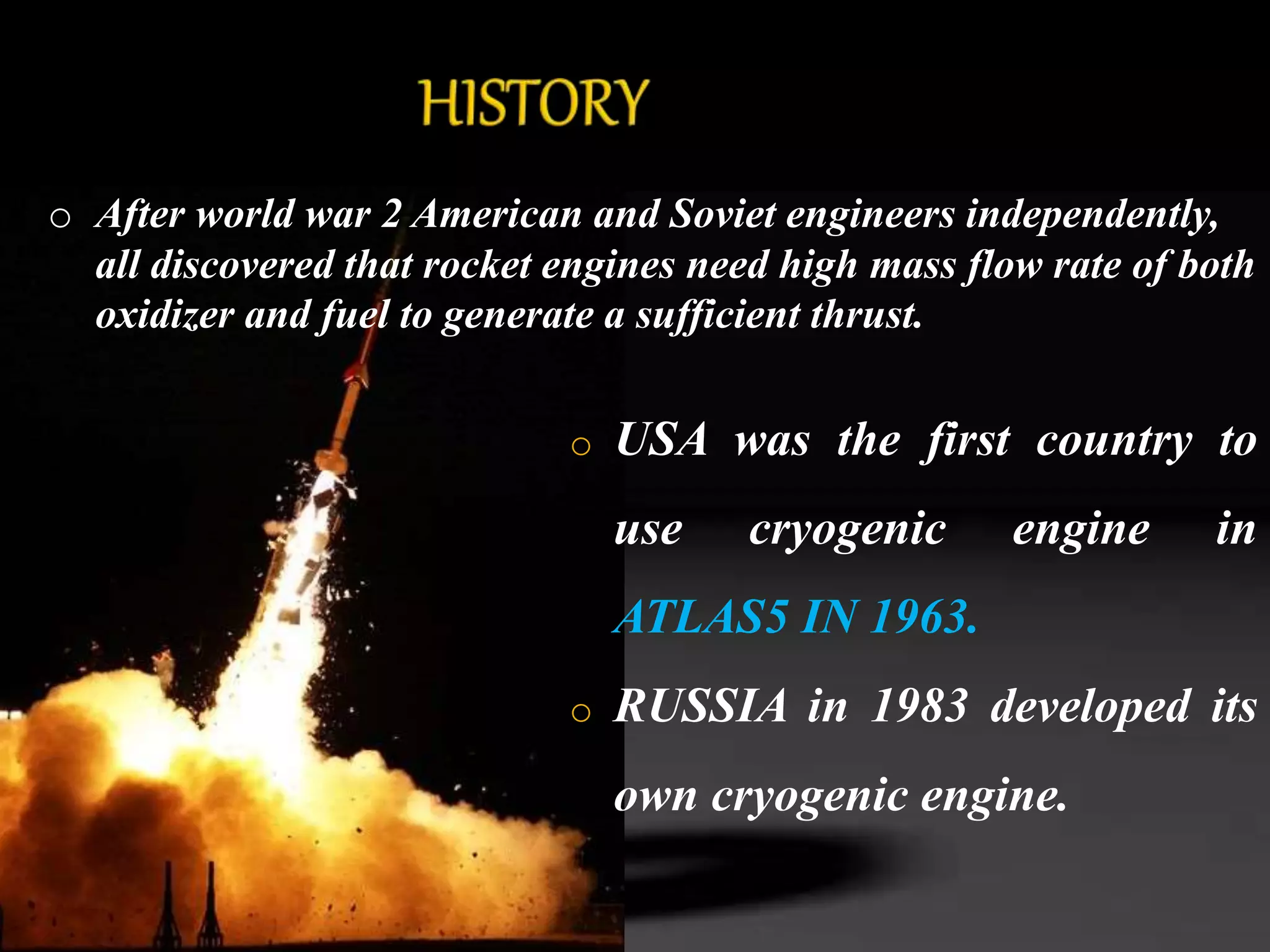
o USA was the first country to
use cryogenic engine in
ATLAS5 IN 1963.
o RUSSIA in 1983 developed its
own cryogenic engine.
o After world war 2 American and Soviet engineers independently,
all discovered that rocket engines need high mass flow rate of both
oxidizer and fuel to generate a sufficient thrust.
 The basic principle driving a cryogenic rocket
engine are:
 Newton third law of motion
 Law of conservation of momentum
 In principle, cryogenic rocket engine derives
thrust like all other rocket engines by accelerating
an impulse carrier to high speeds.
 The chemical energy stored in the fuel is converted
into kinetic energy by burning the fuel in the
combustion chamber and subsequent expansion in
the nozzle to produce thrust .
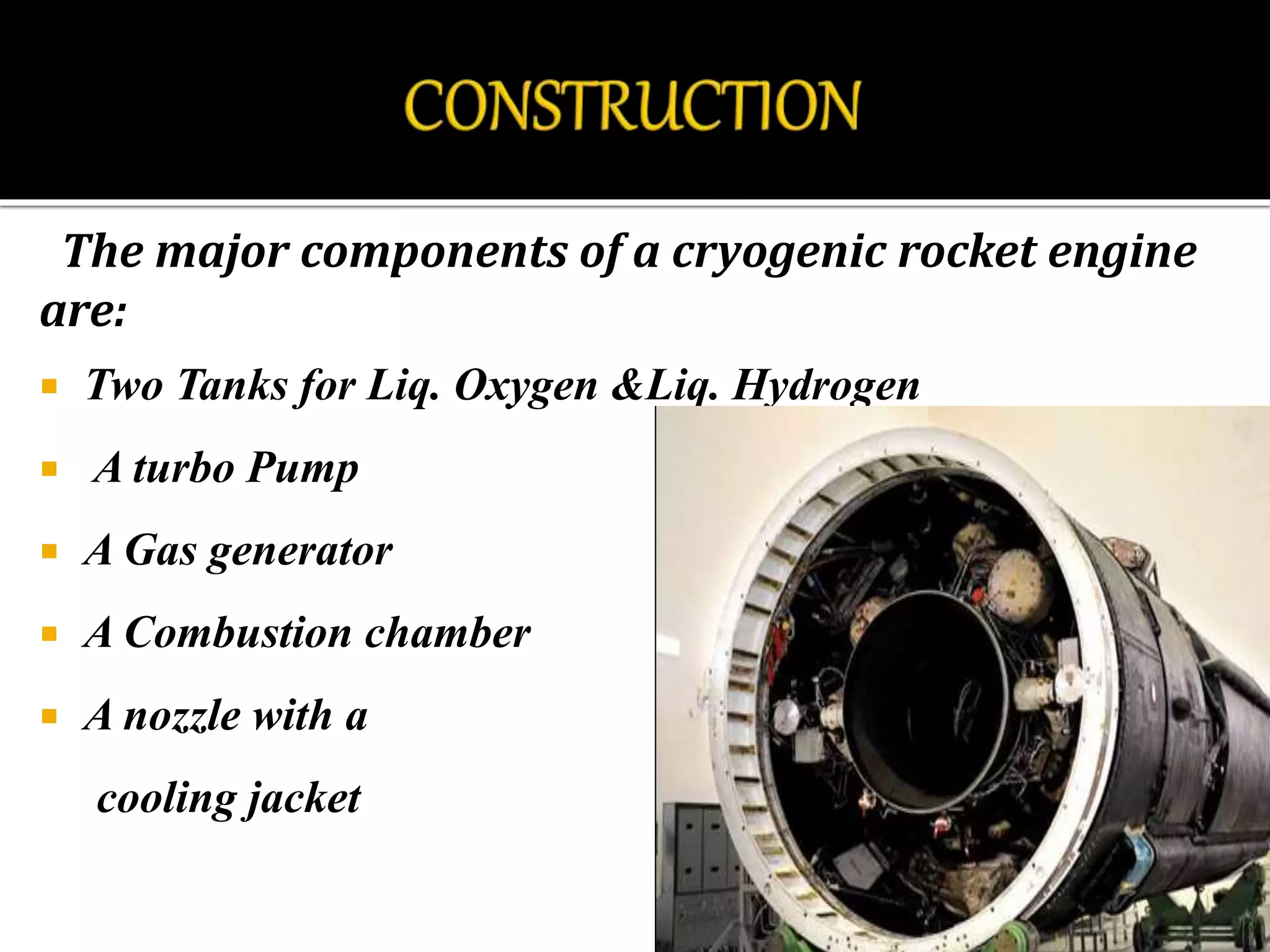
The major components of a cryogenic rocket engine
are:
 Two Tanks for Liq. Oxygen &Liq. Hydrogen
 A turbo Pump
 A Gas generator
 A Combustion chamber
 A nozzle with a
cooling jacket
Lay out of liquid rocket engine
o The RL10 was the first
liquid hydrogen cryogenic
rocket engine to be built in
the United States, and
development of the engine
by Marshall Space Flight
Center and Pratt &
Whitney began in the 1950s,
with the first flight
occurring in 1961.
o These engines were one of
the main factors of NASA's
success in reaching the
Moon by the Saturn V rocket
RL 10
 Currently, six
countries have
successfully
developed and
deployed
cryogenic rocket
engines.
 It was developed to make
India launch satellites on its
own.n.
 GSLV uses major
components that are
already proven in the Polar
Satellite Launch Vehicle
(PSLV) launchers in the
form of the S125/S139 solid
booster and the liquid-
fueledVikas engine.
ISRO's Initial Cryogenic Engine Development
Efforts
 ISRO started developing a cryogenic engine shortly after the project to
develop the Geostationary Satellite Launch Vehicle (GSLV) was
launched in 1986. The GSLV is capable of placing a 2 ton satellite into a
geostationary transfer orbit (GTO).
 Transfer of technology from RUSSIA
The transfer of technology (TOT)
included transfer of drawings,
documents and sale of material for
fabrication of the engines.
Glavkosmos also agreed to train
ISRO scientists during development
and testing of the C12 engine.
 ISRO has developed its cryogenic upper stage
powered by 7.5-ton thrust CE-7.5 cryogenic
engine at the Liquid Propulsion Systems
Center (LPSC), Mahendragiri, Tamil Nadu.
 The CUS broadly comprises the main CE-7.5
engine and two smaller gimbaled steering
engines with a nominal thrust of 73.55 kN in
vacuum. CUS operates for a nominal
duration of 720 seconds.
Indian Cryogenic Upper Stage (CUS)
 A main cryogenic engine
 Two smaller (cryogenic) steering
engines for orientation and
stabilization.
 Insulated propellant tanks
 Booster pumps
 Inter-stage structures
 Fill and drain systems
 Pressurization systems
 Gas bottles
 Command block
 Igniters
 Pyro valves
 Cold gas
The specifications and key characteristics of the
engine are:
Operating Cycle – Staged combustion
Propellant Combination – LOX / LH2
Maximum thrust (Vacuum) – 75 kN
Operating Thrust Range (as demonstrated during
GSLV Mk2 D5 flight) – 73.55 kN to 82 kN
Chamber Pressure (Nom) – 58 bar
Engine Mixture ratio (Oxidizer/Fuel by mass) – 5.05
Engine Specific Impulse - 454 ± 3 seconds
(4.452 ± 0.029 km/s)
Engine Burn Duration (Nom) – 720 seconds
Propellant Mass – 12800 kg
Two independent regulators: thrust control and
mixture ratio control
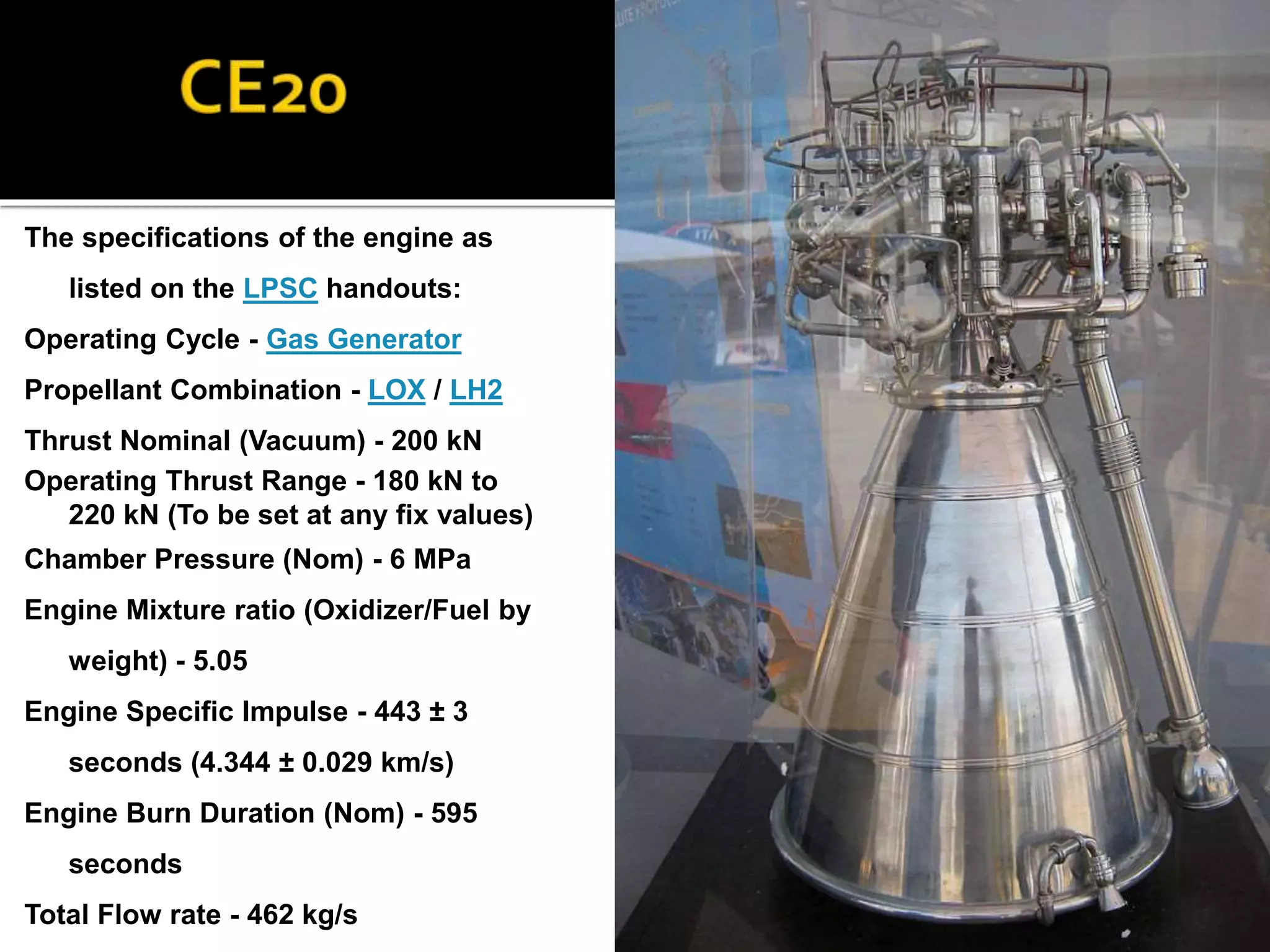
The specifications of the engine as
listed on the LPSC handouts:
Operating Cycle - Gas Generator
Propellant Combination - LOX / LH2
Thrust Nominal (Vacuum) - 200 kN
Operating Thrust Range - 180 kN to
220 kN (To be set at any fix values)
Chamber Pressure (Nom) - 6 MPa
Engine Mixture ratio (Oxidizer/Fuel by
weight) - 5.05
Engine Specific Impulse - 443 ± 3
seconds (4.344 ± 0.029 km/s)
Engine Burn Duration (Nom) - 595
seconds
Total Flow rate - 462 kg/s
The first test flight of
Cryogenic Upper Stage
(CUS) in GSLV D-3
developed by ISRO was
unsuccessful due to
shutdown of CUS a few
seconds after its ignition
on April 15,2010.
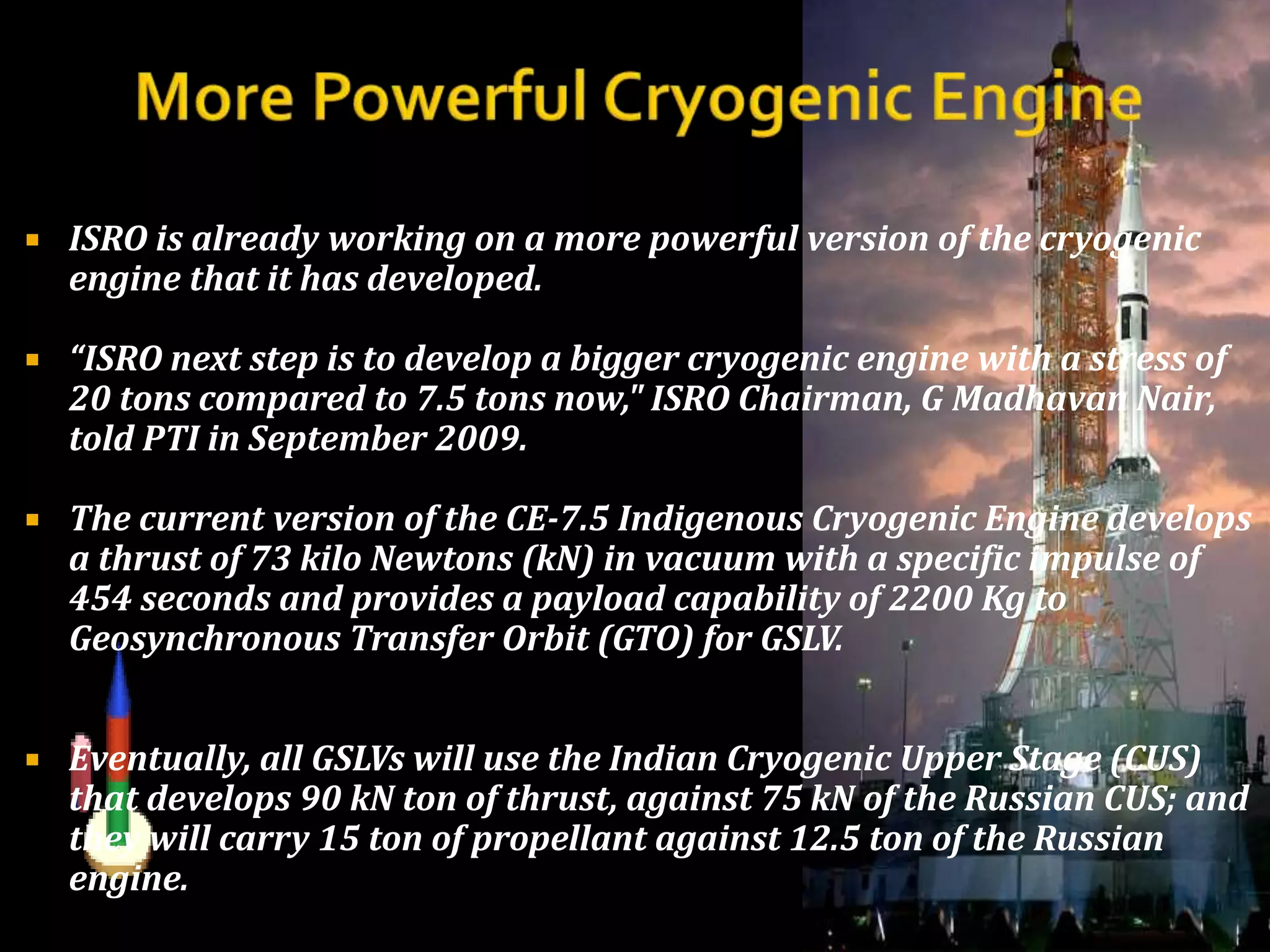
 ISRO is already working on a more powerful version of the cryogenic
engine that it has developed.
 “ISRO next step is to develop a bigger cryogenic engine with a stress of
20 tons compared to 7.5 tons now," ISRO Chairman, G Madhavan Nair,
told PTI in September 2009.
 The current version of the CE-7.5 Indigenous Cryogenic Engine develops
a thrust of 73 kilo Newtons (kN) in vacuum with a specific impulse of
454 seconds and provides a payload capability of 2200 Kg to
Geosynchronous Transfer Orbit (GTO) for GSLV.
 Eventually, all GSLVs will use the Indian Cryogenic Upper Stage (CUS)
that develops 90 kN ton of thrust, against 75 kN of the Russian CUS; and
they will carry 15 ton of propellant against 12.5 ton of the Russian
engine.
 High Energy per unit mass:
 Propellants like oxygen and hydrogen in liquid form give very high amounts of
energy per unit mass due to which the amount of fuel to be carried aboard the
rockets decreases.
 Clean Fuels
 Hydrogen and oxygen are extremely clean fuels. When they combine, they give
out only water.This water is thrown out of the nozzle in form of very hot
vapour.Thus the rocket is nothing but a high burning steam engine
 Economical
 Use of oxygen and hydrogen as fuels is very economical, as liquid oxygen costs
less than gasoline.
 Cryogenic liquids difficult to store for longer periods
 High density requires larger tanks
 Highly reactive gases
 Leakage problems
 Boil off rate
 Hydrogen embrittlement
 Zero gravity conditions
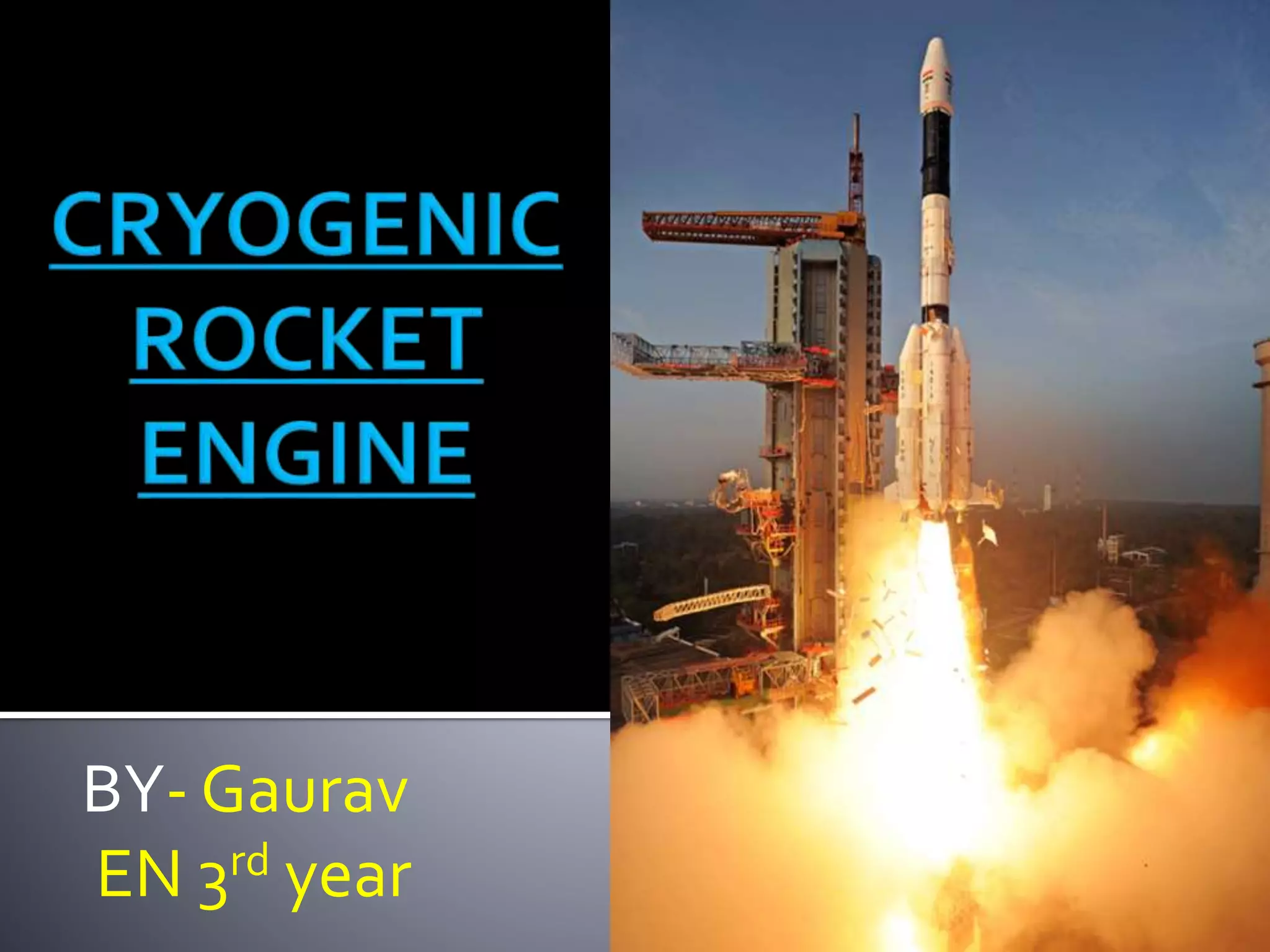
Cryogenic rocket engine

Cryogenic rocket engine

  • 1.
  • 2.
    1.CRYOGENIC ? 2.INTRODUCTION 3.HISTORY OFCRE 4.CONSTRUCTION 5.WORKING 6.APPLICATIONS 7.REFERENCES
  • 4.
     The word‘cryogenic’ is derived from Greek, meaning “production of freezing cold”.  Cryogenicsisthestudyoftheproductionand behaviourofmaterialsatverylowtemperature (below−150°C,−238°For123K).  Oxygen liquifies at -183c(90k)  Hydrogen liquifies at -253c(20k)
  • 5.
    A cryogenic rocketengine is a rocket engine that uses a cryogenic fuel or oxidizer as its fuel or oxidizer. Cryogenic fuels are fuels that require storage at extremely low temperatures in order to maintain them in a liquid state.
  • 6.
    o USA wasthe first country to use cryogenic engine in ATLAS5 IN 1963. o RUSSIA in 1983 developed its own cryogenic engine. o After world war 2 American and Soviet engineers independently, all discovered that rocket engines need high mass flow rate of both oxidizer and fuel to generate a sufficient thrust.
  • 7.
     The basicprinciple driving a cryogenic rocket engine are:  Newton third law of motion  Law of conservation of momentum  In principle, cryogenic rocket engine derives thrust like all other rocket engines by accelerating an impulse carrier to high speeds.  The chemical energy stored in the fuel is converted into kinetic energy by burning the fuel in the combustion chamber and subsequent expansion in the nozzle to produce thrust .
  • 8.
    The major componentsof a cryogenic rocket engine are:  Two Tanks for Liq. Oxygen &Liq. Hydrogen  A turbo Pump  A Gas generator  A Combustion chamber  A nozzle with a cooling jacket
  • 9.
    Lay out ofliquid rocket engine
  • 11.
    o The RL10was the first liquid hydrogen cryogenic rocket engine to be built in the United States, and development of the engine by Marshall Space Flight Center and Pratt & Whitney began in the 1950s, with the first flight occurring in 1961. o These engines were one of the main factors of NASA's success in reaching the Moon by the Saturn V rocket RL 10
  • 12.
     Currently, six countrieshave successfully developed and deployed cryogenic rocket engines.
  • 14.
     It wasdeveloped to make India launch satellites on its own.n.  GSLV uses major components that are already proven in the Polar Satellite Launch Vehicle (PSLV) launchers in the form of the S125/S139 solid booster and the liquid- fueledVikas engine.
  • 16.
    ISRO's Initial CryogenicEngine Development Efforts  ISRO started developing a cryogenic engine shortly after the project to develop the Geostationary Satellite Launch Vehicle (GSLV) was launched in 1986. The GSLV is capable of placing a 2 ton satellite into a geostationary transfer orbit (GTO).  Transfer of technology from RUSSIA The transfer of technology (TOT) included transfer of drawings, documents and sale of material for fabrication of the engines. Glavkosmos also agreed to train ISRO scientists during development and testing of the C12 engine.
  • 17.
     ISRO hasdeveloped its cryogenic upper stage powered by 7.5-ton thrust CE-7.5 cryogenic engine at the Liquid Propulsion Systems Center (LPSC), Mahendragiri, Tamil Nadu.  The CUS broadly comprises the main CE-7.5 engine and two smaller gimbaled steering engines with a nominal thrust of 73.55 kN in vacuum. CUS operates for a nominal duration of 720 seconds. Indian Cryogenic Upper Stage (CUS)
  • 18.
     A maincryogenic engine  Two smaller (cryogenic) steering engines for orientation and stabilization.  Insulated propellant tanks  Booster pumps  Inter-stage structures  Fill and drain systems  Pressurization systems  Gas bottles  Command block  Igniters  Pyro valves  Cold gas
  • 19.
    The specifications andkey characteristics of the engine are: Operating Cycle – Staged combustion Propellant Combination – LOX / LH2 Maximum thrust (Vacuum) – 75 kN Operating Thrust Range (as demonstrated during GSLV Mk2 D5 flight) – 73.55 kN to 82 kN Chamber Pressure (Nom) – 58 bar Engine Mixture ratio (Oxidizer/Fuel by mass) – 5.05 Engine Specific Impulse - 454 ± 3 seconds (4.452 ± 0.029 km/s) Engine Burn Duration (Nom) – 720 seconds Propellant Mass – 12800 kg Two independent regulators: thrust control and mixture ratio control
  • 20.
    The specifications ofthe engine as listed on the LPSC handouts: Operating Cycle - Gas Generator Propellant Combination - LOX / LH2 Thrust Nominal (Vacuum) - 200 kN Operating Thrust Range - 180 kN to 220 kN (To be set at any fix values) Chamber Pressure (Nom) - 6 MPa Engine Mixture ratio (Oxidizer/Fuel by weight) - 5.05 Engine Specific Impulse - 443 ± 3 seconds (4.344 ± 0.029 km/s) Engine Burn Duration (Nom) - 595 seconds Total Flow rate - 462 kg/s
  • 21.
    The first testflight of Cryogenic Upper Stage (CUS) in GSLV D-3 developed by ISRO was unsuccessful due to shutdown of CUS a few seconds after its ignition on April 15,2010.
  • 22.
     ISRO isalready working on a more powerful version of the cryogenic engine that it has developed.  “ISRO next step is to develop a bigger cryogenic engine with a stress of 20 tons compared to 7.5 tons now," ISRO Chairman, G Madhavan Nair, told PTI in September 2009.  The current version of the CE-7.5 Indigenous Cryogenic Engine develops a thrust of 73 kilo Newtons (kN) in vacuum with a specific impulse of 454 seconds and provides a payload capability of 2200 Kg to Geosynchronous Transfer Orbit (GTO) for GSLV.  Eventually, all GSLVs will use the Indian Cryogenic Upper Stage (CUS) that develops 90 kN ton of thrust, against 75 kN of the Russian CUS; and they will carry 15 ton of propellant against 12.5 ton of the Russian engine.
  • 24.
     High Energyper unit mass:  Propellants like oxygen and hydrogen in liquid form give very high amounts of energy per unit mass due to which the amount of fuel to be carried aboard the rockets decreases.  Clean Fuels  Hydrogen and oxygen are extremely clean fuels. When they combine, they give out only water.This water is thrown out of the nozzle in form of very hot vapour.Thus the rocket is nothing but a high burning steam engine  Economical  Use of oxygen and hydrogen as fuels is very economical, as liquid oxygen costs less than gasoline.
  • 25.
     Cryogenic liquidsdifficult to store for longer periods  High density requires larger tanks  Highly reactive gases  Leakage problems  Boil off rate  Hydrogen embrittlement  Zero gravity conditions