Introduction
 The vapour absorption refrigeration system is one of the oldest methods of
producing refrigerating effect
 The principle of vapour absorption was first discovered by Michael Faraday
in 1824
 The first vapour absorption refrigeration machine was developed by French
Scientist, Ferdinard Carre, in 1860.
 In this system ammonia is used as the refrigerant and water is used as the
absorbent.
Comparison of VAR with VCR :
 The absorption system differs fundamentally from vapour compression
system only in the method of employed for compressing the refrigerant.
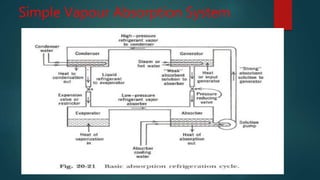
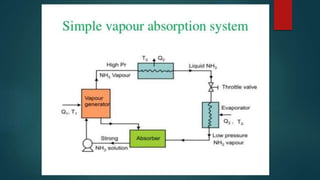
 In the absorption system, the compressor is replaced by an absorber,
generator and a pump.
 The vapour absorption system uses heat energy, instead of mechanical energy
as in vapour compression system, in order to change the conditions of the
refrigerant for the operation of the refrigeration cycle.
 The major drawback of the vapour compression refrigeration system is that it
requires large volume of refrigerant vapour which requires large mechanical
power for its operation.
Principle of Vapour Absorption System
 There is the peculiar property of some substances to have affinity for
another substances at some temperature and pressure conditions and less
affinity at another conditions.
 This idea for the working principle of a vapour absorption system was
generated by Michael Faraday in 1824.
 He knew that silver chloride (AgCl)m a white powder , had a property of
absorbing large amount of ammonia gas at the normal temperature and
pressure.
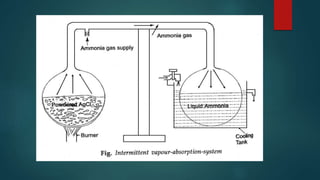
. Two chambers are combined with the help of a tube.
 The white powder was kept inside the first chamber to which ammonia gas was
supplied and sealed.
 The powder was heated up while other end was cooled using circulating water.
 Liquid ammonia was obtained in the cool end of the apparatus. After stopping
heat, it was observed that, the liquid ammonia instead of sitting there, started
boiling( bubbles produced) and vapour was reabsorbed by the white powder.
 Upon touching the boiling end , it was astonished to find that the vessel was
very cold.
 He repeated the experiments and cooling was observed again.
 This led to invention of the intermittent Vapour absorption system having solid
as an absorber
Simple Vapour Absorption System
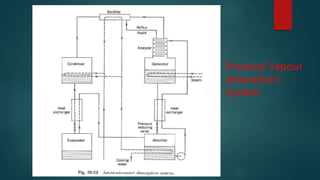
Practical Vapour
Absorption
System
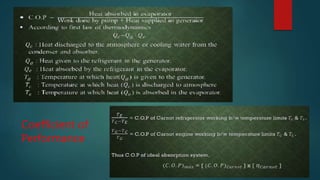
Coefficient of
Performance
Domestic Electrolux (Ammonia Hydrogen)
Refrigerator
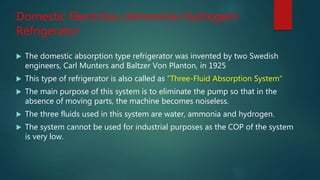
 The domestic absorption type refrigerator was invented by two Swedish
engineers, Carl Munters and Baltzer Von Planton, in 1925
 This type of refrigerator is also called as “Three-Fluid Absorption System“
 The main purpose of this system is to eliminate the pump so that in the
absence of moving parts, the machine becomes noiseless.
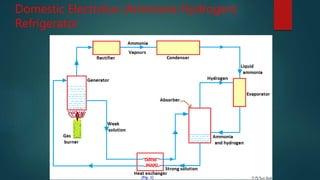
 The three fluids used in this system are water, ammonia and hydrogen.
 The system cannot be used for industrial purposes as the COP of the system
is very low.
Domestic Electrolux (Ammonia Hydrogen)
Refrigerator
Advantages of VA Systems
 No moving part except pump which has a small motor, which is
comparatively smaller than compressor system results in Quiet operation
and low maintenance.
 The vapour absorption system uses heat energy to change the condition of
the refrigerant from the evaporator where as vapour compression uses
mechanical energy to change the condition of the refrigerant.
 Can be built for huge working capacities. (even for above 1000 TR)
 Can be operated at designed C.O.P’s or even at part loads by varying
generator temperature.
 Space and Auto. control requirements favour absorption system.
Disadvantages of VA Systems
 Efficiency is low
 Takes long time to produce cooling effect
 Kerosene/oil/gas flame gives bad smell.
 Due to the low working pressure, the COP of vapour refrigeration is
low (nearly 1.1).
 Initial cost of the equipment is high in case of Practical Vapour
Absorption system.
Vapour Absorption Refrigeration System

Vapour Absorption Refrigeration System

  • 2.
    Introduction  The vapourabsorption refrigeration system is one of the oldest methods of producing refrigerating effect  The principle of vapour absorption was first discovered by Michael Faraday in 1824  The first vapour absorption refrigeration machine was developed by French Scientist, Ferdinard Carre, in 1860.  In this system ammonia is used as the refrigerant and water is used as the absorbent.
  • 3.
    Comparison of VARwith VCR :  The absorption system differs fundamentally from vapour compression system only in the method of employed for compressing the refrigerant.  In the absorption system, the compressor is replaced by an absorber, generator and a pump.  The vapour absorption system uses heat energy, instead of mechanical energy as in vapour compression system, in order to change the conditions of the refrigerant for the operation of the refrigeration cycle.  The major drawback of the vapour compression refrigeration system is that it requires large volume of refrigerant vapour which requires large mechanical power for its operation.
  • 4.
    Principle of VapourAbsorption System  There is the peculiar property of some substances to have affinity for another substances at some temperature and pressure conditions and less affinity at another conditions.  This idea for the working principle of a vapour absorption system was generated by Michael Faraday in 1824.  He knew that silver chloride (AgCl)m a white powder , had a property of absorbing large amount of ammonia gas at the normal temperature and pressure.
  • 5.
    . Two chambersare combined with the help of a tube.  The white powder was kept inside the first chamber to which ammonia gas was supplied and sealed.  The powder was heated up while other end was cooled using circulating water.  Liquid ammonia was obtained in the cool end of the apparatus. After stopping heat, it was observed that, the liquid ammonia instead of sitting there, started boiling( bubbles produced) and vapour was reabsorbed by the white powder.  Upon touching the boiling end , it was astonished to find that the vessel was very cold.  He repeated the experiments and cooling was observed again.  This led to invention of the intermittent Vapour absorption system having solid as an absorber
  • 7.
  • 9.
  • 10.
  • 11.
    Domestic Electrolux (AmmoniaHydrogen) Refrigerator  The domestic absorption type refrigerator was invented by two Swedish engineers, Carl Munters and Baltzer Von Planton, in 1925  This type of refrigerator is also called as “Three-Fluid Absorption System“  The main purpose of this system is to eliminate the pump so that in the absence of moving parts, the machine becomes noiseless.  The three fluids used in this system are water, ammonia and hydrogen.  The system cannot be used for industrial purposes as the COP of the system is very low.
  • 12.
    Domestic Electrolux (AmmoniaHydrogen) Refrigerator
  • 13.
    Advantages of VASystems  No moving part except pump which has a small motor, which is comparatively smaller than compressor system results in Quiet operation and low maintenance.  The vapour absorption system uses heat energy to change the condition of the refrigerant from the evaporator where as vapour compression uses mechanical energy to change the condition of the refrigerant.  Can be built for huge working capacities. (even for above 1000 TR)  Can be operated at designed C.O.P’s or even at part loads by varying generator temperature.  Space and Auto. control requirements favour absorption system.
  • 14.
    Disadvantages of VASystems  Efficiency is low  Takes long time to produce cooling effect  Kerosene/oil/gas flame gives bad smell.  Due to the low working pressure, the COP of vapour refrigeration is low (nearly 1.1).  Initial cost of the equipment is high in case of Practical Vapour Absorption system.