Presenting,
By;
D YASHWANTH REDDY
 Introduction
 Problems faced in Conventional Grinding
 Cryogenic Grinding Technology
 Working Principle of CryoGrinder
 Performance Data &Technical Data
 Merits & Demerits
 Field of applications
 Conclusion
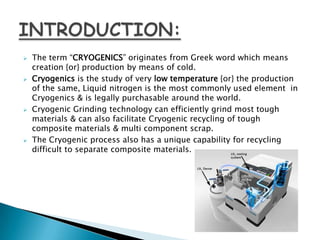
 The term “CRYOGENICS” originates from Greek word which means
creation {or} production by means of cold.
 Cryogenics is the study of very low temperature {or} the production
of the same, Liquid nitrogen is the most commonly used element in
Cryogenics & is legally purchasable around the world.
 Cryogenic Grinding technology can efficiently grind most tough
materials & can also facilitate Cryogenic recycling of tough
composite materials & multi component scrap.
 The Cryogenic process also has a unique capability for recycling
difficult to separate composite materials.
High heat generation.
Introduction of tensile residual stress.
Less tool life.
Clogging and Gumming of the mill.
Oxidation.
Loss of Enteric oil in Spice grinding.
HOW..???
Here comes the necessity
of
CRYOGENIC
GRINDING
…..also known as Freeze
Grinding
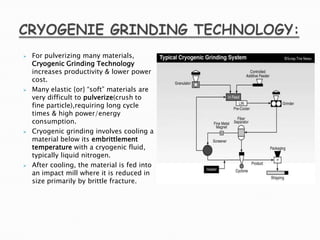
 For pulverizing many materials,
Cryogenic Grinding Technology
increases productivity & lower power
cost.
 Many elastic {or} “soft” materials are
very difficult to pulverize(crush to
fine particle),requiring long cycle
times & high power/energy
consumption.
 Cryogenic grinding involves cooling a
material below its embrittlement
temperature with a cryogenic fluid,
typically liquid nitrogen.
 After cooling, the material is fed into
an impact mill where it is reduced in
size primarily by brittle fracture.
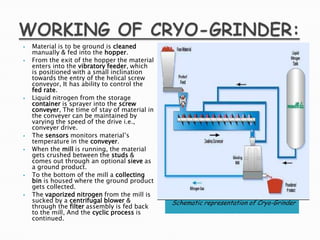
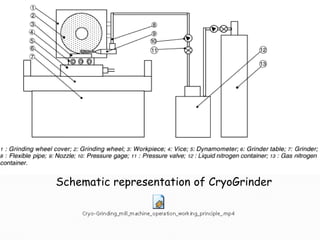
Schematic representation of Cryo-Grinder
 Material is to be ground is cleaned
manually & fed into the hopper.
 From the exit of the hopper the material
enters into the vibratory feeder, which
is positioned with a small inclination
towards the entry of the helical screw
conveyor, It has ability to control the
fed rate.
 Liquid nitrogen from the storage
container is sprayer into the screw
conveyer, The time of stay of material in
the conveyer can be maintained by
varying the speed of the drive i.e.,
conveyer drive.
 The sensors monitors material’s
temperature in the conveyer.
 When the mill is running, the material
gets crushed between the studs &
comes out through an optional sieve as
a ground product.
 To the bottom of the mill a collecting
bin is housed where the ground product
gets collected.
 The vaporized nitrogen from the mill is
sucked by a centrifugal blower &
through the filter assembly is fed back
to the mill, And the cyclic process is
continued.
Schematic representation of CryoGrinder
Performance Data Cryo-Mill
Field Of Application* Size reduction, Homogenation
Feed Material* Hard, Brittle, Soft, elastic & Fibrous
Feed size* Up to 8 mm
Final Fineness* Approx. 5micro-mm
Batch/Sample Volume* Max.20ml
Typical Mean Grinding Time* Pre-cooling:10 mins
grinding 1 minute
Memory for Parameter Combination* 1 nos
Technical Data Parameters
Power Consumption 160 Watts
W*H*D 385*370*570 mm
Net Weight Approx. 46 Kg
*depending on feed material & instrument configuration/setting.
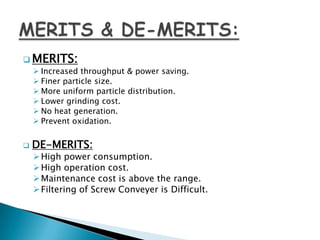
 MERITS:
 Increased throughput & power saving.
 Finer particle size.
 More uniform particle distribution.
 Lower grinding cost.
 No heat generation.
 Prevent oxidation.
 DE-MERITS:
High power consumption.
High operation cost.
Maintenance cost is above the range.
Filtering of Screw Conveyer is Difficult.
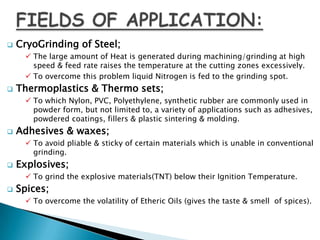
 CryoGrinding of Steel;
 The large amount of Heat is generated during machining/grinding at high
speed & feed rate raises the temperature at the cutting zones excessively.
 To overcome this problem liquid Nitrogen is fed to the grinding spot.
 Thermoplastics & Thermo sets;
 To which Nylon, PVC, Polyethylene, synthetic rubber are commonly used in
powder form, but not limited to, a variety of applications such as adhesives,
powdered coatings, fillers & plastic sintering & molding.
 Adhesives & waxes;
 To avoid pliable & sticky of certain materials which is unable in conventional
grinding.
 Explosives;
 To grind the explosive materials(TNT) below their Ignition Temperature.
 Spices;
 To overcome the volatility of Etheric Oils (gives the taste & smell of spices).
Presented by:
D YASHWANTH REDDY
LINGADALLI PRAKASH

Cryogenic grinding{renew}

  • 1.
  • 2.
     Introduction  Problemsfaced in Conventional Grinding  Cryogenic Grinding Technology  Working Principle of CryoGrinder  Performance Data &Technical Data  Merits & Demerits  Field of applications  Conclusion
  • 3.
     The term“CRYOGENICS” originates from Greek word which means creation {or} production by means of cold.  Cryogenics is the study of very low temperature {or} the production of the same, Liquid nitrogen is the most commonly used element in Cryogenics & is legally purchasable around the world.  Cryogenic Grinding technology can efficiently grind most tough materials & can also facilitate Cryogenic recycling of tough composite materials & multi component scrap.  The Cryogenic process also has a unique capability for recycling difficult to separate composite materials.
  • 4.
    High heat generation. Introductionof tensile residual stress. Less tool life. Clogging and Gumming of the mill. Oxidation. Loss of Enteric oil in Spice grinding.
  • 5.
  • 6.
    Here comes thenecessity of CRYOGENIC GRINDING …..also known as Freeze Grinding
  • 7.
     For pulverizingmany materials, Cryogenic Grinding Technology increases productivity & lower power cost.  Many elastic {or} “soft” materials are very difficult to pulverize(crush to fine particle),requiring long cycle times & high power/energy consumption.  Cryogenic grinding involves cooling a material below its embrittlement temperature with a cryogenic fluid, typically liquid nitrogen.  After cooling, the material is fed into an impact mill where it is reduced in size primarily by brittle fracture.
  • 8.
    Schematic representation ofCryo-Grinder  Material is to be ground is cleaned manually & fed into the hopper.  From the exit of the hopper the material enters into the vibratory feeder, which is positioned with a small inclination towards the entry of the helical screw conveyor, It has ability to control the fed rate.  Liquid nitrogen from the storage container is sprayer into the screw conveyer, The time of stay of material in the conveyer can be maintained by varying the speed of the drive i.e., conveyer drive.  The sensors monitors material’s temperature in the conveyer.  When the mill is running, the material gets crushed between the studs & comes out through an optional sieve as a ground product.  To the bottom of the mill a collecting bin is housed where the ground product gets collected.  The vaporized nitrogen from the mill is sucked by a centrifugal blower & through the filter assembly is fed back to the mill, And the cyclic process is continued.
  • 9.
  • 10.
    Performance Data Cryo-Mill FieldOf Application* Size reduction, Homogenation Feed Material* Hard, Brittle, Soft, elastic & Fibrous Feed size* Up to 8 mm Final Fineness* Approx. 5micro-mm Batch/Sample Volume* Max.20ml Typical Mean Grinding Time* Pre-cooling:10 mins grinding 1 minute Memory for Parameter Combination* 1 nos Technical Data Parameters Power Consumption 160 Watts W*H*D 385*370*570 mm Net Weight Approx. 46 Kg *depending on feed material & instrument configuration/setting.
  • 11.
     MERITS:  Increasedthroughput & power saving.  Finer particle size.  More uniform particle distribution.  Lower grinding cost.  No heat generation.  Prevent oxidation.  DE-MERITS: High power consumption. High operation cost. Maintenance cost is above the range. Filtering of Screw Conveyer is Difficult.
  • 12.
     CryoGrinding ofSteel;  The large amount of Heat is generated during machining/grinding at high speed & feed rate raises the temperature at the cutting zones excessively.  To overcome this problem liquid Nitrogen is fed to the grinding spot.  Thermoplastics & Thermo sets;  To which Nylon, PVC, Polyethylene, synthetic rubber are commonly used in powder form, but not limited to, a variety of applications such as adhesives, powdered coatings, fillers & plastic sintering & molding.  Adhesives & waxes;  To avoid pliable & sticky of certain materials which is unable in conventional grinding.  Explosives;  To grind the explosive materials(TNT) below their Ignition Temperature.  Spices;  To overcome the volatility of Etheric Oils (gives the taste & smell of spices).
  • 14.
    Presented by: D YASHWANTHREDDY LINGADALLI PRAKASH