CRYOGENICS - In Brief
(JGC Annamalai)
Normal or accepted range of cryogenic is from Absolute Zero to 120ºK (
‐
-273ºC to
‐
-150ºC).
The cycle is repeated till we achieve the cryogenic temperatures.
fracture study, better materials and improvements on Toughness / Impact Energy.
Application of Cryogenic Technology:
(C). ASME Sec VIII code permits material to use at temperature below -20ºF(
‐
- 29ºC)
only if the material is tested at the operating temperature and passes the minimum
requirements for impact resistance.
(D).Titanic Ship , Liberty Ships, Pressure Vessels etc., fabricated during or before
World War-II, cracked in cold weather / temperature . This lead to brittle
Definition of Cryogenics: In Romans, Cryo means super cold and genics means knowledge or science. In Greek,
Crogenics is to attain low temperature.
Achieving of Cryogenic Temperatures: The process is like normal refrigeration cycle to make ice . Instead of
Freon/Refrigerant, Cryogens (Liquid Helium, liquid Nitrogen, petroleum gases etc) or mixture of them(MRC) are used.
(6). Superconductivity: Superconducting electromagnets are used in the Particle Accelerators. The facilities require very
powerful magnetic flux that conventional electromagnets could be melted by the electric currents they carry. Liquid helium
cools the cable through which the currents flow to about 4 K , allowing much stronger currents to flow without generating
heat by electrical resistance. The electrical resistance at sub-zero temperature is near zero.
(A). Most BCC Metals, Iron, CS & low alloy steels, Moly, Nb, Zinc, elastomeric &
plastics materials: they generally, on cooling from room temp. to cryo temperature
(
‐
- 273ºC), the following happens: (1). Tensile & Yield Strength increases. , (2). %
Elangation(ductility) decreases, (3). Youngs Modulus increases, (means little
deflection/rigid), (4). Coefficient of thermal expansion continue to decrease and it is
negligible, near to absolute zero. (5). impact Energy decreases and the structure
becomes brittle.
(B). Most FCC Metals, Cu, Ni, Cu
‐
Ni alloys, Al & its alloys, Austenitic Stainless Steels
(with min 7%Ni), Zirconium, Titanium, Teflon, polyurethane, pyrex glass, 9% Ni steel
are generally safe for cryo temp. range.
[1]. Effects of Low Temp & Cryo temp on Toughness and Ductility:
(Unit Joules, 1J = 0.738 ft.lb)
(8). As a cooling medium: Liquid N2 & Liquid He are used for cooling purpose on infrared cameras, thermal imagers,
high vacuum pumps, storing human blood, tissues, cells etc. For testing at low temperature / cryo temperature : weld test
coupons/PTC, impact test specimens, samples, valves, equipments etc.
(E). 20J (15 ft.lb) impact energy at Operating Temperature is considered minimum to control brittle failure, at low temp /
Cryogenic Engineering Applications. Allowances are added for further safety.
[2]. Effect of Cryo temp on Electrical Resistance of Material :
The Electrical Resistance, reduces near to zero Ohms(Ω), as the temp. is lowered , near to absolute zero. Zero Electrical
Resistance at Zero absolute temperature, is called Super Conductivity.
(2). LNG Transport: Cryogenic gas liquefaction techniques is the storage and transportation of liquefied natural gas
(LNG), a mixture largely composed of methane, ethane, and other combustible gases. Natural gas(Methane, CH4) is
liquefied at
‐
-163ºC, causing it to contract to 1/600th of its volume at room temperature and making it sufficiently compact
for swift transport in specially insulated tankers to a far away distant places(say from Gulf Countries to Japan, Korea).
(1). Liquefaction & Gas Separation: Using cryo technology, Air is separated into Oxygen, nitrogen and other
constituents. Cryotechnology is used to separte petroleum products like Methane, Ethane etc. Oxygen(liquid & gas) is used
in Metallaurgical units, Hospitals, Space Applications etc.
(3). Food Preservation: Very low temperatures are also used for preserving food, simply and inexpensively. Produce is
placed in a sealed tank and sprayed with liquid nitrogen. The nitrogen immediately vaporizes, absorbing the heat content of
the produce.
(4). Cryo
‐
medicine & Cryosurgery: A low
‐
temperature scalpel or probe can be used to freeze to cut & kill unhealthy
tissue & unwanted human growth(cancer or dead body part). The resulting dead cells are removed through normal bodily
processes. The advantage : freezing the tissue rather than normal cutting, it produces less bleeding
(5). Space Application: Cryo fuel/Propellants (Liquid Hydrogen & Oxygen) were first used in Rockets, like Apollo-11
(Saturn-V) which took man to moon in 1969 and first used in Space-Shuttle “Columbia” in 1981
(7). Brittle Nature: Many materials at cryo temp range, have brittle structure (%Elangation <5%, is considered brittle
fracture). Food grains, elastic materials like rubber, sticky material, plastics and tools used to metal cutting etc are sub
‐
cooled to cryo temp range and machined and also ground to powder, as the material is brittle and easy to machine. Dead
Human body, at cryo temp, is shaved, at 1 mm layers and photographed to make 3D model for training/analysis/treatment
by Doctors. Some steels are treated at
‐
- 185ºC. Tools: Life of metal tools increases to between 200
‐
400% of the original
life expectancy using cryo tempering instead of heat treating.
1
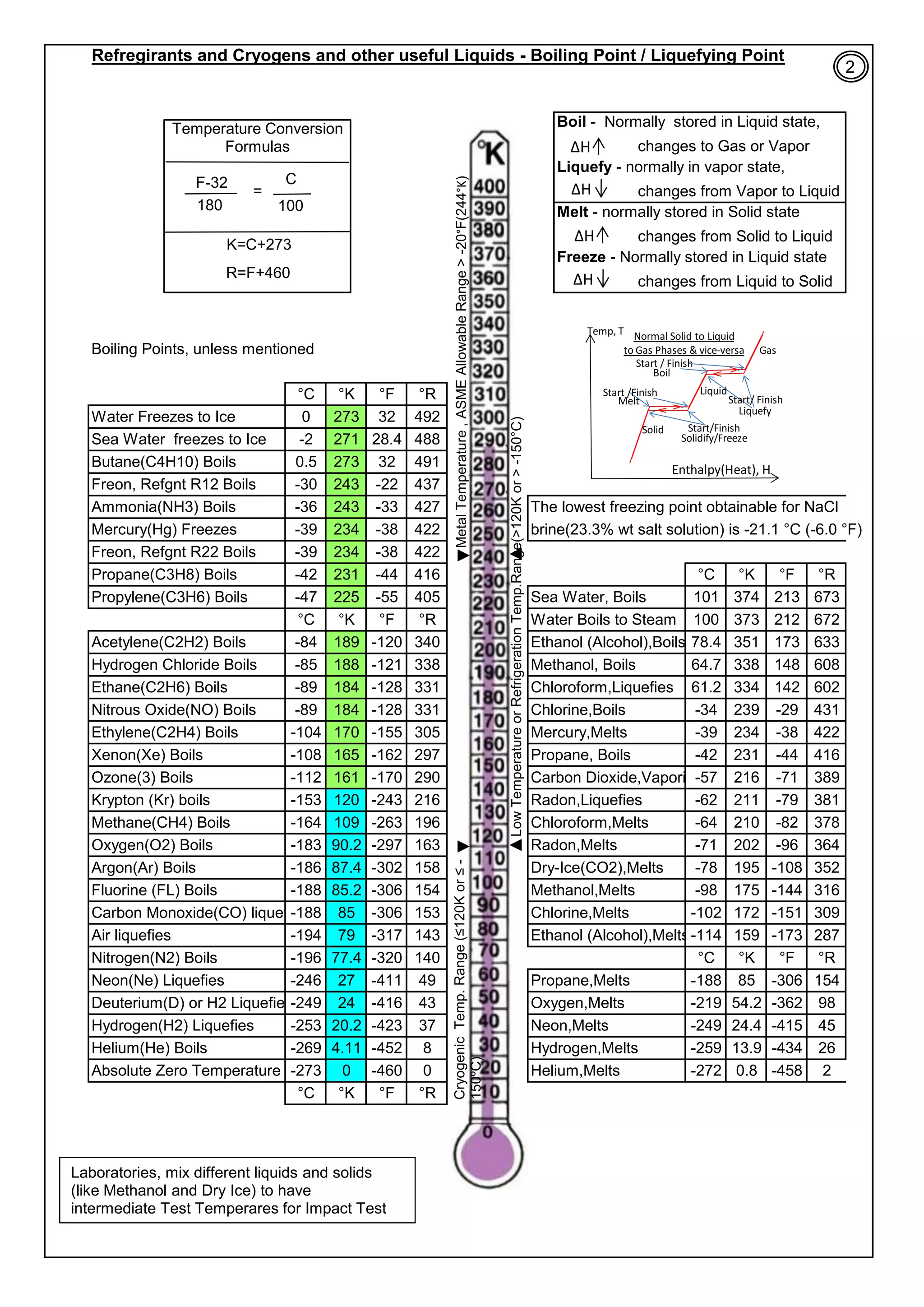
Refregirants and Cryogens and other useful Liquids - Boiling Point / Liquefying Point
Boil - Normally stored in Liquid state,
changes to Gas or Vapor
Liquefy - normally in vapor state,
changes from Vapor to Liquid
Melt - normally stored in Solid state
changes from Solid to Liquid
Freeze - Normally stored in Liquid state
changes from Liquid to Solid
Boiling Points, unless mentioned
°C °K °F °R
Water Freezes to Ice 0 273 32 492
Sea Water freezes to Ice -2 271 28.4 488
Butane(C4H10) Boils 0.5 273 32 491
Freon, Refgnt R12 Boils -30 243 -22 437
Ammonia(NH3) Boils -36 243 -33 427 The lowest freezing point obtainable for NaCl
Mercury(Hg) Freezes -39 234 -38 422 brine(23.3% wt salt solution) is -21.1 °C (-6.0 °F)
Freon, Refgnt R22 Boils -39 234 -38 422
Propane(C3H8) Boils -42 231 -44 416 °C °K °F °R
Propylene(C3H6) Boils -47 225 -55 405 Sea Water, Boils 101 374 213 673
°C °K °F °R Water Boils to Steam 100 373 212 672
Acetylene(C2H2) Boils -84 189 -120 340 Ethanol (Alcohol),Boils 78.4 351 173 633
Hydrogen Chloride Boils -85 188 -121 338 Methanol, Boils 64.7 338 148 608
Ethane(C2H6) Boils -89 184 -128 331 Chloroform,Liquefies 61.2 334 142 602
Nitrous Oxide(NO) Boils -89 184 -128 331 Chlorine,Boils -34 239 -29 431
Ethylene(C2H4) Boils -104 170 -155 305 Mercury,Melts -39 234 -38 422
Xenon(Xe) Boils -108 165 -162 297 Propane, Boils -42 231 -44 416
Ozone(3) Boils -112 161 -170 290 Carbon Dioxide,Vaporize-57 216 -71 389
Krypton (Kr) boils -153 120 -243 216 Radon,Liquefies -62 211 -79 381
Methane(CH4) Boils -164 109 -263 196 Chloroform,Melts -64 210 -82 378
Oxygen(O2) Boils -183 90.2 -297 163 Radon,Melts -71 202 -96 364
Argon(Ar) Boils -186 87.4 -302 158 Dry-Ice(CO2),Melts -78 195 -108 352
Fluorine (FL) Boils -188 85.2 -306 154 Methanol,Melts -98 175 -144 316
Carbon Monoxide(CO) liquefies-188 85 -306 153 Chlorine,Melts -102 172 -151 309
Air liquefies -194 79 -317 143 Ethanol (Alcohol),Melts-114 159 -173 287
Nitrogen(N2) Boils -196 77.4 -320 140 °C °K °F °R
Neon(Ne) Liquefies -246 27 -411 49 Propane,Melts -188 85 -306 154
Deuterium(D) or H2 Liquefies-249 24 -416 43 Oxygen,Melts -219 54.2 -362 98
Hydrogen(H2) Liquefies -253 20.2 -423 37 Neon,Melts -249 24.4 -415 45
Helium(He) Boils -269 4.11 -452 8 Hydrogen,Melts -259 13.9 -434 26
Absolute Zero Temperature -273 0 -460 0 Helium,Melts -272 0.8 -458 2
°C °K °F °R
Temperature Conversion
Formulas
F-32
180
=
C
100
R=F+460
K=C+273
Laboratories, mix different liquids and solids
(like Methanol and Dry Ice) to have
intermediate Test Temperares for Impact Test
ΔH
ΔH
ΔH
ΔH
Normal Solid to Liquid
to Gas Phases & vice-versa
Solid
Liquid
Start/Finish
Start/ Finish
Start / Finish
Start /Finish
Temp, T
Enthalpy(Heat), H
Boil
Melt
Liquefy
Solidify/Freeze
Gas
LowTemperatureorRefrigerationTemp.Range(>120Kor>-150°C)
CryogenicTemp.Range(≤120Kor≤-
150ºC)
◄
◄
◄
◄
MetalTemperature,ASMEAllowableRange>-20°F(244°K)
2
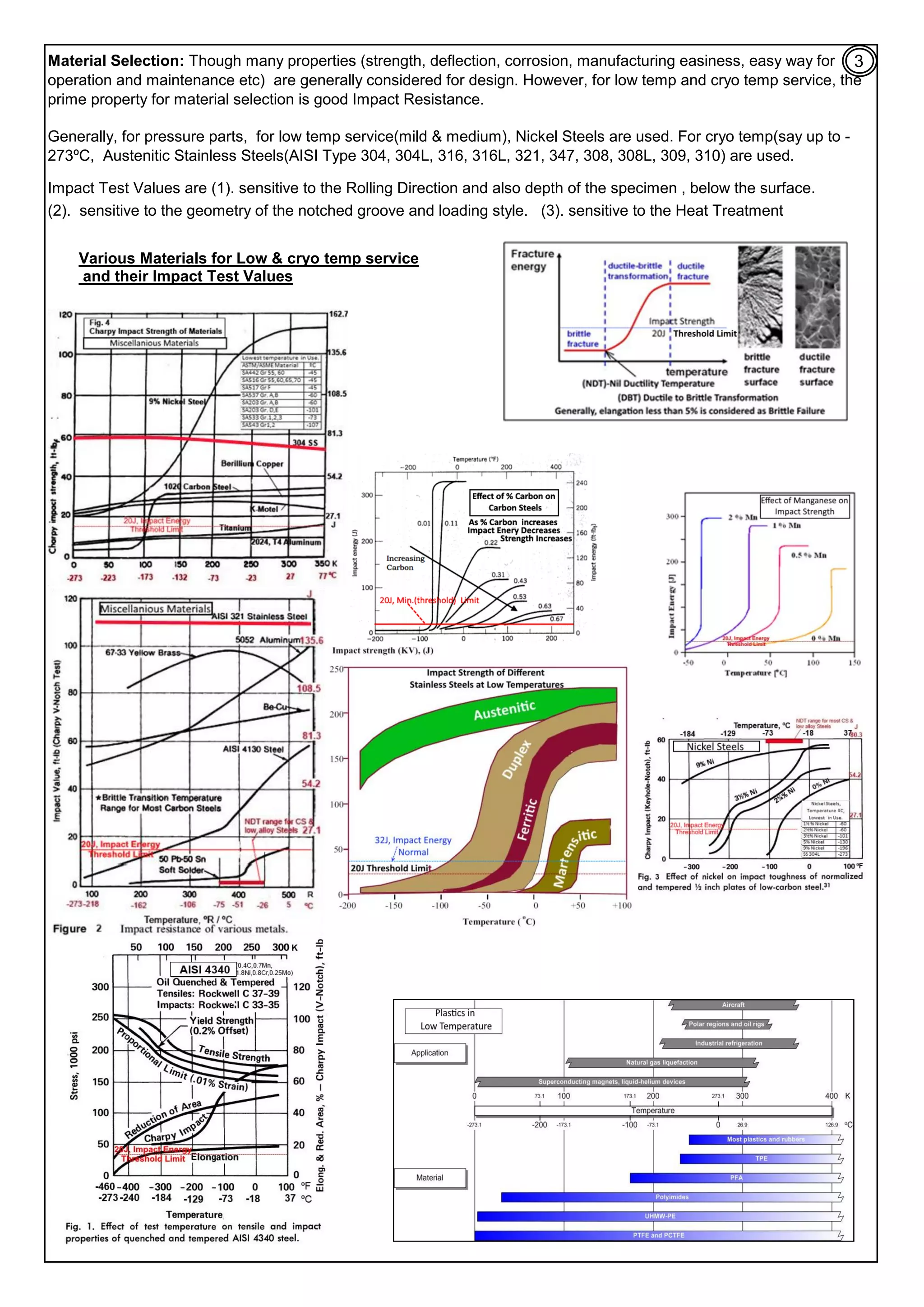
Material Selection: Though many properties (strength, deflection, corrosion, manufacturing easiness, easy way for
operation and maintenance etc) are generally considered for design. However, for low temp and cryo temp service, the
prime property for material selection is good Impact Resistance.
Generally, for pressure parts, for low temp service(mild & medium), Nickel Steels are used. For cryo temp(say up to -
273ºC, Austenitic Stainless Steels(AISI Type 304, 304L, 316, 316L, 321, 347, 308, 308L, 309, 310) are used.
Impact Test Values are (1). sensitive to the Rolling Direction and also depth of the specimen , below the surface.
(2). sensitive to the geometry of the notched groove and loading style. (3). sensitive to the Heat Treatment
Various Materials for Low & cryo temp service
and their Impact Test Values
3
Year
1877 Cailletet and Pictet liquefied oxygen (Pictet 1892).
1879 Linde founded the Linde Eismaschinen AG.
1883 Wroblewski and Olszewski completely liquefied nitrogen and oxygen at the Cracow University Laboratory (Olszewski 1895).
1884 Wroblewski produced a mist of liquid hydrogen.
1892 Dewar developed a vacuum-insulated vessel for cryogenic-fluid storage (Dewar 1927).
1895 Onnes established the Leiden Laboratory. Linde was granted a basic patent on air liquefaction in Germany.
1898 Dewar produced liquid hydrogen in bulk at the Royal Institute of London.
1902 Claude established l'Air Liquide and developed an air-liquefaction system using an expansion engine.
1907 Linde installed the first air-liquefaction plant in America. Claude produced neon as a by-product of an air plant.
1908 Onnes liquefied helium (Onnes 1908).
1910 Linde developed the double-column air-separation system.
1911 Onnes discovered superconductivity (Onnes 1913).
1912 First American-made air-liquefaction plant completed.
1916 First commercial production of argon in the United States.
1917 First natural-gas liquefaction plant to produce helium.
1922 First commercial production of neon in the United States.
1926
1933 Magnetic cooling used to attain temperatures below I K.
1934 first used on commercial cryo-fluid storage vessels.
1939 First vacuum-insulated railway tank car built for transport of liquid oxygen.
1942 The German V-2 Rocket / weapon system was test-fired (Dornberger 1954). The Collins cryostat developed.
1948 First 140 ton/day oxygen system built in America.
1949 First 300 ton/day on-site oxygen plant for chemical industry completed.
1952 National Bureau of Standards Cryogenic Engineering Laboratory established (Brickwedde 1960).
1957 LOX-RP-I propelled Atlas ICBM test-fired. Fundamental theory (BCS theory) of superconductivity presented.
1958 High-efficiency multilayer cryogenic insulation developed (Black 1960).
1959 Large NASA liquid-hydrogen plant at Torrance, California, completed.
1960 Large-scale liquid-hydrogen plant completed at West Palm Beach, Florida.
1961 Saturn launch vehicle test-fired.
1963 60 ton/day liquid-hydrogen plant completed by Linde Co. at Sacramento, California.
1964 Two liquid-methane(LNG) tanker ships designed by Conch Methane Services. Ltd., entered service.
1966 Dilution refrigerator using HeJ-He' mixtures developed (Hall 1966; Neganov 1966).
1969 Man lands on Moon, using Saturn-V Rockets. 3250-hp de superconducting motor constructed (Appleton 1971).
1970 Liquid oxygen plants with capacities between 60,000 mJ/h and 70,000 mJ/h developed.
1975 Record high superconducting transition temperature (23 K) achieved.
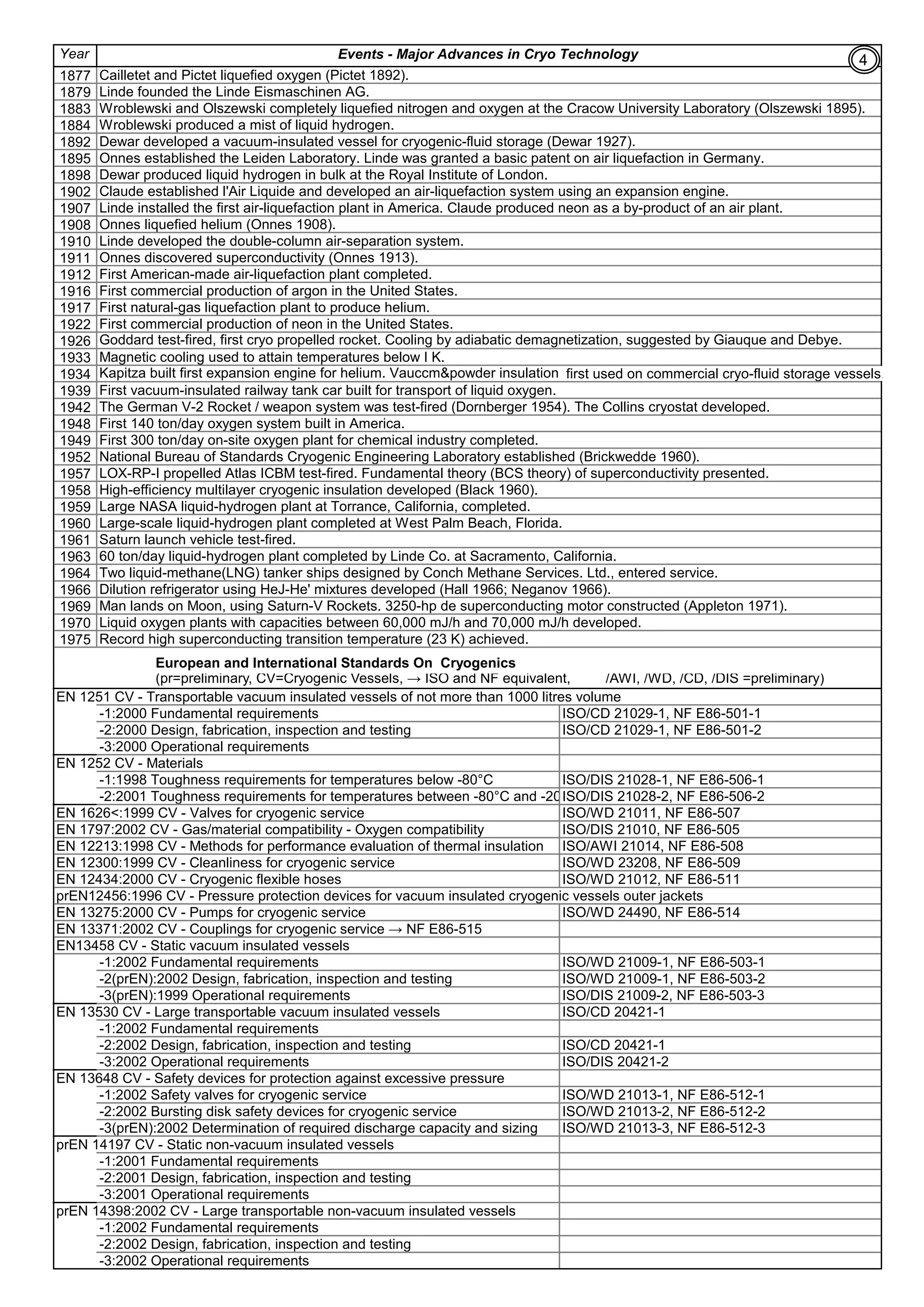
European and International Standards On Cryogenics
(pr=preliminary, CV=Cryogenic Vessels, → ISO and NF equivalent, /AWI, /WD, /CD, /DIS =preliminary)
EN 1251 CV - Transportable vacuum insulated vessels of not more than 1000 litres volume
-1:2000 Fundamental requirements ISO/CD 21029-1, NF E86-501-1
-2:2000 Design, fabrication, inspection and testing ISO/CD 21029-1, NF E86-501-2
-3:2000 Operational requirements
EN 1252 CV - Materials
-1:1998 Toughness requirements for temperatures below -80°C ISO/DIS 21028-1, NF E86-506-1
-2:2001 Toughness requirements for temperatures between -80°C and -20°CISO/DIS 21028-2, NF E86-506-2
EN 1626<:1999 CV - Valves for cryogenic service ISO/WD 21011, NF E86-507
EN 1797:2002 CV - Gas/material compatibility - Oxygen compatibility ISO/DIS 21010, NF E86-505
EN 12213:1998 CV - Methods for performance evaluation of thermal insulation ISO/AWI 21014, NF E86-508
EN 12300:1999 CV - Cleanliness for cryogenic service ISO/WD 23208, NF E86-509
EN 12434:2000 CV - Cryogenic flexible hoses ISO/WD 21012, NF E86-511
prEN12456:1996 CV - Pressure protection devices for vacuum insulated cryogenic vessels outer jackets
EN 13275:2000 CV - Pumps for cryogenic service ISO/WD 24490, NF E86-514
EN 13371:2002 CV - Couplings for cryogenic service → NF E86-515
EN13458 CV - Static vacuum insulated vessels
-1:2002 Fundamental requirements ISO/WD 21009-1, NF E86-503-1
-2(prEN):2002 Design, fabrication, inspection and testing ISO/WD 21009-1, NF E86-503-2
-3(prEN):1999 Operational requirements ISO/DIS 21009-2, NF E86-503-3
EN 13530 CV - Large transportable vacuum insulated vessels ISO/CD 20421-1
-1:2002 Fundamental requirements
-2:2002 Design, fabrication, inspection and testing ISO/CD 20421-1
-3:2002 Operational requirements ISO/DIS 20421-2
EN 13648 CV - Safety devices for protection against excessive pressure
-1:2002 Safety valves for cryogenic service ISO/WD 21013-1, NF E86-512-1
-2:2002 Bursting disk safety devices for cryogenic service ISO/WD 21013-2, NF E86-512-2
-3(prEN):2002 Determination of required discharge capacity and sizing ISO/WD 21013-3, NF E86-512-3
prEN 14197 CV - Static non-vacuum insulated vessels
-1:2001 Fundamental requirements
-2:2001 Design, fabrication, inspection and testing
-3:2001 Operational requirements
prEN 14398:2002 CV - Large transportable non-vacuum insulated vessels
-1:2002 Fundamental requirements
-2:2002 Design, fabrication, inspection and testing
-3:2002 Operational requirements
Kapitza built first expansion engine for helium. Vauccm&powder insulation
Events - Major Advances in Cryo Technology
Goddard test-fired, first cryo propelled rocket. Cooling by adiabatic demagnetization, suggested by Giauque and Debye.
4

Cryogenics in Brief

  • 1.
    CRYOGENICS - InBrief (JGC Annamalai) Normal or accepted range of cryogenic is from Absolute Zero to 120ºK ( ‐ -273ºC to ‐ -150ºC). The cycle is repeated till we achieve the cryogenic temperatures. fracture study, better materials and improvements on Toughness / Impact Energy. Application of Cryogenic Technology: (C). ASME Sec VIII code permits material to use at temperature below -20ºF( ‐ - 29ºC) only if the material is tested at the operating temperature and passes the minimum requirements for impact resistance. (D).Titanic Ship , Liberty Ships, Pressure Vessels etc., fabricated during or before World War-II, cracked in cold weather / temperature . This lead to brittle Definition of Cryogenics: In Romans, Cryo means super cold and genics means knowledge or science. In Greek, Crogenics is to attain low temperature. Achieving of Cryogenic Temperatures: The process is like normal refrigeration cycle to make ice . Instead of Freon/Refrigerant, Cryogens (Liquid Helium, liquid Nitrogen, petroleum gases etc) or mixture of them(MRC) are used. (6). Superconductivity: Superconducting electromagnets are used in the Particle Accelerators. The facilities require very powerful magnetic flux that conventional electromagnets could be melted by the electric currents they carry. Liquid helium cools the cable through which the currents flow to about 4 K , allowing much stronger currents to flow without generating heat by electrical resistance. The electrical resistance at sub-zero temperature is near zero. (A). Most BCC Metals, Iron, CS & low alloy steels, Moly, Nb, Zinc, elastomeric & plastics materials: they generally, on cooling from room temp. to cryo temperature ( ‐ - 273ºC), the following happens: (1). Tensile & Yield Strength increases. , (2). % Elangation(ductility) decreases, (3). Youngs Modulus increases, (means little deflection/rigid), (4). Coefficient of thermal expansion continue to decrease and it is negligible, near to absolute zero. (5). impact Energy decreases and the structure becomes brittle. (B). Most FCC Metals, Cu, Ni, Cu ‐ Ni alloys, Al & its alloys, Austenitic Stainless Steels (with min 7%Ni), Zirconium, Titanium, Teflon, polyurethane, pyrex glass, 9% Ni steel are generally safe for cryo temp. range. [1]. Effects of Low Temp & Cryo temp on Toughness and Ductility: (Unit Joules, 1J = 0.738 ft.lb) (8). As a cooling medium: Liquid N2 & Liquid He are used for cooling purpose on infrared cameras, thermal imagers, high vacuum pumps, storing human blood, tissues, cells etc. For testing at low temperature / cryo temperature : weld test coupons/PTC, impact test specimens, samples, valves, equipments etc. (E). 20J (15 ft.lb) impact energy at Operating Temperature is considered minimum to control brittle failure, at low temp / Cryogenic Engineering Applications. Allowances are added for further safety. [2]. Effect of Cryo temp on Electrical Resistance of Material : The Electrical Resistance, reduces near to zero Ohms(Ω), as the temp. is lowered , near to absolute zero. Zero Electrical Resistance at Zero absolute temperature, is called Super Conductivity. (2). LNG Transport: Cryogenic gas liquefaction techniques is the storage and transportation of liquefied natural gas (LNG), a mixture largely composed of methane, ethane, and other combustible gases. Natural gas(Methane, CH4) is liquefied at ‐ -163ºC, causing it to contract to 1/600th of its volume at room temperature and making it sufficiently compact for swift transport in specially insulated tankers to a far away distant places(say from Gulf Countries to Japan, Korea). (1). Liquefaction & Gas Separation: Using cryo technology, Air is separated into Oxygen, nitrogen and other constituents. Cryotechnology is used to separte petroleum products like Methane, Ethane etc. Oxygen(liquid & gas) is used in Metallaurgical units, Hospitals, Space Applications etc. (3). Food Preservation: Very low temperatures are also used for preserving food, simply and inexpensively. Produce is placed in a sealed tank and sprayed with liquid nitrogen. The nitrogen immediately vaporizes, absorbing the heat content of the produce. (4). Cryo ‐ medicine & Cryosurgery: A low ‐ temperature scalpel or probe can be used to freeze to cut & kill unhealthy tissue & unwanted human growth(cancer or dead body part). The resulting dead cells are removed through normal bodily processes. The advantage : freezing the tissue rather than normal cutting, it produces less bleeding (5). Space Application: Cryo fuel/Propellants (Liquid Hydrogen & Oxygen) were first used in Rockets, like Apollo-11 (Saturn-V) which took man to moon in 1969 and first used in Space-Shuttle “Columbia” in 1981 (7). Brittle Nature: Many materials at cryo temp range, have brittle structure (%Elangation <5%, is considered brittle fracture). Food grains, elastic materials like rubber, sticky material, plastics and tools used to metal cutting etc are sub ‐ cooled to cryo temp range and machined and also ground to powder, as the material is brittle and easy to machine. Dead Human body, at cryo temp, is shaved, at 1 mm layers and photographed to make 3D model for training/analysis/treatment by Doctors. Some steels are treated at ‐ - 185ºC. Tools: Life of metal tools increases to between 200 ‐ 400% of the original life expectancy using cryo tempering instead of heat treating. 1
  • 2.
    Refregirants and Cryogensand other useful Liquids - Boiling Point / Liquefying Point Boil - Normally stored in Liquid state, changes to Gas or Vapor Liquefy - normally in vapor state, changes from Vapor to Liquid Melt - normally stored in Solid state changes from Solid to Liquid Freeze - Normally stored in Liquid state changes from Liquid to Solid Boiling Points, unless mentioned °C °K °F °R Water Freezes to Ice 0 273 32 492 Sea Water freezes to Ice -2 271 28.4 488 Butane(C4H10) Boils 0.5 273 32 491 Freon, Refgnt R12 Boils -30 243 -22 437 Ammonia(NH3) Boils -36 243 -33 427 The lowest freezing point obtainable for NaCl Mercury(Hg) Freezes -39 234 -38 422 brine(23.3% wt salt solution) is -21.1 °C (-6.0 °F) Freon, Refgnt R22 Boils -39 234 -38 422 Propane(C3H8) Boils -42 231 -44 416 °C °K °F °R Propylene(C3H6) Boils -47 225 -55 405 Sea Water, Boils 101 374 213 673 °C °K °F °R Water Boils to Steam 100 373 212 672 Acetylene(C2H2) Boils -84 189 -120 340 Ethanol (Alcohol),Boils 78.4 351 173 633 Hydrogen Chloride Boils -85 188 -121 338 Methanol, Boils 64.7 338 148 608 Ethane(C2H6) Boils -89 184 -128 331 Chloroform,Liquefies 61.2 334 142 602 Nitrous Oxide(NO) Boils -89 184 -128 331 Chlorine,Boils -34 239 -29 431 Ethylene(C2H4) Boils -104 170 -155 305 Mercury,Melts -39 234 -38 422 Xenon(Xe) Boils -108 165 -162 297 Propane, Boils -42 231 -44 416 Ozone(3) Boils -112 161 -170 290 Carbon Dioxide,Vaporize-57 216 -71 389 Krypton (Kr) boils -153 120 -243 216 Radon,Liquefies -62 211 -79 381 Methane(CH4) Boils -164 109 -263 196 Chloroform,Melts -64 210 -82 378 Oxygen(O2) Boils -183 90.2 -297 163 Radon,Melts -71 202 -96 364 Argon(Ar) Boils -186 87.4 -302 158 Dry-Ice(CO2),Melts -78 195 -108 352 Fluorine (FL) Boils -188 85.2 -306 154 Methanol,Melts -98 175 -144 316 Carbon Monoxide(CO) liquefies-188 85 -306 153 Chlorine,Melts -102 172 -151 309 Air liquefies -194 79 -317 143 Ethanol (Alcohol),Melts-114 159 -173 287 Nitrogen(N2) Boils -196 77.4 -320 140 °C °K °F °R Neon(Ne) Liquefies -246 27 -411 49 Propane,Melts -188 85 -306 154 Deuterium(D) or H2 Liquefies-249 24 -416 43 Oxygen,Melts -219 54.2 -362 98 Hydrogen(H2) Liquefies -253 20.2 -423 37 Neon,Melts -249 24.4 -415 45 Helium(He) Boils -269 4.11 -452 8 Hydrogen,Melts -259 13.9 -434 26 Absolute Zero Temperature -273 0 -460 0 Helium,Melts -272 0.8 -458 2 °C °K °F °R Temperature Conversion Formulas F-32 180 = C 100 R=F+460 K=C+273 Laboratories, mix different liquids and solids (like Methanol and Dry Ice) to have intermediate Test Temperares for Impact Test ΔH ΔH ΔH ΔH Normal Solid to Liquid to Gas Phases & vice-versa Solid Liquid Start/Finish Start/ Finish Start / Finish Start /Finish Temp, T Enthalpy(Heat), H Boil Melt Liquefy Solidify/Freeze Gas LowTemperatureorRefrigerationTemp.Range(>120Kor>-150°C) CryogenicTemp.Range(≤120Kor≤- 150ºC) ◄ ◄ ◄ ◄ MetalTemperature,ASMEAllowableRange>-20°F(244°K) 2
  • 3.
    Material Selection: Thoughmany properties (strength, deflection, corrosion, manufacturing easiness, easy way for operation and maintenance etc) are generally considered for design. However, for low temp and cryo temp service, the prime property for material selection is good Impact Resistance. Generally, for pressure parts, for low temp service(mild & medium), Nickel Steels are used. For cryo temp(say up to - 273ºC, Austenitic Stainless Steels(AISI Type 304, 304L, 316, 316L, 321, 347, 308, 308L, 309, 310) are used. Impact Test Values are (1). sensitive to the Rolling Direction and also depth of the specimen , below the surface. (2). sensitive to the geometry of the notched groove and loading style. (3). sensitive to the Heat Treatment Various Materials for Low & cryo temp service and their Impact Test Values 3
  • 4.
    Year 1877 Cailletet andPictet liquefied oxygen (Pictet 1892). 1879 Linde founded the Linde Eismaschinen AG. 1883 Wroblewski and Olszewski completely liquefied nitrogen and oxygen at the Cracow University Laboratory (Olszewski 1895). 1884 Wroblewski produced a mist of liquid hydrogen. 1892 Dewar developed a vacuum-insulated vessel for cryogenic-fluid storage (Dewar 1927). 1895 Onnes established the Leiden Laboratory. Linde was granted a basic patent on air liquefaction in Germany. 1898 Dewar produced liquid hydrogen in bulk at the Royal Institute of London. 1902 Claude established l'Air Liquide and developed an air-liquefaction system using an expansion engine. 1907 Linde installed the first air-liquefaction plant in America. Claude produced neon as a by-product of an air plant. 1908 Onnes liquefied helium (Onnes 1908). 1910 Linde developed the double-column air-separation system. 1911 Onnes discovered superconductivity (Onnes 1913). 1912 First American-made air-liquefaction plant completed. 1916 First commercial production of argon in the United States. 1917 First natural-gas liquefaction plant to produce helium. 1922 First commercial production of neon in the United States. 1926 1933 Magnetic cooling used to attain temperatures below I K. 1934 first used on commercial cryo-fluid storage vessels. 1939 First vacuum-insulated railway tank car built for transport of liquid oxygen. 1942 The German V-2 Rocket / weapon system was test-fired (Dornberger 1954). The Collins cryostat developed. 1948 First 140 ton/day oxygen system built in America. 1949 First 300 ton/day on-site oxygen plant for chemical industry completed. 1952 National Bureau of Standards Cryogenic Engineering Laboratory established (Brickwedde 1960). 1957 LOX-RP-I propelled Atlas ICBM test-fired. Fundamental theory (BCS theory) of superconductivity presented. 1958 High-efficiency multilayer cryogenic insulation developed (Black 1960). 1959 Large NASA liquid-hydrogen plant at Torrance, California, completed. 1960 Large-scale liquid-hydrogen plant completed at West Palm Beach, Florida. 1961 Saturn launch vehicle test-fired. 1963 60 ton/day liquid-hydrogen plant completed by Linde Co. at Sacramento, California. 1964 Two liquid-methane(LNG) tanker ships designed by Conch Methane Services. Ltd., entered service. 1966 Dilution refrigerator using HeJ-He' mixtures developed (Hall 1966; Neganov 1966). 1969 Man lands on Moon, using Saturn-V Rockets. 3250-hp de superconducting motor constructed (Appleton 1971). 1970 Liquid oxygen plants with capacities between 60,000 mJ/h and 70,000 mJ/h developed. 1975 Record high superconducting transition temperature (23 K) achieved. European and International Standards On Cryogenics (pr=preliminary, CV=Cryogenic Vessels, → ISO and NF equivalent, /AWI, /WD, /CD, /DIS =preliminary) EN 1251 CV - Transportable vacuum insulated vessels of not more than 1000 litres volume -1:2000 Fundamental requirements ISO/CD 21029-1, NF E86-501-1 -2:2000 Design, fabrication, inspection and testing ISO/CD 21029-1, NF E86-501-2 -3:2000 Operational requirements EN 1252 CV - Materials -1:1998 Toughness requirements for temperatures below -80°C ISO/DIS 21028-1, NF E86-506-1 -2:2001 Toughness requirements for temperatures between -80°C and -20°CISO/DIS 21028-2, NF E86-506-2 EN 1626<:1999 CV - Valves for cryogenic service ISO/WD 21011, NF E86-507 EN 1797:2002 CV - Gas/material compatibility - Oxygen compatibility ISO/DIS 21010, NF E86-505 EN 12213:1998 CV - Methods for performance evaluation of thermal insulation ISO/AWI 21014, NF E86-508 EN 12300:1999 CV - Cleanliness for cryogenic service ISO/WD 23208, NF E86-509 EN 12434:2000 CV - Cryogenic flexible hoses ISO/WD 21012, NF E86-511 prEN12456:1996 CV - Pressure protection devices for vacuum insulated cryogenic vessels outer jackets EN 13275:2000 CV - Pumps for cryogenic service ISO/WD 24490, NF E86-514 EN 13371:2002 CV - Couplings for cryogenic service → NF E86-515 EN13458 CV - Static vacuum insulated vessels -1:2002 Fundamental requirements ISO/WD 21009-1, NF E86-503-1 -2(prEN):2002 Design, fabrication, inspection and testing ISO/WD 21009-1, NF E86-503-2 -3(prEN):1999 Operational requirements ISO/DIS 21009-2, NF E86-503-3 EN 13530 CV - Large transportable vacuum insulated vessels ISO/CD 20421-1 -1:2002 Fundamental requirements -2:2002 Design, fabrication, inspection and testing ISO/CD 20421-1 -3:2002 Operational requirements ISO/DIS 20421-2 EN 13648 CV - Safety devices for protection against excessive pressure -1:2002 Safety valves for cryogenic service ISO/WD 21013-1, NF E86-512-1 -2:2002 Bursting disk safety devices for cryogenic service ISO/WD 21013-2, NF E86-512-2 -3(prEN):2002 Determination of required discharge capacity and sizing ISO/WD 21013-3, NF E86-512-3 prEN 14197 CV - Static non-vacuum insulated vessels -1:2001 Fundamental requirements -2:2001 Design, fabrication, inspection and testing -3:2001 Operational requirements prEN 14398:2002 CV - Large transportable non-vacuum insulated vessels -1:2002 Fundamental requirements -2:2002 Design, fabrication, inspection and testing -3:2002 Operational requirements Kapitza built first expansion engine for helium. Vauccm&powder insulation Events - Major Advances in Cryo Technology Goddard test-fired, first cryo propelled rocket. Cooling by adiabatic demagnetization, suggested by Giauque and Debye. 4