
-By Nishit Desai
Cryogenics
(World’s Largest Cryogenic System)
Largest Cryogenic System
 LHC = Large Hadron Collider
 One of the coldest places on the Earth
 Main magnets operate at 1.9 K (-271.3°C), colder
than outer space which is at 2.7 K (-270.5°C)
 Requires 120 tones (120000 kg) of superfluid helium
to keep magnets at 1.9 K
Why LHC required low temperatures?
 Uses powerful electromagnets to keep its high-energy
particles on a circular track.
 To provide the strong fields needed to grip its high-
energy particles, the LHC electromagnets should be
superconductors.
 In this way, the LHC magnets can be powered to very
high fields and at minimal cost.
Why LHC required low temperatures?
 Most materials which become superconducting only
do so at liquid helium temperatures.
 The critical current at which LHC is operating depends
on temperature.
 To maintain the required high currents, the LHC's
electromagnets are cooled down to just 1.9 K, at
which temperature helium is a superfluid.
Largest Cryogenic System
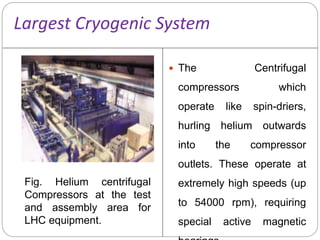
 The Centrifugal
compressors which
operate like spin-driers,
hurling helium outwards
into the compressor
outlets. These operate at
extremely high speeds (up
to 54000 rpm), requiring
special active magnetic
Fig. Helium centrifugal
Compressors at the test
and assembly area for
LHC equipment.
Largest Cryogenic System
 With almost no viscosity,
superfluid helium penetrates tiny
cracks, 'soaking' deep inside the
magnet coils to absorb any
deposited or generated heat.
 The heat is quickly transported to
a heat exchanger pipe containing
a mixture of saturated vapour
and superfluid helium arranged in
a series of 107-metre cooling
loops all around the ring.
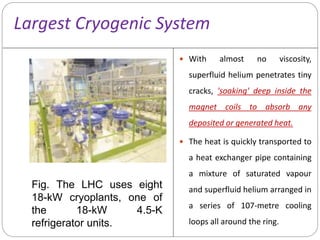
Fig. The LHC uses eight
18-kW cryoplants, one of
the 18-kW 4.5-K
refrigerator units.
Cooling Process
 Entire cooling process consisting of 3 stages
takes weeks to complete
 First Stage = Helium is cooled at 80 K.
 10,000 tones of liquid nitrogen are used in
heat exchangers in the refrigerating equipment to
bring the temperature of the helium down to 80
K.
Cooling Process
 Second Stage = Helium is cooled to 4.5 K from
80 K
 Turbines are used for this purpose
 Third Stage = Helium is cooled to 1.9 K from 4.5
K
 The 1.8 KW refrigeration units are used for this
purpose
 The Cryogenics System cools 36,000 tones of
Why Superfluid Helium?
 Helium is natural choice of coolant as its
properties allow components to be kept cool over
long distances.
 Superfluid helium (cooled below 2.17 K) has
high thermal conductivity and zero viscosity.
 It is an efficient heat conductor.
References
 CERN Document Server
Article: - Cryogenics: Low temperatures, high
performance.
Article: - The LHC cryogenic system
Cryogenics System

Cryogenics System

  • 1.
    -By Nishit Desai Cryogenics (World’sLargest Cryogenic System)
  • 2.
    Largest Cryogenic System LHC = Large Hadron Collider  One of the coldest places on the Earth  Main magnets operate at 1.9 K (-271.3°C), colder than outer space which is at 2.7 K (-270.5°C)  Requires 120 tones (120000 kg) of superfluid helium to keep magnets at 1.9 K
  • 3.
    Why LHC requiredlow temperatures?  Uses powerful electromagnets to keep its high-energy particles on a circular track.  To provide the strong fields needed to grip its high- energy particles, the LHC electromagnets should be superconductors.  In this way, the LHC magnets can be powered to very high fields and at minimal cost.
  • 4.
    Why LHC requiredlow temperatures?  Most materials which become superconducting only do so at liquid helium temperatures.  The critical current at which LHC is operating depends on temperature.  To maintain the required high currents, the LHC's electromagnets are cooled down to just 1.9 K, at which temperature helium is a superfluid.
  • 5.
    Largest Cryogenic System The Centrifugal compressors which operate like spin-driers, hurling helium outwards into the compressor outlets. These operate at extremely high speeds (up to 54000 rpm), requiring special active magnetic Fig. Helium centrifugal Compressors at the test and assembly area for LHC equipment.
  • 6.
    Largest Cryogenic System With almost no viscosity, superfluid helium penetrates tiny cracks, 'soaking' deep inside the magnet coils to absorb any deposited or generated heat.  The heat is quickly transported to a heat exchanger pipe containing a mixture of saturated vapour and superfluid helium arranged in a series of 107-metre cooling loops all around the ring. Fig. The LHC uses eight 18-kW cryoplants, one of the 18-kW 4.5-K refrigerator units.
  • 7.
    Cooling Process  Entirecooling process consisting of 3 stages takes weeks to complete  First Stage = Helium is cooled at 80 K.  10,000 tones of liquid nitrogen are used in heat exchangers in the refrigerating equipment to bring the temperature of the helium down to 80 K.
  • 8.
    Cooling Process  SecondStage = Helium is cooled to 4.5 K from 80 K  Turbines are used for this purpose  Third Stage = Helium is cooled to 1.9 K from 4.5 K  The 1.8 KW refrigeration units are used for this purpose  The Cryogenics System cools 36,000 tones of
  • 9.
    Why Superfluid Helium? Helium is natural choice of coolant as its properties allow components to be kept cool over long distances.  Superfluid helium (cooled below 2.17 K) has high thermal conductivity and zero viscosity.  It is an efficient heat conductor.
  • 10.
    References  CERN DocumentServer Article: - Cryogenics: Low temperatures, high performance. Article: - The LHC cryogenic system