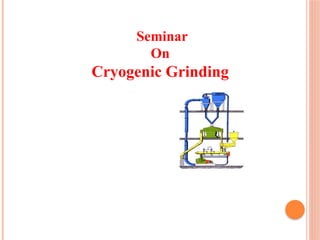
Seminar
On
Cryogenic Grinding
CONTENTS
 Introduction
 What is Cryogenic Grinding Application of
Cryogenics
 Cryogenic Grinding Technology
 Advantages of Cryogenics
 Application of Cryogenic Grinding
 Problems with Conventional Grinding
 Advantages of Cryogrinding with Liquid
Nitrogen
 Future Prospects
 References
INTRODUCTION
• The term “Cryogenics” originates from Greek word
which means creation or production by means of cold.
• As prices for energy and raw materials rise and concern
for the environment makes safe waste disposal difficult
and Costly, resource recovery becomes a vital matter for
today’s business.
• Cryogenic grinding technology can efficiently grind
most tough materials and can also facilitate Cryogenic
recycling of tough composite materials and multi
component scrap.
WHAT IS CRYOGENIC GRINDING
 Cryogenic grinding, also known as freezer
milling, freezer grinding, and cryomilling, is the
act of cooling or chilling a material and then
reducing it into a small particle size.
APPLICATION OF CRYOGENICS
 In biology – for preservation and in treatment of
diseases.
 In food industry – for food handling and processing
 In nuclear and high – energy physics
 Metal fabrication
CRYOGENIC GRINDING TECHNOLOGY
 For pulverizing many materials, cryogenic grinding
technology increases productivity and lowers power
costs.
 Many elastic or "soft" materials are very difficult to
pulverize, requiring long cycle times and high energy
consumption.
 This combination decreased productivity and increased
costs unnecessarily.
 Cryogenic grinding involves cooling a material below its
embrittlement temperature with a cryogenic fluid,
typically liquid nitrogen or, in certain applications,
carbon dioxide.
ADVANTAGES OF CRYOGRINDING
 Higher production rate.
 Lower energy consumption.
 Finer particle size .
 More uniform particle distribution.
 Lower grinding cost.
 No heat generation which is good while grinding
spices, pharmaceuticals and scrap plastics.
 Provides an inert atmosphere thus eliminating the
possibility of oxidation.
APPLICATIONS OF CRYOGENIC GRINDING
 CryoGrinding of steel
 Thermoplastics
 Thermo sets
 Adhesives & Waxes
 Explosives
 Spices
PROBLEMS WITH CONVENTION
GRINDING
 Loss of etheric oil
 Clogging and gumming of themill
 Oxidation and related degradation
ADVANTAGES OF CRYOGRINDING WITH LIQUID NITROGEN
 Higher retention of etheric oils
 Prevention of oxidation and rancidity
 Increased throughput and power saving
 Finer particle size
 Reduction in microbial load
 Possibility of fine grinding of difficult spices
FUTURE PROSPECTS
 As the cost of raw materials and energy is
increasing day by day, it is very necessary to use
optimum quantity and at the same time getting
the required quality.
 By using CryoGrinding technology these aspects
can be met efficiently. By using this we can also
recycle tough and composite materials.
 It has many significant advantages over
conventional grinding. This also leads to value
addition to the product. CryoGrinding is
economically viable, if liquid nitrogen costs are
not formidable.
REFERENCES
 www.google.com
 www.wikipedia.com
 www.studymafia.org
THANKS

Engineering- Cryogenic grinding ppt.pptx

  • 1.
  • 2.
    CONTENTS  Introduction  Whatis Cryogenic Grinding Application of Cryogenics  Cryogenic Grinding Technology  Advantages of Cryogenics  Application of Cryogenic Grinding  Problems with Conventional Grinding  Advantages of Cryogrinding with Liquid Nitrogen  Future Prospects  References
  • 3.
    INTRODUCTION • The term“Cryogenics” originates from Greek word which means creation or production by means of cold. • As prices for energy and raw materials rise and concern for the environment makes safe waste disposal difficult and Costly, resource recovery becomes a vital matter for today’s business. • Cryogenic grinding technology can efficiently grind most tough materials and can also facilitate Cryogenic recycling of tough composite materials and multi component scrap.
  • 4.
    WHAT IS CRYOGENICGRINDING  Cryogenic grinding, also known as freezer milling, freezer grinding, and cryomilling, is the act of cooling or chilling a material and then reducing it into a small particle size.
  • 5.
    APPLICATION OF CRYOGENICS In biology – for preservation and in treatment of diseases.  In food industry – for food handling and processing  In nuclear and high – energy physics  Metal fabrication
  • 6.
    CRYOGENIC GRINDING TECHNOLOGY For pulverizing many materials, cryogenic grinding technology increases productivity and lowers power costs.  Many elastic or "soft" materials are very difficult to pulverize, requiring long cycle times and high energy consumption.  This combination decreased productivity and increased costs unnecessarily.  Cryogenic grinding involves cooling a material below its embrittlement temperature with a cryogenic fluid, typically liquid nitrogen or, in certain applications, carbon dioxide.
  • 7.
    ADVANTAGES OF CRYOGRINDING Higher production rate.  Lower energy consumption.  Finer particle size .  More uniform particle distribution.  Lower grinding cost.  No heat generation which is good while grinding spices, pharmaceuticals and scrap plastics.  Provides an inert atmosphere thus eliminating the possibility of oxidation.
  • 8.
    APPLICATIONS OF CRYOGENICGRINDING  CryoGrinding of steel  Thermoplastics  Thermo sets  Adhesives & Waxes  Explosives  Spices
  • 9.
    PROBLEMS WITH CONVENTION GRINDING Loss of etheric oil  Clogging and gumming of themill  Oxidation and related degradation
  • 10.
    ADVANTAGES OF CRYOGRINDINGWITH LIQUID NITROGEN  Higher retention of etheric oils  Prevention of oxidation and rancidity  Increased throughput and power saving  Finer particle size  Reduction in microbial load  Possibility of fine grinding of difficult spices
  • 11.
    FUTURE PROSPECTS  Asthe cost of raw materials and energy is increasing day by day, it is very necessary to use optimum quantity and at the same time getting the required quality.  By using CryoGrinding technology these aspects can be met efficiently. By using this we can also recycle tough and composite materials.  It has many significant advantages over conventional grinding. This also leads to value addition to the product. CryoGrinding is economically viable, if liquid nitrogen costs are not formidable.
  • 12.
  • 13.