
Koya University
Faculty of Engineering
Chemical Engineering Department
3rd Stage (2021-2022)
Instructor
Mr. Fakhri H. Ibrahim
Prepared by
Safeen Yaseen Jafar
Submitted Date
9 Oct. 2021
Chemical Industry
Cryogenic Process
TABLE OF CONTENTS
ABSTRACT/SUMMARY................................................................................................ 1
1. INTRODUCTION........................................................................................................ 2
1.1 WHAT CRYOGENICS AND CRYOGENIC PROCESS ARE? ............................................... 3
1.2 WHAT ARE THE IMPORTANCE’S OF CRYOGENIC PROCESSES? .................................... 3
2. THEORY ...................................................................................................................... 5
2.1 CRYOGENIC MANUFACTURING PROCESS................................................................ 5
2.1.1 General Cryogenic Process of Air Separation.................................................... 5
2.1.2 Cryogenic Oxygen and Nitrogen Liquid Manufacturing Process ..................... 6
2.1.3 Liquid Carbon Dioxide (CO2) Production......................................................... 8
2.1.4 Argon gas Production ......................................................................................... 8
4. LIST OF REFERENCES ......................................................................................... 10
LIST OF FIGURES
Figure 1 ............................................................................................................................. 2
Figure 2 ............................................................................................................................. 2
Figure 3 ............................................................................................................................. 3
Figure 4 ............................................................................................................................. 4
Figure 5 ............................................................................................................................. 6
Figure 6 ............................................................................................................................. 7
Figure 7 ............................................................................................................................. 8
Figure 8 ............................................................................................................................. 9
1
Abstract
We know that in nowadays, engineering is the important branch for many works and the
world of today’s needs engineers for construction and making products efficiently and quickly.
So, in this report we introduce the fast and efficient way for production of materials by cooling
or by another word at the very low temperature. On of the common usage of this materials
production method is the production of industrial gases in liquid phase such as, Oxygen,
Nitrogen and Argon gases which called Industrial Gases as we mention and explain in next
pages during this report.
2
1. Introduction
Nowadays we have many of methods for producing materials such as fluids, and gases. So,
the Cryogenics is related to the branch of the physic science which talking about production
materials in low temperatures and their effects on them. Cryogenic have many applications by the
process of cryogenics, for example we can produce the liquid oxygen and other industrial gases.
The cryogenic region of most interest is characterized principally by five fluids: oxygen, nitrogen,
neon, hydrogen, and helium. [1]
The word of cryogenic is
derived from the Greek language where
“CRYOS” means “frost” or “cold”. The
development of cryogenics as a low
temperature science is a direct result of
attempts by 19th century scientists to
liquefy the permanent gases. One of
these scientists, Michael Faraday, had
succeeded, by 1845, in liquefying most
of the gases then known to exist. [2]
Cryogenics is efficient and has many
benefits and uses in our really life, for example when you want to preserve the foods in your
refrigerant or any place you can spraying the foods by one of the cryogenics like liquid nitrogen.
So, we know that this phenomenon is clearly visible in frozen fruit. When food is removed from a
"standard" freezer, it loses both its appearance and its quality. Cryogenic air separation is the most
cost-effective technology for larger plants and for producing very high purity oxygen and nitrogen.
[3]
Figure 2: Flow diagram of a
cryogenic air separation unit
Figure 1: Cryogenic Process Plant
3
1.1 What Cryogenics and Cryogenic Process are?
Cryogenics is defined as the science and technology that related to application of the
physic science which the production of extremely low temperatures and their effects on matter, a
definition that encompasses both the attainment of low temperatures that do not occur naturally on
Earth and the application of such temperatures to the study of nature or human industry.
Cryogenic Process: is the process of production and maintaining at very low temperatures. Also,
Cryogenic processes include liquefaction of air, oxygen, nitrogen, hydrogen and helium. [5]
1.2 What are the importance’s of cryogenic processes?
The process of the manufacturing Cryogenics is important and have many benefits for
daily life and to make longer in age of the foods. It has many applications in various sectors like
health sector (medical uses), material production, welding or cutting (such as liquified oxygen),
etc. Cryogenics is used in a variety of applications. It can be used to produce cryogenic fields for
rockets, in MRI machines that use liquid helium and require cryogenic cooling, storing large
quantities of food, special effects fog, recycling, freezing blood and tissue samples, and even
cooling superconductors. [6]
Applications of Cryogenics
1. General Applications
• Cryosurgery
• Cryoelectronics
• Cryobiology
• Cryonics
• Cryotherapy
2. Some Industrial benefits:
• Liquid oxygen is used in
welding,
• in the manufacture of steel
• For the preservation of blood,
dead bodies and medicines.
• Quick healing of wounds.
• Cooling the body parts by anesthesia.
• Transportation of Gases
3. Uses:
• For freezing the food for preservation for example by spraying of nitrogen liquids.
• Blood banking.
Figure 3: Liquid nitrogen is a good
example of a cryogenic fluid.
4
• X-ray
• Elictronics
• Electric power transmission
• Infarared sensors
• Liquid oxygen in artificial breathing in hospitals & aircrafts. [7]
Figure 4: By applying cryogenic freezing techniques, our fruits and food will safer than other
ways for eating and using.
5
2. Theory
The process of cryogenic or by another word production of materials under very low
temperature is important process to production by lesser time and faster work in these days. So, in
this section we will talk about Cryogenic Process or plants which related to it in details and with
some examples of this process like Air Separation Plant, Cryogenic Oxygen Plant, Argon gas
Production, Nitrogen Liquification. Also, we need PFD of them for more understand about the
process as well as faster for all. [8]
2.1 Cryogenic Manufacturing Process:
The separation or liquefaction of gases under process settings that may include increased
pressures but invariably involve very low temperatures is a frequent aspect of a cryogenic facility.
Many industrial cryogenic processes run at temperatures ranging from –165°C to –195°C at their
lowest point, with some going as low as –269°C. As a result, cold conservation becomes a key
aspect in the design of such systems, which are focused on extremely efficient heat exchange. A
typical cryogenic process, on the other hand, is made up of numerous components, with the
cryogenic section being just a small part of the total flow scheme. A typical cryogenic plant is seen
in Figure 1, which contains a pretreatment section, a cryogenic section, and a compressor/expander
section that provides process refrigeration. Feed compression, like in the case of air separation,
may be required in numerous instances. Another characteristic of cryogenic facilities is the use of
aluminum and stainless steel for the plant's cold sections to minimize embrittlement problems that
might arise with carbon steel. [9]
2.1.1 General Cryogenic Process of Air Separation
Air is made up of different gasses, with nitrogen and oxygen accounting for
approximately 99 percent of the entire sample volume. Dry air includes around 78 percent
nitrogen, approximately 21 percent oxygen, and approximately 0.93 percent argon by volume, as
well as traces of a variety of other gases such as hydrogen, neon, helium, krypton, xenon, and
carbon dioxide. Water vapor and other gases created by natural processes and human activities
can be found in different amounts in ambient air. The production of oxygen and nitrogen is
accomplished by an air separation process, which involves the separation of air into its
constituents. As byproducts of the air separation process, rare gases such as argon and krypton
can be recovered. [10]
6
Figure 5: Cryogenic air separation into its constituent gases involves various processes.
Combination of these processes are needed in a cryogenic air separation plant, of which the
fundamental ones are:
(a) air compression, (b) air purification, (c) heat exchanging, (d) distillation, and (e) product
compression.
2.1.2 Cryogenic Oxygen and Nitrogen Liquid Manufacturing Process
The plant of manufacturing Oxygen originally produce in air separation plant, it means
cryogenic oxygen manufacturing process is one of the facilities of industries which creates
oxygen gas. This plant is important for production of liquid oxygen for many benefits and uses
of oxygen in liquid phase in various sectors like. Medical, industrial, military, etc.
Oxygen and nitrogen products are warmed by heat exchange with the cold box feeds and
pressurized by compressors to the final delivery pressure. Alternatively, products may be
pressurized by small boost compressors. Oxygen storage may be advisable to ensure steady
gasifier operation through periods of high oxygen demand. [11]
Process Description
• Air Compressor-Low Pressure: Air is compressed at a low pressure of 5-7 bar (0.5-
0.7mpa). Air can be compressed at such low pressure by trouble free rotary compressor
(Screw/Centrifugal Type advanced technology is employed in lieu of old bulky piston
compressor).
• Pre-Cooling System: The second stage of the process uses a low-pressure refrigerant for
pre-cooling the processed air to temperature around 12o
C before it enters the purifier.
• Purification of Air by Purifier: The air enters a purifier consisting of twin Molecular
Sieve driers, working alternatively. The Molecular Sieves remove the Carbon dioxide &
moisture from the process air before the air enters Air Separation Unit.
• Cryogenic Cooling of Air By Turbo Expander: The air has to be cooled to subzero
temperatures for liquification & the cryogenic refrigeration & the cooling is provided by
7
highly efficient turbo expander, which cools the air to temperature almost below -165 to -
I 70 deg C.
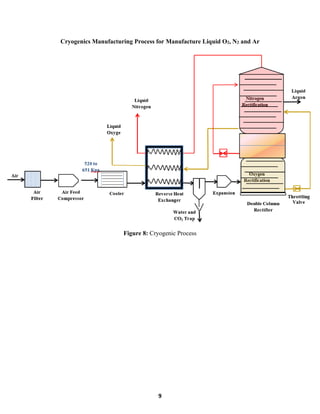
• Separation if Liquid Air into Oxygen and Nitrogen by Air Separation Column: Oil
free, moisture free and Carbon Dioxide free air enters into low pressure plate fin type
Heat exchanger where the air is cooled below subzero temperatures by air expansion
process in the turbo expander. Due to the excellent thermal efficiency, we can achieve a
temperature difference delta t as low as 2 deg c at the warm end of these exchangers. Air
gets liquefied when it enters the air separation column & gets separated into oxygen &
nitrogen by the process of rectification. Liquid nitrogen is available at the outlet at purity
of 99.9% to 99.99% or 3ppm as required. Nitrogen gas is available as required.
• Final Product Liquid Nitrogen: The final product in the form liquid nitrogen to fill in
cryogenic liquid tanks for storage. [12]
Figure 6: Above diagram shows the process of manufacturing of cryogenic liquids (N2 and O2)
8
2.1.3 Liquid Carbon Dioxide (CO2) Production
Liquid CO2 is often accessible as a byproduct from major refineries and chemical
facilities and is transported by truck to its final destination. Long distances, inconsistent supply,
logistical issues, or just not accessible, then installing a stand-alone CO2-Production Plant to
manufacture your own food grade CO2 locally is an obvious obstacle. When utilizing the proper
grade of plant, such an in-house CO2 Manufacture Plant will be a significant help in overcoming
CO2 shortages, as it will always be supplied on time and at a very low price. There are several
essential elements to consider in order to keep CO2 production costs as low as feasible, and CO2
quality must match
international quality
standards. [13]
Figure 7: Liquid CO2
production plant.
2.1.4 Manufacture of Argon (Ar):
Argon is a chemical element in the eighteen group of the periodic table. It is a noble gas
and it is the third most abundant gas in earth’s atmosphere. Argon was suspected to be present in
air by Henry Cavendish in the year 1785. Fractional distillation is used in the commercial
extraction of argon from liquid air in a cryogenic air separation unit. When nitrogen gas in the
atmosphere is heated with hot calcium or magnesium, a nitride is produced, with a trace of argon
remaining as an impurity. It can also be obtained as a byproduct of natural gas purification.
Properties of Argon:
• It is odorless, colorless gas that is totally inert into other substance.
• Under extreme conditions, argon can form certain compounds even though it is a gas.
• It is characterized by same solubility level in water as that of oxygen.
• It has low thermal conductivity. [14]
9
Cryogenics Manufacturing Process for Manufacture Liquid O2, N2 and Ar
Figure 8: Cryogenic Process
10
3. List of References
1. Timmermans, K.D. and Flynn, T.M. (1989). Cryogenic Process
Engineering. [eBook] New York: Plenum Press, pages(605). Available at:
Cryogenic Process Engineering - Klaus D. Timmerhaus, Thomas M. Flynn -
Google Books [Accessed 7 Oct. 2021].
2. Controlled Thermal Processing. (n.d.). History of Cryogenics | CTP Cryogenics. [online]
Available at: https://ctpcryogenics.com/cryogenics/what-is-cryogenic-processing/history-
of-cryogenics/ [Accessed 9 Oct. 2021].
3. www.process-cooling.com. (n.d.). Cryogenic Air Separation and Liquefier Systems.
[online] Available at: https://www.process-cooling.com/articles/84579-cryogenic-air-
separation-and-liquefier-systems [Accessed 9 Oct. 2021].
4. trc.nist.gov. (n.d.). About Cryogenics. [online] Available at:
https://trc.nist.gov/cryogenics/aboutCryogenics.html. [Accessed 8 Oct.
2021].
5. America, C.S. of, Ellyn, I. 800 R.R.S. 312-C. G. and Fax: 1-630-790-3095, I.
60137 U.P. 1-630-686-8889 (n.d.). Cryogenic Treatment of Materials. [online]
Cryogenic Society of America. Available at:
https://cryogenicsociety.org/resources/cryo_central/cryogenic_treatment_of
_materials/ [Accessed 9 Oct. 2021].
6. AZoNano (2018). What are Cryogenics? [online] AZoNano.com. Available at:
https://www.azonano.com/article.aspx?ArticleID=5091 [Accessed 9 Oct.
2021].
7. Controlled Thermal Processing. (2020). How Cryogenic Processing Makes
Carbide End Mills BetterHow Cryogenic Fluids Work | CTP Cryogenics. [online]
Available at: https://ctpcryogenics.com/how-cryogenic-fluids-work/ [Accessed
9 Oct. 2021].
8. www.sciencedirect.com. (n.d.). Cryogenic Separation - an overview |
ScienceDirect Topics. [online] Available at:
https://www.sciencedirect.com/topics/engineering/cryogenic-separation.
[Accessed 9 Oct. 2021].
9. Cryogenics | physics | Britannica. (2019). In: Encyclopædia Britannica. [online]
Available at: https://www.britannica.com/science/cryogenics. [Accessed 9
Oct. 2021].
11
10. Anon, (n.d.). Cryogenic Process of Air Separation – IspatGuru. [online]
Available at: https://www.ispatguru.com/cryogenic-process-of-air-separation/
[Accessed 8 Oct. 2021].
11. Oxygen Plants. (2021). How Does Cryogenic Oxygen Plant Work
Process? [online] Available at: https://www.oxygen-plants.com/blog/how-
does-cryogenic-oxygen-plant-work/ [Accessed 8 Oct. 2021].
12. www.universalboschi.com. (n.d.). Tonnage Liquid/Gas Oxygen & Nitrogen
Plant - UNIVERSAL BOSCHI. [online] Available at:
https://www.universalboschi.com/tonnage-asu-plants.php [Accessed 8 Oct.
2021].
13. GmbH, V. (n.d.). co2 vaporiser,co2 recovery plant manufacturers,co2 recovery
plant manufacturers. [online] www.comtecswiss.com. Available at:
http://www.comtecswiss.com/en/equipment-and-plants/co2-production-
plant/ [Accessed 9 Oct. 2021].
14. AZoM (2012). Argon (Ar) - Discovery, Occurrence, Production, Properties and
Applications of Argon. [online] AZoM.com. Available at:
https://www.azom.com/article.aspx?ArticleID=7906. [Accessed 8 Oct. 2021].

Cryogenic Manufacturing Process

  • 1.
    Koya University Faculty ofEngineering Chemical Engineering Department 3rd Stage (2021-2022) Instructor Mr. Fakhri H. Ibrahim Prepared by Safeen Yaseen Jafar Submitted Date 9 Oct. 2021 Chemical Industry Cryogenic Process
  • 2.
    TABLE OF CONTENTS ABSTRACT/SUMMARY................................................................................................1 1. INTRODUCTION........................................................................................................ 2 1.1 WHAT CRYOGENICS AND CRYOGENIC PROCESS ARE? ............................................... 3 1.2 WHAT ARE THE IMPORTANCE’S OF CRYOGENIC PROCESSES? .................................... 3 2. THEORY ...................................................................................................................... 5 2.1 CRYOGENIC MANUFACTURING PROCESS................................................................ 5 2.1.1 General Cryogenic Process of Air Separation.................................................... 5 2.1.2 Cryogenic Oxygen and Nitrogen Liquid Manufacturing Process ..................... 6 2.1.3 Liquid Carbon Dioxide (CO2) Production......................................................... 8 2.1.4 Argon gas Production ......................................................................................... 8 4. LIST OF REFERENCES ......................................................................................... 10
  • 3.
    LIST OF FIGURES Figure1 ............................................................................................................................. 2 Figure 2 ............................................................................................................................. 2 Figure 3 ............................................................................................................................. 3 Figure 4 ............................................................................................................................. 4 Figure 5 ............................................................................................................................. 6 Figure 6 ............................................................................................................................. 7 Figure 7 ............................................................................................................................. 8 Figure 8 ............................................................................................................................. 9
  • 4.
    1 Abstract We know thatin nowadays, engineering is the important branch for many works and the world of today’s needs engineers for construction and making products efficiently and quickly. So, in this report we introduce the fast and efficient way for production of materials by cooling or by another word at the very low temperature. On of the common usage of this materials production method is the production of industrial gases in liquid phase such as, Oxygen, Nitrogen and Argon gases which called Industrial Gases as we mention and explain in next pages during this report.
  • 5.
    2 1. Introduction Nowadays wehave many of methods for producing materials such as fluids, and gases. So, the Cryogenics is related to the branch of the physic science which talking about production materials in low temperatures and their effects on them. Cryogenic have many applications by the process of cryogenics, for example we can produce the liquid oxygen and other industrial gases. The cryogenic region of most interest is characterized principally by five fluids: oxygen, nitrogen, neon, hydrogen, and helium. [1] The word of cryogenic is derived from the Greek language where “CRYOS” means “frost” or “cold”. The development of cryogenics as a low temperature science is a direct result of attempts by 19th century scientists to liquefy the permanent gases. One of these scientists, Michael Faraday, had succeeded, by 1845, in liquefying most of the gases then known to exist. [2] Cryogenics is efficient and has many benefits and uses in our really life, for example when you want to preserve the foods in your refrigerant or any place you can spraying the foods by one of the cryogenics like liquid nitrogen. So, we know that this phenomenon is clearly visible in frozen fruit. When food is removed from a "standard" freezer, it loses both its appearance and its quality. Cryogenic air separation is the most cost-effective technology for larger plants and for producing very high purity oxygen and nitrogen. [3] Figure 2: Flow diagram of a cryogenic air separation unit Figure 1: Cryogenic Process Plant
  • 6.
    3 1.1 What Cryogenicsand Cryogenic Process are? Cryogenics is defined as the science and technology that related to application of the physic science which the production of extremely low temperatures and their effects on matter, a definition that encompasses both the attainment of low temperatures that do not occur naturally on Earth and the application of such temperatures to the study of nature or human industry. Cryogenic Process: is the process of production and maintaining at very low temperatures. Also, Cryogenic processes include liquefaction of air, oxygen, nitrogen, hydrogen and helium. [5] 1.2 What are the importance’s of cryogenic processes? The process of the manufacturing Cryogenics is important and have many benefits for daily life and to make longer in age of the foods. It has many applications in various sectors like health sector (medical uses), material production, welding or cutting (such as liquified oxygen), etc. Cryogenics is used in a variety of applications. It can be used to produce cryogenic fields for rockets, in MRI machines that use liquid helium and require cryogenic cooling, storing large quantities of food, special effects fog, recycling, freezing blood and tissue samples, and even cooling superconductors. [6] Applications of Cryogenics 1. General Applications • Cryosurgery • Cryoelectronics • Cryobiology • Cryonics • Cryotherapy 2. Some Industrial benefits: • Liquid oxygen is used in welding, • in the manufacture of steel • For the preservation of blood, dead bodies and medicines. • Quick healing of wounds. • Cooling the body parts by anesthesia. • Transportation of Gases 3. Uses: • For freezing the food for preservation for example by spraying of nitrogen liquids. • Blood banking. Figure 3: Liquid nitrogen is a good example of a cryogenic fluid.
  • 7.
    4 • X-ray • Elictronics •Electric power transmission • Infarared sensors • Liquid oxygen in artificial breathing in hospitals & aircrafts. [7] Figure 4: By applying cryogenic freezing techniques, our fruits and food will safer than other ways for eating and using.
  • 8.
    5 2. Theory The processof cryogenic or by another word production of materials under very low temperature is important process to production by lesser time and faster work in these days. So, in this section we will talk about Cryogenic Process or plants which related to it in details and with some examples of this process like Air Separation Plant, Cryogenic Oxygen Plant, Argon gas Production, Nitrogen Liquification. Also, we need PFD of them for more understand about the process as well as faster for all. [8] 2.1 Cryogenic Manufacturing Process: The separation or liquefaction of gases under process settings that may include increased pressures but invariably involve very low temperatures is a frequent aspect of a cryogenic facility. Many industrial cryogenic processes run at temperatures ranging from –165°C to –195°C at their lowest point, with some going as low as –269°C. As a result, cold conservation becomes a key aspect in the design of such systems, which are focused on extremely efficient heat exchange. A typical cryogenic process, on the other hand, is made up of numerous components, with the cryogenic section being just a small part of the total flow scheme. A typical cryogenic plant is seen in Figure 1, which contains a pretreatment section, a cryogenic section, and a compressor/expander section that provides process refrigeration. Feed compression, like in the case of air separation, may be required in numerous instances. Another characteristic of cryogenic facilities is the use of aluminum and stainless steel for the plant's cold sections to minimize embrittlement problems that might arise with carbon steel. [9] 2.1.1 General Cryogenic Process of Air Separation Air is made up of different gasses, with nitrogen and oxygen accounting for approximately 99 percent of the entire sample volume. Dry air includes around 78 percent nitrogen, approximately 21 percent oxygen, and approximately 0.93 percent argon by volume, as well as traces of a variety of other gases such as hydrogen, neon, helium, krypton, xenon, and carbon dioxide. Water vapor and other gases created by natural processes and human activities can be found in different amounts in ambient air. The production of oxygen and nitrogen is accomplished by an air separation process, which involves the separation of air into its constituents. As byproducts of the air separation process, rare gases such as argon and krypton can be recovered. [10]
  • 9.
    6 Figure 5: Cryogenicair separation into its constituent gases involves various processes. Combination of these processes are needed in a cryogenic air separation plant, of which the fundamental ones are: (a) air compression, (b) air purification, (c) heat exchanging, (d) distillation, and (e) product compression. 2.1.2 Cryogenic Oxygen and Nitrogen Liquid Manufacturing Process The plant of manufacturing Oxygen originally produce in air separation plant, it means cryogenic oxygen manufacturing process is one of the facilities of industries which creates oxygen gas. This plant is important for production of liquid oxygen for many benefits and uses of oxygen in liquid phase in various sectors like. Medical, industrial, military, etc. Oxygen and nitrogen products are warmed by heat exchange with the cold box feeds and pressurized by compressors to the final delivery pressure. Alternatively, products may be pressurized by small boost compressors. Oxygen storage may be advisable to ensure steady gasifier operation through periods of high oxygen demand. [11] Process Description • Air Compressor-Low Pressure: Air is compressed at a low pressure of 5-7 bar (0.5- 0.7mpa). Air can be compressed at such low pressure by trouble free rotary compressor (Screw/Centrifugal Type advanced technology is employed in lieu of old bulky piston compressor). • Pre-Cooling System: The second stage of the process uses a low-pressure refrigerant for pre-cooling the processed air to temperature around 12o C before it enters the purifier. • Purification of Air by Purifier: The air enters a purifier consisting of twin Molecular Sieve driers, working alternatively. The Molecular Sieves remove the Carbon dioxide & moisture from the process air before the air enters Air Separation Unit. • Cryogenic Cooling of Air By Turbo Expander: The air has to be cooled to subzero temperatures for liquification & the cryogenic refrigeration & the cooling is provided by
  • 10.
    7 highly efficient turboexpander, which cools the air to temperature almost below -165 to - I 70 deg C. • Separation if Liquid Air into Oxygen and Nitrogen by Air Separation Column: Oil free, moisture free and Carbon Dioxide free air enters into low pressure plate fin type Heat exchanger where the air is cooled below subzero temperatures by air expansion process in the turbo expander. Due to the excellent thermal efficiency, we can achieve a temperature difference delta t as low as 2 deg c at the warm end of these exchangers. Air gets liquefied when it enters the air separation column & gets separated into oxygen & nitrogen by the process of rectification. Liquid nitrogen is available at the outlet at purity of 99.9% to 99.99% or 3ppm as required. Nitrogen gas is available as required. • Final Product Liquid Nitrogen: The final product in the form liquid nitrogen to fill in cryogenic liquid tanks for storage. [12] Figure 6: Above diagram shows the process of manufacturing of cryogenic liquids (N2 and O2)
  • 11.
    8 2.1.3 Liquid CarbonDioxide (CO2) Production Liquid CO2 is often accessible as a byproduct from major refineries and chemical facilities and is transported by truck to its final destination. Long distances, inconsistent supply, logistical issues, or just not accessible, then installing a stand-alone CO2-Production Plant to manufacture your own food grade CO2 locally is an obvious obstacle. When utilizing the proper grade of plant, such an in-house CO2 Manufacture Plant will be a significant help in overcoming CO2 shortages, as it will always be supplied on time and at a very low price. There are several essential elements to consider in order to keep CO2 production costs as low as feasible, and CO2 quality must match international quality standards. [13] Figure 7: Liquid CO2 production plant. 2.1.4 Manufacture of Argon (Ar): Argon is a chemical element in the eighteen group of the periodic table. It is a noble gas and it is the third most abundant gas in earth’s atmosphere. Argon was suspected to be present in air by Henry Cavendish in the year 1785. Fractional distillation is used in the commercial extraction of argon from liquid air in a cryogenic air separation unit. When nitrogen gas in the atmosphere is heated with hot calcium or magnesium, a nitride is produced, with a trace of argon remaining as an impurity. It can also be obtained as a byproduct of natural gas purification. Properties of Argon: • It is odorless, colorless gas that is totally inert into other substance. • Under extreme conditions, argon can form certain compounds even though it is a gas. • It is characterized by same solubility level in water as that of oxygen. • It has low thermal conductivity. [14]
  • 12.
    9 Cryogenics Manufacturing Processfor Manufacture Liquid O2, N2 and Ar Figure 8: Cryogenic Process
  • 13.
    10 3. List ofReferences 1. Timmermans, K.D. and Flynn, T.M. (1989). Cryogenic Process Engineering. [eBook] New York: Plenum Press, pages(605). Available at: Cryogenic Process Engineering - Klaus D. Timmerhaus, Thomas M. Flynn - Google Books [Accessed 7 Oct. 2021]. 2. Controlled Thermal Processing. (n.d.). History of Cryogenics | CTP Cryogenics. [online] Available at: https://ctpcryogenics.com/cryogenics/what-is-cryogenic-processing/history- of-cryogenics/ [Accessed 9 Oct. 2021]. 3. www.process-cooling.com. (n.d.). Cryogenic Air Separation and Liquefier Systems. [online] Available at: https://www.process-cooling.com/articles/84579-cryogenic-air- separation-and-liquefier-systems [Accessed 9 Oct. 2021]. 4. trc.nist.gov. (n.d.). About Cryogenics. [online] Available at: https://trc.nist.gov/cryogenics/aboutCryogenics.html. [Accessed 8 Oct. 2021]. 5. America, C.S. of, Ellyn, I. 800 R.R.S. 312-C. G. and Fax: 1-630-790-3095, I. 60137 U.P. 1-630-686-8889 (n.d.). Cryogenic Treatment of Materials. [online] Cryogenic Society of America. Available at: https://cryogenicsociety.org/resources/cryo_central/cryogenic_treatment_of _materials/ [Accessed 9 Oct. 2021]. 6. AZoNano (2018). What are Cryogenics? [online] AZoNano.com. Available at: https://www.azonano.com/article.aspx?ArticleID=5091 [Accessed 9 Oct. 2021]. 7. Controlled Thermal Processing. (2020). How Cryogenic Processing Makes Carbide End Mills BetterHow Cryogenic Fluids Work | CTP Cryogenics. [online] Available at: https://ctpcryogenics.com/how-cryogenic-fluids-work/ [Accessed 9 Oct. 2021]. 8. www.sciencedirect.com. (n.d.). Cryogenic Separation - an overview | ScienceDirect Topics. [online] Available at: https://www.sciencedirect.com/topics/engineering/cryogenic-separation. [Accessed 9 Oct. 2021]. 9. Cryogenics | physics | Britannica. (2019). In: Encyclopædia Britannica. [online] Available at: https://www.britannica.com/science/cryogenics. [Accessed 9 Oct. 2021].
  • 14.
    11 10. Anon, (n.d.).Cryogenic Process of Air Separation – IspatGuru. [online] Available at: https://www.ispatguru.com/cryogenic-process-of-air-separation/ [Accessed 8 Oct. 2021]. 11. Oxygen Plants. (2021). How Does Cryogenic Oxygen Plant Work Process? [online] Available at: https://www.oxygen-plants.com/blog/how- does-cryogenic-oxygen-plant-work/ [Accessed 8 Oct. 2021]. 12. www.universalboschi.com. (n.d.). Tonnage Liquid/Gas Oxygen & Nitrogen Plant - UNIVERSAL BOSCHI. [online] Available at: https://www.universalboschi.com/tonnage-asu-plants.php [Accessed 8 Oct. 2021]. 13. GmbH, V. (n.d.). co2 vaporiser,co2 recovery plant manufacturers,co2 recovery plant manufacturers. [online] www.comtecswiss.com. Available at: http://www.comtecswiss.com/en/equipment-and-plants/co2-production- plant/ [Accessed 9 Oct. 2021]. 14. AZoM (2012). Argon (Ar) - Discovery, Occurrence, Production, Properties and Applications of Argon. [online] AZoM.com. Available at: https://www.azom.com/article.aspx?ArticleID=7906. [Accessed 8 Oct. 2021].