

Suresh Babu G
Credit and Semester System
Suresh Babu G
Assistant Professor
CTE CPAS Paippad, Kottayam
Suresh Babu G
Credit and Semester System
It is ratio of total credit points
secured by a student in
various courses registered in
a semester and the total
course credits taken during
that semester.
Suresh Babu G
It shall be expressed up to two decimal places.
• Credit system - A credit system is a systematic
way of describing an educational programme by
attaching credits to its components. The definition
of credits in higher education systems may be
based on different parameters, such as student
workload, learning outcomes and contact hours.
• Semester system - Each semester will consist of
15-18 weeks of academic work equivalent to 90
actual teaching days. The old semester may be
scheduled from July to December and even
semester from January to July.
Credit and Semester System
Suresh Babu G
• The University Grants Commission (UGC) has
initiated several measures to bring equity,
efficiency and excellence in the Higher
Education System of country. To bring in the
desired uniformity, in grading system and
method for computing the cumulative grade
point average (CGPA) based on the
performance of students in the examinations, the
UGC has formulated these guidelines.
Credit and Semester System
Suresh Babu G
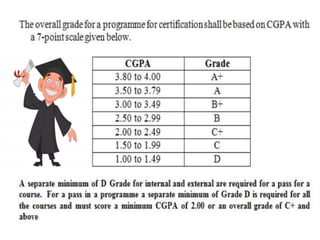
Applicability of the Grading
System
• The guidelines of UGC applied to all
undergraduate and postgraduate level degree,
diploma and certificate programmes under the
credit system awarded by the Central, State and
Deemed to be universities in India.
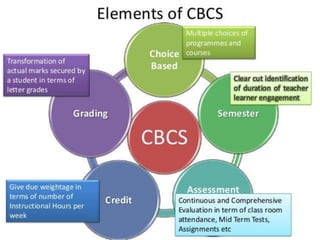
• Introduced Choice Based Credit System (CBCS)
and Credit Based Semester System (CBSS)
Suresh Babu G
Definitions of Key Words
• Academic Year: Two consecutive (one odd +
one even) semesters constitute one academic
year.
• Choice Based Credit System (CBCS): The
CBCS provides choice for students to select
from the prescribed courses (core, elective or
minor or soft skill courses).
Suresh Babu G
• Course: Usually referred to, as ‘papers’ is a
component of a programme. All courses need
not carry the same weight. The courses should
define learning objectives and learning
outcomes. A course may be designed to
comprise lectures/ tutorials/laboratory work/ field
work/ outreach activities/ project work/
vocational training/viva/ seminars/ term
papers/assignments/ presentations/ self-study
etc. or a combination of some of these.
Suresh Babu G
• Credit Based Semester System
(CBSS): Under the CBSS, the requirement
for awarding a degree or diploma or
certificate is prescribed in terms of number of
credits to be completed by the students.
• Credit Point : It is the product of grade point
and number of credits for a course.
• Credit : A unit by which the course work is
measured. It determines the number of hours
of instructions required per week. One credit
is equivalent to one hour of teaching (lecture
or tutorial) or two hours of practical work/field
work per week.
Suresh Babu G
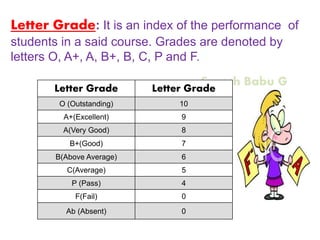
Letter Grade Letter Grade
O (Outstanding) 10
A+(Excellent) 9
A(Very Good) 8
B+(Good) 7
B(Above Average) 6
C(Average) 5
P (Pass) 4
F(Fail) 0
Ab (Absent) 0
Letter Grade: It is an index of the performance of
students in a said course. Grades are denoted by
letters O, A+, A, B+, B, C, P and F.
Suresh Babu G
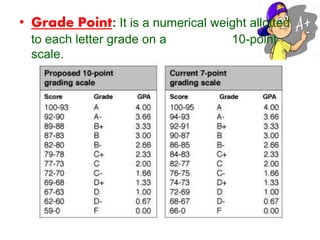
• Grade Point: It is a numerical weight allotted
to each letter grade on a 10-point
scale.
Suresh Babu G
• Cumulative Grade Point Average
(CGPA) : It is a measure of overall cumulative
performance of a student over all semesters.
The CGPA is the ratio of total credit points
secured by a student in various courses in all
semesters and the sum of the total credits of all
courses in all the semesters. It is expressed up
to two decimal places.
Suresh Babu G
Suresh Babu G
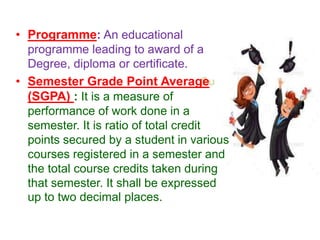
• Programme: An educational
programme leading to award of a
Degree, diploma or certificate.
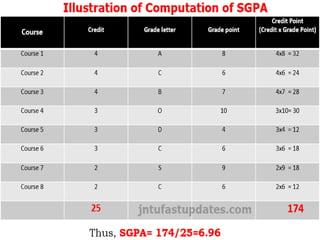
• Semester Grade Point Average
(SGPA) : It is a measure of
performance of work done in a
semester. It is ratio of total credit
points secured by a student in various
courses registered in a semester and
the total course credits taken during
that semester. It shall be expressed
up to two decimal places.
Suresh Babu G
CREDIT POINT AND CREDIT POINT AVERAGE
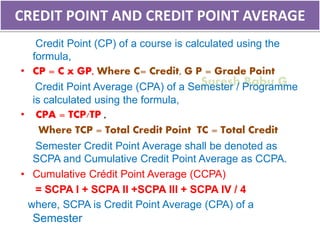
Credit Point (CP) of a course is calculated using the
formula,
• CP = C x GP, Where C= Credit, G P = Grade Point
Credit Point Average (CPA) of a Semester / Programme
is calculated using the formula,
• CPA = TCP/TP ,
Where TCP = Total Credit Point TC = Total Credit
Semester Credit Point Average shall be denoted as
SCPA and Cumulative Credit Point Average as CCPA.
• Cumulative Crédit Point Average (CCPA)
= SCPA I + SCPA II +SCPA III + SCPA IV / 4
where, SCPA is Credit Point Average (CPA) of a
Semester
Suresh Babu G
Suresh Babu G
• Transcript or Grade Card
or Certificate: Based on the
grades earned, a grade
certificate shall be issued to all
the registered students after
every semester. The grade
certificate will display the course
details (code, title, number of
credits, grade secured) along
with SGPA of that semester and
CGPA earned till that semester.
Suresh Babu G
Suresh Babu G
Types of Courses
Courses in a programme may be of three kinds:
Core, Elective and Foundation.
Core Course
There may be a Core Course in every semester.
This is the course which is to be compulsorily
studied by a student as a core requirement to
complete the requirement of a programme in a
said discipline of study.
Suresh Babu G
Elective Course
• Elective course is a course which can be
chosen from a pool of papers. It may be:
– Supportive to the discipline of study
– Providing an expanded scope
– Enabling an exposure to some other
discipline/domain
– Nurturing student’s proficiency/skill.
• An elective may be “Generic Elective”
focusing on those courses which add generic
proficiency to the students. An elective may
be “Discipline centric "or may be chosen from
an unrelated discipline. It may be called an
“Open Elective.”
Suresh Babu G
Foundation Course
The Foundation Courses may be of two kinds:
Compulsory Foundation and Elective foundation.
“Compulsory Foundation” courses are the
courses based upon the content that leads to
Knowledge enhancement. They are mandatory
for all disciplines. Elective Foundation courses
are value-based and are aimed at man-making
education.
Suresh Babu G
Examination and Assessment
• In assessing the performance of the students in
examinations, the usual approach is to award
marks based on the examinations conducted at
various stages (sectional, mid-term, end-
semester etc.,) in a semester. Some of the HEIs
convert these marks to letter grades based on
absolute or relative grading system and award
the grades.
Suresh Babu G
Letter Grades and Grade Points
• Two methods -relative grading or
absolute grading
• . The relative grading is based on the
distribution (usually normal
distribution) of marks obtained by all
the students of the course and the
grades are awarded based on a cut-
off marks or percentile.
Suresh Babu G
Absolute Grading
Under the absolute grading, the
marks are converted to grades
based on pre-determined class
intervals. To implement the
following grading system, the
colleges and universities can use
any one of the above methods.
Suresh Babu G
Benefits of Academic Credit
System
• Keep track of student progress and determine
when he or she has met the requirements for
awarding a specific academic degree.
• Offers a good estimate of the workload of a
programme.
• Some academic credit systems permit students
to transfer to different programmes and keep
part or all of their previously earned credit
points.
Suresh Babu G

Credit and Semester System

  • 1.
    Suresh Babu G Creditand Semester System Suresh Babu G Assistant Professor CTE CPAS Paippad, Kottayam
  • 2.
    Suresh Babu G Creditand Semester System It is ratio of total credit points secured by a student in various courses registered in a semester and the total course credits taken during that semester.
  • 3.
    Suresh Babu G Itshall be expressed up to two decimal places. • Credit system - A credit system is a systematic way of describing an educational programme by attaching credits to its components. The definition of credits in higher education systems may be based on different parameters, such as student workload, learning outcomes and contact hours. • Semester system - Each semester will consist of 15-18 weeks of academic work equivalent to 90 actual teaching days. The old semester may be scheduled from July to December and even semester from January to July. Credit and Semester System
  • 4.
    Suresh Babu G •The University Grants Commission (UGC) has initiated several measures to bring equity, efficiency and excellence in the Higher Education System of country. To bring in the desired uniformity, in grading system and method for computing the cumulative grade point average (CGPA) based on the performance of students in the examinations, the UGC has formulated these guidelines. Credit and Semester System
  • 5.
    Suresh Babu G Applicabilityof the Grading System • The guidelines of UGC applied to all undergraduate and postgraduate level degree, diploma and certificate programmes under the credit system awarded by the Central, State and Deemed to be universities in India. • Introduced Choice Based Credit System (CBCS) and Credit Based Semester System (CBSS)
  • 6.
    Suresh Babu G Definitionsof Key Words • Academic Year: Two consecutive (one odd + one even) semesters constitute one academic year. • Choice Based Credit System (CBCS): The CBCS provides choice for students to select from the prescribed courses (core, elective or minor or soft skill courses).
  • 7.
    Suresh Babu G •Course: Usually referred to, as ‘papers’ is a component of a programme. All courses need not carry the same weight. The courses should define learning objectives and learning outcomes. A course may be designed to comprise lectures/ tutorials/laboratory work/ field work/ outreach activities/ project work/ vocational training/viva/ seminars/ term papers/assignments/ presentations/ self-study etc. or a combination of some of these.
  • 8.
    Suresh Babu G •Credit Based Semester System (CBSS): Under the CBSS, the requirement for awarding a degree or diploma or certificate is prescribed in terms of number of credits to be completed by the students. • Credit Point : It is the product of grade point and number of credits for a course. • Credit : A unit by which the course work is measured. It determines the number of hours of instructions required per week. One credit is equivalent to one hour of teaching (lecture or tutorial) or two hours of practical work/field work per week.
  • 9.
    Suresh Babu G LetterGrade Letter Grade O (Outstanding) 10 A+(Excellent) 9 A(Very Good) 8 B+(Good) 7 B(Above Average) 6 C(Average) 5 P (Pass) 4 F(Fail) 0 Ab (Absent) 0 Letter Grade: It is an index of the performance of students in a said course. Grades are denoted by letters O, A+, A, B+, B, C, P and F.
  • 10.
    Suresh Babu G •Grade Point: It is a numerical weight allotted to each letter grade on a 10-point scale.
  • 11.
    Suresh Babu G •Cumulative Grade Point Average (CGPA) : It is a measure of overall cumulative performance of a student over all semesters. The CGPA is the ratio of total credit points secured by a student in various courses in all semesters and the sum of the total credits of all courses in all the semesters. It is expressed up to two decimal places.
  • 12.
  • 13.
    Suresh Babu G •Programme: An educational programme leading to award of a Degree, diploma or certificate. • Semester Grade Point Average (SGPA) : It is a measure of performance of work done in a semester. It is ratio of total credit points secured by a student in various courses registered in a semester and the total course credits taken during that semester. It shall be expressed up to two decimal places.
  • 14.
    Suresh Babu G CREDITPOINT AND CREDIT POINT AVERAGE Credit Point (CP) of a course is calculated using the formula, • CP = C x GP, Where C= Credit, G P = Grade Point Credit Point Average (CPA) of a Semester / Programme is calculated using the formula, • CPA = TCP/TP , Where TCP = Total Credit Point TC = Total Credit Semester Credit Point Average shall be denoted as SCPA and Cumulative Credit Point Average as CCPA. • Cumulative Crédit Point Average (CCPA) = SCPA I + SCPA II +SCPA III + SCPA IV / 4 where, SCPA is Credit Point Average (CPA) of a Semester
  • 15.
  • 16.
    Suresh Babu G •Transcript or Grade Card or Certificate: Based on the grades earned, a grade certificate shall be issued to all the registered students after every semester. The grade certificate will display the course details (code, title, number of credits, grade secured) along with SGPA of that semester and CGPA earned till that semester.
  • 17.
  • 18.
    Suresh Babu G Typesof Courses Courses in a programme may be of three kinds: Core, Elective and Foundation. Core Course There may be a Core Course in every semester. This is the course which is to be compulsorily studied by a student as a core requirement to complete the requirement of a programme in a said discipline of study.
  • 19.
    Suresh Babu G ElectiveCourse • Elective course is a course which can be chosen from a pool of papers. It may be: – Supportive to the discipline of study – Providing an expanded scope – Enabling an exposure to some other discipline/domain – Nurturing student’s proficiency/skill. • An elective may be “Generic Elective” focusing on those courses which add generic proficiency to the students. An elective may be “Discipline centric "or may be chosen from an unrelated discipline. It may be called an “Open Elective.”
  • 20.
    Suresh Babu G FoundationCourse The Foundation Courses may be of two kinds: Compulsory Foundation and Elective foundation. “Compulsory Foundation” courses are the courses based upon the content that leads to Knowledge enhancement. They are mandatory for all disciplines. Elective Foundation courses are value-based and are aimed at man-making education.
  • 21.
    Suresh Babu G Examinationand Assessment • In assessing the performance of the students in examinations, the usual approach is to award marks based on the examinations conducted at various stages (sectional, mid-term, end- semester etc.,) in a semester. Some of the HEIs convert these marks to letter grades based on absolute or relative grading system and award the grades.
  • 22.
    Suresh Babu G LetterGrades and Grade Points • Two methods -relative grading or absolute grading • . The relative grading is based on the distribution (usually normal distribution) of marks obtained by all the students of the course and the grades are awarded based on a cut- off marks or percentile.
  • 23.
    Suresh Babu G AbsoluteGrading Under the absolute grading, the marks are converted to grades based on pre-determined class intervals. To implement the following grading system, the colleges and universities can use any one of the above methods.
  • 24.
    Suresh Babu G Benefitsof Academic Credit System • Keep track of student progress and determine when he or she has met the requirements for awarding a specific academic degree. • Offers a good estimate of the workload of a programme. • Some academic credit systems permit students to transfer to different programmes and keep part or all of their previously earned credit points.
  • 25.