 According to National Knowledge Commission (NKC), the
Present System is
 Teacher centric approach
 Teacher never asks, “why am I teaching this, what will students do
after this exposure?”
 What are the kinds of activities student should be engaged to have
“learning opportunities”?
 There are no opportunities for – Group work – Individual work –
Data collection – Field work – Quizzes – Class tests – Community
involvement
 No inter-disciplinary mobility possible
 Lack of multi-disciplinary, closed isolated environment
 Lack of choices for the student
 No opportunity to the learner to walk out and walk in to
earn a certification
 No scope to introduce latest knowledge in the
curriculum, and
 Learning goals of the course and learning objectives of
the units/submits never enunciated.19th Century‟s
Mindset, 20th Century‟s Process and 21st Century‟s
Needs (Dr. Sam Pitroda)
 Hence Choice Based Credit System (CBCS)
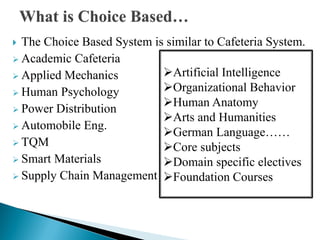
 The Choice Based System is similar to Cafeteria System.
 Academic Cafeteria
 Applied Mechanics
 Human Psychology
 Power Distribution
 Automobile Eng.
 TQM
 Smart Materials
 Supply Chain Management
Artificial Intelligence
Organizational Behavior
Human Anatomy
Arts and Humanities
German Language……
Core subjects
Domain specific electives
Foundation Courses
A credit system is a systematic way of
describing an educational programme by
attaching credits to its components.
The definition of credits in higher education
systems may be based on different parameters,
such as student workload, learning outcomes,
entrepreneurship skills, contact hours,
innovation and Creativity talents, etc.
 A “cafeteria” type approach in which the students
can take courses of their choice, learn at their own
pace, undergo additional courses, acquire more than
the required credits, and adopt an interdisciplinary
approach to learning.
 Transformation from the traditional teacher-centered
education to a student-centered education.
 CBCS provides greater flexibility with multiple
exits, multiple pathways, vertical mobility.
 To provide broad based education;
 To provide students with greater flexibility in choice of
courses;
 To provide students multi-disciplinary curriculum;
 To enable students to choose courses at basic/advanced
level/inter-disciplinary;
 To enable students to acquire job oriented skills;
 To enable students to progress at their own pace;
 To enable highly motivated students gain extra credits;
and
 To Bridge the gap between professional and social
exposure to provide a holistic education.
Health & Nutrition
Academic Excellence
Research Ability
Exposure
Leadership Qualities
 Choice enables a learner to pursue any area of
knowledge domain depending upon his / her interest.
 Choice also widens the horizon of learner‟s
intellectual insight.
 Rigidity of present system does not allow pursuit of
areas of interest as well as widening the educational
horizon of the learner, and
 Provision of choice is an essential condition for
broad- based learner‟s profile across areas of
knowledge.
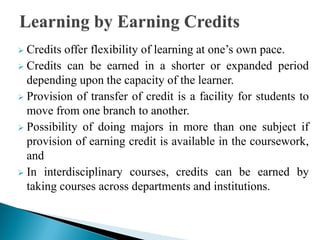
 Credits offer flexibility of learning at one‟s own pace.
 Credits can be earned in a shorter or expanded period
depending upon the capacity of the learner.
 Provision of transfer of credit is a facility for students to
move from one branch to another.
 Possibility of doing majors in more than one subject if
provision of earning credit is available in the coursework,
and
 In interdisciplinary courses, credits can be earned by
taking courses across departments and institutions.
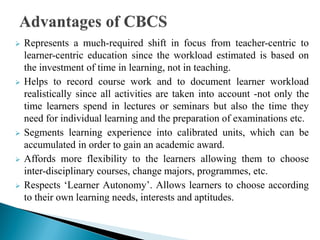
 Represents a much-required shift in focus from teacher-centric to
learner-centric education since the workload estimated is based on
the investment of time in learning, not in teaching.
 Helps to record course work and to document learner workload
realistically since all activities are taken into account -not only the
time learners spend in lectures or seminars but also the time they
need for individual learning and the preparation of examinations etc.
 Segments learning experience into calibrated units, which can be
accumulated in order to gain an academic award.
 Affords more flexibility to the learners allowing them to choose
inter-disciplinary courses, change majors, programmes, etc.
 Respects „Learner Autonomy‟. Allows learners to choose according
to their own learning needs, interests and aptitudes.
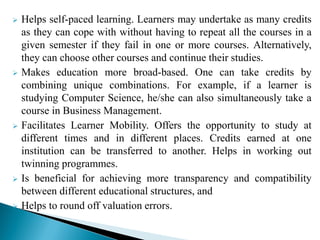
 Helps self-paced learning. Learners may undertake as many credits
as they can cope with without having to repeat all the courses in a
given semester if they fail in one or more courses. Alternatively,
they can choose other courses and continue their studies.
 Makes education more broad-based. One can take credits by
combining unique combinations. For example, if a learner is
studying Computer Science, he/she can also simultaneously take a
course in Business Management.
 Facilitates Learner Mobility. Offers the opportunity to study at
different times and in different places. Credits earned at one
institution can be transferred to another. Helps in working out
twinning programmes.
 Is beneficial for achieving more transparency and compatibility
between different educational structures, and
 Helps to round off valuation errors.
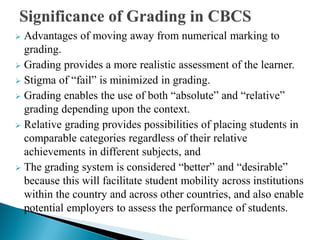
 Advantages of moving away from numerical marking to
grading.
 Grading provides a more realistic assessment of the learner.
 Stigma of “fail” is minimized in grading.
 Grading enables the use of both “absolute” and “relative”
grading depending upon the context.
 Relative grading provides possibilities of placing students in
comparable categories regardless of their relative
achievements in different subjects, and
 The grading system is considered “better” and “desirable”
because this will facilitate student mobility across institutions
within the country and across other countries, and also enable
potential employers to assess the performance of students.
 Definitions of Key Words
 Choice Based Credit System (CBCS): The CBCS provides choice
for students to select from the prescribed courses (core, elective or
minor or soft skill courses).
 Course: All courses need not carry the same weight. The courses
should define learning objectives and learning outcomes. A course
may be designed to comprise lectures/ tutorials / laboratory work/
field work/ outreach activities/ project work/ vocational
training/viva/ seminars/term papers/assignments/ presentations/ self-
study etc. or a combination of some of these.
 Credit Point: It is the product of grade point and number of credits
for a course.
 Grade Point: It is a numerical weight allotted to each letter
grade on a 10-point
 Letter Grade: It is an index of the performance of students in a
said course. Grades are denoted by letters O, A+, A, B+, B, C, P
and F.
 Semester Grade Point Average (SGPA): It is a measure of
performance of work done in a semester. It is ratio of total credit
points secured by a student in various courses registered in a
semester and the total course credits taken during that semester.
It shall be expressed up to two decimal places.
 Semester: weeks of academic work equivalent to 90 actual
teaching days. The odd semester may be scheduled from July to
December and even semester from January to June.
 Transcript or Grade Card or Certificate: Based on the grades
earned, a grade certificate shall be issued to all the registered
students after every semester.
 Core Course: There may be a Core Course in every semester.
This is the course which is to be compulsorily studied by a
student as a core requirement to complete the requirement of a
programme in a said discipline of study.
 Elective Course:- Elective course is a course which can be
chosen from a pool of papers. It may be:
 Supportive to the discipline of study
 Providing an expanded scope
 Enabling an exposure to some other discipline/domain
 Nurturing student‟s proficiency/skill.
 An elective may be “Generic Elective” focusing on those
courses which add generic proficiency to the students. An
elective may be “Discipline centric”
 or may be chosen from an unrelated discipline. It may be
called an “Open Elective.”
 Foundation Course:
 The Foundation Courses may be of two kinds:
Compulsory Foundation and Elective foundation.
“Compulsory Foundation” courses are the courses
based upon the content that leads to Knowledge
enhancement.
 They are mandatory for all disciplines. “Elective
Foundation” courses are value-based and are aimed at
man-making education.
 The UGC recommends the following system to be
implemented in awarding the grades and CGPA under
the credit based semester system.
 Two methods -relative grading or absolute grading–
have been in vogue for awarding grades in a course,
and
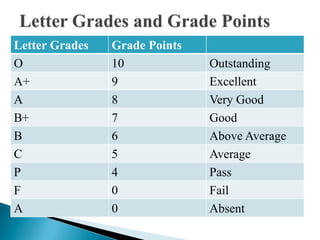
 The UGC recommends a 10-point grading system with
the following letter grades as given below:
Letter Grades Grade Points
O 10 Outstanding
A+ 9 Excellent
A 8 Very Good
B+ 7 Good
B 6 Above Average
C 5 Average
P 4 Pass
F 0 Fail
A 0 Absent
Choice Based Credit System (CBCS)-Objectives, Importance, Advantages, and UGC Guidelines

Choice Based Credit System (CBCS)-Objectives, Importance, Advantages, and UGC Guidelines

  • 2.
     According toNational Knowledge Commission (NKC), the Present System is  Teacher centric approach  Teacher never asks, “why am I teaching this, what will students do after this exposure?”  What are the kinds of activities student should be engaged to have “learning opportunities”?  There are no opportunities for – Group work – Individual work – Data collection – Field work – Quizzes – Class tests – Community involvement  No inter-disciplinary mobility possible  Lack of multi-disciplinary, closed isolated environment  Lack of choices for the student
  • 3.
     No opportunityto the learner to walk out and walk in to earn a certification  No scope to introduce latest knowledge in the curriculum, and  Learning goals of the course and learning objectives of the units/submits never enunciated.19th Century‟s Mindset, 20th Century‟s Process and 21st Century‟s Needs (Dr. Sam Pitroda)  Hence Choice Based Credit System (CBCS)
  • 5.
     The ChoiceBased System is similar to Cafeteria System.  Academic Cafeteria  Applied Mechanics  Human Psychology  Power Distribution  Automobile Eng.  TQM  Smart Materials  Supply Chain Management Artificial Intelligence Organizational Behavior Human Anatomy Arts and Humanities German Language…… Core subjects Domain specific electives Foundation Courses
  • 6.
    A credit systemis a systematic way of describing an educational programme by attaching credits to its components. The definition of credits in higher education systems may be based on different parameters, such as student workload, learning outcomes, entrepreneurship skills, contact hours, innovation and Creativity talents, etc.
  • 7.
     A “cafeteria”type approach in which the students can take courses of their choice, learn at their own pace, undergo additional courses, acquire more than the required credits, and adopt an interdisciplinary approach to learning.  Transformation from the traditional teacher-centered education to a student-centered education.  CBCS provides greater flexibility with multiple exits, multiple pathways, vertical mobility.
  • 8.
     To providebroad based education;  To provide students with greater flexibility in choice of courses;  To provide students multi-disciplinary curriculum;  To enable students to choose courses at basic/advanced level/inter-disciplinary;  To enable students to acquire job oriented skills;  To enable students to progress at their own pace;  To enable highly motivated students gain extra credits; and  To Bridge the gap between professional and social exposure to provide a holistic education.
  • 9.
    Health & Nutrition AcademicExcellence Research Ability Exposure Leadership Qualities
  • 10.
     Choice enablesa learner to pursue any area of knowledge domain depending upon his / her interest.  Choice also widens the horizon of learner‟s intellectual insight.  Rigidity of present system does not allow pursuit of areas of interest as well as widening the educational horizon of the learner, and  Provision of choice is an essential condition for broad- based learner‟s profile across areas of knowledge.
  • 11.
     Credits offerflexibility of learning at one‟s own pace.  Credits can be earned in a shorter or expanded period depending upon the capacity of the learner.  Provision of transfer of credit is a facility for students to move from one branch to another.  Possibility of doing majors in more than one subject if provision of earning credit is available in the coursework, and  In interdisciplinary courses, credits can be earned by taking courses across departments and institutions.
  • 12.
     Represents amuch-required shift in focus from teacher-centric to learner-centric education since the workload estimated is based on the investment of time in learning, not in teaching.  Helps to record course work and to document learner workload realistically since all activities are taken into account -not only the time learners spend in lectures or seminars but also the time they need for individual learning and the preparation of examinations etc.  Segments learning experience into calibrated units, which can be accumulated in order to gain an academic award.  Affords more flexibility to the learners allowing them to choose inter-disciplinary courses, change majors, programmes, etc.  Respects „Learner Autonomy‟. Allows learners to choose according to their own learning needs, interests and aptitudes.
  • 13.
     Helps self-pacedlearning. Learners may undertake as many credits as they can cope with without having to repeat all the courses in a given semester if they fail in one or more courses. Alternatively, they can choose other courses and continue their studies.  Makes education more broad-based. One can take credits by combining unique combinations. For example, if a learner is studying Computer Science, he/she can also simultaneously take a course in Business Management.  Facilitates Learner Mobility. Offers the opportunity to study at different times and in different places. Credits earned at one institution can be transferred to another. Helps in working out twinning programmes.  Is beneficial for achieving more transparency and compatibility between different educational structures, and  Helps to round off valuation errors.
  • 14.
     Advantages ofmoving away from numerical marking to grading.  Grading provides a more realistic assessment of the learner.  Stigma of “fail” is minimized in grading.  Grading enables the use of both “absolute” and “relative” grading depending upon the context.  Relative grading provides possibilities of placing students in comparable categories regardless of their relative achievements in different subjects, and  The grading system is considered “better” and “desirable” because this will facilitate student mobility across institutions within the country and across other countries, and also enable potential employers to assess the performance of students.
  • 15.
     Definitions ofKey Words  Choice Based Credit System (CBCS): The CBCS provides choice for students to select from the prescribed courses (core, elective or minor or soft skill courses).  Course: All courses need not carry the same weight. The courses should define learning objectives and learning outcomes. A course may be designed to comprise lectures/ tutorials / laboratory work/ field work/ outreach activities/ project work/ vocational training/viva/ seminars/term papers/assignments/ presentations/ self- study etc. or a combination of some of these.  Credit Point: It is the product of grade point and number of credits for a course.
  • 16.
     Grade Point:It is a numerical weight allotted to each letter grade on a 10-point  Letter Grade: It is an index of the performance of students in a said course. Grades are denoted by letters O, A+, A, B+, B, C, P and F.  Semester Grade Point Average (SGPA): It is a measure of performance of work done in a semester. It is ratio of total credit points secured by a student in various courses registered in a semester and the total course credits taken during that semester. It shall be expressed up to two decimal places.  Semester: weeks of academic work equivalent to 90 actual teaching days. The odd semester may be scheduled from July to December and even semester from January to June.  Transcript or Grade Card or Certificate: Based on the grades earned, a grade certificate shall be issued to all the registered students after every semester.
  • 17.
     Core Course:There may be a Core Course in every semester. This is the course which is to be compulsorily studied by a student as a core requirement to complete the requirement of a programme in a said discipline of study.  Elective Course:- Elective course is a course which can be chosen from a pool of papers. It may be:  Supportive to the discipline of study  Providing an expanded scope  Enabling an exposure to some other discipline/domain  Nurturing student‟s proficiency/skill.  An elective may be “Generic Elective” focusing on those courses which add generic proficiency to the students. An elective may be “Discipline centric”  or may be chosen from an unrelated discipline. It may be called an “Open Elective.”
  • 18.
     Foundation Course: The Foundation Courses may be of two kinds: Compulsory Foundation and Elective foundation. “Compulsory Foundation” courses are the courses based upon the content that leads to Knowledge enhancement.  They are mandatory for all disciplines. “Elective Foundation” courses are value-based and are aimed at man-making education.
  • 19.
     The UGCrecommends the following system to be implemented in awarding the grades and CGPA under the credit based semester system.  Two methods -relative grading or absolute grading– have been in vogue for awarding grades in a course, and  The UGC recommends a 10-point grading system with the following letter grades as given below:
  • 20.
    Letter Grades GradePoints O 10 Outstanding A+ 9 Excellent A 8 Very Good B+ 7 Good B 6 Above Average C 5 Average P 4 Pass F 0 Fail A 0 Absent