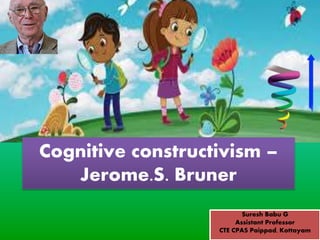

Cognitive constructivism –
Jerome.S. Bruner
Suresh Babu G
Assistant Professor
CTE CPAS Paippad, Kottayam
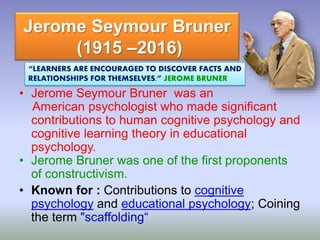
Jerome Seymour Bruner
(1915 –2016)
• Jerome Seymour Bruner was an
American psychologist who made significant
contributions to human cognitive psychology and
cognitive learning theory in educational
psychology.
• Jerome Bruner was one of the first proponents
of constructivism.
• Known for : Contributions to cognitive
psychology and educational psychology; Coining
the term "scaffolding“
“LEARNERS ARE ENCOURAGED TO DISCOVER FACTS AND
RELATIONSHIPS FOR THEMSELVES.” JEROME BRUNER
Six aspects of Cognitive
Development – Jerome.S.Bruner
1. Cognitive development is characterized by
increasing independence of a response from a
stimulus.
2. Cognitive development is characterized by any
internal storage and information processing
system that can describe reality quite closely.
3. Cognitive development involves an increasing
capacity to express by
words or symbols what one
has done and what one will do.
4. Cognitive development depends upon
systematic interaction with members of society.
5. Cognitive development is quite closely related to
language development.
6. Cognitive development is marked by increasing
ability to perform concurrent activities and to
allocate attention sequentially to various
activities.
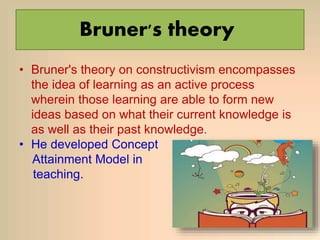
Bruner's theory
• Bruner's theory on constructivism encompasses
the idea of learning as an active process
wherein those learning are able to form new
ideas based on what their current knowledge is
as well as their past knowledge.
• He developed Concept
Attainment Model in
teaching.
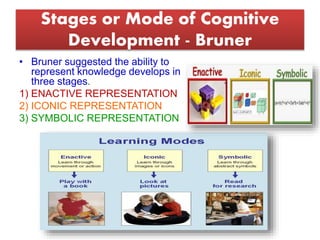
Stages or Mode of Cognitive
Development - Bruner
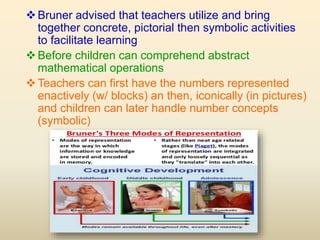
• Bruner suggested the ability to
represent knowledge develops in
three stages.
1) ENACTIVE REPRESENTATION
2) ICONIC REPRESENTATION
3) SYMBOLIC REPRESENTATION
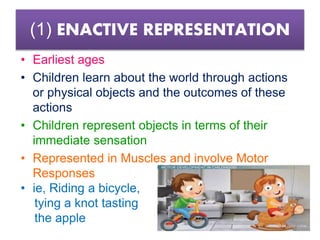
(1) ENACTIVE REPRESENTATION
• Earliest ages
• Children learn about the world through actions
or physical objects and the outcomes of these
actions
• Children represent objects in terms of their
immediate sensation
• Represented in Muscles and involve Motor
Responses
• ie, Riding a bicycle,
tying a knot tasting
the apple
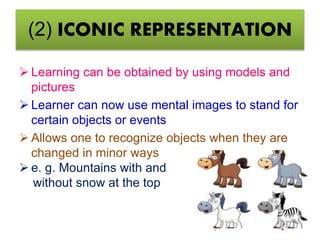
(2) ICONIC REPRESENTATION
 Learning can be obtained by using models and
pictures
 Learner can now use mental images to stand for
certain objects or events
 Allows one to recognize objects when they are
changed in minor ways
 e. g. Mountains with and
without snow at the top
(3) SYMBOLIC REPRESENTATION
Learner has developed the ability to think in
abstract terms
Uses symbol system to encode knowledge
Most common symbol systems are language
and mathematical notation
Bruner advised that teachers utilize and bring
together concrete, pictorial then symbolic activities
to facilitate learning
Before children can comprehend abstract
mathematical operations
Teachers can first have the numbers represented
enactively (w/ blocks) an then, iconically (in pictures)
and children can later handle number concepts
(symbolic)
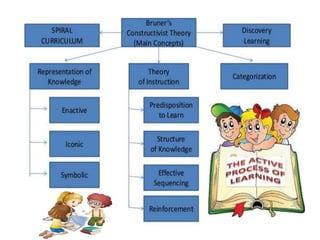
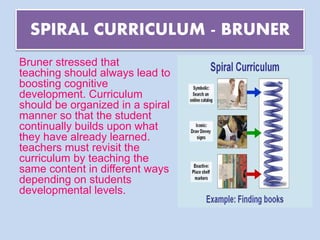
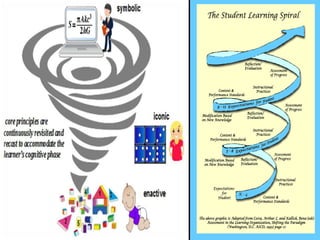
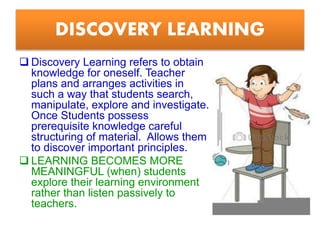
SPIRAL CURRICULUM - BRUNER
Bruner stressed that
teaching should always lead to
boosting cognitive
development. Curriculum
should be organized in a spiral
manner so that the student
continually builds upon what
they have already learned.
teachers must revisit the
curriculum by teaching the
same content in different ways
depending on students
developmental levels.
DISCOVERY LEARNING
 Discovery Learning refers to obtain
knowledge for oneself. Teacher
plans and arranges activities in
such a way that students search,
manipulate, explore and investigate.
Once Students possess
prerequisite knowledge careful
structuring of material. Allows them
to discover important principles.
 LEARNING BECOMES MORE
MEANINGFUL (when) students
explore their learning environment
rather than listen passively to
teachers.
THEORY OF INSTRUCTION
BRUNER (1966) states that a theory of instruction
should address four major aspects:
1. PREDISPOSITION TO LEARN- introduced the ideas
of “readiness learning”.
2. STRUCTURE OF KNOWLEDGE- the ways in w/c a
body of knowledge can be structured so that it can be
most readily grasped by the learner.
3. EFFECTIVE SEQUENCING- No one sequencing will
fit every learner, but in general, the lesson can be
presented in increasing difficulty.
4. REINFORCEMENT - Rewards and
punishment should be selected
and paced appropriately.
KINDS OF CATEGORIES
1. IDENTITY CATEGORIES - include objects based
on the attributes or features. (Example, for an
object to be included in the category "car" it must
have an engine, 4 wheels, and be a possible
means of transportation)
2. EQUIVALENT CATEGORIES - (provide rules for
combining categories MOTOR VEHICLE = CAR,
TRUCK, VAN SCIENCE = AN APPLE green, ripe,
dried,
3. CODING SYSTEMS – categories that serve to
recognize sensory input people interpret the
world largely in terms of similarities and
differences.
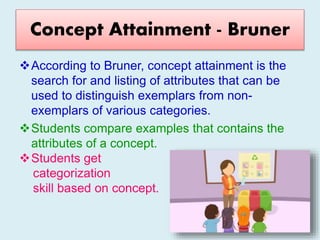
Concept Attainment - Bruner
According to Bruner, concept attainment is the
search for and listing of attributes that can be
used to distinguish exemplars from non-
exemplars of various categories.
Students compare examples that contains the
attributes of a concept.
Students get
categorization
skill based on concept.
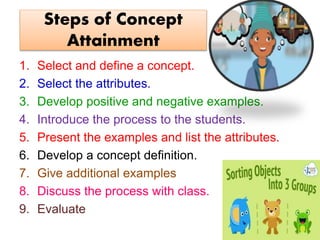
Steps of Concept
Attainment
1. Select and define a concept.
2. Select the attributes.
3. Develop positive and negative examples.
4. Introduce the process to the students.
5. Present the examples and list the attributes.
6. Develop a concept definition.
7. Give additional examples
8. Discuss the process with class.
9. Evaluate
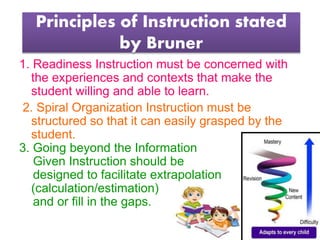
Principles of Instruction stated
by Bruner
1. Readiness Instruction must be concerned with
the experiences and contexts that make the
student willing and able to learn.
2. Spiral Organization Instruction must be
structured so that it can easily grasped by the
student.
3. Going beyond the Information
Given Instruction should be
designed to facilitate extrapolation
(calculation/estimation)
and or fill in the gaps.
Implication of Bruner's
learning theory on teaching
• Learning is an active process.
• Learners make appropriate decisions and postulate
hypotheses and test their effectiveness.
• Learners use prior experience to fit new information
into the pre-existing structures.
• Scaffolding is the process through which able peers or
adults offer supports for learning.
• The notion of spiral curriculum states that a curriculum
should revisit basic ideas, building on them until the
student grasps the full formal concept.
• Although extrinsic motivation may work in the short
run, intrinsic motivation has more value
Implications on the learning process
Bruner’s learning theory has direct implications on
the teaching practices.
 Instruction must be appropriate to the level of the
learners.
 The teachers must revisit material to enhance
knowledge
 Material must be presented in a sequence giving
the learners the opportunity to:
a. acquire and construct knowledge,
b. transform and transfer his learning.
 Students should be involved in using their prior
experiences and structures to learn new
knowledge.
 Help students to categorize new information in
order to able to see similarities and differences
between items.
 Teachers should assist learners in building their
knowledge. This assistance should fade away as it
becomes unnecessary.
 Teachers should provide feedback that is directed
towards intrinsic motivation.
Implications on the learning process
Suresh Babu

Cognitive constructivism – Jerome.S. Bruner

  • 1.
    Cognitive constructivism – Jerome.S.Bruner Suresh Babu G Assistant Professor CTE CPAS Paippad, Kottayam
  • 2.
    Jerome Seymour Bruner (1915–2016) • Jerome Seymour Bruner was an American psychologist who made significant contributions to human cognitive psychology and cognitive learning theory in educational psychology. • Jerome Bruner was one of the first proponents of constructivism. • Known for : Contributions to cognitive psychology and educational psychology; Coining the term "scaffolding“ “LEARNERS ARE ENCOURAGED TO DISCOVER FACTS AND RELATIONSHIPS FOR THEMSELVES.” JEROME BRUNER
  • 3.
    Six aspects ofCognitive Development – Jerome.S.Bruner 1. Cognitive development is characterized by increasing independence of a response from a stimulus. 2. Cognitive development is characterized by any internal storage and information processing system that can describe reality quite closely. 3. Cognitive development involves an increasing capacity to express by words or symbols what one has done and what one will do.
  • 4.
    4. Cognitive developmentdepends upon systematic interaction with members of society. 5. Cognitive development is quite closely related to language development. 6. Cognitive development is marked by increasing ability to perform concurrent activities and to allocate attention sequentially to various activities.
  • 5.
    Bruner's theory • Bruner'stheory on constructivism encompasses the idea of learning as an active process wherein those learning are able to form new ideas based on what their current knowledge is as well as their past knowledge. • He developed Concept Attainment Model in teaching.
  • 7.
    Stages or Modeof Cognitive Development - Bruner • Bruner suggested the ability to represent knowledge develops in three stages. 1) ENACTIVE REPRESENTATION 2) ICONIC REPRESENTATION 3) SYMBOLIC REPRESENTATION
  • 8.
    (1) ENACTIVE REPRESENTATION •Earliest ages • Children learn about the world through actions or physical objects and the outcomes of these actions • Children represent objects in terms of their immediate sensation • Represented in Muscles and involve Motor Responses • ie, Riding a bicycle, tying a knot tasting the apple
  • 9.
    (2) ICONIC REPRESENTATION Learning can be obtained by using models and pictures  Learner can now use mental images to stand for certain objects or events  Allows one to recognize objects when they are changed in minor ways  e. g. Mountains with and without snow at the top
  • 10.
    (3) SYMBOLIC REPRESENTATION Learnerhas developed the ability to think in abstract terms Uses symbol system to encode knowledge Most common symbol systems are language and mathematical notation
  • 11.
    Bruner advised thatteachers utilize and bring together concrete, pictorial then symbolic activities to facilitate learning Before children can comprehend abstract mathematical operations Teachers can first have the numbers represented enactively (w/ blocks) an then, iconically (in pictures) and children can later handle number concepts (symbolic)
  • 12.
    SPIRAL CURRICULUM -BRUNER Bruner stressed that teaching should always lead to boosting cognitive development. Curriculum should be organized in a spiral manner so that the student continually builds upon what they have already learned. teachers must revisit the curriculum by teaching the same content in different ways depending on students developmental levels.
  • 14.
    DISCOVERY LEARNING  DiscoveryLearning refers to obtain knowledge for oneself. Teacher plans and arranges activities in such a way that students search, manipulate, explore and investigate. Once Students possess prerequisite knowledge careful structuring of material. Allows them to discover important principles.  LEARNING BECOMES MORE MEANINGFUL (when) students explore their learning environment rather than listen passively to teachers.
  • 15.
    THEORY OF INSTRUCTION BRUNER(1966) states that a theory of instruction should address four major aspects: 1. PREDISPOSITION TO LEARN- introduced the ideas of “readiness learning”. 2. STRUCTURE OF KNOWLEDGE- the ways in w/c a body of knowledge can be structured so that it can be most readily grasped by the learner. 3. EFFECTIVE SEQUENCING- No one sequencing will fit every learner, but in general, the lesson can be presented in increasing difficulty. 4. REINFORCEMENT - Rewards and punishment should be selected and paced appropriately.
  • 16.
    KINDS OF CATEGORIES 1.IDENTITY CATEGORIES - include objects based on the attributes or features. (Example, for an object to be included in the category "car" it must have an engine, 4 wheels, and be a possible means of transportation) 2. EQUIVALENT CATEGORIES - (provide rules for combining categories MOTOR VEHICLE = CAR, TRUCK, VAN SCIENCE = AN APPLE green, ripe, dried, 3. CODING SYSTEMS – categories that serve to recognize sensory input people interpret the world largely in terms of similarities and differences.
  • 17.
    Concept Attainment -Bruner According to Bruner, concept attainment is the search for and listing of attributes that can be used to distinguish exemplars from non- exemplars of various categories. Students compare examples that contains the attributes of a concept. Students get categorization skill based on concept.
  • 18.
    Steps of Concept Attainment 1.Select and define a concept. 2. Select the attributes. 3. Develop positive and negative examples. 4. Introduce the process to the students. 5. Present the examples and list the attributes. 6. Develop a concept definition. 7. Give additional examples 8. Discuss the process with class. 9. Evaluate
  • 19.
    Principles of Instructionstated by Bruner 1. Readiness Instruction must be concerned with the experiences and contexts that make the student willing and able to learn. 2. Spiral Organization Instruction must be structured so that it can easily grasped by the student. 3. Going beyond the Information Given Instruction should be designed to facilitate extrapolation (calculation/estimation) and or fill in the gaps.
  • 20.
    Implication of Bruner's learningtheory on teaching • Learning is an active process. • Learners make appropriate decisions and postulate hypotheses and test their effectiveness. • Learners use prior experience to fit new information into the pre-existing structures. • Scaffolding is the process through which able peers or adults offer supports for learning. • The notion of spiral curriculum states that a curriculum should revisit basic ideas, building on them until the student grasps the full formal concept. • Although extrinsic motivation may work in the short run, intrinsic motivation has more value
  • 21.
    Implications on thelearning process Bruner’s learning theory has direct implications on the teaching practices.  Instruction must be appropriate to the level of the learners.  The teachers must revisit material to enhance knowledge  Material must be presented in a sequence giving the learners the opportunity to: a. acquire and construct knowledge, b. transform and transfer his learning.
  • 22.
     Students shouldbe involved in using their prior experiences and structures to learn new knowledge.  Help students to categorize new information in order to able to see similarities and differences between items.  Teachers should assist learners in building their knowledge. This assistance should fade away as it becomes unnecessary.  Teachers should provide feedback that is directed towards intrinsic motivation. Implications on the learning process
  • 23.