MEDI-CAPS UNIVERSITY
INDORE
Contemporary Issues In Management: Report
Comparative Study of Choice Based Credit System.
Submitted as Partial Fulfillment for
Degree Masters of Business Administration to
Medi-Caps University, Indore.
2018-2020
GUIDED BY:
Dr. Mukesh Porwal Sir
SUBMITTED BY:
1. Mayank
Mulchandani
2. Hiteshi Punjabi
3. Mahak Jain
4.Mansi Bhati
5. Geetica Jain
6. Harsh Mishra
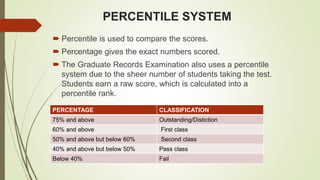
PERCENTILE SYSTEM
 Percentile is used to compare the scores.
 Percentage gives the exact numbers scored.
 The Graduate Records Examination also uses a percentile
system due to the sheer number of students taking the test.
Students earn a raw score, which is calculated into a
percentile rank.
PERCENTAGE CLASSIFICATION
75% and above Outstanding/Distiction
60% and above First class
50% and above but below 60% Second class
40% and above but below 50% Pass class
Below 40% Fail
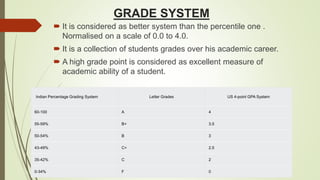
GRADE SYSTEM
 It is considered as better system than the percentile one .
Normalised on a scale of 0.0 to 4.0.
 It is a collection of students grades over his academic career.
 A high grade point is considered as excellent measure of
academic ability of a student.
Indian Percentage Grading System Letter Grades US 4-point GPA System
60-100 A 4
55-59% B+ 3.5
50-54% B 3
43-49% C+ 2.5
35-42% C 2
0-34% F 0
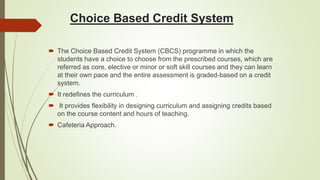
Choice Based Credit System
 The Choice Based Credit System (CBCS) programme in which the
students have a choice to choose from the prescribed courses, which are
referred as core, elective or minor or soft skill courses and they can learn
at their own pace and the entire assessment is graded-based on a credit
system.
 It redefines the curriculum .
 It provides flexibility in designing curriculum and assigning credits based
on the course content and hours of teaching.
 Cafeteria Approach.
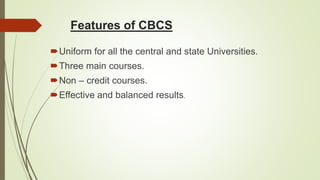
Features of CBCS
Uniform for all the central and state Universities.
Three main courses.
Non – credit courses.
Effective and balanced results.
Definition of key words:
 Academic Year.
 CBCS
 Courses
 CBSS
 Credit Points
 Credit
 CGPA
 Grade Point
 Letter Grade
 SGPA
 Semester
 Grade card
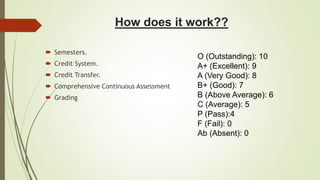
How does it work??
 Semesters.
 Credit System.
 Credit Transfer.
 Comprehensive Continuous Assessment
 Grading
O (Outstanding): 10
A+ (Excellent): 9
A (Very Good): 8
B+ (Good): 7
B (Above Average): 6
C (Average): 5
P (Pass):4
F (Fail): 0
Ab (Absent): 0
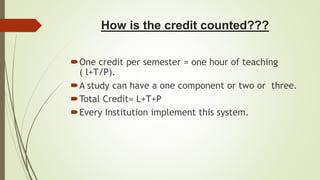
How is the credit counted???
One credit per semester = one hour of teaching
( l+T/P).
A study can have a one component or two or three.
Total Credit= L+T+P
Every Institution implement this system.
Advantages of CBCS
 Cafeteria Approach.
 Based on interest and preferences.
 Learning at own pace.
 Additional courses can be opt up.
 Inter college migration.
 Enhancement of skills.
 Improves the job opportunities.
Disadvantages of CBCS
Exact marks can not be estimated.
Work load of teachers may
fluctuate.
Need of proper infrastructure.
Types of Courses.
 Core courses.
 Elective Courses.
 Foundation Courses.
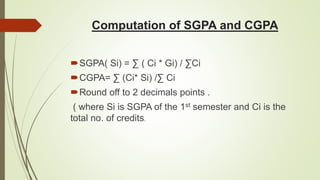
Computation of SGPA and CGPA
SGPA( Si) = ∑ ( Ci * Gi) / ∑Ci
CGPA= ∑ (Ci* Si) /∑ Ci
Round off to 2 decimals points .
( where Si is SGPA of the 1st semester and Ci is the
total no. of credits.
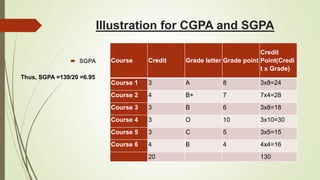
Illustration for CGPA and SGPA
 SGPA Course Credit Grade letter Grade point
Credit
Point(Credi
t x Grade)
Course 1 3 A 8 3x8=24
Course 2 4 B+ 7 7x4=28
Course 3 3 B 6 3x8=18
Course 4 3 O 10 3x10=30
Course 5 3 C 5 3x5=15
Course 6 4 B 4 4x4=16
20 130
Thus, SGPA =139/20 =6.95
• CGPA
Semester
1
Semester
2
Semester
3
Semester
4
Semester
5
Semester
6
Credit :
20
SGPA:6.9
Credit : 22
SGPA:7.8
Credit : 25
SGPA: 5.6
Credit : 26
SGPA:6.0
Credit : 26
SGPA:6.3
Credit : 25
SGPA: 8.0
Thus, CGPA = 20 x 6.9 + 22 x 7.8 + 25 x 5.6 + 26 x 6.0 +
26 x 6.3 + 25 x 8.0/ 144 = 6.73
CONCLUSION
It is too early to say whether CBCS will be successful or not. The UGC has always
initiated measures to bring efficiency and excellence in the Higher Education System of
India. The basic motive is to expand academic quality in all aspects, right from the
curriculum to the learning-teaching process to examination and evaluation systems.
However, so far multiple methods are followed by different universities across the country
towards examination, evaluation and grading system. Considering this diversity, the
implementation of the choice based credit system seems to be a good system in
assessing the overall performance of a student in a universal way of a single grading
system.
 Choice Based Credit System CBCS

Choice Based Credit System CBCS

  • 1.
    MEDI-CAPS UNIVERSITY INDORE Contemporary IssuesIn Management: Report Comparative Study of Choice Based Credit System. Submitted as Partial Fulfillment for Degree Masters of Business Administration to Medi-Caps University, Indore. 2018-2020
  • 2.
    GUIDED BY: Dr. MukeshPorwal Sir SUBMITTED BY: 1. Mayank Mulchandani 2. Hiteshi Punjabi 3. Mahak Jain 4.Mansi Bhati 5. Geetica Jain 6. Harsh Mishra
  • 3.
    PERCENTILE SYSTEM  Percentileis used to compare the scores.  Percentage gives the exact numbers scored.  The Graduate Records Examination also uses a percentile system due to the sheer number of students taking the test. Students earn a raw score, which is calculated into a percentile rank. PERCENTAGE CLASSIFICATION 75% and above Outstanding/Distiction 60% and above First class 50% and above but below 60% Second class 40% and above but below 50% Pass class Below 40% Fail
  • 4.
    GRADE SYSTEM  Itis considered as better system than the percentile one . Normalised on a scale of 0.0 to 4.0.  It is a collection of students grades over his academic career.  A high grade point is considered as excellent measure of academic ability of a student. Indian Percentage Grading System Letter Grades US 4-point GPA System 60-100 A 4 55-59% B+ 3.5 50-54% B 3 43-49% C+ 2.5 35-42% C 2 0-34% F 0
  • 5.
    Choice Based CreditSystem  The Choice Based Credit System (CBCS) programme in which the students have a choice to choose from the prescribed courses, which are referred as core, elective or minor or soft skill courses and they can learn at their own pace and the entire assessment is graded-based on a credit system.  It redefines the curriculum .  It provides flexibility in designing curriculum and assigning credits based on the course content and hours of teaching.  Cafeteria Approach.
  • 6.
    Features of CBCS Uniformfor all the central and state Universities. Three main courses. Non – credit courses. Effective and balanced results.
  • 7.
    Definition of keywords:  Academic Year.  CBCS  Courses  CBSS  Credit Points  Credit  CGPA  Grade Point  Letter Grade  SGPA  Semester  Grade card
  • 8.
    How does itwork??  Semesters.  Credit System.  Credit Transfer.  Comprehensive Continuous Assessment  Grading O (Outstanding): 10 A+ (Excellent): 9 A (Very Good): 8 B+ (Good): 7 B (Above Average): 6 C (Average): 5 P (Pass):4 F (Fail): 0 Ab (Absent): 0
  • 9.
    How is thecredit counted??? One credit per semester = one hour of teaching ( l+T/P). A study can have a one component or two or three. Total Credit= L+T+P Every Institution implement this system.
  • 10.
    Advantages of CBCS Cafeteria Approach.  Based on interest and preferences.  Learning at own pace.  Additional courses can be opt up.  Inter college migration.  Enhancement of skills.  Improves the job opportunities.
  • 11.
    Disadvantages of CBCS Exactmarks can not be estimated. Work load of teachers may fluctuate. Need of proper infrastructure.
  • 12.
    Types of Courses. Core courses.  Elective Courses.  Foundation Courses.
  • 13.
    Computation of SGPAand CGPA SGPA( Si) = ∑ ( Ci * Gi) / ∑Ci CGPA= ∑ (Ci* Si) /∑ Ci Round off to 2 decimals points . ( where Si is SGPA of the 1st semester and Ci is the total no. of credits.
  • 14.
    Illustration for CGPAand SGPA  SGPA Course Credit Grade letter Grade point Credit Point(Credi t x Grade) Course 1 3 A 8 3x8=24 Course 2 4 B+ 7 7x4=28 Course 3 3 B 6 3x8=18 Course 4 3 O 10 3x10=30 Course 5 3 C 5 3x5=15 Course 6 4 B 4 4x4=16 20 130 Thus, SGPA =139/20 =6.95
  • 15.
    • CGPA Semester 1 Semester 2 Semester 3 Semester 4 Semester 5 Semester 6 Credit : 20 SGPA:6.9 Credit: 22 SGPA:7.8 Credit : 25 SGPA: 5.6 Credit : 26 SGPA:6.0 Credit : 26 SGPA:6.3 Credit : 25 SGPA: 8.0 Thus, CGPA = 20 x 6.9 + 22 x 7.8 + 25 x 5.6 + 26 x 6.0 + 26 x 6.3 + 25 x 8.0/ 144 = 6.73
  • 16.
    CONCLUSION It is tooearly to say whether CBCS will be successful or not. The UGC has always initiated measures to bring efficiency and excellence in the Higher Education System of India. The basic motive is to expand academic quality in all aspects, right from the curriculum to the learning-teaching process to examination and evaluation systems. However, so far multiple methods are followed by different universities across the country towards examination, evaluation and grading system. Considering this diversity, the implementation of the choice based credit system seems to be a good system in assessing the overall performance of a student in a universal way of a single grading system.