
V. SURESH KUMAR
Assistant Professor Of Mathematics,
Rajalakshmi College Of Education,
Vagaikulam.
Continues & Comprehensive
Evaluation
What is CCE ?
A system of school based assessment that
covers all the aspects of a student’s development.
It was designed to reduce the student stress
related to board exams.
Aim of CCE
To reduce stress on children.
Make evaluation comprehensive & regular.
Provide space for the teacher for creative teaching.
Provide a tool of diagnosis & remediation.
Produce learners with greater skills.
Objectives of CCE
To help developing cognitive , psychomotor & affective
skills.
To lay emphasis on thought processes & de – emphasis
memorization.
To make evaluation an integral part of teaching – learning
process.
To use evaluation for improvement of students achievement
& teaching – learning strategies on the basis of regular diagnosis
followed by remedial instruction.
Con/-
To use evaluation as a quality control devise to
maintain desired standard.
To make the process of teaching & learning a
learner – centered activity.
Characteristics of CCE
The continuous aspect of CCE takes care of
“continual” & “periodicity” aspect of evaluation.
Continual means assessment of students in the
beginning of instructions (Placement Evaluation) &
assessment during the instructional process (Formative
Evaluation) done informally using multiple techniques of
evaluation
Con/-
Periodicity means assessment of performance done
frequently at the end of unit/term (summative).
The comprehensive component CCE takes care of
assessment of all round development of the child’s
personality .it includes assessment in scholastic as well
as co – scholastic aspects of the pupil’s growth.
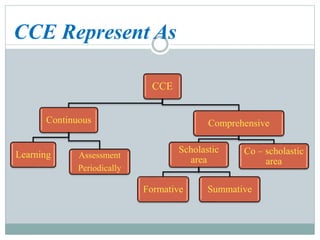
CCE Represent As
CCE
Continuous
Learning Assessment
Periodically
Comprehensive
Scholastic
area
Formative Summative
Co – scholastic
area
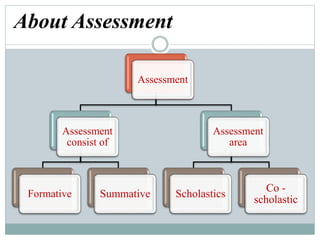
About Assessment
Assessment
Assessment
consist of
Formative Summative
Assessment
area
Scholastics
Co -
scholastic
Scholastic area
More concerned with cognitive & knowledge aspects.
Can be assessed directly by observing their reactions
to various learning experiences.
The intelligence or mental ability tests come under its
category.
Functions of scholastic area
It helps the teacher to organize effective strategies.
Continuous evaluation helps in regular assessment to
the extent & degree of learner’s progress.
Continuous evaluation serves to diagnose weaknesses
& permits the teacher to ascertain each individual
learner’s strengths & weakness & their needs.
helps in identifying changes in attitudes & value
system.
Con/-
Motivate the students to develop good study habits,
to correct errors & to direct their activities towards the
achievement of desired goals.
Identifies areas of aptitude & interest.
Helps in making decisions for the future, regarding
choice of subjects courses & careers.
It provides information & reports on the progress of
students in scholastic & co – scholastic areas.
Objectives of the scholastic domain
Desirable behaviour related to the learner’s
knowledge, understanding, application, evaluation,
analysis & creating the ability to apply it in an
unfamiliar situation.
To improve the teaching – learning process,
assessment should be both formative & summative.
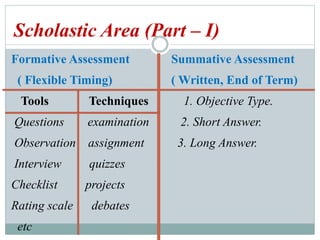
Scholastic Area (Part – I)
Formative Assessment Summative Assessment
( Flexible Timing) ( Written, End of Term)
Tools Techniques 1. Objective Type.
Questions examination 2. Short Answer.
Observation assignment 3. Long Answer.
Interview quizzes
Checklist projects
Rating scale debates
etc
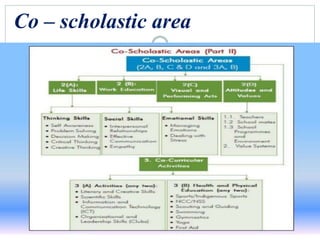
Co – Scholastic Assessment
Desired behavior related to learners life skills,
attitudes, interest values, co – curricular activities
physical health are described as skills to be acquired in
co – scholastic domain.
Co – scholastic area
Reporting
The most popular method of reporting is the
progress report.
The grade or marks describe the level of
achievement.
The checklist items include performance in
non- scholastic areas such as conduct, regularity,
interest, attitude & social development.
Importance of progress report
Major bases for crucial decisions about the
educational & vocational destiny of the students.
Give general picture of how a student is doing as
well as the adequacy of his learning progress.
Indicate the student’s strengths & weaknesses in
learning.
Use of progress report
To Students.
To Parents.
To Teachers.
To Administration.
To Students
To motivate students for learning.
Helps in improving study – habits & correction of
errors.
Helps in the selection of major & minor courses of
study ( science /arts/ commerce / vocational streams)
To parents
Take decisions about their child’s future
educational or vocational career.
To teachers
Used in identifying the topics/ units difficult for
most of the students & planning teaching strategies
accordingly.
Help students in developing increased self –
understanding & make more realistic educational &
vocational career selection.
To Administration
Determining promotion to higher class in
same school.
Every school & college has limited facilities,
they cannot have their own admission tests.
By employers
The employers often want information about
performance in scholastic & non – scholastic areas.
Employers use the marks & other relevant
information mentioned in the progress report for
selecting the applicant most likely to perform best the
service they require.
Recording
Testing result should be recorded in the
organized form.
Records should be conveniently available for
various users.
Cumulative records include the scholastic test
results & other types of information on pupils like non –
scholastic achievement, essentials for describing his
personality, guidance provided etc.
Con/-
Recording is a local matter & differ from school to
school.
Record is not what is put into them but how much is
extracted out of them.
Types of Information to be Record
Personal Bio data.
Scholastic achievements.
Physical health.
Co – curricular activities & character building
values.
Habits, interest & attitudes.
continouis & comprehensive evaluation

continouis & comprehensive evaluation

  • 1.
    V. SURESH KUMAR AssistantProfessor Of Mathematics, Rajalakshmi College Of Education, Vagaikulam. Continues & Comprehensive Evaluation
  • 2.
    What is CCE? A system of school based assessment that covers all the aspects of a student’s development. It was designed to reduce the student stress related to board exams.
  • 3.
    Aim of CCE Toreduce stress on children. Make evaluation comprehensive & regular. Provide space for the teacher for creative teaching. Provide a tool of diagnosis & remediation. Produce learners with greater skills.
  • 4.
    Objectives of CCE Tohelp developing cognitive , psychomotor & affective skills. To lay emphasis on thought processes & de – emphasis memorization. To make evaluation an integral part of teaching – learning process. To use evaluation for improvement of students achievement & teaching – learning strategies on the basis of regular diagnosis followed by remedial instruction.
  • 5.
    Con/- To use evaluationas a quality control devise to maintain desired standard. To make the process of teaching & learning a learner – centered activity.
  • 6.
    Characteristics of CCE Thecontinuous aspect of CCE takes care of “continual” & “periodicity” aspect of evaluation. Continual means assessment of students in the beginning of instructions (Placement Evaluation) & assessment during the instructional process (Formative Evaluation) done informally using multiple techniques of evaluation
  • 7.
    Con/- Periodicity means assessmentof performance done frequently at the end of unit/term (summative). The comprehensive component CCE takes care of assessment of all round development of the child’s personality .it includes assessment in scholastic as well as co – scholastic aspects of the pupil’s growth.
  • 8.
    CCE Represent As CCE Continuous LearningAssessment Periodically Comprehensive Scholastic area Formative Summative Co – scholastic area
  • 9.
    About Assessment Assessment Assessment consist of FormativeSummative Assessment area Scholastics Co - scholastic
  • 10.
    Scholastic area More concernedwith cognitive & knowledge aspects. Can be assessed directly by observing their reactions to various learning experiences. The intelligence or mental ability tests come under its category.
  • 11.
    Functions of scholasticarea It helps the teacher to organize effective strategies. Continuous evaluation helps in regular assessment to the extent & degree of learner’s progress. Continuous evaluation serves to diagnose weaknesses & permits the teacher to ascertain each individual learner’s strengths & weakness & their needs. helps in identifying changes in attitudes & value system.
  • 12.
    Con/- Motivate the studentsto develop good study habits, to correct errors & to direct their activities towards the achievement of desired goals. Identifies areas of aptitude & interest. Helps in making decisions for the future, regarding choice of subjects courses & careers. It provides information & reports on the progress of students in scholastic & co – scholastic areas.
  • 13.
    Objectives of thescholastic domain Desirable behaviour related to the learner’s knowledge, understanding, application, evaluation, analysis & creating the ability to apply it in an unfamiliar situation. To improve the teaching – learning process, assessment should be both formative & summative.
  • 14.
    Scholastic Area (Part– I) Formative Assessment Summative Assessment ( Flexible Timing) ( Written, End of Term) Tools Techniques 1. Objective Type. Questions examination 2. Short Answer. Observation assignment 3. Long Answer. Interview quizzes Checklist projects Rating scale debates etc
  • 15.
    Co – ScholasticAssessment Desired behavior related to learners life skills, attitudes, interest values, co – curricular activities physical health are described as skills to be acquired in co – scholastic domain.
  • 16.
  • 17.
    Reporting The most popularmethod of reporting is the progress report. The grade or marks describe the level of achievement. The checklist items include performance in non- scholastic areas such as conduct, regularity, interest, attitude & social development.
  • 18.
    Importance of progressreport Major bases for crucial decisions about the educational & vocational destiny of the students. Give general picture of how a student is doing as well as the adequacy of his learning progress. Indicate the student’s strengths & weaknesses in learning.
  • 19.
    Use of progressreport To Students. To Parents. To Teachers. To Administration.
  • 20.
    To Students To motivatestudents for learning. Helps in improving study – habits & correction of errors. Helps in the selection of major & minor courses of study ( science /arts/ commerce / vocational streams)
  • 21.
    To parents Take decisionsabout their child’s future educational or vocational career.
  • 22.
    To teachers Used inidentifying the topics/ units difficult for most of the students & planning teaching strategies accordingly. Help students in developing increased self – understanding & make more realistic educational & vocational career selection.
  • 23.
    To Administration Determining promotionto higher class in same school. Every school & college has limited facilities, they cannot have their own admission tests.
  • 24.
    By employers The employersoften want information about performance in scholastic & non – scholastic areas. Employers use the marks & other relevant information mentioned in the progress report for selecting the applicant most likely to perform best the service they require.
  • 25.
    Recording Testing result shouldbe recorded in the organized form. Records should be conveniently available for various users. Cumulative records include the scholastic test results & other types of information on pupils like non – scholastic achievement, essentials for describing his personality, guidance provided etc.
  • 26.
    Con/- Recording is alocal matter & differ from school to school. Record is not what is put into them but how much is extracted out of them.
  • 27.
    Types of Informationto be Record Personal Bio data. Scholastic achievements. Physical health. Co – curricular activities & character building values. Habits, interest & attitudes.