Scoring and Grading
M Shoaib GH
www.talenthiker.com
• Scoring and Grading
• Definitions of grading
• Types of grading framework
• Defining grade boundaries
• Fair and Effective grading
Content
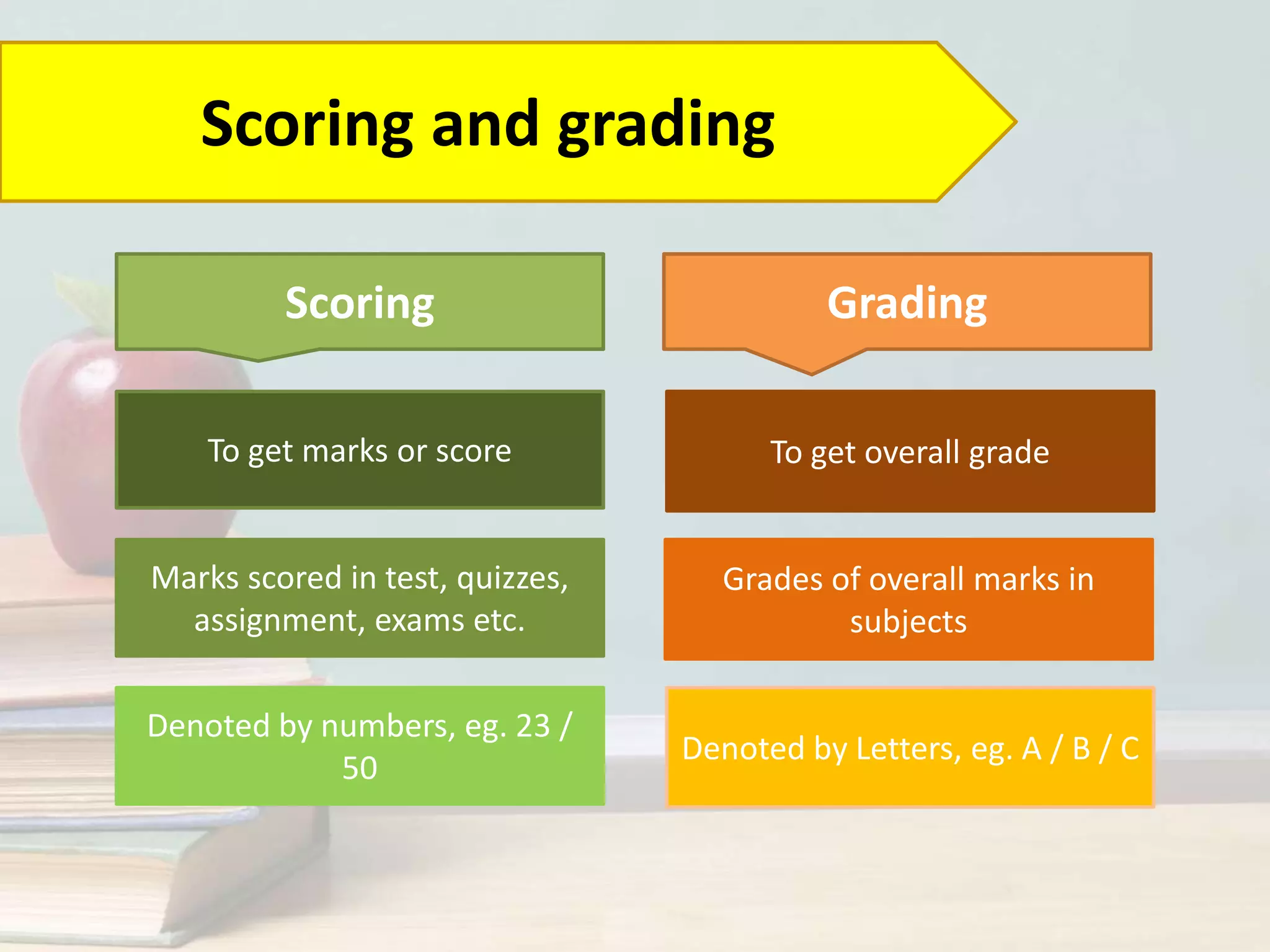
Scoring and grading
To get marks or score To get overall grade
Marks scored in test, quizzes,
assignment, exams etc.
Grades of overall marks in
subjects
Denoted by numbers, eg. 23 /
50
Denoted by Letters, eg. A / B / C
Scoring Grading
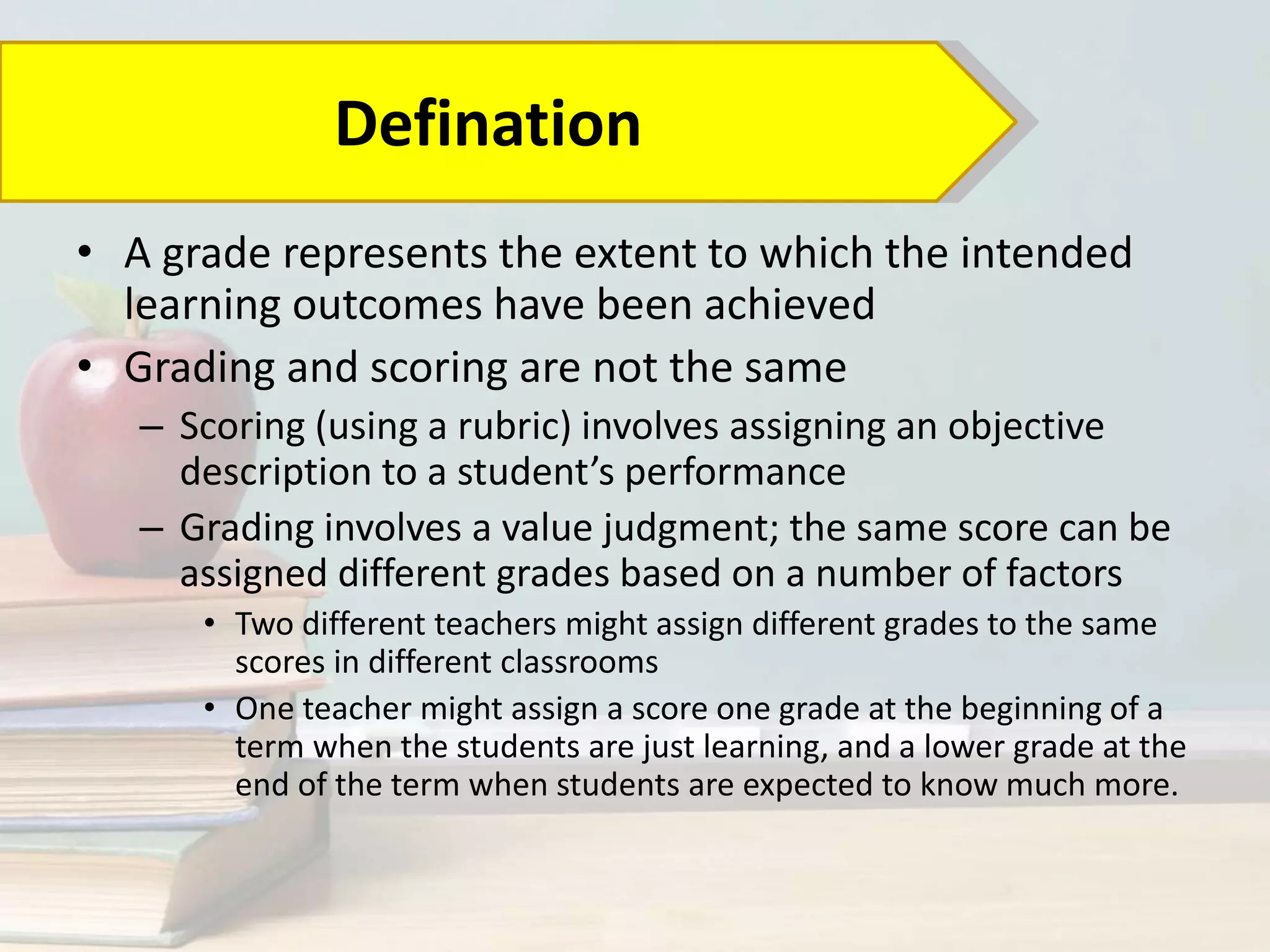
• A grade represents the extent to which the intended
learning outcomes have been achieved
• Grading and scoring are not the same
– Scoring (using a rubric) involves assigning an objective
description to a student’s performance
– Grading involves a value judgment; the same score can be
assigned different grades based on a number of factors
• Two different teachers might assign different grades to the same
scores in different classrooms
• One teacher might assign a score one grade at the beginning of a
term when the students are just learning, and a lower grade at the
end of the term when students are expected to know much more.
Defination
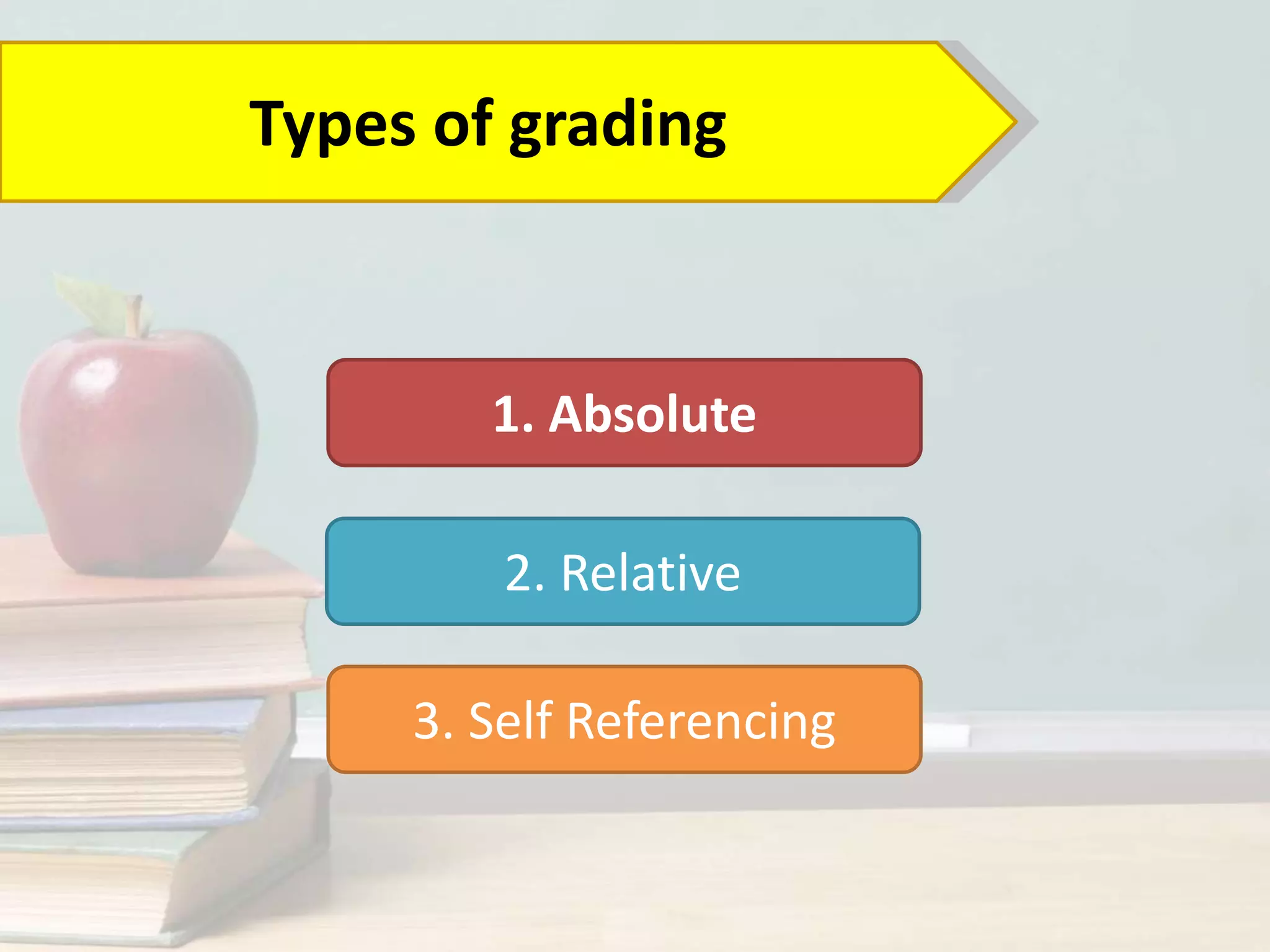
Types of grading
1. Absolute
2. Relative
3. Self Referencing
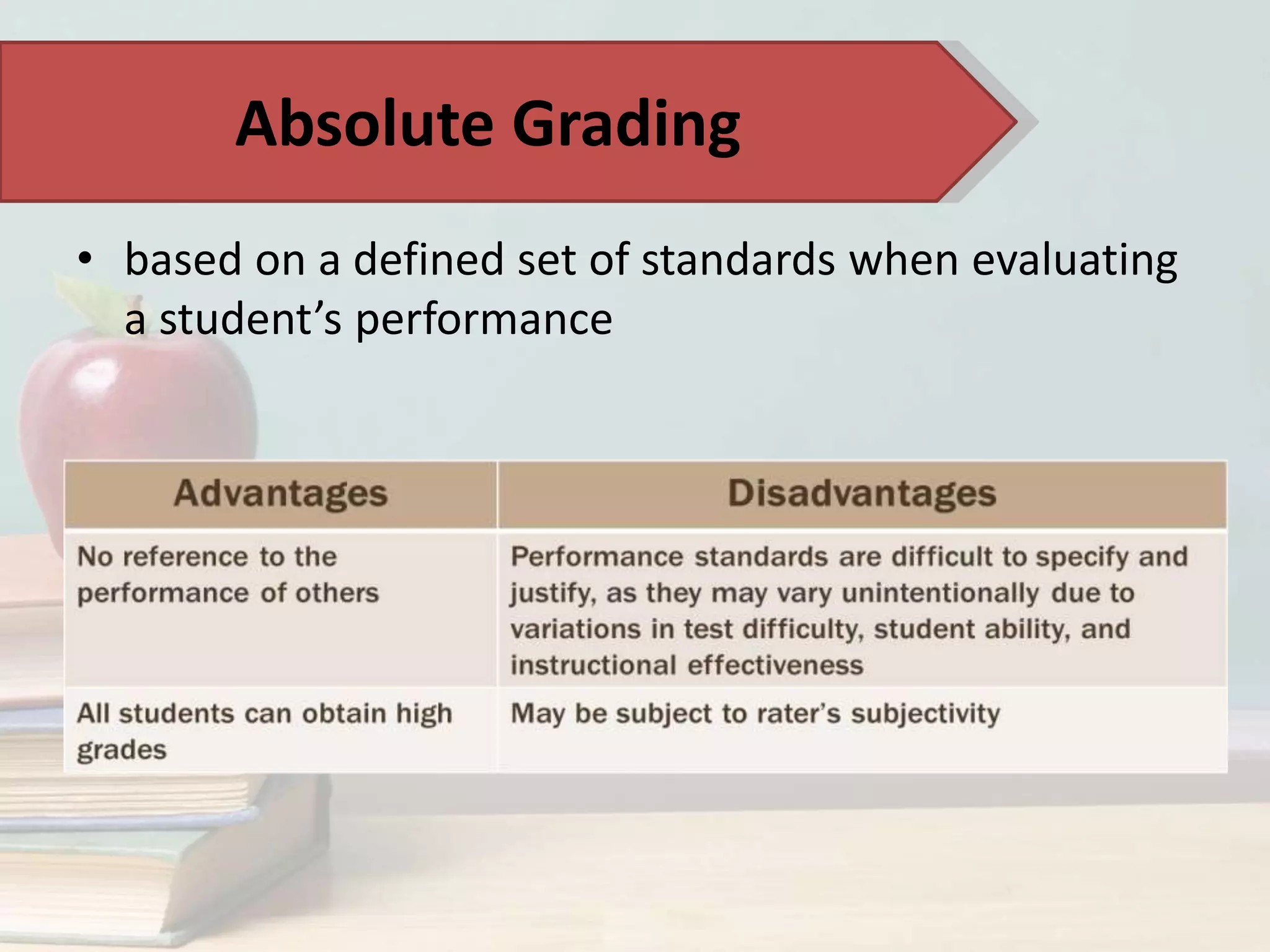
• based on a defined set of standards when evaluating
a student’s performance
Absolute Grading
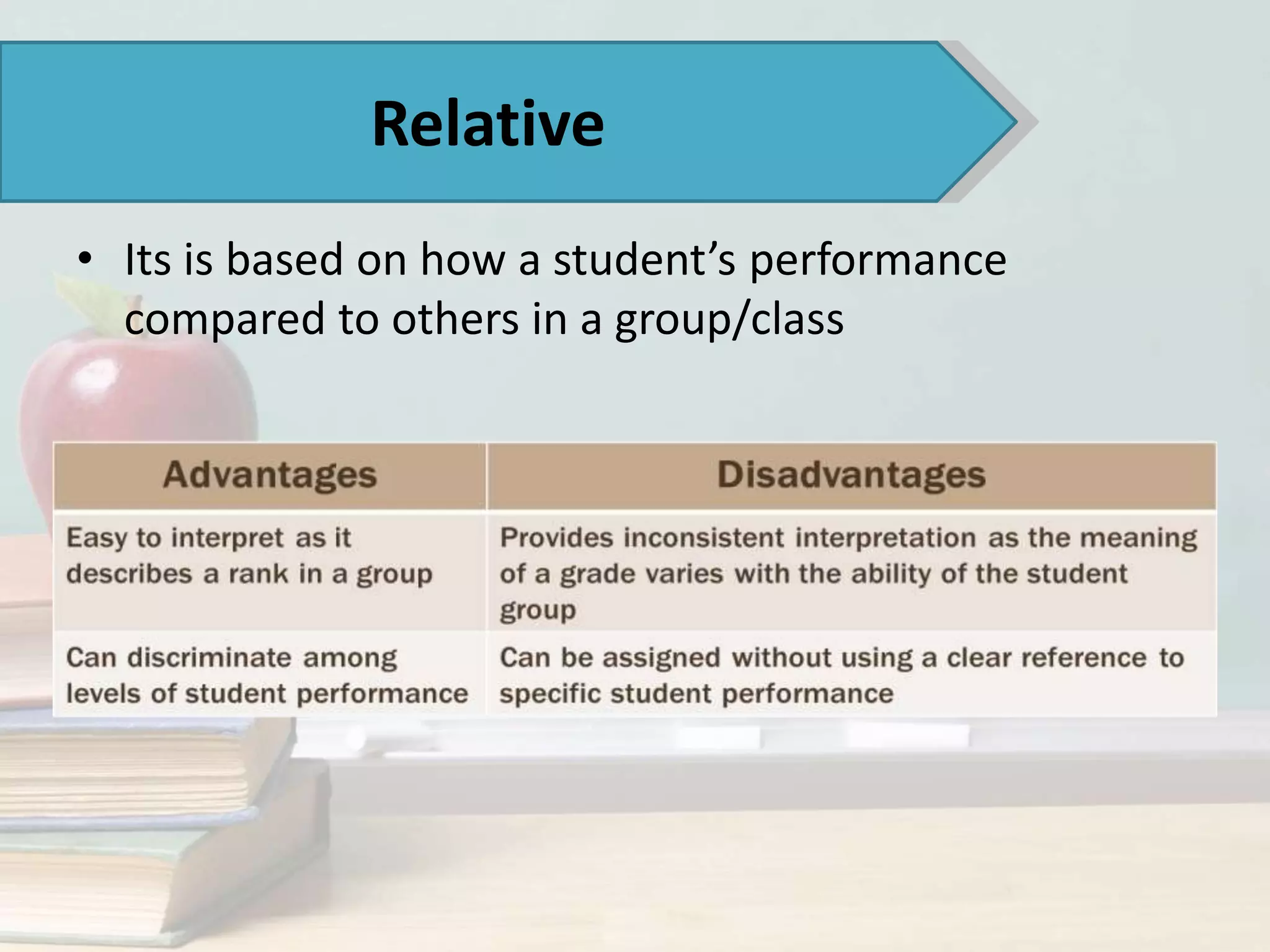
• Its is based on how a student’s performance
compared to others in a group/class
Relative
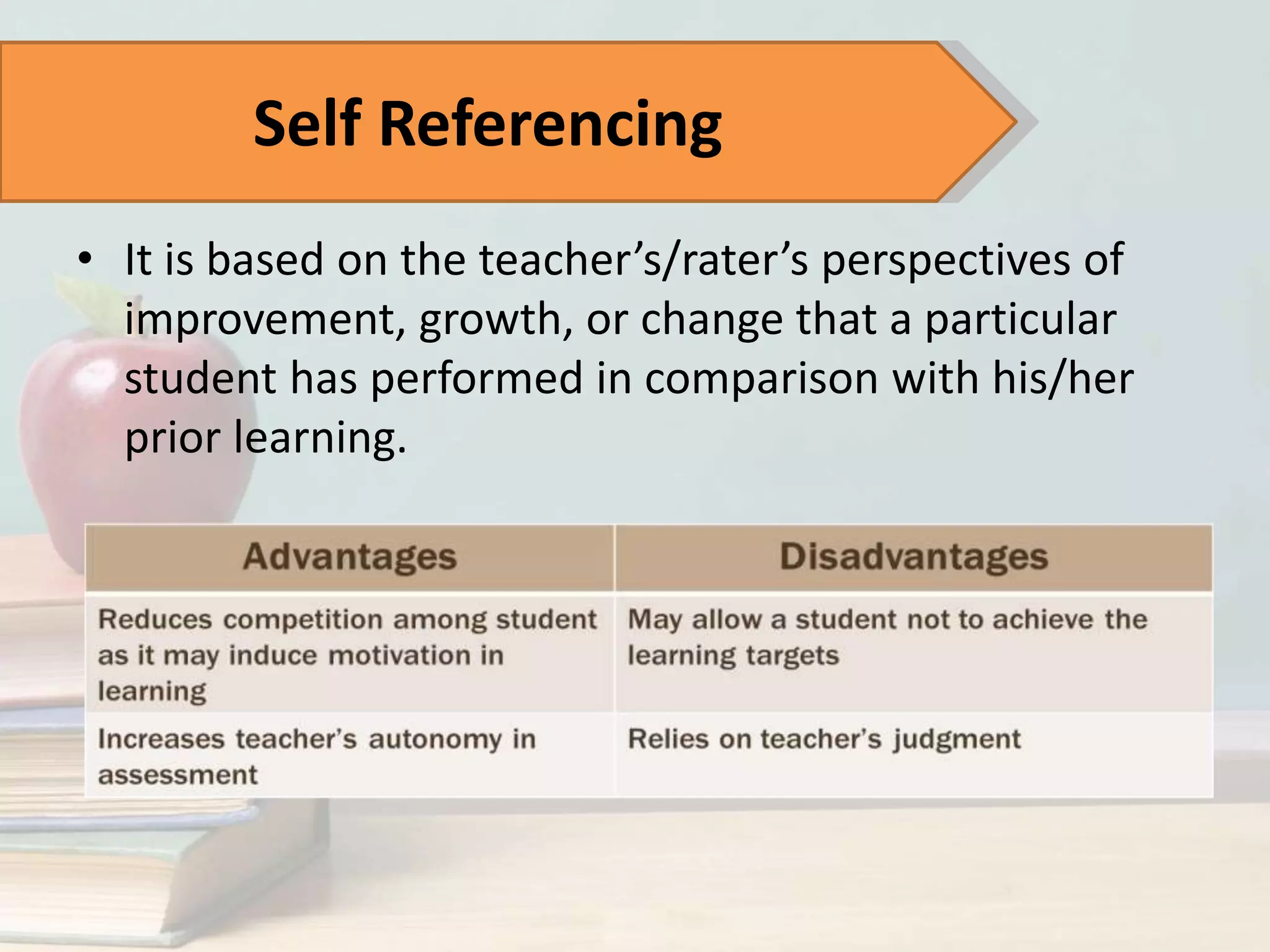
• It is based on the teacher’s/rater’s perspectives of
improvement, growth, or change that a particular
student has performed in comparison with his/her
prior learning.
Self Referencing
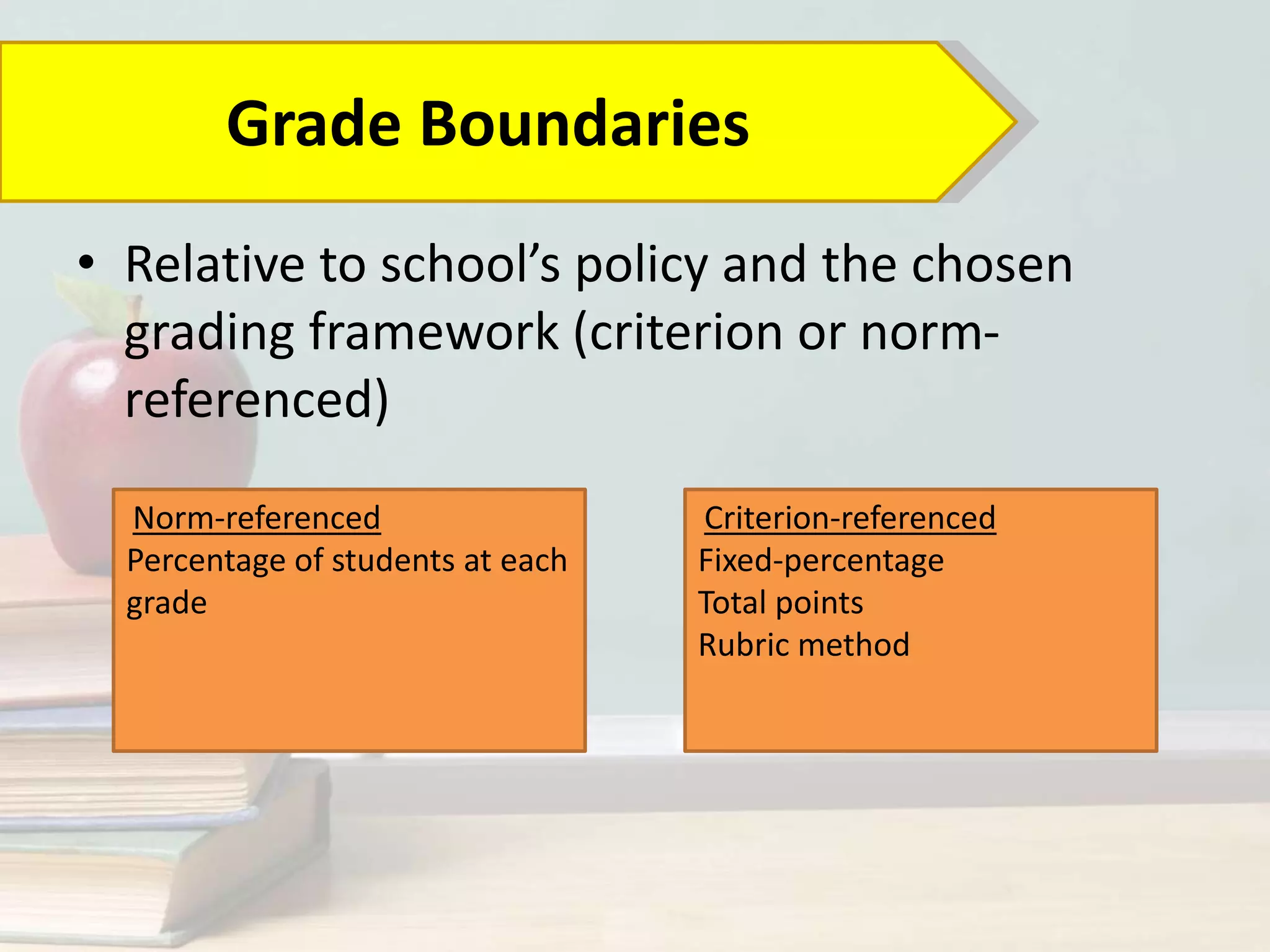
• Relative to school’s policy and the chosen
grading framework (criterion or norm-
referenced)
Grade Boundaries
Criterion-referenced
Fixed-percentage
Total points
Rubric method
Norm-referenced
Percentage of students at each
grade
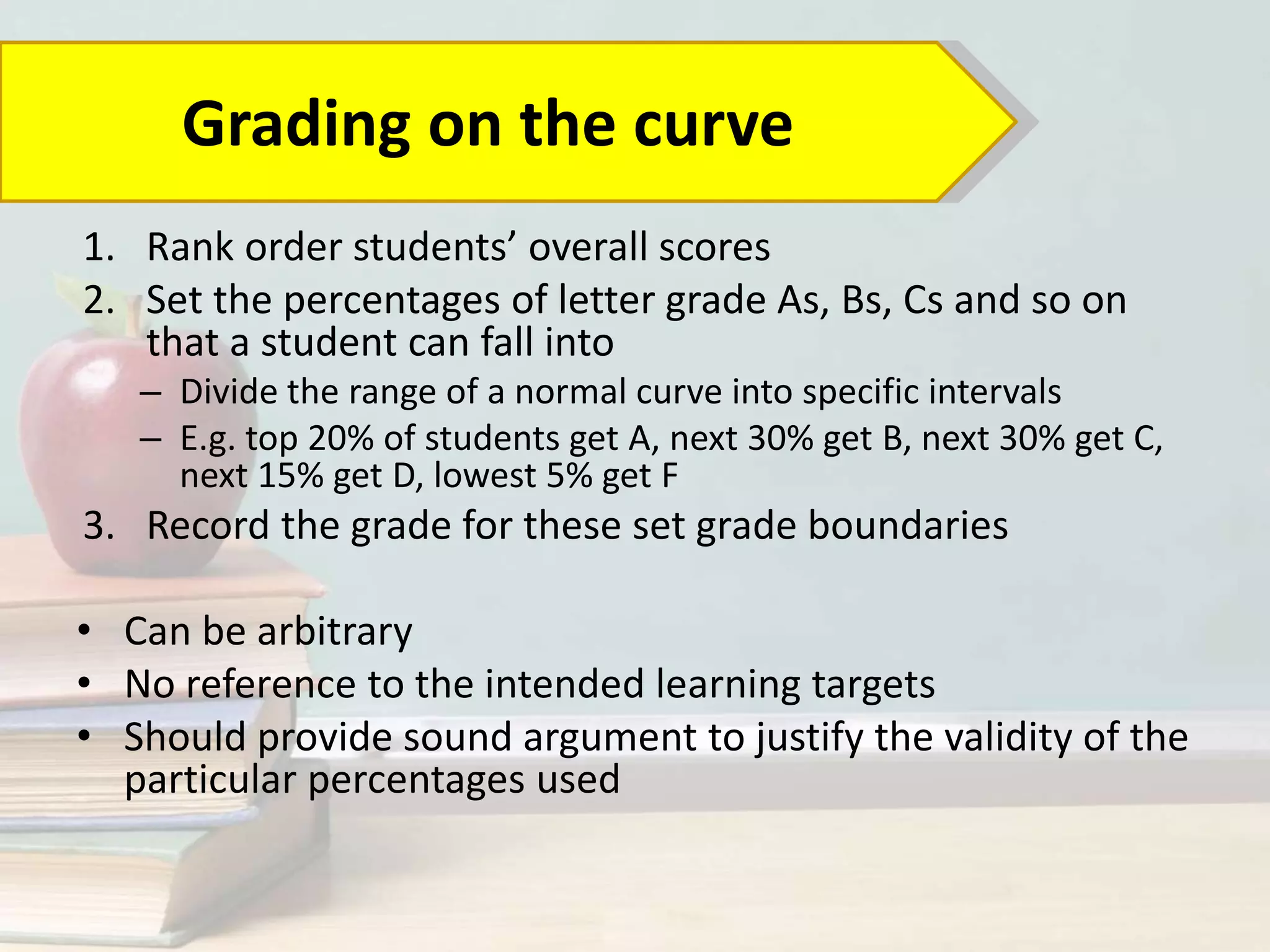
1. Rank order students’ overall scores
2. Set the percentages of letter grade As, Bs, Cs and so on
that a student can fall into
– Divide the range of a normal curve into specific intervals
– E.g. top 20% of students get A, next 30% get B, next 30% get C,
next 15% get D, lowest 5% get F
3. Record the grade for these set grade boundaries
• Can be arbitrary
• No reference to the intended learning targets
• Should provide sound argument to justify the validity of the
particular percentages used
Grading on the curve
1. Give a percentage correct score for each student for each
task
2. Multiply each task’s percentage by its corresponding
weight and add these products together
3. Divide the sum of products by the sum of weights to get a
composite percentage score
4. Translate this final score to letter grade
• Relationship between percentage correct and letter grade
is arbitrary  follow school policy
• This method may encourage us to focus more on the task
difficulty than on the intended learning outcomes.
Grading using fixed percentage
1. Assign a maximum point value for each task
2. Sum these maximum points
3. Use the maximum possible total values to set
the letter-grade boundaries
4. Translate this final score to a letter grade
• Easy to adjust or give “extra credits” to an
assessment task to increase scores of students
with low performance
Grading using total points
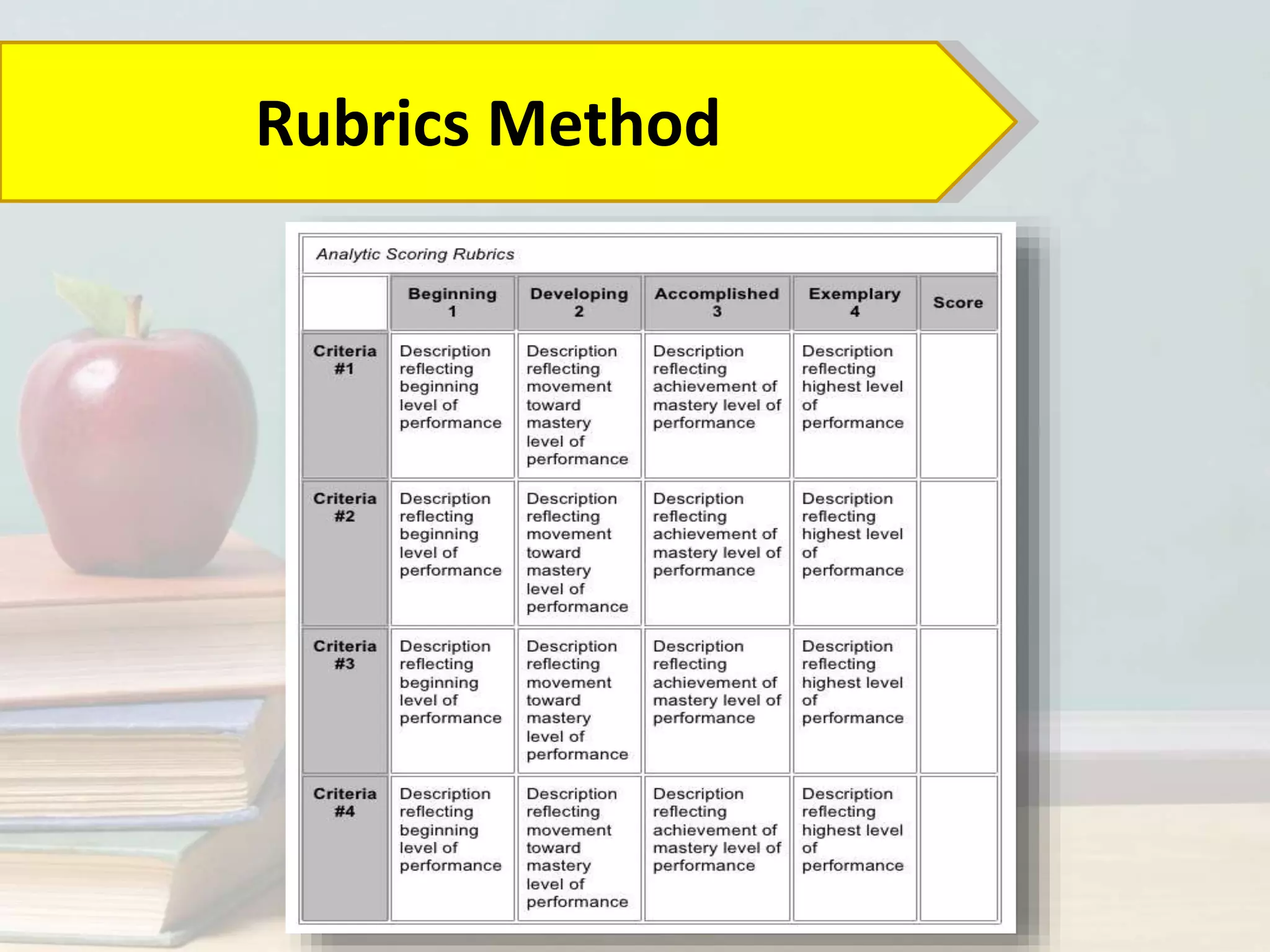
• Assign an ordered number to each level of
rubrics.
– Higher number represents a higher complexity
• Summing across components
• Calculate the sum or the average of the
numbers, or use fixed percentage method
– Care is needed to avoid grade distortion (e.g. 3 on
a 4-point rubric is 75%; converting this to a grade
of C may not make sense)
Grading using Rubrics Method
Rubrics Method
1. Inform scoring/grading procedures to students at the beginning of
instruction
- To better inform expectations of students
- To motivate student’s learning and promote student’s critical thinking
2. Base grades on student achievement of the intended learning
outcomes, not other factors
- Other factors such as student’s tardiness, misbehavior, effort, etc.
should be reported separately, if needed
3. Use a wide variety of valid assessment data
- Using several different assessment tasks can provide good validity
evidence to justify the meaning of the grade given
Fair and effective grading
* As adapted from Waugh & Gronlund (2013, pp. 200-201)
4. When combining scores for grading, use a proper
weighting technique
– Consider the spread/variability of the scores from a particular
test/assessment task when defining weights
5. Select an appropriate frame of reference for grading
– Use of Learning Progression Map as the standards of reference
– Give examples of standards
– For conventional classroom assessment,
• Use absolute grading for pass/fail (P/F) decision when the minimum
standards of achievement have been set
• Use relative grading to assign a grade above P/F level to describe how
a student has achieved the intended outcomes with higher degree of
cognitive skills
Fair and effective grading
6. Review borderline cases by reexamining all
achievement evidence
– Re-evaluate the borderline student’s performance
in all assessment tasks given
– Favor a higher grade
– Cautions of giving a Failing grade (F):
• Given to a student who consistently performs below
the minimum standards of achievement
• Notion of measurement error of an observed score
Fair and effective grading
* As adapt from Waugh & Gronlund (2013, pp. 200-201)
Suggest to improve
May Allah enlighten us to reflect
effectively

Scoring and grading ppt

  • 1.
    Scoring and Grading MShoaib GH www.talenthiker.com
  • 2.
    • Scoring andGrading • Definitions of grading • Types of grading framework • Defining grade boundaries • Fair and Effective grading Content
  • 3.
    Scoring and grading Toget marks or score To get overall grade Marks scored in test, quizzes, assignment, exams etc. Grades of overall marks in subjects Denoted by numbers, eg. 23 / 50 Denoted by Letters, eg. A / B / C Scoring Grading
  • 4.
    • A graderepresents the extent to which the intended learning outcomes have been achieved • Grading and scoring are not the same – Scoring (using a rubric) involves assigning an objective description to a student’s performance – Grading involves a value judgment; the same score can be assigned different grades based on a number of factors • Two different teachers might assign different grades to the same scores in different classrooms • One teacher might assign a score one grade at the beginning of a term when the students are just learning, and a lower grade at the end of the term when students are expected to know much more. Defination
  • 5.
    Types of grading 1.Absolute 2. Relative 3. Self Referencing
  • 6.
    • based ona defined set of standards when evaluating a student’s performance Absolute Grading
  • 7.
    • Its isbased on how a student’s performance compared to others in a group/class Relative
  • 8.
    • It isbased on the teacher’s/rater’s perspectives of improvement, growth, or change that a particular student has performed in comparison with his/her prior learning. Self Referencing
  • 9.
    • Relative toschool’s policy and the chosen grading framework (criterion or norm- referenced) Grade Boundaries Criterion-referenced Fixed-percentage Total points Rubric method Norm-referenced Percentage of students at each grade
  • 10.
    1. Rank orderstudents’ overall scores 2. Set the percentages of letter grade As, Bs, Cs and so on that a student can fall into – Divide the range of a normal curve into specific intervals – E.g. top 20% of students get A, next 30% get B, next 30% get C, next 15% get D, lowest 5% get F 3. Record the grade for these set grade boundaries • Can be arbitrary • No reference to the intended learning targets • Should provide sound argument to justify the validity of the particular percentages used Grading on the curve
  • 11.
    1. Give apercentage correct score for each student for each task 2. Multiply each task’s percentage by its corresponding weight and add these products together 3. Divide the sum of products by the sum of weights to get a composite percentage score 4. Translate this final score to letter grade • Relationship between percentage correct and letter grade is arbitrary  follow school policy • This method may encourage us to focus more on the task difficulty than on the intended learning outcomes. Grading using fixed percentage
  • 12.
    1. Assign amaximum point value for each task 2. Sum these maximum points 3. Use the maximum possible total values to set the letter-grade boundaries 4. Translate this final score to a letter grade • Easy to adjust or give “extra credits” to an assessment task to increase scores of students with low performance Grading using total points
  • 13.
    • Assign anordered number to each level of rubrics. – Higher number represents a higher complexity • Summing across components • Calculate the sum or the average of the numbers, or use fixed percentage method – Care is needed to avoid grade distortion (e.g. 3 on a 4-point rubric is 75%; converting this to a grade of C may not make sense) Grading using Rubrics Method
  • 14.
  • 15.
    1. Inform scoring/gradingprocedures to students at the beginning of instruction - To better inform expectations of students - To motivate student’s learning and promote student’s critical thinking 2. Base grades on student achievement of the intended learning outcomes, not other factors - Other factors such as student’s tardiness, misbehavior, effort, etc. should be reported separately, if needed 3. Use a wide variety of valid assessment data - Using several different assessment tasks can provide good validity evidence to justify the meaning of the grade given Fair and effective grading * As adapted from Waugh & Gronlund (2013, pp. 200-201)
  • 16.
    4. When combiningscores for grading, use a proper weighting technique – Consider the spread/variability of the scores from a particular test/assessment task when defining weights 5. Select an appropriate frame of reference for grading – Use of Learning Progression Map as the standards of reference – Give examples of standards – For conventional classroom assessment, • Use absolute grading for pass/fail (P/F) decision when the minimum standards of achievement have been set • Use relative grading to assign a grade above P/F level to describe how a student has achieved the intended outcomes with higher degree of cognitive skills Fair and effective grading
  • 17.
    6. Review borderlinecases by reexamining all achievement evidence – Re-evaluate the borderline student’s performance in all assessment tasks given – Favor a higher grade – Cautions of giving a Failing grade (F): • Given to a student who consistently performs below the minimum standards of achievement • Notion of measurement error of an observed score Fair and effective grading * As adapt from Waugh & Gronlund (2013, pp. 200-201)
  • 18.
    Suggest to improve MayAllah enlighten us to reflect effectively