EDUCATION(B.Ed.)
Assessment of Learning and Action Research
Unit-II
Neeraj Yadav
Assistant Professor
Department of B.Ed.
Shri Lal Bahadur Shastri Degree College, Gonda, U.P.
(Dr. Rammanohar Lohia Avadh University, Ayodhya, U.P.)
No Detention Policy
Context:
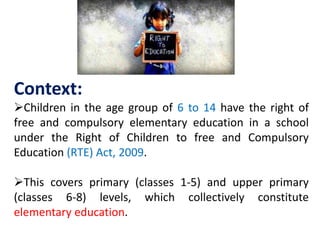
Children in the age group of 6 to 14 have the right of
free and compulsory elementary education in a school
under the Right of Children to free and Compulsory
Education (RTE) Act, 2009.
This covers primary (classes 1-5) and upper primary
(classes 6-8) levels, which collectively constitute
elementary education.
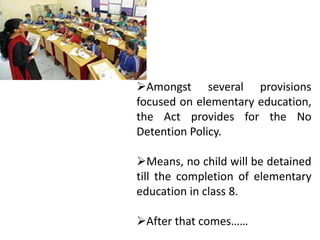
Amongst several provisions
focused on elementary education,
the Act provides for the No
Detention Policy.
Means, no child will be detained
till the completion of elementary
education in class 8.
After that comes……
RTE
(Second Amendment) Bill,
2017
Initial Stage:
In light of this, we will discuss the No
Detention Policy and issues affecting
the implementation of RTE.
Why No Detention Policy?
The rationale for the No Detention Policy or automatic
promotion to the next class is minimizing dropouts,
making learning joyful and removing the fear of failure
in exams.
Continuous and Comprehensive Education(CCE)
•Paper-pencil test, drawing and reading pictures and
expressing orally opposed to the traditional system of
examinations.
RTE (Second Amendment) Bill, 2017?
Proposes a ‘regular examination’ which will be held in
class 5 and class 8 at the end of every academic year.
In the event that a child fails these examinations, he
will be given remedial instruction and the opportunity
for a re-examination.
If he fails in the re-examination, the central or state
government may choose
•To not detain the child at all
•To detain the child in class 5, class 8 or in both classes
This is in contrast to the current policy where a child
cannot be detained until the completion of class 8.
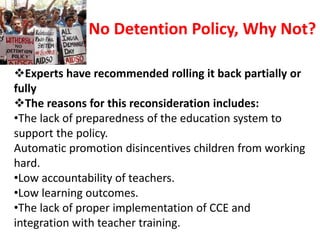
No Detention Policy, Why Not?
Experts have recommended rolling it back partially or
fully
The reasons for this reconsideration includes:
•The lack of preparedness of the education system to
support the policy.
Automatic promotion disincentives children from working
hard.
•Low accountability of teachers.
•Low learning outcomes.
•The lack of proper implementation of CCE and
integration with teacher training.
Statistics Says……..
Enrollment has been 100% at the primary level
Also, low transition of students from one class to
another at progressive higher levels has been noted
High dropouts at the secondary education level
With the highest dropout rate being 17% at the
class 10 level
 One of the reasons for low dropouts at the elementary level
may be the obligation to automatically promote and not detain
children under the No Detention Policy
The reasons which explain the rise in dropouts at the
secondary level include domestic activities for girls and
economic activities for boys, reasons common to both include
financial constraints and lack of interest in education.
How Can RTE ensure quality
Education?
The Economic Survey 2015-16 pointed out that only
about 42% of students in class 5 are able to read a
class 2 text. (In Government schools)
National Achievement Survey 2015 for class 5 has
also revealed that performance of students, on an
average, had gone down.
Standing Committee on Human Resource
Development says:
Against a total of 19 lakh teacher positions
sanctioned under Serva Shiksha Abhiyan in 2011-12,
only 12 lakh were filled.
Approximately 4.5 lakh untrained teachers were
operating in 19 states.
Teacher training institutes such as District Institute
of Education and Training, DIET are also experiencing
high vacancies with regard to trainers who train
teachers.
Presence of contract/temporary teachers, instead of
permanent teachers.
Experts have recommended that to ensure quality
secondary education, the reliance on
contract/temporary teachers must be done away with
Fully qualified teachers with salary and benefits must
be hired
Teachers should not be burdened with ancillary tasks
of supervising cooking and serving of mid-day meals.
RTE Act, 2009 sought to ensure that teachers acquire
minimum qualifications for their appointment, within
five years of its enactment (i.e. till March 31, 2015)
Another bill was introduced in Parliament to amend
this provision under the Act (till 2019)
References:
1.RTE (2009).MHRD, Govt. of India, website: mhrd.gov.in.
2.SSA Website: http://ssa.nic.in/.
3.RTE: 2nd year review report published by HRD Ministry (http://ssa.nic.in/rte).
4.Newspapers: The Hindu, The Telegraph, Economic Times.
5.National Policy of Education-1986, 1992.
6.NCF (2005). NCERT, New Delhi.
No detention policy

No detention policy

  • 1.
    EDUCATION(B.Ed.) Assessment of Learningand Action Research Unit-II
  • 2.
    Neeraj Yadav Assistant Professor Departmentof B.Ed. Shri Lal Bahadur Shastri Degree College, Gonda, U.P. (Dr. Rammanohar Lohia Avadh University, Ayodhya, U.P.) No Detention Policy
  • 3.
    Context: Children in theage group of 6 to 14 have the right of free and compulsory elementary education in a school under the Right of Children to free and Compulsory Education (RTE) Act, 2009. This covers primary (classes 1-5) and upper primary (classes 6-8) levels, which collectively constitute elementary education.
  • 4.
    Amongst several provisions focusedon elementary education, the Act provides for the No Detention Policy. Means, no child will be detained till the completion of elementary education in class 8. After that comes……
  • 5.
  • 6.
    Initial Stage: In lightof this, we will discuss the No Detention Policy and issues affecting the implementation of RTE.
  • 7.
    Why No DetentionPolicy? The rationale for the No Detention Policy or automatic promotion to the next class is minimizing dropouts, making learning joyful and removing the fear of failure in exams. Continuous and Comprehensive Education(CCE) •Paper-pencil test, drawing and reading pictures and expressing orally opposed to the traditional system of examinations.
  • 8.
    RTE (Second Amendment)Bill, 2017? Proposes a ‘regular examination’ which will be held in class 5 and class 8 at the end of every academic year. In the event that a child fails these examinations, he will be given remedial instruction and the opportunity for a re-examination.
  • 9.
    If he failsin the re-examination, the central or state government may choose •To not detain the child at all •To detain the child in class 5, class 8 or in both classes This is in contrast to the current policy where a child cannot be detained until the completion of class 8.
  • 10.
    No Detention Policy,Why Not? Experts have recommended rolling it back partially or fully The reasons for this reconsideration includes: •The lack of preparedness of the education system to support the policy. Automatic promotion disincentives children from working hard. •Low accountability of teachers. •Low learning outcomes. •The lack of proper implementation of CCE and integration with teacher training.
  • 11.
    Statistics Says…….. Enrollment hasbeen 100% at the primary level Also, low transition of students from one class to another at progressive higher levels has been noted High dropouts at the secondary education level With the highest dropout rate being 17% at the class 10 level
  • 12.
     One ofthe reasons for low dropouts at the elementary level may be the obligation to automatically promote and not detain children under the No Detention Policy The reasons which explain the rise in dropouts at the secondary level include domestic activities for girls and economic activities for boys, reasons common to both include financial constraints and lack of interest in education.
  • 13.
    How Can RTEensure quality Education? The Economic Survey 2015-16 pointed out that only about 42% of students in class 5 are able to read a class 2 text. (In Government schools) National Achievement Survey 2015 for class 5 has also revealed that performance of students, on an average, had gone down.
  • 14.
    Standing Committee onHuman Resource Development says: Against a total of 19 lakh teacher positions sanctioned under Serva Shiksha Abhiyan in 2011-12, only 12 lakh were filled. Approximately 4.5 lakh untrained teachers were operating in 19 states. Teacher training institutes such as District Institute of Education and Training, DIET are also experiencing high vacancies with regard to trainers who train teachers.
  • 15.
    Presence of contract/temporaryteachers, instead of permanent teachers. Experts have recommended that to ensure quality secondary education, the reliance on contract/temporary teachers must be done away with Fully qualified teachers with salary and benefits must be hired Teachers should not be burdened with ancillary tasks of supervising cooking and serving of mid-day meals.
  • 16.
    RTE Act, 2009sought to ensure that teachers acquire minimum qualifications for their appointment, within five years of its enactment (i.e. till March 31, 2015) Another bill was introduced in Parliament to amend this provision under the Act (till 2019)
  • 17.
    References: 1.RTE (2009).MHRD, Govt.of India, website: mhrd.gov.in. 2.SSA Website: http://ssa.nic.in/. 3.RTE: 2nd year review report published by HRD Ministry (http://ssa.nic.in/rte). 4.Newspapers: The Hindu, The Telegraph, Economic Times. 5.National Policy of Education-1986, 1992. 6.NCF (2005). NCERT, New Delhi.