
Mathetics is a type of programmed instruction developed by Thomas Gilbert that applies principles of reinforcement theory to analyze and construct complex behaviors and skills. It involves breaking tasks down into constituent behavioral elements through task analysis.
In mathetics, learning takes place through a series of exercises where learners build skills sequentially through principles of discrimination, chaining, and generalization. Each exercise reinforces learning upon completion of the task.
While mathetics is effective for teaching concrete skills through backward chaining, it also has limitations in individualizing for learners and addressing higher-order thinking.
Types of ProgrammedInstruction
Mathetics
By
Dr Umashree D K
Asst. professor
Sri Sarvajna college of Education
Bangalore, Karnataka.
1
2.
Mathetics
The wordMathetics is derived from The Greek word Mathein- which
means to learn.
Thomas F Gilbert (1962) is the originator of the concept Mathetics.
According to him “ Mathetics is the systematic application of
reinforcement theory to the analysis and construction of complex
behaviour repertories usually known as subject matter mastery,
knowledge and skills”.
Mathetics, if applied appropriately produces materials that exceed
the efficiency of lesson produced by any known method.
3.
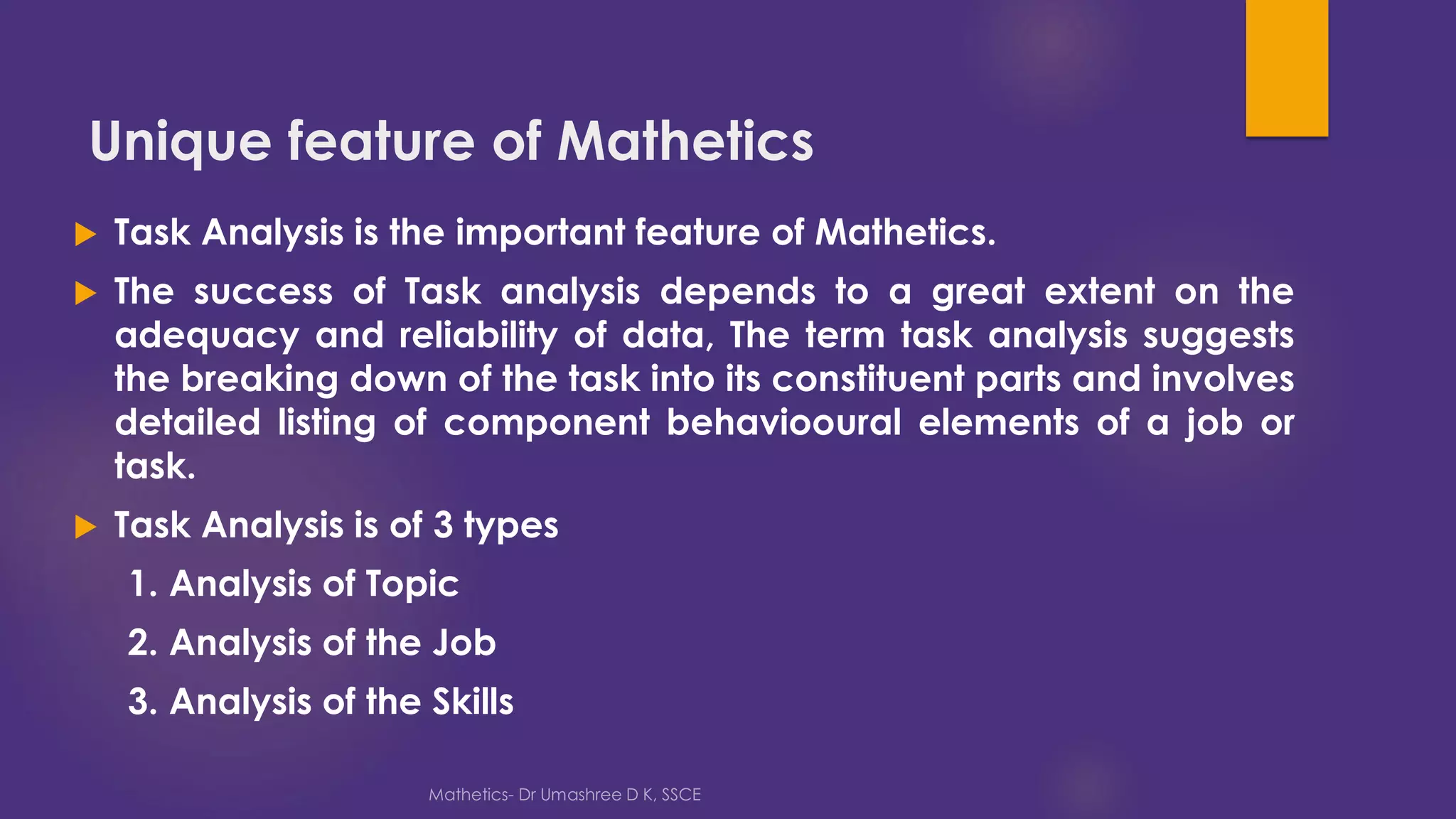
Unique feature ofMathetics
Task Analysis is the important feature of Mathetics.
The success of Task analysis depends to a great extent on the
adequacy and reliability of data, The term task analysis suggests
the breaking down of the task into its constituent parts and involves
detailed listing of component behaviooural elements of a job or
task.
Task Analysis is of 3 types
1. Analysis of Topic
2. Analysis of the Job
3. Analysis of the Skills
4.
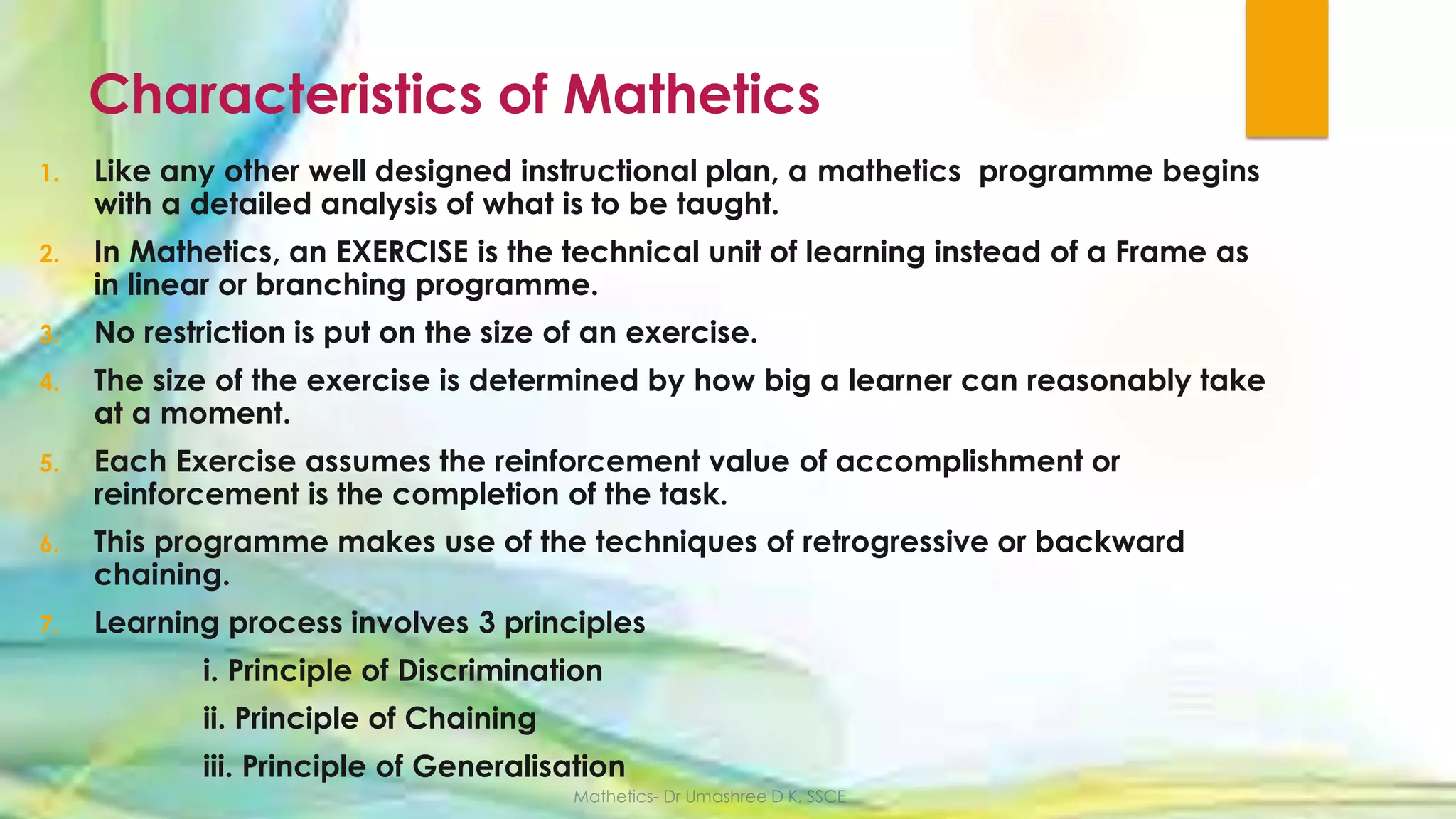
Characteristics of Mathetics
1.Like any other well designed instructional plan, a mathetics programme begins
with a detailed analysis of what is to be taught.
2. In Mathetics, an EXERCISE is the technical unit of learning instead of a Frame as
in linear or branching programme.
3. No restriction is put on the size of an exercise.
4. The size of the exercise is determined by how big a learner can reasonably take
at a moment.
5. Each Exercise assumes the reinforcement value of accomplishment or
reinforcement is the completion of the task.
6. This programme makes use of the techniques of retrogressive or backward
chaining.
7. Learning process involves 3 principles
i. Principle of Discrimination
ii. Principle of Chaining
iii. Principle of Generalisation
5.
Example:
Instructions:
1.Do Whateverprogramme asks. If you come to
the blank________ put the correct word or Number,
Symbol or whatever the required response
2.When a response is required, you will find the
correct response on the lower part of the page.
Check your answer then go to the next Exercise.
6.
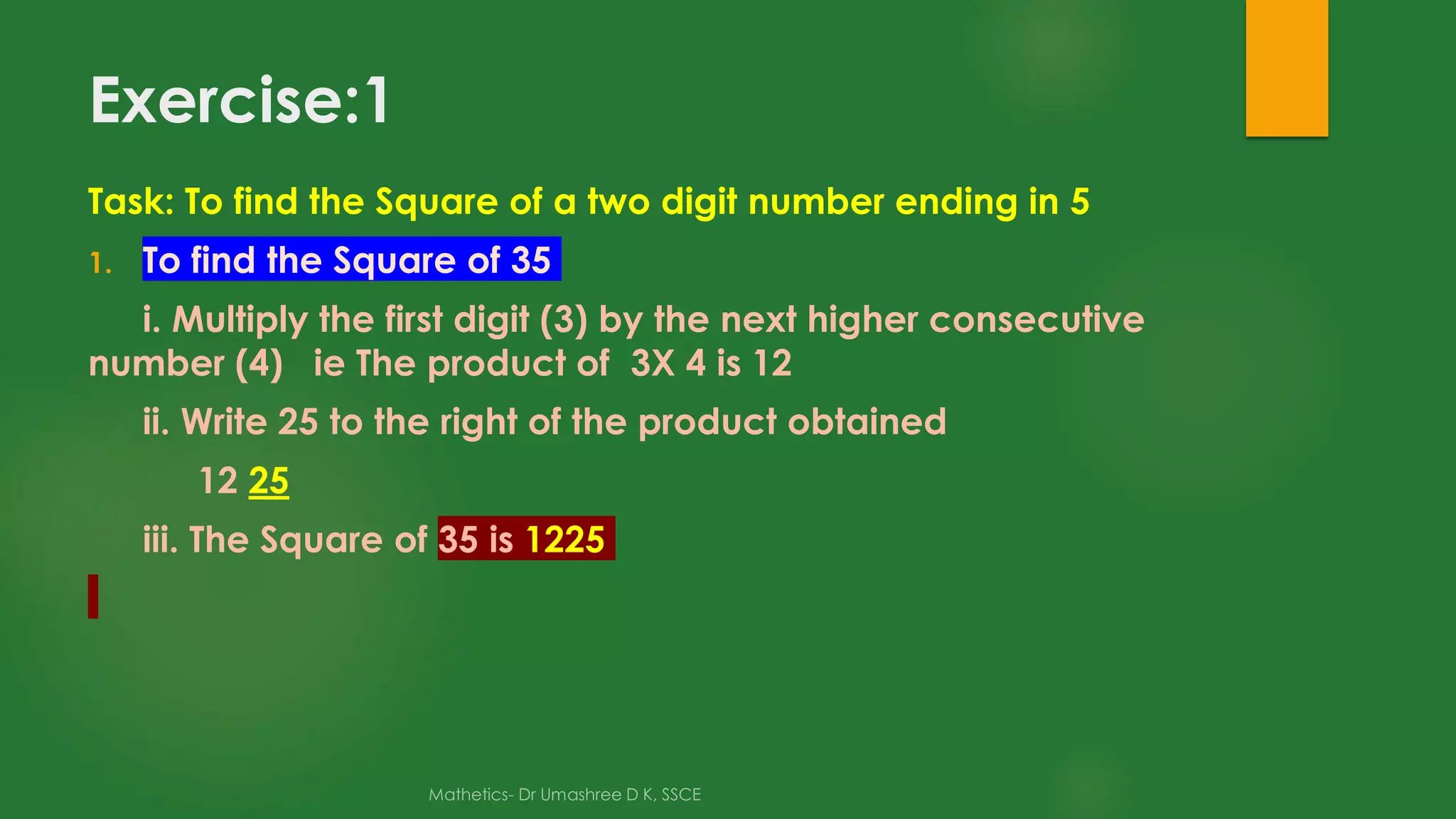
Exercise:1
Task: To findthe Square of a two digit number ending in 5
1. To find the Square of 35
i. Multiply the first digit (3) by the next higher consecutive
number (4) ie The product of 3X 4 is 12
ii. Write 25 to the right of the product obtained
12 25
iii. The Square of 35 is 1225
7.
Excercise:2
Task: To findthe Square of a two digit number ending in 3
1. To find the Square of 23
i. Multiply the given number (23) by its first digit (2)
23x2=46
ii. Add to it the product of the two digits( 2x3=6)
46+6= 52
iii. Write 9 to the right of the result
52 9
The required response is 529
8.
Advantages of Mathetics
1.It is a job or task oriented programme
2. Results can be linked to concrete goals with which we intend to
achieve through a mathetics programme
3. It stresses on learner success to 90/90 crtiterion level of mastery
which motivates the learner.
4. It utilizes the principle of backward chaining.
5. It is relevant, significant meaningful and valid in the eyes of the
learner and the programmer.
6. It can be applied to wide range of subject matter but it
significantly suits the teaching of skills where the main objective
is transfer of training of skills from one situation to another.
9.
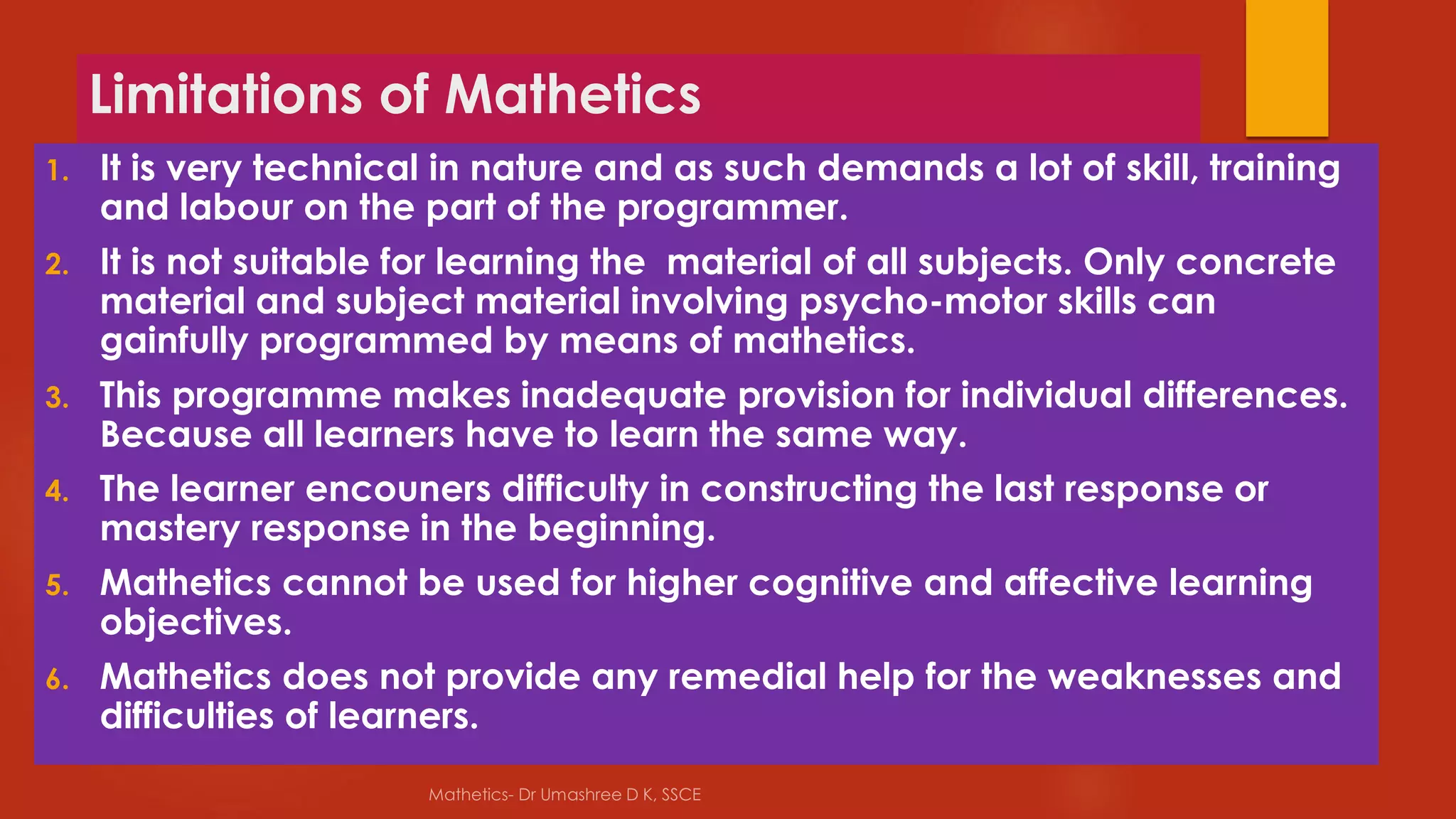
Limitations of Mathetics
1.It is very technical in nature and as such demands a lot of skill, training
and labour on the part of the programmer.
2. It is not suitable for learning the material of all subjects. Only concrete
material and subject material involving psycho-motor skills can
gainfully programmed by means of mathetics.
3. This programme makes inadequate provision for individual differences.
Because all learners have to learn the same way.
4. The learner encouners difficulty in constructing the last response or
mastery response in the beginning.
5. Mathetics cannot be used for higher cognitive and affective learning
objectives.
6. Mathetics does not provide any remedial help for the weaknesses and
difficulties of learners.