CORNEAL CONFOCAL MICROSCOPY
DIYAR J.K.
CONFOCAL MICROSCOPY
• is an emerging noninvasive imaging and diagnostic tool.
• enables morphological and quantitative analysis of
ocular surface microstructure, both in health and
disease.
• The principal of confocal microscopy was patented in
1957 by Marvin Minsky while he was a junior fellow at
Harvard University.
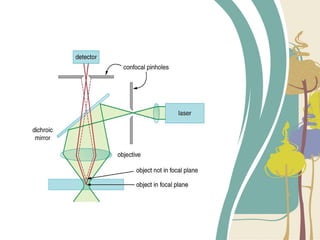
• The key elements of Minsky's confocal microscope
design: the pinhole apertures, point-by- point illumination
of the specimen and also rejection out-of-focus light
TRY TO THINK
 (TSCM) which used a spinning disk containing
thousands of optically conjugate (source/detector)
pinholes arranged in Archimedean spirals
TYPES : Tandem scanning confocal microscope
TRIAL TO THINK OUT OF BOX
Scanning slit confocal microscopy
• The Confoscan 4 confocal microscope : uses a slit
scanning design has 20× lens that works 12 mm from
the corneal apex for endothelial cell count, allowing fully
no-contact exam with z-adapter
• provides images of all corneal cell layers, albeit with less
resolution than the HRT-RCM. Is particularly well suited
to imaging the corneal endothelial cells.
• Due to its thicker optical volume, full-field images are
easily obtained.the optical sectioning capability of
confocal microscopy allows imaging through edematous
corneas.
BE CREATIVE
Laser scanning confocal microscopy
The HRT III with Rostock Corneal Module (HRT-RCM).
has 63× lens and optional 10 × to see deeper (lens,zonules)
uses 670 nm diode laser and provides 1micron resolution.
HRT-RCM does applanate cornea and the use of PMMA
disposabel cap and gel is mandatory for the exam.]
TEAR FILM
EPITHELIUM
BOWMAN LAYER
• Changes in the pattern of innervation can be assessed
using quantitative outcome measures such as nerve
density, length, branching &tortuosity.
STROMA
ENDOTHELIUM
ONE OF THE THEORY OF CREATIVITY
Confocal microscopy through-focusing (CMTF)
• To collect and quantify 3-D information from the cornea
• CMTF scans are obtained by focusing through the
cornea from the epithelium to endothelium at a constant
lens speed, while continuously digitizing images.
• The CMTF intensity curve is generated by calculating the
average pixel intensity in a central region of each image
& plotting versusz depth.
• Because of its unique ability to image the cornea four-
dimensionally at the cellular level.
• allows measurement of wound gape, the depth of
epithelial ingrowth & the degree of corneal fibrosis in
radial keratotomy wounds.
• Confocal microscopy is especially well suited to
assessing the corneal response to PRK and
LASIK,LASEK & epiLASIK as well as other surgical
techniques such as DSAEK.
CLINICAL APPLICATION : Wound healing following
injury or refractive surgery
Infectious keratitis ..ACANTHAMOEBA K.
FUNGAL KERATITIS
Imaging changes in the sub basal nerve plexus
• Following PRK, regenerating sub-basal nerve fibers were
detected as early as7 days after PRK,but required at
least 1–2 years for complete recovery, perhaps
due to the persistence of the subepithelial scarring.
Following LASIK, sub-basal nerve density remained
lower for 3–5 years after surgery
• significant differences have been identified between
normal and diabetic subjects, which may precede the
development of diabetic retinopathy.
• To studying the structure of the cornea, since collagen
fibrils generate strong SHG signals that can be imaged
using optical microscopic techniques.
• To generate an SHG signal, a material is excited
by the simultaneous absorption of two photons of light of
the same frequency and then the material emits a single
photon of light that is double the frequency or half the
wavelength of the excitation light.
• The ability to generate SHG signals is limited to
materials that are highly ordered and non-
centrosymmetric, such as collagen.
Advanced Technology:Second Harmonic Generation
Imaging of Corneal Collagen Architecture
THANK YOU

Corneal confocal microscopy

  • 1.
  • 2.
    CONFOCAL MICROSCOPY • isan emerging noninvasive imaging and diagnostic tool. • enables morphological and quantitative analysis of ocular surface microstructure, both in health and disease. • The principal of confocal microscopy was patented in 1957 by Marvin Minsky while he was a junior fellow at Harvard University. • The key elements of Minsky's confocal microscope design: the pinhole apertures, point-by- point illumination of the specimen and also rejection out-of-focus light
  • 4.
  • 5.
     (TSCM) whichused a spinning disk containing thousands of optically conjugate (source/detector) pinholes arranged in Archimedean spirals TYPES : Tandem scanning confocal microscope
  • 6.
    TRIAL TO THINKOUT OF BOX
  • 7.
    Scanning slit confocalmicroscopy • The Confoscan 4 confocal microscope : uses a slit scanning design has 20× lens that works 12 mm from the corneal apex for endothelial cell count, allowing fully no-contact exam with z-adapter • provides images of all corneal cell layers, albeit with less resolution than the HRT-RCM. Is particularly well suited to imaging the corneal endothelial cells. • Due to its thicker optical volume, full-field images are easily obtained.the optical sectioning capability of confocal microscopy allows imaging through edematous corneas.
  • 9.
  • 10.
    Laser scanning confocalmicroscopy The HRT III with Rostock Corneal Module (HRT-RCM). has 63× lens and optional 10 × to see deeper (lens,zonules) uses 670 nm diode laser and provides 1micron resolution. HRT-RCM does applanate cornea and the use of PMMA disposabel cap and gel is mandatory for the exam.]
  • 13.
  • 14.
  • 16.
    BOWMAN LAYER • Changesin the pattern of innervation can be assessed using quantitative outcome measures such as nerve density, length, branching &tortuosity.
  • 17.
  • 18.
  • 20.
    ONE OF THETHEORY OF CREATIVITY
  • 21.
    Confocal microscopy through-focusing(CMTF) • To collect and quantify 3-D information from the cornea • CMTF scans are obtained by focusing through the cornea from the epithelium to endothelium at a constant lens speed, while continuously digitizing images. • The CMTF intensity curve is generated by calculating the average pixel intensity in a central region of each image & plotting versusz depth.
  • 24.
    • Because ofits unique ability to image the cornea four- dimensionally at the cellular level. • allows measurement of wound gape, the depth of epithelial ingrowth & the degree of corneal fibrosis in radial keratotomy wounds. • Confocal microscopy is especially well suited to assessing the corneal response to PRK and LASIK,LASEK & epiLASIK as well as other surgical techniques such as DSAEK. CLINICAL APPLICATION : Wound healing following injury or refractive surgery
  • 27.
  • 28.
  • 29.
    Imaging changes inthe sub basal nerve plexus • Following PRK, regenerating sub-basal nerve fibers were detected as early as7 days after PRK,but required at least 1–2 years for complete recovery, perhaps due to the persistence of the subepithelial scarring. Following LASIK, sub-basal nerve density remained lower for 3–5 years after surgery • significant differences have been identified between normal and diabetic subjects, which may precede the development of diabetic retinopathy.
  • 32.
    • To studyingthe structure of the cornea, since collagen fibrils generate strong SHG signals that can be imaged using optical microscopic techniques. • To generate an SHG signal, a material is excited by the simultaneous absorption of two photons of light of the same frequency and then the material emits a single photon of light that is double the frequency or half the wavelength of the excitation light. • The ability to generate SHG signals is limited to materials that are highly ordered and non- centrosymmetric, such as collagen. Advanced Technology:Second Harmonic Generation Imaging of Corneal Collagen Architecture
  • 35.

Editor's Notes

  • #8 DEPTH OF FOCUS TANDEM 7-9,SLIT 26,LASER 5-7