JUST SMILE
SMALL INCISION LENTICULE EXTRACTION/Dr.Diyar j.k.
RELEX SMILE
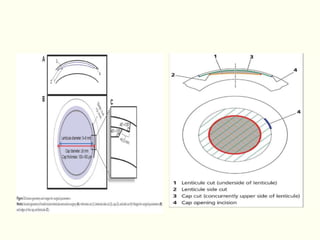
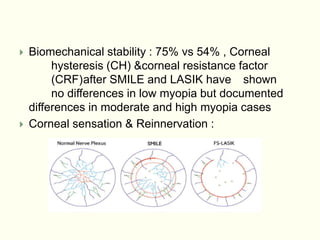
 is a relatively new refractive procedure designed to
treat a multitude of refractive errors such as myopia,
hyperopia, presbyopia, and astigmatism. The
procedure involves using a femtosecond laser to
create a corneal lenticule which is extracted whole
through a small incision without the use of an
excimer laser
 It is flapless ,bladeless procedure
 Currently, ReLEx SMILE corrects myopia from up to
−10.00 D, myopic astigmatism up to −5.00 D and a
spherical equivalent (SE) of up to −12.5D
 Biomechanical stability : 75% vs 54% , Corneal
hysteresis (CH) &corneal resistance factor
(CRF)after SMILE and LASIK have shown
no differences in low myopia but documented
differences in moderate and high myopia cases
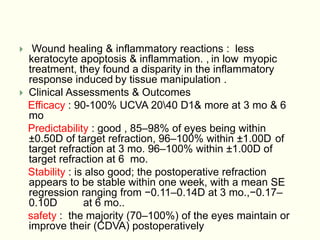
 Corneal sensation & Reinnervation :
 Wound healing & inflammatory reactions : less
keratocyte apoptosis & inflammation. , in low myopic
treatment, they found a disparity in the inflammatory
response induced by tissue manipulation .
 Clinical Assessments & Outcomes
Efficacy : 90-100% UCVA 2040 D1& more at 3 mo & 6
mo
Predictability : good , 85–98% of eyes being within
±0.50D of target refraction, 96–100% within ±1.00D of
target refraction at 3 mo. 96–100% within ±1.00D of
target refraction at 6 mo.
Stability : is also good; the postoperative refraction
appears to be stable within one week, with a mean SE
regression ranging from −0.11–0.14D at 3 mo.,−0.17–
0.10D at 6 mo..
safety : the majority (70–100%) of the eyes maintain or
improve their (CDVA) postoperatively
 Contrast sensitivity : is reported to be better than
that in femtosecond-LASIK patients.
 HOA : It is reported that the HOA mainly coma
& spherical aberration increased after
SMILE.However,the induction of HOAs is
significantly lower in SMILE patients than in
femtosecond-LASIK patients
 Topographic changes :The treatment zone is
observed as a slightly prolated & well-centered area
after SMILE
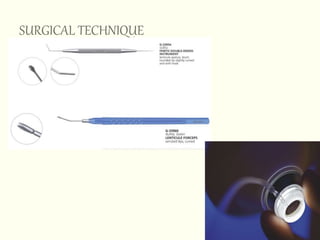
SURGICAL TECHNIQUE
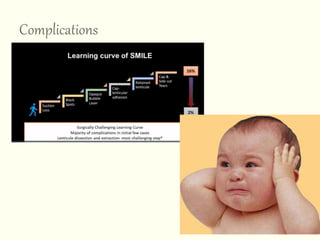
Complications
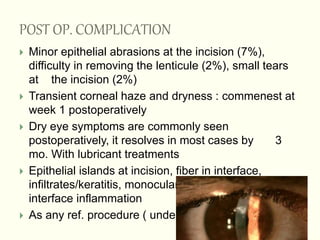
 The Mx of suction loss depends on the surgical step
at which it occurs : stage 1 (posterior lenticule cut
<10%), restart; stage 2 (posterior lenticule cut >
10%), switch to LASIK; stage 3 (lenticule side cut),
repeat the lenticule side cut & decrease the
lenticule diameter by 0.2 to 0.4 mm; stage 4 (anterior
lenticule cut), repeat the anterior lenticule cut; and
stage 5 (anterior lenticule side cut), repeat the
anterior lenticule side cut and decrease the lenticule
diameter by 0.2 to 0.4 mm.
POST OP. COMPLICATION
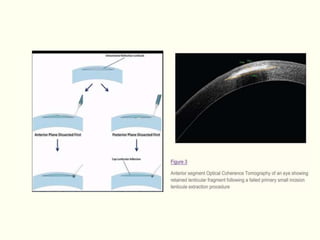
 Minor epithelial abrasions at the incision (7%),
difficulty in removing the lenticule (2%), small tears
at the incision (2%)
 Transient corneal haze and dryness : commenest at
week 1 postoperatively
 Dry eye symptoms are commonly seen
postoperatively, it resolves in most cases by 3
mo. With lubricant treatments
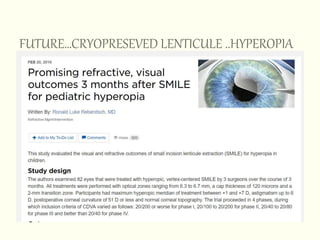
 Epithelial islands at incision, fiber in interface,
infiltrates/keratitis, monocular ghost images, and
interface inflammation
 As any ref. procedure ( under crr.
ENHANCEMENT
 Is considered only when stability has been
demonstrated, defined as a change in SE refraction
within ±0.25D in three months
 The only enhancement option reported clinically
utilized (PRK) procedure. The authors reported that
PRK with MMC was able to improve visual
symptoms of the patients after complicated SMILE
cases.
 perform secondary SMILE anterior/posterior to
the primary SMILE.
 conversion of the cap into a flap with a
larger diameter than the original cap by
using the VisuMax Circle software
FUTURE…CRYOPRESEVED LENTICULE ..HYPEROPIA
IS IT REALLY MAKE THE PATIENT SMILE
VS
THANK YOU

Just SMILE (small incision lenticule extraction )

  • 1.
    JUST SMILE SMALL INCISIONLENTICULE EXTRACTION/Dr.Diyar j.k.
  • 3.
    RELEX SMILE  isa relatively new refractive procedure designed to treat a multitude of refractive errors such as myopia, hyperopia, presbyopia, and astigmatism. The procedure involves using a femtosecond laser to create a corneal lenticule which is extracted whole through a small incision without the use of an excimer laser  It is flapless ,bladeless procedure  Currently, ReLEx SMILE corrects myopia from up to −10.00 D, myopic astigmatism up to −5.00 D and a spherical equivalent (SE) of up to −12.5D
  • 5.
     Biomechanical stability: 75% vs 54% , Corneal hysteresis (CH) &corneal resistance factor (CRF)after SMILE and LASIK have shown no differences in low myopia but documented differences in moderate and high myopia cases  Corneal sensation & Reinnervation :
  • 6.
     Wound healing& inflammatory reactions : less keratocyte apoptosis & inflammation. , in low myopic treatment, they found a disparity in the inflammatory response induced by tissue manipulation .  Clinical Assessments & Outcomes Efficacy : 90-100% UCVA 2040 D1& more at 3 mo & 6 mo Predictability : good , 85–98% of eyes being within ±0.50D of target refraction, 96–100% within ±1.00D of target refraction at 3 mo. 96–100% within ±1.00D of target refraction at 6 mo. Stability : is also good; the postoperative refraction appears to be stable within one week, with a mean SE regression ranging from −0.11–0.14D at 3 mo.,−0.17– 0.10D at 6 mo.. safety : the majority (70–100%) of the eyes maintain or improve their (CDVA) postoperatively
  • 7.
     Contrast sensitivity: is reported to be better than that in femtosecond-LASIK patients.  HOA : It is reported that the HOA mainly coma & spherical aberration increased after SMILE.However,the induction of HOAs is significantly lower in SMILE patients than in femtosecond-LASIK patients  Topographic changes :The treatment zone is observed as a slightly prolated & well-centered area after SMILE
  • 9.
  • 10.
  • 13.
     The Mxof suction loss depends on the surgical step at which it occurs : stage 1 (posterior lenticule cut <10%), restart; stage 2 (posterior lenticule cut > 10%), switch to LASIK; stage 3 (lenticule side cut), repeat the lenticule side cut & decrease the lenticule diameter by 0.2 to 0.4 mm; stage 4 (anterior lenticule cut), repeat the anterior lenticule cut; and stage 5 (anterior lenticule side cut), repeat the anterior lenticule side cut and decrease the lenticule diameter by 0.2 to 0.4 mm.
  • 14.
    POST OP. COMPLICATION Minor epithelial abrasions at the incision (7%), difficulty in removing the lenticule (2%), small tears at the incision (2%)  Transient corneal haze and dryness : commenest at week 1 postoperatively  Dry eye symptoms are commonly seen postoperatively, it resolves in most cases by 3 mo. With lubricant treatments  Epithelial islands at incision, fiber in interface, infiltrates/keratitis, monocular ghost images, and interface inflammation  As any ref. procedure ( under crr.
  • 15.
    ENHANCEMENT  Is consideredonly when stability has been demonstrated, defined as a change in SE refraction within ±0.25D in three months  The only enhancement option reported clinically utilized (PRK) procedure. The authors reported that PRK with MMC was able to improve visual symptoms of the patients after complicated SMILE cases.  perform secondary SMILE anterior/posterior to the primary SMILE.  conversion of the cap into a flap with a larger diameter than the original cap by using the VisuMax Circle software
  • 16.
  • 17.
    IS IT REALLYMAKE THE PATIENT SMILE
  • 18.
  • 19.

Editor's Notes

  • #4  Preserve Cornea Structure Less Dry EyesSuitable for the Active Sports Person or those in the Militar
  • #7  86% eyes had unchanged or improved CDVA by three months after SMILE, while 1.5% of eyes had a loss of two or more lines of CDVA