ALLPPT.com _ Free PowerPoint Templates, Diagrams and Charts
Dr. Diyar J.K.
PRESBYOPIA
PART 1
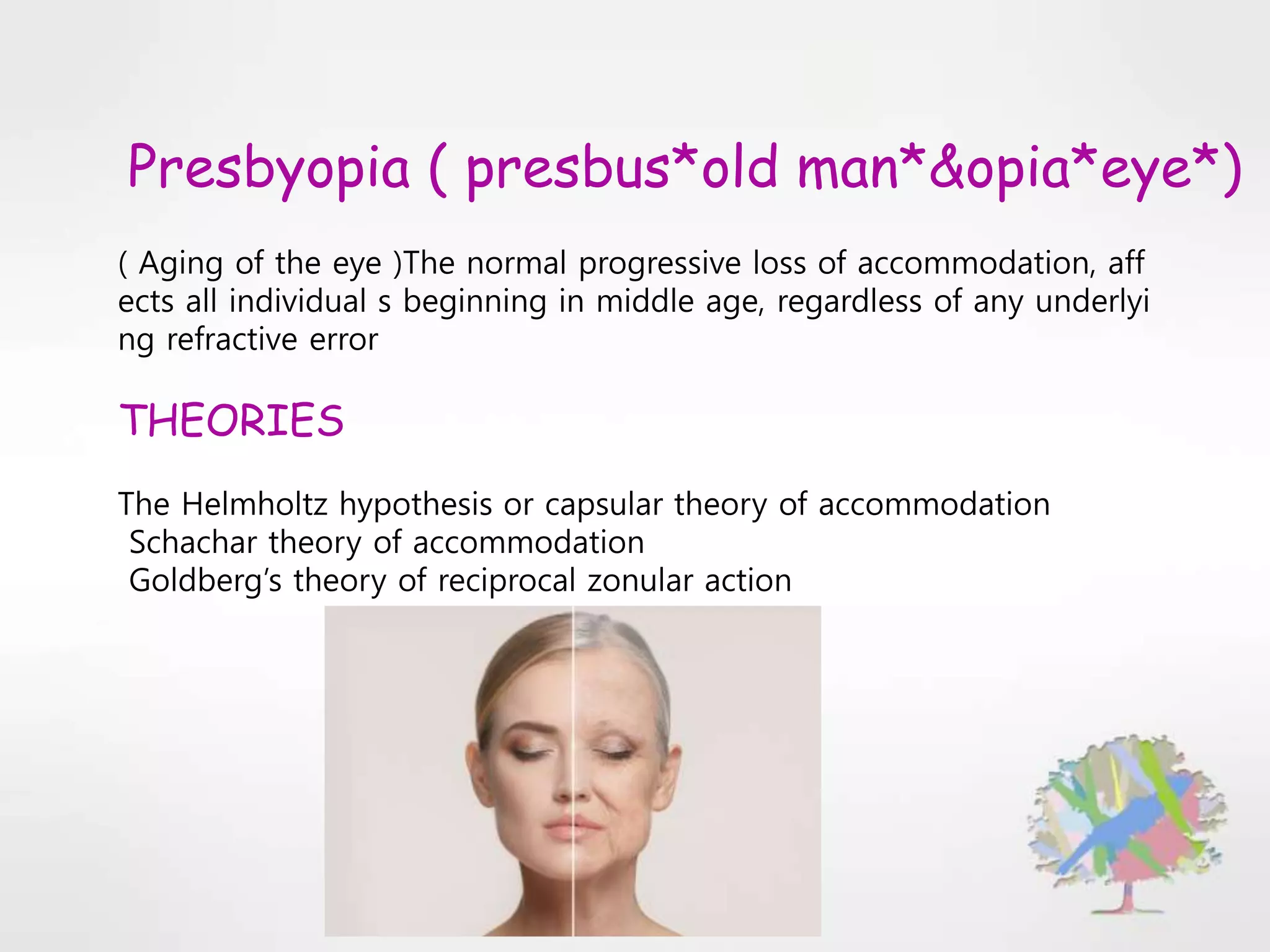
( Aging of the eye )The normal progressive loss of accommodation, aff
ects all individual s beginning in middle age, regardless of any underlyi
ng refractive error
THEORIES
The Helmholtz hypothesis or capsular theory of accommodation
Schachar theory of accommodation
Goldberg’s theory of reciprocal zonular action
Presbyopia ( presbus*old man*&opia*eye*)
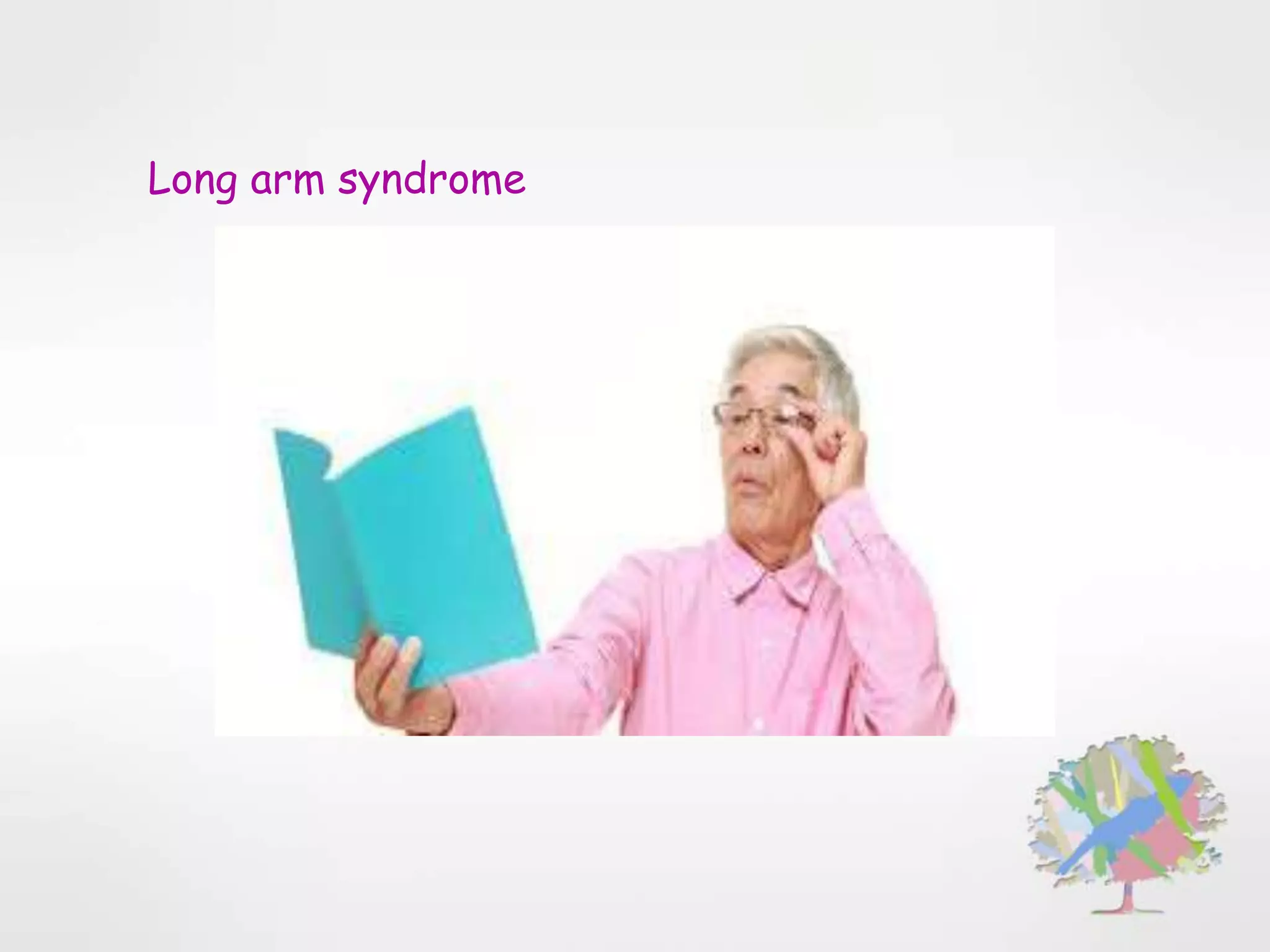
Long arm syndrome
MANAGEMENT
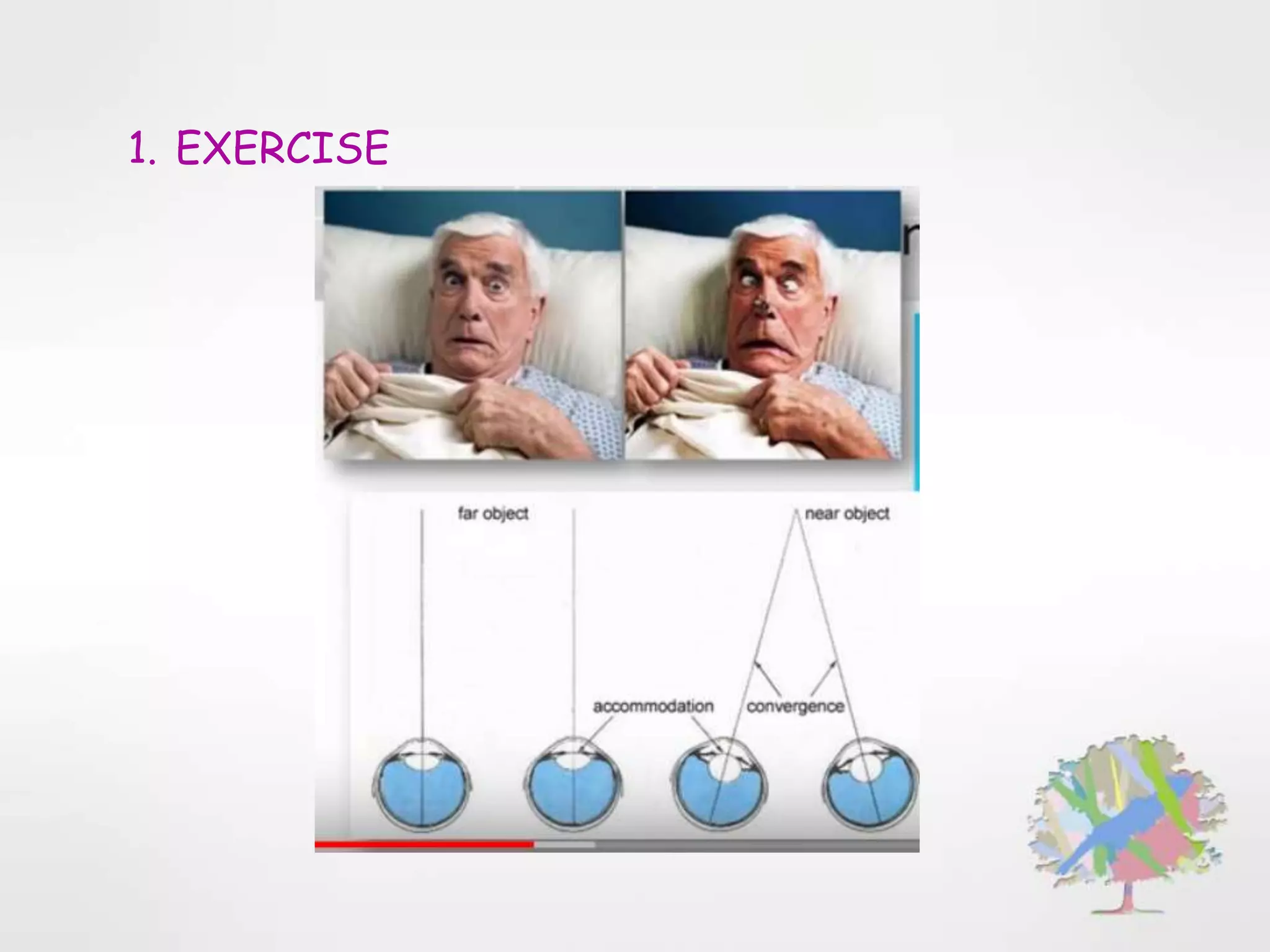
1. EXERCISE
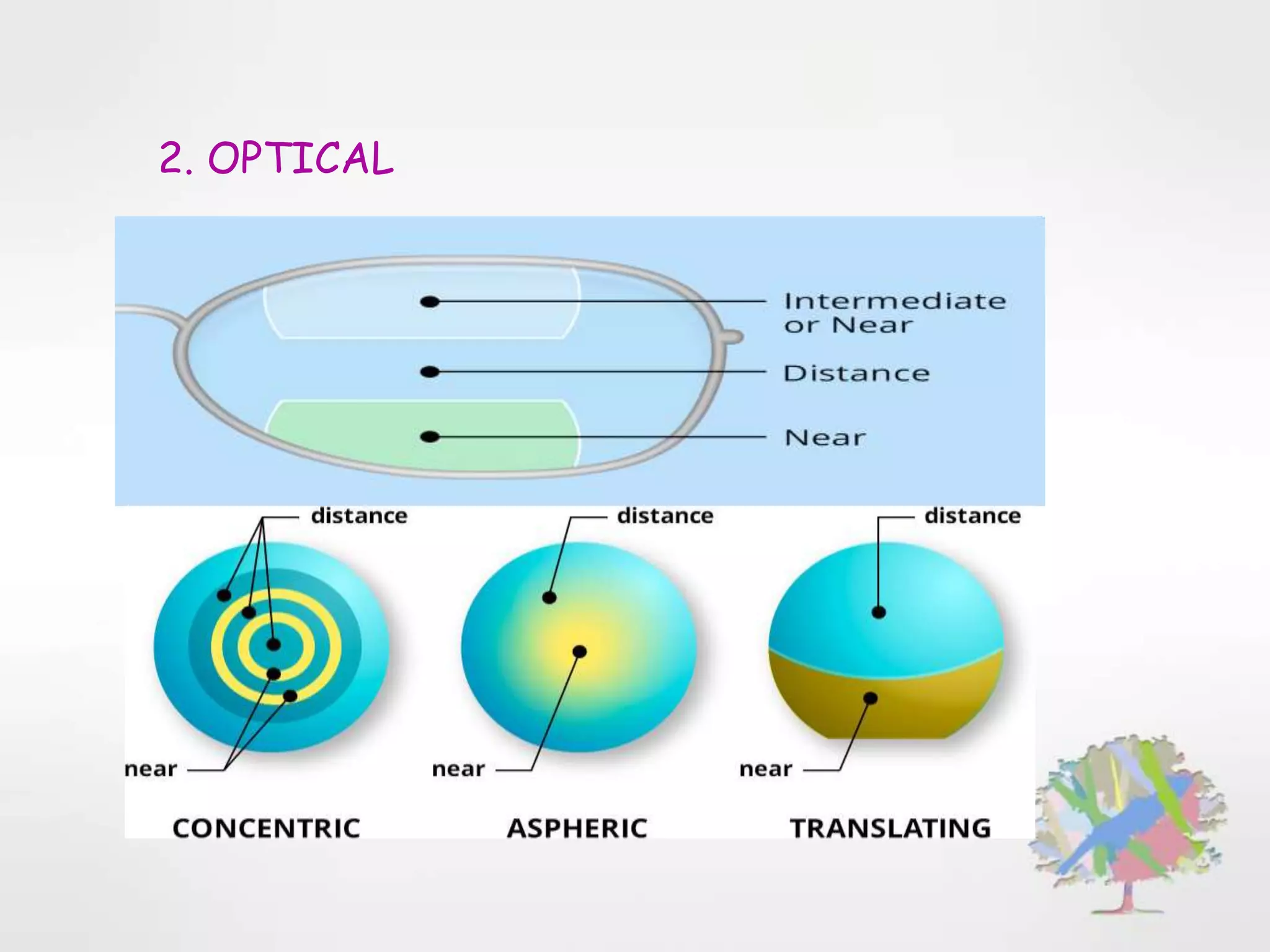
2. OPTICAL
3. EYE DROPS
4. SURGICAL
1. EXERCISE
2. OPTICAL
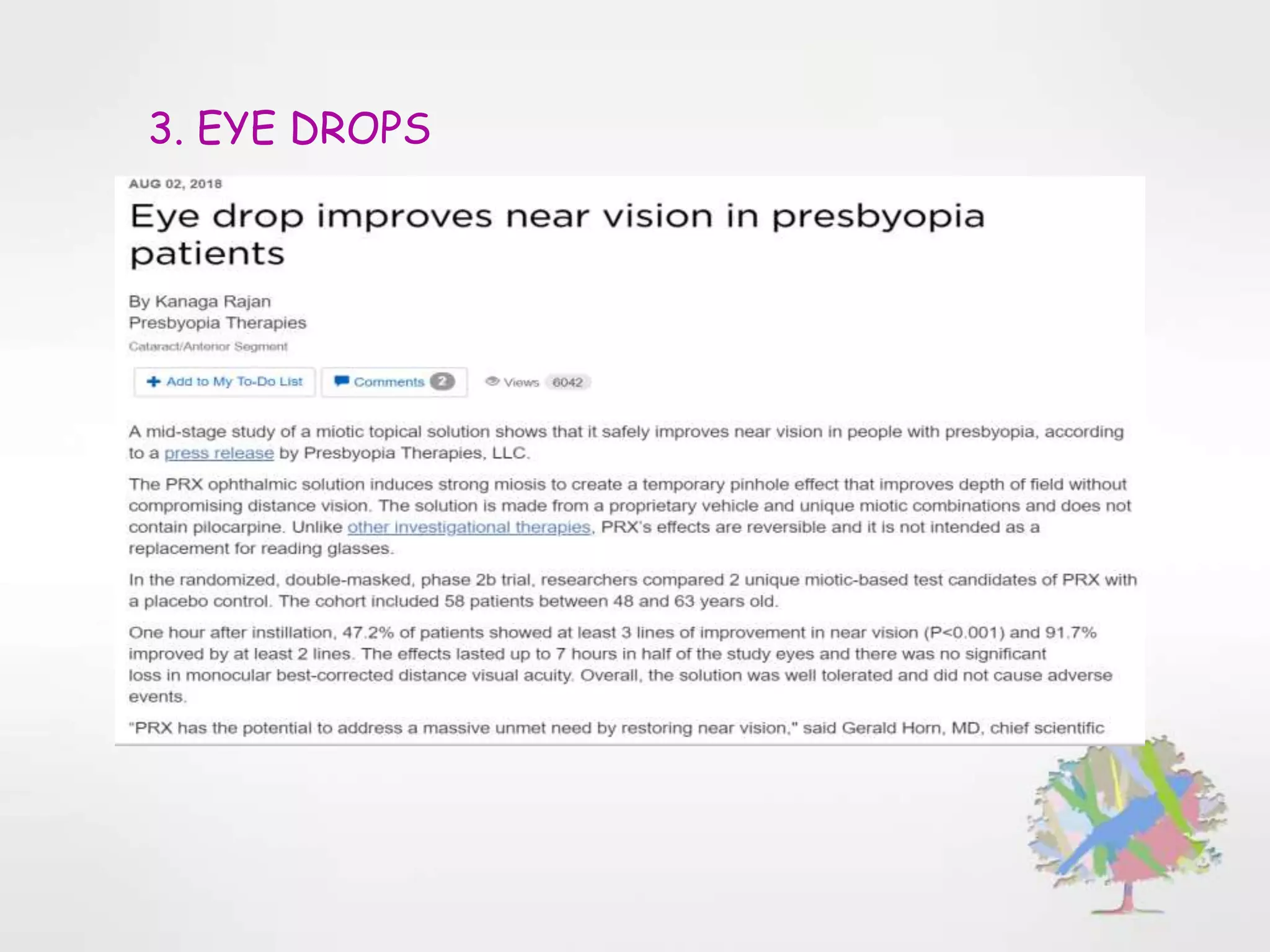
3. EYE DROPS
4. SURGICAL
1. Scleral Approaches
2. Lenticular Approaches
3. Corneal Approaches
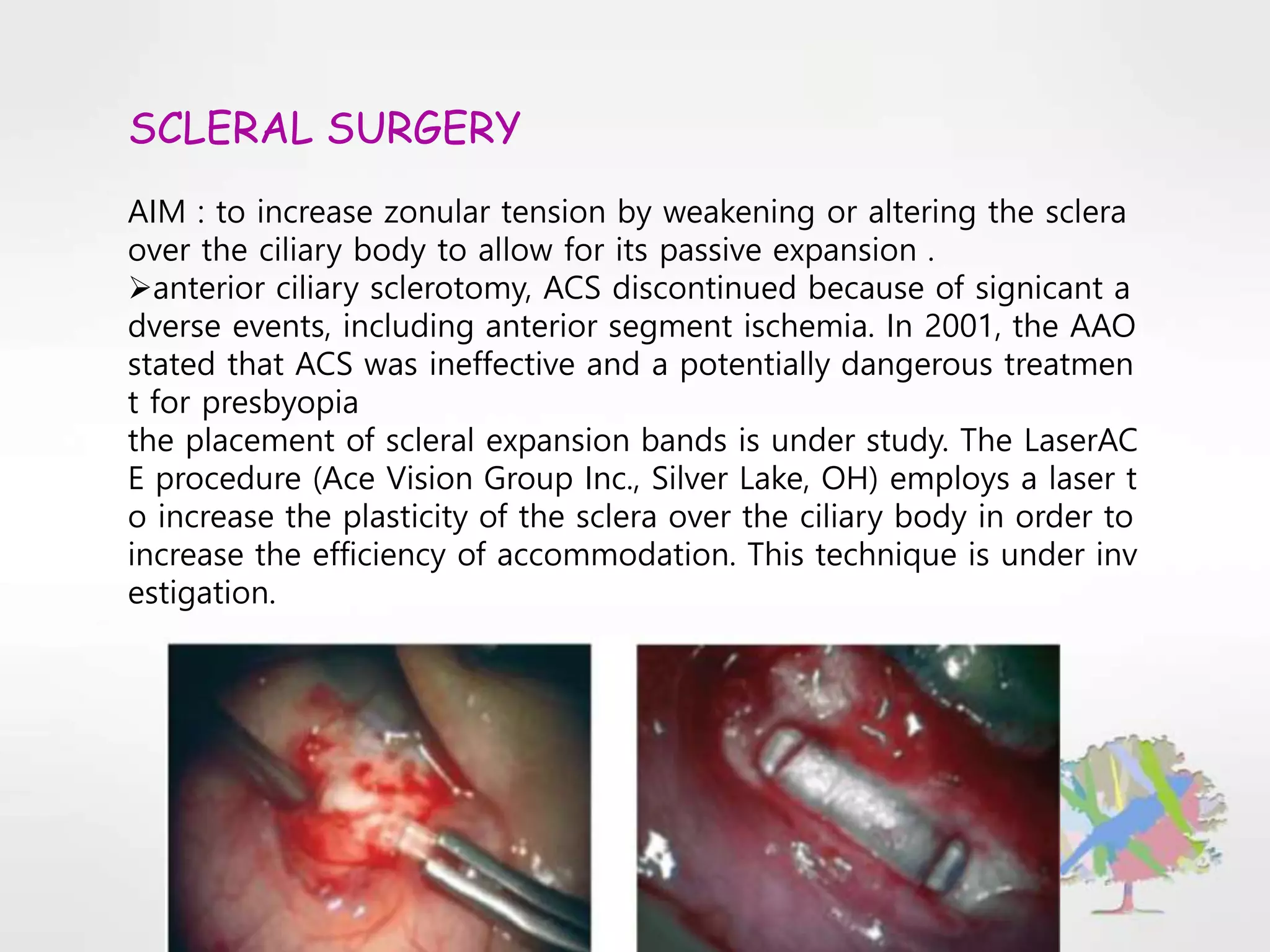
SCLERAL SURGERY
AIM : to increase zonular tension by weakening or altering the sclera
over the ciliary body to allow for its passive expansion .
anterior ciliary sclerotomy, ACS discontinued because of signicant a
dverse events, including anterior segment ischemia. In 2001, the AAO
stated that ACS was ineffective and a potentially dangerous treatmen
t for presbyopia
the placement of scleral expansion bands is under study. The LaserAC
E procedure (Ace Vision Group Inc., Silver Lake, OH) employs a laser t
o increase the plasticity of the sclera over the ciliary body in order to
increase the efficiency of accommodation. This technique is under inv
estigation.
Lenticular Approaches
1. MONOVISION
2. MULTIFOCAL IOL
3. EDOF IOL
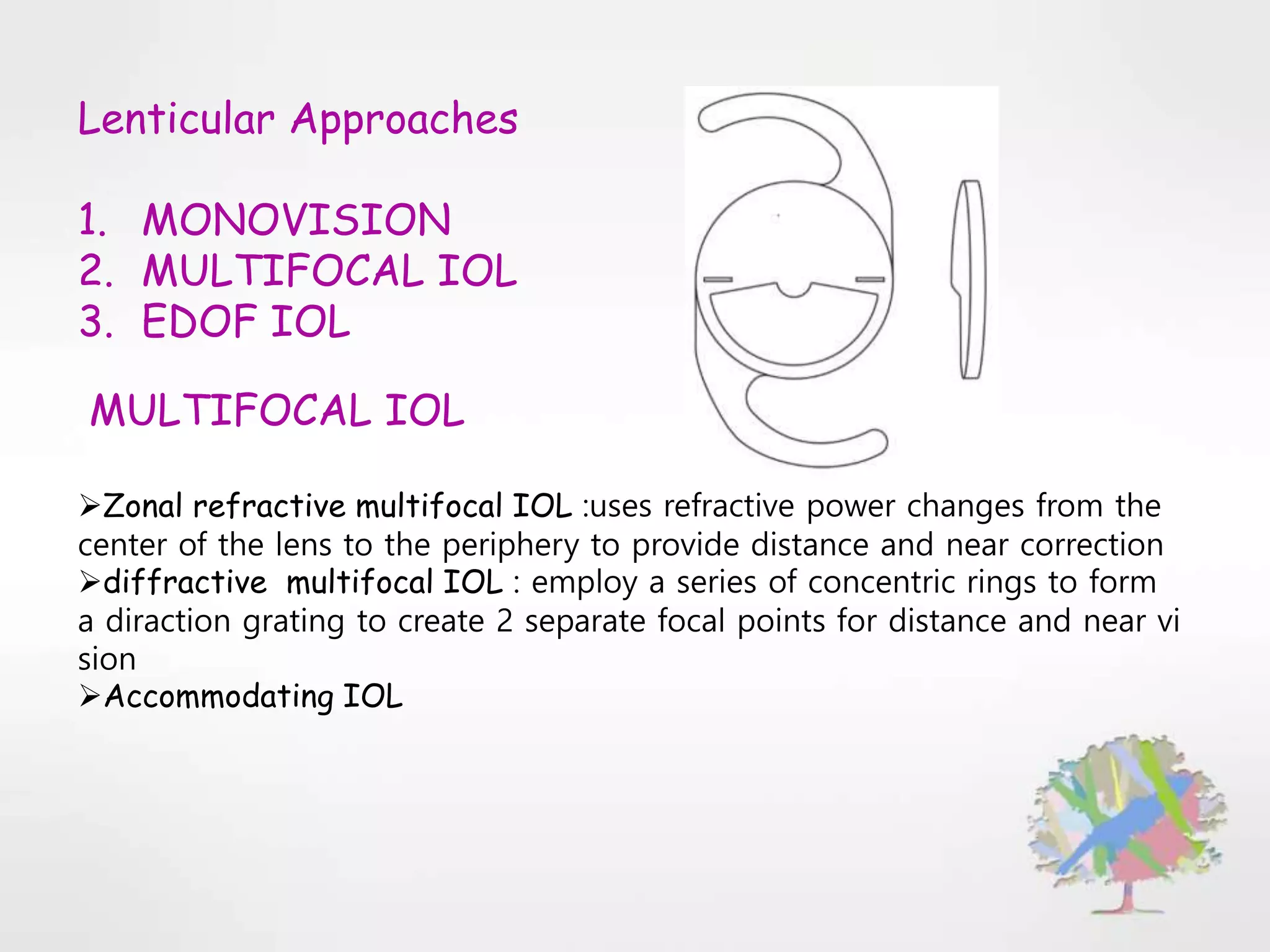
MULTIFOCAL IOL
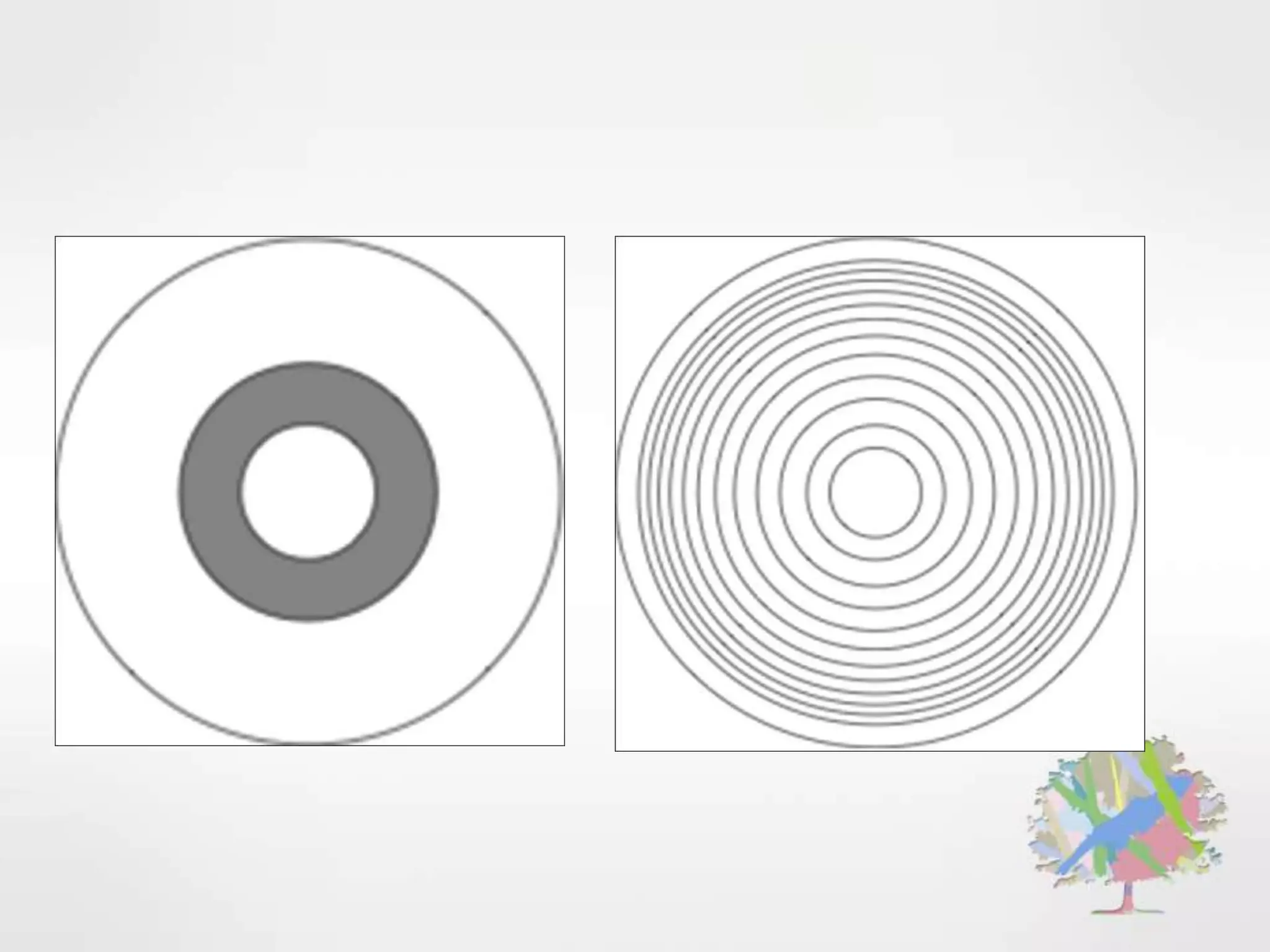
Zonal refractive multifocal IOL :uses refractive power changes from the
center of the lens to the periphery to provide distance and near correction
diffractive multifocal IOL : employ a series of concentric rings to form
a diraction grating to create 2 separate focal points for distance and near vi
sion
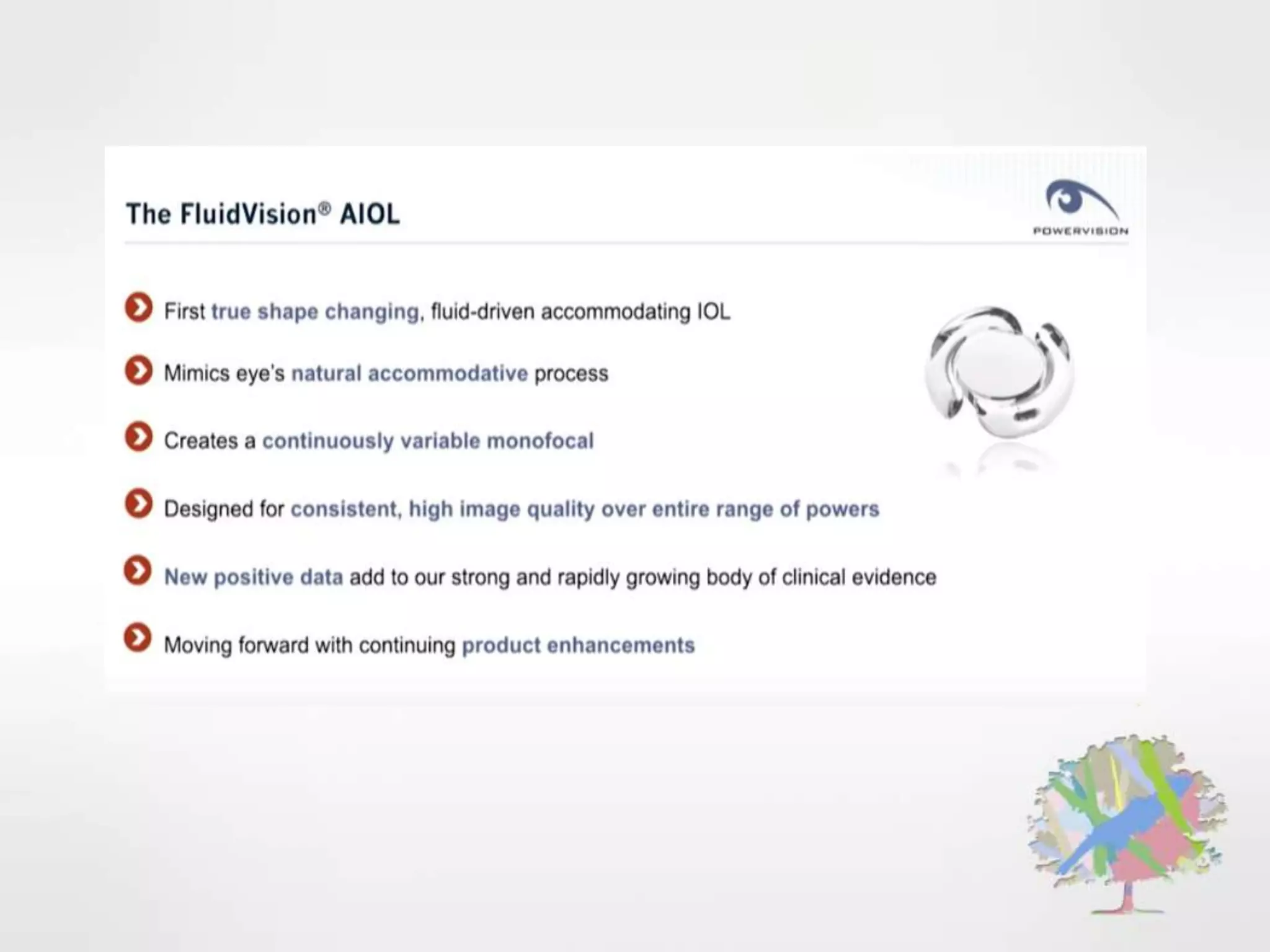
Accommodating IOL
Accommodating IOL :
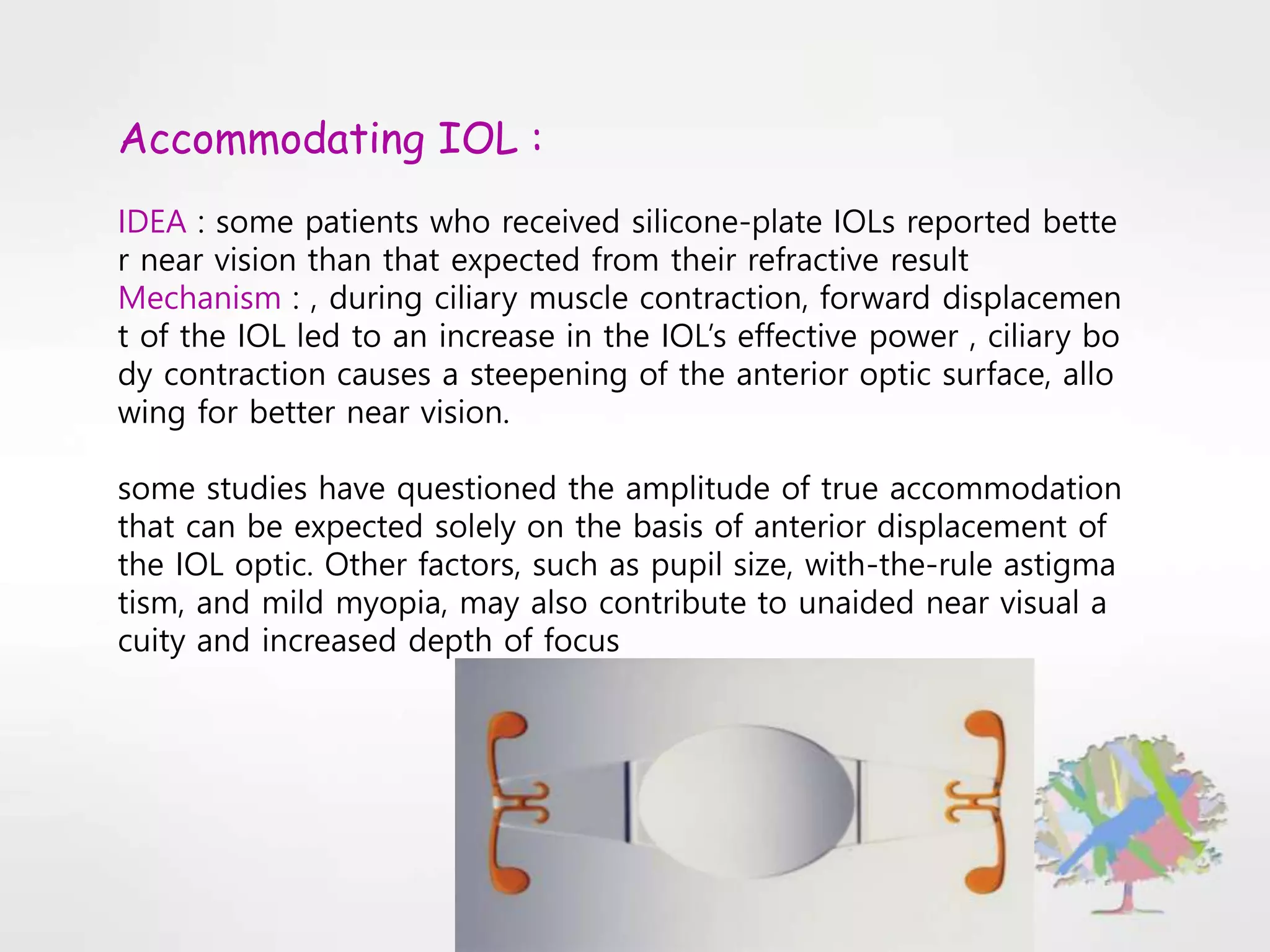
IDEA : some patients who received silicone-plate IOLs reported bette
r near vision than that expected from their refractive result
Mechanism : , during ciliary muscle contraction, forward displacemen
t of the IOL led to an increase in the IOL’s effective power , ciliary bo
dy contraction causes a steepening of the anterior optic surface, allo
wing for better near vision.
some studies have questioned the amplitude of true accommodation
that can be expected solely on the basis of anterior displacement of
the IOL optic. Other factors, such as pupil size, with-the-rule astigma
tism, and mild myopia, may also contribute to unaided near visual a
cuity and increased depth of focus
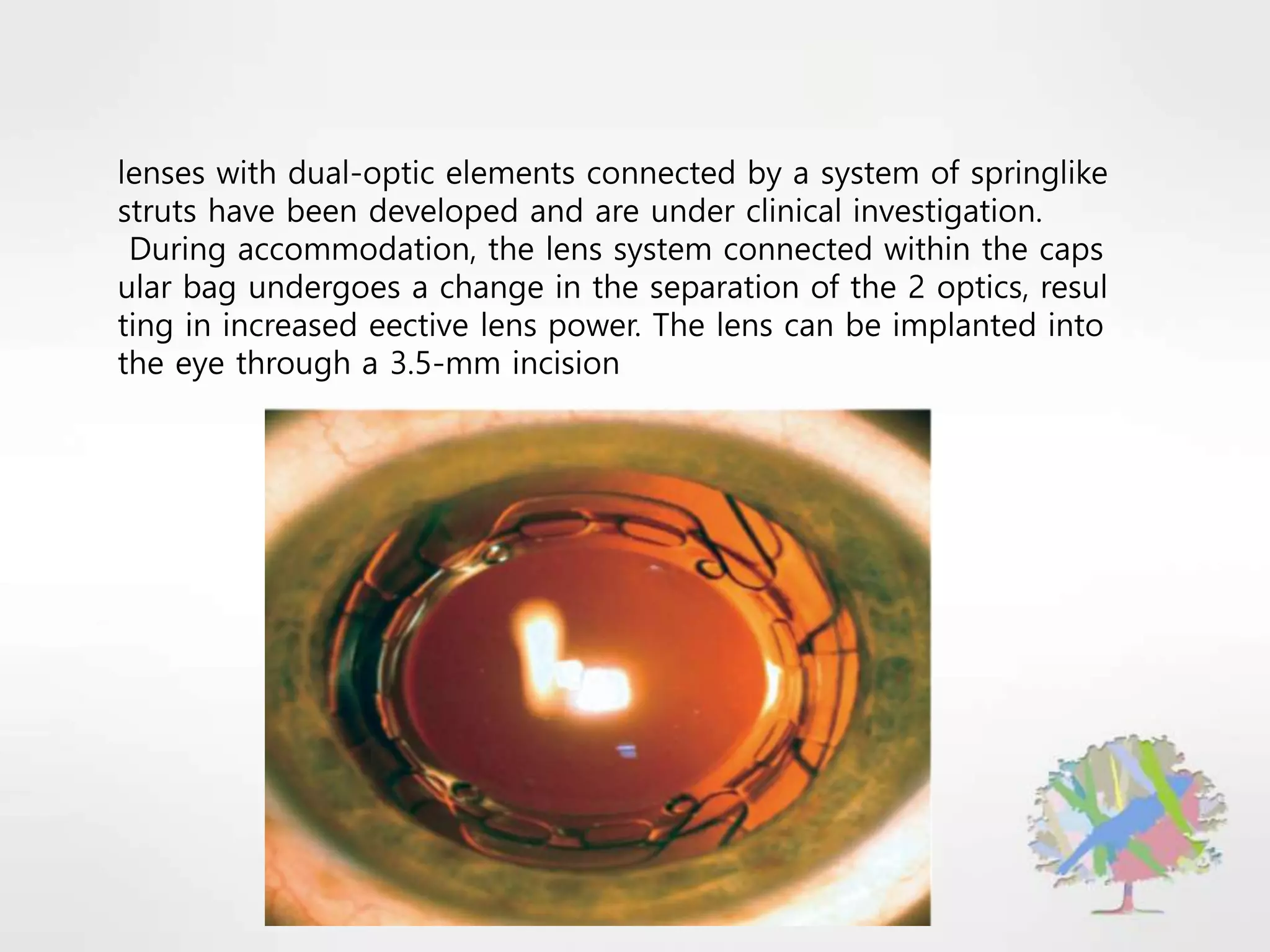
lenses with dual-optic elements connected by a system of springlike
struts have been developed and are under clinical investigation.
During accommodation, the lens system connected within the caps
ular bag undergoes a change in the separation of the 2 optics, resul
ting in increased eective lens power. The lens can be implanted into
the eye through a 3.5-mm incision
Extended Depth of Focus IOLs
The basic principle : is to create a single-elongated focal point to enh
ance depth of focus or range of vision. EDOF lenses work by focusing
incoming waves in an extended longitudinal plane, as opposed to the
monofocal lenses which focus plane waves in one single point or two
to three discrete points (bifocal or multifocal, respectively).
This elongated focus is meant to eliminate the overlapping of near an
d far images caused by traditional multifocal IOLs, thereby eliminating
the halo effect.
In several studies, the Symfony IOL has performed similarly with mon
ofocal and multifocal IOLs in regards to distance visual acuity results,
with a trend toward superior uncorrected intermediate visual acuity, w
hile multifocal IOLs have trended toward having superior uncorrected
near visual acuity results.[
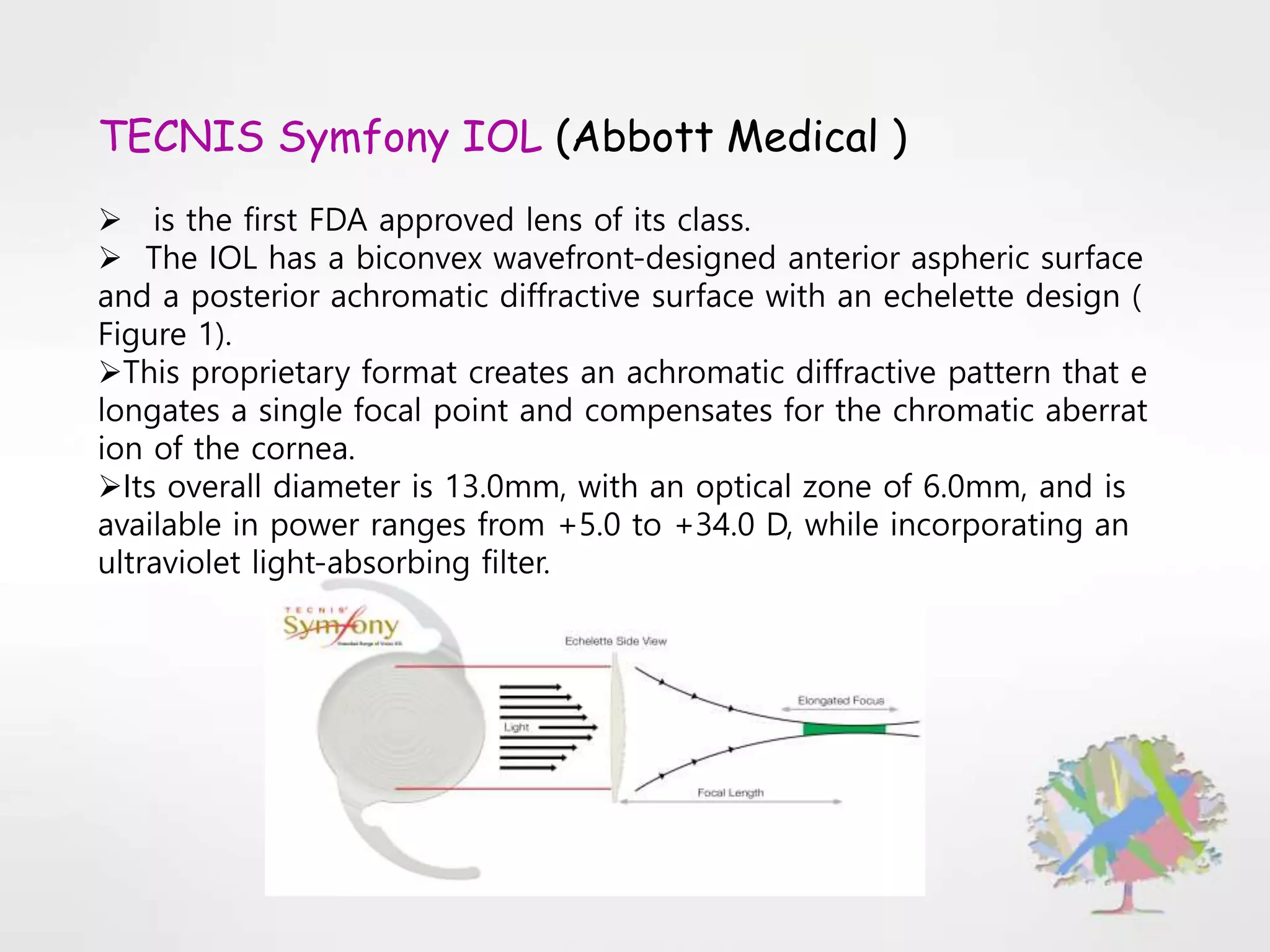
TECNIS Symfony IOL (Abbott Medical )
 is the first FDA approved lens of its class.
 The IOL has a biconvex wavefront-designed anterior aspheric surface
and a posterior achromatic diffractive surface with an echelette design (
Figure 1).
This proprietary format creates an achromatic diffractive pattern that e
longates a single focal point and compensates for the chromatic aberrat
ion of the cornea.
Its overall diameter is 13.0mm, with an optical zone of 6.0mm, and is
available in power ranges from +5.0 to +34.0 D, while incorporating an
ultraviolet light-absorbing filter.
A PINHOLE IOL
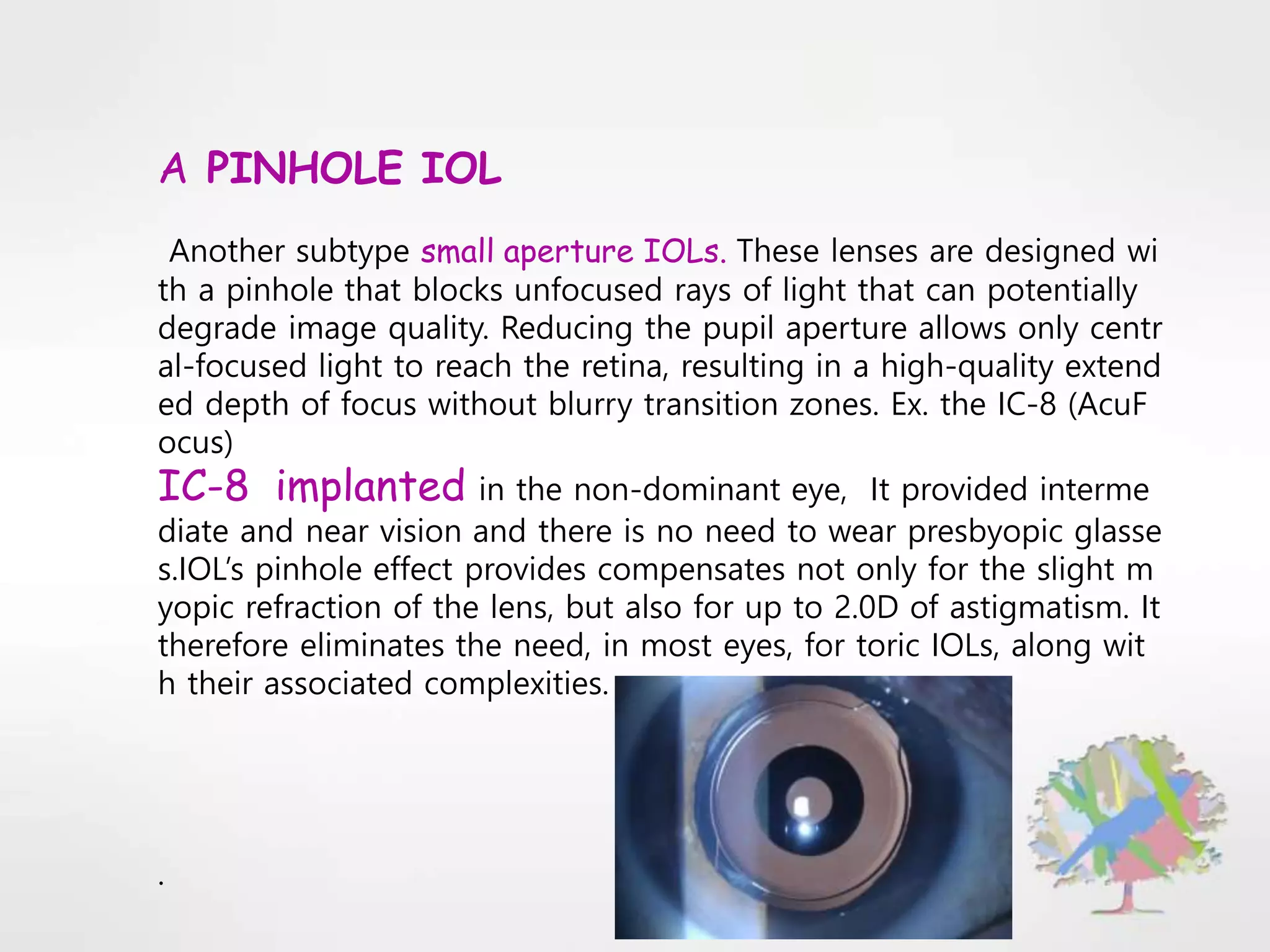
Another subtype small aperture IOLs. These lenses are designed wi
th a pinhole that blocks unfocused rays of light that can potentially
degrade image quality. Reducing the pupil aperture allows only centr
al-focused light to reach the retina, resulting in a high-quality extend
ed depth of focus without blurry transition zones. Ex. the IC-8 (AcuF
ocus)
IC-8 implanted in the non-dominant eye, It provided interme
diate and near vision and there is no need to wear presbyopic glasse
s.IOL’s pinhole effect provides compensates not only for the slight m
yopic refraction of the lens, but also for up to 2.0D of astigmatism. It
therefore eliminates the need, in most eyes, for toric IOLs, along wit
h their associated complexities.
.
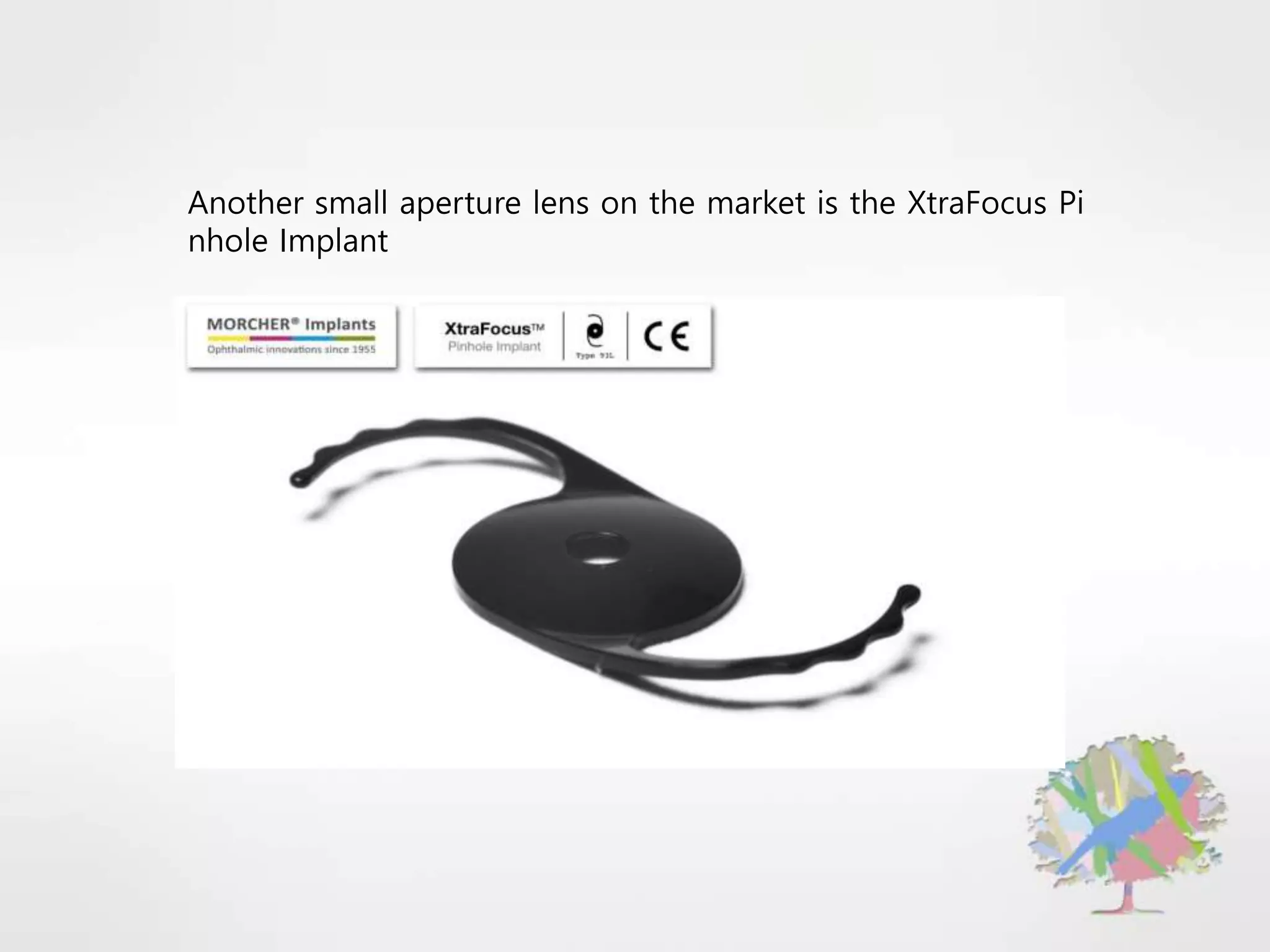
Another small aperture lens on the market is the XtraFocus Pi
nhole Implant
CONTRAINDICATION
1. Patients with unrealistic expectation.
2. in eyes with preexisting poor vision potential.
3. any ocular abnormality that could increase systemic ocular aberra
tions (eg, corneal scarring, irregular astigmatism, dry eye) may sig
nicantly decrease image quality with these lenses.
4. The clinician should carefully consider the possibility of patient di
ssatisfaction with the quality of vision after MFIOL implantation.
Patient unhappiness
is due to one or more of the following:
•Inappropriately high expectations;
•Residual refractive error;
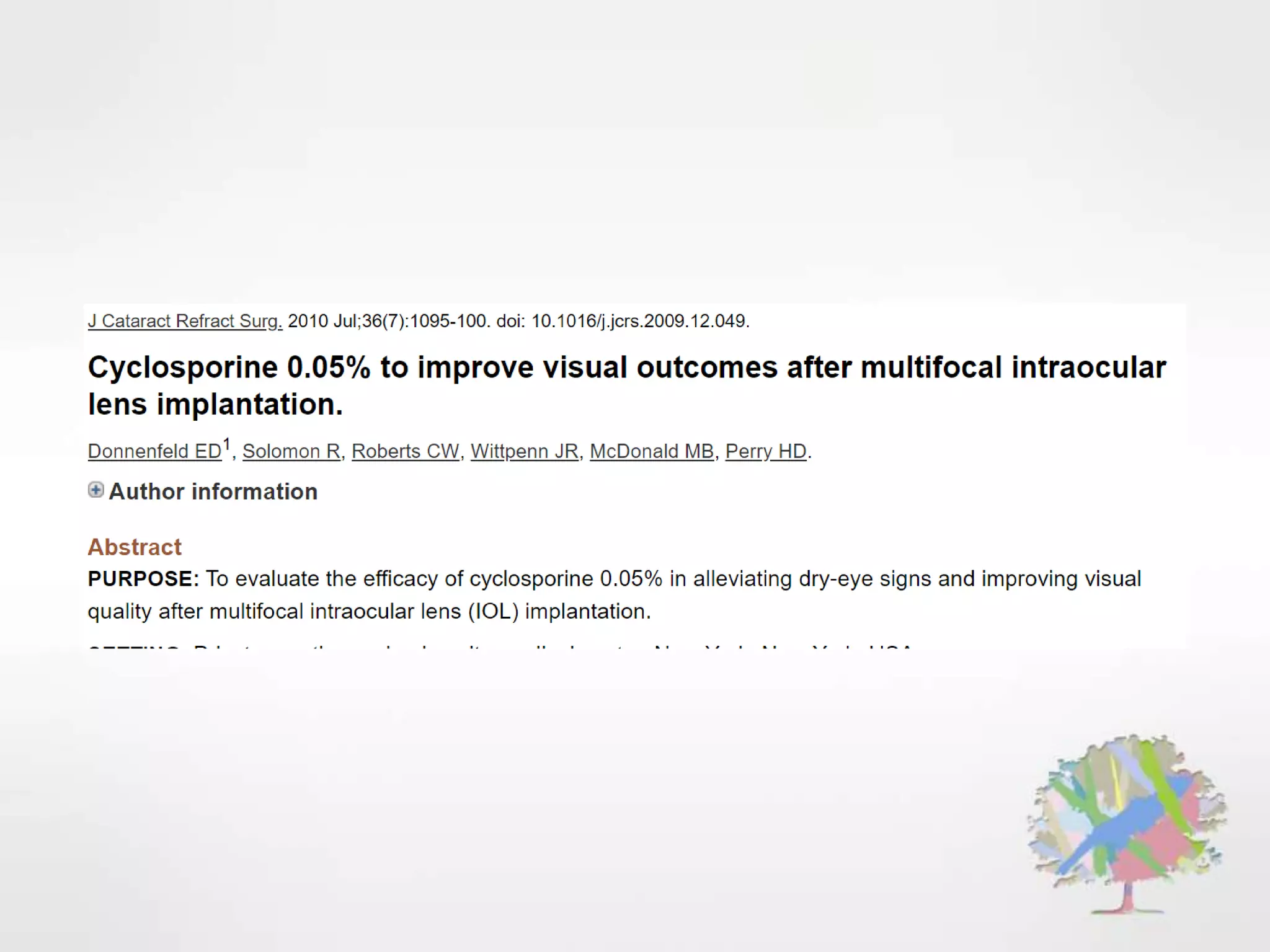
•Visual quality fluctuations due to dry eye; or
•Nighttime glare, halos, and starbursts.
These potential sources of unhappiness are concepts we address when we
counsel patients preoperatively. As a result, if there is a patient in the 3-to-
6-month postoperative period who remains unhappy, the discussion of an
IOL explantation
SUCCESSFUL STEPS
1. SELECTION OF PATIENT, PATIENT EDUCATION
2. BILATERAL IS BETTER
3. LIGHTING EFFECT
4. SMALL AMOUNT OF ASTIGMATISM
5. GOOD POLISHING OF POST. CAPSULE
ALLPPT.com _ Free PowerPoint Templates, Diagrams and Charts
THANK YOU

Presbyopia ( Part 1 / lenticular approach )..Types of MFIOL

  • 1.
    ALLPPT.com _ FreePowerPoint Templates, Diagrams and Charts Dr. Diyar J.K. PRESBYOPIA PART 1
  • 2.
    ( Aging ofthe eye )The normal progressive loss of accommodation, aff ects all individual s beginning in middle age, regardless of any underlyi ng refractive error THEORIES The Helmholtz hypothesis or capsular theory of accommodation Schachar theory of accommodation Goldberg’s theory of reciprocal zonular action Presbyopia ( presbus*old man*&opia*eye*)
  • 3.
  • 4.
  • 5.
  • 7.
  • 8.
  • 9.
    4. SURGICAL 1. ScleralApproaches 2. Lenticular Approaches 3. Corneal Approaches
  • 10.
    SCLERAL SURGERY AIM :to increase zonular tension by weakening or altering the sclera over the ciliary body to allow for its passive expansion . anterior ciliary sclerotomy, ACS discontinued because of signicant a dverse events, including anterior segment ischemia. In 2001, the AAO stated that ACS was ineffective and a potentially dangerous treatmen t for presbyopia the placement of scleral expansion bands is under study. The LaserAC E procedure (Ace Vision Group Inc., Silver Lake, OH) employs a laser t o increase the plasticity of the sclera over the ciliary body in order to increase the efficiency of accommodation. This technique is under inv estigation.
  • 11.
    Lenticular Approaches 1. MONOVISION 2.MULTIFOCAL IOL 3. EDOF IOL MULTIFOCAL IOL Zonal refractive multifocal IOL :uses refractive power changes from the center of the lens to the periphery to provide distance and near correction diffractive multifocal IOL : employ a series of concentric rings to form a diraction grating to create 2 separate focal points for distance and near vi sion Accommodating IOL
  • 13.
    Accommodating IOL : IDEA: some patients who received silicone-plate IOLs reported bette r near vision than that expected from their refractive result Mechanism : , during ciliary muscle contraction, forward displacemen t of the IOL led to an increase in the IOL’s effective power , ciliary bo dy contraction causes a steepening of the anterior optic surface, allo wing for better near vision. some studies have questioned the amplitude of true accommodation that can be expected solely on the basis of anterior displacement of the IOL optic. Other factors, such as pupil size, with-the-rule astigma tism, and mild myopia, may also contribute to unaided near visual a cuity and increased depth of focus
  • 15.
    lenses with dual-opticelements connected by a system of springlike struts have been developed and are under clinical investigation. During accommodation, the lens system connected within the caps ular bag undergoes a change in the separation of the 2 optics, resul ting in increased eective lens power. The lens can be implanted into the eye through a 3.5-mm incision
  • 16.
    Extended Depth ofFocus IOLs The basic principle : is to create a single-elongated focal point to enh ance depth of focus or range of vision. EDOF lenses work by focusing incoming waves in an extended longitudinal plane, as opposed to the monofocal lenses which focus plane waves in one single point or two to three discrete points (bifocal or multifocal, respectively). This elongated focus is meant to eliminate the overlapping of near an d far images caused by traditional multifocal IOLs, thereby eliminating the halo effect. In several studies, the Symfony IOL has performed similarly with mon ofocal and multifocal IOLs in regards to distance visual acuity results, with a trend toward superior uncorrected intermediate visual acuity, w hile multifocal IOLs have trended toward having superior uncorrected near visual acuity results.[
  • 17.
    TECNIS Symfony IOL(Abbott Medical )  is the first FDA approved lens of its class.  The IOL has a biconvex wavefront-designed anterior aspheric surface and a posterior achromatic diffractive surface with an echelette design ( Figure 1). This proprietary format creates an achromatic diffractive pattern that e longates a single focal point and compensates for the chromatic aberrat ion of the cornea. Its overall diameter is 13.0mm, with an optical zone of 6.0mm, and is available in power ranges from +5.0 to +34.0 D, while incorporating an ultraviolet light-absorbing filter.
  • 18.
    A PINHOLE IOL Anothersubtype small aperture IOLs. These lenses are designed wi th a pinhole that blocks unfocused rays of light that can potentially degrade image quality. Reducing the pupil aperture allows only centr al-focused light to reach the retina, resulting in a high-quality extend ed depth of focus without blurry transition zones. Ex. the IC-8 (AcuF ocus) IC-8 implanted in the non-dominant eye, It provided interme diate and near vision and there is no need to wear presbyopic glasse s.IOL’s pinhole effect provides compensates not only for the slight m yopic refraction of the lens, but also for up to 2.0D of astigmatism. It therefore eliminates the need, in most eyes, for toric IOLs, along wit h their associated complexities. .
  • 19.
    Another small aperturelens on the market is the XtraFocus Pi nhole Implant
  • 20.
    CONTRAINDICATION 1. Patients withunrealistic expectation. 2. in eyes with preexisting poor vision potential. 3. any ocular abnormality that could increase systemic ocular aberra tions (eg, corneal scarring, irregular astigmatism, dry eye) may sig nicantly decrease image quality with these lenses. 4. The clinician should carefully consider the possibility of patient di ssatisfaction with the quality of vision after MFIOL implantation.
  • 21.
    Patient unhappiness is dueto one or more of the following: •Inappropriately high expectations; •Residual refractive error; •Visual quality fluctuations due to dry eye; or •Nighttime glare, halos, and starbursts. These potential sources of unhappiness are concepts we address when we counsel patients preoperatively. As a result, if there is a patient in the 3-to- 6-month postoperative period who remains unhappy, the discussion of an IOL explantation SUCCESSFUL STEPS 1. SELECTION OF PATIENT, PATIENT EDUCATION 2. BILATERAL IS BETTER 3. LIGHTING EFFECT 4. SMALL AMOUNT OF ASTIGMATISM 5. GOOD POLISHING OF POST. CAPSULE
  • 24.
    ALLPPT.com _ FreePowerPoint Templates, Diagrams and Charts THANK YOU