Chronic Obstructive
Pulmonary Disease
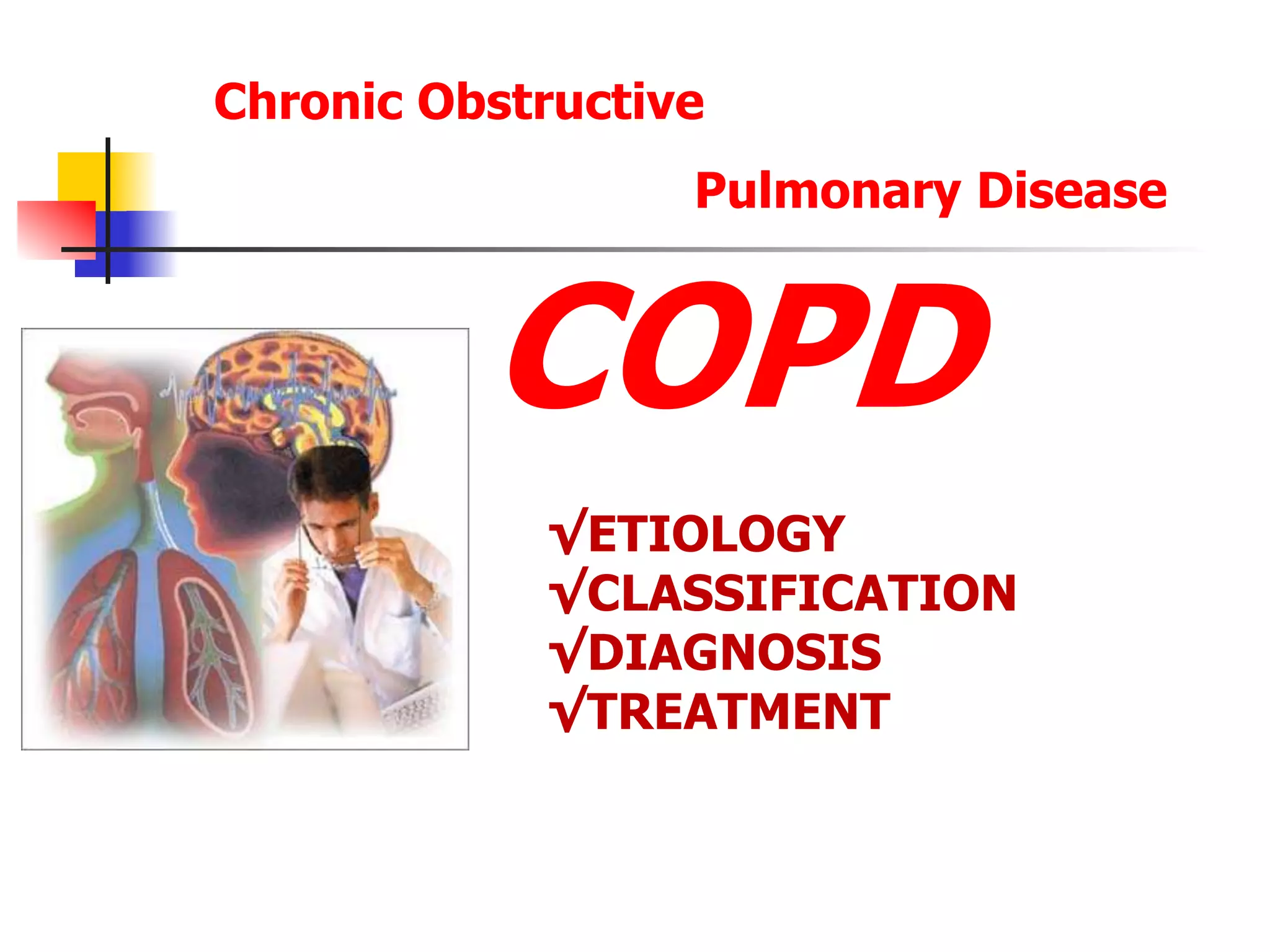
COPD
√ETIOLOGY
√CLASSIFICATION
√DIAGNOSIS
√TREATMENT
WHAT IS CHRRONIOC OBSTRUCTI
VE PULMONARY DISEASE (COPD)?
Chronic obstructive pulmonary disease (COPD) –
-Is a disease characterized by progressive irreversible airways obst
ruction as result of chronic obstructive bronchitis and emphysema;
Clinically manifested by cough with production of sputum and dys
pnea not less than 3 month per year during 2 years in a row and mo
re and,
As usually, complicated by pulmonary hypertension and chronic c
or pulmonale.
RISK FACTORS:
WHAT CAUSES COPD?
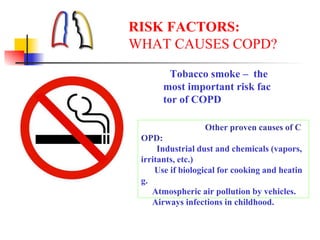
Tobacco smoke – the
most important risk fac
tor of COPD
Other proven causes of C
OPD:
Industrial dust and chemicals (vapors,
irritants, etc.)
Use if biological for cooking and heatin
g.
Atmospheric air pollution by vehicles.
Airways infections in childhood.
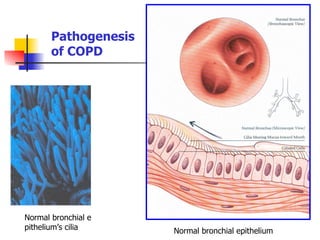
Normal bronchial e
pithelium’s cilia
Pathogenesis
of COPD
Normal bronchial epithelium
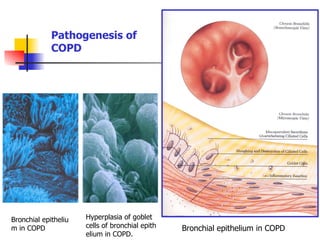
Bronchial epitheliu
m in COPD
Hyperplasia of goblet
cells of bronchial epith
elium in COPD.
Pathogenesis of
COPD
Bronchial epithelium in COPD
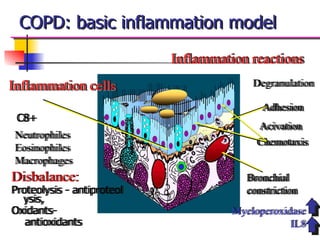
COPD: basic inflammation model
Disbalance:
Proteolysis - antiproteol
ysis,
Oxidants-
antioxidants
Degranulation
Adhesion
C8+
Chemotaxis
Acivation
Bronchial
constriction
Neutrophiles
Eosinophiles
Macrophages
Myeloperoxidase
IL8
Inflammation cells
Inflammation reactions
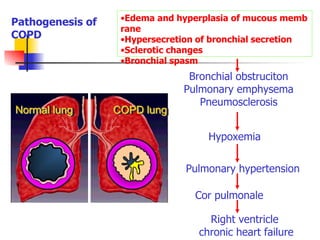
Normal lung COPD lung
Bronchial obstruciton
Pulmonary emphysema
Pneumosclerosis
Hypoxemia
Pulmonary hypertension
Cor pulmonale
Right ventricle
chronic heart failure
Pathogenesis of
COPD
•Edema and hyperplasia of mucous memb
rane
•Hypersecretion of bronchial secretion
•Sclerotic changes
•Bronchial spasm
• Chronic cough.
• Chronic sputum production.
• Dyspnea: persistent (continues all the time), progressive, increases
in condition of physical exertion and in exacerbations
• Repetitive exacerbations of bronchitis are typical
• Risk factors in anamnesis:
• tobacco smoke (including local types of smoking),
• industrial dust and chemicals
DIAGNOSIS of COPD
•Inspection
in early stages there are no significant changes.
Later on:
•Skin cyanosis.
•Emphysematous chest.
• Percussion: bandbox resonance, lowering of lung borders and lim
itation of their mobility.
• Auscultation: diminished breathing, prolonged phase pf expiratio
n, diffuse dry rales, wheezing.
DIAGNOSIS of COPD
Laboratory methods:
Obligatory:
 General sputum analysis
If indicated:
 General blood test
DIAGNOSIS of COPD
Instrumental:
Obligatory:
 Radiological study of chest organs during first visit, then not less t
han once a year.
 Lung function test (FEV1 or peakflowmetry) with bronchodilation
test in every visit.
If indicated:
 ECG (for diagnostics of cor pulmonale, arrhythmias and conducti
on impairment).
 Echo-CG – if available
DIAGNOSIS of COPD
Spirometry measures:
• Forced Vital Capacity (FVC)
• Forced Expiratory Volume on the 1 second (FEV1).
Bronchodilation test:
In COPD growth of FEV1 and PEF less than 15% after 10-30 m
inutes of inhalation of 2 doses of -agonists indicates irreversibi
lity or partial reversibility of bronchial obstruction.
Functional Diagnostics
• Stage 0: risk of development – chronic cough and sputum production; lung functi
ons are not impaired.
• Stage I: mild COPD – insignificant limitation of airflow (FEV1/FVC<70%, but
FEV1 >80% of predicted) and cough and sputum production are usual.
• Stage II: Moderate COPD – (FEV150% of predicted, but <80%) symptoms are
usually more severe, accompanied by dyspnea that appears in physical exertion.
• Stage III: Severe COPD – strong limitation of airflow (FEV1<50% of predicted)
or presence of respiratory failure or clinical signs of right heart chambers failure.
Classification of COPD by s
everity
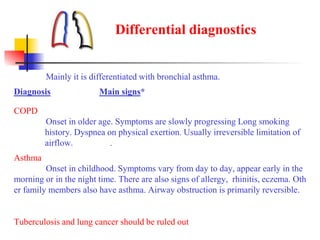
Differential diagnostics
Mainly it is differentiated with bronchial asthma.
Diagnosis Main signs*
COPD
Onset in older age. Symptoms are slowly progressing Long smoking
history. Dyspnea on physical exertion. Usually irreversible limitation of
airflow. .
Asthma
Onset in childhood. Symptoms vary from day to day, appear early in the
morning or in the night time. There are also signs of allergy, rhinitis, eczema. Oth
er family members also have asthma. Airway obstruction is primarily reversible.
Tuberculosis and lung cancer should be ruled out
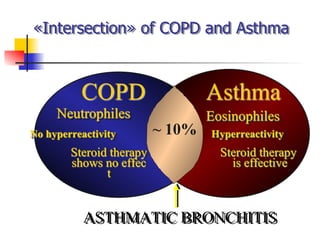
«Intersection» of COPD and Asthma
COPD Asthma
Neutrophiles Eosinophiles
No hyperreactivity Hyperreactivity
Steroid therapy
shows no effec
t
Steroid therapy
is effective
ASTHMATIC BRONCHITIS
~ 10%
SUPPORT COMPONENTS:
COPD THERAPY PROGRAMME
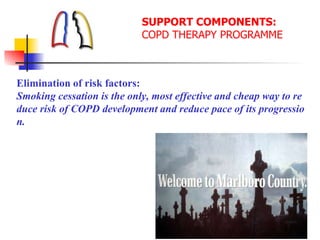
Elimination of risk factors:
Smoking cessation is the only, most effective and cheap way to re
duce risk of COPD development and reduce pace of its progressio
n.
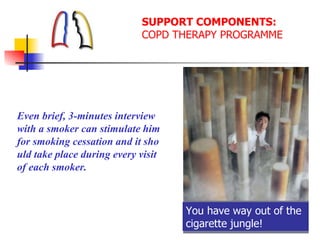
Even brief, 3-minutes interview
with a smoker can stimulate him
for smoking cessation and it sho
uld take place during every visit
of each smoker.
SUPPORT COMPONENTS:
COPD THERAPY PROGRAMME
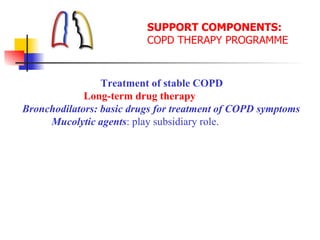
You have way out of the
cigarette jungle!
SUPPORT COMPONENTS:
COPD THERAPY PROGRAMME
Treatment of stable COPD
Long-term drug therapy
Bronchodilators: basic drugs for treatment of COPD symptoms
Mucolytic agents: play subsidiary role.
Bronchodilation therapy of COPD
1. Inhalation anticholinergics
(Ipratropium bromide - atrovent, oxitropiume bromide)
2. 2-agonists
• Non-selective (orziprenalin - astmopent)
• Selective (salbutamol, fenoterol)
• Long-acting (formoterol, salmeterol)
3. Methylxantines
(theophylline/aminophylline orally or by parenteral route)
 Mild COPD
- Ipratropium bromide when necessary or regularly up to 2 puffs 4 times (daily dose 1
60-320 mcg).
or β2-agonists (salbutamol) when necessary.
· Moderate COPD
- Ipratropium bromide regularly in daily dose of 160-320mcg
+ β2-agonists (salbutamol) when necessary.
Severe COPD
- Ipratropium bromide regularly in daily dose of 160-320mcg
+ theophylline in slow release form in daily dose of 400-600mg
+ β2-agonists when necessary.
Bronchodilation therapy of COPD
N-ACETYLCYSTEINE (АЦЦ-100/200, etc.) – derivation of L-cysteine, pro
duced in tablets, capsules, granules solution for inhalation.
CARBOCYSTEIN (Fluditek, etc) – analogue of acetylcysteine. Produced in
tablets, capsules, granules, solution for inhalation, syrup.
AMBROXAL HYDROCHLORIDE (Lasolvan, Ambrosan, etc.) produced i
n tablets by 30 mg., solution for IM, IV, and inhalation administration.
Mucolytic therapy of COPD
SUPPORT COMPONENTS:
COPD THERAPY PROGRAMME
Treatment of exacerbations
1. Bronchodilators: increase of dose or additional administration of bronchodilator
of another group.
2. Glucocorticosteroids: if FEV<50% then 30 mg of prednisone is additionally ad
ministered for 7-8 days with subsequent cessation.
3. Antibacterial agents: only if signs of inflammation of bronchial tree are present
.
1 Line drugs: Amoxicillin 0,5g 3 times a day or
Erythromycin 0,5g 4 times a day
2 line drugs: Amoxicillin/clavulanic acid 375-625 mg 3 times or
Doxycyclin 0,2 g once a day
Term of treatment of exacerbation is 5-7-10 days
Oxygen therapy: long-term administration of oxygen (more than 1
5 hours a day) in patients with chronic respiratory failure promotes
growth of survival rate and positively influences on pressure in pul
monary artery, polycythemia (haematocrit more than 55%), physica
l tolerance, lung function and emotional status.
Goal of long-term oxygen-therapy:
To increase РаО2 up to 8,0 кpа (60 mmHg)
and/or saturation SaО2 up to 90% (at sea level).
SUPPORT COMPONENTS:
COPD THERAPY PROGRAMME
SUPPORT COMPONENTS:
COPD THERAPY PROGRAMME
Non-drug therapy includes
Rehabilitation and oxygen therapy.
Rehabilitation must include at least following::
• Physical exercises (respiratory muscles training)
• Diet
• Education

COPD

  • 1.
  • 2.
    WHAT IS CHRRONIOCOBSTRUCTI VE PULMONARY DISEASE (COPD)? Chronic obstructive pulmonary disease (COPD) – -Is a disease characterized by progressive irreversible airways obst ruction as result of chronic obstructive bronchitis and emphysema; Clinically manifested by cough with production of sputum and dys pnea not less than 3 month per year during 2 years in a row and mo re and, As usually, complicated by pulmonary hypertension and chronic c or pulmonale.
  • 3.
    RISK FACTORS: WHAT CAUSESCOPD? Tobacco smoke – the most important risk fac tor of COPD Other proven causes of C OPD: Industrial dust and chemicals (vapors, irritants, etc.) Use if biological for cooking and heatin g. Atmospheric air pollution by vehicles. Airways infections in childhood.
  • 4.
    Normal bronchial e pithelium’scilia Pathogenesis of COPD Normal bronchial epithelium
  • 5.
    Bronchial epitheliu m inCOPD Hyperplasia of goblet cells of bronchial epith elium in COPD. Pathogenesis of COPD Bronchial epithelium in COPD
  • 6.
    COPD: basic inflammationmodel Disbalance: Proteolysis - antiproteol ysis, Oxidants- antioxidants Degranulation Adhesion C8+ Chemotaxis Acivation Bronchial constriction Neutrophiles Eosinophiles Macrophages Myeloperoxidase IL8 Inflammation cells Inflammation reactions
  • 7.
    Normal lung COPDlung Bronchial obstruciton Pulmonary emphysema Pneumosclerosis Hypoxemia Pulmonary hypertension Cor pulmonale Right ventricle chronic heart failure Pathogenesis of COPD •Edema and hyperplasia of mucous memb rane •Hypersecretion of bronchial secretion •Sclerotic changes •Bronchial spasm
  • 8.
    • Chronic cough. •Chronic sputum production. • Dyspnea: persistent (continues all the time), progressive, increases in condition of physical exertion and in exacerbations • Repetitive exacerbations of bronchitis are typical • Risk factors in anamnesis: • tobacco smoke (including local types of smoking), • industrial dust and chemicals DIAGNOSIS of COPD
  • 9.
    •Inspection in early stagesthere are no significant changes. Later on: •Skin cyanosis. •Emphysematous chest. • Percussion: bandbox resonance, lowering of lung borders and lim itation of their mobility. • Auscultation: diminished breathing, prolonged phase pf expiratio n, diffuse dry rales, wheezing. DIAGNOSIS of COPD
  • 10.
    Laboratory methods: Obligatory:  Generalsputum analysis If indicated:  General blood test DIAGNOSIS of COPD
  • 11.
    Instrumental: Obligatory:  Radiological studyof chest organs during first visit, then not less t han once a year.  Lung function test (FEV1 or peakflowmetry) with bronchodilation test in every visit. If indicated:  ECG (for diagnostics of cor pulmonale, arrhythmias and conducti on impairment).  Echo-CG – if available DIAGNOSIS of COPD
  • 12.
    Spirometry measures: • ForcedVital Capacity (FVC) • Forced Expiratory Volume on the 1 second (FEV1). Bronchodilation test: In COPD growth of FEV1 and PEF less than 15% after 10-30 m inutes of inhalation of 2 doses of -agonists indicates irreversibi lity or partial reversibility of bronchial obstruction. Functional Diagnostics
  • 13.
    • Stage 0:risk of development – chronic cough and sputum production; lung functi ons are not impaired. • Stage I: mild COPD – insignificant limitation of airflow (FEV1/FVC<70%, but FEV1 >80% of predicted) and cough and sputum production are usual. • Stage II: Moderate COPD – (FEV150% of predicted, but <80%) symptoms are usually more severe, accompanied by dyspnea that appears in physical exertion. • Stage III: Severe COPD – strong limitation of airflow (FEV1<50% of predicted) or presence of respiratory failure or clinical signs of right heart chambers failure. Classification of COPD by s everity
  • 14.
    Differential diagnostics Mainly itis differentiated with bronchial asthma. Diagnosis Main signs* COPD Onset in older age. Symptoms are slowly progressing Long smoking history. Dyspnea on physical exertion. Usually irreversible limitation of airflow. . Asthma Onset in childhood. Symptoms vary from day to day, appear early in the morning or in the night time. There are also signs of allergy, rhinitis, eczema. Oth er family members also have asthma. Airway obstruction is primarily reversible. Tuberculosis and lung cancer should be ruled out
  • 15.
    «Intersection» of COPDand Asthma COPD Asthma Neutrophiles Eosinophiles No hyperreactivity Hyperreactivity Steroid therapy shows no effec t Steroid therapy is effective ASTHMATIC BRONCHITIS ~ 10%
  • 16.
    SUPPORT COMPONENTS: COPD THERAPYPROGRAMME Elimination of risk factors: Smoking cessation is the only, most effective and cheap way to re duce risk of COPD development and reduce pace of its progressio n.
  • 17.
    Even brief, 3-minutesinterview with a smoker can stimulate him for smoking cessation and it sho uld take place during every visit of each smoker. SUPPORT COMPONENTS: COPD THERAPY PROGRAMME You have way out of the cigarette jungle!
  • 18.
    SUPPORT COMPONENTS: COPD THERAPYPROGRAMME Treatment of stable COPD Long-term drug therapy Bronchodilators: basic drugs for treatment of COPD symptoms Mucolytic agents: play subsidiary role.
  • 19.
    Bronchodilation therapy ofCOPD 1. Inhalation anticholinergics (Ipratropium bromide - atrovent, oxitropiume bromide) 2. 2-agonists • Non-selective (orziprenalin - astmopent) • Selective (salbutamol, fenoterol) • Long-acting (formoterol, salmeterol) 3. Methylxantines (theophylline/aminophylline orally or by parenteral route)
  • 20.
     Mild COPD -Ipratropium bromide when necessary or regularly up to 2 puffs 4 times (daily dose 1 60-320 mcg). or β2-agonists (salbutamol) when necessary. · Moderate COPD - Ipratropium bromide regularly in daily dose of 160-320mcg + β2-agonists (salbutamol) when necessary. Severe COPD - Ipratropium bromide regularly in daily dose of 160-320mcg + theophylline in slow release form in daily dose of 400-600mg + β2-agonists when necessary. Bronchodilation therapy of COPD
  • 21.
    N-ACETYLCYSTEINE (АЦЦ-100/200, etc.)– derivation of L-cysteine, pro duced in tablets, capsules, granules solution for inhalation. CARBOCYSTEIN (Fluditek, etc) – analogue of acetylcysteine. Produced in tablets, capsules, granules, solution for inhalation, syrup. AMBROXAL HYDROCHLORIDE (Lasolvan, Ambrosan, etc.) produced i n tablets by 30 mg., solution for IM, IV, and inhalation administration. Mucolytic therapy of COPD
  • 22.
    SUPPORT COMPONENTS: COPD THERAPYPROGRAMME Treatment of exacerbations 1. Bronchodilators: increase of dose or additional administration of bronchodilator of another group. 2. Glucocorticosteroids: if FEV<50% then 30 mg of prednisone is additionally ad ministered for 7-8 days with subsequent cessation. 3. Antibacterial agents: only if signs of inflammation of bronchial tree are present . 1 Line drugs: Amoxicillin 0,5g 3 times a day or Erythromycin 0,5g 4 times a day 2 line drugs: Amoxicillin/clavulanic acid 375-625 mg 3 times or Doxycyclin 0,2 g once a day Term of treatment of exacerbation is 5-7-10 days
  • 23.
    Oxygen therapy: long-termadministration of oxygen (more than 1 5 hours a day) in patients with chronic respiratory failure promotes growth of survival rate and positively influences on pressure in pul monary artery, polycythemia (haematocrit more than 55%), physica l tolerance, lung function and emotional status. Goal of long-term oxygen-therapy: To increase РаО2 up to 8,0 кpа (60 mmHg) and/or saturation SaО2 up to 90% (at sea level). SUPPORT COMPONENTS: COPD THERAPY PROGRAMME
  • 24.
    SUPPORT COMPONENTS: COPD THERAPYPROGRAMME Non-drug therapy includes Rehabilitation and oxygen therapy. Rehabilitation must include at least following:: • Physical exercises (respiratory muscles training) • Diet • Education