BRONCHIAL ASTHMA
LEARNING OBJECTIVES
• To know the commonly used drugs in
bronchial asthma
• To understand the mechanism of action of the
major classes of drugs used in bronchial
asthma
• To know the adverse effects of these drugs
BRONCHIAL ASTHMA
• Chronic inflammatory disease
• Reversible episodes of airway
obstruction
• Due to hyperresponsiveness of
tracheobronchial smooth muscle
to various stimuli, resulting in :
-Bronchospasm
-Narrowing of airtubes
-Mucosal edema
-Increased bronchial mucus
secretion and mucus plugging
Cardinal symptoms
• Breathlessness
• Wheezing
• Cough
• Chest tightness
Trigger factors for asthma
• Infection
• Irritants (pollen, house dust mites, chemical etc.)
• Pollutants
• Exercise
• Exposure to cold air
• Psychogenic
Different types of asthma
• Acute asthma
• Chronic asthma
• Extrinsic asthma
• Intrinsic asthma
 Status asthmaticus
Pathophysiology
Inflammation underlying hyperactivity
• Early reaction – Reversible airway obstruction
• Late reaction – Worsening of disease
• Increased vagal discharge to bronchial muscle
Bronchoconstriction and increased mucus secretion
• Adenosine - bronchoconstriction
Approaches to treatment
• Prevention of Ag-Ab reaction – avoidence of antigen
• Suppression of inflammation and bronchial hyperactivity
– corticosteroids
• Prevention of release of mediators – mast cell stabilizers
• Antagonism of released mediators – LT antagonists
• Blockade of constrictor neurotransmitter –
anticholinergics
• Mimicking dilator neurotransmitter – sympathomimetics
• Directly acting bronchodilators – methylxanthines
Classification
A.Bronchodilators
i. Non-selective sympathomimetics – Adrenaline,
ephedrine, isoprenaline
ii. Selective beta2 agonists - Salbutamol, terbutaline,
salmeterol, formoterol
iii.Anticholinergics – Ipratropium bromide, atropine
methonitrate
iv.Methylxanthines – Theophylline, aminophylline, choline
theophyllinate
B. Corticosteroids
i. Systemic – Oral: Prednisone
Parenteral : Methylprednisolone,
hydrocortisone
ii. Non- systemic – Inhalational : Beclomethasone,
fluticasone, budesonide
C. Mast cell stabilizers – Nedocromil, ketotifen, sodium
cromoglycate
D.Leukotrine (LT) modulators
i. 5’- lipoxygenase inhibitors – Zileuton
ii. LT receptor antagonist – Zafirlukast, montelukast
Role of beta agonists in asthma
MOA
β2 agonists have other beneficial effects including inhibition of
mast cell-mediator release, prevention of microvascular
leakage and airway edema, and enhanced mucocillary
clearance. The inhibitor effects on mast cell actions suggest
that β2 agonists may modify acute inflammation.
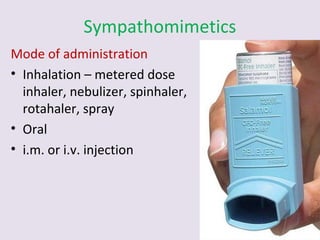
Sympathomimetics
Mode of administration
• Inhalation – metered dose
inhaler, nebulizer, spinhaler,
rotahaler, spray
• Oral
• i.m. or i.v. injection
• Adrenaline – prompt but short-lasting action;
rarely used because of adverse effects
• Isoprenaline – prompt and marked
bronchodilatation; disadvantage – tachycardia
• Ephedrine – mild slowly developing
bronchodilatation; used for mild to moderate
asthma
• Salbutamol – inhaled drug – rapid onset, short
duration of action; used for acute attack
A/E: tremors, tachycardia, palpitation,
nervousness
• Terbutaline – can be used safely during
pregnancy
• Salmeterol – slow onset of action, long acting;
used for maintenance therapy and nocturnal
asthma
• Formoterol – faster onset of action, long acting;
used for acute attack and maintenance therapy
Limitations
• Non-selective sympathomimetics – cardiac side effects
(β1action) – not preferred in elderly or heart patients
• Long term use of salbutamol and terbutaline –
downregulation of receptors – diminished
responsiveness – worsening of disease
Anticholinergics
• MOA
• Atropine and ipratropium antagonize the
actions of Ach at parasympathetic,
postganglionic, effector cell junctions by
competing with Ach for M3 receptor
sites.
• This antagonism of Ach results in airway
smooth muscle relaxation and
bronchodilation.
Anticholinergics
• Mode of administration - inhalation
• Slow onset of action – better suited for regular
prophylactic use
• Indications –
– Asthmatic bronchitis
– Psychogenic asthma
COPD
Nebulized ipratropium + salbutamol – refractory asthma
Methylxanthines
• MOA –
i. Inhibition of phosphodiesterase – increased
cAMP and cGMP level
ii.Blockade of adenosine receptors
• Mode of administration - oral, i.m., i.v. , rectal
suppositories
Plasma therapeutic range – 5-20 µg/ml
Side effects :
• GIT: nausea, vomiting, gastritis, aggravation of
peptic ulcer
• CVS: tachycardis, palpitation, arrhythmias,
hypotension
• CNS: insomnia, headache, delirium,
restlessness, tremor
• Diuresis, flushing
• Rapid i.v. – syncope and sudden death
Methylxanthines x Sympathomimetics
potentiate the effects of sympathomimetics
• Bronchodilatation – beneficial
• Cardiac stimulation - harmful
Corticosteroids
MOA:
• Decreases the synthesis of inflammatory mediators
• Prevent recruitment, proliferation and activation of
leukocytes
Systemic steroid therapy –
• Severe chronic asthma
• Status asthmaticus
Inhaled steroids –
Long term treatment of asthma
• Others Indications
Rhinitis
Nasal polyposis
Adverse effects
Inhaled steroids– drymouth, dysphonia, sore throat,
oropharyngeal candidiasis
Systemic steroids – mood changes, osteoporosis,
hyperglycemia, hypertension, HPA axis suppression
• MOA
– They block IgE-regulated calcium channels
essential for mast cell degranulation
– Prevent the release of histamine and related
mediators.
Mast cell stabilizers
Mode of administration - inhalation, oral
Indications
• Bronchial asthma
• Allergic rhinitis – nasal spray
• Allergic conjunctivitis – eye drops
Adverse effects - irritation, cough, dry mouth,
sedation, headache, rashes
Leukotriene modulators
Indications
Prophylactic treatment of mild to moderate
asthma
Adverse effects
Hepatotoxicity, headache, GI distress, rashes
Zafirlukast – Churg-Strauss syndrome
Treatment of status asthmaticus
• Humidified oxygen inhalation
• Nebulized salbutamol+ ipratropium
• Systemic steroids – hydrocortisone,prednisolone i.v.
• IV fluids – correct dehydration
• Potassium supplements – correct hypokalemia
• Sodium bicarbonate – treat acidosis
• Antibiotics – treat infection
Drugs contraindicated in bronchial
asthma
• Beta blockers
• Cholinergic drugs
• NSAIDs ( expect paracetamol)
Recent advances
Omalizumab - anti IgE antibody
19.bronchial asthma

19.bronchial asthma

  • 1.
  • 2.
    LEARNING OBJECTIVES • Toknow the commonly used drugs in bronchial asthma • To understand the mechanism of action of the major classes of drugs used in bronchial asthma • To know the adverse effects of these drugs
  • 3.
    BRONCHIAL ASTHMA • Chronicinflammatory disease • Reversible episodes of airway obstruction • Due to hyperresponsiveness of tracheobronchial smooth muscle to various stimuli, resulting in : -Bronchospasm -Narrowing of airtubes -Mucosal edema -Increased bronchial mucus secretion and mucus plugging
  • 4.
    Cardinal symptoms • Breathlessness •Wheezing • Cough • Chest tightness
  • 5.
    Trigger factors forasthma • Infection • Irritants (pollen, house dust mites, chemical etc.) • Pollutants • Exercise • Exposure to cold air • Psychogenic
  • 6.
    Different types ofasthma • Acute asthma • Chronic asthma • Extrinsic asthma • Intrinsic asthma  Status asthmaticus
  • 7.
    Pathophysiology Inflammation underlying hyperactivity •Early reaction – Reversible airway obstruction • Late reaction – Worsening of disease • Increased vagal discharge to bronchial muscle Bronchoconstriction and increased mucus secretion • Adenosine - bronchoconstriction
  • 8.
    Approaches to treatment •Prevention of Ag-Ab reaction – avoidence of antigen • Suppression of inflammation and bronchial hyperactivity – corticosteroids • Prevention of release of mediators – mast cell stabilizers • Antagonism of released mediators – LT antagonists • Blockade of constrictor neurotransmitter – anticholinergics • Mimicking dilator neurotransmitter – sympathomimetics • Directly acting bronchodilators – methylxanthines
  • 9.
    Classification A.Bronchodilators i. Non-selective sympathomimetics– Adrenaline, ephedrine, isoprenaline ii. Selective beta2 agonists - Salbutamol, terbutaline, salmeterol, formoterol iii.Anticholinergics – Ipratropium bromide, atropine methonitrate iv.Methylxanthines – Theophylline, aminophylline, choline theophyllinate
  • 10.
    B. Corticosteroids i. Systemic– Oral: Prednisone Parenteral : Methylprednisolone, hydrocortisone ii. Non- systemic – Inhalational : Beclomethasone, fluticasone, budesonide C. Mast cell stabilizers – Nedocromil, ketotifen, sodium cromoglycate D.Leukotrine (LT) modulators i. 5’- lipoxygenase inhibitors – Zileuton ii. LT receptor antagonist – Zafirlukast, montelukast
  • 12.
    Role of betaagonists in asthma MOA β2 agonists have other beneficial effects including inhibition of mast cell-mediator release, prevention of microvascular leakage and airway edema, and enhanced mucocillary clearance. The inhibitor effects on mast cell actions suggest that β2 agonists may modify acute inflammation.
  • 13.
    Sympathomimetics Mode of administration •Inhalation – metered dose inhaler, nebulizer, spinhaler, rotahaler, spray • Oral • i.m. or i.v. injection
  • 14.
    • Adrenaline –prompt but short-lasting action; rarely used because of adverse effects • Isoprenaline – prompt and marked bronchodilatation; disadvantage – tachycardia • Ephedrine – mild slowly developing bronchodilatation; used for mild to moderate asthma • Salbutamol – inhaled drug – rapid onset, short duration of action; used for acute attack A/E: tremors, tachycardia, palpitation, nervousness
  • 15.
    • Terbutaline –can be used safely during pregnancy • Salmeterol – slow onset of action, long acting; used for maintenance therapy and nocturnal asthma • Formoterol – faster onset of action, long acting; used for acute attack and maintenance therapy
  • 16.
    Limitations • Non-selective sympathomimetics– cardiac side effects (β1action) – not preferred in elderly or heart patients • Long term use of salbutamol and terbutaline – downregulation of receptors – diminished responsiveness – worsening of disease
  • 17.
    Anticholinergics • MOA • Atropineand ipratropium antagonize the actions of Ach at parasympathetic, postganglionic, effector cell junctions by competing with Ach for M3 receptor sites. • This antagonism of Ach results in airway smooth muscle relaxation and bronchodilation.
  • 18.
    Anticholinergics • Mode ofadministration - inhalation • Slow onset of action – better suited for regular prophylactic use • Indications – – Asthmatic bronchitis – Psychogenic asthma COPD Nebulized ipratropium + salbutamol – refractory asthma
  • 19.
    Methylxanthines • MOA – i.Inhibition of phosphodiesterase – increased cAMP and cGMP level ii.Blockade of adenosine receptors • Mode of administration - oral, i.m., i.v. , rectal suppositories
  • 20.
    Plasma therapeutic range– 5-20 µg/ml Side effects : • GIT: nausea, vomiting, gastritis, aggravation of peptic ulcer • CVS: tachycardis, palpitation, arrhythmias, hypotension • CNS: insomnia, headache, delirium, restlessness, tremor • Diuresis, flushing • Rapid i.v. – syncope and sudden death
  • 21.
    Methylxanthines x Sympathomimetics potentiatethe effects of sympathomimetics • Bronchodilatation – beneficial • Cardiac stimulation - harmful
  • 22.
    Corticosteroids MOA: • Decreases thesynthesis of inflammatory mediators • Prevent recruitment, proliferation and activation of leukocytes Systemic steroid therapy – • Severe chronic asthma • Status asthmaticus Inhaled steroids – Long term treatment of asthma
  • 23.
    • Others Indications Rhinitis Nasalpolyposis Adverse effects Inhaled steroids– drymouth, dysphonia, sore throat, oropharyngeal candidiasis Systemic steroids – mood changes, osteoporosis, hyperglycemia, hypertension, HPA axis suppression
  • 24.
    • MOA – Theyblock IgE-regulated calcium channels essential for mast cell degranulation – Prevent the release of histamine and related mediators. Mast cell stabilizers
  • 25.
    Mast cell stabilizers Modeof administration - inhalation, oral Indications • Bronchial asthma • Allergic rhinitis – nasal spray • Allergic conjunctivitis – eye drops Adverse effects - irritation, cough, dry mouth, sedation, headache, rashes
  • 26.
    Leukotriene modulators Indications Prophylactic treatmentof mild to moderate asthma Adverse effects Hepatotoxicity, headache, GI distress, rashes Zafirlukast – Churg-Strauss syndrome
  • 27.
    Treatment of statusasthmaticus • Humidified oxygen inhalation • Nebulized salbutamol+ ipratropium • Systemic steroids – hydrocortisone,prednisolone i.v. • IV fluids – correct dehydration • Potassium supplements – correct hypokalemia • Sodium bicarbonate – treat acidosis • Antibiotics – treat infection
  • 28.
    Drugs contraindicated inbronchial asthma • Beta blockers • Cholinergic drugs • NSAIDs ( expect paracetamol)
  • 29.