
DR.Bilal Natiq Nuaman,MD
C.A.B.M.,F.I.B.M.S.,D.I.M.
2016-2017
Chronic obstructive
pulmonary disease
1
Definition
Chronic obstructive pulmonary disease (COPD) is
a preventable and treatable disease state
characterized by airflow limitation that is not
fully reversible.
The airflow limitation is usually progressive and
is associated with an abnormal inflammatory
response of the lungs, primarily caused by
cigarette smoking.
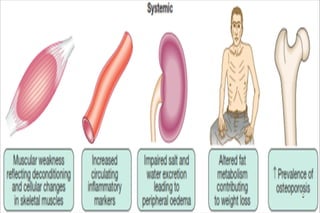
Although COPD affects the lungs, it also
produces significant systemic consequences.
2
3
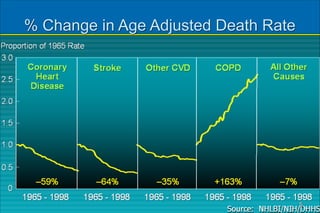
➢Major cause of death and disability
➢4th leading cause of death
➢COPD is the only chronic disease that is
showing progressive upward trend in both
mortality and morbidity
➢It is expected to be the third leading cause of
death by 2020


COPD 

GENERAL FACTS
4
% Change in Age Adjusted Death Rate
5
6
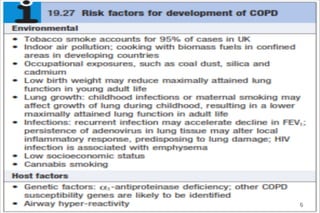
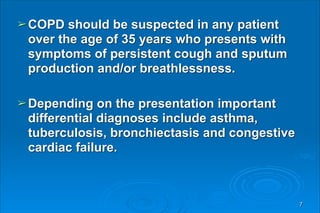
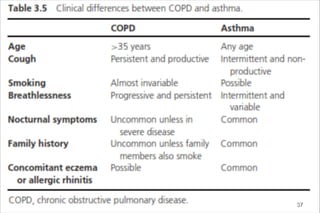
➢COPD should be suspected in any patient
over the age of 35 years who presents with
symptoms of persistent cough and sputum
production and/or breathlessness.
➢Depending on the presentation important
differential diagnoses include asthma,
tuberculosis, bronchiectasis and congestive
cardiac failure.
7
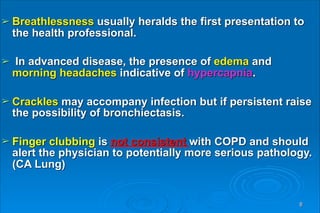
➢ Breathlessness usually heralds the first presentation to
the health professional.
➢ In advanced disease, the presence of edema and
morning headaches indicative of hypercapnia.
➢ Crackles may accompany infection but if persistent raise
the possibility of bronchiectasis.
➢ Finger clubbing is not consistent with COPD and should
alert the physician to potentially more serious pathology.
(CA Lung)
8
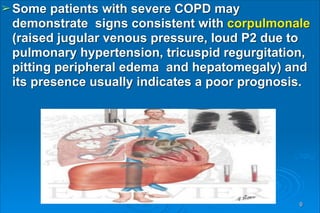
➢Some patients with severe COPD may
demonstrate signs consistent with corpulmonale
(raised jugular venous pressure, loud P2 due to
pulmonary hypertension, tricuspid regurgitation,
pitting peripheral edema and hepatomegaly) and
its presence usually indicates a poor prognosis.
9
Skeletal muscle wasting and cachexia may
occur in advanced disease, while some
patients may also be overweight.
The body mass index (BMI; weight/height²)
should be calculated during the initial
examination.
10
11
12
13
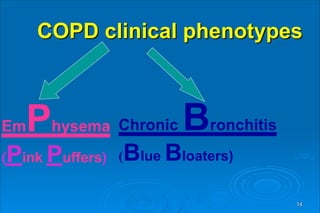
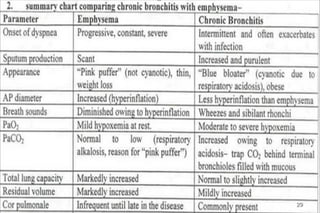
COPD clinical phenotypes
Chronic Bronchitis
(Blue Bloaters)
EmPhysema
(Pink Puffers)
14
15
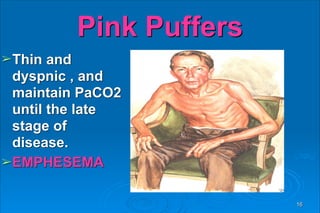
Pink Puffers
➢Thin and
dyspnic , and
maintain PaCO2
until the late
stage of
disease.
➢EMPHESEMA
16
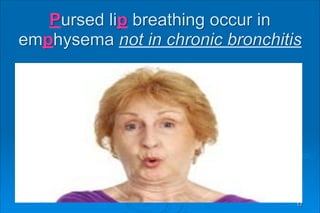
Pursed lip breathing occur in
emphysema not in chronic bronchitis
17
EMPHYSEMA
Pathological definition
permanent dilatation of air spaces
distal to terminal bronchioles,
accompanied by destruction of
their walls
18
19


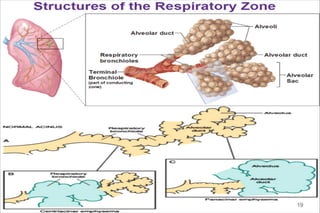
1. CENTRIACINAR (Centrilobular):
Central part of the acinus (respiratory bronchioles)
is affected, while distal alveoli is spared. Upper
lobes, particularly apical segments are involved
Cause: Cigarette smoking
2) PANACINAR (Panlobular):
Entire acinus (from respiratory bronchiole to distal
alveoli affected) , Affects lower lobes
Cause: α-1 antitryPsin deficiency
Types of emphysema
20
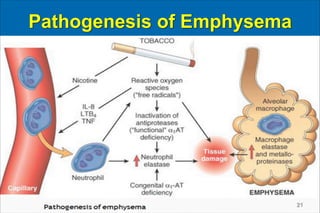
Pathogenesis of Emphysema
21
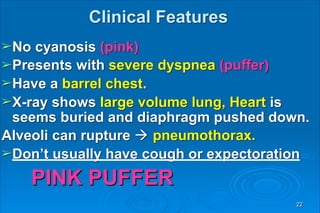
Clinical Features
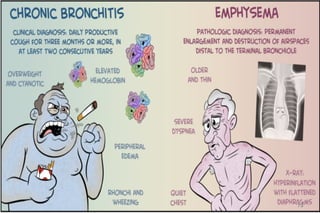
➢No cyanosis (pink)
➢Presents with severe dyspnea (puffer)
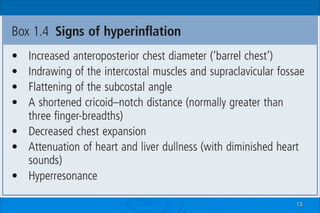
➢Have a barrel chest.
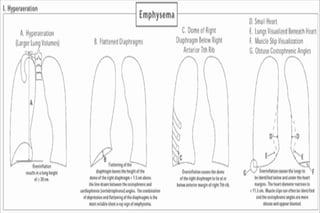
➢X-ray shows large volume lung, Heart is
seems buried and diaphragm pushed down.
Alveoli can rupture ! pneumothorax.
➢Don’t usually have cough or expectoration
PINK PUFFER
22
23
24
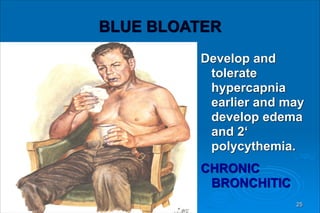
BLUE BLOATER
Develop and
tolerate
hypercapnia
earlier and may
develop edema
and 2‘
polycythemia.
CHRONIC
BRONCHITIC
25
CHRONIC BRONCHITIS
➢Defined clinically
Persistent cough with sputum
production for at least 3 months in
at least 2 consecutive years, with
exclusion of other causes like
Bronchiectasis .
26
PATHOGENESIS
SMOKING
4-10 times more common in heavy smokers
✓ a smoking history of more than 20 pack years
➢Smoke and other irritants cause
Hypertrophy of submucosal glands--- hypersecretion
of mucus
Increase in goblet cells
↑predisposition to infection
27
Clinical Features
➢Cyanosed (Blue)
➢Edematous (Bloater)
➢Productive Cough
➢CorPulmonale – heart failure
➢Usually dyspnea triggered by infection
➢Respiratory acidosis
Blue bloater
28
29
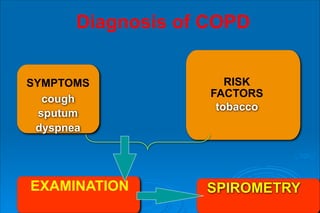
Diagnosis of COPD
SYMPTOMS
cough
sputum
dyspnea
RISK
FACTORS
tobacco
SPIROMETRYEXAMINATION
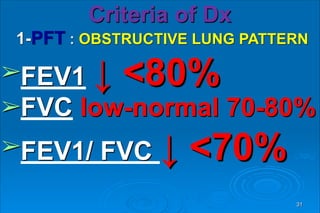
Criteria of Dx

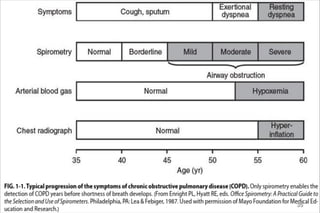
1-PFT : OBSTRUCTIVE LUNG PATTERN
➢FEV1 ↓ <80%
➢FVC low-normal 70-80%
➢FEV1/ FVC ↓ <70%
31
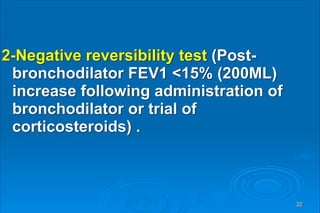
2-Negative reversibility test (Post-
bronchodilator FEV1 <15% (200ML)
increase following administration of
bronchodilator or trial of
corticosteroids) .
32
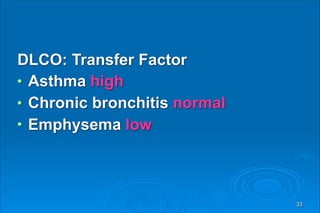
DLCO: Transfer Factor
• Asthma high
• Chronic bronchitis normal
• Emphysema low
33


Other tests

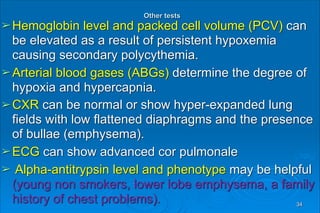
➢Hemoglobin level and packed cell volume (PCV) can
be elevated as a result of persistent hypoxemia
causing secondary polycythemia.
➢Arterial blood gases (ABGs) determine the degree of
hypoxia and hypercapnia.
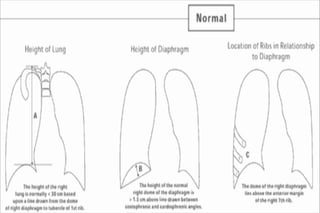
➢CXR can be normal or show hyper-expanded lung
fields with low flattened diaphragms and the presence
of bullae (emphysema).
➢ECG can show advanced cor pulmonale
➢ Alpha-antitrypsin level and phenotype may be helpful
(young non smokers, lower lobe emphysema, a family
history of chest problems). 34
35
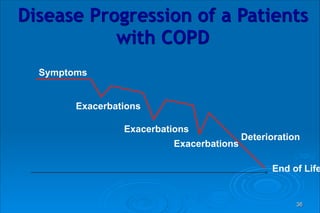
Disease Progression of a Patients
with COPD
Symptoms
Exacerbations
Exacerbations
Exacerbations
Deterioration
End of Life
36
37


Management of
COPD
38
39
40
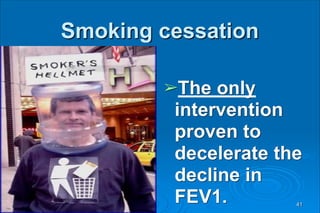
Smoking cessation
➢The only
intervention
proven to
decelerate the
decline in
FEV1. 41
Pharmacotherapy
BRONCHODILATORS
➢Decrease airway muscle tone
➢Three types (short & long acting):
● Anticholinergics (inhaled)
● Beta-2 agonists (inhaled)
● Methylxanthines (po)
42
Bronchodilators

Short Acting Beta2 Agonist (SABA)
➢e.g. Salbutamol
➢Improve pulmonary function/SOB/exercise
performance
➢Combination SABA’s and anticholinergics
produce better bronchodilation
➢For patients with MILD symptoms
● SOB on exertion
43
Bronchodilators

Long Acting Beta2 Agonist (LABA)
➢e.g.– Formoterol, Salmeterol
➢For patients who still have symptoms
on SABA’s (MODERATE disease)
➢More sustained effect on PFT’s, chronic
SOB
➢Early evidence these may prolong time
between exacerbations
44
Inhaled anticholinergics
inhaled ipratropium bromide is preferred over
beta-2 agonists by many as the bronchodilator of
choice in COPD for the following reasons:
➢Its minimal cardiac stimulatory effects compared
to those of beta agonists
➢Its greater effectiveness than either beta agonist
or methylxanthine bronchodilators in most studies
of patients with COPD
45
46
Steroids
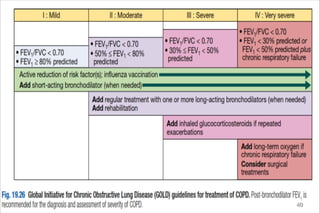
Inhaled steroid
➢Not recommended as first line therapy
➢No consistent effect on decreasing inflammation
➢Consider inhaled form in those with mod-severe
disease
➢Consider in those who have maximal
bronchodilator therapy
➢Inhaled corticosteroids are currently
recommended in severe disease( FEV1 <50%) who
report two or more exacerbations requiring
antibiotics or oral steroids per year . 47
48
49
Additional measures

➢Vaccines. Patients with COPD should receive a single
dose of the polyvalent pneumococcal polysaccharide
vaccine and yearly influenza vaccinations.
➢ a1-Antitrypsin replacement. Weekly or monthly
Infusions of a1-antitrypsin have been recommended for
patients with serum levels below 310mg/L and
abnormal lung function. 1
➢ Heart failure should be treated with diuretics .
➢ Secondary polycythemia requires venesection if the
PCV is >55%.
50
SURGERY
➢Bullectomy : young with emphysema
➢Lung Volume reduction surgery (LVRS):
emphysema
➢Lung transplant
Have been used for severe COPD
51
52
Emergency treatment
Emergency treatment
Exacerbations of COPD are characterized by an acute worsening
of symptoms, with
increased breathlessness,
sputum volume and
sputum purulence.
They may occur spontaneously or as a result of infections.
Mild exacerbations can be managed at home but patients with
severe exacerbations require admission to hospital.
key adverse features that indicate a severe exacerbation :
(confusion, cyanosis, severe respiratory distress).
53
Patients admitted to hospital should have
• Chest X-ray,
• Arterial blood gas measurement,
• ECG (to exclude comorbidities),
• Full blood count and
• Urea and electrolyte measurements.
• Culture of sputum
• Blood cultures should be taken if the patient is
pyrexial and
• Theophylline level should be measured in patients
on theophylline therapy.
54
Bronchodilator therapy
is usually given by nebulizer, using a
combination of salbutamol 2.5 – 5.0 mg and
ipratropium 500 mcg
ORAL STEROIDS
ORAL STEROIDS are useful during exacerbations
(rule of 15)
PREDINSOLON 15 mg TWICE DAILY GIVEN FOR 15
DAYS MAY BENEFIT 15% OF PATIENTS WITH
COPD EXACERBATION
55
56
Antibiotics
Common bacteria associated with COPD exacerbation
include
Haemophilus inluenzae,
Streptococcus pneumoniae and
Moraxella catarrhalis.
Treatment
Augmentin(amoxicillin and clavulanic acid),
or doxycycline, or ciprofloxacin or clarithromycin.
57
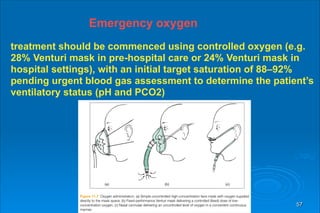
Emergency oxygen
treatment should be commenced using controlled oxygen (e.g.
28% Venturi mask in pre-hospital care or 24% Venturi mask in
hospital settings), with an initial target saturation of 88–92%
pending urgent blood gas assessment to determine the patient’s
ventilatory status (pH and PCO2)
58
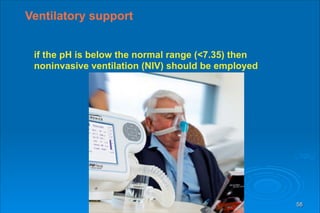
Ventilatory support
if the pH is below the normal range (<7.35) then
noninvasive ventilation (NIV) should be employed
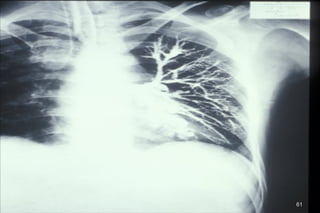
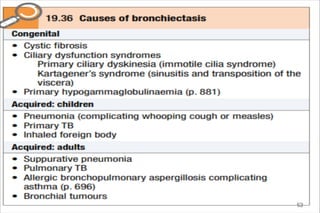
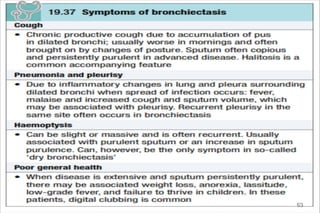
BRONCHIECTASIS
A destructive lung disease characterized by:
● Abnormal & permanent dilatation of medium sized
bronchi
● An associated, persistent and variable inflammatory
process producing damage to bronchial elastic and
muscular elements
59
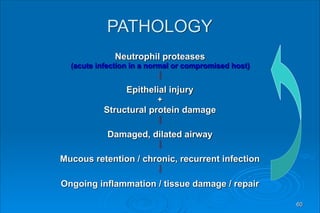
PATHOLOGY
Neutrophil proteases
(acute infection in a normal or compromised host)
⇩
Epithelial injury
+
Structural protein damage
⇩
Damaged, dilated airway
⇩
Mucous retention / chronic, recurrent infection
⇩
Ongoing inflammation / tissue damage / repair
60
61
62
63
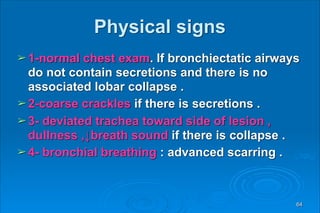
Physical signs
➢ 1-normal chest exam. If bronchiectatic airways
do not contain secretions and there is no
associated lobar collapse .
➢ 2-coarse crackles if there is secretions .
➢ 3- deviated trachea toward side of lesion ,
dullness ,↓breath sound if there is collapse .
➢ 4- bronchial breathing : advanced scarring .
64
INVESTIGATIONS
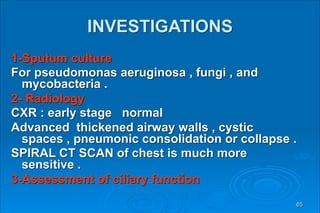
1-Sputum culture
For pseudomonas aeruginosa , fungi , and
mycobacteria .
2- Radiology
CXR : early stage normal
Advanced thickened airway walls , cystic
spaces , pneumonic consolidation or collapse .
SPIRAL CT SCAN of chest is much more
sensitive .
3-Assessment of ciliary function
65
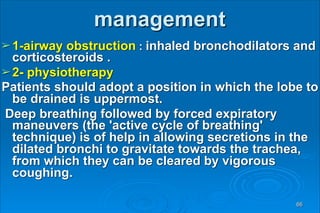
management
➢1-airway obstruction : inhaled bronchodilators and
corticosteroids .
➢2- physiotherapy
Patients should adopt a position in which the lobe to
be drained is uppermost.
Deep breathing followed by forced expiratory
maneuvers (the 'active cycle of breathing'
technique) is of help in allowing secretions in the
dilated bronchi to gravitate towards the trachea,
from which they can be cleared by vigorous
coughing.
66
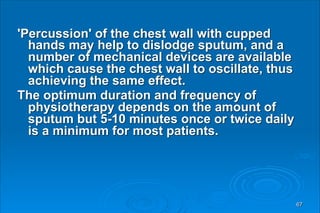
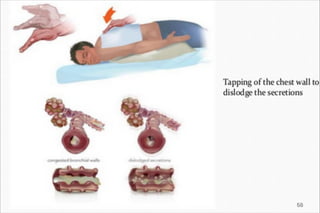
'Percussion' of the chest wall with cupped
hands may help to dislodge sputum, and a
number of mechanical devices are available
which cause the chest wall to oscillate, thus
achieving the same effect.
The optimum duration and frequency of
physiotherapy depends on the amount of
sputum but 5-10 minutes once or twice daily
is a minimum for most patients.
67
68
3- antibiotics
Oral ciprofloxacin 500-750 mg bid
Or ceftazidime by IV inj. Or infusion 1-2 gm 8-
hourly.
4- surgery
Only in unilateral , single lobe in young patient
69
THANK YOU
70

L3 4 .copd

  • 1.
  • 2.
    Definition Chronic obstructive pulmonarydisease (COPD) is a preventable and treatable disease state characterized by airflow limitation that is not fully reversible. The airflow limitation is usually progressive and is associated with an abnormal inflammatory response of the lungs, primarily caused by cigarette smoking. Although COPD affects the lungs, it also produces significant systemic consequences. 2
  • 3.
  • 4.
    ➢Major cause ofdeath and disability ➢4th leading cause of death ➢COPD is the only chronic disease that is showing progressive upward trend in both mortality and morbidity ➢It is expected to be the third leading cause of death by 2020 
 COPD 
 GENERAL FACTS 4
  • 5.
    % Change inAge Adjusted Death Rate 5
  • 6.
  • 7.
    ➢COPD should besuspected in any patient over the age of 35 years who presents with symptoms of persistent cough and sputum production and/or breathlessness. ➢Depending on the presentation important differential diagnoses include asthma, tuberculosis, bronchiectasis and congestive cardiac failure. 7
  • 8.
    ➢ Breathlessness usuallyheralds the first presentation to the health professional. ➢ In advanced disease, the presence of edema and morning headaches indicative of hypercapnia. ➢ Crackles may accompany infection but if persistent raise the possibility of bronchiectasis. ➢ Finger clubbing is not consistent with COPD and should alert the physician to potentially more serious pathology. (CA Lung) 8
  • 9.
    ➢Some patients withsevere COPD may demonstrate signs consistent with corpulmonale (raised jugular venous pressure, loud P2 due to pulmonary hypertension, tricuspid regurgitation, pitting peripheral edema and hepatomegaly) and its presence usually indicates a poor prognosis. 9
  • 10.
    Skeletal muscle wastingand cachexia may occur in advanced disease, while some patients may also be overweight. The body mass index (BMI; weight/height²) should be calculated during the initial examination. 10
  • 11.
  • 12.
  • 13.
  • 14.
    COPD clinical phenotypes ChronicBronchitis (Blue Bloaters) EmPhysema (Pink Puffers) 14
  • 15.
  • 16.
    Pink Puffers ➢Thin and dyspnic, and maintain PaCO2 until the late stage of disease. ➢EMPHESEMA 16
  • 17.
    Pursed lip breathingoccur in emphysema not in chronic bronchitis 17
  • 18.
    EMPHYSEMA Pathological definition permanent dilatationof air spaces distal to terminal bronchioles, accompanied by destruction of their walls 18
  • 19.
  • 20.
    
 1. CENTRIACINAR (Centrilobular): Centralpart of the acinus (respiratory bronchioles) is affected, while distal alveoli is spared. Upper lobes, particularly apical segments are involved Cause: Cigarette smoking 2) PANACINAR (Panlobular): Entire acinus (from respiratory bronchiole to distal alveoli affected) , Affects lower lobes Cause: α-1 antitryPsin deficiency Types of emphysema 20
  • 21.
  • 22.
    Clinical Features ➢No cyanosis(pink) ➢Presents with severe dyspnea (puffer) ➢Have a barrel chest. ➢X-ray shows large volume lung, Heart is seems buried and diaphragm pushed down. Alveoli can rupture ! pneumothorax. ➢Don’t usually have cough or expectoration PINK PUFFER 22
  • 23.
  • 24.
  • 25.
    BLUE BLOATER Develop and tolerate hypercapnia earlierand may develop edema and 2‘ polycythemia. CHRONIC BRONCHITIC 25
  • 26.
    CHRONIC BRONCHITIS ➢Defined clinically Persistentcough with sputum production for at least 3 months in at least 2 consecutive years, with exclusion of other causes like Bronchiectasis . 26
  • 27.
    PATHOGENESIS SMOKING 4-10 times morecommon in heavy smokers ✓ a smoking history of more than 20 pack years ➢Smoke and other irritants cause Hypertrophy of submucosal glands--- hypersecretion of mucus Increase in goblet cells ↑predisposition to infection 27
  • 28.
    Clinical Features ➢Cyanosed (Blue) ➢Edematous(Bloater) ➢Productive Cough ➢CorPulmonale – heart failure ➢Usually dyspnea triggered by infection ➢Respiratory acidosis Blue bloater 28
  • 29.
  • 30.
  • 31.
    Criteria of Dx
 1-PFT: OBSTRUCTIVE LUNG PATTERN ➢FEV1 ↓ <80% ➢FVC low-normal 70-80% ➢FEV1/ FVC ↓ <70% 31
  • 32.
    2-Negative reversibility test(Post- bronchodilator FEV1 <15% (200ML) increase following administration of bronchodilator or trial of corticosteroids) . 32
  • 33.
    DLCO: Transfer Factor •Asthma high • Chronic bronchitis normal • Emphysema low 33
  • 34.
    
 Other tests
 ➢Hemoglobin leveland packed cell volume (PCV) can be elevated as a result of persistent hypoxemia causing secondary polycythemia. ➢Arterial blood gases (ABGs) determine the degree of hypoxia and hypercapnia. ➢CXR can be normal or show hyper-expanded lung fields with low flattened diaphragms and the presence of bullae (emphysema). ➢ECG can show advanced cor pulmonale ➢ Alpha-antitrypsin level and phenotype may be helpful (young non smokers, lower lobe emphysema, a family history of chest problems). 34
  • 35.
  • 36.
    Disease Progression ofa Patients with COPD Symptoms Exacerbations Exacerbations Exacerbations Deterioration End of Life 36
  • 37.
  • 38.
  • 39.
  • 40.
  • 41.
    Smoking cessation ➢The only intervention provento decelerate the decline in FEV1. 41
  • 42.
    Pharmacotherapy BRONCHODILATORS ➢Decrease airway muscletone ➢Three types (short & long acting): ● Anticholinergics (inhaled) ● Beta-2 agonists (inhaled) ● Methylxanthines (po) 42
  • 43.
    Bronchodilators
 Short Acting Beta2Agonist (SABA) ➢e.g. Salbutamol ➢Improve pulmonary function/SOB/exercise performance ➢Combination SABA’s and anticholinergics produce better bronchodilation ➢For patients with MILD symptoms ● SOB on exertion 43
  • 44.
    Bronchodilators
 Long Acting Beta2Agonist (LABA) ➢e.g.– Formoterol, Salmeterol ➢For patients who still have symptoms on SABA’s (MODERATE disease) ➢More sustained effect on PFT’s, chronic SOB ➢Early evidence these may prolong time between exacerbations 44
  • 45.
    Inhaled anticholinergics inhaled ipratropiumbromide is preferred over beta-2 agonists by many as the bronchodilator of choice in COPD for the following reasons: ➢Its minimal cardiac stimulatory effects compared to those of beta agonists ➢Its greater effectiveness than either beta agonist or methylxanthine bronchodilators in most studies of patients with COPD 45
  • 46.
  • 47.
    Steroids Inhaled steroid ➢Not recommendedas first line therapy ➢No consistent effect on decreasing inflammation ➢Consider inhaled form in those with mod-severe disease ➢Consider in those who have maximal bronchodilator therapy ➢Inhaled corticosteroids are currently recommended in severe disease( FEV1 <50%) who report two or more exacerbations requiring antibiotics or oral steroids per year . 47
  • 48.
  • 49.
  • 50.
    Additional measures
 ➢Vaccines. Patientswith COPD should receive a single dose of the polyvalent pneumococcal polysaccharide vaccine and yearly influenza vaccinations. ➢ a1-Antitrypsin replacement. Weekly or monthly Infusions of a1-antitrypsin have been recommended for patients with serum levels below 310mg/L and abnormal lung function. 1 ➢ Heart failure should be treated with diuretics . ➢ Secondary polycythemia requires venesection if the PCV is >55%. 50
  • 51.
    SURGERY ➢Bullectomy : youngwith emphysema ➢Lung Volume reduction surgery (LVRS): emphysema ➢Lung transplant Have been used for severe COPD 51
  • 52.
    52 Emergency treatment Emergency treatment Exacerbationsof COPD are characterized by an acute worsening of symptoms, with increased breathlessness, sputum volume and sputum purulence. They may occur spontaneously or as a result of infections. Mild exacerbations can be managed at home but patients with severe exacerbations require admission to hospital. key adverse features that indicate a severe exacerbation : (confusion, cyanosis, severe respiratory distress).
  • 53.
    53 Patients admitted tohospital should have • Chest X-ray, • Arterial blood gas measurement, • ECG (to exclude comorbidities), • Full blood count and • Urea and electrolyte measurements. • Culture of sputum • Blood cultures should be taken if the patient is pyrexial and • Theophylline level should be measured in patients on theophylline therapy.
  • 54.
    54 Bronchodilator therapy is usuallygiven by nebulizer, using a combination of salbutamol 2.5 – 5.0 mg and ipratropium 500 mcg
  • 55.
    ORAL STEROIDS ORAL STEROIDSare useful during exacerbations (rule of 15) PREDINSOLON 15 mg TWICE DAILY GIVEN FOR 15 DAYS MAY BENEFIT 15% OF PATIENTS WITH COPD EXACERBATION 55
  • 56.
    56 Antibiotics Common bacteria associatedwith COPD exacerbation include Haemophilus inluenzae, Streptococcus pneumoniae and Moraxella catarrhalis. Treatment Augmentin(amoxicillin and clavulanic acid), or doxycycline, or ciprofloxacin or clarithromycin.
  • 57.
    57 Emergency oxygen treatment shouldbe commenced using controlled oxygen (e.g. 28% Venturi mask in pre-hospital care or 24% Venturi mask in hospital settings), with an initial target saturation of 88–92% pending urgent blood gas assessment to determine the patient’s ventilatory status (pH and PCO2)
  • 58.
    58 Ventilatory support if thepH is below the normal range (<7.35) then noninvasive ventilation (NIV) should be employed
  • 59.
    BRONCHIECTASIS A destructive lungdisease characterized by: ● Abnormal & permanent dilatation of medium sized bronchi ● An associated, persistent and variable inflammatory process producing damage to bronchial elastic and muscular elements 59
  • 60.
    PATHOLOGY Neutrophil proteases (acute infectionin a normal or compromised host) ⇩ Epithelial injury + Structural protein damage ⇩ Damaged, dilated airway ⇩ Mucous retention / chronic, recurrent infection ⇩ Ongoing inflammation / tissue damage / repair 60
  • 61.
  • 62.
  • 63.
  • 64.
    Physical signs ➢ 1-normalchest exam. If bronchiectatic airways do not contain secretions and there is no associated lobar collapse . ➢ 2-coarse crackles if there is secretions . ➢ 3- deviated trachea toward side of lesion , dullness ,↓breath sound if there is collapse . ➢ 4- bronchial breathing : advanced scarring . 64
  • 65.
    INVESTIGATIONS 1-Sputum culture For pseudomonasaeruginosa , fungi , and mycobacteria . 2- Radiology CXR : early stage normal Advanced thickened airway walls , cystic spaces , pneumonic consolidation or collapse . SPIRAL CT SCAN of chest is much more sensitive . 3-Assessment of ciliary function 65
  • 66.
    management ➢1-airway obstruction :inhaled bronchodilators and corticosteroids . ➢2- physiotherapy Patients should adopt a position in which the lobe to be drained is uppermost. Deep breathing followed by forced expiratory maneuvers (the 'active cycle of breathing' technique) is of help in allowing secretions in the dilated bronchi to gravitate towards the trachea, from which they can be cleared by vigorous coughing. 66
  • 67.
    'Percussion' of thechest wall with cupped hands may help to dislodge sputum, and a number of mechanical devices are available which cause the chest wall to oscillate, thus achieving the same effect. The optimum duration and frequency of physiotherapy depends on the amount of sputum but 5-10 minutes once or twice daily is a minimum for most patients. 67
  • 68.
  • 69.
    3- antibiotics Oral ciprofloxacin500-750 mg bid Or ceftazidime by IV inj. Or infusion 1-2 gm 8- hourly. 4- surgery Only in unilateral , single lobe in young patient 69
  • 70.