Scabies
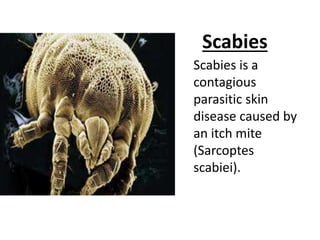
Scabies is a
contagious
parasitic skin
disease caused by
an itch mite
(Sarcoptes
scabiei).
Scabies mite
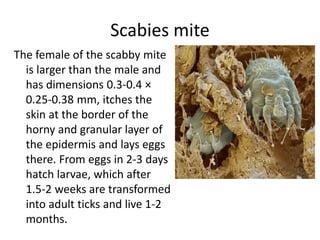
The female of the scabby mite
is larger than the male and
has dimensions 0.3-0.4 ×
0.25-0.38 mm, itches the
skin at the border of the
horny and granular layer of
the epidermis and lays eggs
there. From eggs in 2-3 days
hatch larvae, which after
1.5-2 weeks are transformed
into adult ticks and live 1-2
months.
Scabies mite can be contagious at any stage of
its development. It is estimated that under
favorable conditions 1 female in 3 months is
able to give life to 6 generations of ticks in the
amount of 150 million individuals.
The scabies have a low resistance to the
environment. In dry and hot conditions mites
quickly die (at 60 ° C - for 1 hour, with humidity
below 35% - per day). In the room it is enough
to wait 5 days for the complete death of
scabies.
Pathogenesis of Scabies
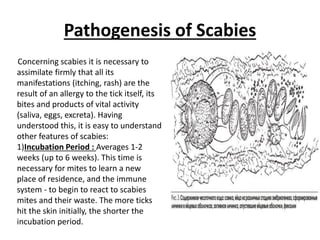
Concerning scabies it is necessary to
assimilate firmly that all its
manifestations (itching, rash) are the
result of an allergy to the tick itself, its
bites and products of vital activity
(saliva, eggs, excreta). Having
understood this, it is easy to understand
other features of scabies:
1)Incubation Period : Averages 1-2
weeks (up to 6 weeks). This time is
necessary for mites to learn a new
place of residence, and the immune
system - to begin to react to scabies
mites and their waste. The more ticks
hit the skin initially, the shorter the
incubation period.
• 2) In case of repeated infection, the reaction to the
pathogen appears within a few hours. Although there
is no immunity to scabies, it is more difficult to re-
enter, and in this case less scabies are detected on the
skin.
3) The severity of the rash depends little on the
number of ticks in the skin, but is due to the severity of
the allergic reaction to the products of their vital
activity.
Due to severe itching and frequent scratching, it is
possible to attach a bacterial infection (eg,
staphylococcus), which causes the skin rash to become
more diverse, including pustules.
Transmission of Scabies
Scabies are transmitted by prolonged direct contact "skin-to-
skin", so it's easier to get infected in bed at night. Children
often become infected when they sleep in the same bed
with sick parents. This is due to the biological
characteristics of the tick:
scabies mite is active in the evening and at night,
to penetrate the skin mites need about 30 minutes,
in the external environment, the mite quickly dies (at 21 ° C
and humidity 40-80% after 24-36 hours), and activity loses
even earlier.
Infection in the team is possible with direct contacts
(fussing, frequent and strong handshakes, contact sports,
etc.). Infection through household items is now considered
unlikely.
Clinical forms of scabies
There are several of them:
•Typical
complicated by pyoderma
(pustules)
•Pseudotypic
(pseudosarctopus).
scabies of clean,
•Nodular scabies
(scabious lymphoplasia),
Norwegian scabies,
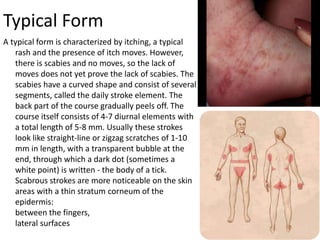
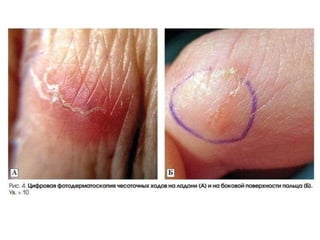
Typical Form
A typical form is characterized by itching, a typical
rash and the presence of itch moves. However,
there is scabies and no moves, so the lack of
moves does not yet prove the lack of scabies. The
scabies have a curved shape and consist of several
segments, called the daily stroke element. The
back part of the course gradually peels off. The
course itself consists of 4-7 diurnal elements with
a total length of 5-8 mm. Usually these strokes
look like straight-line or zigzag scratches of 1-10
mm in length, with a transparent bubble at the
end, through which a dark dot (sometimes a
white point) is written - the body of a tick.
Scabrous strokes are more noticeable on the skin
areas with a thin stratum corneum of the
epidermis:
between the fingers,
lateral surfaces
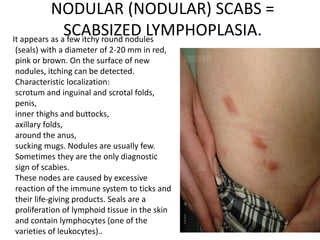
NODULAR (NODULAR) SCABS =
SCABSIZED LYMPHOPLASIA.
It appears as a few itchy round nodules
(seals) with a diameter of 2-20 mm in red,
pink or brown. On the surface of new
nodules, itching can be detected.
Characteristic localization:
scrotum and inguinal and scrotal folds,
penis,
inner thighs and buttocks,
axillary folds,
around the anus,
sucking mugs. Nodules are usually few.
Sometimes they are the only diagnostic
sign of scabies.
These nodes are caused by excessive
reaction of the immune system to ticks and
their life-giving products. Seals are a
proliferation of lymphoid tissue in the skin
and contain lymphocytes (one of the
varieties of leukocytes)..
• Nodules and itching in scabious lymphoplasia can
persist for several weeks and even months even
after a qualitative treatment. According to recent
studies, the source of allergens in such cases are
living unfertilized female scabies mites, not laying
eggs and not making holes in the roof of the
passages, which limits access to the drug from
the skin surface. If we recall that female mites live
up to 4-6 weeks, it becomes clear why patients
can long to itch after scabies treatment
NORWEGIAN SCIENCE
• This form is the rarest, and the name is because
it was first described in Norway a century and a
half ago in patients with leprosy (leprosy). Occurs
in patients who, for whatever reason, do not itch,
although half of the patients have itching. The
causes of Norwegian scabies are divided into
several groups:
absence of itching due to immunodeficiency,
when the immune system is so weak that mites
can not cause a significant allergic reaction. It is
observed in AIDS, malnutrition, tuberculosis, in
the treatment of glucocorticosteroids,
cytostatics, etc .; absence of itching due to
disorders of nerve sensitivity of the skin
(polyneuropathy, leprosy, syringomyelia -
formation of cavities in the spinal cord, etc.);
when patients want, but can not itch (paralysis,
myopathy, etc.);
in others - hereditary predisposition
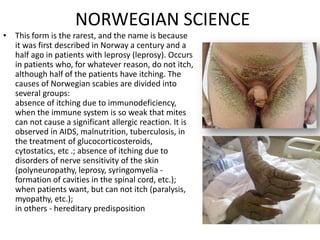
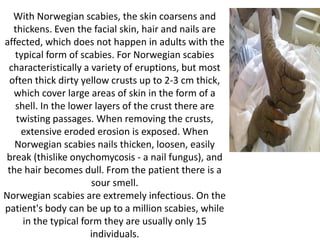
With Norwegian scabies, the skin coarsens and
thickens. Even the facial skin, hair and nails are
affected, which does not happen in adults with the
typical form of scabies. For Norwegian scabies
characteristically a variety of eruptions, but most
often thick dirty yellow crusts up to 2-3 cm thick,
which cover large areas of skin in the form of a
shell. In the lower layers of the crust there are
twisting passages. When removing the crusts,
extensive eroded erosion is exposed. When
Norwegian scabies nails thicken, loosen, easily
break (thislike onychomycosis - a nail fungus), and
the hair becomes dull. From the patient there is a
sour smell.
Norwegian scabies are extremely infectious. On the
patient's body can be up to a million scabies, while
in the typical form they are usually only 15
individuals.
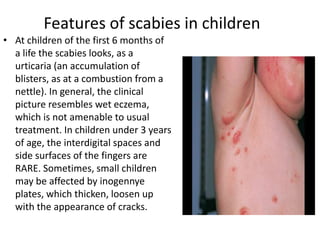
Features of scabies in children
• At children of the first 6 months of
a life the scabies looks, as a
urticaria (an accumulation of
blisters, as at a combustion from a
nettle). In general, the clinical
picture resembles wet eczema,
which is not amenable to usual
treatment. In children under 3 years
of age, the interdigital spaces and
side surfaces of the fingers are
RARE. Sometimes, small children
may be affected by inogennye
plates, which thicken, loosen up
with the appearance of cracks.
It is characteristic that the whole body skin, even
the face and the scalp, are affected in children,
which is not the case with adults (accordingly,
when treating scabies children need to also treat
face and head, and adults do not). For the
treatment of children, preparations with a lower
(half) concentration of the active substance are
usually used. The use of drugs with "infant"
concentration for the treatment of adults is a
mistake and is one of the reasons for the
ineffectiveness of the treatment.
Confirmation of diagnosis
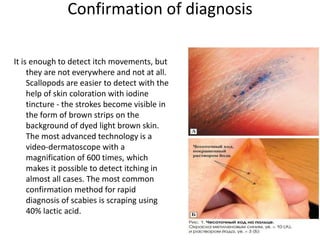
It is enough to detect itch movements, but
they are not everywhere and not at all.
Scallopods are easier to detect with the
help of skin coloration with iodine
tincture - the strokes become visible in
the form of brown strips on the
background of dyed light brown skin.
The most advanced technology is a
video-dermatoscope with a
magnification of 600 times, which
makes it possible to detect itching in
almost all cases. The most common
confirmation method for rapid
diagnosis of scabies is scraping using
40% lactic acid.
• Lactic acid well loosens the stratum corneum of
the epidermis, does not irritate the skin, prevents
the development of suppuration and spillage of
the material during scraping. A drop of 40% lactic
acid is applied to the itch element (stroke,
nodule, etc.). After 5 minutes, the loosened
epidermis is scraped off until the appearance of
capillary blood. The material is transferred to a
slide in a drop of lactic acid, covered with a cover
slip and microscopized.
Another method is common for extracting a tick
with a needle, followed by microscopy.
Treatment of scabies
After the diagnosis of "scabies" was made on the basis
of the symptoms and according to the results of
microscopy (laboratory diagnosis), treatment should be
started. To safely cure scabies at home, you must follow
the principles listed below:
1. The treatment course should go through all the
patients who were found in the outbreak (in the
preschool, in the family).
2. Anyone who has had contact with a man infected
with scabies must necessarily undergo a preventive
treatment at the same time.
3. For the period of treatment, patients are not allowed
to wash and change bed linens. It is necessary to
change the bed linen and bed linen before and after
the treatment.
4. Bed linen and clothes used by a sick
person should be boiled and ironed.
5. By means of scabies, adult patients
should treat the whole body, except for the
head and neck. Painful children are treated
with the whole body, while closing the
napkin, eyes and mouth with a napkin.
6. Treatment is in the evening, before
bedtime. Apply the drug from scabies by
hand, after the procedure, you do not need
to wash your hands.
Treatment of scabies
The most famous medicines:
1) BENZYL BENZOATE in the form of emulsion and
ointment (20% for adults and 10% for children)
2) PERMETRIN (cream, ointment, lotion, spray):
highly effective and most popular drug in the West.
5% cream with permethrin is more often used. 2
treatments are required.
3) SPREGAL: in the form of an aerosol, which is
enough for 3 treatments. Contains neurotoxic for the
tick mites: esdepalletrin (esbiol) and piperonyl
butoxide. It is convenient in application, does not
leave traces, almost without a smell, but it can not
be inhaled.

SCABIES

  • 1.
    Scabies Scabies is a contagious parasiticskin disease caused by an itch mite (Sarcoptes scabiei).
  • 2.
    Scabies mite The femaleof the scabby mite is larger than the male and has dimensions 0.3-0.4 × 0.25-0.38 mm, itches the skin at the border of the horny and granular layer of the epidermis and lays eggs there. From eggs in 2-3 days hatch larvae, which after 1.5-2 weeks are transformed into adult ticks and live 1-2 months.
  • 3.
    Scabies mite canbe contagious at any stage of its development. It is estimated that under favorable conditions 1 female in 3 months is able to give life to 6 generations of ticks in the amount of 150 million individuals. The scabies have a low resistance to the environment. In dry and hot conditions mites quickly die (at 60 ° C - for 1 hour, with humidity below 35% - per day). In the room it is enough to wait 5 days for the complete death of scabies.
  • 4.
    Pathogenesis of Scabies Concerningscabies it is necessary to assimilate firmly that all its manifestations (itching, rash) are the result of an allergy to the tick itself, its bites and products of vital activity (saliva, eggs, excreta). Having understood this, it is easy to understand other features of scabies: 1)Incubation Period : Averages 1-2 weeks (up to 6 weeks). This time is necessary for mites to learn a new place of residence, and the immune system - to begin to react to scabies mites and their waste. The more ticks hit the skin initially, the shorter the incubation period.
  • 5.
    • 2) Incase of repeated infection, the reaction to the pathogen appears within a few hours. Although there is no immunity to scabies, it is more difficult to re- enter, and in this case less scabies are detected on the skin. 3) The severity of the rash depends little on the number of ticks in the skin, but is due to the severity of the allergic reaction to the products of their vital activity. Due to severe itching and frequent scratching, it is possible to attach a bacterial infection (eg, staphylococcus), which causes the skin rash to become more diverse, including pustules.
  • 6.
    Transmission of Scabies Scabiesare transmitted by prolonged direct contact "skin-to- skin", so it's easier to get infected in bed at night. Children often become infected when they sleep in the same bed with sick parents. This is due to the biological characteristics of the tick: scabies mite is active in the evening and at night, to penetrate the skin mites need about 30 minutes, in the external environment, the mite quickly dies (at 21 ° C and humidity 40-80% after 24-36 hours), and activity loses even earlier. Infection in the team is possible with direct contacts (fussing, frequent and strong handshakes, contact sports, etc.). Infection through household items is now considered unlikely.
  • 7.
    Clinical forms ofscabies There are several of them: •Typical complicated by pyoderma (pustules) •Pseudotypic (pseudosarctopus). scabies of clean, •Nodular scabies (scabious lymphoplasia), Norwegian scabies,
  • 8.
    Typical Form A typicalform is characterized by itching, a typical rash and the presence of itch moves. However, there is scabies and no moves, so the lack of moves does not yet prove the lack of scabies. The scabies have a curved shape and consist of several segments, called the daily stroke element. The back part of the course gradually peels off. The course itself consists of 4-7 diurnal elements with a total length of 5-8 mm. Usually these strokes look like straight-line or zigzag scratches of 1-10 mm in length, with a transparent bubble at the end, through which a dark dot (sometimes a white point) is written - the body of a tick. Scabrous strokes are more noticeable on the skin areas with a thin stratum corneum of the epidermis: between the fingers, lateral surfaces
  • 10.
    NODULAR (NODULAR) SCABS= SCABSIZED LYMPHOPLASIA. It appears as a few itchy round nodules (seals) with a diameter of 2-20 mm in red, pink or brown. On the surface of new nodules, itching can be detected. Characteristic localization: scrotum and inguinal and scrotal folds, penis, inner thighs and buttocks, axillary folds, around the anus, sucking mugs. Nodules are usually few. Sometimes they are the only diagnostic sign of scabies. These nodes are caused by excessive reaction of the immune system to ticks and their life-giving products. Seals are a proliferation of lymphoid tissue in the skin and contain lymphocytes (one of the varieties of leukocytes)..
  • 11.
    • Nodules anditching in scabious lymphoplasia can persist for several weeks and even months even after a qualitative treatment. According to recent studies, the source of allergens in such cases are living unfertilized female scabies mites, not laying eggs and not making holes in the roof of the passages, which limits access to the drug from the skin surface. If we recall that female mites live up to 4-6 weeks, it becomes clear why patients can long to itch after scabies treatment
  • 12.
    NORWEGIAN SCIENCE • Thisform is the rarest, and the name is because it was first described in Norway a century and a half ago in patients with leprosy (leprosy). Occurs in patients who, for whatever reason, do not itch, although half of the patients have itching. The causes of Norwegian scabies are divided into several groups: absence of itching due to immunodeficiency, when the immune system is so weak that mites can not cause a significant allergic reaction. It is observed in AIDS, malnutrition, tuberculosis, in the treatment of glucocorticosteroids, cytostatics, etc .; absence of itching due to disorders of nerve sensitivity of the skin (polyneuropathy, leprosy, syringomyelia - formation of cavities in the spinal cord, etc.); when patients want, but can not itch (paralysis, myopathy, etc.); in others - hereditary predisposition
  • 13.
    With Norwegian scabies,the skin coarsens and thickens. Even the facial skin, hair and nails are affected, which does not happen in adults with the typical form of scabies. For Norwegian scabies characteristically a variety of eruptions, but most often thick dirty yellow crusts up to 2-3 cm thick, which cover large areas of skin in the form of a shell. In the lower layers of the crust there are twisting passages. When removing the crusts, extensive eroded erosion is exposed. When Norwegian scabies nails thicken, loosen, easily break (thislike onychomycosis - a nail fungus), and the hair becomes dull. From the patient there is a sour smell. Norwegian scabies are extremely infectious. On the patient's body can be up to a million scabies, while in the typical form they are usually only 15 individuals.
  • 14.
    Features of scabiesin children • At children of the first 6 months of a life the scabies looks, as a urticaria (an accumulation of blisters, as at a combustion from a nettle). In general, the clinical picture resembles wet eczema, which is not amenable to usual treatment. In children under 3 years of age, the interdigital spaces and side surfaces of the fingers are RARE. Sometimes, small children may be affected by inogennye plates, which thicken, loosen up with the appearance of cracks.
  • 15.
    It is characteristicthat the whole body skin, even the face and the scalp, are affected in children, which is not the case with adults (accordingly, when treating scabies children need to also treat face and head, and adults do not). For the treatment of children, preparations with a lower (half) concentration of the active substance are usually used. The use of drugs with "infant" concentration for the treatment of adults is a mistake and is one of the reasons for the ineffectiveness of the treatment.
  • 16.
    Confirmation of diagnosis Itis enough to detect itch movements, but they are not everywhere and not at all. Scallopods are easier to detect with the help of skin coloration with iodine tincture - the strokes become visible in the form of brown strips on the background of dyed light brown skin. The most advanced technology is a video-dermatoscope with a magnification of 600 times, which makes it possible to detect itching in almost all cases. The most common confirmation method for rapid diagnosis of scabies is scraping using 40% lactic acid.
  • 17.
    • Lactic acidwell loosens the stratum corneum of the epidermis, does not irritate the skin, prevents the development of suppuration and spillage of the material during scraping. A drop of 40% lactic acid is applied to the itch element (stroke, nodule, etc.). After 5 minutes, the loosened epidermis is scraped off until the appearance of capillary blood. The material is transferred to a slide in a drop of lactic acid, covered with a cover slip and microscopized. Another method is common for extracting a tick with a needle, followed by microscopy.
  • 18.
    Treatment of scabies Afterthe diagnosis of "scabies" was made on the basis of the symptoms and according to the results of microscopy (laboratory diagnosis), treatment should be started. To safely cure scabies at home, you must follow the principles listed below: 1. The treatment course should go through all the patients who were found in the outbreak (in the preschool, in the family). 2. Anyone who has had contact with a man infected with scabies must necessarily undergo a preventive treatment at the same time. 3. For the period of treatment, patients are not allowed to wash and change bed linens. It is necessary to change the bed linen and bed linen before and after the treatment.
  • 19.
    4. Bed linenand clothes used by a sick person should be boiled and ironed. 5. By means of scabies, adult patients should treat the whole body, except for the head and neck. Painful children are treated with the whole body, while closing the napkin, eyes and mouth with a napkin. 6. Treatment is in the evening, before bedtime. Apply the drug from scabies by hand, after the procedure, you do not need to wash your hands.
  • 20.
    Treatment of scabies Themost famous medicines: 1) BENZYL BENZOATE in the form of emulsion and ointment (20% for adults and 10% for children) 2) PERMETRIN (cream, ointment, lotion, spray): highly effective and most popular drug in the West. 5% cream with permethrin is more often used. 2 treatments are required. 3) SPREGAL: in the form of an aerosol, which is enough for 3 treatments. Contains neurotoxic for the tick mites: esdepalletrin (esbiol) and piperonyl butoxide. It is convenient in application, does not leave traces, almost without a smell, but it can not be inhaled.