Cough – The Challenge of
       treatment
       Dr. B. K. Iyer
Topics for discussion today
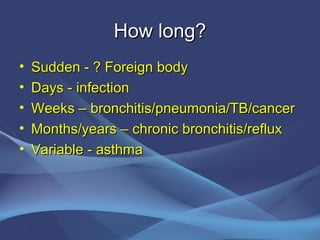
How long?
•   Sudden - ? Foreign body
•   Days - infection
•   Weeks – bronchitis/pneumonia/TB/cancer
•   Months/years – chronic bronchitis/reflux
•   Variable - asthma
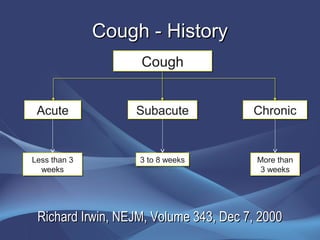
Cough - History
                   Cough


 Acute            Subacute             Chronic


Less than 3
Less than 3        3 to 8 weeks
                   3 to 8 weeks         More than
                                        More than
  weeks
  weeks                                  3 weeks
                                         3 weeks


 Richard Irwin, NEJM, Volume 343, Dec 7, 2000
Cough - Acute
• Most common causes
  – Common cold [viral]
  – Acute bacterial sinusitis
  – Pertussis
  – Exacerbation of COPD
  – Allergic rhinitis
  – Rhinitis secondary to environmental irritants
Cough – Viral Infection
• Upper respiratory viral infections are the
  most common cause of cough
  – 83% within first 48 hours
  – 26% on day 14
• Arises from the stimulation of the cough
  reflex in upper airway by postnasal drip
  and/or clearing of the throat
Cough – Viral Infection
• Signs and symptoms include: rhinorrhea,
  sneezing, nasal obstruction, post nasal
  drip, irritation of the throat, +/- fever and
  normal chest exam
  – Diagnostic testing is not indicated in a
    immunocompetent patient as there is a very
    low yield — over 97% of CXR are normal
Cough - Acute
• Remember:
  – Think bacterial bronchitis & use antibiotics if exacerbation
    of COPD with worsening SOB or wheezing is present
  – Cough and vomiting is suggestive of Bordetella pertussis
  – Bacterial sinusitis can present like a viral rhinitis but use
    antibiotics only two of the following are present:
     •   Maxillary toothache
     •   Purulent nasal discharge, discolored nasal discharge
     •   Abnormal transillumination of any sinus
Cough - Acute
• In elderly, classic signs and symptoms
  may be minimal, so consider
  – Pneumonia
  – CHF
  – Asthma
  – Aspiration
Cough - Subacute
• Most common etiologies
  1. Post-infectious cough
    •   Begins with respiratory tract infection
    •   NOT pneumonia
    •   Ultimately resolves without treatment
    •   Results from PND or clearing of throat
    •   With or without bronchial hyper-responsiveness
  1. Bacterial sinusitis
  2. Asthma
Postinfectious Cough -
             Treatment
• Begin with treatment similar to the
  common cold
• If wheezing – use bronchodilators
  – This does not make the diagnosis of asthma
• If not resolved in one week
     • Nasal decongestant for 5 days
     • Antibiotics till total disappearance of cough
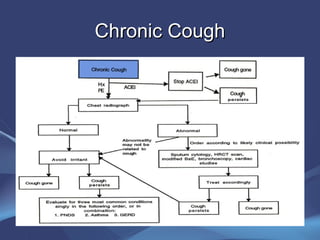
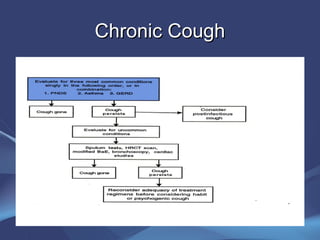
Chronic Cough
• In immunocompetent patients, 95% caused by
  –   Postnasal drip
  –   Asthma
  –   Gastroesophageal reflux
  –   Chronic bronchitis due to cigarette smoking
  –   Bronchiectasis
  –   Use of angiotensin-converting enzymes inhibitors
Chronic Cough
Evaluation of Chronic Cough
• History
  – Character of cough, quality of the sound and
    the timing of cough (except the absence
    during sleep) have not shown to be useful
• Physical
  – Oropharyngeal mucous or cobblestone
    appearance suggests postnasal-drip
    syndrome
  – “silent” postnasal-drip syndrome
Evaluation of Chronic Cough
• Heartburn and regurgitation suggest
  Gastroesophageal reflux disease
  – “silent”GERD in up to 75% of patients
    • Irwin,Chest 1993;104:1511-1517

• Wheezing suggests asthma
  – “silent”asthma (cough variant asthma) in up to
    57% of cases
    • Irwin, Am Rev Respir Dis 1981;123:413-417
Evaluation of Chronic Cough
• Where to start
  – CXR: normal is consistent with PND, GERD,
    asthma, chronic bronchitis.
     • Unlikely : bronchogenic carcinoma, sarcoid, TB
       and bronchiectasis
  – Since PND syndromes are most common---
    start there
     • Sinusitis or rhinitis of the following varieties:
       nonallergic, allergic, postinfectious, vasomotor,
       drug-induced and environmental-irritant induced
Chronic Cough - PND
• PND is by far the most common cause of
  chronic cough
• Since the signs and symptoms are
  nonspecific, the definitive diagnosis
  cannot be made by History and Physical
  examination alone
• Therapy
  – 1st generation antihistamine + a decongestant
Therapy
• Remember
 – “The newer-generation H1 antagonist do not
   appear to be effective when cough induced by
   postnasal drip is not mediated by histamine”
   • Irwin, Consensus Report of the American College of Chest
     Physicians. Chest 1998;114:suppl:133S-181S.
Chronic Cough – Asthma
• Cough can be the only symptom of
  asthma in up to 57% of patients—cough-
  variant asthma
• +/- airflow obstruction on PFT’s
• Therapy
  – If severe, PO steroids followed by inhaled
    steroids for 6-8 weeks with β2 agonist
  – If mild, inhaled steroids with β2 agonists
Chronic Cough -- GERD
• Etiology
  – Gross aspiration including pulmonary
    aspiration syndromes, abscess, chronic
    bronchitis, bronchiectasis, and pulmonary
    fibrosis
  – Laryngeal inflammation
  – Vagally mediated distal esophageal-
    tracheobronchial reflex
Chronic Cough -- GERD
• When GERD is cause of chronic cough, up
  to 75% of patients have no GI symptoms
• Empiric therapy can if tried if
  – GI complaints compatible with GERD or
  – No GI complaints with normal CXR, no ACEI,
    patients who do not smoke and in whom PND
    and asthma have been eliminated.
• Improvement may take 2-3 months to begin
• MEAN TIME TO RECOVERY IS 161-179
  DAYS.
Chronic Cough -- ACEI
• Class effect of drug; not drug related
• Incidence of 0.2 to 33%;
  – True incidence ≈ 10%
• Cough may appear within a few hours up to
  months after taking the first dose
  – Pathogenesis seems be an accumulation of
    inflammatory mediators: bradykinin, substance
    P and/or prostaglandins.
• Therapy
  – STOP ACEI
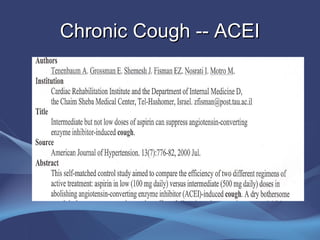
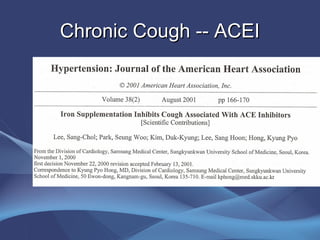
  – Other therapies include oral sulindac, ASA,
    indomethacin and even oral iron.
Chronic Cough -- ACEI
Cough therapy

   Principles
Treatment of cough
• Cough is a useful physiological mechanism
  that serves to clear the respiratory passages
  of foreign material and excess secretions.
  – It should not be suppressed indiscriminately.
• There are, however, many situations in
  which cough does not serve any useful
  purpose
  – Instead it only annoys the patient or prevents
    rest and sleep.
• Cough may be
  – i) Un productive (dry) cough OR
Treatment of cough
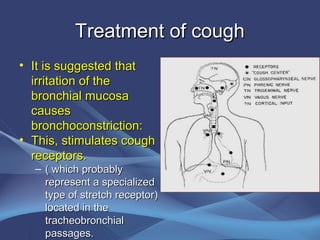
• It is suggested that
  irritation of the
  bronchial mucosa
  causes
  bronchoconstriction:
• This, stimulates cough
  receptors.
  – ( which probably
    represent a specialized
    type of stretch receptor)
    located in the
    tracheobronchial
    passages.
Specific treatment approach to
              cough
• 1) Upper / lower respiratory
  – Appropriate antibiotics tract infections
• 2) Smoking/chronic bronchitis
  – Cessation of smoking
• 3) Pulmonary tuberculosis
  – Antibiotics
• 4) Asthmatic cough
  – Inhaled β2-agonists/ipratropium/corticosteroid
• 5) Postnasal drip (sinusitis)
  – Antibiotics, nasal decongestants, antihistamines
Treatment of Cough
•   Antitussives (cough centre suppressants)
•   Antihistamines
•   Bronchodilators
•   Pharyngeal Demulcents
•   Expectorants, Mucokinetics & Mucolytics
Antitussives (cough centre
         suppressants)
• Drugs suppress cough & produces
  symptomatic relief
• MOA
  – Mainly suppress cough centre in medulla (both
    central & peripheral effects)
    • E.g., Opoid drugs (codeine, pholcodeine, noscapine,
      dextromethorphan)
  – Opioid = most effective for cough.
Codeine
• Codeine= prodrug ⇒ metabolized to
  morphine
  – It is an alkaloid found in Opium poppy plant
• Has less addiction + resp. centre depressant
  action
  – Has useful antitussive action at low doses (<15
    mg)
• Produce drowsiness, thickening of sputum &
• constipation
Noscapine & Pholcodeine
• Related to papaverine
• Do not have addictive, analgesic &
  constipating properties
• Do not interfere with mucocilliary movement
  – Noscapine (15 mg) &
  – pholcodeine (10 mg)=syrup
Dextromethorphan
• Available in syrup, tablets, spray forms
• MOA
  – NMDA receptor antagonist
• Uses
  – Cough suppressant, temporary relief of cough
    caused by minor throat & bronchial irritation
    (accompanies with flu & cold), pain relief
• Adverse Effects
  – Nausea, vomiting, drowsiness, dizziness, blurred
    vision.
Antihistamines
• Added to antitussives / expectorant
  formulation
  – Due to sedative & anticholinergic actions
    produce relief in cough but lack selectivity for
    cough centre
  – No expectorant action =▼secretions
    (anticholinergic effect)
• Suitable for allergic cough (not for asthma)
  – E.g., Chlorpheniramine, diphenhydramine,
    promethazine.
Bronchodilators
• Bronchospasm or stimulation of
  pulmonary receptors = induce or
  aggravate cough + bronchoconstriction
• e.g. β2-agonist (salbutamol, terbutaline)
• MOA of bronchodilators in cough
  – ▲surface velocity of air flow during cough→
    Clear secretions of airway
  – Not used routinely for every type of cough but
    only when bronchoconstriction is present
Pharyngeal demulcents
• Soothe the throat (directly & also by
  promoting salivation)
  – ▼ afferent impulses from inflamed/irritated
    pharyngeal mucosa
• Provide symptomatic relief in dry cough
  arising from throat
  – E.g. lozenges, cough drops, glycerine, liquorice,
    honey
Chronic Cough
Chronic Cough
Mucoactive agents


    A closer look
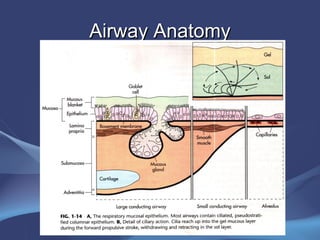
Airway Anatomy
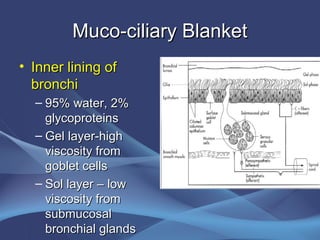
Muco-ciliary Blanket
• Inner lining of
  bronchi
  – 95% water, 2%
    glycoproteins
  – Gel layer-high
    viscosity from
    goblet cells
  – Sol layer – low
    viscosity from
    submucosal
    bronchial glands
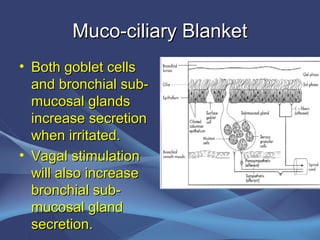
Muco-ciliary Blanket
• Both goblet cells
  and bronchial sub-
  mucosal glands
  increase secretion
  when irritated.
• Vagal stimulation
  will also increase
  bronchial sub-
  mucosal gland
  secretion.
Muco-ciliary Blanket
• Increased goblet
  cell secretion =
  – Increased sputum
    viscosity.
• Increased bronchial
  sub-mucosal gland
  secretion =
  – Decreased sputum
    viscosity
Mucus Layer
• Gel (1 to 2 µm): Gelatinous and sticky (flypaper)
• Sol (4 to 8 µm): Watery, Cilia in this layer
  – Total layer thickness: 5 to 10 µm thick
• Surface Epithelial Cells
  –   Pseudostratified ciliated columnar
  –   Surface goblet cells (6,800/mm 2)
  –   Serous cells – Sol layer
  –   Clara cells – Unknown function (enzymes?)
• Submucosal Gland
  – Bronchial Gland
Mucus Layer
• Bronchial Gland
  – Found in submucosa
  – Found down to terminal bronchioles
  – Parasympathetic control (Vagus nerve)
  – Provide the majority of mucus secretion
  – Total volume 40 times greater than goblet
    cells
Function of Mucociliary
             Escalator
• Protective function
  – Remove trapped or inhaled particles and
    dead or aging cells.
  – Antimicrobial (enzymes in sol/gel)
  – Humidification
  – Insulation (prevents heat and moisture loss)
     • NOTE: No cilia or mucus in lower airways
       (respiratory bronchioles on down)
• Mucus also protects the epithelium from
  toxic materials.
Structure and Composition of
            Mucus
• Composition
  – 95% water
    • Need for water intake to replenish
    • Mucus doesn’t easily absorb water once created
  – 3% protein and carbohydrates
  – 1% lipids
  – Less than 0.3% DNA
Structure and Composition of
             Mucus
• Glycoprotein
  – Large (macro)molecules
  – Strands of polypeptides (protein) that make
    up the backbone of the molecule
    • String of amino acids
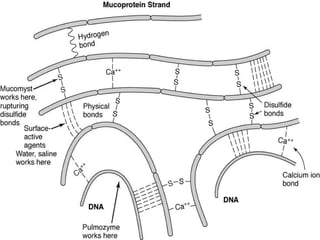
  – Carbohydrate side chains
  – Chemical bonds “hold” mucus together
    • Intramolecular: Dipeptide links
       – Connect amino acids
    • Intermolecular: Disulfide and Hydrogen bonds
       – Connect adjacent macromolecules
Mucus Production
• Normal person produces 100 mL of
  mucus per 24 hour period
  – Most is reabsorbed back in the bronchial
    mucosa
  – 10 mL reaches the glottis
  – Most of this is swallowed
• Mucus production increases with lung
  disease
Increased Mucus Production
•   Smoking
•   Environmental irritants
•   Allergy
•   Infections
•   Genetic predisposition
•   Foreign bodies
Increased Mucus Production
   ↑ Viscosity of mucus
   ↓ Ciliary effectiveness
   ↑ Mucus plugs
   ↑ Airway Resistance
   ↑ Infections
   Obstructed bronchioles leads to
    atelectasis
Diseases that Increase Mucus
             Production
•   Chronic Bronchitis
•   Asthma
•   Cystic Fibrosis
•   Acute Bronchitis
•   Pneumonia

• Also some drugs (anticholinergics,
  antimuscarinics)
Factors that Impair Ciliary
               Activity
•   Endotracheal tubes
•   Temperature extremes
•   High FiO2 levels
•   Dust, Fumes, Smoke
•   Dehydration
•   Thick Mucus
•   Infections
Viscosity and Elasticity
• Rheology
• Viscosity: Property of a liquid that measures the
  resistance to movement when a force is applied.
   – Increased viscosity, increased resistance to flow
      • Olive oil vs. Water
• Elasticity: Property of solid whereby a solid
  changes shape (deforms) when a force is
  applied.
   – Ideally, a solid is totally elastic, and returns to its
     original shape when force is released.
• The mucus layer is ideally very elastic and has a
  very low viscosity.
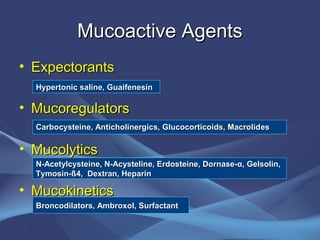
Mucoactive Agents
• Expectorants
  Hypertonic saline, Guaifenesin

• Mucoregulators
  Carbocysteine, Anticholinergics, Glucocorticoids, Macrolid es

• Mucolytics
  N-Acetylcysteine, N-Acysteline, Erdosteine, Dornase-α, Gelsolin,
  Tymosin-ß4, Dextran, Heparin

• Mucokinetics
  Broncodilators, Ambroxol, Surfactant
Hypoviscosity/Wetting Agents:
       Saline solutions
• Normal Saline (.9%)
  – Isotonic and good diluent for drugs
• Half-normal Saline (.45%)
  – Hypotonic, good diluent, and can be
    administered via USN
• Aerosol solutions tend to increase in
  tonicity as they go deeper into the lung
  because of evaporation!
Hypoviscosity/Wetting Agents:
    Saline solutions (cont.)
• Hypertonic Saline (usually 10%)
  – Wetting agent
  – Bronchorrhea (draws fluid from mucosa to
    dilute gel)
  – May also help break up mucoprotein-DNA
    bonds in mucus (mucolytic effect!)
• Limitations:
  – Bronchospasm
  – Hypernatremia
Hypoviscosity/Wetting Agents:
           Sodium Bicarb
• Usually 2 – 7.5% solution
• Wetting agent and bronchorrhea
• Also alkaline pH breaks up hydrogen bonds
• Also breaks up calcium bonds
• Like hypertonic saline, it is both a wetting agent
  and a mucolytic
• Can usually NOT be used as a diluent for drugs
• Has same side effects as hypertonic saline
Mucociliary Escalator
• Mucosal Blanket
  – Sol layer
  – Gel layer
• Cilia
  – 200 per cell
  – 6 µm in length
  – Beat 1000/min
  – Move mucus 2 cm/min
  – Paralyzed by cigarette smoke
Mucus vs. Sputum
• Mucus is the total secretion from mucous
  membranes including the surface goblet
  cell and the bronchial glands.

• Sputum is the expectorated secretions
  that contains mucus, as well as
  oropharyngeal and nasopharyngeal
  secretions (saliva).
Facilitation of Mucus Clearance
• Provide adequate hydration
    – Increase fluid intake orally or IV
• Remove causative factors
    – Smoking, pollution, allergens
•   Optimize tracheobronchial clearance
•   Use Mucolytics
•   Reduce Inflammation
Function of Mucolytics
• Weakening of intermolecular forces
  binding adjacent glycoprotein chains
  – Disruption of Disulfide Bonds
• Alteration of pH to weaken sugar side
  chains of glycoproteins
• Destruction of protein (Proteolysis)
  contained in the glycoprotein core of
  proteolytic enzymes
  – Breaking down of DNA in mucus
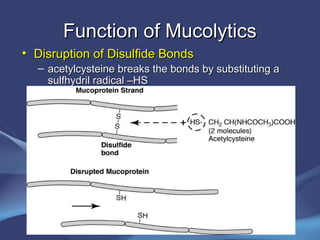
Function of Mucolytics
• Disruption of Disulfide Bonds
  – acetylcysteine breaks the bonds by substituting a
    sulfhydril radical –HS
Function of Mucolytics
• Alteration of pH
  – 2% NaHCO3 solutions are used to increase
    the pH of mucus by weakening carbohydrate
    side chains
  – Can be injected directly into the trachea or
     aerosolized (2-5 mL)
Function of Mucolytics
• Proteolysis
  – Dornase alfa (Pulmozyme)
  – Attacks the protein component of the mucus
Hazard of Mucolytics
• The problem with all three mucolytics is
  that they destroy the elasticity of mucus
  while reducing the viscosity.
• Elasticity is crucial for mucociliary
  transport.
• The patient must be able to cough
  adequately to remove the mucus.
Mucolysis
• Mucolysis is the breakdown of mucus.
• Mucolysis is needed in diseases in which
  there is increased mucus production:
  – Cystic Fibrosis
  – COPD
  – Bronchiectasis
  – Respiratory Infections
    • Turberculosis
Mucolysis
• These diseases result in a marked slowing
  of mucus transport
  – Changes in properties of the mucus
  – Decreased ciliary activity
  – Both
Mucolytics
• acetylcysteine
• sodium bicarbonate (NaHCO3)
• dornase alfa
  – Pulmozyme
Mucolytics
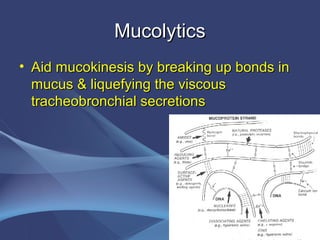
• Aid mucokinesis by breaking up bonds in
  mucus & liquefying the viscous
  tracheobronchial secretions
Mucolytics
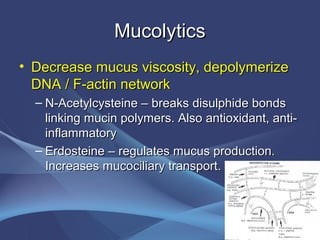
• Decrease mucus viscosity, depolymerize
  DNA / F-actin network
  – N-Acetylcysteine – breaks disulphide bonds
    linking mucin polymers. Also antioxidant, anti-
    inflammatory
  – Erdosteine – regulates mucus production.
    Increases mucociliary transport.
Dairy Intake
• No evidence to support the common belief
  that drinking milk increases the production
  of mucus or phlegm and congestion in the
  respiratory tract
• There is a loose cough associated with
  milk intake
Secretion Management
• Increase the depth of the sol layer
  – Water
  – Saline
  – Expectorants
• Alter the consistency of the gel layer
  – Mucolytics
• Improve ciliary activity
  – Sympathomimetic bronchodilators
  – Corticosteroids
Bland Aerosols
• “Dilutes” mucus molecule
• Also known as wetting agents
  – Function may be more of an irritant than a wetter
• Types
  – Sterile & Distilled Water
     • Humectant
     • Dense aerosols and asthmatics
  – Normal (isotonic) Saline
  – Hypertonic Saline
     • Increase mucus production
  – Hypotonic Saline
Cough Suppressants
• Vagal stimulation causes a cough.
• Irritation of pharynx, larynx, and bronchi
  lead to a reflex cough impulse.
• If the cough is dry and non-productive, it
  may be desirable to suppress its activity.
• Cough suppressants depress the cough
  center in medulla (?).
  – Narcotic preparations (codeine)
  – Non-Narcotic preparations (dextromethorphan)
• Caution in patients with thick secretions.
acetylcysteine
• Indications
  – Mucolytic by aerosol or direct instillation into
    the ET tube.
  – Given orally to reduce liver injury with
    acetaminophen (Tylenol) overdose.
     • Mix with cola or given by NG tube.
Dosage of acetylcysteine
• Concentration
  – 10% or 20%
• Dosage
  – 3-5 mL of a 20% solution TID or QID
    • Maximum dose 10 mL
  – 6-10 mL of a 10% solution TID or QID
    • Maximum dose 20 mL
• 1-2 mL of a 10% or 20% for direct
  instillation
Hazards of acetylcysteine
• Bronchospasm
  – Asthma – may be a problem during an acute
    asthma attack.
    • Anecdotal; lack of evidence
  – If used with asthma, use 10% and mix with a
    bronchodilator (preferably a short-acting
    agent).
• Increase mucus production
  – Be prepared to suction a patient who cannot
    cough or who is intubated.
Hazards of acetylcysteine
• Do not mix with antibiotics in the same
  nebulizer (incompatible).
• Nausea & Vomiting
  – Disagreeable odor (smells like rotten eggs)
    due to the hydrogen sulfide.
• Open vials should be used within 96 hours
  to prevent contamination.
Expectorants (Bronchomucotropics)
 • Drugs that increase and aid clearance of
   respiratory tract secretions
      • Act peripherally to increase expulsion of mucus from
        the respiratory tract.
         –   Increase bronchial secretion OR
         –   Decrease its viscosity & facilitate its removal by coughing
         –   Loosen cough ► less tiring & more productive
   – Hypoviscosity agents (Wetting agents)
      • Aerosol hypertonic saline – increases secretion
        volume and/or hydration, may decrease viscosity by
        diluting the gel layer
   – Mucolytics
Classification of Expectorants
• Classified into
• 2 types:
  1. Stimulant expectorants – increase overall
     mucus volume to enhance clearance.
     • Directly acting
     • Reflexly acting
  1. Mucolytic expectorants - break down mucus
Expectorants
• Iodides
  – Unclear function
  – SSKI (Saturated Solution of Potassium Iodide)
• Guifenesin
  – At high doses, stimulates bronchial gland
    secretion
  – Robitussin
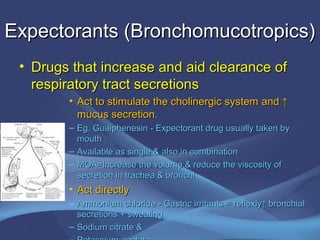
Expectorants (Bronchomucotropics)
 • Drugs that increase and aid clearance of
   respiratory tract secretions
        • Act to stimulate the cholinergic system and ↑
          mucus secretion.
        – Eg. Guaiphenesin - Expectorant drug usually taken by
          mouth
        – Available as single & also in combination
        – MOA=Increase the volume & reduce the viscosity of
          secretion in trachea & bronchi
        • Act directly
        – Ammonium chloride - Gastric irritants = reflexly↑ bronchial
          secretions + sweating
        – Sodium citrate &
Expectorants (Bronchomucotropics)
 • Drugs that increase and aid clearance of
   respiratory tract secretions
   – Usually stimulate sol layer production by direct
     irritation or indirect through vagal stimulation
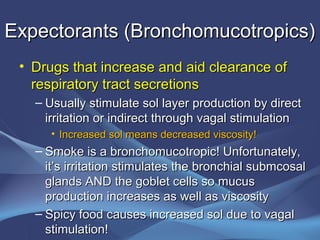
      • Increased sol means decreased viscosity!
   – Smoke is a bronchomucotropic! Unfortunately,
     it’s irritation stimulates the bronchial submcosal
     glands AND the goblet cells so mucus
     production increases as well as viscosity
   – Spicy food causes increased sol due to vagal
     stimulation!
N-Acetylcysteine
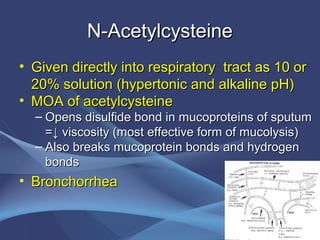
• Given directly into respiratory tract as 10 or
  20% solution (hypertonic and alkaline pH)
• MOA of acetylcysteine
  – Opens disulfide bond in mucoproteins of sputum
    =↓ viscosity (most effective form of mucolysis)
  – Also breaks mucoprotein bonds and hydrogen
    bonds
• Bronchorrhea
N-Acetylcysteine
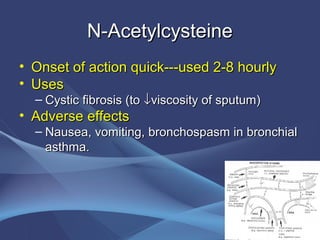
• Onset of action quick---used 2-8 hourly
• Uses
  – Cystic fibrosis (to ↓viscosity of sputum)
• Adverse effects
  – Nausea, vomiting, bronchospasm in bronchial
    asthma.
Pulmozyme (Dornase Alpha or DNAse)
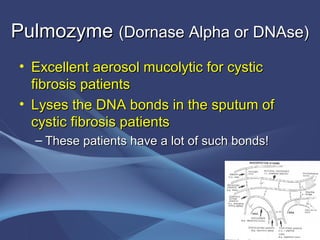
• Excellent aerosol mucolytic for cystic
  fibrosis patients
• Lyses the DNA bonds in the sputum of
  cystic fibrosis patients
  – These patients have a lot of such bonds!
Mucolytic treatment in acute
        exacerbations :
• Mucolytic drugs have a small effect in
  decreasing acute exacerbations.
• Improvement of subjective complaints
  – Decrease of inflammatory markers
  – Bacterial eradication
  – They are not effective on FEV1 decline.
  – They may have some effects on frequent
    exacerbators requiring hospitalization BUT no
    difference on hospitalization length.
Mucoregulators
• Agents regulating mucus secretion or
  interfere with the DNA/F-actin network
  – Carbocysteine - regulates mucus visco-elasticity.
    Also antioxidant, anti-inflammatory
  – Anticholinergics- inhibits cholinergic system
    which ↑ mucus secretion (M3 res).
  – Glucocorticoids – decrease airway inflammation
    and mucus secretion.
  – Macrolides – ↓ airway inflammation & mucus
    secretion.
Mucokinetics
• Agents used when secretions ↑ in amount
  and/or viscosity to ↑ the mucociliary transport
  – Bronchodilators - Improves cough by increasing
    expiratory flow and increase in secretion
    expulsion, Also antioxidant, antiinflammatory
  – Bromhexine
  – Ambroxol-increases in surfactant production,
    inhibits chloride channels, Decrease in viscosity
    of secretions
  – Surfactant –decreases surface adhesion
    between mucus and airway.
Bromhexine
• MOA of Bromhexine
  – Synthetic derivative of vasicine (alkaloid=
    Adhatoda vasica)
  – Thinning & fragmentation of mucopolysaccaride
    fibers
  – ↑ volume & ↓ viscosity of sputum
Ambroxol
• Ambroxol Hydrochloride is the active
  metabolite of Bromhexine & works as
  – Secretolytic agent used in the treatment of viscid
    or excessive mucus.
  – Mucoactive drug with several properties
    including secretolytic and secretomotoric actions
    that restore the physiological clearance
    mechanisms of the respiratory tract,
  – Stimulates synthesis and release of surfactant by
    type II pneumocytes. Surfactant acts as an anti-
    glue factor by reducing the adhesion of mucus to
    the bronchial wall, in improving its transport.
Ambroxol
• Ambroxol allows patients to breathe freely
  and deeply by:
  – Promoting mucus clearance,
  – Facilitating expectoration and
  – Easing productive cough.
• Anti-inflammatory properties of Ambroxol
  lead to ↓ of redness of the sore throat and
  thus, ambroxol relieves pain in acute sore
  throat, with a fast onset of action and a long
  duration of effect of at least 3 hours.

Cough

  • 1.
    Cough – TheChallenge of treatment Dr. B. K. Iyer
  • 2.
  • 3.
    How long? • Sudden - ? Foreign body • Days - infection • Weeks – bronchitis/pneumonia/TB/cancer • Months/years – chronic bronchitis/reflux • Variable - asthma
  • 4.
    Cough - History Cough Acute Subacute Chronic Less than 3 Less than 3 3 to 8 weeks 3 to 8 weeks More than More than weeks weeks 3 weeks 3 weeks Richard Irwin, NEJM, Volume 343, Dec 7, 2000
  • 5.
    Cough - Acute •Most common causes – Common cold [viral] – Acute bacterial sinusitis – Pertussis – Exacerbation of COPD – Allergic rhinitis – Rhinitis secondary to environmental irritants
  • 6.
    Cough – ViralInfection • Upper respiratory viral infections are the most common cause of cough – 83% within first 48 hours – 26% on day 14 • Arises from the stimulation of the cough reflex in upper airway by postnasal drip and/or clearing of the throat
  • 7.
    Cough – ViralInfection • Signs and symptoms include: rhinorrhea, sneezing, nasal obstruction, post nasal drip, irritation of the throat, +/- fever and normal chest exam – Diagnostic testing is not indicated in a immunocompetent patient as there is a very low yield — over 97% of CXR are normal
  • 8.
    Cough - Acute •Remember: – Think bacterial bronchitis & use antibiotics if exacerbation of COPD with worsening SOB or wheezing is present – Cough and vomiting is suggestive of Bordetella pertussis – Bacterial sinusitis can present like a viral rhinitis but use antibiotics only two of the following are present: • Maxillary toothache • Purulent nasal discharge, discolored nasal discharge • Abnormal transillumination of any sinus
  • 9.
    Cough - Acute •In elderly, classic signs and symptoms may be minimal, so consider – Pneumonia – CHF – Asthma – Aspiration
  • 10.
    Cough - Subacute •Most common etiologies 1. Post-infectious cough • Begins with respiratory tract infection • NOT pneumonia • Ultimately resolves without treatment • Results from PND or clearing of throat • With or without bronchial hyper-responsiveness 1. Bacterial sinusitis 2. Asthma
  • 11.
    Postinfectious Cough - Treatment • Begin with treatment similar to the common cold • If wheezing – use bronchodilators – This does not make the diagnosis of asthma • If not resolved in one week • Nasal decongestant for 5 days • Antibiotics till total disappearance of cough
  • 12.
    Chronic Cough • Inimmunocompetent patients, 95% caused by – Postnasal drip – Asthma – Gastroesophageal reflux – Chronic bronchitis due to cigarette smoking – Bronchiectasis – Use of angiotensin-converting enzymes inhibitors
  • 13.
  • 14.
    Evaluation of ChronicCough • History – Character of cough, quality of the sound and the timing of cough (except the absence during sleep) have not shown to be useful • Physical – Oropharyngeal mucous or cobblestone appearance suggests postnasal-drip syndrome – “silent” postnasal-drip syndrome
  • 15.
    Evaluation of ChronicCough • Heartburn and regurgitation suggest Gastroesophageal reflux disease – “silent”GERD in up to 75% of patients • Irwin,Chest 1993;104:1511-1517 • Wheezing suggests asthma – “silent”asthma (cough variant asthma) in up to 57% of cases • Irwin, Am Rev Respir Dis 1981;123:413-417
  • 16.
    Evaluation of ChronicCough • Where to start – CXR: normal is consistent with PND, GERD, asthma, chronic bronchitis. • Unlikely : bronchogenic carcinoma, sarcoid, TB and bronchiectasis – Since PND syndromes are most common--- start there • Sinusitis or rhinitis of the following varieties: nonallergic, allergic, postinfectious, vasomotor, drug-induced and environmental-irritant induced
  • 17.
    Chronic Cough -PND • PND is by far the most common cause of chronic cough • Since the signs and symptoms are nonspecific, the definitive diagnosis cannot be made by History and Physical examination alone • Therapy – 1st generation antihistamine + a decongestant
  • 18.
    Therapy • Remember –“The newer-generation H1 antagonist do not appear to be effective when cough induced by postnasal drip is not mediated by histamine” • Irwin, Consensus Report of the American College of Chest Physicians. Chest 1998;114:suppl:133S-181S.
  • 19.
    Chronic Cough –Asthma • Cough can be the only symptom of asthma in up to 57% of patients—cough- variant asthma • +/- airflow obstruction on PFT’s • Therapy – If severe, PO steroids followed by inhaled steroids for 6-8 weeks with β2 agonist – If mild, inhaled steroids with β2 agonists
  • 20.
    Chronic Cough --GERD • Etiology – Gross aspiration including pulmonary aspiration syndromes, abscess, chronic bronchitis, bronchiectasis, and pulmonary fibrosis – Laryngeal inflammation – Vagally mediated distal esophageal- tracheobronchial reflex
  • 21.
    Chronic Cough --GERD • When GERD is cause of chronic cough, up to 75% of patients have no GI symptoms • Empiric therapy can if tried if – GI complaints compatible with GERD or – No GI complaints with normal CXR, no ACEI, patients who do not smoke and in whom PND and asthma have been eliminated. • Improvement may take 2-3 months to begin • MEAN TIME TO RECOVERY IS 161-179 DAYS.
  • 22.
    Chronic Cough --ACEI • Class effect of drug; not drug related • Incidence of 0.2 to 33%; – True incidence ≈ 10% • Cough may appear within a few hours up to months after taking the first dose – Pathogenesis seems be an accumulation of inflammatory mediators: bradykinin, substance P and/or prostaglandins. • Therapy – STOP ACEI – Other therapies include oral sulindac, ASA, indomethacin and even oral iron.
  • 23.
  • 24.
  • 25.
    Cough therapy Principles
  • 26.
    Treatment of cough •Cough is a useful physiological mechanism that serves to clear the respiratory passages of foreign material and excess secretions. – It should not be suppressed indiscriminately. • There are, however, many situations in which cough does not serve any useful purpose – Instead it only annoys the patient or prevents rest and sleep. • Cough may be – i) Un productive (dry) cough OR
  • 27.
    Treatment of cough •It is suggested that irritation of the bronchial mucosa causes bronchoconstriction: • This, stimulates cough receptors. – ( which probably represent a specialized type of stretch receptor) located in the tracheobronchial passages.
  • 28.
    Specific treatment approachto cough • 1) Upper / lower respiratory – Appropriate antibiotics tract infections • 2) Smoking/chronic bronchitis – Cessation of smoking • 3) Pulmonary tuberculosis – Antibiotics • 4) Asthmatic cough – Inhaled β2-agonists/ipratropium/corticosteroid • 5) Postnasal drip (sinusitis) – Antibiotics, nasal decongestants, antihistamines
  • 29.
    Treatment of Cough • Antitussives (cough centre suppressants) • Antihistamines • Bronchodilators • Pharyngeal Demulcents • Expectorants, Mucokinetics & Mucolytics
  • 30.
    Antitussives (cough centre suppressants) • Drugs suppress cough & produces symptomatic relief • MOA – Mainly suppress cough centre in medulla (both central & peripheral effects) • E.g., Opoid drugs (codeine, pholcodeine, noscapine, dextromethorphan) – Opioid = most effective for cough.
  • 31.
    Codeine • Codeine= prodrug⇒ metabolized to morphine – It is an alkaloid found in Opium poppy plant • Has less addiction + resp. centre depressant action – Has useful antitussive action at low doses (<15 mg) • Produce drowsiness, thickening of sputum & • constipation
  • 32.
    Noscapine & Pholcodeine •Related to papaverine • Do not have addictive, analgesic & constipating properties • Do not interfere with mucocilliary movement – Noscapine (15 mg) & – pholcodeine (10 mg)=syrup
  • 33.
    Dextromethorphan • Available insyrup, tablets, spray forms • MOA – NMDA receptor antagonist • Uses – Cough suppressant, temporary relief of cough caused by minor throat & bronchial irritation (accompanies with flu & cold), pain relief • Adverse Effects – Nausea, vomiting, drowsiness, dizziness, blurred vision.
  • 34.
    Antihistamines • Added toantitussives / expectorant formulation – Due to sedative & anticholinergic actions produce relief in cough but lack selectivity for cough centre – No expectorant action =▼secretions (anticholinergic effect) • Suitable for allergic cough (not for asthma) – E.g., Chlorpheniramine, diphenhydramine, promethazine.
  • 35.
    Bronchodilators • Bronchospasm orstimulation of pulmonary receptors = induce or aggravate cough + bronchoconstriction • e.g. β2-agonist (salbutamol, terbutaline) • MOA of bronchodilators in cough – ▲surface velocity of air flow during cough→ Clear secretions of airway – Not used routinely for every type of cough but only when bronchoconstriction is present
  • 36.
    Pharyngeal demulcents • Soothethe throat (directly & also by promoting salivation) – ▼ afferent impulses from inflamed/irritated pharyngeal mucosa • Provide symptomatic relief in dry cough arising from throat – E.g. lozenges, cough drops, glycerine, liquorice, honey
  • 37.
  • 38.
  • 39.
    Mucoactive agents A closer look
  • 40.
  • 41.
    Muco-ciliary Blanket • Innerlining of bronchi – 95% water, 2% glycoproteins – Gel layer-high viscosity from goblet cells – Sol layer – low viscosity from submucosal bronchial glands
  • 42.
    Muco-ciliary Blanket • Bothgoblet cells and bronchial sub- mucosal glands increase secretion when irritated. • Vagal stimulation will also increase bronchial sub- mucosal gland secretion.
  • 43.
    Muco-ciliary Blanket • Increasedgoblet cell secretion = – Increased sputum viscosity. • Increased bronchial sub-mucosal gland secretion = – Decreased sputum viscosity
  • 44.
    Mucus Layer • Gel(1 to 2 µm): Gelatinous and sticky (flypaper) • Sol (4 to 8 µm): Watery, Cilia in this layer – Total layer thickness: 5 to 10 µm thick • Surface Epithelial Cells – Pseudostratified ciliated columnar – Surface goblet cells (6,800/mm 2) – Serous cells – Sol layer – Clara cells – Unknown function (enzymes?) • Submucosal Gland – Bronchial Gland
  • 45.
    Mucus Layer • BronchialGland – Found in submucosa – Found down to terminal bronchioles – Parasympathetic control (Vagus nerve) – Provide the majority of mucus secretion – Total volume 40 times greater than goblet cells
  • 46.
    Function of Mucociliary Escalator • Protective function – Remove trapped or inhaled particles and dead or aging cells. – Antimicrobial (enzymes in sol/gel) – Humidification – Insulation (prevents heat and moisture loss) • NOTE: No cilia or mucus in lower airways (respiratory bronchioles on down) • Mucus also protects the epithelium from toxic materials.
  • 47.
    Structure and Compositionof Mucus • Composition – 95% water • Need for water intake to replenish • Mucus doesn’t easily absorb water once created – 3% protein and carbohydrates – 1% lipids – Less than 0.3% DNA
  • 48.
    Structure and Compositionof Mucus • Glycoprotein – Large (macro)molecules – Strands of polypeptides (protein) that make up the backbone of the molecule • String of amino acids – Carbohydrate side chains – Chemical bonds “hold” mucus together • Intramolecular: Dipeptide links – Connect amino acids • Intermolecular: Disulfide and Hydrogen bonds – Connect adjacent macromolecules
  • 50.
    Mucus Production • Normalperson produces 100 mL of mucus per 24 hour period – Most is reabsorbed back in the bronchial mucosa – 10 mL reaches the glottis – Most of this is swallowed • Mucus production increases with lung disease
  • 51.
    Increased Mucus Production • Smoking • Environmental irritants • Allergy • Infections • Genetic predisposition • Foreign bodies
  • 52.
    Increased Mucus Production  ↑ Viscosity of mucus  ↓ Ciliary effectiveness  ↑ Mucus plugs  ↑ Airway Resistance  ↑ Infections  Obstructed bronchioles leads to atelectasis
  • 53.
    Diseases that IncreaseMucus Production • Chronic Bronchitis • Asthma • Cystic Fibrosis • Acute Bronchitis • Pneumonia • Also some drugs (anticholinergics, antimuscarinics)
  • 54.
    Factors that ImpairCiliary Activity • Endotracheal tubes • Temperature extremes • High FiO2 levels • Dust, Fumes, Smoke • Dehydration • Thick Mucus • Infections
  • 55.
    Viscosity and Elasticity •Rheology • Viscosity: Property of a liquid that measures the resistance to movement when a force is applied. – Increased viscosity, increased resistance to flow • Olive oil vs. Water • Elasticity: Property of solid whereby a solid changes shape (deforms) when a force is applied. – Ideally, a solid is totally elastic, and returns to its original shape when force is released. • The mucus layer is ideally very elastic and has a very low viscosity.
  • 56.
    Mucoactive Agents • Expectorants Hypertonic saline, Guaifenesin • Mucoregulators Carbocysteine, Anticholinergics, Glucocorticoids, Macrolid es • Mucolytics N-Acetylcysteine, N-Acysteline, Erdosteine, Dornase-α, Gelsolin, Tymosin-ß4, Dextran, Heparin • Mucokinetics Broncodilators, Ambroxol, Surfactant
  • 57.
    Hypoviscosity/Wetting Agents: Saline solutions • Normal Saline (.9%) – Isotonic and good diluent for drugs • Half-normal Saline (.45%) – Hypotonic, good diluent, and can be administered via USN • Aerosol solutions tend to increase in tonicity as they go deeper into the lung because of evaporation!
  • 58.
    Hypoviscosity/Wetting Agents: Saline solutions (cont.) • Hypertonic Saline (usually 10%) – Wetting agent – Bronchorrhea (draws fluid from mucosa to dilute gel) – May also help break up mucoprotein-DNA bonds in mucus (mucolytic effect!) • Limitations: – Bronchospasm – Hypernatremia
  • 59.
    Hypoviscosity/Wetting Agents: Sodium Bicarb • Usually 2 – 7.5% solution • Wetting agent and bronchorrhea • Also alkaline pH breaks up hydrogen bonds • Also breaks up calcium bonds • Like hypertonic saline, it is both a wetting agent and a mucolytic • Can usually NOT be used as a diluent for drugs • Has same side effects as hypertonic saline
  • 60.
    Mucociliary Escalator • MucosalBlanket – Sol layer – Gel layer • Cilia – 200 per cell – 6 µm in length – Beat 1000/min – Move mucus 2 cm/min – Paralyzed by cigarette smoke
  • 61.
    Mucus vs. Sputum •Mucus is the total secretion from mucous membranes including the surface goblet cell and the bronchial glands. • Sputum is the expectorated secretions that contains mucus, as well as oropharyngeal and nasopharyngeal secretions (saliva).
  • 62.
    Facilitation of MucusClearance • Provide adequate hydration – Increase fluid intake orally or IV • Remove causative factors – Smoking, pollution, allergens • Optimize tracheobronchial clearance • Use Mucolytics • Reduce Inflammation
  • 63.
    Function of Mucolytics •Weakening of intermolecular forces binding adjacent glycoprotein chains – Disruption of Disulfide Bonds • Alteration of pH to weaken sugar side chains of glycoproteins • Destruction of protein (Proteolysis) contained in the glycoprotein core of proteolytic enzymes – Breaking down of DNA in mucus
  • 64.
    Function of Mucolytics •Disruption of Disulfide Bonds – acetylcysteine breaks the bonds by substituting a sulfhydril radical –HS
  • 65.
    Function of Mucolytics •Alteration of pH – 2% NaHCO3 solutions are used to increase the pH of mucus by weakening carbohydrate side chains – Can be injected directly into the trachea or aerosolized (2-5 mL)
  • 66.
    Function of Mucolytics •Proteolysis – Dornase alfa (Pulmozyme) – Attacks the protein component of the mucus
  • 67.
    Hazard of Mucolytics •The problem with all three mucolytics is that they destroy the elasticity of mucus while reducing the viscosity. • Elasticity is crucial for mucociliary transport. • The patient must be able to cough adequately to remove the mucus.
  • 68.
    Mucolysis • Mucolysis isthe breakdown of mucus. • Mucolysis is needed in diseases in which there is increased mucus production: – Cystic Fibrosis – COPD – Bronchiectasis – Respiratory Infections • Turberculosis
  • 69.
    Mucolysis • These diseasesresult in a marked slowing of mucus transport – Changes in properties of the mucus – Decreased ciliary activity – Both
  • 70.
    Mucolytics • acetylcysteine • sodiumbicarbonate (NaHCO3) • dornase alfa – Pulmozyme
  • 71.
    Mucolytics • Aid mucokinesisby breaking up bonds in mucus & liquefying the viscous tracheobronchial secretions
  • 72.
    Mucolytics • Decrease mucusviscosity, depolymerize DNA / F-actin network – N-Acetylcysteine – breaks disulphide bonds linking mucin polymers. Also antioxidant, anti- inflammatory – Erdosteine – regulates mucus production. Increases mucociliary transport.
  • 73.
    Dairy Intake • Noevidence to support the common belief that drinking milk increases the production of mucus or phlegm and congestion in the respiratory tract • There is a loose cough associated with milk intake
  • 74.
    Secretion Management • Increasethe depth of the sol layer – Water – Saline – Expectorants • Alter the consistency of the gel layer – Mucolytics • Improve ciliary activity – Sympathomimetic bronchodilators – Corticosteroids
  • 75.
    Bland Aerosols • “Dilutes”mucus molecule • Also known as wetting agents – Function may be more of an irritant than a wetter • Types – Sterile & Distilled Water • Humectant • Dense aerosols and asthmatics – Normal (isotonic) Saline – Hypertonic Saline • Increase mucus production – Hypotonic Saline
  • 76.
    Cough Suppressants • Vagalstimulation causes a cough. • Irritation of pharynx, larynx, and bronchi lead to a reflex cough impulse. • If the cough is dry and non-productive, it may be desirable to suppress its activity. • Cough suppressants depress the cough center in medulla (?). – Narcotic preparations (codeine) – Non-Narcotic preparations (dextromethorphan) • Caution in patients with thick secretions.
  • 77.
    acetylcysteine • Indications – Mucolytic by aerosol or direct instillation into the ET tube. – Given orally to reduce liver injury with acetaminophen (Tylenol) overdose. • Mix with cola or given by NG tube.
  • 78.
    Dosage of acetylcysteine •Concentration – 10% or 20% • Dosage – 3-5 mL of a 20% solution TID or QID • Maximum dose 10 mL – 6-10 mL of a 10% solution TID or QID • Maximum dose 20 mL • 1-2 mL of a 10% or 20% for direct instillation
  • 79.
    Hazards of acetylcysteine •Bronchospasm – Asthma – may be a problem during an acute asthma attack. • Anecdotal; lack of evidence – If used with asthma, use 10% and mix with a bronchodilator (preferably a short-acting agent). • Increase mucus production – Be prepared to suction a patient who cannot cough or who is intubated.
  • 80.
    Hazards of acetylcysteine •Do not mix with antibiotics in the same nebulizer (incompatible). • Nausea & Vomiting – Disagreeable odor (smells like rotten eggs) due to the hydrogen sulfide. • Open vials should be used within 96 hours to prevent contamination.
  • 81.
    Expectorants (Bronchomucotropics) •Drugs that increase and aid clearance of respiratory tract secretions • Act peripherally to increase expulsion of mucus from the respiratory tract. – Increase bronchial secretion OR – Decrease its viscosity & facilitate its removal by coughing – Loosen cough ► less tiring & more productive – Hypoviscosity agents (Wetting agents) • Aerosol hypertonic saline – increases secretion volume and/or hydration, may decrease viscosity by diluting the gel layer – Mucolytics
  • 82.
    Classification of Expectorants •Classified into • 2 types: 1. Stimulant expectorants – increase overall mucus volume to enhance clearance. • Directly acting • Reflexly acting 1. Mucolytic expectorants - break down mucus
  • 83.
    Expectorants • Iodides – Unclear function – SSKI (Saturated Solution of Potassium Iodide) • Guifenesin – At high doses, stimulates bronchial gland secretion – Robitussin
  • 84.
    Expectorants (Bronchomucotropics) •Drugs that increase and aid clearance of respiratory tract secretions • Act to stimulate the cholinergic system and ↑ mucus secretion. – Eg. Guaiphenesin - Expectorant drug usually taken by mouth – Available as single & also in combination – MOA=Increase the volume & reduce the viscosity of secretion in trachea & bronchi • Act directly – Ammonium chloride - Gastric irritants = reflexly↑ bronchial secretions + sweating – Sodium citrate &
  • 85.
    Expectorants (Bronchomucotropics) •Drugs that increase and aid clearance of respiratory tract secretions – Usually stimulate sol layer production by direct irritation or indirect through vagal stimulation • Increased sol means decreased viscosity! – Smoke is a bronchomucotropic! Unfortunately, it’s irritation stimulates the bronchial submcosal glands AND the goblet cells so mucus production increases as well as viscosity – Spicy food causes increased sol due to vagal stimulation!
  • 86.
    N-Acetylcysteine • Given directlyinto respiratory tract as 10 or 20% solution (hypertonic and alkaline pH) • MOA of acetylcysteine – Opens disulfide bond in mucoproteins of sputum =↓ viscosity (most effective form of mucolysis) – Also breaks mucoprotein bonds and hydrogen bonds • Bronchorrhea
  • 87.
    N-Acetylcysteine • Onset ofaction quick---used 2-8 hourly • Uses – Cystic fibrosis (to ↓viscosity of sputum) • Adverse effects – Nausea, vomiting, bronchospasm in bronchial asthma.
  • 88.
    Pulmozyme (Dornase Alphaor DNAse) • Excellent aerosol mucolytic for cystic fibrosis patients • Lyses the DNA bonds in the sputum of cystic fibrosis patients – These patients have a lot of such bonds!
  • 89.
    Mucolytic treatment inacute exacerbations : • Mucolytic drugs have a small effect in decreasing acute exacerbations. • Improvement of subjective complaints – Decrease of inflammatory markers – Bacterial eradication – They are not effective on FEV1 decline. – They may have some effects on frequent exacerbators requiring hospitalization BUT no difference on hospitalization length.
  • 90.
    Mucoregulators • Agents regulatingmucus secretion or interfere with the DNA/F-actin network – Carbocysteine - regulates mucus visco-elasticity. Also antioxidant, anti-inflammatory – Anticholinergics- inhibits cholinergic system which ↑ mucus secretion (M3 res). – Glucocorticoids – decrease airway inflammation and mucus secretion. – Macrolides – ↓ airway inflammation & mucus secretion.
  • 91.
    Mucokinetics • Agents usedwhen secretions ↑ in amount and/or viscosity to ↑ the mucociliary transport – Bronchodilators - Improves cough by increasing expiratory flow and increase in secretion expulsion, Also antioxidant, antiinflammatory – Bromhexine – Ambroxol-increases in surfactant production, inhibits chloride channels, Decrease in viscosity of secretions – Surfactant –decreases surface adhesion between mucus and airway.
  • 92.
    Bromhexine • MOA ofBromhexine – Synthetic derivative of vasicine (alkaloid= Adhatoda vasica) – Thinning & fragmentation of mucopolysaccaride fibers – ↑ volume & ↓ viscosity of sputum
  • 93.
    Ambroxol • Ambroxol Hydrochlorideis the active metabolite of Bromhexine & works as – Secretolytic agent used in the treatment of viscid or excessive mucus. – Mucoactive drug with several properties including secretolytic and secretomotoric actions that restore the physiological clearance mechanisms of the respiratory tract, – Stimulates synthesis and release of surfactant by type II pneumocytes. Surfactant acts as an anti- glue factor by reducing the adhesion of mucus to the bronchial wall, in improving its transport.
  • 94.
    Ambroxol • Ambroxol allowspatients to breathe freely and deeply by: – Promoting mucus clearance, – Facilitating expectoration and – Easing productive cough. • Anti-inflammatory properties of Ambroxol lead to ↓ of redness of the sore throat and thus, ambroxol relieves pain in acute sore throat, with a fast onset of action and a long duration of effect of at least 3 hours.