COPDChronic obstructive pulmonary disease
Dr Muhammed Aslam
MBBS MD Pulmonary Medicine
www.medicalppt.blogspot.com
Outline
n INTRODUCTION
n TYPES
n PATHOLOGY
n RISK FACTORS
n CLINICAL FEATURES
n DIAGNOSIS
n MANAGEMENT
n COMPLICATION
n COPD AND ASTHMA
INTRODUCTION
n It affects more than 5 percent of the population
and is associated with high morbidity and
mortality
n It is the third-ranked cause of death in the United
States, killing more than 120,000 individuals
each year
Burden of COPD
The burden of COPD is projected to increase in coming
decades due to continued exposure to COPD risk factors and
the aging of the world’s population.
COPD is associated with significant economic burden.
© 2015 Global Initiative for Chronic Obstructive Lung Disease
Definition of COPD
COPD, a common preventable and treatable disease, is
characterized by persistent airflow limitation that is usually
progressive and associated with an enhanced chronic
inflammatory response in the airways and the lung to noxious
particles or gases.
© Global Initiative for Chronic Obstructive Lung Disease
COPD includes
1) Chronic Bronchitis
2) Emphysema
Chronic bronchitis
Defined as a chronic productive cough
for three months in each of two
successive years in a patient in whom
other causes of chronic cough have
been excluded
Emphysema
Abnormal and permanent enlargement
of the airspaces distal to the terminal
bronchioles that is accompanied by
destruction of the airspace walls, without
obvious fibrosis
PATHOLOGY
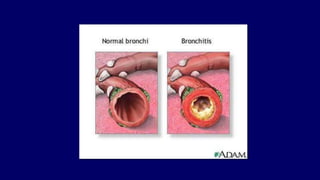
Airways
 Chronic inflammation
 Increased numbers of goblet cells
 Mucus gland hyperplasia
 Fibrosis
 Narrowing and reduction in the number of small airways
 Airway collapse due to the loss of tethering caused by
alveolar wall destruction in emphysema
Lung Parenchyma
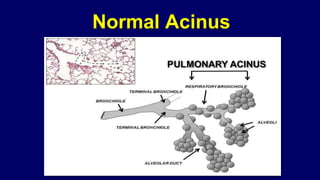
Emphysema affects the structures distal
to the terminal bronchiole, consisting of
the respiratory bronchiole, alveolar
ducts, alveolar sacs, and alveoli, known
collectively as the acinus.
Normal Acinus
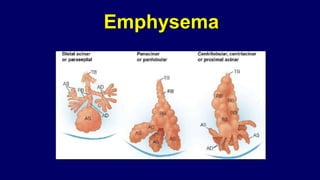
Subtype of emphysema.
Centrilobular emphysema (Proximal acinar)
Abnormal dilation or destruction of the respiratory
bronchiole, the central portion of the acinus. It is
commonly associated with cigarette smoking,
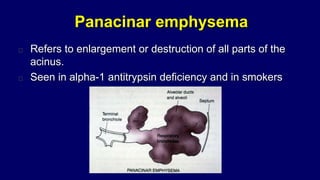
Panacinar emphysema
Refers to enlargement or destruction of all parts of the
acinus.
Seen in alpha-1 antitrypsin deficiency and in smokers
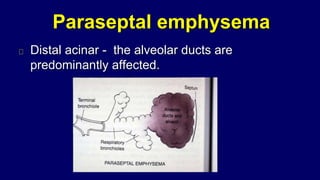
Paraseptal emphysema
Distal acinar - the alveolar ducts are
predominantly affected.
Emphysema
Pulmonary vasculature
Intimal hyperplasia and smooth muscle hypertrophy or
hyperplasia thought to be due to chronic hypoxic
vasoconstriction of the small pulmonary arteries
Destruction of alveoli due to emphysema can lead to loss
of the associated areas of the pulmonary capillary bed
and pruning of the distal vasculature
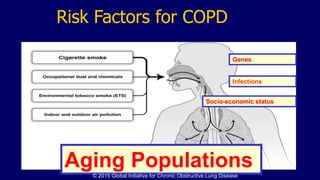
Risk Factors for COPD
Genes
Infections
Socio-economic status
Aging Populations© 2015 Global Initiative for Chronic Obstructive Lung Disease
Genetics
Alpha 1-antitrypsin deficiency is a genetic condition that is
responsible for about 2% of cases of COPD.
In this condition, the body does not make enough of a protein,
alpha 1-antitrypsin.
Alpha 1-antitrypsin protects the lungs from damage caused by
protease enzymes, such as elastase and trypsin, that can be
released as a result of an inflammatory response to tobacco
smoke.
The characteristic symptoms of COPD are chronic and progressive
dyspnea, cough, and sputum production that can be variable from day-
to-day.
Dyspnea: Progressive, persistent and characteristically worse with
exercise.
Chronic cough: May be intermittent and may be unproductive.
Chronic sputum production: COPD patients commonly cough up sputum.
Symptoms of COPD
© 2015 Global Initiative for Chronic Obstructive Lung Disease
Other Clinical features
 Wheezing
 Chest tightness
 Wt.loss
 Respiratory infections
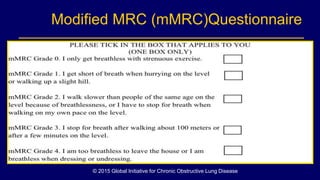
Modified MRC (mMRC)Questionnaire
© 2015 Global Initiative for Chronic Obstructive Lung Disease
Physical signs:
*Inspection:
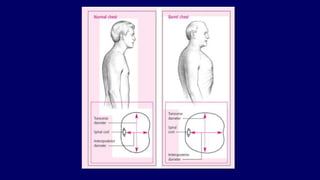
Barrel-shaped chest ,
Accessory respiratory muscle participate ,
Prolonged expiration during quiet breathing.
Expiration through pursed lips
Paradoxical retraction of the lower interspaces during inspiration (ie,
hoover's sign)
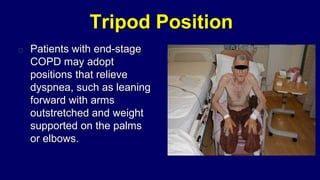
Tripod Position
Tripod Position
Patients with end-stage
COPD may adopt
positions that relieve
dyspnea, such as leaning
forward with arms
outstretched and weight
supported on the palms
or elbows.
*Palpation:
Decreased fremitus vocalis
*Percussion :
Hyperresonant
Depressed diaphragm,
Dimination of the area of absolute cardiac dullness.
*Auscultation:
Prolonged expiration ;
Reduced breath sounds;
The presence of wheezing during quiet breathing
Crackle can be heard if infection exist.
Clinical Manifestation
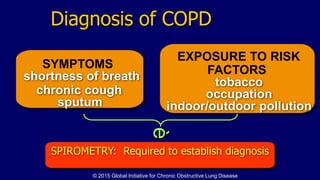
SYMPTOMS
chronic cough
shortness of breath
EXPOSURE TO RISK
FACTORS
tobacco
occupation
indoor/outdoor pollution
SPIROMETRY: Required to establish diagnosis
Diagnosis of COPD
è
sputum
© 2015 Global Initiative for Chronic Obstructive Lung Disease
Diagnosis
The presence of a post-bronchodilator FEV1/FVC < 0.70
confirms the presence of persistent airflow limitation and thus
of COPD.
© 2015 Global Initiative for Chronic Obstructive Lung Disease
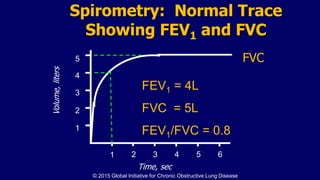
Spirometry: Normal Trace
Showing FEV1 and FVC
1 2 3 4 5 6
1
2
3
4
Volume,liters
Time, sec
FVC5
1
FEV1 = 4L
FVC = 5L
FEV1/FVC = 0.8
© 2015 Global Initiative for Chronic Obstructive Lung Disease
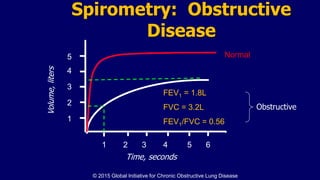
Spirometry: Obstructive
Disease
Volume,liters
Time, seconds
5
4
3
2
1
1 2 3 4 5 6
FEV1 = 1.8L
FVC = 3.2L
FEV1/FVC = 0.56
Normal
Obstructive
© 2015 Global Initiative for Chronic Obstructive Lung Disease
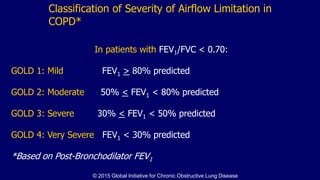
Classification of Severity of Airflow Limitation in
COPD*
In patients with FEV1/FVC < 0.70:
GOLD 1: Mild FEV1 > 80% predicted
GOLD 2: Moderate 50% < FEV1 < 80% predicted
GOLD 3: Severe 30% < FEV1 < 50% predicted
GOLD 4: Very Severe FEV1 < 30% predicted
*Based on Post-Bronchodilator FEV1
© 2015 Global Initiative for Chronic Obstructive Lung Disease
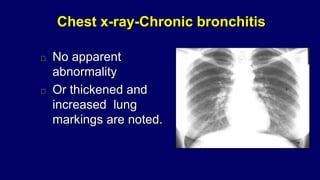
Chest x-ray-Chronic bronchitis
No apparent
abnormality
Or thickened and
increased lung
markings are noted.
Chest X-Ray --emphysema
Marked over inflation is noted with flattend and low
diaphragm
Intercostal space becomes widen
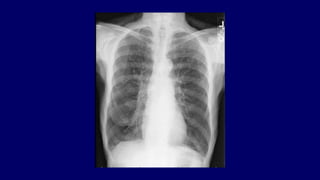
A horizontal pattern of ribs
A long thin heart shadow
Decreased markings of lung peripheral vessels
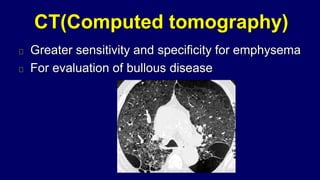
CT(Computed tomography)
Greater sensitivity and specificity for emphysema
For evaluation of bullous disease
Labortory Examination
Blood examination
In excerbation or acute infection in airway,
leucocytosis may be detected.
Sputum examination
Streptococcus pneumonia
haemophilus influenzae
moraxella catarrhalis
klebsiella pneumonia
Arterial blood gas measurements (in hospital):
PaO2 < 8.0 kPa with or without PaCO2 > 6.7
kPa when breathing room air indicates
respiratory failure.
Management
Based on the principles of
Prevention of further progress of disease
Preservation and enhancement of
pulmonary functional capacity
Avoidance of exacerbations in order to
improve the quality of life.
1.Bronchodilators
Bronchodilators are central to the symptomatic
management of COPD.
Improve emptying of the lungs,reduce
dynamic hyperinflation and improve
exercise performance .
Bronchodilators
Three major classes of bronchodilators:
β2 - agonists:
Short acting: salbutamol & terbutaline
Long acting :Salmeterol & formoterol
Anticholinergic agents:
Ipratropium,tiotropium
Theophylline (a weak bronchodilator, which may
have some anti-inflammatory properties)
2.Glucocorticoids
Regular treatment with inhaled glucocorticoids is
appropriate for symptomatic patients with an
FEV1<50%pred and repeated exacerbations.
Chronic treatment with systemic glucocorticoids
should be avoided because of an unfavorable
benefit-to-risk ratio.
3. COMBINATION THERAPY
Combination therapy of long acting ß2-agonists
and inhaled corticosteroids show a significant
additional effect on pulmonary function and a
reduction in symptoms.
Mainly in patients with an FEV1<50%pred
4.Others:
Antioxidant agents
Mucolytic
In patients with severe and very severe COPD (GOLD 3 and
4) and a history of exacerbations and chronic bronchitis, the
phospodiesterase-4 inhibitor, roflumilast, reduces
exacerbations treated with oral glucocorticosteroids.
Phosphodiesterase-4 Inhibitors
© 2015 Global Initiative for Chronic Obstructive Lung Disease
Influenza vaccines can reduce serious illness. Pneumococcal
polysaccharide vaccine is recommended for COPD patients 65
years and older and for COPD patients younger than age 65 with
an FEV1 < 40% predicted.
The use of antibiotics, other than for treating infectious
exacerbations of COPD and other bacterial infections, is currently
not indicated.
Other Pharmacologic Treatments
© 2015 Global Initiative for Chronic Obstructive Lung Disease
Oxygen Therapy
Oxygen -- >15 h /d
Long-term oxygen therapy (LTOT) improves
survival,exercise,sleep and cognitive performance in
patients with respiratory failure.
The therapeutic goal is to maintain SaO2 ≥ 90% and
PaO2 ≥ 60mmHg at sea level and rest .
Pulmonary rehabilitation
Nutrition
Surgery:
Bullectomy
Lung volume reduction surgery
Lung transplantation
Other Treatments
Smoking cessation has the greatest capacity to
influence the natural history of COPD
Pharmacotherapy and nicotine replacement reliably
increase long-term smoking abstinence rates.
© 2015 Global Initiative for Chronic Obstructive Lung Disease
Smoking cessation
Smoking Cessation
Nicotine replacement therapy (nicotine gum, inhaler,
nasal spray, transdermal patch, sublingual tablet, or
lozenge) as well as pharmacotherapy with varenicline,
bupropion, and nortriptyline reliably increases long-term
smoking abstinence rates and are significantly more
effective than placebo.
© 2015 Global Initiative for Chronic Obstructive Lung Disease
Brief Strategies to Help the
Patient Willing to Quit Smoking
1. ASK - -Systematically identify all tobacco users at every
visit
2. ADVISE - Strongly urge all tobacco users to quit
3. ASSESS - Determine willingness to make a quit attempt
4. ASSIST - Aid the patient in quitting
5. ARRANGE - Schedule follow-up contact.
© 2015 Global Initiative for Chronic Obstructive Lung Disease
Complications
Pneumothorax
Cor pulmonale
Exacerbations of copd
Respiratory failure
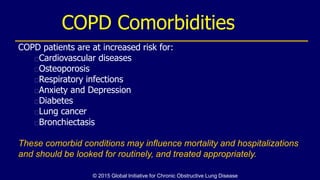
COPD Comorbidities
COPD patients are at increased risk for:
Cardiovascular diseases
Osteoporosis
Respiratory infections
Anxiety and Depression
Diabetes
Lung cancer
Bronchiectasis
These comorbid conditions may influence mortality and hospitalizations
and should be looked for routinely, and treated appropriately.
© 2015 Global Initiative for Chronic Obstructive Lung Disease
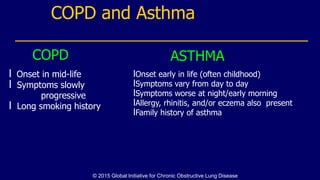
COPD and Asthma
COPD
l Onset in mid-life
l Symptoms slowly
progressive
l Long smoking history
ASTHMA
lOnset early in life (often childhood)
lSymptoms vary from day to day
lSymptoms worse at night/early morning
lAllergy, rhinitis, and/or eczema also present
lFamily history of asthma
© 2015 Global Initiative for Chronic Obstructive Lung Disease
Asthma-COPD overlap syndrome
"characterized by persistent airflow limitation with several
features usually associated with asthma and several
features usually associated with COPD. ACOS is
therefore identified in clinical practice by the features that
it shares with both asthma and COPD."
Tomorrow - MAY 31
World No Tobacco Day - 31 May 2016
THANK YOU !!!

COPD (Chronic obstructive Pulmonary Disease) PowerPoint Presentation -aslam

  • 1.
    COPDChronic obstructive pulmonarydisease Dr Muhammed Aslam MBBS MD Pulmonary Medicine www.medicalppt.blogspot.com
  • 2.
    Outline n INTRODUCTION n TYPES nPATHOLOGY n RISK FACTORS n CLINICAL FEATURES n DIAGNOSIS n MANAGEMENT n COMPLICATION n COPD AND ASTHMA
  • 3.
    INTRODUCTION n It affectsmore than 5 percent of the population and is associated with high morbidity and mortality n It is the third-ranked cause of death in the United States, killing more than 120,000 individuals each year
  • 4.
    Burden of COPD Theburden of COPD is projected to increase in coming decades due to continued exposure to COPD risk factors and the aging of the world’s population. COPD is associated with significant economic burden. © 2015 Global Initiative for Chronic Obstructive Lung Disease
  • 5.
    Definition of COPD COPD,a common preventable and treatable disease, is characterized by persistent airflow limitation that is usually progressive and associated with an enhanced chronic inflammatory response in the airways and the lung to noxious particles or gases. © Global Initiative for Chronic Obstructive Lung Disease
  • 6.
    COPD includes 1) ChronicBronchitis 2) Emphysema
  • 7.
    Chronic bronchitis Defined asa chronic productive cough for three months in each of two successive years in a patient in whom other causes of chronic cough have been excluded
  • 8.
    Emphysema Abnormal and permanentenlargement of the airspaces distal to the terminal bronchioles that is accompanied by destruction of the airspace walls, without obvious fibrosis
  • 9.
  • 10.
    Airways  Chronic inflammation Increased numbers of goblet cells  Mucus gland hyperplasia  Fibrosis  Narrowing and reduction in the number of small airways  Airway collapse due to the loss of tethering caused by alveolar wall destruction in emphysema
  • 12.
    Lung Parenchyma Emphysema affectsthe structures distal to the terminal bronchiole, consisting of the respiratory bronchiole, alveolar ducts, alveolar sacs, and alveoli, known collectively as the acinus.
  • 13.
  • 14.
    Subtype of emphysema. Centrilobularemphysema (Proximal acinar) Abnormal dilation or destruction of the respiratory bronchiole, the central portion of the acinus. It is commonly associated with cigarette smoking,
  • 15.
    Panacinar emphysema Refers toenlargement or destruction of all parts of the acinus. Seen in alpha-1 antitrypsin deficiency and in smokers
  • 16.
    Paraseptal emphysema Distal acinar- the alveolar ducts are predominantly affected.
  • 17.
  • 18.
    Pulmonary vasculature Intimal hyperplasiaand smooth muscle hypertrophy or hyperplasia thought to be due to chronic hypoxic vasoconstriction of the small pulmonary arteries Destruction of alveoli due to emphysema can lead to loss of the associated areas of the pulmonary capillary bed and pruning of the distal vasculature
  • 20.
    Risk Factors forCOPD Genes Infections Socio-economic status Aging Populations© 2015 Global Initiative for Chronic Obstructive Lung Disease
  • 21.
    Genetics Alpha 1-antitrypsin deficiencyis a genetic condition that is responsible for about 2% of cases of COPD. In this condition, the body does not make enough of a protein, alpha 1-antitrypsin. Alpha 1-antitrypsin protects the lungs from damage caused by protease enzymes, such as elastase and trypsin, that can be released as a result of an inflammatory response to tobacco smoke.
  • 22.
    The characteristic symptomsof COPD are chronic and progressive dyspnea, cough, and sputum production that can be variable from day- to-day. Dyspnea: Progressive, persistent and characteristically worse with exercise. Chronic cough: May be intermittent and may be unproductive. Chronic sputum production: COPD patients commonly cough up sputum. Symptoms of COPD © 2015 Global Initiative for Chronic Obstructive Lung Disease
  • 23.
    Other Clinical features Wheezing  Chest tightness  Wt.loss  Respiratory infections
  • 24.
    Modified MRC (mMRC)Questionnaire ©2015 Global Initiative for Chronic Obstructive Lung Disease
  • 25.
    Physical signs: *Inspection: Barrel-shaped chest, Accessory respiratory muscle participate , Prolonged expiration during quiet breathing. Expiration through pursed lips Paradoxical retraction of the lower interspaces during inspiration (ie, hoover's sign) Tripod Position
  • 27.
    Tripod Position Patients withend-stage COPD may adopt positions that relieve dyspnea, such as leaning forward with arms outstretched and weight supported on the palms or elbows.
  • 28.
    *Palpation: Decreased fremitus vocalis *Percussion: Hyperresonant Depressed diaphragm, Dimination of the area of absolute cardiac dullness. *Auscultation: Prolonged expiration ; Reduced breath sounds; The presence of wheezing during quiet breathing Crackle can be heard if infection exist. Clinical Manifestation
  • 29.
    SYMPTOMS chronic cough shortness ofbreath EXPOSURE TO RISK FACTORS tobacco occupation indoor/outdoor pollution SPIROMETRY: Required to establish diagnosis Diagnosis of COPD è sputum © 2015 Global Initiative for Chronic Obstructive Lung Disease
  • 30.
    Diagnosis The presence ofa post-bronchodilator FEV1/FVC < 0.70 confirms the presence of persistent airflow limitation and thus of COPD. © 2015 Global Initiative for Chronic Obstructive Lung Disease
  • 31.
    Spirometry: Normal Trace ShowingFEV1 and FVC 1 2 3 4 5 6 1 2 3 4 Volume,liters Time, sec FVC5 1 FEV1 = 4L FVC = 5L FEV1/FVC = 0.8 © 2015 Global Initiative for Chronic Obstructive Lung Disease
  • 32.
    Spirometry: Obstructive Disease Volume,liters Time, seconds 5 4 3 2 1 12 3 4 5 6 FEV1 = 1.8L FVC = 3.2L FEV1/FVC = 0.56 Normal Obstructive © 2015 Global Initiative for Chronic Obstructive Lung Disease
  • 33.
    Classification of Severityof Airflow Limitation in COPD* In patients with FEV1/FVC < 0.70: GOLD 1: Mild FEV1 > 80% predicted GOLD 2: Moderate 50% < FEV1 < 80% predicted GOLD 3: Severe 30% < FEV1 < 50% predicted GOLD 4: Very Severe FEV1 < 30% predicted *Based on Post-Bronchodilator FEV1 © 2015 Global Initiative for Chronic Obstructive Lung Disease
  • 34.
    Chest x-ray-Chronic bronchitis Noapparent abnormality Or thickened and increased lung markings are noted.
  • 35.
    Chest X-Ray --emphysema Markedover inflation is noted with flattend and low diaphragm Intercostal space becomes widen A horizontal pattern of ribs A long thin heart shadow Decreased markings of lung peripheral vessels
  • 37.
    CT(Computed tomography) Greater sensitivityand specificity for emphysema For evaluation of bullous disease
  • 38.
    Labortory Examination Blood examination Inexcerbation or acute infection in airway, leucocytosis may be detected. Sputum examination Streptococcus pneumonia haemophilus influenzae moraxella catarrhalis klebsiella pneumonia
  • 39.
    Arterial blood gasmeasurements (in hospital): PaO2 < 8.0 kPa with or without PaCO2 > 6.7 kPa when breathing room air indicates respiratory failure.
  • 40.
    Management Based on theprinciples of Prevention of further progress of disease Preservation and enhancement of pulmonary functional capacity Avoidance of exacerbations in order to improve the quality of life.
  • 41.
    1.Bronchodilators Bronchodilators are centralto the symptomatic management of COPD. Improve emptying of the lungs,reduce dynamic hyperinflation and improve exercise performance .
  • 42.
    Bronchodilators Three major classesof bronchodilators: β2 - agonists: Short acting: salbutamol & terbutaline Long acting :Salmeterol & formoterol Anticholinergic agents: Ipratropium,tiotropium Theophylline (a weak bronchodilator, which may have some anti-inflammatory properties)
  • 43.
    2.Glucocorticoids Regular treatment withinhaled glucocorticoids is appropriate for symptomatic patients with an FEV1<50%pred and repeated exacerbations. Chronic treatment with systemic glucocorticoids should be avoided because of an unfavorable benefit-to-risk ratio.
  • 44.
    3. COMBINATION THERAPY Combinationtherapy of long acting ß2-agonists and inhaled corticosteroids show a significant additional effect on pulmonary function and a reduction in symptoms. Mainly in patients with an FEV1<50%pred
  • 45.
  • 46.
    In patients withsevere and very severe COPD (GOLD 3 and 4) and a history of exacerbations and chronic bronchitis, the phospodiesterase-4 inhibitor, roflumilast, reduces exacerbations treated with oral glucocorticosteroids. Phosphodiesterase-4 Inhibitors © 2015 Global Initiative for Chronic Obstructive Lung Disease
  • 47.
    Influenza vaccines canreduce serious illness. Pneumococcal polysaccharide vaccine is recommended for COPD patients 65 years and older and for COPD patients younger than age 65 with an FEV1 < 40% predicted. The use of antibiotics, other than for treating infectious exacerbations of COPD and other bacterial infections, is currently not indicated. Other Pharmacologic Treatments © 2015 Global Initiative for Chronic Obstructive Lung Disease
  • 48.
    Oxygen Therapy Oxygen -->15 h /d Long-term oxygen therapy (LTOT) improves survival,exercise,sleep and cognitive performance in patients with respiratory failure. The therapeutic goal is to maintain SaO2 ≥ 90% and PaO2 ≥ 60mmHg at sea level and rest .
  • 49.
    Pulmonary rehabilitation Nutrition Surgery: Bullectomy Lung volumereduction surgery Lung transplantation Other Treatments
  • 50.
    Smoking cessation hasthe greatest capacity to influence the natural history of COPD Pharmacotherapy and nicotine replacement reliably increase long-term smoking abstinence rates. © 2015 Global Initiative for Chronic Obstructive Lung Disease Smoking cessation
  • 51.
    Smoking Cessation Nicotine replacementtherapy (nicotine gum, inhaler, nasal spray, transdermal patch, sublingual tablet, or lozenge) as well as pharmacotherapy with varenicline, bupropion, and nortriptyline reliably increases long-term smoking abstinence rates and are significantly more effective than placebo. © 2015 Global Initiative for Chronic Obstructive Lung Disease
  • 52.
    Brief Strategies toHelp the Patient Willing to Quit Smoking 1. ASK - -Systematically identify all tobacco users at every visit 2. ADVISE - Strongly urge all tobacco users to quit 3. ASSESS - Determine willingness to make a quit attempt 4. ASSIST - Aid the patient in quitting 5. ARRANGE - Schedule follow-up contact. © 2015 Global Initiative for Chronic Obstructive Lung Disease
  • 53.
  • 54.
    COPD Comorbidities COPD patientsare at increased risk for: Cardiovascular diseases Osteoporosis Respiratory infections Anxiety and Depression Diabetes Lung cancer Bronchiectasis These comorbid conditions may influence mortality and hospitalizations and should be looked for routinely, and treated appropriately. © 2015 Global Initiative for Chronic Obstructive Lung Disease
  • 55.
    COPD and Asthma COPD lOnset in mid-life l Symptoms slowly progressive l Long smoking history ASTHMA lOnset early in life (often childhood) lSymptoms vary from day to day lSymptoms worse at night/early morning lAllergy, rhinitis, and/or eczema also present lFamily history of asthma © 2015 Global Initiative for Chronic Obstructive Lung Disease
  • 56.
    Asthma-COPD overlap syndrome "characterizedby persistent airflow limitation with several features usually associated with asthma and several features usually associated with COPD. ACOS is therefore identified in clinical practice by the features that it shares with both asthma and COPD."
  • 57.
  • 58.
    World No TobaccoDay - 31 May 2016
  • 59.