Pneumonia
Dr. Sameh Ahmad Muhamad abdelghany
Lecturer Of Clinical Pharmacology
Mansura Faculty of medicine
Contents
Introduction
Risk Factors
Types - Causes
Diagnosis(C/P – Investigation)
Treatment
INTRODUCTION
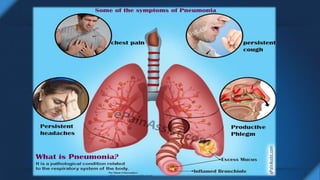
What is pneumonia?
 Pneumonia is an infection in
one or both lungs.
 It can be caused by bacteria,
viruses, or fungi.
 Bacterial pneumonia is the most
common type in adults.
What is pneumonia?
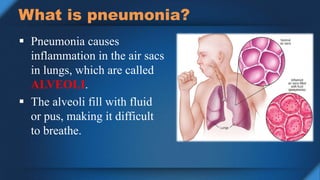
 Pneumonia causes
inflammation in the air sacs
in lungs, which are called
ALVEOLI.
 The alveoli fill with fluid
or pus, making it difficult
to breathe.
Risk Factors
Factors that predispose to Pneumonia
 Cigarette smoking
 Upper respiratory tract infections
 Alcohol
 Corticosteroid therapy
 Old age
 Recent influenza infection
 Pre-existing lung disease
Factors that predispose to Pneumonia
 Reduced host defenses against bacteria
o Reduced immune defenses (e.g. corticosteroid
treatment, diabetes, malignancy)
o Reduced cough reflex (e.g. post-operative)
o Disordered mucociliary clearance (e.g. anaesthetic
agents)
Types of Pneumonia
ANATOMICAL CLASSIFICATION
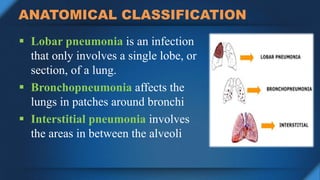
 Lobar pneumonia is an infection
that only involves a single lobe, or
section, of a lung.
 Bronchopneumonia affects the
lungs in patches around bronchi
 Interstitial pneumonia involves
the areas in between the alveoli
CLINICAL CLASSIFICATION
 Community Acquired - Typical/Atypical/Aspiration
 Pneumonia in Elderly
 Nosocomial- HAP,VAP,HCAP
 Pneumonia in Immunocompromised
Community Acquired Pneumonia (CAP)
 An infection of the pulmonary parenchyma
 Associated with symptoms of infection
 Presence of infiltrates on CXR or auscultatory
findings consistent with Pneumonia
Hospital Acquired pneumonia - HAP
 HAP is defined as pneumonia that occurs 48
hours or more after admission, which was not
incubating at the time of admission.
Ventilator Associated Pneumonia- VAP
 VAP refers to pneumonia that arises more
than 48–72 hours after endotracheal
intubation .
Health Care Associated Pneumonia HCAP
 HCAP includes any patient
i. Who was hospitalized in an acute care hospital for 2 or
more days within 90 days of the infection
ii. Resided in a nursing home or long-term care facility
iii. Received recent i.v antibiotic therapy, chemotherapy,
or wound care within the past 30 days of the current
infection
iv. Attended a hospital or hemodialysis clinic
Causes of Pneumonia
Etiology
I. Bacterial
II. Viral
III. Mycobacterial
IV. Fungal
V. Parasitic
Etiology
 Streptococcus pneumoniae most common
 Haemophilus influenzae
 Staphylococcus aureus
 Klebsiella pneumonia
 Mycoplasma pneumoniae
 Legionella pneumophila
 Viruses
Clinical Picture
GENERAL SYMPTOMS
 High grade fever
 Cough-productive
 Pleuritic chest pain
 Breathlessness
Additional symptoms
 Sharp or stabbing chest pain
 Headache
 Excessive sweating and clammy skin
 Loss of appetite and fatigue
 Confusion, especially in older people
General Signs
 Febrile
 Tachypnoea (increase respiratory rate)
 Tachycardia(increase heart rate)
 Cyanosis-central
 Hypotension
 Use of accessory muscles of respiration
 Confusion- advanced cases
SIGNS OF CONSOLIDATION
 Percussion-dull
 Crackles
 Pleural Rub
Investigation
SPUTUM
 Gram Staining
 AFB(acid-fast bacillus)
 Giemsa or methenamine silver stain
 KOH (potassium hydroxide) mount
 Culture
X Ray
 Homogenous opacity with air bronchogram
LAB
 Complete white blood count
 Blood Sugar
 Electrolytes
 Creatinine
 Blood culture
 Oxygen saturation by pulse oximetry
 ABG(arterial blood gases)
 Chest Ultrasound
 Mantaux(for TB)
INVASIVE
 Bronchoscopy
 Thoracoscopy
 Percutaneous aspiration/biopsy
 Open lung biopsy
 Pleural asp
Treatment
CURB 65
 C onfusion – Altered mental status
 U remia – Blood urea nitrogen (BUN) level greater than 20 mg/dL
 R espiratory rate –30 breaths or more per minute
 B lood pressure – Systolic pressure less than 90 mm Hg or diastolic
pressure less than 60 mm Hg
 Age older than 65 years
 Current guidelines suggest that patients may be treated in an
outpatient setting or may require hospitalization according to their
CURB-65 score, as follows:
o Score of 0-1 – Outpatient treatment
o Score of 2 – Admission to hospital(No ICU)
o Score of 3 or higher – Admission to intensive care unit (ICU)
Outpatients Treatment(empirical)
 Previously healthy and no antibiotics in past 3 months:
o A macrolide (clarithromycin or azithromycin or
Doxycycline )
 Comorbidities or antibiotics in past 3 months:
o Respiratory fluoroquinolone [moxifloxacin ,levofloxacin
] or β-lactam ( high-dose amoxicillin or
amoxicillin/clavulanate)
Inpatients, non-ICU
 A respiratory fluoroquinolone [moxifloxacin
,levofloxacin ]
 β -lactam [cefotaxime ,ceftriaxone ,ampicillin]
PLUS a macrolide [oral clarithromycin or
azithromycin)
Inpatients, ICU
 β -lactam PLUS Azithromycin or a
fluoroquinolone.
Pseudomonas
 An antipneumococcal, antipseudomonal β-lactam
[piperacillin/tazobactam, cefepime , imipenem ,
meropenem] PLUS Flouroquinolons
 Above β-lactams PLUS an aminoglycoside and
azithromycin
 Above β-lactams PLUS an Aminoglycoside
PLUS an antipneumococcal Fluoroquinolone
Methicillin-resistant Staphylococcus
aureus
 If MRSA , add linezolid or vancomycin
Pneumonia complications
 SLAP HER (please don’t)
 S - Septicaemia
 L - Lung abcess
 A - ARDS
 P - Para-pneumonic effusions
 H - Hypotension
 E - Empyema
 R - Respiratory failure /renal failure
Course
 Most healthy people recover from pneumonia in one to
three weeks, but pneumonia can be life-threatening.
 The mortality rate associated with community-acquired
pneumonia (CAP) is very low in most ambulatory
patients and higher in patients requiring hospitalization,
being as high as 37 percent in patients admitted to the
intensive care unit (ICU)
Prevention
 Smoking cessation
 Better Nutrition
 Respiratory hygiene measures
 Pneumococcal polysaccharide vaccine
 Inactivated influenza vaccine
 Live attenuated influenza vaccine
Conclusion
 The presence of an infiltrate on plain chest radiograph is
considered the "gold standard" for diagnosing pneumonia
when clinical and microbiologic features are supportive
 Most initial treatment regimens for hospitalized patients with
community-acquired pneumonia (CAP) are empiric
 The mortality rate associated with community-acquired
pneumonia (CAP) is very low in most ambulatory patients
and higher in patients requiring hospitalization
Thank you!
Any Questions?

Pneumonia

  • 1.
    Pneumonia Dr. Sameh AhmadMuhamad abdelghany Lecturer Of Clinical Pharmacology Mansura Faculty of medicine
  • 2.
    Contents Introduction Risk Factors Types -Causes Diagnosis(C/P – Investigation) Treatment
  • 3.
  • 4.
    What is pneumonia? Pneumonia is an infection in one or both lungs.  It can be caused by bacteria, viruses, or fungi.  Bacterial pneumonia is the most common type in adults.
  • 5.
    What is pneumonia? Pneumonia causes inflammation in the air sacs in lungs, which are called ALVEOLI.  The alveoli fill with fluid or pus, making it difficult to breathe.
  • 6.
  • 7.
    Factors that predisposeto Pneumonia  Cigarette smoking  Upper respiratory tract infections  Alcohol  Corticosteroid therapy  Old age  Recent influenza infection  Pre-existing lung disease
  • 8.
    Factors that predisposeto Pneumonia  Reduced host defenses against bacteria o Reduced immune defenses (e.g. corticosteroid treatment, diabetes, malignancy) o Reduced cough reflex (e.g. post-operative) o Disordered mucociliary clearance (e.g. anaesthetic agents)
  • 9.
  • 10.
    ANATOMICAL CLASSIFICATION  Lobarpneumonia is an infection that only involves a single lobe, or section, of a lung.  Bronchopneumonia affects the lungs in patches around bronchi  Interstitial pneumonia involves the areas in between the alveoli
  • 11.
    CLINICAL CLASSIFICATION  CommunityAcquired - Typical/Atypical/Aspiration  Pneumonia in Elderly  Nosocomial- HAP,VAP,HCAP  Pneumonia in Immunocompromised
  • 12.
    Community Acquired Pneumonia(CAP)  An infection of the pulmonary parenchyma  Associated with symptoms of infection  Presence of infiltrates on CXR or auscultatory findings consistent with Pneumonia
  • 13.
    Hospital Acquired pneumonia- HAP  HAP is defined as pneumonia that occurs 48 hours or more after admission, which was not incubating at the time of admission.
  • 14.
    Ventilator Associated Pneumonia-VAP  VAP refers to pneumonia that arises more than 48–72 hours after endotracheal intubation .
  • 15.
    Health Care AssociatedPneumonia HCAP  HCAP includes any patient i. Who was hospitalized in an acute care hospital for 2 or more days within 90 days of the infection ii. Resided in a nursing home or long-term care facility iii. Received recent i.v antibiotic therapy, chemotherapy, or wound care within the past 30 days of the current infection iv. Attended a hospital or hemodialysis clinic
  • 16.
  • 17.
    Etiology I. Bacterial II. Viral III.Mycobacterial IV. Fungal V. Parasitic
  • 18.
    Etiology  Streptococcus pneumoniaemost common  Haemophilus influenzae  Staphylococcus aureus  Klebsiella pneumonia  Mycoplasma pneumoniae  Legionella pneumophila  Viruses
  • 19.
  • 20.
    GENERAL SYMPTOMS  Highgrade fever  Cough-productive  Pleuritic chest pain  Breathlessness
  • 21.
    Additional symptoms  Sharpor stabbing chest pain  Headache  Excessive sweating and clammy skin  Loss of appetite and fatigue  Confusion, especially in older people
  • 23.
    General Signs  Febrile Tachypnoea (increase respiratory rate)  Tachycardia(increase heart rate)  Cyanosis-central  Hypotension  Use of accessory muscles of respiration  Confusion- advanced cases
  • 24.
    SIGNS OF CONSOLIDATION Percussion-dull  Crackles  Pleural Rub
  • 25.
  • 26.
    SPUTUM  Gram Staining AFB(acid-fast bacillus)  Giemsa or methenamine silver stain  KOH (potassium hydroxide) mount  Culture
  • 27.
    X Ray  Homogenousopacity with air bronchogram
  • 28.
    LAB  Complete whiteblood count  Blood Sugar  Electrolytes  Creatinine  Blood culture  Oxygen saturation by pulse oximetry  ABG(arterial blood gases)  Chest Ultrasound  Mantaux(for TB)
  • 29.
    INVASIVE  Bronchoscopy  Thoracoscopy Percutaneous aspiration/biopsy  Open lung biopsy  Pleural asp
  • 30.
  • 31.
    CURB 65  Confusion – Altered mental status  U remia – Blood urea nitrogen (BUN) level greater than 20 mg/dL  R espiratory rate –30 breaths or more per minute  B lood pressure – Systolic pressure less than 90 mm Hg or diastolic pressure less than 60 mm Hg  Age older than 65 years  Current guidelines suggest that patients may be treated in an outpatient setting or may require hospitalization according to their CURB-65 score, as follows: o Score of 0-1 – Outpatient treatment o Score of 2 – Admission to hospital(No ICU) o Score of 3 or higher – Admission to intensive care unit (ICU)
  • 32.
    Outpatients Treatment(empirical)  Previouslyhealthy and no antibiotics in past 3 months: o A macrolide (clarithromycin or azithromycin or Doxycycline )  Comorbidities or antibiotics in past 3 months: o Respiratory fluoroquinolone [moxifloxacin ,levofloxacin ] or β-lactam ( high-dose amoxicillin or amoxicillin/clavulanate)
  • 33.
    Inpatients, non-ICU  Arespiratory fluoroquinolone [moxifloxacin ,levofloxacin ]  β -lactam [cefotaxime ,ceftriaxone ,ampicillin] PLUS a macrolide [oral clarithromycin or azithromycin)
  • 34.
    Inpatients, ICU  β-lactam PLUS Azithromycin or a fluoroquinolone.
  • 35.
    Pseudomonas  An antipneumococcal,antipseudomonal β-lactam [piperacillin/tazobactam, cefepime , imipenem , meropenem] PLUS Flouroquinolons  Above β-lactams PLUS an aminoglycoside and azithromycin  Above β-lactams PLUS an Aminoglycoside PLUS an antipneumococcal Fluoroquinolone
  • 36.
    Methicillin-resistant Staphylococcus aureus  IfMRSA , add linezolid or vancomycin
  • 37.
    Pneumonia complications  SLAPHER (please don’t)  S - Septicaemia  L - Lung abcess  A - ARDS  P - Para-pneumonic effusions  H - Hypotension  E - Empyema  R - Respiratory failure /renal failure
  • 38.
    Course  Most healthypeople recover from pneumonia in one to three weeks, but pneumonia can be life-threatening.  The mortality rate associated with community-acquired pneumonia (CAP) is very low in most ambulatory patients and higher in patients requiring hospitalization, being as high as 37 percent in patients admitted to the intensive care unit (ICU)
  • 39.
    Prevention  Smoking cessation Better Nutrition  Respiratory hygiene measures  Pneumococcal polysaccharide vaccine  Inactivated influenza vaccine  Live attenuated influenza vaccine
  • 40.
    Conclusion  The presenceof an infiltrate on plain chest radiograph is considered the "gold standard" for diagnosing pneumonia when clinical and microbiologic features are supportive  Most initial treatment regimens for hospitalized patients with community-acquired pneumonia (CAP) are empiric  The mortality rate associated with community-acquired pneumonia (CAP) is very low in most ambulatory patients and higher in patients requiring hospitalization
  • 41.