Presented by- Sagar Bharat Koli
G.H Hospital Nashik Praramedical
Nursing College
Other Name for COPD
1) Chronic Obstructive Lung Disease (COLD)
2) Chronic Obstructive Pulmonary Disorder
(COPD)
3) Chronic Air-Flow Limitation (CAL)
4) Chronic Lower Respiratory Disease (CLRD)
Definition :-Chronic Obstructive
Pulmonary Disease (COPD) is a chronic
inflammatory lung disease that causes
obstructed airflow from the lungs
Progressive and Irreversible & also be
associated with air-way Hyperactivity.
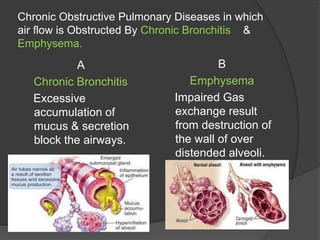
Chronic Obstructive Pulmonary Diseases in which
air flow is Obstructed By Chronic Bronchitis &
Emphysema.
A
Chronic Bronchitis
Excessive
accumulation of
mucus & secretion
block the airways.
B
Emphysema
Impaired Gas
exchange result
from destruction of
the wall of over
distended alveoli.
In COPD
Less air flow in and out of the air way
because of one or more of the following:-
1. The airway and air sacs lose their elastic quality.
2. The wall between many of the air sacs are destroyed.
3. The wall of the airways become Thick and Inflamed.
4. The airways make more mucus than usual, which tends to
Clog them.
1.Cigarette Smoking
2.Passive Smoking
3.Occupations Exposure to Dusts &
Chemicals
4.Emphysema
5.Chronic Bronchitis
6.Ambient Air-Pollution
7.Genetic abnormality Deficiency of
alpha-antitrypsin Enzyme
8.Family History
Due to Causes & Risk factors
Affected Ciliary cleaning mechanism of respiratory
tract
↓
Airflow is obstructed & air becomes trapped behind
the obstruction
↓
Alveoli greatly distend & lung capacity decreased
↓
Increased accumulation of the mucus from mucus
glands
↓
Produce more Irritation, Infection.
↓
Damage to Lungs
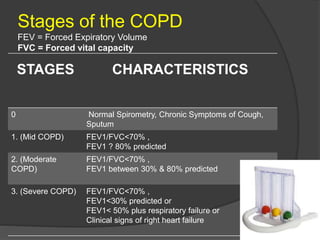
Stages of the COPD
FEV = Forced Expiratory Volume
FVC = Forced vital capacity
STAGES CHARACTERISTICS
0 Normal Spirometry, Chronic Symptoms of Cough,
Sputum
1. (Mid COPD) FEV1/FVC<70% ,
FEV1 ? 80% predicted
2. (Moderate
COPD)
FEV1/FVC<70% ,
FEV1 between 30% & 80% predicted
3. (Severe COPD) FEV1/FVC<70% ,
FEV1<30% predicted or
FEV1< 50% plus respiratory failure or
Clinical signs of right heart failure
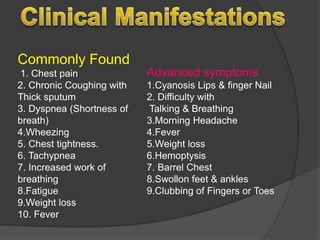
Commonly Found
1. Chest pain
2. Chronic Coughing with
Thick sputum
3. Dyspnea (Shortness of
breath)
4.Wheezing
5. Chest tightness.
6. Tachypnea
7. Increased work of
breathing
8.Fatigue
9.Weight loss
10. Fever
Advanced symptoms
1.Cyanosis Lips & finger Nail
2. Difficulty with
Talking & Breathing
3.Morning Headache
4.Fever
5.Weight loss
6.Hemoptysis
7. Barrel Chest
8.Swollon feet & ankles
9.Clubbing of Fingers or Toes
1.Medical History
2.Physical Examination
3.Pulse Oximetry :- <93 below abnormal
4.X-Ray:-
5.Computerized Tomography(CAT or CT Scan
6.Lungs Function Tests:- Spirometry ,
lungs vloume diffusion capacity
7.Arterial Blood Gas Analysis:-
Normal level
(PaO2) = 10.5 to 13.5 kilopascal (kPa)
(PaCO2): 38 to 42 mm Hg (5.1 to 5.6 kPa)
8.Alpha-1-Antitrypsin Level :-
(Normal Range 100-300mg/dl ) below 80r risk lungs diseases
1. Respiratory Insufficiency
2. Respiratory Failure
3. Pneumonia
4. Atelectasis
5. Pneumothorax
6. Hypoxemia
7. Respiratory Acidosis
8. Cardiac Failure
9. Status of asthmatics
Medical Management
The Goals of COPD treatment are
1. To Prevent further deterioration in lung function
2. To alleviate symptoms
3. To improve Performance of daily activities and
quality of life.
1. Norcotine Replacement Therapies:-
* Withdrawal from nicotine may cause have Unpleasant side
effects (1week) such as Anxiety, Irritability, Difficulty
concentrating, Anger , Fatigue, Drowsiness, Depression, Sleep
disturption.
* Nicotine Polacrilex is a chewing gum. {2mg,4mg}
smoking [1 pack/day] = 4mg
smoking [less than 1 pack/day] = 2mg
gradually reduce the amount chewed over the 3 next months.
*
2. Bronchodilators &
Anti- inflammatory Agents :-
*Bronchodilators Drugs :-
Relieves coughing and shortness of breath
1.Beta 2-agonists 2. Anticholinergics 3. Theophylline .
* Anti- inflammatory Drugs :- 1. Corticosteroids
* There are several delivery methods for
Inhaled Medications, including -
Metered-dose inhalers,
Breath–actuated inhalers,
Dry powder inhalers &
Nebulizers
3. Phosphodiesterase-4 Inhibitors :-
Is a new drug used to treat severe COPD. It reduces
INFLAMATION of the air passages and help them relax
4. Mucolytics:-
reduce sputum viscosity & improve sputum clearance.
1. Guaifenesin (Orally) 2.Potassium iodide (Orally)
3.N-acetylcysteine (Nebulizer).
5.Antibiotics:-
Fist line treat choices - Amoxicillin, cfaclor (cephalosporin),
Trimethomycin/ Sulfamethoxazole
Second line treat choices - Azithromycin, clarithromycin,
Fluoroquinolones.
6. Immunizations :- Influenza and pneumoccocal
immunization (vaccination)
7. Alpha-1 Antitrypsin Deficiency
1.Nebulization:-
* Short-acting bronchodilators include:
1. Albuterol (Proair HFA, Ventolin HFA)
2. Levalbuterol (Xopenex)
3. Ipratropium (Atrovent HFA)
4. Albuterol/ipratropium (Combivent Respimat)
* The long-acting bronchodilators
1.Formoterol (Foradil, Perforomist)
2.Glycopyrrolate (Seebri Neohaler, Lonhala Magnair)
3.Olodaterol (Striverdi Respimat)
4.Salmeterol (Serevent)
5. Tiotropium (Spiriva)
2. Oxygen Therapy:-
Nasal Cannula may be
required to rise the
PaO2
60-80mmHg
3. Removing Bronchial
Secretions :-
4. Exercise:-
Pulmonary Rehabilitation:-
1. Education regarding lungs function& Disfunction
2. Nutrition Advice
3. Exercises Training
4. Counseling
5. Proper use of respiratory equipment and Medications
* Rehabilitation Team
1. Doctors
2. Nurses
3. Physical therapy
4. Respiratory therapists.
5. Exercise specialists
6. Dietitians
These health professionals work together and
create a program that meets needs.
Surgery is a option for Severe Emphysema
1. Bullectomy:-Air sacs are destroyed, larger air spaces
called Bullae
These air spaces can become so large that they interfere with
breathing .
In a bullectomy,doctors remove one or more very large bullae
from the lungs.
2. Lung Volume Reduction Surgery:-
surgone removes small wedges of damaged lung tissue.
3. Lung Transplant:-
1. Control Breathing:- Breathing positions and relaxation techniques that
can use for short of breath
2. Clear Airways:- controlling coughing, Drinking plenty of Water and
Using Humidifire
3. Exercise Regularly:- Breathing exercise
4. Eat Healthy Foods:-
Better lung function include
sweet potatoes, carrots, cantaloupe, red and green peppers, apricots,
mango, broccoli, squash, citrus fruits, kiwi, strawberries, tomatoes, and
apples.
foods that should be Avoided include
onion rings, fried chicken, fried fish, ice cream, cheese, butter and
buttermilk
5. Avoid Smoking:- Quitting Smoking & Secondhand smoke
Assessment
1. Assess History:- Nursing History, Family History, Chronic Illness History
and obtains a thorough Smoking History of the patient
2. Assess Respirations- Note quality, rate, pattern, depth, and breathing
effort.
3. Assess lung sounds nothing areas of decreased ventilation.
Ascultation : Wheezing & Crackles sounds, determine depth of
Inspiration
4. Assess Position :- Tripod, Orthopneic & High fowler's positions.
5. Assess for Signs and Symptoms of Hypoxemia:- Tachycardia,
Restlessness, Diaphoresis, Headache, Lethargy, Confusion.
6. Monitor ABGs and note changes. Increasing ↑ PaCO2 and Decreasing
↓ PaO2 are signs of respiratory failure.
7. Use Pulse oximetry to monitor oxygen saturation and Pulse.
8. Assess patient’s ability to cough effectively to clear secretions. Note
quantity, color, and consistency of sputum
9. Assess Vital Signs:- Pulse, Temperature, BP and Peripheral Cyanosis,
Skin Color
10. Ask the client’s daily Sleep Habits, how long sleep , a nap. Often
wake up during sleep caused by pain, itching, urination, difficulty and
others.
 Presentation COPD.pptx
 Presentation COPD.pptx

Presentation COPD.pptx

  • 1.
    Presented by- SagarBharat Koli G.H Hospital Nashik Praramedical Nursing College
  • 2.
    Other Name forCOPD 1) Chronic Obstructive Lung Disease (COLD) 2) Chronic Obstructive Pulmonary Disorder (COPD) 3) Chronic Air-Flow Limitation (CAL) 4) Chronic Lower Respiratory Disease (CLRD)
  • 3.
    Definition :-Chronic Obstructive PulmonaryDisease (COPD) is a chronic inflammatory lung disease that causes obstructed airflow from the lungs Progressive and Irreversible & also be associated with air-way Hyperactivity.
  • 4.
    Chronic Obstructive PulmonaryDiseases in which air flow is Obstructed By Chronic Bronchitis & Emphysema. A Chronic Bronchitis Excessive accumulation of mucus & secretion block the airways. B Emphysema Impaired Gas exchange result from destruction of the wall of over distended alveoli.
  • 5.
    In COPD Less airflow in and out of the air way because of one or more of the following:- 1. The airway and air sacs lose their elastic quality. 2. The wall between many of the air sacs are destroyed. 3. The wall of the airways become Thick and Inflamed. 4. The airways make more mucus than usual, which tends to Clog them.
  • 6.
    1.Cigarette Smoking 2.Passive Smoking 3.OccupationsExposure to Dusts & Chemicals 4.Emphysema 5.Chronic Bronchitis 6.Ambient Air-Pollution 7.Genetic abnormality Deficiency of alpha-antitrypsin Enzyme 8.Family History
  • 7.
    Due to Causes& Risk factors Affected Ciliary cleaning mechanism of respiratory tract ↓ Airflow is obstructed & air becomes trapped behind the obstruction ↓ Alveoli greatly distend & lung capacity decreased ↓ Increased accumulation of the mucus from mucus glands ↓ Produce more Irritation, Infection. ↓ Damage to Lungs
  • 8.
    Stages of theCOPD FEV = Forced Expiratory Volume FVC = Forced vital capacity STAGES CHARACTERISTICS 0 Normal Spirometry, Chronic Symptoms of Cough, Sputum 1. (Mid COPD) FEV1/FVC<70% , FEV1 ? 80% predicted 2. (Moderate COPD) FEV1/FVC<70% , FEV1 between 30% & 80% predicted 3. (Severe COPD) FEV1/FVC<70% , FEV1<30% predicted or FEV1< 50% plus respiratory failure or Clinical signs of right heart failure
  • 9.
    Commonly Found 1. Chestpain 2. Chronic Coughing with Thick sputum 3. Dyspnea (Shortness of breath) 4.Wheezing 5. Chest tightness. 6. Tachypnea 7. Increased work of breathing 8.Fatigue 9.Weight loss 10. Fever Advanced symptoms 1.Cyanosis Lips & finger Nail 2. Difficulty with Talking & Breathing 3.Morning Headache 4.Fever 5.Weight loss 6.Hemoptysis 7. Barrel Chest 8.Swollon feet & ankles 9.Clubbing of Fingers or Toes
  • 11.
    1.Medical History 2.Physical Examination 3.PulseOximetry :- <93 below abnormal 4.X-Ray:- 5.Computerized Tomography(CAT or CT Scan 6.Lungs Function Tests:- Spirometry , lungs vloume diffusion capacity 7.Arterial Blood Gas Analysis:- Normal level (PaO2) = 10.5 to 13.5 kilopascal (kPa) (PaCO2): 38 to 42 mm Hg (5.1 to 5.6 kPa) 8.Alpha-1-Antitrypsin Level :- (Normal Range 100-300mg/dl ) below 80r risk lungs diseases
  • 12.
    1. Respiratory Insufficiency 2.Respiratory Failure 3. Pneumonia 4. Atelectasis 5. Pneumothorax 6. Hypoxemia 7. Respiratory Acidosis 8. Cardiac Failure 9. Status of asthmatics
  • 13.
    Medical Management The Goalsof COPD treatment are 1. To Prevent further deterioration in lung function 2. To alleviate symptoms 3. To improve Performance of daily activities and quality of life.
  • 14.
    1. Norcotine ReplacementTherapies:- * Withdrawal from nicotine may cause have Unpleasant side effects (1week) such as Anxiety, Irritability, Difficulty concentrating, Anger , Fatigue, Drowsiness, Depression, Sleep disturption. * Nicotine Polacrilex is a chewing gum. {2mg,4mg} smoking [1 pack/day] = 4mg smoking [less than 1 pack/day] = 2mg gradually reduce the amount chewed over the 3 next months. *
  • 15.
    2. Bronchodilators & Anti-inflammatory Agents :- *Bronchodilators Drugs :- Relieves coughing and shortness of breath 1.Beta 2-agonists 2. Anticholinergics 3. Theophylline . * Anti- inflammatory Drugs :- 1. Corticosteroids * There are several delivery methods for Inhaled Medications, including - Metered-dose inhalers, Breath–actuated inhalers, Dry powder inhalers & Nebulizers
  • 16.
    3. Phosphodiesterase-4 Inhibitors:- Is a new drug used to treat severe COPD. It reduces INFLAMATION of the air passages and help them relax 4. Mucolytics:- reduce sputum viscosity & improve sputum clearance. 1. Guaifenesin (Orally) 2.Potassium iodide (Orally) 3.N-acetylcysteine (Nebulizer). 5.Antibiotics:- Fist line treat choices - Amoxicillin, cfaclor (cephalosporin), Trimethomycin/ Sulfamethoxazole Second line treat choices - Azithromycin, clarithromycin, Fluoroquinolones.
  • 17.
    6. Immunizations :-Influenza and pneumoccocal immunization (vaccination) 7. Alpha-1 Antitrypsin Deficiency
  • 18.
    1.Nebulization:- * Short-acting bronchodilatorsinclude: 1. Albuterol (Proair HFA, Ventolin HFA) 2. Levalbuterol (Xopenex) 3. Ipratropium (Atrovent HFA) 4. Albuterol/ipratropium (Combivent Respimat) * The long-acting bronchodilators 1.Formoterol (Foradil, Perforomist) 2.Glycopyrrolate (Seebri Neohaler, Lonhala Magnair) 3.Olodaterol (Striverdi Respimat) 4.Salmeterol (Serevent) 5. Tiotropium (Spiriva)
  • 19.
    2. Oxygen Therapy:- NasalCannula may be required to rise the PaO2 60-80mmHg 3. Removing Bronchial Secretions :- 4. Exercise:-
  • 20.
    Pulmonary Rehabilitation:- 1. Educationregarding lungs function& Disfunction 2. Nutrition Advice 3. Exercises Training 4. Counseling 5. Proper use of respiratory equipment and Medications * Rehabilitation Team 1. Doctors 2. Nurses 3. Physical therapy 4. Respiratory therapists. 5. Exercise specialists 6. Dietitians These health professionals work together and create a program that meets needs.
  • 21.
    Surgery is aoption for Severe Emphysema 1. Bullectomy:-Air sacs are destroyed, larger air spaces called Bullae These air spaces can become so large that they interfere with breathing . In a bullectomy,doctors remove one or more very large bullae from the lungs. 2. Lung Volume Reduction Surgery:- surgone removes small wedges of damaged lung tissue. 3. Lung Transplant:-
  • 22.
    1. Control Breathing:-Breathing positions and relaxation techniques that can use for short of breath 2. Clear Airways:- controlling coughing, Drinking plenty of Water and Using Humidifire 3. Exercise Regularly:- Breathing exercise 4. Eat Healthy Foods:- Better lung function include sweet potatoes, carrots, cantaloupe, red and green peppers, apricots, mango, broccoli, squash, citrus fruits, kiwi, strawberries, tomatoes, and apples. foods that should be Avoided include onion rings, fried chicken, fried fish, ice cream, cheese, butter and buttermilk 5. Avoid Smoking:- Quitting Smoking & Secondhand smoke
  • 23.
    Assessment 1. Assess History:-Nursing History, Family History, Chronic Illness History and obtains a thorough Smoking History of the patient 2. Assess Respirations- Note quality, rate, pattern, depth, and breathing effort. 3. Assess lung sounds nothing areas of decreased ventilation. Ascultation : Wheezing & Crackles sounds, determine depth of Inspiration 4. Assess Position :- Tripod, Orthopneic & High fowler's positions. 5. Assess for Signs and Symptoms of Hypoxemia:- Tachycardia, Restlessness, Diaphoresis, Headache, Lethargy, Confusion. 6. Monitor ABGs and note changes. Increasing ↑ PaCO2 and Decreasing ↓ PaO2 are signs of respiratory failure. 7. Use Pulse oximetry to monitor oxygen saturation and Pulse. 8. Assess patient’s ability to cough effectively to clear secretions. Note quantity, color, and consistency of sputum 9. Assess Vital Signs:- Pulse, Temperature, BP and Peripheral Cyanosis, Skin Color 10. Ask the client’s daily Sleep Habits, how long sleep , a nap. Often wake up during sleep caused by pain, itching, urination, difficulty and others.