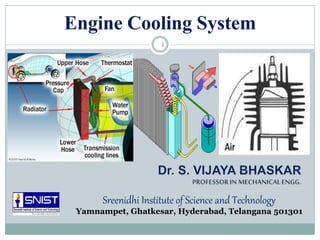
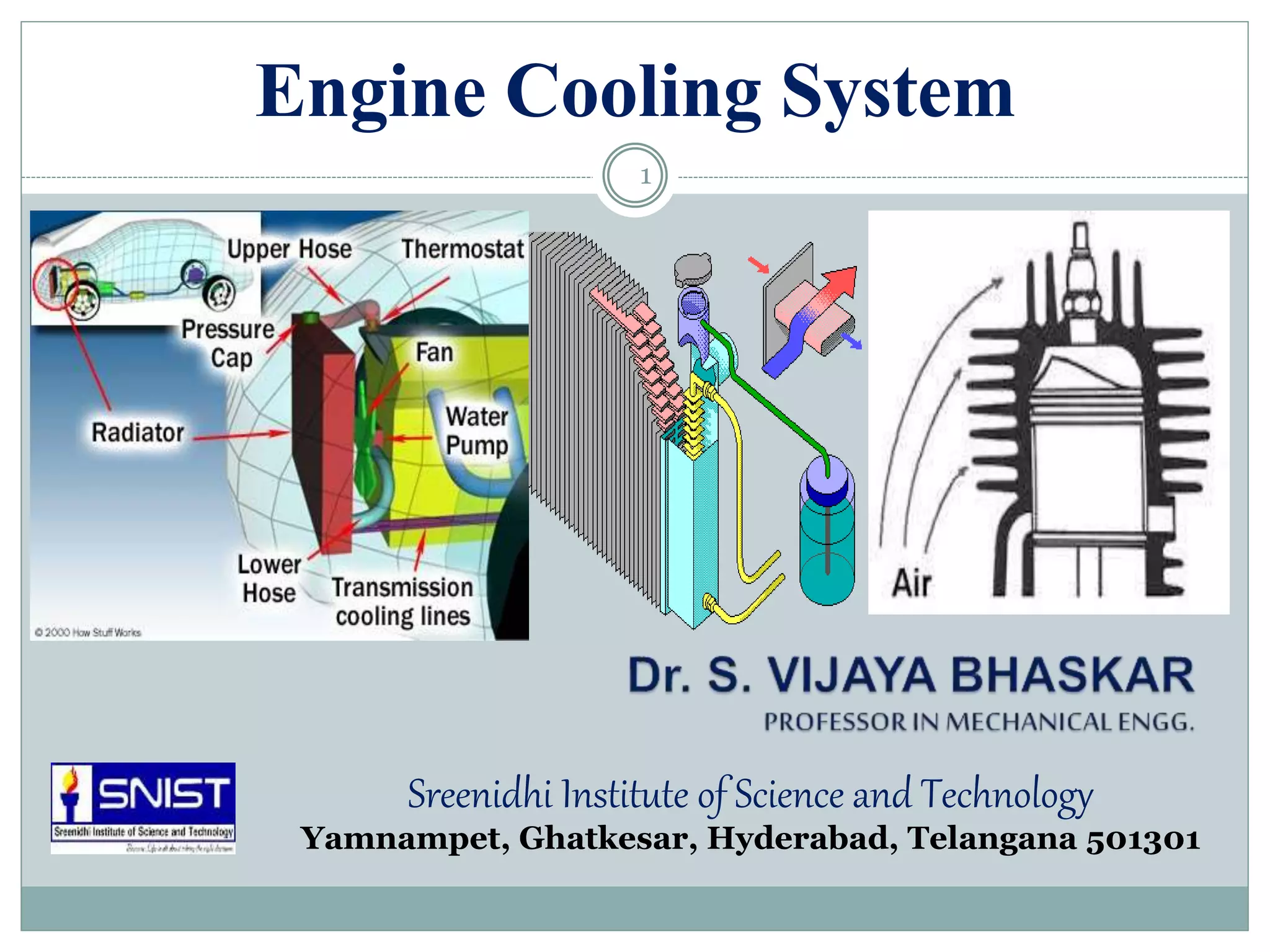
Engine Cooling System
1
Sreenidhi Institute of Science and Technology
Yamnampet, Ghatkesar, Hyderabad, Telangana 501301
10
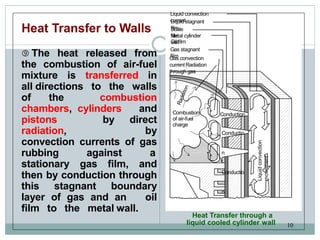
Combustion
of air-fuel
charge
Conduction
Conductio
n
Conductio
n
Liquidconvection
movement
Gas convection
current Radiation
through gas
Oil film
Gas stagnant
film
Metal cylinder
wall
Scale
film
Liquid stagnant
film
Liquid convection
current
Heat Transfer through a
liquid cooled cylinder wall
Heat Transfer to Walls
 The heat released from
the combustion of air-fuel
mixture is transferred in
all directions to the walls
of the combustion
chambers, cylinders and
pistons by direct
radiation, by
convection currents of gas
rubbing against a
stationary gas film, and
then by conduction through
this stagnant boundary
layer of gas and an oil
film to the metal wall.
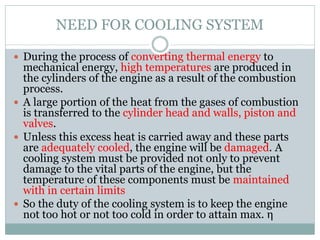
NEED FOR COOLING SYSTEM
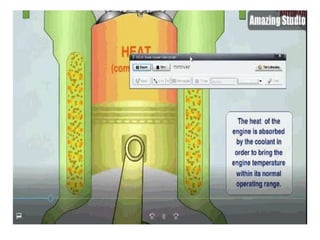
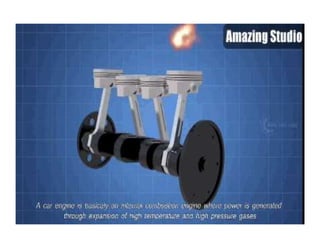
 During the process of converting thermal energy to
mechanical energy, high temperatures are produced in
the cylinders of the engine as a result of the combustion
process.
 A large portion of the heat from the gases of combustion
is transferred to the cylinder head and walls, piston and
valves.
 Unless this excess heat is carried away and these parts
are adequately cooled, the engine will be damaged. A
cooling system must be provided not only to prevent
damage to the vital parts of the engine, but the
temperature of these components must be maintained
with in certain limits
 So the duty of the cooling system is to keep the engine
not too hot or not too cold in order to attain max. η
Significance of Cooling
4
In a spark ignition engine, cooling must
be satisfactory to avoid pre-ignition and
knock. In a compression ignition engine,
since a normal combustion is aided,
cooling must be sufficient to allow the
parts to operate properly.
In short, cooling is a matter of
equalization of internal temperature to
prevent local overheating as well as to
remove sufficient heat energy to maintain
a practical overall working temperature.
Rapidly Auto-igniting
Reasons for
Cooling 5
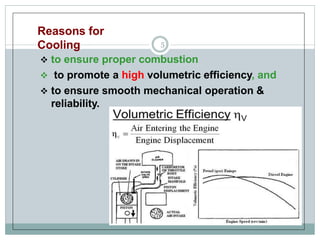
 to ensure proper combustion
 to promote a high volumetric efficiency, and
 to ensure smooth mechanical operation &
reliability.
Effect of Over-cooling
6
the thermal efficiency is decreased due to
more loss of heat carried by the coolant
the vapourization of the fuel is less resulting
in lower combustion efficiency
low temperature increases the viscosity of
lubricant causing more loss due to friction.
CHARACTERISTICS OF AN EFFICIENT
COOLING SYSTEM
The following are the two main characteristics
desired of an efficient coolie system:
 (i) It should be capable of removing about 30% of
heat generated in the combustion chamber while
maintaining the optimum temperature of the
engine under all operating conditions.
 (ii) It should remove heat at a faster rate when
engine is hot. However during starting of the engine
the cooling should be minimum, so that the working
parts of the engine reach their operating
temperatures in a short time.
Types of Cooling
System 8
 Air cooling (or direct cooling) system
 Liquid cooling (or indirect cooling) system
FYI: Aviation engines, motor cycle engines,
scooter engines are air cooled;
while the stationery and
automobile engines are liquid cooled
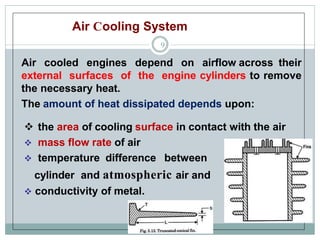
Air Cooling System
9
Air cooled engines depend on airflow across their
external surfaces of the engine cylinders to remove
the necessary heat.
The amount of heat dissipated depends upon:
 the area of cooling surface in contact with the air
 mass flow rate of air
 temperature difference between
cylinder and atmospheric air and
 conductivity of metal.
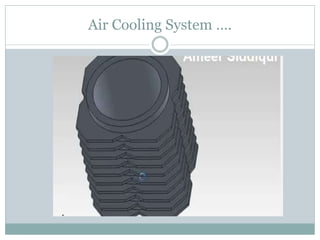
Cooling fins in air cooled system
10
 The area of cooling surface is increased by
forming thin fins, either integrally by machining
them on the outer walls of the engine cylinder and
cylinder head or by attaching separate fins to them.
Air Cooling System ….
Advantages -Air cooling system
The
jackets,
12
absence
coolant
of radiator,
and pumps
cooling
make the
engine lighter.
The engine can be operated in cold
weather conditions where liquid may freeze
in water cooling system.
In places where water is scarce, air
cooled engine is an advantage.
 Handling of liquid coolant requires
piping and pumping auxiliaries. So, air
cooled engines have no
coolant leakage or freezing problems.
Air cooling system - Disadvantages
 Cooling fins under certain conditions
may vibrate and amplify the noise level.
 Cooling is not uniform.
 Engines are subjected to high
working temperature.
 Used in small engines i.e., Engines with
low power output.
13
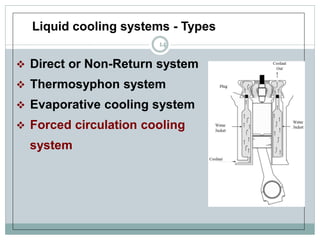
Liquid cooling systems - Types
 Direct or Non-Return system
 Thermosyphon system
 Evaporative cooling system
 Forced circulation cooling
system
14
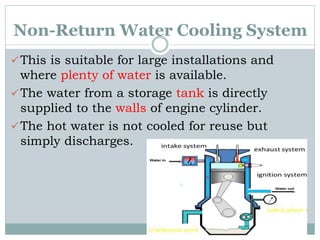
Non-Return Water Cooling System
This is suitable for large installations and
where plenty of water is available.
The water from a storage tank is directly
supplied to the walls of engine cylinder.
The hot water is not cooled for reuse but
simply discharges.
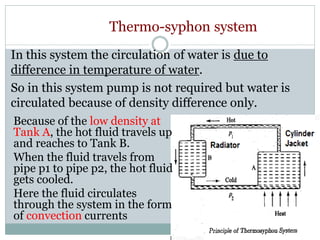
Thermo-syphon system
Because of the low density at
Tank A, the hot fluid travels up
and reaches to Tank B.
When the fluid travels from
pipe p1 to pipe p2, the hot fluid
gets cooled.
Here the fluid circulates
through the system in the form
of convection currents
In this system the circulation of water is due to
difference in temperature of water.
So in this system pump is not required but water is
circulated because of density difference only.
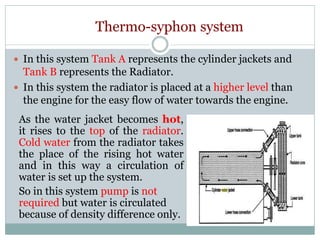
Thermo-syphon system
 In this system Tank A represents the cylinder jackets and
Tank B represents the Radiator.
 In this system the radiator is placed at a higher level than
the engine for the easy flow of water towards the engine.
As the water jacket becomes hot,
it rises to the top of the radiator.
Cold water from the radiator takes
the place of the rising hot water
and in this way a circulation of
water is set up the system.
So in this system pump is not
required but water is circulated
because of density difference only.
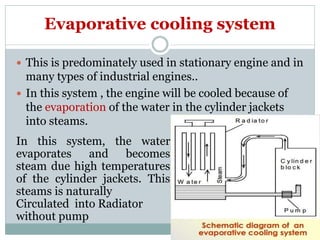
Evaporative cooling system
 This is predominately used in stationary engine and in
many types of industrial engines..
 In this system , the engine will be cooled because of
the evaporation of the water in the cylinder jackets
into steams.
In this system, the water
evaporates and becomes
steam due high temperatures
of the cylinder jackets. This
steams is naturally
Circulated into Radiator
without pump
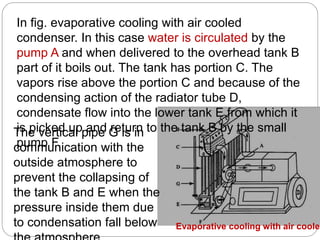
In fig. evaporative cooling with air cooled
condenser. In this case water is circulated by the
pump A and when delivered to the overhead tank B
part of it boils out. The tank has portion C. The
vapors rise above the portion C and because of the
condensing action of the radiator tube D,
condensate flow into the lower tank E from which it
is picked up and return to the tank B by the small
pump F.
The vertical pipe G is in
communication with the
outside atmosphere to
prevent the collapsing of
the tank B and E when the
pressure inside them due
to condensation fall below Evaporative cooling with air cooled
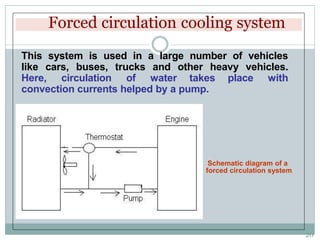
Schematic diagram of a
forced circulation system
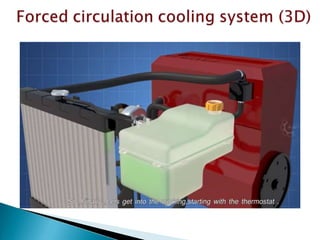
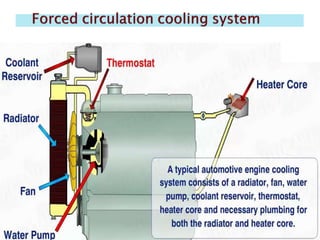
Forced circulation cooling system
20
This system is used in a large number of vehicles
like cars, buses, trucks and other heavy vehicles.
Here, circulation of water takes place with
convection currents helped by a pump.
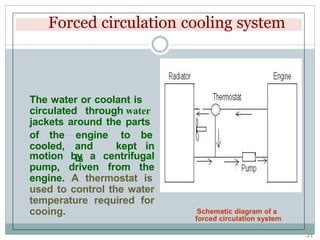
Schematic diagram of a
forced circulation system
Forced circulation cooling system
21
The water or coolant is
circulated through water
jackets around the parts
of the engine to be
cooled, and
is
kept in
motion by a centrifugal
pump, driven from the
engine. A thermostat is
used to control the water
temperature required for
cooing.
• Rejects the coolant heat to the surrounding air
•Disperses the heated coolant into fine streams
so that small quantities of coolant are brought in
contact with large metal surface areas, which in
turn are cooled by air stream
• Two types of radiators
(1) Down-flow type
(2) Cross-flow type
•Availability of space dictates the choice of
radiator, both are equally efficient.
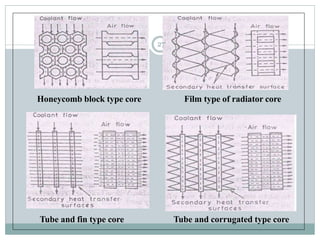
•Various design of radiator cores are used for
cooling the water
Parts of cooling systems - Radiator
26
Honeycomb block type core Film type of radiator core
Tube and fin type core Tube and corrugated type core
27
Materials for radiator
• Good corrosion resistance
• Good thermal conductivity
• Must possess the required strength
• Must be easily formable
• Yellow brass, copper are used
(soldered easily => easy repair)
• Aluminium is used where weight is critical
28
Liquid cooling system - Advantages
29
 Because of even cooling of cylinder barrel
and head (due to jacketing) makes
i
t
possible to reduce the cylinder head and
valve seat temperatures.
The volumetric efficiency of water cooled
engines is higher than that of air- cooled
engines.
Compact design of engines with
appreciably smaller frontal area is possible.
In case of water cooled engines,
installation is not necessarily at the front
of the mobile vehicles, aircraft etc. as
the cooing system can be conveniently
located.
Liquid cooling system - Disadvantages
The system requires more
maintenance.
The engine performance becomes
sensitive to climatic conditions.
The power absorbed by the pump is
considerable and affects the power
output of the engine.
In the event of failure of the cooling
system serious damage may be caused
to the engine.
30
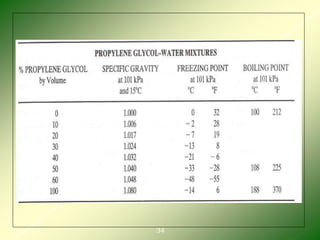
Use of Anti-freezers
During winter or when the engine is kept out
of operation in cold places, the cooling water in
the cylinder jackets, radiator tanks and leading
pipes will freeze, expand and lead to their
fracture. To prevent damage to the engine and
radiator during winter weather, suitable liquids or
compound substances (known as anti-freezers)
which go into solution are added to the water to
lower the freezing temperature of the coolant.
Ethylene glycol is the most widely used
automotive cooling-system antifreeze, although
methanol, ethanol, isopropyl alcohol, and
propylene glycol are also used.
31
Requirements of anti- freezers
 They should thoroughly mix with water.
They should not corrode the surfaces with
which they are in contact.
Their boiling point should be high so that
the loss due to evaporation is minimum.
They should not deposit any foreign matter
in the jackets, hose, pipes or radiator.
It should be chemically stable, a good
conductor of heat, and a poor conductor of
electricity.
32
33
34
35
Lubricating Oil as Coolant
The lubricating oil used in an engine
also helps to cool the engine. The hotter
parts like piston face and back surface
of piston crown is subjected to oil flow,
usually done by spraying the oil by
pressurized systems or by splash in
non- pressurized system. Other
components like camshaft and
connecting rods are also cooled by oil
circulation through oil passages.
36
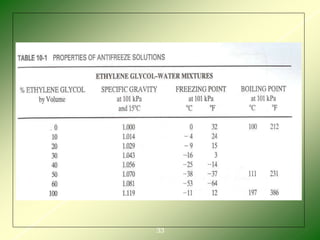
Anti-Freeze Solution…
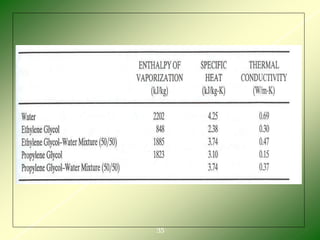
Ethylene glycol
 Ethylene Glycol based water solutions are common in
heat-transfer applications where the temperature in the
heat transfer fluid can be below 32oF (0oC). Ethylene
glycol is also commonly used in heating applications that
temporarily may not be operated (cold) in surroundings
with freezing conditions - such as cars and machines
with water cooled engines.
Propylene glycol
END

Cooling System - IC Engines : Unit-III

  • 1.
    Engine Cooling System 1 SreenidhiInstitute of Science and Technology Yamnampet, Ghatkesar, Hyderabad, Telangana 501301
  • 2.
    10 Combustion of air-fuel charge Conduction Conductio n Conductio n Liquidconvection movement Gas convection currentRadiation through gas Oil film Gas stagnant film Metal cylinder wall Scale film Liquid stagnant film Liquid convection current Heat Transfer through a liquid cooled cylinder wall Heat Transfer to Walls  The heat released from the combustion of air-fuel mixture is transferred in all directions to the walls of the combustion chambers, cylinders and pistons by direct radiation, by convection currents of gas rubbing against a stationary gas film, and then by conduction through this stagnant boundary layer of gas and an oil film to the metal wall.
  • 3.
    NEED FOR COOLINGSYSTEM  During the process of converting thermal energy to mechanical energy, high temperatures are produced in the cylinders of the engine as a result of the combustion process.  A large portion of the heat from the gases of combustion is transferred to the cylinder head and walls, piston and valves.  Unless this excess heat is carried away and these parts are adequately cooled, the engine will be damaged. A cooling system must be provided not only to prevent damage to the vital parts of the engine, but the temperature of these components must be maintained with in certain limits  So the duty of the cooling system is to keep the engine not too hot or not too cold in order to attain max. η
  • 4.
    Significance of Cooling 4 Ina spark ignition engine, cooling must be satisfactory to avoid pre-ignition and knock. In a compression ignition engine, since a normal combustion is aided, cooling must be sufficient to allow the parts to operate properly. In short, cooling is a matter of equalization of internal temperature to prevent local overheating as well as to remove sufficient heat energy to maintain a practical overall working temperature. Rapidly Auto-igniting
  • 5.
    Reasons for Cooling 5 to ensure proper combustion  to promote a high volumetric efficiency, and  to ensure smooth mechanical operation & reliability.
  • 6.
    Effect of Over-cooling 6 thethermal efficiency is decreased due to more loss of heat carried by the coolant the vapourization of the fuel is less resulting in lower combustion efficiency low temperature increases the viscosity of lubricant causing more loss due to friction.
  • 7.
    CHARACTERISTICS OF ANEFFICIENT COOLING SYSTEM The following are the two main characteristics desired of an efficient coolie system:  (i) It should be capable of removing about 30% of heat generated in the combustion chamber while maintaining the optimum temperature of the engine under all operating conditions.  (ii) It should remove heat at a faster rate when engine is hot. However during starting of the engine the cooling should be minimum, so that the working parts of the engine reach their operating temperatures in a short time.
  • 8.
    Types of Cooling System8  Air cooling (or direct cooling) system  Liquid cooling (or indirect cooling) system FYI: Aviation engines, motor cycle engines, scooter engines are air cooled; while the stationery and automobile engines are liquid cooled
  • 9.
    Air Cooling System 9 Aircooled engines depend on airflow across their external surfaces of the engine cylinders to remove the necessary heat. The amount of heat dissipated depends upon:  the area of cooling surface in contact with the air  mass flow rate of air  temperature difference between cylinder and atmospheric air and  conductivity of metal.
  • 10.
    Cooling fins inair cooled system 10  The area of cooling surface is increased by forming thin fins, either integrally by machining them on the outer walls of the engine cylinder and cylinder head or by attaching separate fins to them.
  • 11.
  • 12.
    Advantages -Air coolingsystem The jackets, 12 absence coolant of radiator, and pumps cooling make the engine lighter. The engine can be operated in cold weather conditions where liquid may freeze in water cooling system. In places where water is scarce, air cooled engine is an advantage.  Handling of liquid coolant requires piping and pumping auxiliaries. So, air cooled engines have no coolant leakage or freezing problems.
  • 13.
    Air cooling system- Disadvantages  Cooling fins under certain conditions may vibrate and amplify the noise level.  Cooling is not uniform.  Engines are subjected to high working temperature.  Used in small engines i.e., Engines with low power output. 13
  • 14.
    Liquid cooling systems- Types  Direct or Non-Return system  Thermosyphon system  Evaporative cooling system  Forced circulation cooling system 14
  • 15.
    Non-Return Water CoolingSystem This is suitable for large installations and where plenty of water is available. The water from a storage tank is directly supplied to the walls of engine cylinder. The hot water is not cooled for reuse but simply discharges.
  • 16.
    Thermo-syphon system Because ofthe low density at Tank A, the hot fluid travels up and reaches to Tank B. When the fluid travels from pipe p1 to pipe p2, the hot fluid gets cooled. Here the fluid circulates through the system in the form of convection currents In this system the circulation of water is due to difference in temperature of water. So in this system pump is not required but water is circulated because of density difference only.
  • 17.
    Thermo-syphon system  Inthis system Tank A represents the cylinder jackets and Tank B represents the Radiator.  In this system the radiator is placed at a higher level than the engine for the easy flow of water towards the engine. As the water jacket becomes hot, it rises to the top of the radiator. Cold water from the radiator takes the place of the rising hot water and in this way a circulation of water is set up the system. So in this system pump is not required but water is circulated because of density difference only.
  • 18.
    Evaporative cooling system This is predominately used in stationary engine and in many types of industrial engines..  In this system , the engine will be cooled because of the evaporation of the water in the cylinder jackets into steams. In this system, the water evaporates and becomes steam due high temperatures of the cylinder jackets. This steams is naturally Circulated into Radiator without pump
  • 19.
    In fig. evaporativecooling with air cooled condenser. In this case water is circulated by the pump A and when delivered to the overhead tank B part of it boils out. The tank has portion C. The vapors rise above the portion C and because of the condensing action of the radiator tube D, condensate flow into the lower tank E from which it is picked up and return to the tank B by the small pump F. The vertical pipe G is in communication with the outside atmosphere to prevent the collapsing of the tank B and E when the pressure inside them due to condensation fall below Evaporative cooling with air cooled
  • 20.
    Schematic diagram ofa forced circulation system Forced circulation cooling system 20 This system is used in a large number of vehicles like cars, buses, trucks and other heavy vehicles. Here, circulation of water takes place with convection currents helped by a pump.
  • 21.
    Schematic diagram ofa forced circulation system Forced circulation cooling system 21 The water or coolant is circulated through water jackets around the parts of the engine to be cooled, and is kept in motion by a centrifugal pump, driven from the engine. A thermostat is used to control the water temperature required for cooing.
  • 26.
    • Rejects thecoolant heat to the surrounding air •Disperses the heated coolant into fine streams so that small quantities of coolant are brought in contact with large metal surface areas, which in turn are cooled by air stream • Two types of radiators (1) Down-flow type (2) Cross-flow type •Availability of space dictates the choice of radiator, both are equally efficient. •Various design of radiator cores are used for cooling the water Parts of cooling systems - Radiator 26
  • 27.
    Honeycomb block typecore Film type of radiator core Tube and fin type core Tube and corrugated type core 27
  • 28.
    Materials for radiator •Good corrosion resistance • Good thermal conductivity • Must possess the required strength • Must be easily formable • Yellow brass, copper are used (soldered easily => easy repair) • Aluminium is used where weight is critical 28
  • 29.
    Liquid cooling system- Advantages 29  Because of even cooling of cylinder barrel and head (due to jacketing) makes i t possible to reduce the cylinder head and valve seat temperatures. The volumetric efficiency of water cooled engines is higher than that of air- cooled engines. Compact design of engines with appreciably smaller frontal area is possible. In case of water cooled engines, installation is not necessarily at the front of the mobile vehicles, aircraft etc. as the cooing system can be conveniently located.
  • 30.
    Liquid cooling system- Disadvantages The system requires more maintenance. The engine performance becomes sensitive to climatic conditions. The power absorbed by the pump is considerable and affects the power output of the engine. In the event of failure of the cooling system serious damage may be caused to the engine. 30
  • 31.
    Use of Anti-freezers Duringwinter or when the engine is kept out of operation in cold places, the cooling water in the cylinder jackets, radiator tanks and leading pipes will freeze, expand and lead to their fracture. To prevent damage to the engine and radiator during winter weather, suitable liquids or compound substances (known as anti-freezers) which go into solution are added to the water to lower the freezing temperature of the coolant. Ethylene glycol is the most widely used automotive cooling-system antifreeze, although methanol, ethanol, isopropyl alcohol, and propylene glycol are also used. 31
  • 32.
    Requirements of anti-freezers  They should thoroughly mix with water. They should not corrode the surfaces with which they are in contact. Their boiling point should be high so that the loss due to evaporation is minimum. They should not deposit any foreign matter in the jackets, hose, pipes or radiator. It should be chemically stable, a good conductor of heat, and a poor conductor of electricity. 32
  • 33.
  • 34.
  • 35.
  • 36.
    Lubricating Oil asCoolant The lubricating oil used in an engine also helps to cool the engine. The hotter parts like piston face and back surface of piston crown is subjected to oil flow, usually done by spraying the oil by pressurized systems or by splash in non- pressurized system. Other components like camshaft and connecting rods are also cooled by oil circulation through oil passages. 36
  • 37.
    Anti-Freeze Solution… Ethylene glycol Ethylene Glycol based water solutions are common in heat-transfer applications where the temperature in the heat transfer fluid can be below 32oF (0oC). Ethylene glycol is also commonly used in heating applications that temporarily may not be operated (cold) in surroundings with freezing conditions - such as cars and machines with water cooled engines. Propylene glycol
  • 38.