REGIONAL COLLEGE FOR EDUCATION RESEARCH
AND TECHNOLOGY
NAME : SADDAM HUSSAIN
ROLL NO.: 13ERCME059
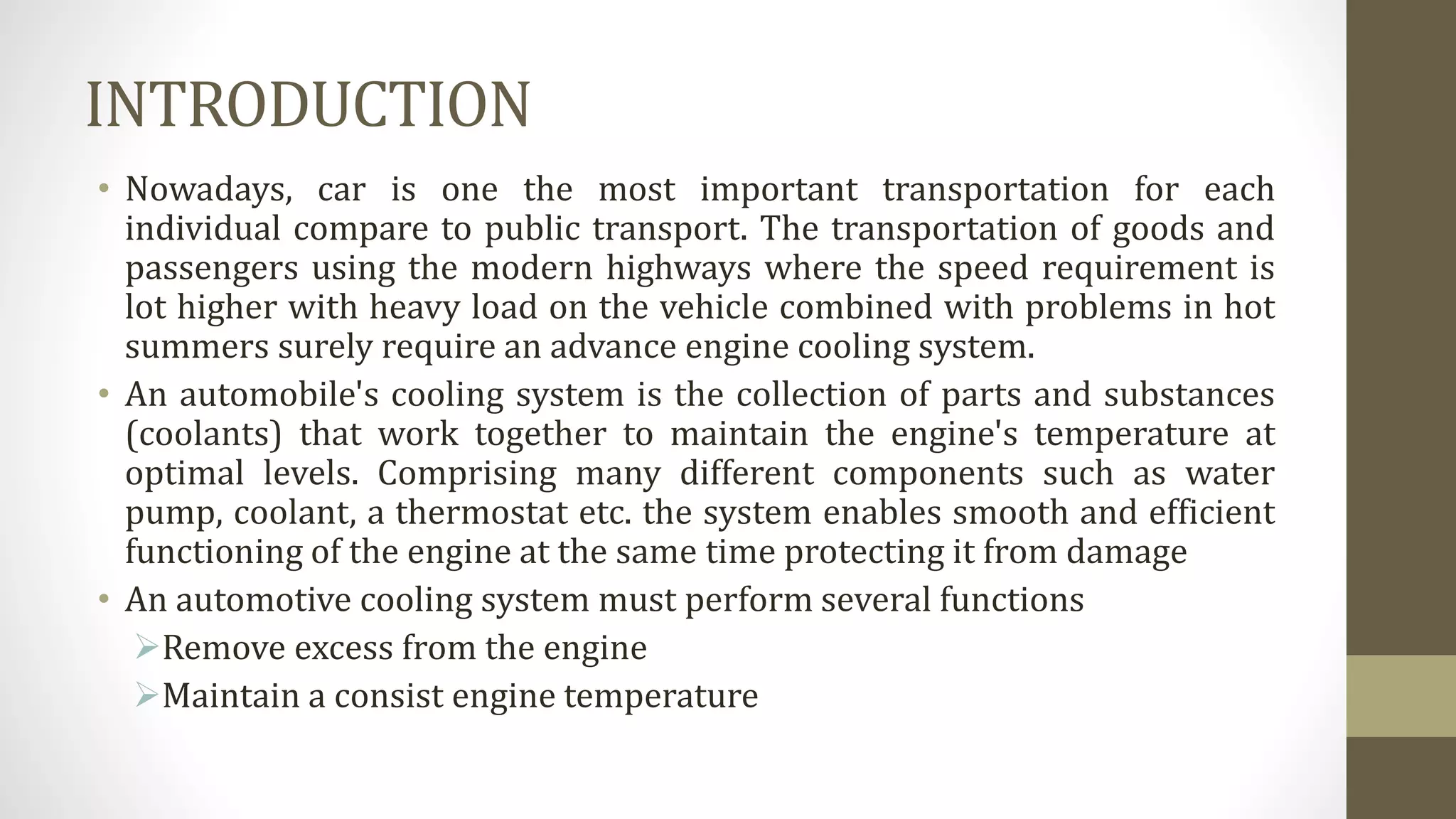
ADVANCE COOLING SYSTEM
IN AUTOMOBILE
ABSTRACT
The advancement in the field of aerodynamics and the engine Management
system has made the modern vehicles lot more Faster as compare to one
from the previous generations. The engine size has not increased much for
reaching this much speed and torque requirement. Modern engine which
produce efficient results in form of fuel efficiency and power to weight ratio
runs at higher rpm and produce more power every cycle, this is a great boon
but the amount of heat to be released from the engine to the surrounding
increases with the increase in maximum power and speed requirement. That
is why we need a more advance engine cooling system that can achieve
proper cooling of the engine without any compromise with the
aerodynamics shape of vehicle.
CONTENT
• INTRODUCTION
• CONVESIONAL COOLING SYSTEM
• REQUIREMENT
• TYPES
• COMPONENTS
• ADVANTAGES
• DISADVATAGES
• COOLANT
• CONCLUSION
• OVERVIEW
INTRODUCTION
• Nowadays, car is one the most important transportation for each
individual compare to public transport. The transportation of goods and
passengers using the modern highways where the speed requirement is
lot higher with heavy load on the vehicle combined with problems in hot
summers surely require an advance engine cooling system.
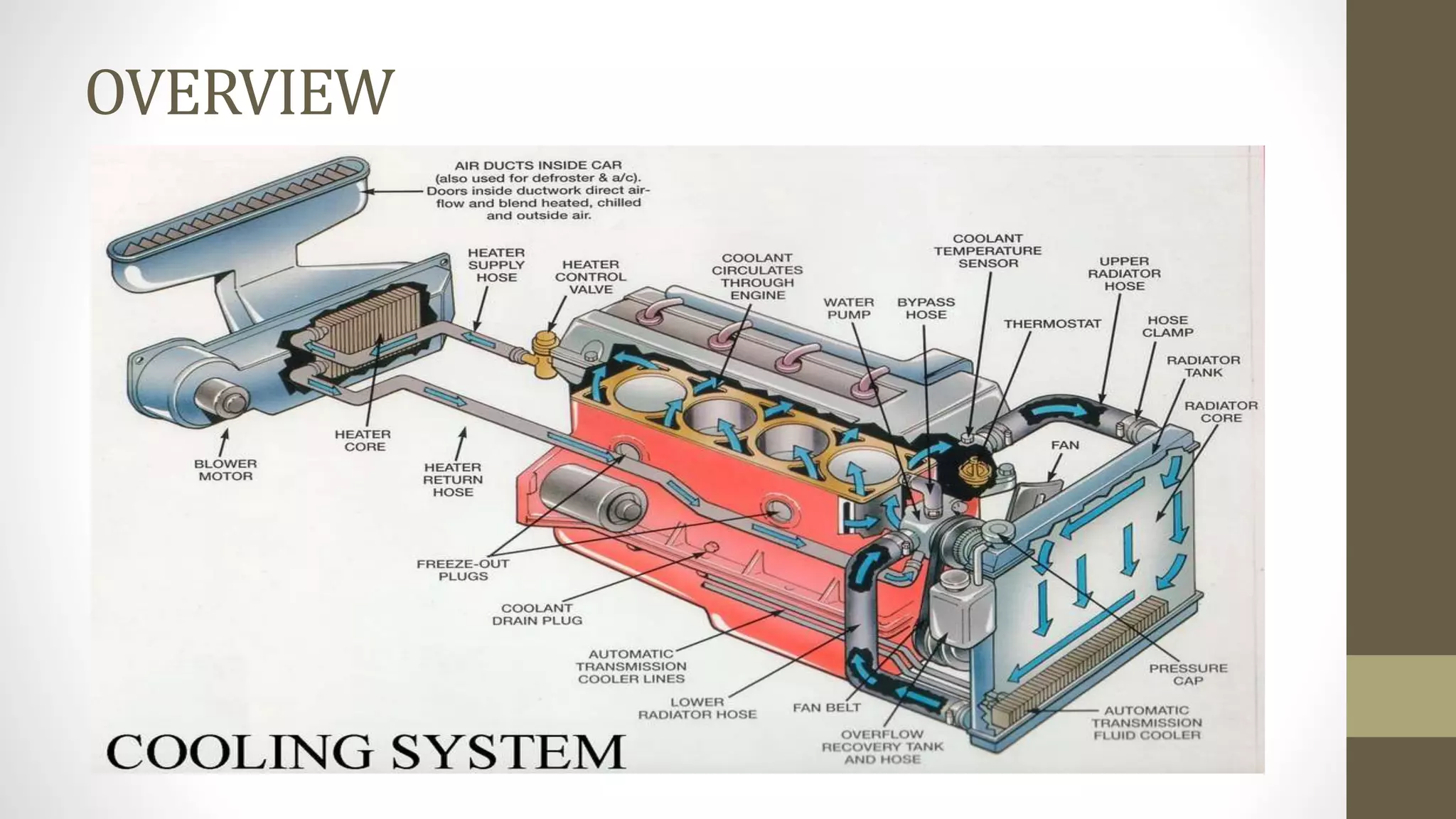
• An automobile's cooling system is the collection of parts and substances
(coolants) that work together to maintain the engine's temperature at
optimal levels. Comprising many different components such as water
pump, coolant, a thermostat etc. the system enables smooth and efficient
functioning of the engine at the same time protecting it from damage
• An automotive cooling system must perform several functions
Remove excess from the engine
Maintain a consist engine temperature
CONVENTIONAL ENGINE COOLING
SYSTEM
Combustion of air and fuel takes place inside the engine cylinder and hot
gases are generated inside an internal combustion engine. The temperature
of gases may raise up to around 2300-2500 ℃, which is a very high
temperature and may result into burning of oil film between the moving
parts, pre combustion and may result into seizing or welding of the moving
parts.
• Heat dissipation to volume ratio of the system is less.
• At high speeds it is difficult to maintain the temperature of engine
components.
• Heat rejected by the system (about 35%of heat generated) is wasted to
the atmosphere.
REQUIREMENT
• Get the engine up to optimum operating Temperature as quickly as
possible and maintains it at that temperature.
• 4000 degree temps. could seriously damage engine parts.
• Controls the heat produced in combustion chamber, so that the engine
parts are not damaged & the oil does not break down.
• The temp. of component must be maintained within certain limit in order
to obtain maximum performance of engine. Adequate cooling is then a
fundamental requirement associated with reciprocating I.C. engine.
TYPES
In order to cool the engine a cooling medium is required. On the basis of
medium ,in general use for cooling I.C. engine ,types of cooling system are:-
1. Liquid or Indirect Cooling System.
2. Air or Direct Cooling System.
3. Oil Cooling System
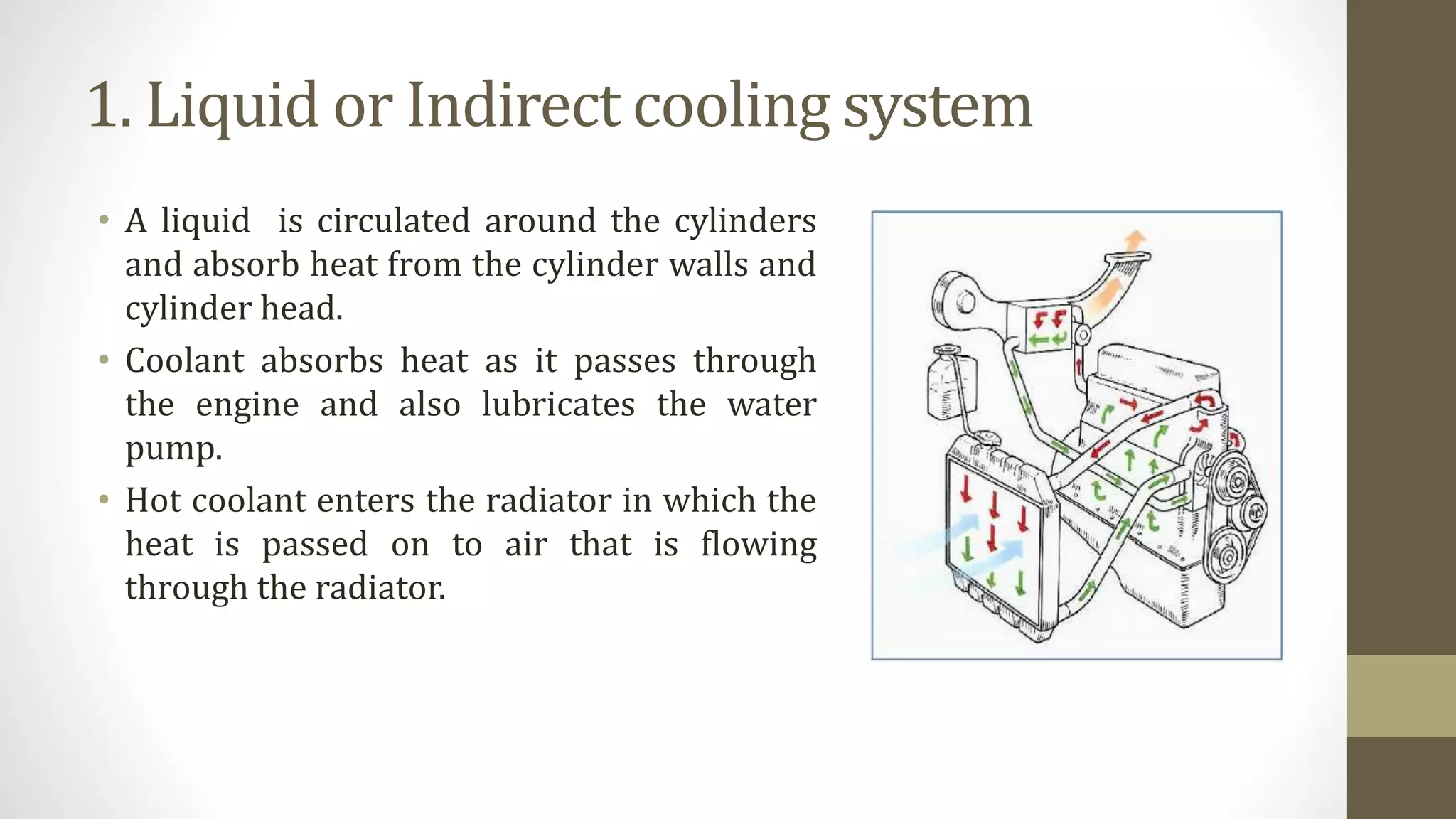
1. Liquid or Indirect cooling system
• A liquid is circulated around the cylinders
and absorb heat from the cylinder walls and
cylinder head.
• Coolant absorbs heat as it passes through
the engine and also lubricates the water
pump.
• Hot coolant enters the radiator in which the
heat is passed on to air that is flowing
through the radiator.
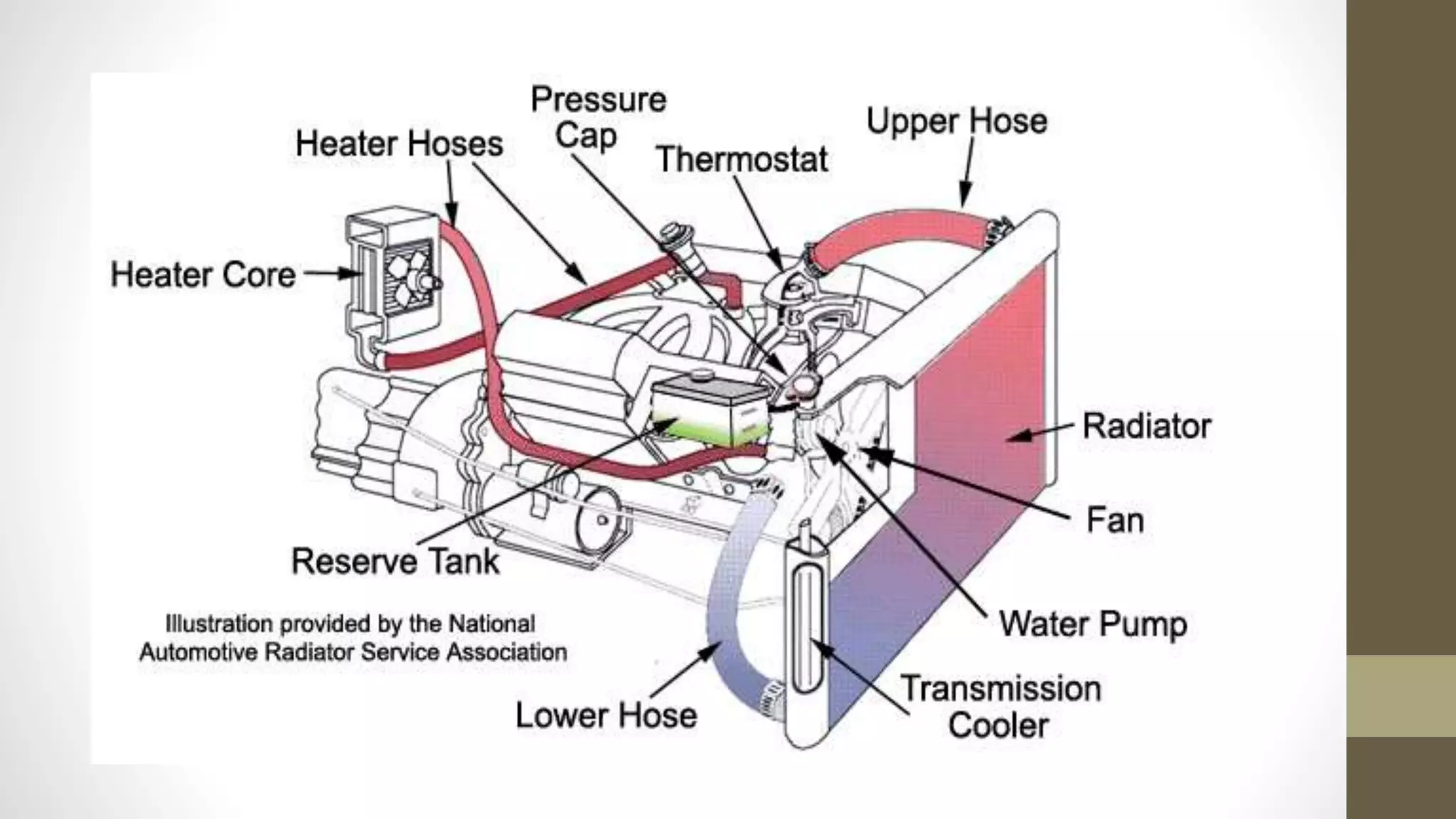
Components of water cooling
• Water Jackets
• Water Pump
• Fan
• Thermostat
• Radiator
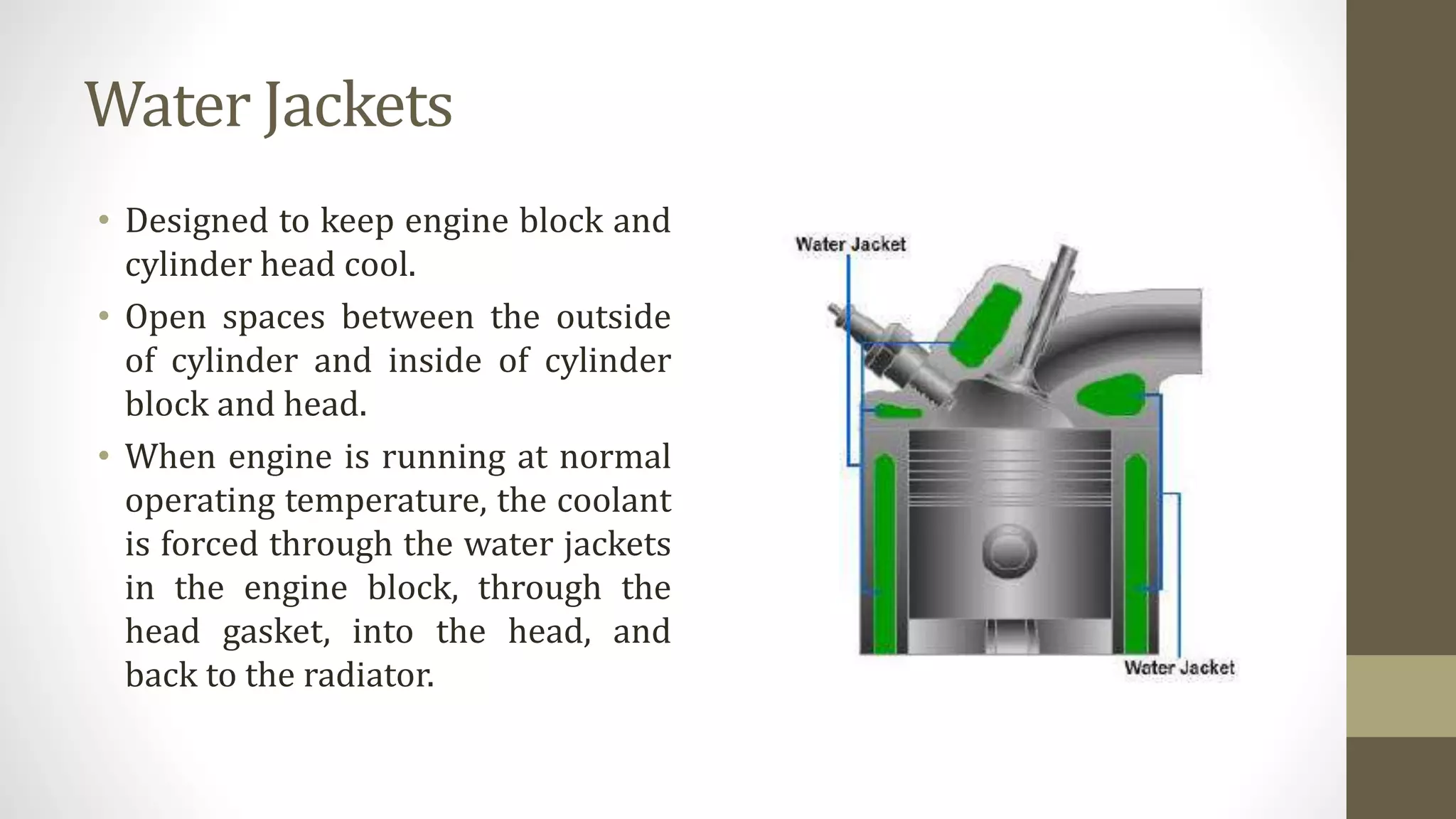
Water Jackets
• Designed to keep engine block and
cylinder head cool.
• Open spaces between the outside
of cylinder and inside of cylinder
block and head.
• When engine is running at normal
operating temperature, the coolant
is forced through the water jackets
in the engine block, through the
head gasket, into the head, and
back to the radiator.
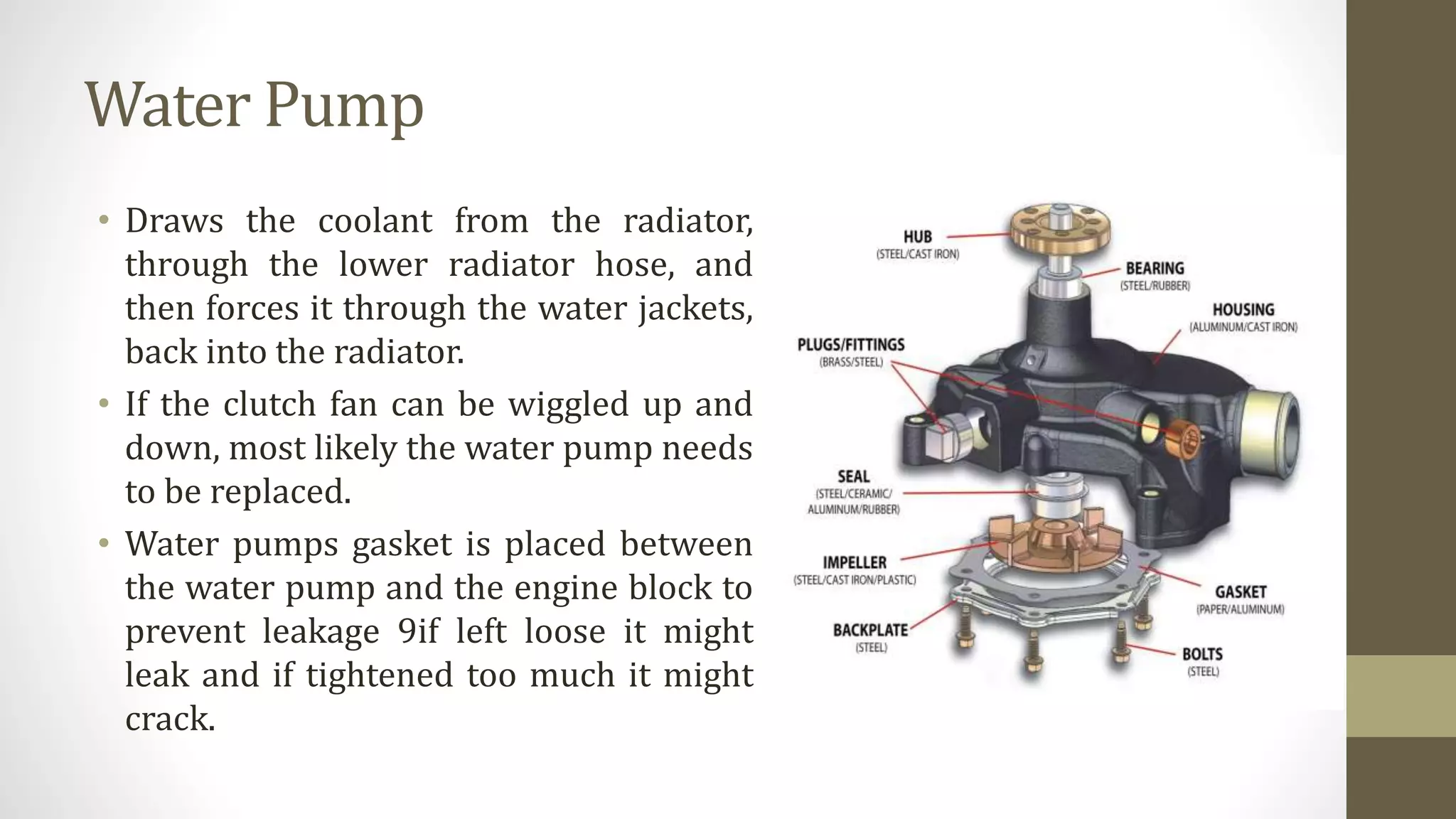
Water Pump
• Draws the coolant from the radiator,
through the lower radiator hose, and
then forces it through the water jackets,
back into the radiator.
• If the clutch fan can be wiggled up and
down, most likely the water pump needs
to be replaced.
• Water pumps gasket is placed between
the water pump and the engine block to
prevent leakage 9if left loose it might
leak and if tightened too much it might
crack.
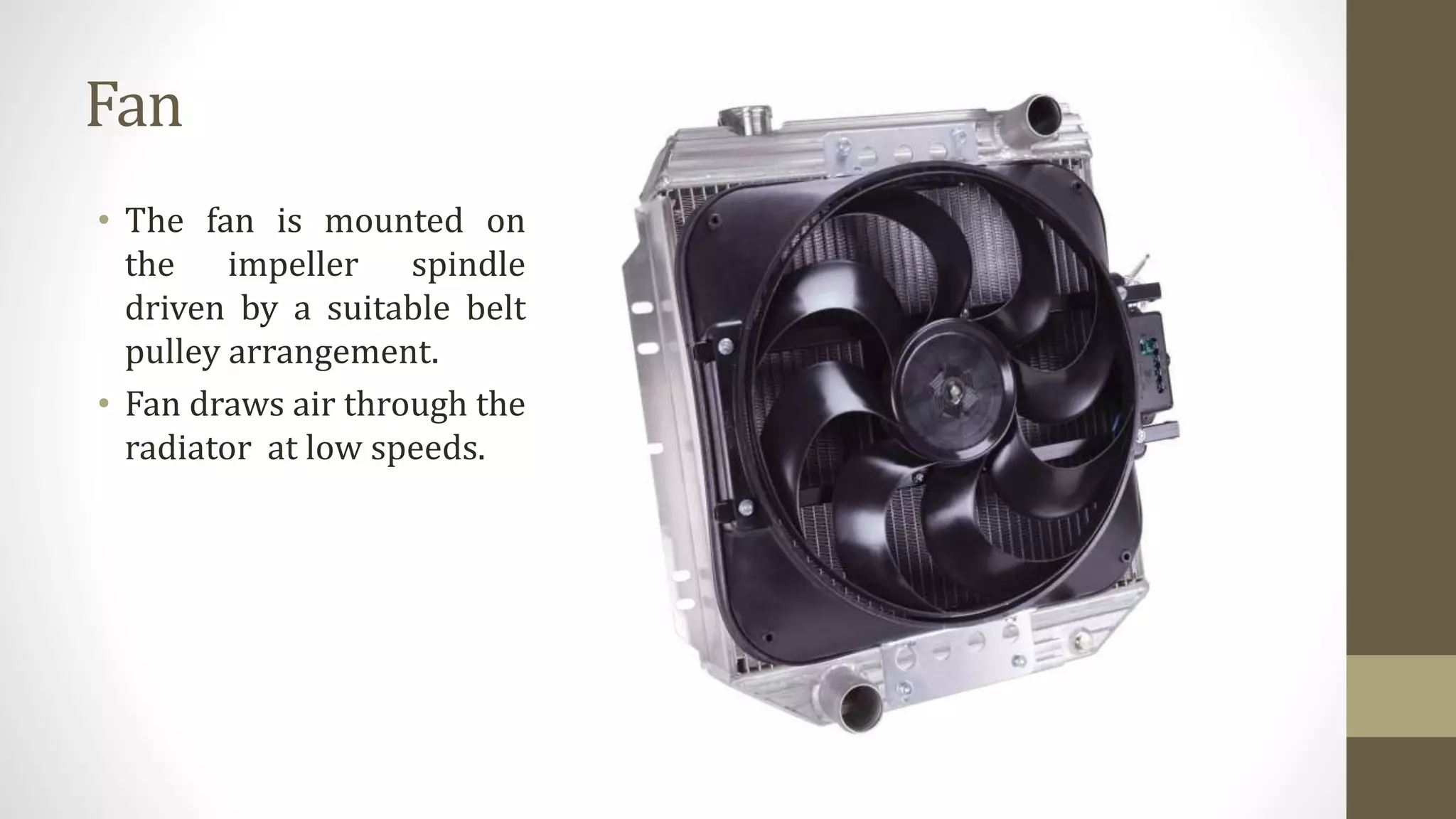
Fan
• The fan is mounted on
the impeller spindle
driven by a suitable belt
pulley arrangement.
• Fan draws air through the
radiator at low speeds.
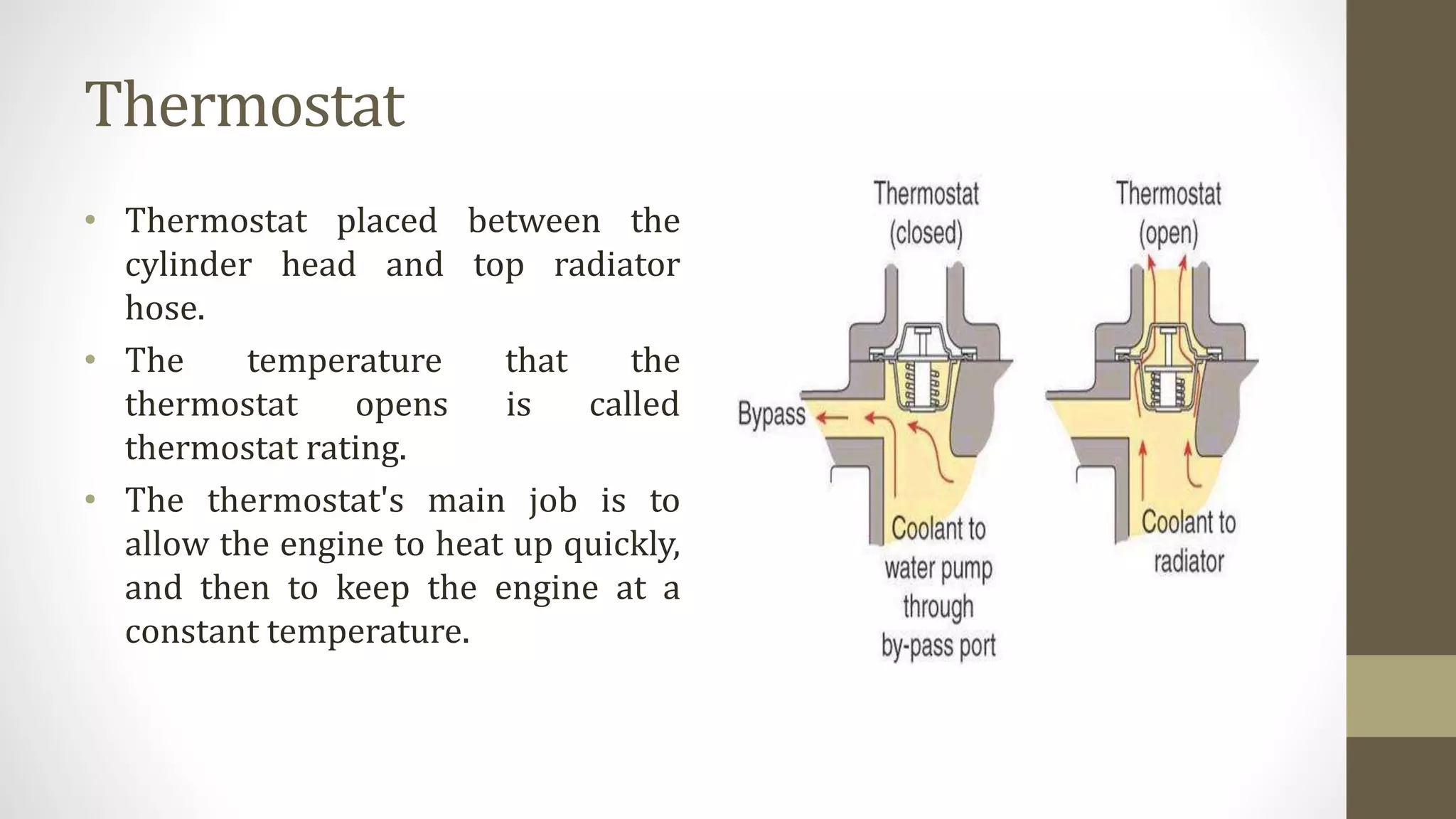
Thermostat
• Thermostat placed between the
cylinder head and top radiator
hose.
• The temperature that the
thermostat opens is called
thermostat rating.
• The thermostat's main job is to
allow the engine to heat up quickly,
and then to keep the engine at a
constant temperature.
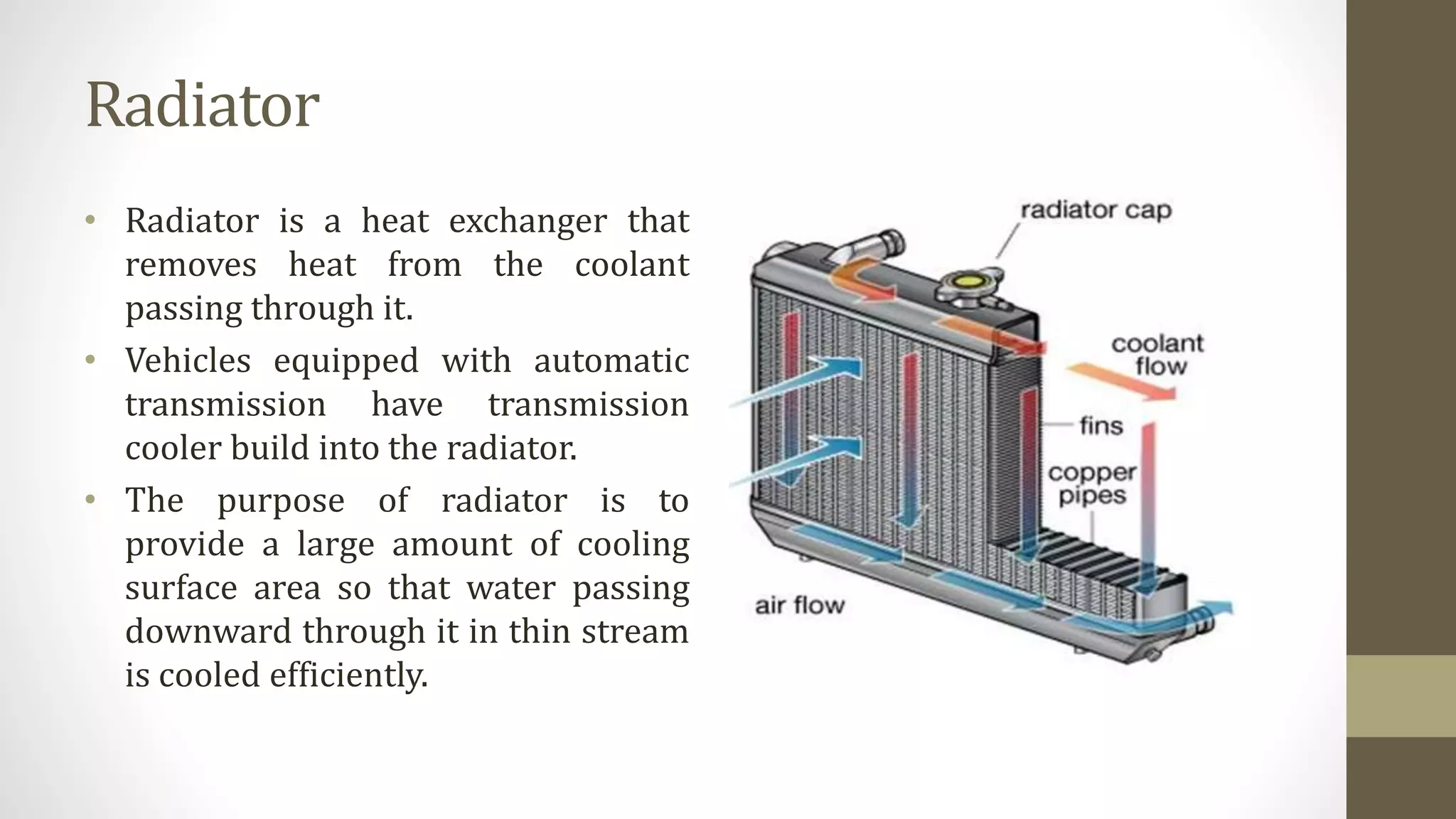
Radiator
• Radiator is a heat exchanger that
removes heat from the coolant
passing through it.
• Vehicles equipped with automatic
transmission have transmission
cooler build into the radiator.
• The purpose of radiator is to
provide a large amount of cooling
surface area so that water passing
downward through it in thin stream
is cooled efficiently.
Advantages
• Uniform cooling of cylinder, cylinder head and valves.
• Specific fuel consumption of engine improves by using water cooling
system.
• If we employ water cooling system, then engine need not be provided at
the front end of moving vehicle.
• Engine is less noisy as compared with air cooled engines, as it has water
for damping noise.
Disadvantages
• It depends upon the supply of water.
• The water pump which circulates water absorbs considerable power.
• If the water cooling system fails then it will result in severe damage of
engine.
• The water cooling system is costlier as it has more number of parts. Also it
requires more maintenance and care for its parts.
2. Air or Direct cooling system
• In air cooled system a current of air made to flow past the outside of the
cylinder barrel ,outer surface area which has been considerably increased
by providing cooling fins.
• The amount of heat dissipated to air depends upon :
Amount of air flowing through the fins.
Fin surface area.
Thermal conductivity of metal used for fins.
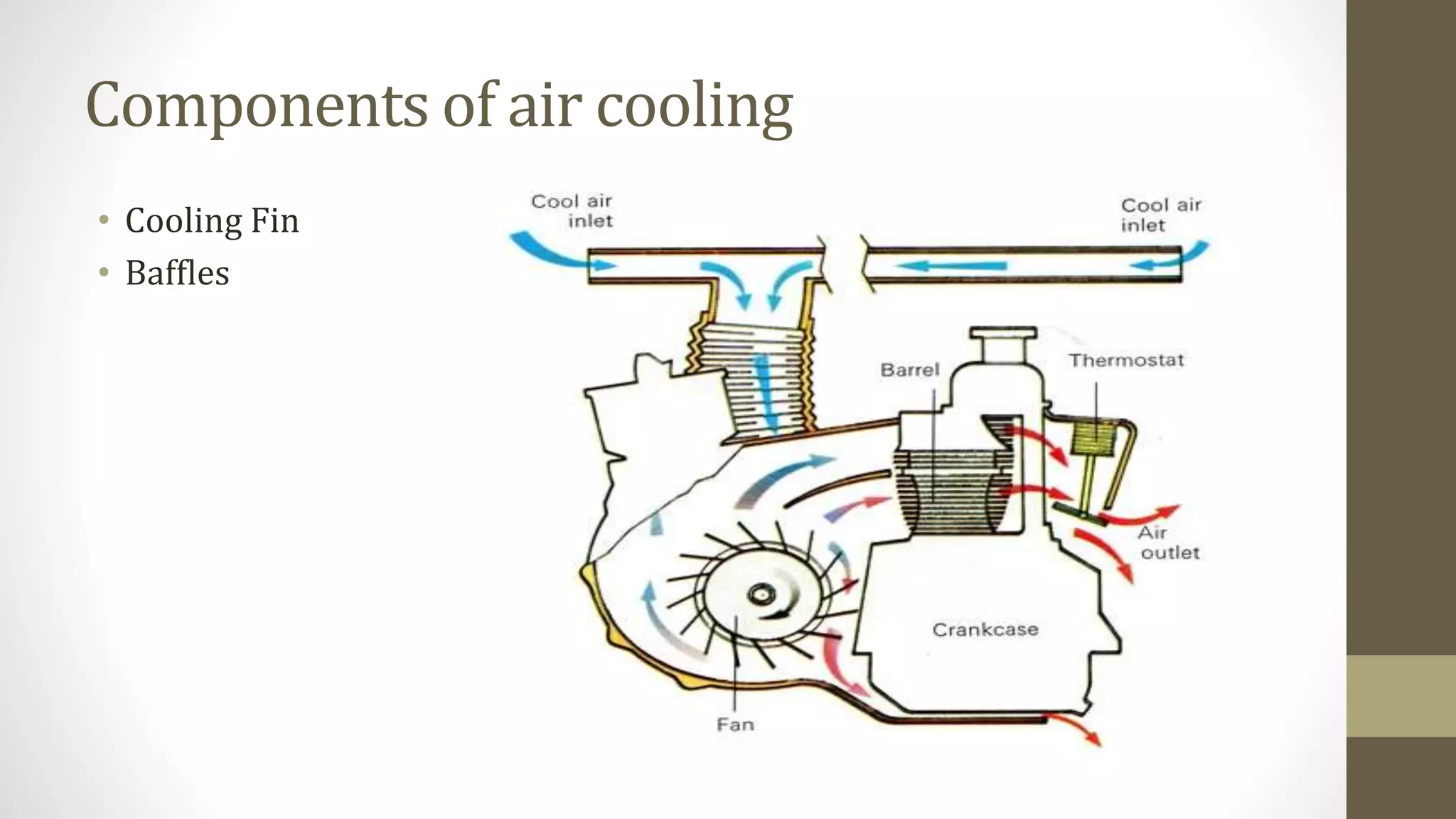
Components of air cooling
• Cooling Fin
• Baffles
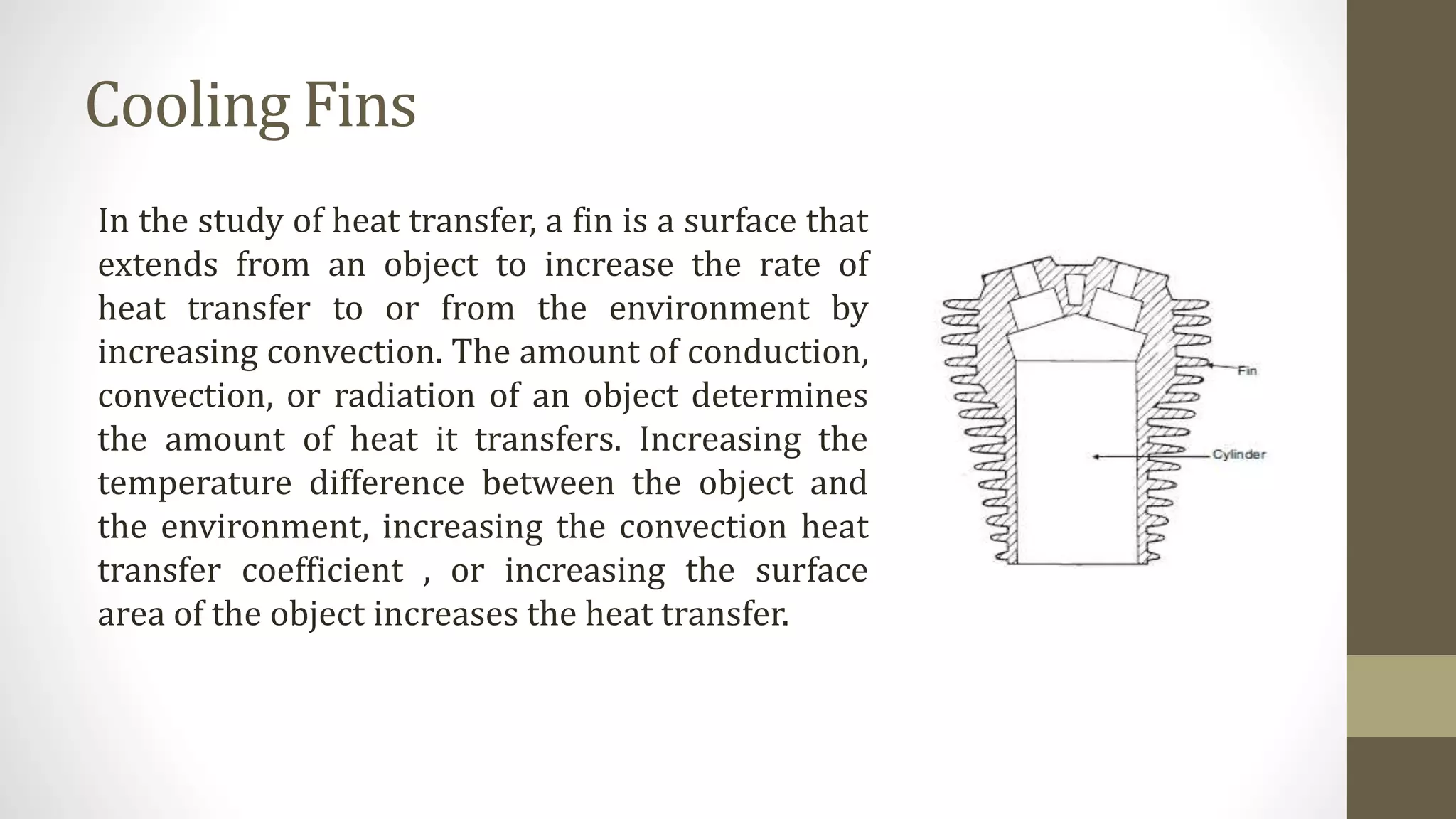
Cooling Fins
In the study of heat transfer, a fin is a surface that
extends from an object to increase the rate of
heat transfer to or from the environment by
increasing convection. The amount of conduction,
convection, or radiation of an object determines
the amount of heat it transfers. Increasing the
temperature difference between the object and
the environment, increasing the convection heat
transfer coefficient , or increasing the surface
area of the object increases the heat transfer.
Baffles
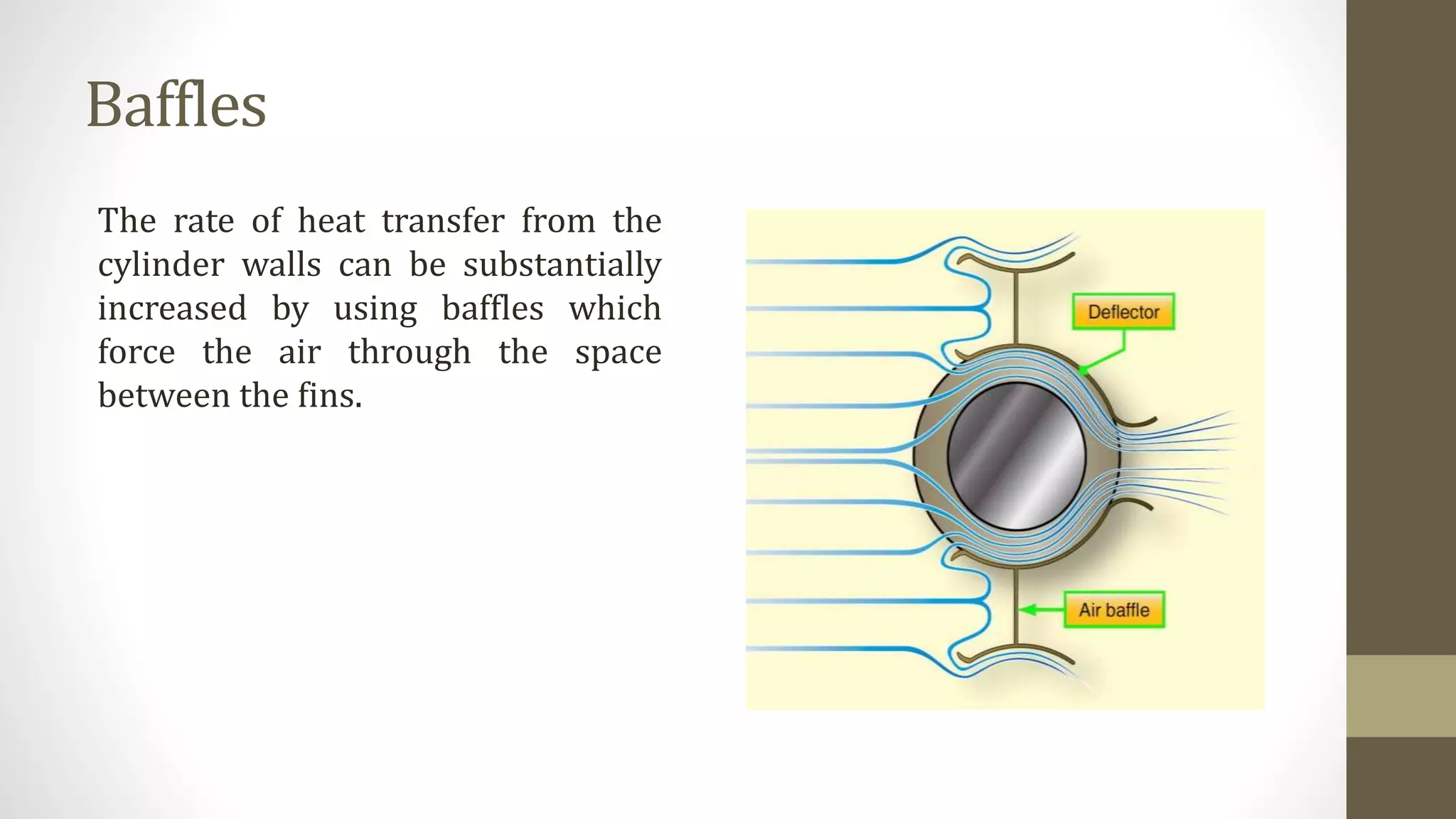
The rate of heat transfer from the
cylinder walls can be substantially
increased by using baffles which
force the air through the space
between the fins.
Advantages
• Radiator/pump is absent hence the system is light.
• In case of water cooling system there are leakages, but in this case here
are no leakages.
• Coolant and antifreeze solutions are not required.
• This system can be used in cold climates, where if water is used it may
freeze.
Disadvantages
• Comparatively it is less efficient.
• It is used in aero planes and motorcycle engines where the engines are
exposed to air directly.
3. Oil Cooling
• Oil cooling is the use of engine oil as a coolant, typically to remove surplus
heat from an internal combustion engine.
• The hot engine transfers heat to the oil which then usually passes through
a heat-exchanger, typically a type of radiator known as an oil cooler.
• The cooled oil flows back into the hot object to cool it continuously.
• If air-cooling proves sufficient for much of the running time,, then oil
cooling is an ideal way to cope with those times when extra cooling is
needed.
• But if the engine is a racing engine that is always producing huge amounts
of heat, water or liquid cooling may be preferable.
Advantages
• Oil has a higher boiling point than water, so it can be used to cool items at
a temperature of 100 °C or higher.
• Oil is an electrical insulator, thus it can be used inside of or in direct
contact with electrical components.
• Oil is already present as a lubricant, so no extra coolant tanks, pumps nor
radiators are required.
• Oil naturally helps to prevent corrosion.
Disadvantages
• Coolant oil may be limited to cooling objects under approximately 200–
300 °C, otherwise the oil may degrade and even leave ashy deposits.
• Pure water may evaporate or boil, but it cannot degrade, although it may
become polluted and acidic.
• Oil may be flammable.
• A given volume of water may absorb more engine heat than can the same
volume of oil.
COOLANT
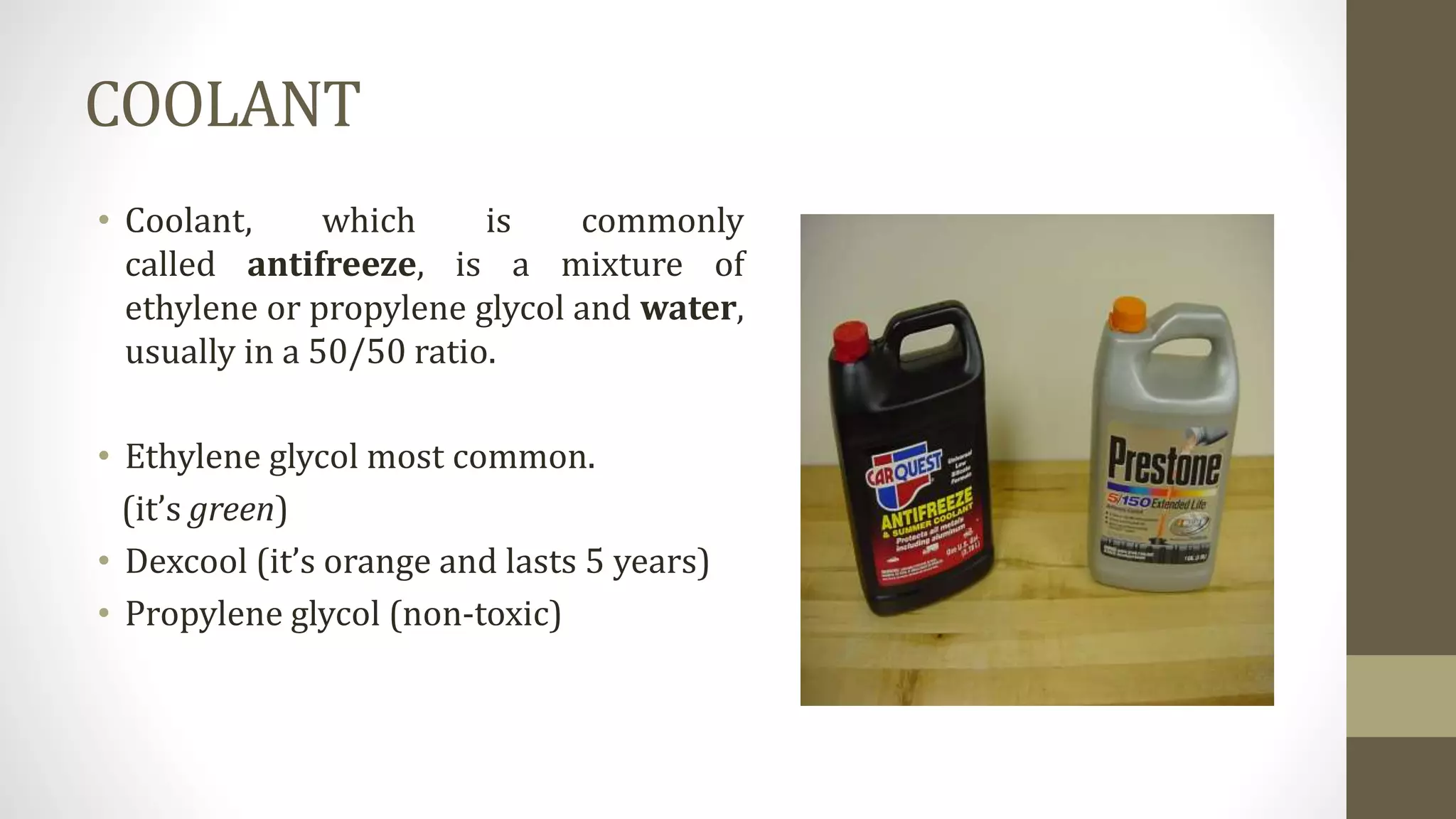
• Coolant, which is commonly
called antifreeze, is a mixture of
ethylene or propylene glycol and water,
usually in a 50/50 ratio.
• Ethylene glycol most common.
(it’s green)
• Dexcool (it’s orange and lasts 5 years)
• Propylene glycol (non-toxic)
CONCLUSION
The main objective of the research is to propose a cooling system that able
to control and maintain temperature inside the car. The radiator material in
the design shows an increased rate of heat transfer which is much greater
than the required value. In this way we can concluded, technically, that Out
of the total heat supplied to the engine in the form of fuel, approximately, 30
to 40% is converted into useful mechanical work; the remaining heat is
expelled to the environment through exhaust gases and engine cooling
systems, resulting in to entropy rise and serious environmental pollution,
so it is required to utilized waste heat into useful work.
OVERVIEW
Thank you

Cooling System in Automobile

  • 1.
    REGIONAL COLLEGE FOREDUCATION RESEARCH AND TECHNOLOGY NAME : SADDAM HUSSAIN ROLL NO.: 13ERCME059 ADVANCE COOLING SYSTEM IN AUTOMOBILE
  • 2.
    ABSTRACT The advancement inthe field of aerodynamics and the engine Management system has made the modern vehicles lot more Faster as compare to one from the previous generations. The engine size has not increased much for reaching this much speed and torque requirement. Modern engine which produce efficient results in form of fuel efficiency and power to weight ratio runs at higher rpm and produce more power every cycle, this is a great boon but the amount of heat to be released from the engine to the surrounding increases with the increase in maximum power and speed requirement. That is why we need a more advance engine cooling system that can achieve proper cooling of the engine without any compromise with the aerodynamics shape of vehicle.
  • 3.
    CONTENT • INTRODUCTION • CONVESIONALCOOLING SYSTEM • REQUIREMENT • TYPES • COMPONENTS • ADVANTAGES • DISADVATAGES • COOLANT • CONCLUSION • OVERVIEW
  • 4.
    INTRODUCTION • Nowadays, caris one the most important transportation for each individual compare to public transport. The transportation of goods and passengers using the modern highways where the speed requirement is lot higher with heavy load on the vehicle combined with problems in hot summers surely require an advance engine cooling system. • An automobile's cooling system is the collection of parts and substances (coolants) that work together to maintain the engine's temperature at optimal levels. Comprising many different components such as water pump, coolant, a thermostat etc. the system enables smooth and efficient functioning of the engine at the same time protecting it from damage • An automotive cooling system must perform several functions Remove excess from the engine Maintain a consist engine temperature
  • 5.
    CONVENTIONAL ENGINE COOLING SYSTEM Combustionof air and fuel takes place inside the engine cylinder and hot gases are generated inside an internal combustion engine. The temperature of gases may raise up to around 2300-2500 ℃, which is a very high temperature and may result into burning of oil film between the moving parts, pre combustion and may result into seizing or welding of the moving parts. • Heat dissipation to volume ratio of the system is less. • At high speeds it is difficult to maintain the temperature of engine components. • Heat rejected by the system (about 35%of heat generated) is wasted to the atmosphere.
  • 6.
    REQUIREMENT • Get theengine up to optimum operating Temperature as quickly as possible and maintains it at that temperature. • 4000 degree temps. could seriously damage engine parts. • Controls the heat produced in combustion chamber, so that the engine parts are not damaged & the oil does not break down. • The temp. of component must be maintained within certain limit in order to obtain maximum performance of engine. Adequate cooling is then a fundamental requirement associated with reciprocating I.C. engine.
  • 7.
    TYPES In order tocool the engine a cooling medium is required. On the basis of medium ,in general use for cooling I.C. engine ,types of cooling system are:- 1. Liquid or Indirect Cooling System. 2. Air or Direct Cooling System. 3. Oil Cooling System
  • 8.
    1. Liquid orIndirect cooling system • A liquid is circulated around the cylinders and absorb heat from the cylinder walls and cylinder head. • Coolant absorbs heat as it passes through the engine and also lubricates the water pump. • Hot coolant enters the radiator in which the heat is passed on to air that is flowing through the radiator.
  • 10.
    Components of watercooling • Water Jackets • Water Pump • Fan • Thermostat • Radiator
  • 11.
    Water Jackets • Designedto keep engine block and cylinder head cool. • Open spaces between the outside of cylinder and inside of cylinder block and head. • When engine is running at normal operating temperature, the coolant is forced through the water jackets in the engine block, through the head gasket, into the head, and back to the radiator.
  • 12.
    Water Pump • Drawsthe coolant from the radiator, through the lower radiator hose, and then forces it through the water jackets, back into the radiator. • If the clutch fan can be wiggled up and down, most likely the water pump needs to be replaced. • Water pumps gasket is placed between the water pump and the engine block to prevent leakage 9if left loose it might leak and if tightened too much it might crack.
  • 13.
    Fan • The fanis mounted on the impeller spindle driven by a suitable belt pulley arrangement. • Fan draws air through the radiator at low speeds.
  • 14.
    Thermostat • Thermostat placedbetween the cylinder head and top radiator hose. • The temperature that the thermostat opens is called thermostat rating. • The thermostat's main job is to allow the engine to heat up quickly, and then to keep the engine at a constant temperature.
  • 15.
    Radiator • Radiator isa heat exchanger that removes heat from the coolant passing through it. • Vehicles equipped with automatic transmission have transmission cooler build into the radiator. • The purpose of radiator is to provide a large amount of cooling surface area so that water passing downward through it in thin stream is cooled efficiently.
  • 16.
    Advantages • Uniform coolingof cylinder, cylinder head and valves. • Specific fuel consumption of engine improves by using water cooling system. • If we employ water cooling system, then engine need not be provided at the front end of moving vehicle. • Engine is less noisy as compared with air cooled engines, as it has water for damping noise.
  • 17.
    Disadvantages • It dependsupon the supply of water. • The water pump which circulates water absorbs considerable power. • If the water cooling system fails then it will result in severe damage of engine. • The water cooling system is costlier as it has more number of parts. Also it requires more maintenance and care for its parts.
  • 18.
    2. Air orDirect cooling system • In air cooled system a current of air made to flow past the outside of the cylinder barrel ,outer surface area which has been considerably increased by providing cooling fins. • The amount of heat dissipated to air depends upon : Amount of air flowing through the fins. Fin surface area. Thermal conductivity of metal used for fins.
  • 19.
    Components of aircooling • Cooling Fin • Baffles
  • 20.
    Cooling Fins In thestudy of heat transfer, a fin is a surface that extends from an object to increase the rate of heat transfer to or from the environment by increasing convection. The amount of conduction, convection, or radiation of an object determines the amount of heat it transfers. Increasing the temperature difference between the object and the environment, increasing the convection heat transfer coefficient , or increasing the surface area of the object increases the heat transfer.
  • 21.
    Baffles The rate ofheat transfer from the cylinder walls can be substantially increased by using baffles which force the air through the space between the fins.
  • 22.
    Advantages • Radiator/pump isabsent hence the system is light. • In case of water cooling system there are leakages, but in this case here are no leakages. • Coolant and antifreeze solutions are not required. • This system can be used in cold climates, where if water is used it may freeze.
  • 23.
    Disadvantages • Comparatively itis less efficient. • It is used in aero planes and motorcycle engines where the engines are exposed to air directly.
  • 24.
    3. Oil Cooling •Oil cooling is the use of engine oil as a coolant, typically to remove surplus heat from an internal combustion engine. • The hot engine transfers heat to the oil which then usually passes through a heat-exchanger, typically a type of radiator known as an oil cooler. • The cooled oil flows back into the hot object to cool it continuously. • If air-cooling proves sufficient for much of the running time,, then oil cooling is an ideal way to cope with those times when extra cooling is needed. • But if the engine is a racing engine that is always producing huge amounts of heat, water or liquid cooling may be preferable.
  • 25.
    Advantages • Oil hasa higher boiling point than water, so it can be used to cool items at a temperature of 100 °C or higher. • Oil is an electrical insulator, thus it can be used inside of or in direct contact with electrical components. • Oil is already present as a lubricant, so no extra coolant tanks, pumps nor radiators are required. • Oil naturally helps to prevent corrosion.
  • 26.
    Disadvantages • Coolant oilmay be limited to cooling objects under approximately 200– 300 °C, otherwise the oil may degrade and even leave ashy deposits. • Pure water may evaporate or boil, but it cannot degrade, although it may become polluted and acidic. • Oil may be flammable. • A given volume of water may absorb more engine heat than can the same volume of oil.
  • 27.
    COOLANT • Coolant, whichis commonly called antifreeze, is a mixture of ethylene or propylene glycol and water, usually in a 50/50 ratio. • Ethylene glycol most common. (it’s green) • Dexcool (it’s orange and lasts 5 years) • Propylene glycol (non-toxic)
  • 28.
    CONCLUSION The main objectiveof the research is to propose a cooling system that able to control and maintain temperature inside the car. The radiator material in the design shows an increased rate of heat transfer which is much greater than the required value. In this way we can concluded, technically, that Out of the total heat supplied to the engine in the form of fuel, approximately, 30 to 40% is converted into useful mechanical work; the remaining heat is expelled to the environment through exhaust gases and engine cooling systems, resulting in to entropy rise and serious environmental pollution, so it is required to utilized waste heat into useful work.
  • 29.
  • 30.