Convolutional Neural Networks on Graphs
with Fast Localized Spectral Filtering
Defferrard, Michaël, Xavier Bresson, and Pierre Vandergheynst
NIPS 2016
Unstructured data as graphs
• Majority of data is naturally unstructured, but can be
structured.
• Irregular / non-Euclidean data can be structured with graphs
• Social networks: Facebook, Twitter.
• Biological networks: genes, molecules, brain connectivity.
• Infrastructure networks: energy, transportation, Internet, telephony.
• Graphs can model heterogeneous pairwise relationships.
• Graphs can encode complex geometric structures.
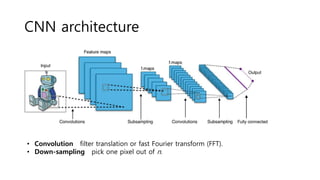
CNN architecture
• Convolution filter translation or fast Fourier transform (FFT).
• Down-sampling pick one pixel out of n.
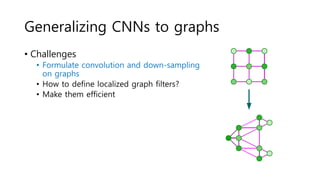
Generalizing CNNs to graphs
• Challenges
• Formulate convolution and down-sampling
on graphs
• How to define localized graph filters?
• Make them efficient
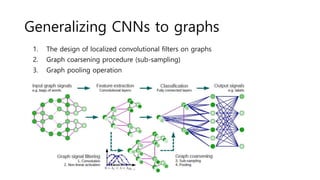
Generalizing CNNs to graphs
1. The design of localized convolutional filters on graphs
2. Graph coarsening procedure (sub-sampling)
3. Graph pooling operation
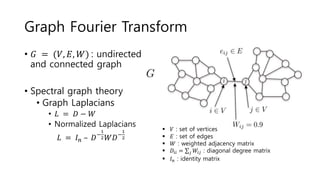
• 𝐺 = (𝑉, 𝐸, 𝑊) : undirected
and connected graph
• Spectral graph theory
• Graph Laplacians
• 𝐿 = 𝐷 − 𝑊
• Normalized Laplacians
𝐿 = 𝐼 𝑛 – 𝐷−
1
2 𝑊𝐷−
1
2
 𝑉 : set of vertices
 𝐸 : set of edges
 𝑊 : weighted adjacency matrix
 𝐷𝑖𝑖 = 𝑗 𝑊𝑖𝑗 : diagonal degree matrix
 𝐼 𝑛 : identity matrix
Graph Fourier Transform
• Graph Fourier Transform
• 𝐿 = 𝑈Λ𝑈 𝑇 (Eigen value decomposition)
• Graph Fourier basis 𝑈 = [𝑢0, … , 𝑢 𝑛−1]
• Graph frequencies Λ =
𝜆0 ⋯ 0
⋮ ⋱ ⋮
0 ⋯ 𝜆 𝑛−1
1. Graph signal 𝑥 ∶ 𝑉 → ℝ, 𝑥 ∈ ℝ 𝑛
2. Transform 𝑥 = 𝑈 𝑇 𝑥 ∈ ℝ 𝑛
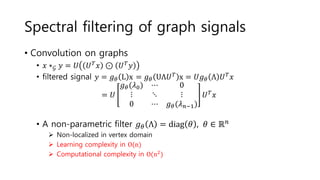
Spectral filtering of graph signals
• Convolution on graphs
• 𝑥 ∗ 𝒢 𝑦 = 𝑈 𝑈 𝑇 𝑥 ⊙ 𝑈 𝑇 𝑦
• filtered signal 𝑦 = 𝑔 𝜃 L x = 𝑔 𝜃 UΛ𝑈 𝑇
x = 𝑈𝑔 𝜃 Λ 𝑈 𝑇
𝑥
= 𝑈
𝑔 𝜃(𝜆0) ⋯ 0
⋮ ⋱ ⋮
0 ⋯ 𝑔 𝜃(𝜆 𝑛−1)
𝑈 𝑇 𝑥
• A non-parametric filter 𝑔 𝜃 Λ = diag 𝜃 , 𝜃 ∈ ℝ 𝑛
 Non-localized in vertex domain
 Learning complexity in O(n)
 Computational complexity in O(n2)
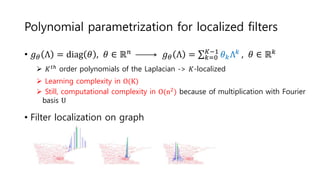
Polynomial parametrization for localized filters
• 𝑔 𝜃 Λ = diag 𝜃 , 𝜃 ∈ ℝ 𝑛
𝑔 𝜃 Λ = 𝑘=0
𝐾−1
𝜃 𝑘Λ 𝑘
, 𝜃 ∈ ℝ 𝑘
 𝐾 𝑡ℎ
order polynomials of the Laplacian -> 𝐾-localized
 Learning complexity in O(K)
 Still, computational complexity in O(n2
) because of multiplication with Fourier
basis U
• Filter localization on graph
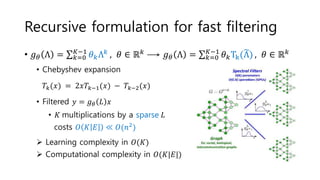
Recursive formulation for fast filtering
• 𝑔 𝜃 Λ = 𝑘=0
𝐾−1
𝜃 𝑘Λ 𝑘 , 𝜃 ∈ ℝ 𝑘 𝑔 𝜃 Λ = 𝑘=0
𝐾−1
𝜃 𝑘Tk(Λ) , 𝜃 ∈ ℝ 𝑘
• Chebyshev expansion
𝑇𝑘(𝑥) = 2𝑥𝑇𝑘−1(𝑥) − 𝑇𝑘−2(𝑥)
• Filtered 𝑦 = 𝑔 𝜃 𝐿 𝑥
• 𝐾 multiplications by a sparse 𝐿
costs 𝑂 𝐾 𝐸 ≪ 𝑂(𝑛2)
 Learning complexity in 𝑂(𝐾)
 Computational complexity in 𝑂(𝐾|𝐸|)
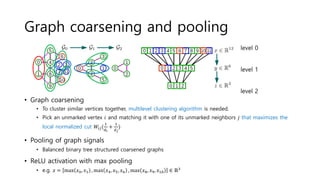
Graph coarsening and pooling
• Graph coarsening
• To cluster similar vertices together, multilevel clustering algorithm is needed.
• Pick an unmarked vertex 𝑖 and matching it with one of its unmarked neighbors 𝑗 that maximizes the
local normalized cut 𝑊𝑖𝑗(
1
𝑑 𝑖
+
1
𝑑 𝑗
)
• Pooling of graph signals
• Balanced binary tree structured coarsened graphs
• ReLU activation with max pooling
• e.g. 𝑧 = max 𝑥0, 𝑥1 , max 𝑥4, 𝑥5, 𝑥6 , max 𝑥8, 𝑥9, 𝑥10 ∈ ℝ3
level 0
level 1
level 2
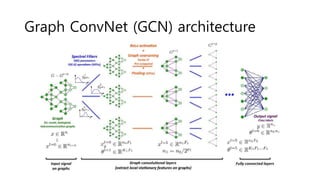
Graph ConvNet (GCN) architecture
Experiments
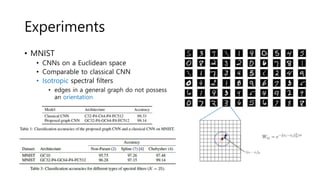
• MNIST
• CNNs on a Euclidean space
• Comparable to classical CNN
• Isotropic spectral filters
• edges in a general graph do not possess
an orientation
Experiments
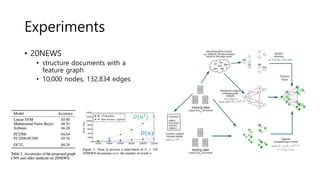
• 20NEWS
• structure documents with a
feature graph
• 10,000 nodes, 132,834 edges
𝑂(𝑛2
)
𝑂(𝑛)
Conclusion
• Contributions
• Spectral formulation of CNNs on graphs in GSP
• Strictly localized spectral filters are proposed
• Linear complexity of filters
• Efficient pooling on graphs
• Limitation
• Filters are not directly transferrable to a different graph
References
• Deep Learning on Graphs, a lecture on A Network Tour of Data Science
(NTDS) 2016
• Shuman, David I., et al. "The emerging field of signal processing on
graphs: Extending high-dimensional data analysis to networks and other
irregular domains." IEEE Signal Processing Magazine 30.3 (2013): 83-98.
• How powerful are Graph Convolutions? (http://www.inference.vc/how-
powerful-are-graph-convolutions-review-of-kipf-welling-2016-2/)
• GRAPH CONVOLUTIONAL NETWORKS (http://tkipf.github.io/graph-
convolutional-networks/)

Convolutional Neural Networks on Graphs with Fast Localized Spectral Filtering

  • 1.
    Convolutional Neural Networkson Graphs with Fast Localized Spectral Filtering Defferrard, Michaël, Xavier Bresson, and Pierre Vandergheynst NIPS 2016
  • 2.
    Unstructured data asgraphs • Majority of data is naturally unstructured, but can be structured. • Irregular / non-Euclidean data can be structured with graphs • Social networks: Facebook, Twitter. • Biological networks: genes, molecules, brain connectivity. • Infrastructure networks: energy, transportation, Internet, telephony. • Graphs can model heterogeneous pairwise relationships. • Graphs can encode complex geometric structures.
  • 3.
    CNN architecture • Convolutionfilter translation or fast Fourier transform (FFT). • Down-sampling pick one pixel out of n.
  • 4.
    Generalizing CNNs tographs • Challenges • Formulate convolution and down-sampling on graphs • How to define localized graph filters? • Make them efficient
  • 5.
    Generalizing CNNs tographs 1. The design of localized convolutional filters on graphs 2. Graph coarsening procedure (sub-sampling) 3. Graph pooling operation
  • 6.
    • 𝐺 =(𝑉, 𝐸, 𝑊) : undirected and connected graph • Spectral graph theory • Graph Laplacians • 𝐿 = 𝐷 − 𝑊 • Normalized Laplacians 𝐿 = 𝐼 𝑛 – 𝐷− 1 2 𝑊𝐷− 1 2  𝑉 : set of vertices  𝐸 : set of edges  𝑊 : weighted adjacency matrix  𝐷𝑖𝑖 = 𝑗 𝑊𝑖𝑗 : diagonal degree matrix  𝐼 𝑛 : identity matrix Graph Fourier Transform
  • 7.
    Graph Fourier Transform •Graph Fourier Transform • 𝐿 = 𝑈Λ𝑈 𝑇 (Eigen value decomposition) • Graph Fourier basis 𝑈 = [𝑢0, … , 𝑢 𝑛−1] • Graph frequencies Λ = 𝜆0 ⋯ 0 ⋮ ⋱ ⋮ 0 ⋯ 𝜆 𝑛−1 1. Graph signal 𝑥 ∶ 𝑉 → ℝ, 𝑥 ∈ ℝ 𝑛 2. Transform 𝑥 = 𝑈 𝑇 𝑥 ∈ ℝ 𝑛
  • 8.
    Spectral filtering ofgraph signals • Convolution on graphs • 𝑥 ∗ 𝒢 𝑦 = 𝑈 𝑈 𝑇 𝑥 ⊙ 𝑈 𝑇 𝑦 • filtered signal 𝑦 = 𝑔 𝜃 L x = 𝑔 𝜃 UΛ𝑈 𝑇 x = 𝑈𝑔 𝜃 Λ 𝑈 𝑇 𝑥 = 𝑈 𝑔 𝜃(𝜆0) ⋯ 0 ⋮ ⋱ ⋮ 0 ⋯ 𝑔 𝜃(𝜆 𝑛−1) 𝑈 𝑇 𝑥 • A non-parametric filter 𝑔 𝜃 Λ = diag 𝜃 , 𝜃 ∈ ℝ 𝑛  Non-localized in vertex domain  Learning complexity in O(n)  Computational complexity in O(n2)
  • 9.
    Polynomial parametrization forlocalized filters • 𝑔 𝜃 Λ = diag 𝜃 , 𝜃 ∈ ℝ 𝑛 𝑔 𝜃 Λ = 𝑘=0 𝐾−1 𝜃 𝑘Λ 𝑘 , 𝜃 ∈ ℝ 𝑘  𝐾 𝑡ℎ order polynomials of the Laplacian -> 𝐾-localized  Learning complexity in O(K)  Still, computational complexity in O(n2 ) because of multiplication with Fourier basis U • Filter localization on graph
  • 10.
    Recursive formulation forfast filtering • 𝑔 𝜃 Λ = 𝑘=0 𝐾−1 𝜃 𝑘Λ 𝑘 , 𝜃 ∈ ℝ 𝑘 𝑔 𝜃 Λ = 𝑘=0 𝐾−1 𝜃 𝑘Tk(Λ) , 𝜃 ∈ ℝ 𝑘 • Chebyshev expansion 𝑇𝑘(𝑥) = 2𝑥𝑇𝑘−1(𝑥) − 𝑇𝑘−2(𝑥) • Filtered 𝑦 = 𝑔 𝜃 𝐿 𝑥 • 𝐾 multiplications by a sparse 𝐿 costs 𝑂 𝐾 𝐸 ≪ 𝑂(𝑛2)  Learning complexity in 𝑂(𝐾)  Computational complexity in 𝑂(𝐾|𝐸|)
  • 11.
    Graph coarsening andpooling • Graph coarsening • To cluster similar vertices together, multilevel clustering algorithm is needed. • Pick an unmarked vertex 𝑖 and matching it with one of its unmarked neighbors 𝑗 that maximizes the local normalized cut 𝑊𝑖𝑗( 1 𝑑 𝑖 + 1 𝑑 𝑗 ) • Pooling of graph signals • Balanced binary tree structured coarsened graphs • ReLU activation with max pooling • e.g. 𝑧 = max 𝑥0, 𝑥1 , max 𝑥4, 𝑥5, 𝑥6 , max 𝑥8, 𝑥9, 𝑥10 ∈ ℝ3 level 0 level 1 level 2
  • 12.
    Graph ConvNet (GCN)architecture
  • 13.
    Experiments • MNIST • CNNson a Euclidean space • Comparable to classical CNN • Isotropic spectral filters • edges in a general graph do not possess an orientation
  • 14.
    Experiments • 20NEWS • structuredocuments with a feature graph • 10,000 nodes, 132,834 edges 𝑂(𝑛2 ) 𝑂(𝑛)
  • 15.
    Conclusion • Contributions • Spectralformulation of CNNs on graphs in GSP • Strictly localized spectral filters are proposed • Linear complexity of filters • Efficient pooling on graphs • Limitation • Filters are not directly transferrable to a different graph
  • 16.
    References • Deep Learningon Graphs, a lecture on A Network Tour of Data Science (NTDS) 2016 • Shuman, David I., et al. "The emerging field of signal processing on graphs: Extending high-dimensional data analysis to networks and other irregular domains." IEEE Signal Processing Magazine 30.3 (2013): 83-98. • How powerful are Graph Convolutions? (http://www.inference.vc/how- powerful-are-graph-convolutions-review-of-kipf-welling-2016-2/) • GRAPH CONVOLUTIONAL NETWORKS (http://tkipf.github.io/graph- convolutional-networks/)