Downloaded 889 times
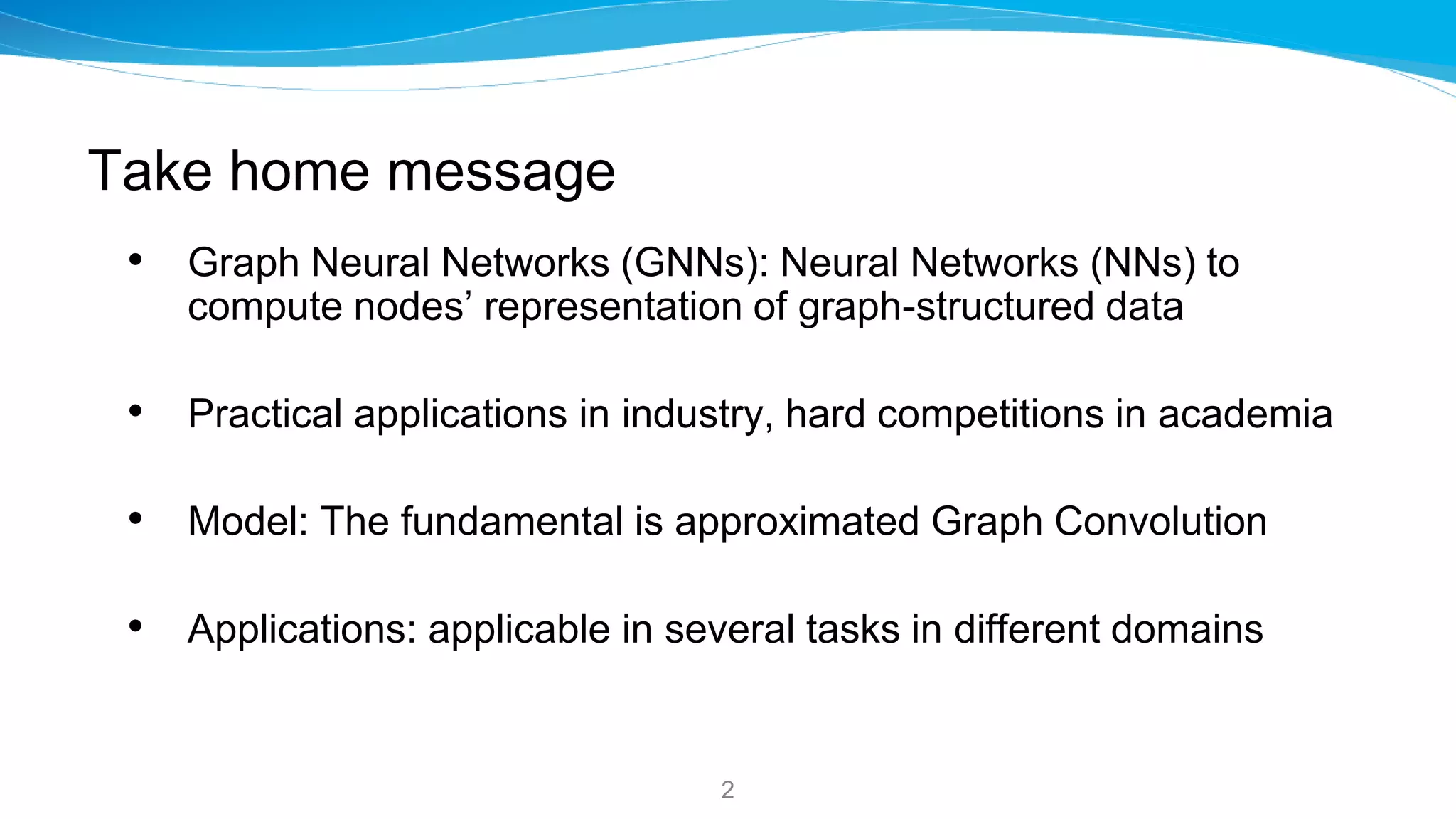


![Application Domains of GNNs: concrete
applications
Chemical Molecular Graph
[Jin18JTVAE, Laugier18CGCNN]
[http://konect.uni-
koblenz.de/networks/ucidata-
zachary]
Social Network
Scene Graph
[Qi19AttentiveRN]
Pointcloud [Landrieu_Boussaha19PCS]
Physical Simulator [Sanchez-Gonzalez20GNS]
Knowledge Graph
[DeCao19QA2]
10](https://image.slidesharecdn.com/ishigurognnintroduction201023-201027054344/75/Introduction-to-Graph-Neural-Networks-Basics-and-Applications-Katsuhiko-Ishiguro-PhD-10-2048.jpg)
![GNN in Machine Learning Researches
11
0
10
20
30
40
50
60
70
80
90
ICML ICLR NeurIPS
Numbers of accepted papers: “title: Graph”
2014 2015 2016 2017 2018 2019 2020 [by the lecturer]
~2016: “graphical models”, “graph kernels”, and pure graph theory works
2017~: GNN works add up the counts](https://image.slidesharecdn.com/ishigurognnintroduction201023-201027054344/75/Introduction-to-Graph-Neural-Networks-Basics-and-Applications-Katsuhiko-Ishiguro-PhD-11-2048.jpg)


![E.g. ConvNet in computer vision [Krizhevsky12ConvNet]
14 [http://image-net.org/challenges/LSVRC/2012/ilsvrc2012.pdf]
CnvNet (Alexnet)
[Krizhevsky12ConvNet]
10% margin
Former (Non-DNN) top runners:
> 1% difference
2012 ILSVRC competition](https://image.slidesharecdn.com/ishigurognnintroduction201023-201027054344/75/Introduction-to-Graph-Neural-Networks-Basics-and-Applications-Katsuhiko-Ishiguro-PhD-14-2048.jpg)
![E.g. ConvNet in computer vision [Krizhevsky12ConvNet]
• L- iterative conv. Operations for image pixels
15
Layer l
Layer l-1
Image signal (feature) at pixel (x,y) of layer l
shift signal filter
pixel (x, y)
[Kipf18talk]](https://image.slidesharecdn.com/ishigurognnintroduction201023-201027054344/75/Introduction-to-Graph-Neural-Networks-Basics-and-Applications-Katsuhiko-Ishiguro-PhD-15-2048.jpg)
![How can we define Conv. in graphs?
• No “axes” in graphs unlike sound signals (time) and
image signals (x, y)
• What is “coordinate”? What is “shift”?
16 [いらすとや]
Spectral approach on Graphs](https://image.slidesharecdn.com/ishigurognnintroduction201023-201027054344/75/Introduction-to-Graph-Neural-Networks-Basics-and-Applications-Katsuhiko-Ishiguro-PhD-16-2048.jpg)

![Def: Graph signals
• Simply concatenate numbers
• 1D node attribute case: N-array
• D-dim attribute case Feature matrix
18
[Ma20tutorial]](https://image.slidesharecdn.com/ishigurognnintroduction201023-201027054344/75/Introduction-to-Graph-Neural-Networks-Basics-and-Applications-Katsuhiko-Ishiguro-PhD-18-2048.jpg)


![21
Spatial domain: x
GFT
Spectral domain: 𝒙
[Ma20tutorial,Shuman13Graph]
Graph Fourier Transform: just multiply U^T or U
IGFT](https://image.slidesharecdn.com/ishigurognnintroduction201023-201027054344/75/Introduction-to-Graph-Neural-Networks-Basics-and-Applications-Katsuhiko-Ishiguro-PhD-21-2048.jpg)


![• Model N trainable param. with K (<<N) order
Chebychev Polynomials
Approximation: ChebyNet [Defferrard16ChebNet]
Chebychev
Polynomial
24](https://image.slidesharecdn.com/ishigurognnintroduction201023-201027054344/75/Introduction-to-Graph-Neural-Networks-Basics-and-Applications-Katsuhiko-Ishiguro-PhD-24-2048.jpg)

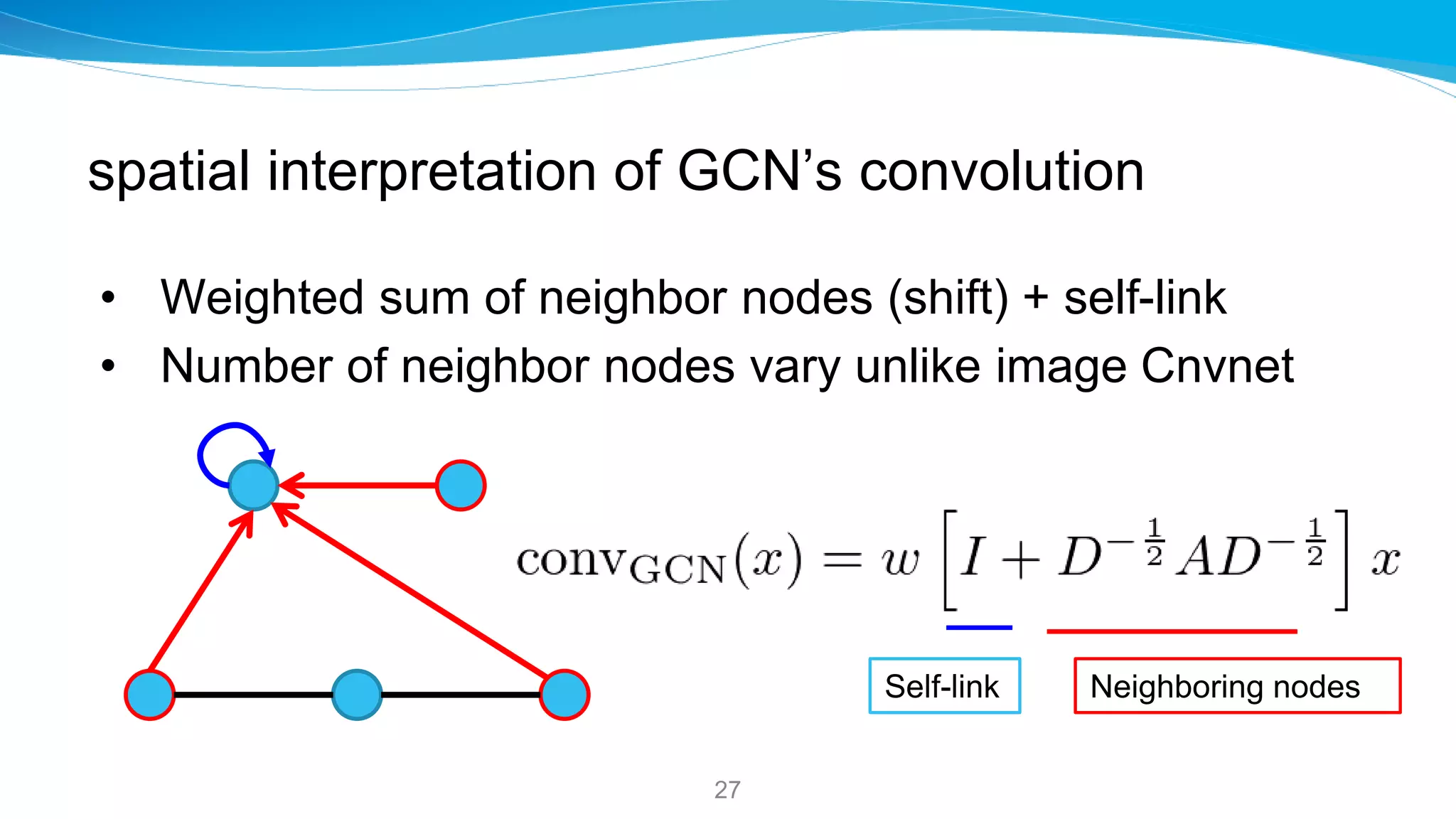
![GCN [Kipf_Welling17GCN]: much simpler Convolution
26
Set K = 1, and replace l_N with 2 (the theoretical maximum value)
Assume w = -w1 = (w0-w1)
Very simple GraphConv
• No Eig. Decomp.
• No Matrix Polynomials
• single tunable parameter (w)](https://image.slidesharecdn.com/ishigurognnintroduction201023-201027054344/75/Introduction-to-Graph-Neural-Networks-Basics-and-Applications-Katsuhiko-Ishiguro-PhD-26-2048.jpg)


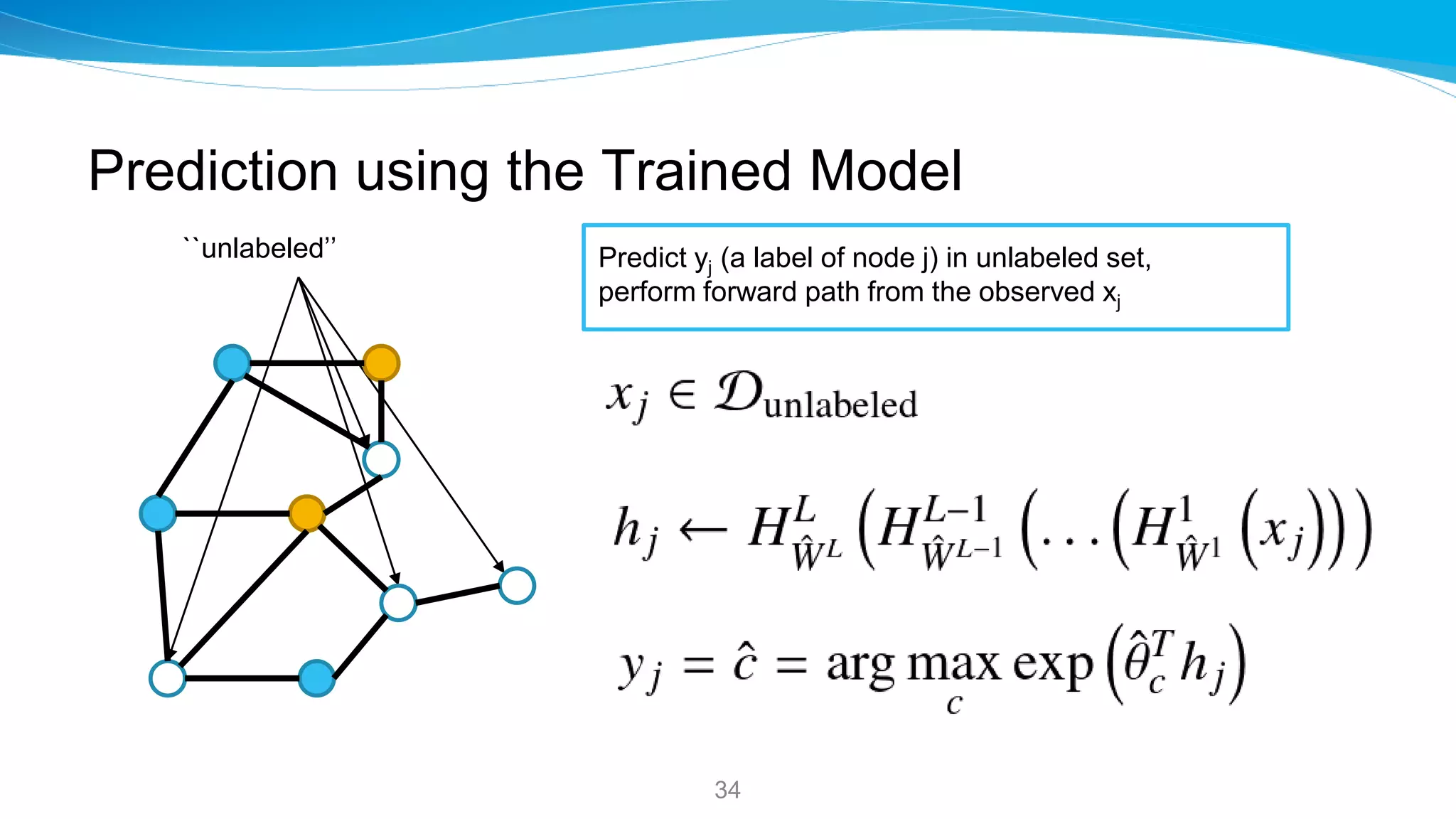
![The simplest GCN… it works quite well
30
[Kipf_Welling17GCN]
Perform better than
the original ChebNet](https://image.slidesharecdn.com/ishigurognnintroduction201023-201027054344/75/Introduction-to-Graph-Neural-Networks-Basics-and-Applications-Katsuhiko-Ishiguro-PhD-30-2048.jpg)




![Predict binding site nodes by GNN [Fout17Interface]
• Predict the binding site regions of ligand-receptor
proteins
– Possible binding = possible drug discovery and
improvement
• Protein: a graph of inter-connected amino acids
• Use GNN for the binding prediction
37](https://image.slidesharecdn.com/ishigurognnintroduction201023-201027054344/75/Introduction-to-Graph-Neural-Networks-Basics-and-Applications-Katsuhiko-Ishiguro-PhD-37-2048.jpg)
![Attributed Protein Graphs
38
[Sanyal20PGCN]
Node (residue): a sub-structure
consists of amino acids
Ligand protein graph
Receptor protein graph
Binding sites: specific nodes interact between ligand and receptor](https://image.slidesharecdn.com/ishigurognnintroduction201023-201027054344/75/Introduction-to-Graph-Neural-Networks-Basics-and-Applications-Katsuhiko-Ishiguro-PhD-38-2048.jpg)
![Training/Test of Interaction Prediction [Fout17Interface]
• Training: optimize parameters to predict the interaction
label between a node pair ( , ) (for all training
sampls)
• Test: predict interactions of node pairs in unseen
Ligand-Receptor pairs
– “Train once, run any graphs (with different topology)”
39
minimize](https://image.slidesharecdn.com/ishigurognnintroduction201023-201027054344/75/Introduction-to-Graph-Neural-Networks-Basics-and-Applications-Katsuhiko-Ishiguro-PhD-39-2048.jpg)
![architecture
40
Classify all pairs of node latent vectors in one-shot
[Fout17Interface]](https://image.slidesharecdn.com/ishigurognnintroduction201023-201027054344/75/Introduction-to-Graph-Neural-Networks-Basics-and-Applications-Katsuhiko-Ishiguro-PhD-40-2048.jpg)
![GCN formulation choices
41
Considering nodes
features only
Node features plus
Edge features
With ordering of
nearest node orders
Neighbor nodes j are ordered by distances from the node i
[Fout17Interface]](https://image.slidesharecdn.com/ishigurognnintroduction201023-201027054344/75/Introduction-to-Graph-Neural-Networks-Basics-and-Applications-Katsuhiko-Ishiguro-PhD-41-2048.jpg)
![Results
42
[Fout17Interface]](https://image.slidesharecdn.com/ishigurognnintroduction201023-201027054344/75/Introduction-to-Graph-Neural-Networks-Basics-and-Applications-Katsuhiko-Ishiguro-PhD-42-2048.jpg)
![43
[Fout17Interface]](https://image.slidesharecdn.com/ishigurognnintroduction201023-201027054344/75/Introduction-to-Graph-Neural-Networks-Basics-and-Applications-Katsuhiko-Ishiguro-PhD-43-2048.jpg)

![Scene Graph: summary graph of image contents
• Useful representation of images’ understanding
• Want to generate a scene graph from image input
45
[Qi19AttentiveRN]
In a scene graph of an image,
node: object region in an image
edge: relation between object regions](https://image.slidesharecdn.com/ishigurognnintroduction201023-201027054344/75/Introduction-to-Graph-Neural-Networks-Basics-and-Applications-Katsuhiko-Ishiguro-PhD-45-2048.jpg)
![Graph R-CNN for scene-graph generation
[Yang18GRCNN]
• Consists of three inner components
– (a) (b) Off-the-shelf object detector [Ren15RCNN] (omit)
– (b) (c) RePN to prune unnecessary branches (omit)
– (c) (d) Attentional GCN to predict labels of nodes and edges
[Yang18GRCNN]46](https://image.slidesharecdn.com/ishigurognnintroduction201023-201027054344/75/Introduction-to-Graph-Neural-Networks-Basics-and-Applications-Katsuhiko-Ishiguro-PhD-46-2048.jpg)
![Graph
Expansion
Expand Graph with Relation Nodes
47
[Yang18GRCNN]
Objects detected
Original input graph
(sparsified by RePN):
node = object
edge = relation Object node
Obj-Obj edge
Relation node
Obj-Rel node
One GNN can infer
all objects and relations](https://image.slidesharecdn.com/ishigurognnintroduction201023-201027054344/75/Introduction-to-Graph-Neural-Networks-Basics-and-Applications-Katsuhiko-Ishiguro-PhD-47-2048.jpg)
![Attentional GCN [Yang18GRCNN]
• GCN update with Attention [Bahdanau15Attention] -based variable
connection
48
GCN
Attentional GCN
Adjacency is fixed
Object node’s
latent vector
Relation node’s
latent vector
Parameter f can switch based on node types
Attention conncection](https://image.slidesharecdn.com/ishigurognnintroduction201023-201027054344/75/Introduction-to-Graph-Neural-Networks-Basics-and-Applications-Katsuhiko-Ishiguro-PhD-48-2048.jpg)
![Ground Truth Scene GraphExpanded Graph
[Yang18GRCNN]
Inferring labels of objects/relations
49
Object node’s latent vector
Relation node’s latent vector](https://image.slidesharecdn.com/ishigurognnintroduction201023-201027054344/75/Introduction-to-Graph-Neural-Networks-Basics-and-Applications-Katsuhiko-Ishiguro-PhD-49-2048.jpg)
![[Yang18GRCNN]50
predicted
predicted
predicted
predicted
predicted
predicted](https://image.slidesharecdn.com/ishigurognnintroduction201023-201027054344/75/Introduction-to-Graph-Neural-Networks-Basics-and-Applications-Katsuhiko-Ishiguro-PhD-50-2048.jpg)
![Other Application of GNNs
• Segmentation of pointcloud w/ 10^5 samples [Hu20RandLaNet]
– Decode laser rangefinder data into 3D obstacle map
• Particle-based Physical simulator [Sanchez-Gonzalez20GNS]
– Simulate fluid dynamics via GNN
• Molecular Graph Generation [Jin18JTVAE, Madhawa19GVNP]
– Generate a novel compound graph in computers
51](https://image.slidesharecdn.com/ishigurognnintroduction201023-201027054344/75/Introduction-to-Graph-Neural-Networks-Basics-and-Applications-Katsuhiko-Ishiguro-PhD-51-2048.jpg)


![``Deep” GNNs do not work well
54
[Kipf_Welling17GCN]
Better
Quite different from the successful deep Conv models in Computer vision](https://image.slidesharecdn.com/ishigurognnintroduction201023-201027054344/75/Introduction-to-Graph-Neural-Networks-Basics-and-Applications-Katsuhiko-Ishiguro-PhD-54-2048.jpg)
![Oversmoothing Problem [Li18Oversmoothing]
• Latent node vectors get closer to each other as the
GCN layers go deeper (higher)
• Difficult to distinguish nodes in deeper GCNs
55
Latent node vectors of ``Karate club’’ social network [Li18Oversmoothing]](https://image.slidesharecdn.com/ishigurognnintroduction201023-201027054344/75/Introduction-to-Graph-Neural-Networks-Basics-and-Applications-Katsuhiko-Ishiguro-PhD-55-2048.jpg)
![Oversmoothing is theoretically proven
• Deeper GCN converges to a solution where
connected nodes will have similar latent vectors
[Li18Oversmoothing, NT_Maehara19revisit]
• Such convergence in GCN proceeds very quickly
(exponential to the depth), regardless of the initial
node vectors [Oono_Suzuki20Exponential]
– Similar conclusion also holds for a generic GNN
56](https://image.slidesharecdn.com/ishigurognnintroduction201023-201027054344/75/Introduction-to-Graph-Neural-Networks-Basics-and-Applications-Katsuhiko-Ishiguro-PhD-56-2048.jpg)
![A good workaround [Zhou20Deep, Chen20SimpleDeep, Li20DeeperGCN]
• Combining a proper normalizer and a residual term
– Normalizing the latent node vectors keep distant
from each other [Zhao_Akoglu20PairNorm]
– Residual terms keep the norm of loss gradients in
a moderate scale [Kipf_Welling17GCN]
57
Residual term:
Add the current layer ‘’as it is’’
Not a workaround for “deeper layers, stronger GNNs” (like image recognition)](https://image.slidesharecdn.com/ishigurognnintroduction201023-201027054344/75/Introduction-to-Graph-Neural-Networks-Basics-and-Applications-Katsuhiko-Ishiguro-PhD-57-2048.jpg)
![The theoretical limit of representation powers of
GNNs
• Surprisingly, the limitation of GNNs is already known in
the problem of “graph isomorphism” test
• The theory does NOT directly give limitations of GNN’s
power for other tasks (i.e. node classification), but it is
loosely related [Chen19RGNN]
58](https://image.slidesharecdn.com/ishigurognnintroduction201023-201027054344/75/Introduction-to-Graph-Neural-Networks-Basics-and-Applications-Katsuhiko-Ishiguro-PhD-58-2048.jpg)
![Graph isomorphism problem (for theory of GNNs)
• Classify whether two given graphs have an edge-
preserving bijective map of node sets
– the same topology in terms of the edges?
59
[ https://ja.wikipedia.org/wiki/グラフ同型 ]
The same
graph?](https://image.slidesharecdn.com/ishigurognnintroduction201023-201027054344/75/Introduction-to-Graph-Neural-Networks-Basics-and-Applications-Katsuhiko-Ishiguro-PhD-59-2048.jpg)
![Weisfeiler-Lehman (WL) test algorithm [Weisfeiler_Lehman68WL]
• A popular heuristics to test the isomorphism
• Idea: concatenate the neighbour nodes’ labels to check
the edge topology
– Used in graph kernels [Shervashidze11WLKernel, Togninalli18WWL] and
GNNs [Jin17WLorg, Morris19kGNN]
60](https://image.slidesharecdn.com/ishigurognnintroduction201023-201027054344/75/Introduction-to-Graph-Neural-Networks-Basics-and-Applications-Katsuhiko-Ishiguro-PhD-60-2048.jpg)
![Weisfeiler-Lehman (WL) test algorithm [Weisfeiler_Lehman68WL]
61
[Shervashidze11WLKernel]](https://image.slidesharecdn.com/ishigurognnintroduction201023-201027054344/75/Introduction-to-Graph-Neural-Networks-Basics-and-Applications-Katsuhiko-Ishiguro-PhD-61-2048.jpg)
![Upper limit of the GNN’s representation power
• In terms of the Graph Isomorphism problem,
a generic GNN ≦ WL test algorithm [Xu19GIN, Morris19WL]
– There could be a case where WL test can decide
isomorphism but GNN can not.
62](https://image.slidesharecdn.com/ishigurognnintroduction201023-201027054344/75/Introduction-to-Graph-Neural-Networks-Basics-and-Applications-Katsuhiko-Ishiguro-PhD-62-2048.jpg)
![Graph Isomorphism Network (GIN) [Xu19GIN]
• Proposed a specific GNN architecture that attain the
same graph isomorphism detection power
63
Each layer update must be as powerful as MLP
A layer update of
typical GNNs
One non-linear activation function
A layer update of
the proposed GIN](https://image.slidesharecdn.com/ishigurognnintroduction201023-201027054344/75/Introduction-to-Graph-Neural-Networks-Basics-and-Applications-Katsuhiko-Ishiguro-PhD-63-2048.jpg)
![Higher-order WL/GNN
• k-dimensional WL (k-WL) test
– labels the k-tuple of nodes
– powerful than the originalWL
– K-GNN [Morris19kGNN] is as good
as k-WL test
64
[Maron19NeurIPS]](https://image.slidesharecdn.com/ishigurognnintroduction201023-201027054344/75/Introduction-to-Graph-Neural-Networks-Basics-and-Applications-Katsuhiko-Ishiguro-PhD-64-2048.jpg)
![More powerful GNNs [Sato20Survey]
• K-order graph network
– consists of all linear functions that are invariant or
equivariant to node permutations [Maron19ICLR]
– as powerful as k-GNN, memory-efficient [Maron19NeurIPS]
• CPNGNN introduces the local node ordering, and is
strictly powerful than GIN [Sato19CPNGNN]
65](https://image.slidesharecdn.com/ishigurognnintroduction201023-201027054344/75/Introduction-to-Graph-Neural-Networks-Basics-and-Applications-Katsuhiko-Ishiguro-PhD-65-2048.jpg)


![Surveys and documents for studying GNN
• Survey papers on GNN
– [Wu19survey] [Zhou18survey]
– For experts: [Battaglia18survey]
• Tutorials, slideshare, blogs
– English: [Kipf18talk], [Ma20AAAI]
– 日本語: [Honda19GNN]
69](https://image.slidesharecdn.com/ishigurognnintroduction201023-201027054344/75/Introduction-to-Graph-Neural-Networks-Basics-and-Applications-Katsuhiko-Ishiguro-PhD-69-2048.jpg)


![Dataset for specific domains
• MoleculeNet [Wu18MoleculeNet]
– Molecular graph datasets from several chemical field.
TensorFlow implmenetaions attached
• Scene Graphs
– Visual Genome[Krishna17VG]: 108K images
• Pointcloud
– S3DIS [Armeni16S3DIS]: inside office
72](https://image.slidesharecdn.com/ishigurognnintroduction201023-201027054344/75/Introduction-to-Graph-Neural-Networks-Basics-and-Applications-Katsuhiko-Ishiguro-PhD-72-2048.jpg)

![References A-G
[Anderson19Cormorant] Anderson+, “Comorant: Covariant Molecular Neural Networks”, NeurIPS, 2019.
[Armeni16S3DIS] Armeni+, “3D Semantics Parsing of Large-scale Indoor Spaces”, CVPR, 2016.
[Bahdanau15Attention] Bahdanau+, “Neural Machine Translation by Jointly Learning to Align and Translate”, ICLR,
2015.
[Battaglia18survey] Battaglia+, “Relational Inductive Biases, Deep Learning, and Graph Networks”, arXiv:
1806.01261v3 [cs.LG], 2018.
[Bruna14Spectral] Bruna+, “Spectral Networks and Locally Connected Networks on Graphs”, ICLR, 2014.
[Chem19RGNN] Chen+, “On the Equivalence between Graph Isofmorphism Testing and Function Approximaion with
GNNs”, NeurIPS 2019.
[Chen20SimpleDeep] Chen+, “Simple and Deep Graph Convolutional Networks”, ICML 2020.
[DeCao19QA2] De Cao+, “Question Answering by Reasoning Across Documents with Graph Convolutional Networks“,
ICML Workshop, 2019.
[Defferrard16ChebNet] Defferrard+, “Convoluional Neural Networks on Graphs with Fast Localized Spectral Filtering”,
NIPS, 2016.
[Fout17Interface] Fout+, “Protein Interface Prediction using Graph Convolutional Networks”, NIPS, 2017.
[Gilmer17MPNN] Gilmer+, “Neural Message Passing for Quantum Chemistry”, ICML, 2017.](https://image.slidesharecdn.com/ishigurognnintroduction201023-201027054344/75/Introduction-to-Graph-Neural-Networks-Basics-and-Applications-Katsuhiko-Ishiguro-PhD-74-2048.jpg)
![References H-K
[Hamilton17GraphSAGE] Hamilton+, “Inductive Representation Learning on Large Graphs”, NIPS 2017.
[Honda19GNN] Honda, “GNNまとめ(1-3)”, 2019. https://qiita.com/shionhonda/items/d27b8f13f7e9232a4ae5
https://qiita.com/shionhonda/items/0d747b00fe6ddaff26e2
https://qiita.com/shionhonda/items/e11a9cf4699878723844
[Hu20RandLaNet] Hu+, “RandLA-Net: Efficient Semantic Segmentation of Large-Scale Point Clouds”, CVPR 2020.
[Jin17WLorg] Jin+, “Predicting Organic Reaction Outcomes with Weisfeiler-Lehman Network”, NIPS 2017.
[Jin18JTVAE] Jin+, “Junction Tree Variational Autoencoder for Molecular Graph Generation”, ICML 2018.
[Kipf18talk] Kipf, “Structured Deep Models: Deep learning on graphs and beyond”, 2018.
http://tkipf.github.io/misc/SlidesCambridge.pdf
[Kipf_Welling17GCN] Kipf and Welling, “Semi-supervised Classification with Graph Convolutional Networks”, ICLR
2017.
[Klicepra20DimeNet] Klicepra+, “Directional Message Passing for Molecular Graphs”, ICLR 2020.
[Krizhevsky12ConvNet] Krizhevsky+, “ImageNet Classification with Deep Convolutional Neural Networks”, NIPS 2012.
[Krishna17VG] Krishna+, “Visual genome: Connecting language and vision using crowdsourced dense image
annotations”, ICCV, 2017. 75](https://image.slidesharecdn.com/ishigurognnintroduction201023-201027054344/75/Introduction-to-Graph-Neural-Networks-Basics-and-Applications-Katsuhiko-Ishiguro-PhD-75-2048.jpg)
![References L
[Landrieu_Boussaha19PCS] Landrieu and Boussaha, “Point Cloud Oversegmentation with Graph-Structured Deep
Metric Learning”, CVPR, 2019.
[Laugier18CGCNN] Laugier+, “Predicting thermoelectric properties from crystal graphs and material descriptors - first
application for functional materials”, NeurIPS Workshop, 2018.
[Li16GGNN] Li+, “Gated Graph Sequence Neural Networks”, ICLR, 2016.
[Li18Oversmoothing] Li+, “Deeper Insights into Graph Convolutional Networks for Semi-Supervised Learning”, arXiv:
1801.07606 [cs.LG], 2018.
[Li19DeepGCNs] Li+, “DeepGCNs: can GCNs go as deep as CNNs?”, ICCV 2019.
[Li20DeperGCN] Li+, “DeeperGCN: ALL You Need to Train Deeper GCNs”, arXiv: 2006.07739, 2020
[Lu16VRD] Lu+,”Visual Relationship Detection with Language Priors”, ECCV, 2016.
[Liu18CGVAE] Liu+, “Constrained Graph Variational Autoencoders for Molecule Design”, NeurIPS 2018.
76](https://image.slidesharecdn.com/ishigurognnintroduction201023-201027054344/75/Introduction-to-Graph-Neural-Networks-Basics-and-Applications-Katsuhiko-Ishiguro-PhD-76-2048.jpg)
![References M-P
[Ma20tutorial] Ma+, “Graph Neural Networks: Models and Applications”, AAAI, 2020.
http://cse.msu.edu/~mayao4/tutorials/aaai2020/
[Madhawa19GNVP] Madhawa+, “GraphNVP: An Invertible Flow Model for Generating Molecular Graphs”, arXiv:
1905.11600, 2019.
[Marrn19NeurIPS] Marron+, “Provably Powerful Graph Networks”, NeurIPS, 2019.
[Maron19ICLR] Marron+, “Invariant and Equivariant Graph Networks”, ICLR 2019.
[Morris19kGNN] Morris+, “Weisfeiler and Lehman Go Neural: Higher-order Graph Neural Networks”, AAAI, 2019.
[Ngueyn_Maehara20Homomorph] Nguyen and Maehara, “Graph Homomorphism Network”, ICML, 2020.
[NT_Maehara19revisit] NT and Maehara, “Revisiting Graph Neural Networks: All We Have is Low-pass Filters”, arXiv:
1905.09550, 2019.
[Oono_Suzuki20Exponential] Oono and Suzuki, “Graph Neural Networks Exponentially Lose Expressive Power for
Node Classification”, ICLR 2020.
[Pei20GeomGCN] Pei+, “Geom-GCN: Geometric Graph Convolutional Networks”, ICLR, 2020.
77](https://image.slidesharecdn.com/ishigurognnintroduction201023-201027054344/75/Introduction-to-Graph-Neural-Networks-Basics-and-Applications-Katsuhiko-Ishiguro-PhD-77-2048.jpg)
![References Q-V
[Qi19AttentiveRN] Qi+, “Attentive Relataional Networks for Mapping Images to Scene Graphs”, CVPR, 2019.
[Sanchez-Gonzalez20GNS] Sanchez-Gonzalez+, “Learning to Simulate Complex Physics with Graph Networks”,
arXiv: 2002.09405. 2020.
[Sanyal20PGCN] Sanyal+, “Protein GCN: Protein model quality assessment using graph convolutional networks”,
bioRxiv, 2020.
[Sato19CPNGNN] Sato+, “Approximation Ratios of Graph Neural Networks for Combinatorial Problems”, NeurIPS,
2019.
[Sato20Survey] Sato, “A Survey on the Expressive Power of Graph Neural Networks”, arXiv: 2003.04078.
[Scarselli08GNN] Scarselli+, “The Graph Neural Network Model”, IEEE Trans. Neural Networks, 20(1), pp. 61-80,
2008
[Schlichtkrull18RGCN] Modeling Relational Data with Graph Convolutional Networks, ESWC 2018.
[Shervashidze11WLKernel: Shervashidez+, “Weisfeiler-Lehman Graph Kernels”, JMLR, 12, pp.2539-2661, 2011.
[Shuman13Graph] Shuman+, “The emerging field of signal processing on graphs: extending high-dimensional data
analysis to networks and other irregular domains”, IEEE Signal Processing Magazine, 30(3), pp.83-98, 2013
[Togninalli18WWL] Togninalli+, “Wasserstein Weisfeiler-Lehman Graph Kernels”, NeurIPS 2018.
[Veličković18GAT] Veličković+, “Graph Attention Networks”, ICLR 2018.](https://image.slidesharecdn.com/ishigurognnintroduction201023-201027054344/75/Introduction-to-Graph-Neural-Networks-Basics-and-Applications-Katsuhiko-Ishiguro-PhD-78-2048.jpg)
![References W-Z
[Wang18NLNN] Wang+, “Non-local Neural Networks”, CVPR 2018.
[Weisfeiler_Lehman68WL] Weisfeiler and Lehman, “A Reduction of a Graph to a Canonical Form and an Algebra
Arising during this Reduction”, Nauchno-Technicheskaya Informatsia, Ser.2(9), pp.12-16, 1968.
[Wu18MoleculeNet] Wu+, “MoleculeNet: a benchmark for molecular machine learning”, Chemical Science, 9(513),
2018.
[Wu19SGC] Wu+, “Simplifying Graph Convolutional Networks”, in Proc. ICML, 2019.
[Wu19survey] Wu+, “A Comprehensive Survey on Graph Neural Networks”, arXiv:1901.00596v1 [cs.LG], 2019.
[Xu19GIN] Xu+, “How powerful are Graph Neural Networks?”, in Proc. ICLR, 2019.
[Yang18GRCNN] Yang+, “Graph R-CNN for Scene Graph Generation”, ECCV, 2018.
[You18GCPN] You+, “Graph Convolutional Policy Network for Goal-Directed Molecular Graph Generation”, NeurIPS
2018.
[Zhao_Akoglu20PairNorm] Zhao and Akoglu, “PairNorm: Tackling Oversmoothing in GNNs”, ICLR, 2020.
[Zhou20Deep] Zhou+, “Effective Training Strategies for Deep Graph Neural Networks”, arXiv: 2006.07107, 2020.
[Zhou18survey] Zhou+, “Graph Neural Networks: A Review of Methods and Applications”, arXiv: 1812.08434v2
[cs.LG], 2018. 79](https://image.slidesharecdn.com/ishigurognnintroduction201023-201027054344/75/Introduction-to-Graph-Neural-Networks-Basics-and-Applications-Katsuhiko-Ishiguro-PhD-79-2048.jpg)
![GNN research history
80
Original GNN
(2008)
Spectral GNN
(ICLR14)
ChebNet
(NIPS16)
GCN
(ICLR17)
GAT
(ICLR18)
MPNN
(ICML18)
GraphSAGE
(NIPS17)
Birth of GNN The Door Opener
NLNN
(CVPR18)
GIN
(ICLR19)
k-GNN
(AAAI19)
CPNGNN
(NeurIPS19)
DimeNet
(ICLR20)
Model Research
Explosion
GNN extremes
Deeper theory
/ applications
Homomorphis
m (ICML20)
SGC
(ICML19)
Original GNN [Scarteslli08GNN] Spectral GNN [Bruna14Spectral] ChebNet[Defferrard16Cheb]
GGNN[Li16GGNN] GCN [Kipf_Welling17GCN] GraphSAGE [Hamilton17GraphSAGE] GAT [Veličković18GAT]
MPNN [Gilmer17MPNN] NLNN [Wang18NLNN] GIN [Xu19GIN] K-GNN [Morris19kGNN] SGC [Wu19SGC]
CPNGNN [Sato19CPNGNN] Graph Homomorphism Convolution [Ngueyn_Maehara20Homomorph] DimeNet [Klcepra20DimeNet]](https://image.slidesharecdn.com/ishigurognnintroduction201023-201027054344/75/Introduction-to-Graph-Neural-Networks-Basics-and-Applications-Katsuhiko-Ishiguro-PhD-80-2048.jpg)
![Def: Graph signals
• Suppose the 1D node attribute case: N-array
81
Low frequency graph signal
High frequency graph signal
[Ma20tutorial]](https://image.slidesharecdn.com/ishigurognnintroduction201023-201027054344/75/Introduction-to-Graph-Neural-Networks-Basics-and-Applications-Katsuhiko-Ishiguro-PhD-81-2048.jpg)

The document provides an introduction to Graph Neural Networks (GNNs), explaining their ability to compute representations of graph-structured data and outlining their applications in various industrial and academic contexts. It discusses the fundamental model of GNN, which involves approximated graph convolution, and highlights use cases such as node classification, protein interface prediction, and scene graph generation in computer vision. Additionally, it addresses theoretical challenges associated with GNNs, including issues of oversmoothing and representation power limits.


![ViT (Vision Transformer) Review [CDM]](https://cdn.slidesharecdn.com/ss_thumbnails/vitreviewcdm-201012184226-thumbnail.jpg?width=640&height=640&fit=bounds)


