Transformers AI
By, Rahul Kumar
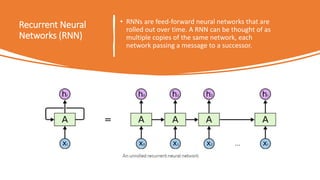
Recurrent Neural
Networks (RNN)
• RNNs are feed-forward neural networks that are
rolled out over time. A RNN can be thought of as
multiple copies of the same network, each
network passing a message to a successor.
An RNN has two major disadvantages
Slow to train Vanishing gradient
Long Short-Term
Memory (LSTM)
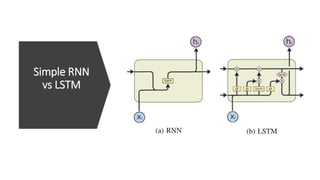
• Long short-term memory (LSTM) is a special kind of
RNN, specially made for solving vanishing gradient
problems. They are capable of learning long-term
dependencies.
• LSTMs can selectively remember or forget things
that are important and not so important.
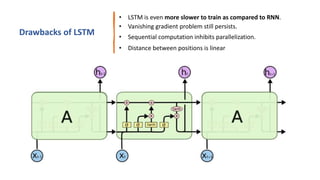
• LSTM is even more slower to train as compared to RNN.
• Vanishing gradient problem still persists.
• Sequential computation inhibits parallelization.
• Distance between positions is linear
Drawbacks of LSTM
Simple RNN
vs LSTM
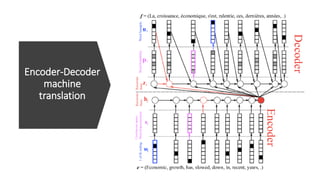
Encoder-Decoder
machine
translation
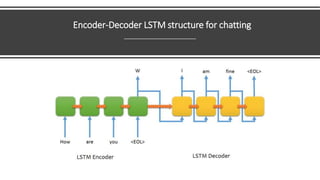
Encoder-Decoder LSTM structure for chatting
Attention
To solve some of these problems like vanishing gradient,
researchers created a technique for paying attention to
specific words.
Attention in neural networks is somewhat similar to what we find in
humans. ‘It means they focus on certain parts of the inputs while
the rest gets less emphasis’. Attention highly improved the quality of
machine translation as it allows the model to focus on the relevant
part of the input sequence as necessary.
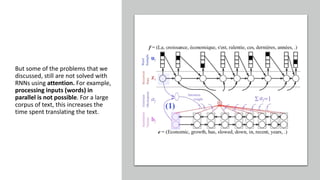
But some of the problems that we
discussed, still are not solved with
RNNs using attention. For example,
processing inputs (words) in
parallel is not possible. For a large
corpus of text, this increases the
time spent translating the text.
Convolutional Neural Networks (CNN)
1. Convolutional Neural Networks help solve these problems. With them we can-
 Trivial to parallelize (per layer)
 Exploits local dependencies
 Distance between positions is logarithmic
2. Why Transformers?
The problem is that Convolutional Neural Networks do not necessarily help with the
problem of figuring out the problem of dependencies when translating sentences. That’s
why Transformers were created, they are a combination of both CNNs with attention.
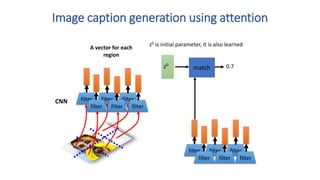
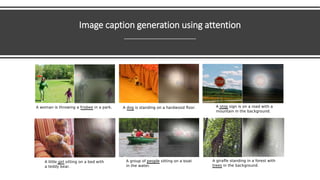
Image caption generation using attention
filter filter filter
match 0.7
CNN
filter filter filter
z0
A vector for each
region
z0 is initial parameter, it is also learned
filter filter filter
CNN
filter filter filter
A vector for each
region
0.7 0.1 0.1
0.1 0.0 0.0
weighted
sum
z1
Word 1
z0
Attention to
a region
filter filter filter
CNN
filter filter filter
A vector for each
region
z0
0.0 0.8 0.2
0.0 0.0 0.0
weighted
sum
z1
Word 1
z2
Word 2
Image caption generation using attention
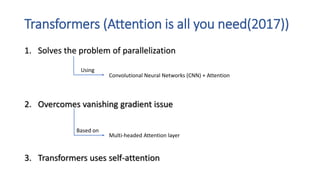
Transformers (Attention is all you need(2017))
1. Solves the problem of parallelization
2. Overcomes vanishing gradient issue
3. Transformers uses self-attention
Convolutional Neural Networks (CNN) + Attention
Using
Based on
Multi-headed Attention layer
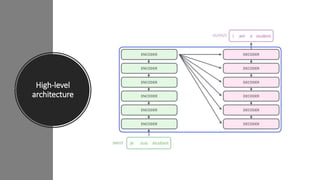
High-level
architecture
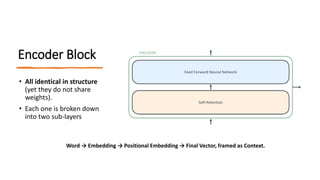
Encoder Block
• All identical in structure
(yet they do not share
weights).
• Each one is broken down
into two sub-layers
Word → Embedding → Positional Embedding → Final Vector, framed as Context.
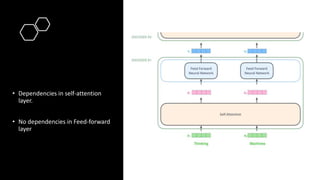
• Dependencies in self-attention
layer.
• No dependencies in Feed-forward
layer
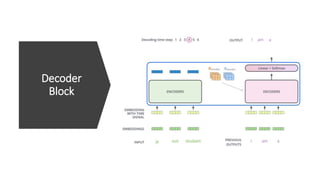
Decoder
Block
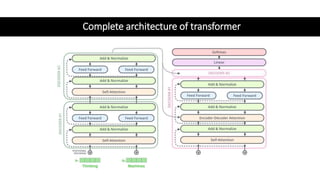
Complete architecture of transformer
Transformers,
GPT-2, and
BERT
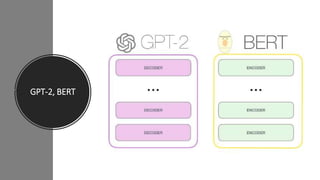
A transformer uses Encoder stack to model
input and uses Decoder stack to model
output (using input information from
encoder side).
But if we do not have input, we just want to
model the “next word”, we can get rid of the
Encoder side of a transformer and output
“next word” one by one. This gives us GPT.
If we are only interested in training a
language model for the input for some other
tasks, then we do not need the Decoder of
the transformer, that gives us BERT.
GPT-2, BERT
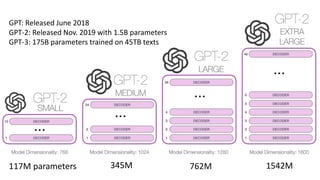
1542M
762M
345M
117M parameters
GPT: Released June 2018
GPT-2: Released Nov. 2019 with 1.5B parameters
GPT-3: 175B parameters trained on 45TB texts
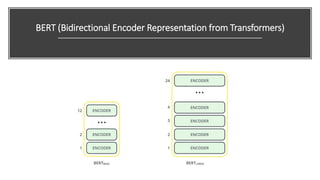
BERT (Bidirectional Encoder Representation from Transformers)
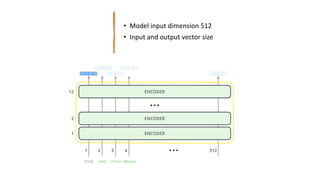
• Model input dimension 512
• Input and output vector size
GPT-3
• OpenAI's third-generation Generative Pretrained
Transformer, GPT-3, is a general-purpose language
algorithm that uses machine learning to translate text,
answer questions, and write text predictively.
• It analyzes a series of terms, text and other data, then
elaborates on those examples in order to generate fully
original production in the form of an article or an image.
Working of GPT-3
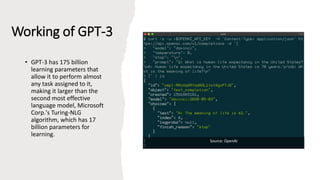
• GPT-3 has 175 billion
learning parameters that
allow it to perform almost
any task assigned to it,
making it larger than the
second most effective
language model, Microsoft
Corp.'s Turing-NLG
algorithm, which has 17
billion parameters for
learning.
Source: OpenAI

Transformers AI PPT.pptx

  • 1.
  • 2.
    Recurrent Neural Networks (RNN) •RNNs are feed-forward neural networks that are rolled out over time. A RNN can be thought of as multiple copies of the same network, each network passing a message to a successor.
  • 3.
    An RNN hastwo major disadvantages Slow to train Vanishing gradient
  • 4.
    Long Short-Term Memory (LSTM) •Long short-term memory (LSTM) is a special kind of RNN, specially made for solving vanishing gradient problems. They are capable of learning long-term dependencies. • LSTMs can selectively remember or forget things that are important and not so important.
  • 5.
    • LSTM iseven more slower to train as compared to RNN. • Vanishing gradient problem still persists. • Sequential computation inhibits parallelization. • Distance between positions is linear Drawbacks of LSTM
  • 6.
  • 7.
  • 8.
  • 9.
    Attention To solve someof these problems like vanishing gradient, researchers created a technique for paying attention to specific words. Attention in neural networks is somewhat similar to what we find in humans. ‘It means they focus on certain parts of the inputs while the rest gets less emphasis’. Attention highly improved the quality of machine translation as it allows the model to focus on the relevant part of the input sequence as necessary.
  • 10.
    But some ofthe problems that we discussed, still are not solved with RNNs using attention. For example, processing inputs (words) in parallel is not possible. For a large corpus of text, this increases the time spent translating the text.
  • 11.
    Convolutional Neural Networks(CNN) 1. Convolutional Neural Networks help solve these problems. With them we can-  Trivial to parallelize (per layer)  Exploits local dependencies  Distance between positions is logarithmic 2. Why Transformers? The problem is that Convolutional Neural Networks do not necessarily help with the problem of figuring out the problem of dependencies when translating sentences. That’s why Transformers were created, they are a combination of both CNNs with attention.
  • 12.
    Image caption generationusing attention filter filter filter filter filter filter match 0.7 CNN filter filter filter filter filter filter z0 A vector for each region z0 is initial parameter, it is also learned
  • 13.
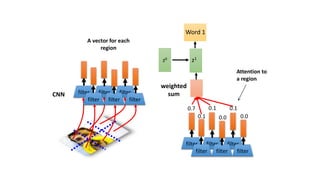
    filter filter filter filterfilter filter CNN filter filter filter filter filter filter A vector for each region 0.7 0.1 0.1 0.1 0.0 0.0 weighted sum z1 Word 1 z0 Attention to a region
  • 14.
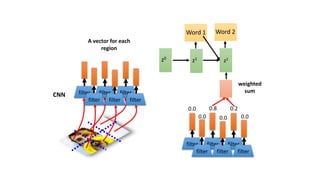
    filter filter filter filterfilter filter CNN filter filter filter filter filter filter A vector for each region z0 0.0 0.8 0.2 0.0 0.0 0.0 weighted sum z1 Word 1 z2 Word 2
  • 15.
    Image caption generationusing attention
  • 16.
    Transformers (Attention isall you need(2017)) 1. Solves the problem of parallelization 2. Overcomes vanishing gradient issue 3. Transformers uses self-attention Convolutional Neural Networks (CNN) + Attention Using Based on Multi-headed Attention layer
  • 17.
  • 18.
    Encoder Block • Allidentical in structure (yet they do not share weights). • Each one is broken down into two sub-layers Word → Embedding → Positional Embedding → Final Vector, framed as Context.
  • 19.
    • Dependencies inself-attention layer. • No dependencies in Feed-forward layer
  • 20.
  • 21.
  • 22.
    Transformers, GPT-2, and BERT A transformeruses Encoder stack to model input and uses Decoder stack to model output (using input information from encoder side). But if we do not have input, we just want to model the “next word”, we can get rid of the Encoder side of a transformer and output “next word” one by one. This gives us GPT. If we are only interested in training a language model for the input for some other tasks, then we do not need the Decoder of the transformer, that gives us BERT.
  • 23.
  • 24.
    1542M 762M 345M 117M parameters GPT: ReleasedJune 2018 GPT-2: Released Nov. 2019 with 1.5B parameters GPT-3: 175B parameters trained on 45TB texts
  • 25.
    BERT (Bidirectional EncoderRepresentation from Transformers)
  • 26.
    • Model inputdimension 512 • Input and output vector size
  • 27.
    GPT-3 • OpenAI's third-generationGenerative Pretrained Transformer, GPT-3, is a general-purpose language algorithm that uses machine learning to translate text, answer questions, and write text predictively. • It analyzes a series of terms, text and other data, then elaborates on those examples in order to generate fully original production in the form of an article or an image.
  • 28.
    Working of GPT-3 •GPT-3 has 175 billion learning parameters that allow it to perform almost any task assigned to it, making it larger than the second most effective language model, Microsoft Corp.'s Turing-NLG algorithm, which has 17 billion parameters for learning. Source: OpenAI