Swarm Intelligence 
BugsBusters Research Team
Table of contents 
• What is meant by Swarm Intelligence? 
• Examples in insects life 
• PSO and ACO Algorithms 
• Applications and Recent Developments 
• Advantages and Disadvantages 
• Conclusion 
• References
What is meant by Swarm 
Intelligence? • Definition 
• any attempt to design 
algorithms or distributed 
problem-solving devices 
inspired by the collective 
behavior of social insect 
colonies and other animal 
societies” [Bonabeau, 
Dorigo, Theraulaz: Swarm 
Intelligence] One worker of robot designed as a 
worker of ant
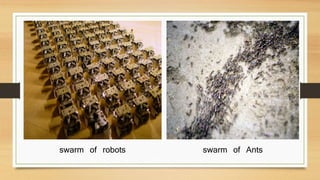
swarm of robots swarm of Ants
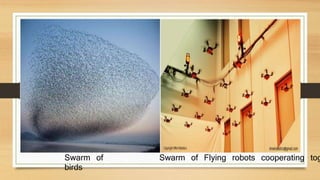
Swarm of 
birds 
Swarm of Flying robots cooperating together
What is meant by Swarm 
Intelligence? • It is an artificial intelligence (AI) technique based on the 
collective behavior in decentralized, self-organized systems 
• Generally made up of agents who interact with 
each other and the environment 
• No centralized control structures 
• Based on group behavior found in nature 
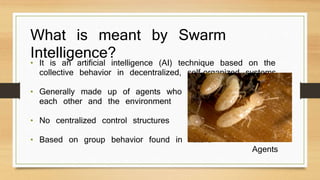
Agents
What is meant by Swarm 
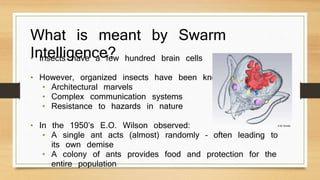
Intelligence? • Insects have a few hundred brain cells 
• However, organized insects have been known for: 
• Architectural marvels 
• Complex communication systems 
• Resistance to hazards in nature 
• In the 1950’s E.O. Wilson observed: 
• A single ant acts (almost) randomly – often leading to 
its own demise 
• A colony of ants provides food and protection for the 
entire population
Medium Real Ant nests, Taken from the earth
• This huge Ant 
colony 
Concrete, that 
has been 
Excavated 
from earth in 
several weeks. 
• This Colony 
has roads 
with shortest 
path between 
every two 
points.
What is meant by Swarm 
Intelligence? • Characteristics 
• Composed of many 
individuals 
• Individuals are 
homogeneous 
• Local interaction based 
on simple 
rules 
• Self-organization
What is meant by Swarm 
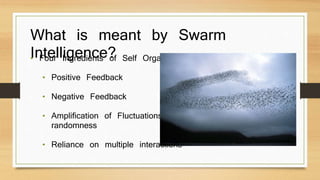
Intelligence? • Four Ingredients of Self Organization 
• Positive Feedback 
• Negative Feedback 
• Amplification of Fluctuations – 
randomness 
• Reliance on multiple interactions
Example 
• Original Example: Swarm of Bees 
• Ant colony 
• Agents: ants 
• Flock of birds 
• Agents: birds 
• Traffic 
• Agents: cars 
• Crowd 
• Agents: humans 
• Immune system 
• Agents: cells and molecules
Cont. Example 
• Ant Colony 
• Every single insect in a social insect colony seems to 
have its own agenda, and yet an insect colony looks 
so organized. 
• The seamless integration of all individual activities does 
not seem to require any supervisor. 
• For Example there is in one colony different type of 
workers: 
• Leafcutter Ants 
• Weaver Ants 
• Army Ants
Cont. Examples 
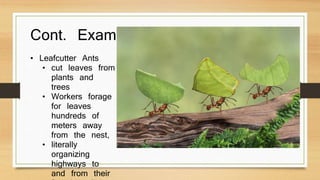
• Leafcutter Ants 
• cut leaves from 
plants and 
trees 
• Workers forage 
for leaves 
hundreds of 
meters away 
from the nest, 
• literally 
organizing 
highways to 
and from their 
foraging sites
Cont. Examples 
• Weaver Ants 
• workers form chains 
of their own bodies, 
allowing them to 
cross wide gaps and 
pull stiff leaf edges 
together to form a 
nest 
• Several chains can 
join to form a bigger 
one over which 
workers run back 
and forth. 
• Such chains create 
enough force to pull 
leaf edges together.
Cont. Example 
• Army Ants 
• organize 
impressive 
hunting raids, 
involving up to 
200,000 workers, 
during which 
they collect 
thousands of 
prey
Cont. Examples 
• Ant Colony Swarm 
benefits: 
• Ants forage 
better. 
• Settle in 
organized home. 
• Defend it self 
against predators 
• Social Insects have 
survived for millions 
of years.
Cont. Examples, How to Interact? 
• Direct Interactions 
• Food/liquid exchange, visual contact, chemical contact 
(pheromones) 
• Indirect Interactions (Stigmergy) 
• Individual behavior modifies the environment, which in 
turn modifies the behavior of other individuals 
Stigmergy 
Example.
PSO and ACO Algorithms 
• Two Common SI Algorithms 
• Ant Colony Optimization 
• Particle Swarm Optimization
Cont. PSO 
• PSO 
• A population based stochastic optimization 
technique Searches for an optimal solution in 
the computable search space. 
• Developed in 1995 by Dr. Eberhart and Dr. Kennedy.
Cont. PSO 
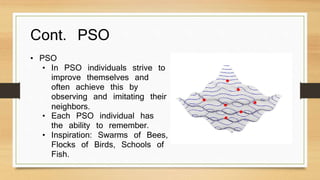
• PSO 
• In PSO individuals strive to 
improve themselves and 
often achieve this by 
observing and imitating their 
neighbors. 
• Each PSO individual has 
the ability to remember. 
• Inspiration: Swarms of Bees, 
Flocks of Birds, Schools of 
Fish.
Particle Optimization 
Technique searching 
robots
Cont. ACO 
• ACO 
• Optimization Technique Proposed by Marco Dorigo in the 
early ’90 
• Heuristic optimization method inspired by biological 
systems 
• Multi-agent approach for solving difficult combinatorial 
optimization problems 
• Has become new and fruitful research area
Cont. ACO
Cont. ACO 
• The way ants find their food in shortest path is 
interesting. 
• Ants secrete pheromones to remember their path. 
• These pheromones evaporate with time. 
• Whenever an ant finds food , it marks its return journey 
with pheromones.
Cont. ACO 
• Pheromones evaporate faster on longer paths. 
(Evaporation) 
• Shorter paths serve as the way to food for most of 
the other ants. 
• The shorter path will be reinforced by the pheromones 
further. (Reinforcement) 
• Finally , the ants arrive at the shortest path. 
(Establishment)
Ant Colony Optimization on 
Traveling Salesman Pro.
Applications and Recent 
Developments • Some applications Uses S.I Algorithms : 
• Movie effects 
• Lord of the Rings 
• Network Routing 
• ACO Routing 
• Swarm Robotics 
• Swarm bots
Movies 
Used 
Swarm 
Intelligence
Cont. Applications and Recent 
ODtheerv Reelcoenpt mdeveelnoptesd 
• Human tremor analysis 
• Human performance assessment 
• Ingredient mix optimization
Cont. Applications and Recent 
ODtheerv Reelcoenpt mdeveelnoptesd 
• Evolving neural networks to solve problems 
• U.S. Military is applying SI techniques to control of 
unmanned vehicles 
• NASA is applying SI techniques for planetary mapping 
• Medical Research is trying SI based controls for nanobots 
to fight cancer
Advantages and Disadvantages 
• ADVANTAGES: 
• The systems are scalable because the same control 
architecture can be applied to a couple of agents or 
thousands of agents 
• The systems are flexible because agents can be easily 
added or removed without influencing the structure
Advantages and Disadvantages 
• ADVANTAGES: 
• The systems are robust because agents are simple in 
design, the reliance on individual agents is small, and 
failure of a single agents has little impact on the 
system’s performance 
• The systems are able to adapt to new situations easily
Cont. Advantages and 
Disadvantages • DISADVANTAGES 
• Non-optimal – Because swarm systems are highly 
redundant and have no central control, they tend to be 
inefficient. The allocation of resources is not efficient, 
and duplication of effort is always rampant. 
• Uncontrollable – It is very difficult to exercise control 
over a swarm.
Cont. Advantages and 
Disadvantages • DISADVANTAGES 
• Unpredictable – The complexity of a swarm system leads 
to unforeseeable results. 
• Non-understandable – Sequential systems are 
understandable; complex adaptive systems, instead, are a 
jumble of intersecting logic. 
• Non-immediate – complex swarm systems with rich 
hierarchies take time. The more complex the swarm, the 
longer it takes to shift states
Conclusion 
• SI provides heuristics to solve difficult optimization 
problems. 
• Has wide variety of applications. 
• Basic philosophy of Swarm Intelligence : Observe the 
behaviour of social animals and try to mimic those 
animals on computer systems. 
• Basic theme of Natural Computing: Observe nature, mimic 
nature.
References 
• Reynolds, C. W. (1987) Flocks, Herds, and Schools: A 
Distributed Behavioral Model, in Computer Graphics, 21(4) 
(SIGGRAPH '87 Conference Proceedings) pages 25-34. 
• James Kennedy, Russell Eberhart. Particle Swarm 
Optimization, IEEE Conf. on Neural networks – 1995 
• www.adaptiveview.com/articles/ ipsop1 
• Ruud Schoonderwoerd, Owen Holland, Janet Bruten - 1996. 
Ant like agents for load balancing in telecommunication 
networks, Adaptive behavior, 5(2) .
References 
• A Bee Algorithm for Multi-Agents System-Lemmens ,Steven . 
Karl Tuyls, Ann Nowe -2007 
• Swarm Intelligence – Literature Overview, Yang Liu , Kevin 
M. Passino. 2000. 
• www.wikipedia.org 
• The ACO metaheuristic: Algorithms, Applications, and 
Advances. Marco Dorigo and Thomas Stutzle-Handbook of 
metaheuristics, 2002. 
• Ant Algorithms for Discrete Optimization Artificial Life 
• M.Dorigo, M.Birattari, T.Stutzle, Ant colony optimization – 
Artificial Ants as a computational intelligence technique, IEEE 
Computational Intelligence Magazine 2006
References 
• M. Dorigo, G. Di Caro & L. M. Gambardella (1999). 
• addr:http://iridia.ulb.ac.be/~mdorigo/ 
• Swarm Intelligence, From Natural to Artificial Systems 
• M. Dorigo, E. Bonabeau, G. Theraulaz 
• The Yellowjackets of the Northwestern United States, Matthew Kweskin 
• addr:http://www.evergreen.edu/user/serv_res/research/arthropod/TESCBiota/Vespi 
dae/Kweskin97/main.htm 
• Entomology & Plant Pathology, Dr. Michael R. Williams 
addr: http://www.msstate.edu/Entomology/GLOWORM/GLOW1PAGE.html 
• Urban Entomology Program, Dr. Timothy G. Myles 
addr:http://www.utoronto.ca/forest/termite/termite.htm
References 
• Dorigo, Marco and Stützle, Thomas. (2004) Ant Colony Optimization, 
Cambridge, MA: The MIT Press. 
• Dorigo, Marco, Gambardella, Luca M., Middendorf, Martin. (2002) 
“Guest Editorial,” IEEE Transactions on Evolutionary Computation, 6(4): 
317-320. 
• Ant Colony Optimization by Marco Dorigo and Thomas Stϋtzle, The MIT 
Press, 2004 
• Swarm Intelligence by James Kennedy and Russell Eberhart with Yuhui 
Shi, Morgan Kauffmann Publishers, 2001 
• Advances in Applied Artificial Intelligence edited by John Fulcher, IGI 
Publishing, 2006 
• Data Mining: A Heuristic Approach by Hussein Abbass, Ruhul Sarker, 
and Charles Newton, IGI Publishing, 2002

Swarm intelligence

  • 1.
  • 2.
    Table of contents • What is meant by Swarm Intelligence? • Examples in insects life • PSO and ACO Algorithms • Applications and Recent Developments • Advantages and Disadvantages • Conclusion • References
  • 3.
    What is meantby Swarm Intelligence? • Definition • any attempt to design algorithms or distributed problem-solving devices inspired by the collective behavior of social insect colonies and other animal societies” [Bonabeau, Dorigo, Theraulaz: Swarm Intelligence] One worker of robot designed as a worker of ant
  • 4.
    swarm of robotsswarm of Ants
  • 5.
    Swarm of birds Swarm of Flying robots cooperating together
  • 6.
    What is meantby Swarm Intelligence? • It is an artificial intelligence (AI) technique based on the collective behavior in decentralized, self-organized systems • Generally made up of agents who interact with each other and the environment • No centralized control structures • Based on group behavior found in nature Agents
  • 7.
    What is meantby Swarm Intelligence? • Insects have a few hundred brain cells • However, organized insects have been known for: • Architectural marvels • Complex communication systems • Resistance to hazards in nature • In the 1950’s E.O. Wilson observed: • A single ant acts (almost) randomly – often leading to its own demise • A colony of ants provides food and protection for the entire population
  • 8.
    Medium Real Antnests, Taken from the earth
  • 9.
    • This hugeAnt colony Concrete, that has been Excavated from earth in several weeks. • This Colony has roads with shortest path between every two points.
  • 10.
    What is meantby Swarm Intelligence? • Characteristics • Composed of many individuals • Individuals are homogeneous • Local interaction based on simple rules • Self-organization
  • 11.
    What is meantby Swarm Intelligence? • Four Ingredients of Self Organization • Positive Feedback • Negative Feedback • Amplification of Fluctuations – randomness • Reliance on multiple interactions
  • 13.
    Example • OriginalExample: Swarm of Bees • Ant colony • Agents: ants • Flock of birds • Agents: birds • Traffic • Agents: cars • Crowd • Agents: humans • Immune system • Agents: cells and molecules
  • 14.
    Cont. Example •Ant Colony • Every single insect in a social insect colony seems to have its own agenda, and yet an insect colony looks so organized. • The seamless integration of all individual activities does not seem to require any supervisor. • For Example there is in one colony different type of workers: • Leafcutter Ants • Weaver Ants • Army Ants
  • 15.
    Cont. Examples •Leafcutter Ants • cut leaves from plants and trees • Workers forage for leaves hundreds of meters away from the nest, • literally organizing highways to and from their foraging sites
  • 16.
    Cont. Examples •Weaver Ants • workers form chains of their own bodies, allowing them to cross wide gaps and pull stiff leaf edges together to form a nest • Several chains can join to form a bigger one over which workers run back and forth. • Such chains create enough force to pull leaf edges together.
  • 17.
    Cont. Example •Army Ants • organize impressive hunting raids, involving up to 200,000 workers, during which they collect thousands of prey
  • 18.
    Cont. Examples •Ant Colony Swarm benefits: • Ants forage better. • Settle in organized home. • Defend it self against predators • Social Insects have survived for millions of years.
  • 19.
    Cont. Examples, Howto Interact? • Direct Interactions • Food/liquid exchange, visual contact, chemical contact (pheromones) • Indirect Interactions (Stigmergy) • Individual behavior modifies the environment, which in turn modifies the behavior of other individuals Stigmergy Example.
  • 20.
    PSO and ACOAlgorithms • Two Common SI Algorithms • Ant Colony Optimization • Particle Swarm Optimization
  • 21.
    Cont. PSO •PSO • A population based stochastic optimization technique Searches for an optimal solution in the computable search space. • Developed in 1995 by Dr. Eberhart and Dr. Kennedy.
  • 22.
    Cont. PSO •PSO • In PSO individuals strive to improve themselves and often achieve this by observing and imitating their neighbors. • Each PSO individual has the ability to remember. • Inspiration: Swarms of Bees, Flocks of Birds, Schools of Fish.
  • 23.
  • 24.
    Cont. ACO •ACO • Optimization Technique Proposed by Marco Dorigo in the early ’90 • Heuristic optimization method inspired by biological systems • Multi-agent approach for solving difficult combinatorial optimization problems • Has become new and fruitful research area
  • 25.
  • 26.
    Cont. ACO •The way ants find their food in shortest path is interesting. • Ants secrete pheromones to remember their path. • These pheromones evaporate with time. • Whenever an ant finds food , it marks its return journey with pheromones.
  • 27.
    Cont. ACO •Pheromones evaporate faster on longer paths. (Evaporation) • Shorter paths serve as the way to food for most of the other ants. • The shorter path will be reinforced by the pheromones further. (Reinforcement) • Finally , the ants arrive at the shortest path. (Establishment)
  • 28.
    Ant Colony Optimizationon Traveling Salesman Pro.
  • 29.
    Applications and Recent Developments • Some applications Uses S.I Algorithms : • Movie effects • Lord of the Rings • Network Routing • ACO Routing • Swarm Robotics • Swarm bots
  • 30.
    Movies Used Swarm Intelligence
  • 31.
    Cont. Applications andRecent ODtheerv Reelcoenpt mdeveelnoptesd • Human tremor analysis • Human performance assessment • Ingredient mix optimization
  • 32.
    Cont. Applications andRecent ODtheerv Reelcoenpt mdeveelnoptesd • Evolving neural networks to solve problems • U.S. Military is applying SI techniques to control of unmanned vehicles • NASA is applying SI techniques for planetary mapping • Medical Research is trying SI based controls for nanobots to fight cancer
  • 33.
    Advantages and Disadvantages • ADVANTAGES: • The systems are scalable because the same control architecture can be applied to a couple of agents or thousands of agents • The systems are flexible because agents can be easily added or removed without influencing the structure
  • 34.
    Advantages and Disadvantages • ADVANTAGES: • The systems are robust because agents are simple in design, the reliance on individual agents is small, and failure of a single agents has little impact on the system’s performance • The systems are able to adapt to new situations easily
  • 35.
    Cont. Advantages and Disadvantages • DISADVANTAGES • Non-optimal – Because swarm systems are highly redundant and have no central control, they tend to be inefficient. The allocation of resources is not efficient, and duplication of effort is always rampant. • Uncontrollable – It is very difficult to exercise control over a swarm.
  • 36.
    Cont. Advantages and Disadvantages • DISADVANTAGES • Unpredictable – The complexity of a swarm system leads to unforeseeable results. • Non-understandable – Sequential systems are understandable; complex adaptive systems, instead, are a jumble of intersecting logic. • Non-immediate – complex swarm systems with rich hierarchies take time. The more complex the swarm, the longer it takes to shift states
  • 37.
    Conclusion • SIprovides heuristics to solve difficult optimization problems. • Has wide variety of applications. • Basic philosophy of Swarm Intelligence : Observe the behaviour of social animals and try to mimic those animals on computer systems. • Basic theme of Natural Computing: Observe nature, mimic nature.
  • 38.
    References • Reynolds,C. W. (1987) Flocks, Herds, and Schools: A Distributed Behavioral Model, in Computer Graphics, 21(4) (SIGGRAPH '87 Conference Proceedings) pages 25-34. • James Kennedy, Russell Eberhart. Particle Swarm Optimization, IEEE Conf. on Neural networks – 1995 • www.adaptiveview.com/articles/ ipsop1 • Ruud Schoonderwoerd, Owen Holland, Janet Bruten - 1996. Ant like agents for load balancing in telecommunication networks, Adaptive behavior, 5(2) .
  • 39.
    References • ABee Algorithm for Multi-Agents System-Lemmens ,Steven . Karl Tuyls, Ann Nowe -2007 • Swarm Intelligence – Literature Overview, Yang Liu , Kevin M. Passino. 2000. • www.wikipedia.org • The ACO metaheuristic: Algorithms, Applications, and Advances. Marco Dorigo and Thomas Stutzle-Handbook of metaheuristics, 2002. • Ant Algorithms for Discrete Optimization Artificial Life • M.Dorigo, M.Birattari, T.Stutzle, Ant colony optimization – Artificial Ants as a computational intelligence technique, IEEE Computational Intelligence Magazine 2006
  • 40.
    References • M.Dorigo, G. Di Caro & L. M. Gambardella (1999). • addr:http://iridia.ulb.ac.be/~mdorigo/ • Swarm Intelligence, From Natural to Artificial Systems • M. Dorigo, E. Bonabeau, G. Theraulaz • The Yellowjackets of the Northwestern United States, Matthew Kweskin • addr:http://www.evergreen.edu/user/serv_res/research/arthropod/TESCBiota/Vespi dae/Kweskin97/main.htm • Entomology & Plant Pathology, Dr. Michael R. Williams addr: http://www.msstate.edu/Entomology/GLOWORM/GLOW1PAGE.html • Urban Entomology Program, Dr. Timothy G. Myles addr:http://www.utoronto.ca/forest/termite/termite.htm
  • 41.
    References • Dorigo,Marco and Stützle, Thomas. (2004) Ant Colony Optimization, Cambridge, MA: The MIT Press. • Dorigo, Marco, Gambardella, Luca M., Middendorf, Martin. (2002) “Guest Editorial,” IEEE Transactions on Evolutionary Computation, 6(4): 317-320. • Ant Colony Optimization by Marco Dorigo and Thomas Stϋtzle, The MIT Press, 2004 • Swarm Intelligence by James Kennedy and Russell Eberhart with Yuhui Shi, Morgan Kauffmann Publishers, 2001 • Advances in Applied Artificial Intelligence edited by John Fulcher, IGI Publishing, 2006 • Data Mining: A Heuristic Approach by Hussein Abbass, Ruhul Sarker, and Charles Newton, IGI Publishing, 2002