You Only Look Once:
Unified, Real-Time Object Detection (2016)
Taegyun Jeon
Redmon, Joseph, et al. "You only look once: Unified, real-time object detection." 

Proceedings of the IEEE Conference on Computer Vision and Pattern Recognition. 2016.
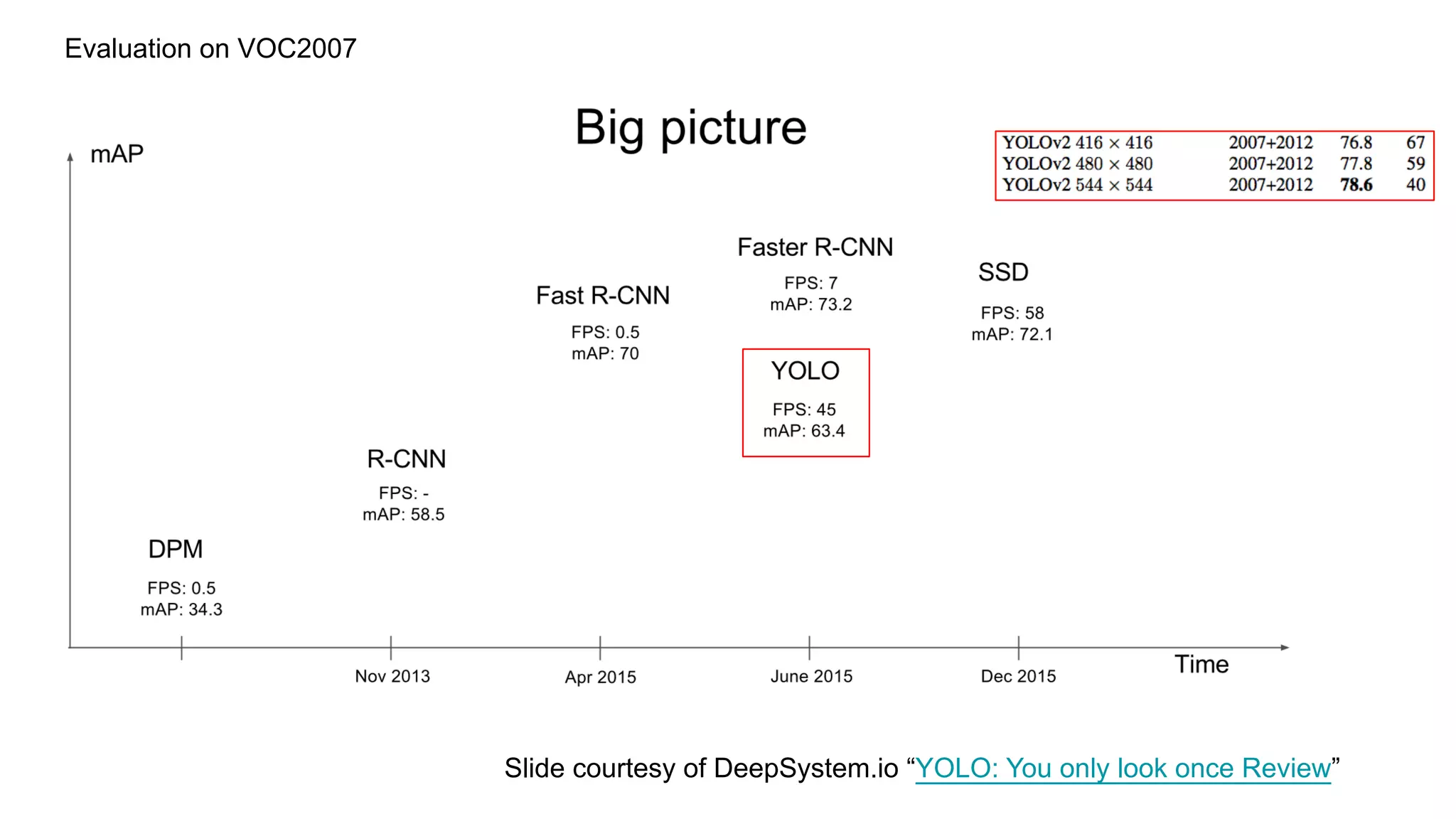
Slide courtesy of DeepSystem.io “YOLO: You only look once Review”
Evaluation on VOC2007
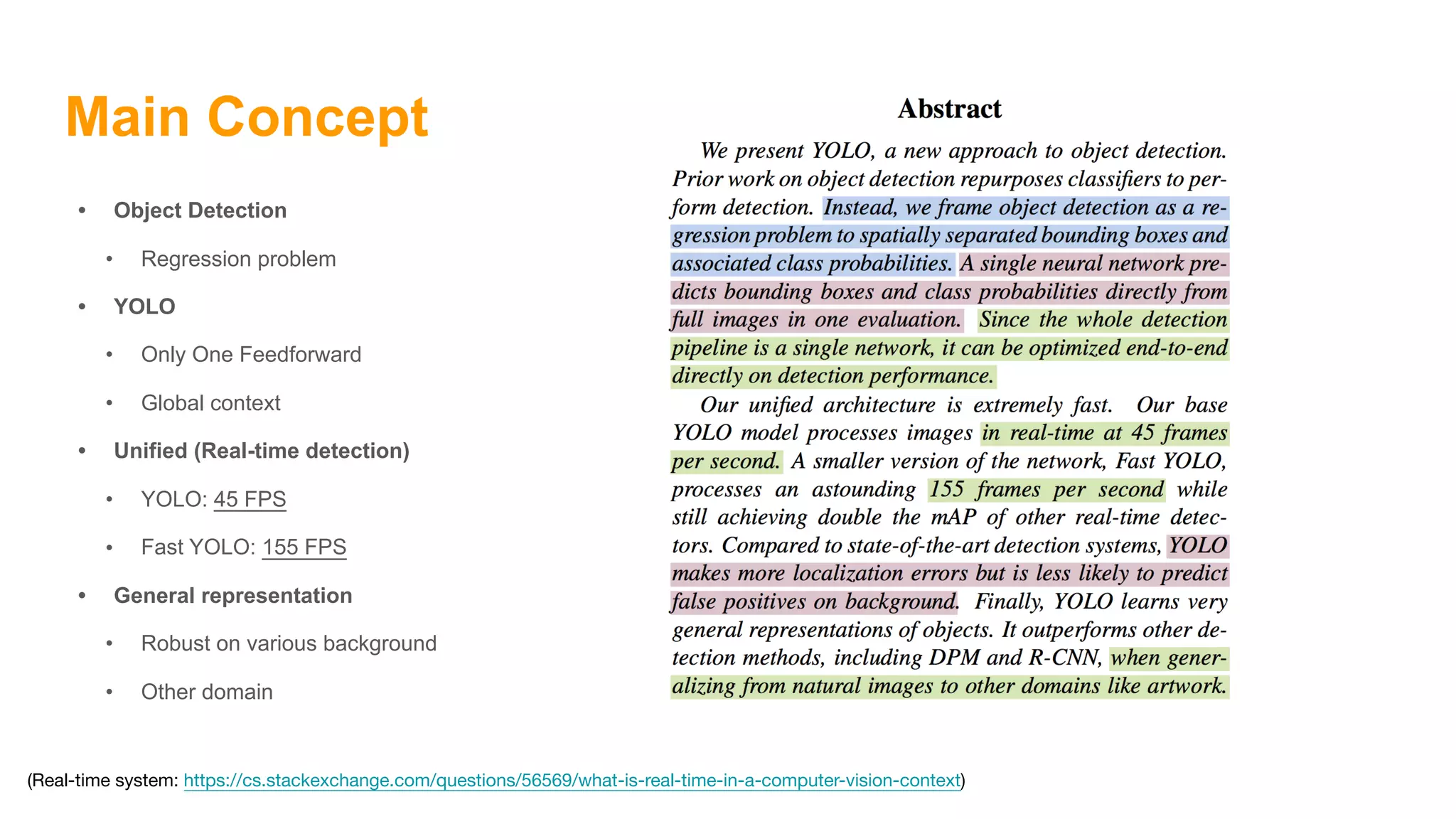
Main Concept
• Object Detection
• Regression problem
• YOLO
• Only One Feedforward
• Global context
• Unified (Real-time detection)
• YOLO: 45 FPS
• Fast YOLO: 155 FPS
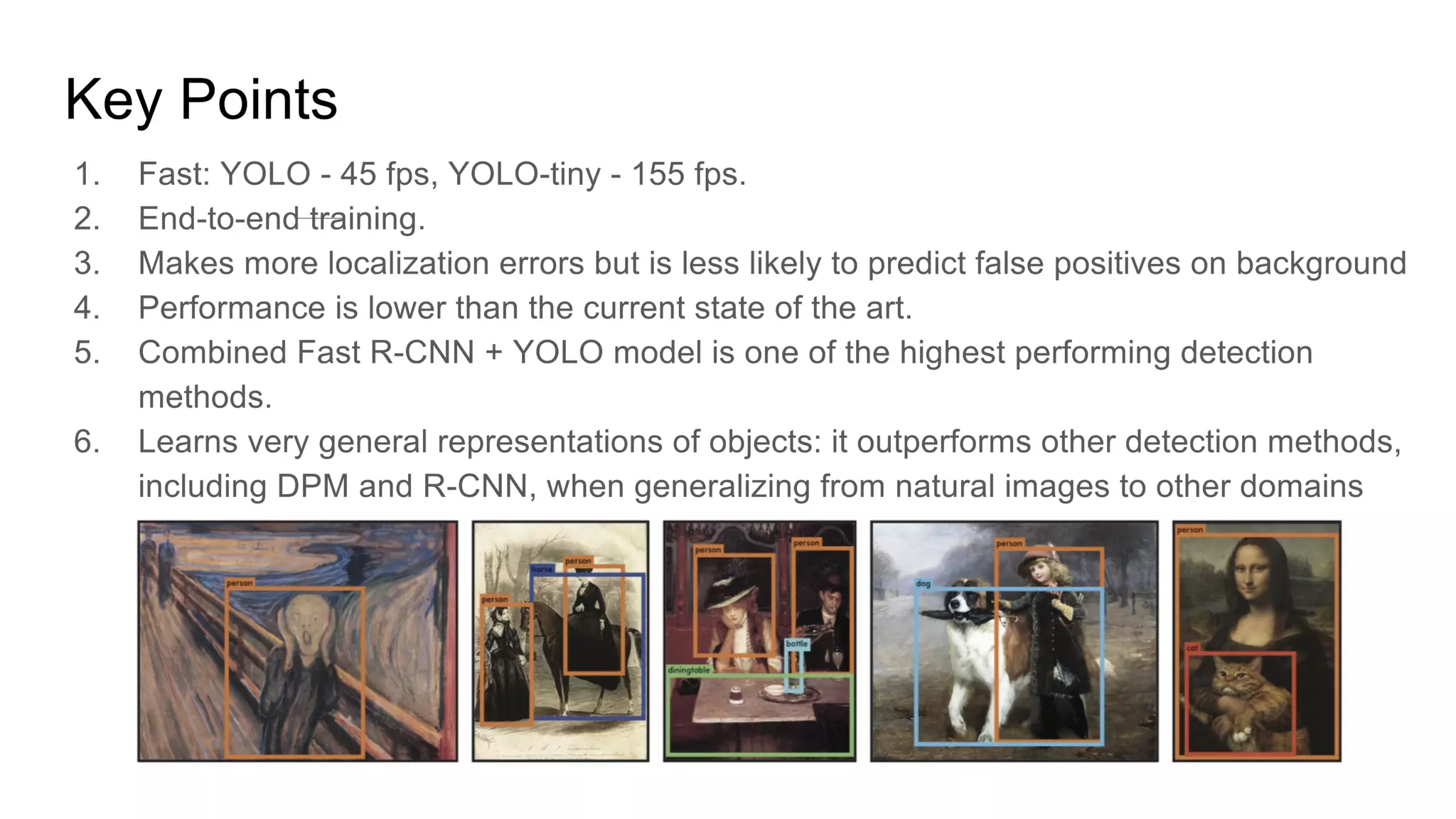
• General representation
• Robust on various background
• Other domain
(Real-time system: https://cs.stackexchange.com/questions/56569/what-is-real-time-in-a-computer-vision-context)
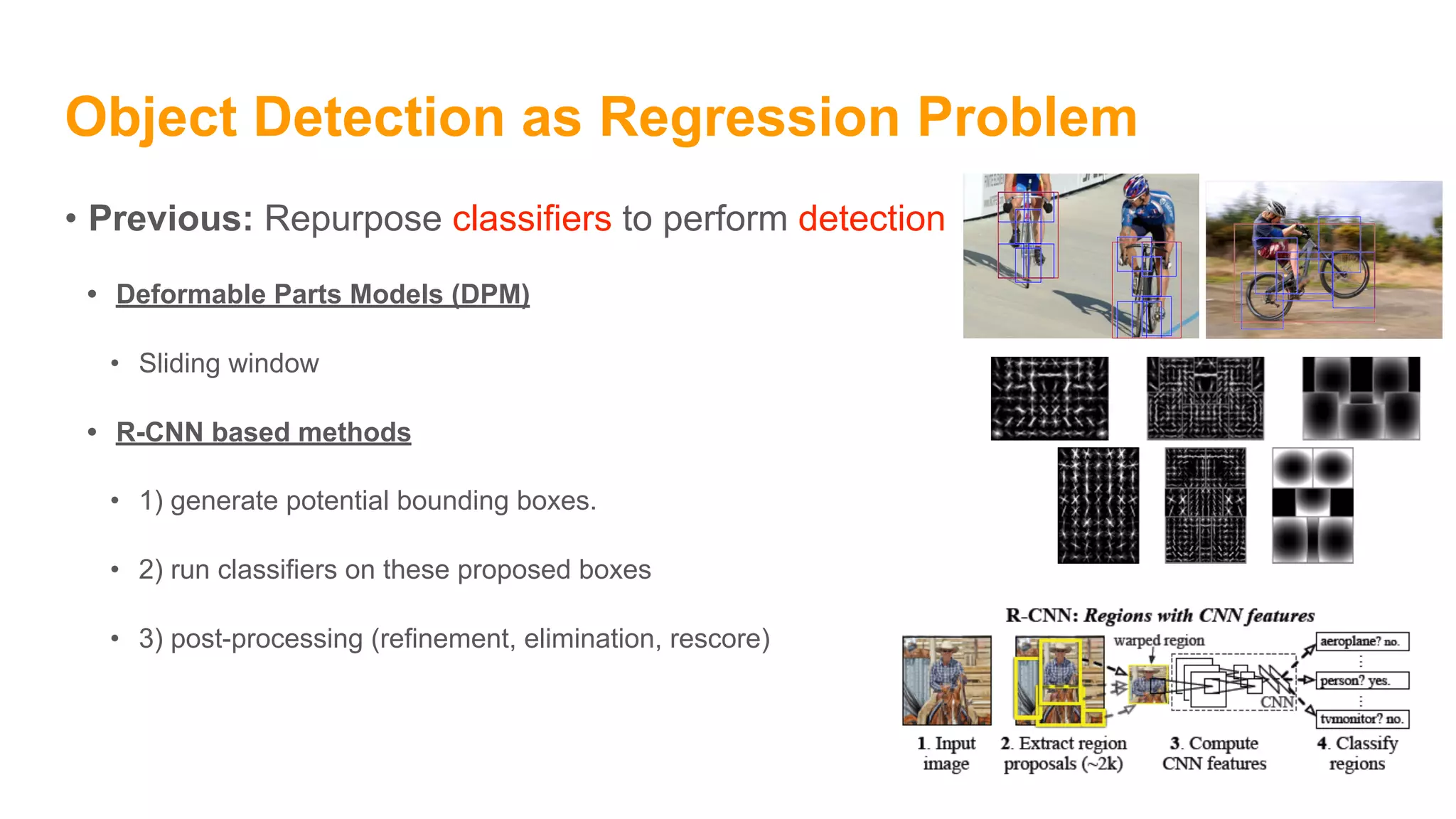
Object Detection as Regression Problem
• Previous: Repurpose classifiers to perform detection
• Deformable Parts Models (DPM)
• Sliding window
• R-CNN based methods
• 1) generate potential bounding boxes.
• 2) run classifiers on these proposed boxes
• 3) post-processing (refinement, elimination, rescore)
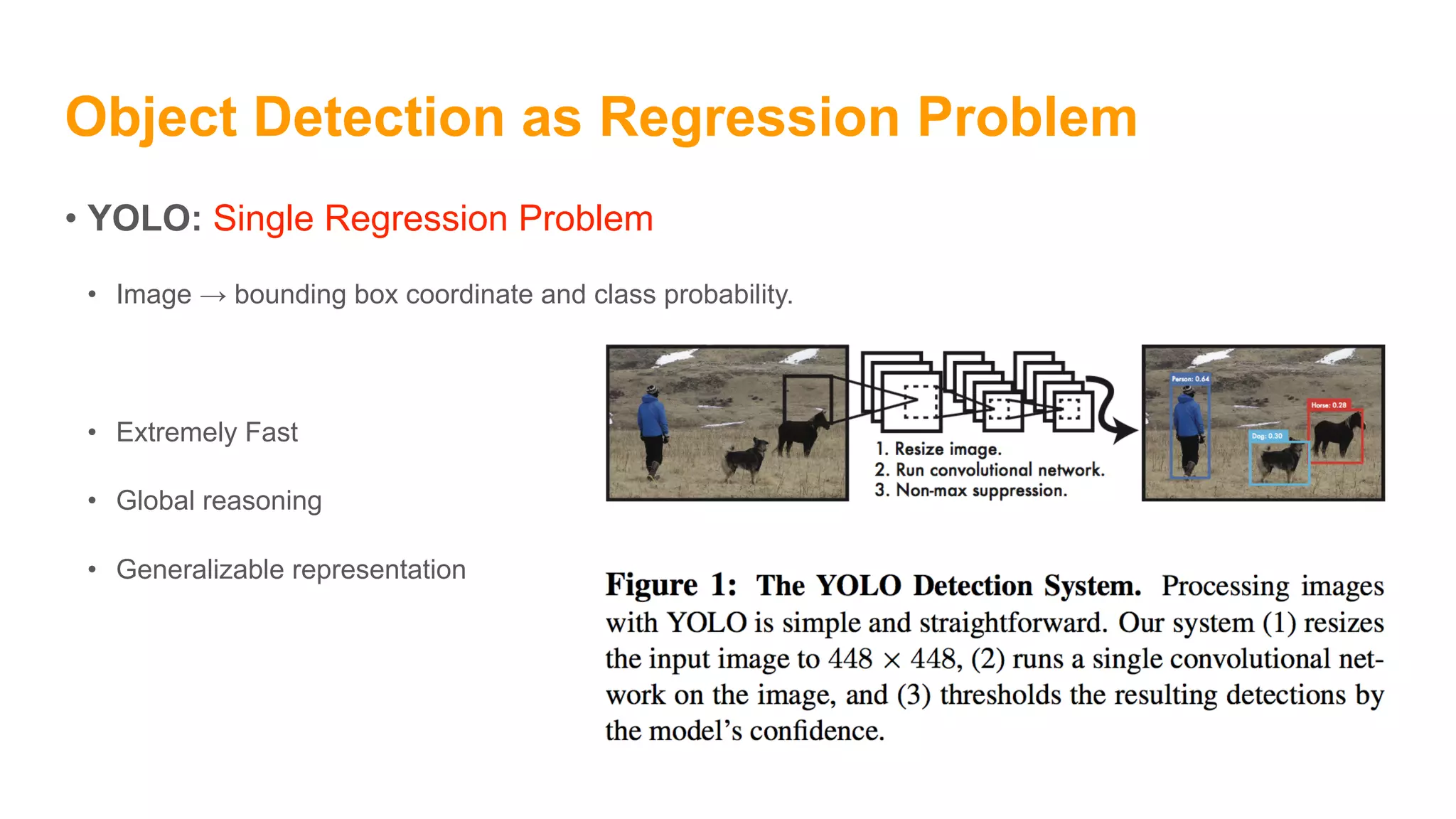
Object Detection as Regression Problem
• YOLO: Single Regression Problem
• Image → bounding box coordinate and class probability.
• Extremely Fast
• Global reasoning
• Generalizable representation
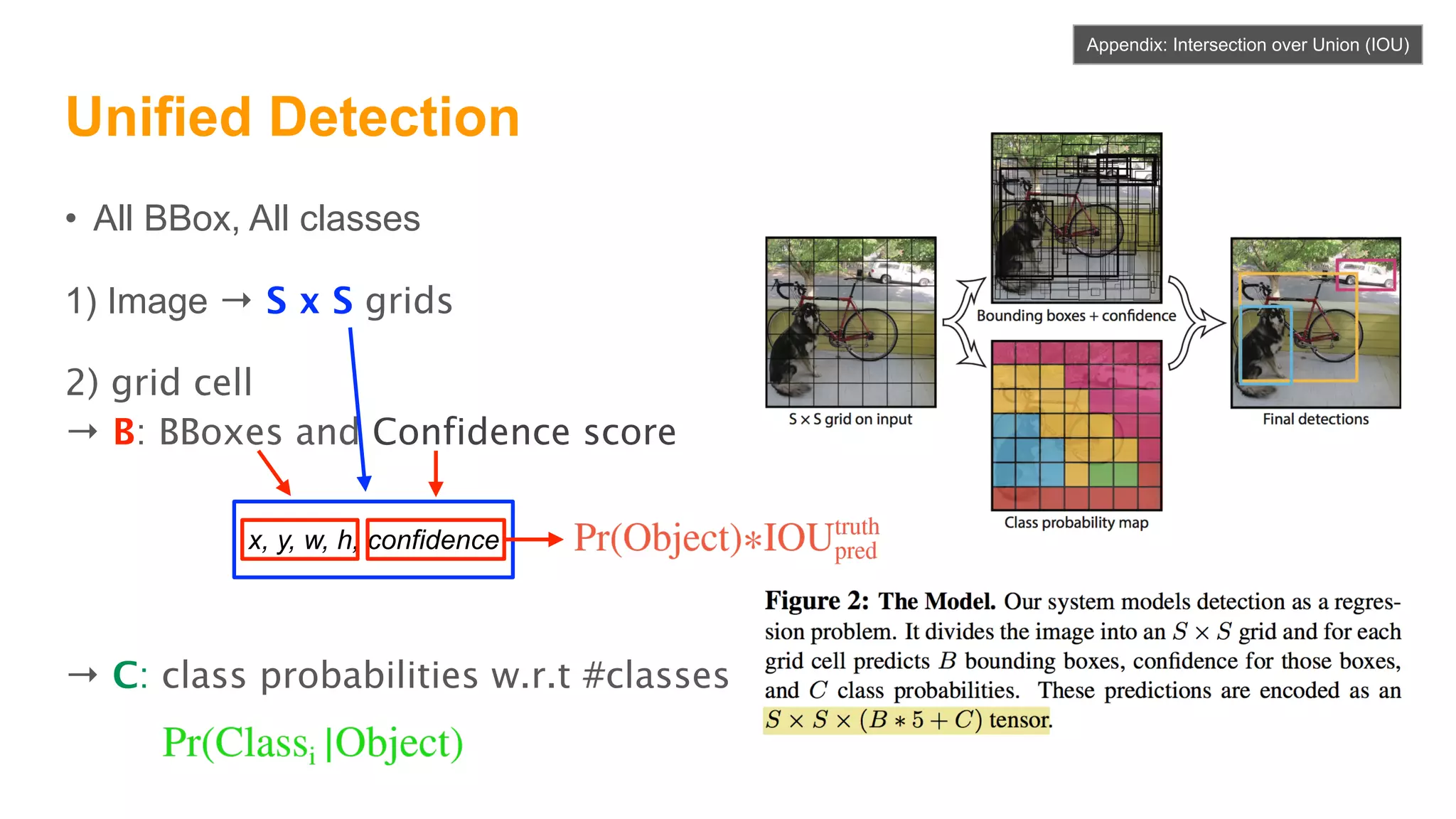
Unified Detection
• All BBox, All classes
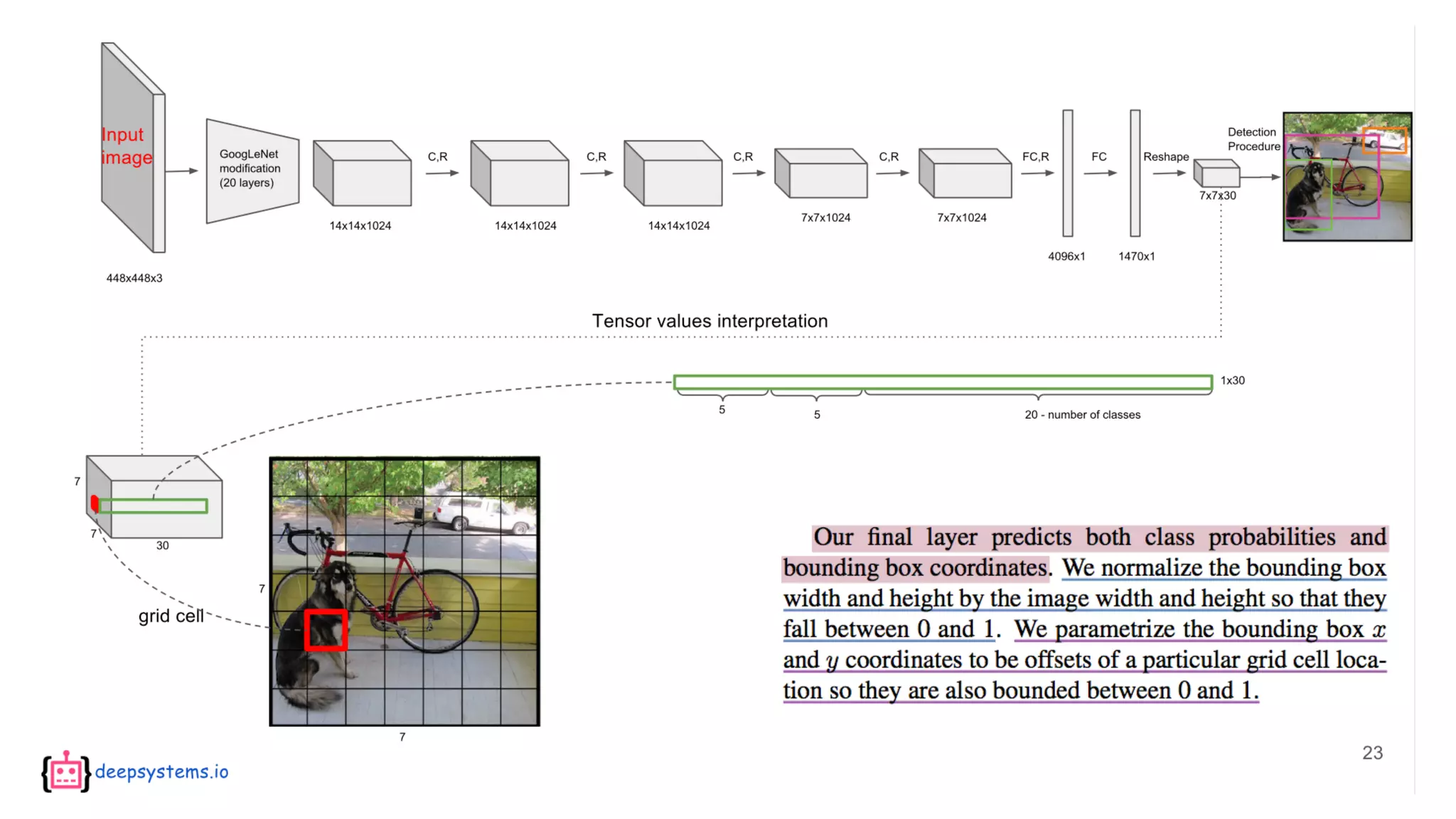
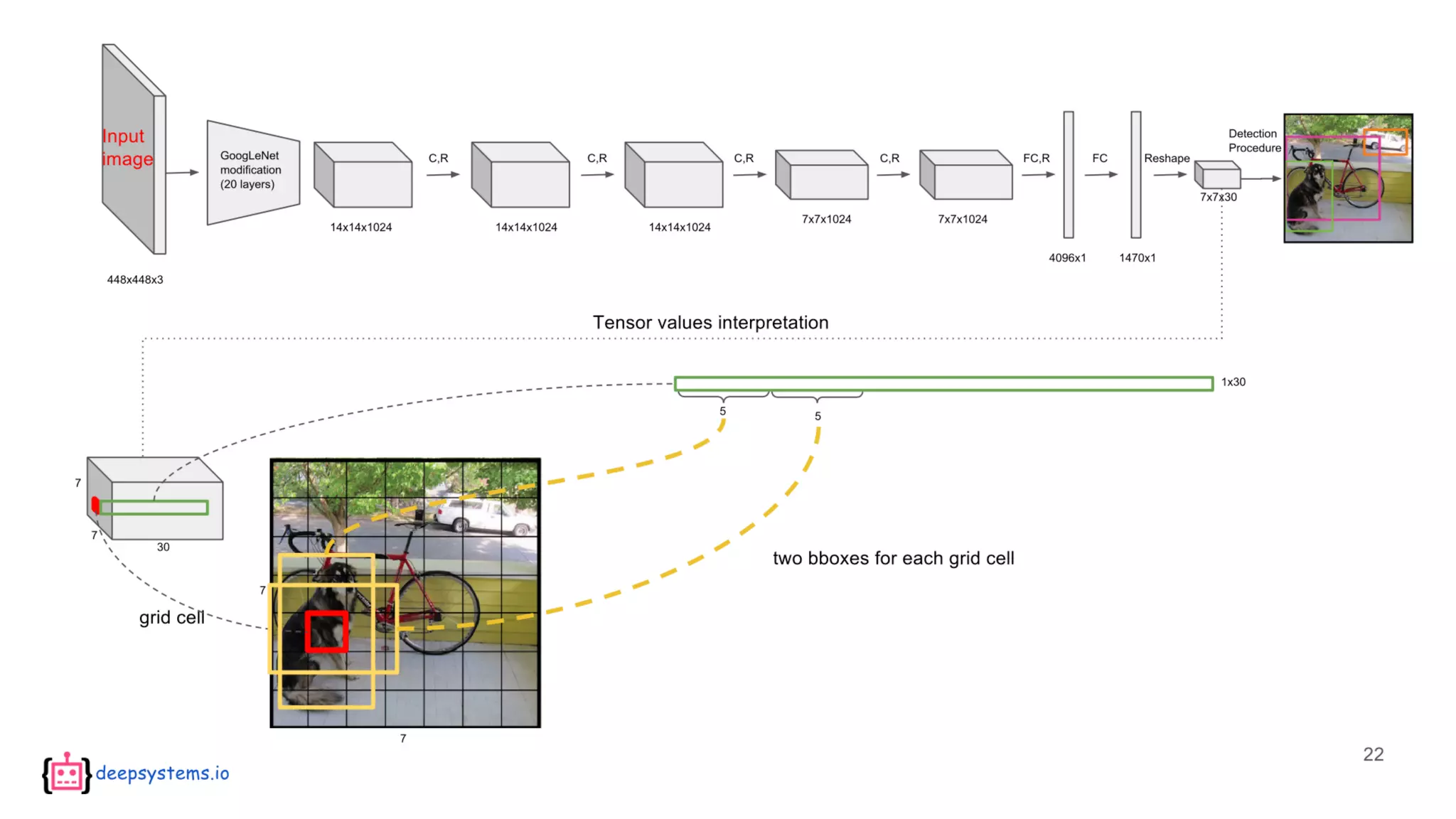
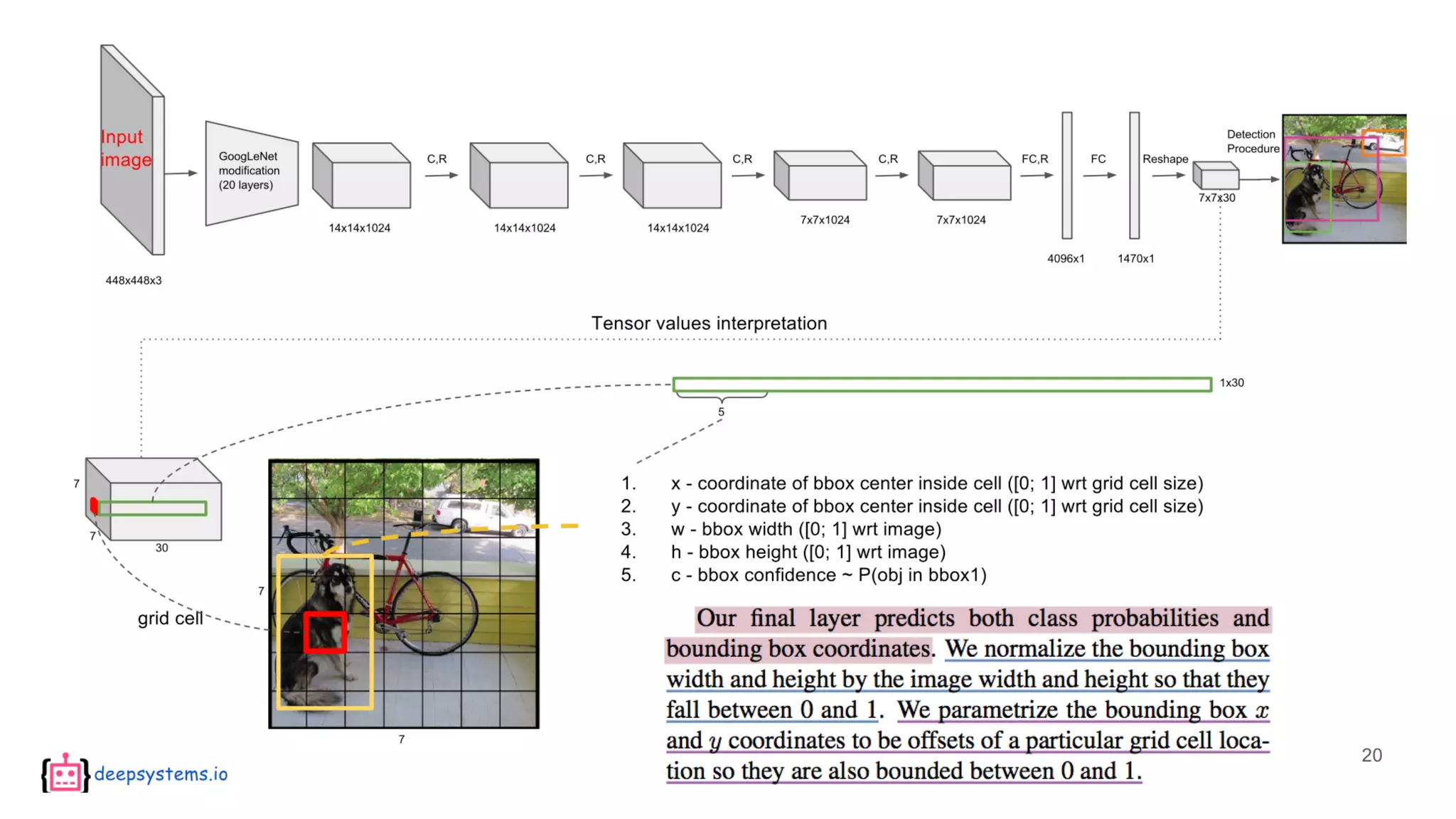
1) Image → S x S grids
2) grid cell 

→ B: BBoxes and Confidence score
→ C: class probabilities w.r.t #classes
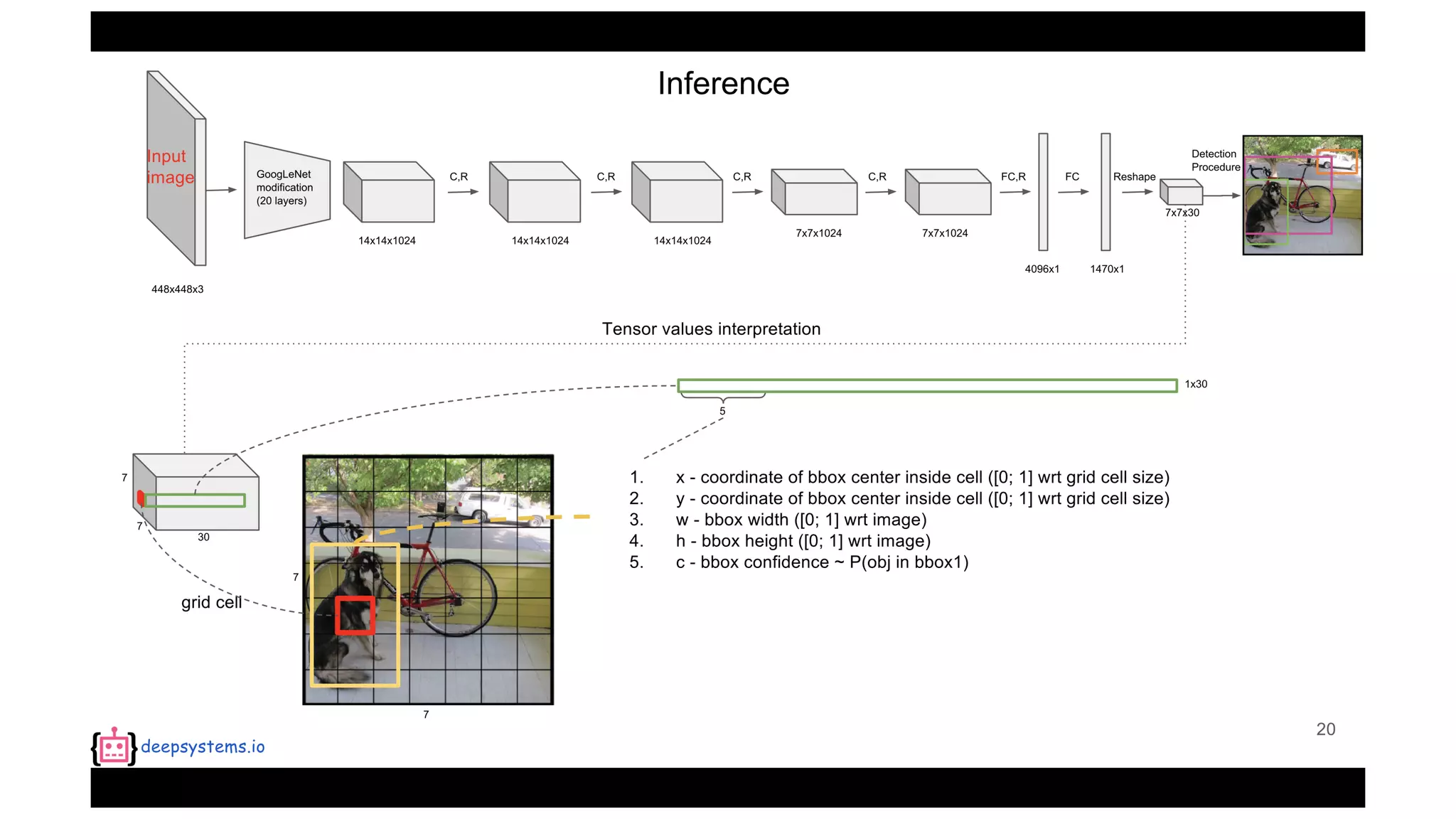
x, y, w, h, confidence
Appendix: Intersection over Union (IOU)
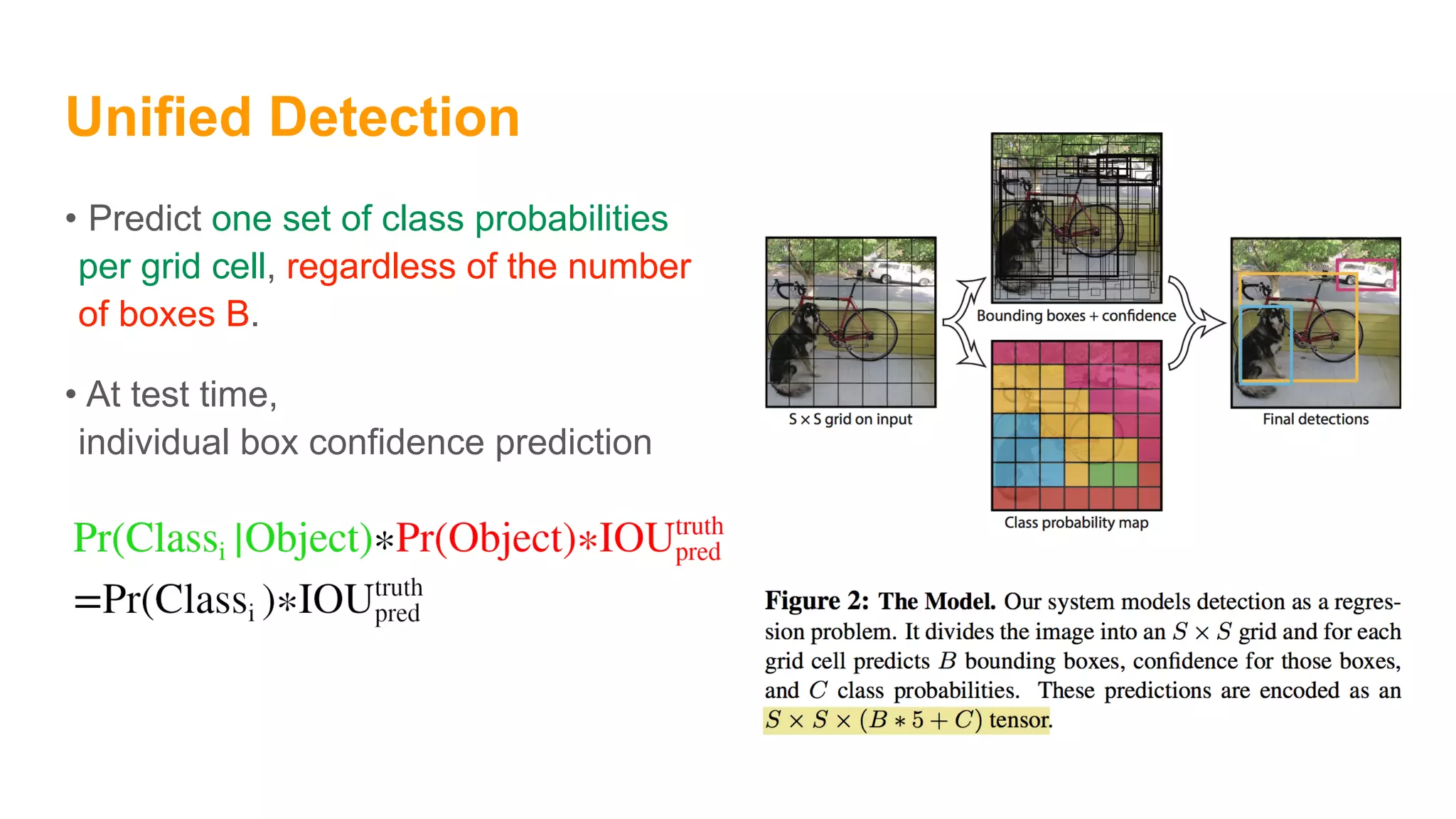
Unified Detection
• Predict one set of class probabilities 

per grid cell, regardless of the number 

of boxes B.
• At test time, 

individual box confidence prediction
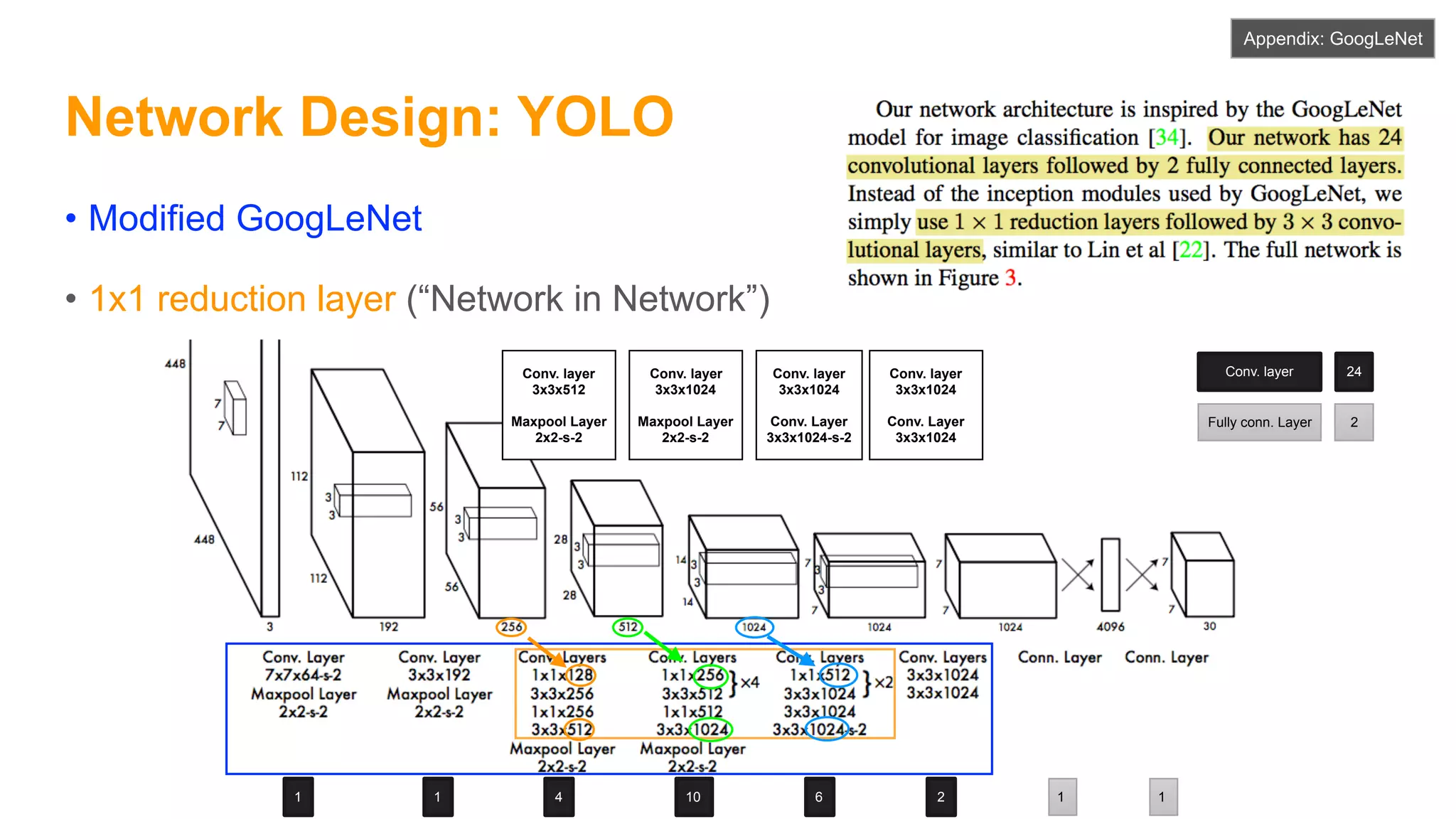
Network Design: YOLO
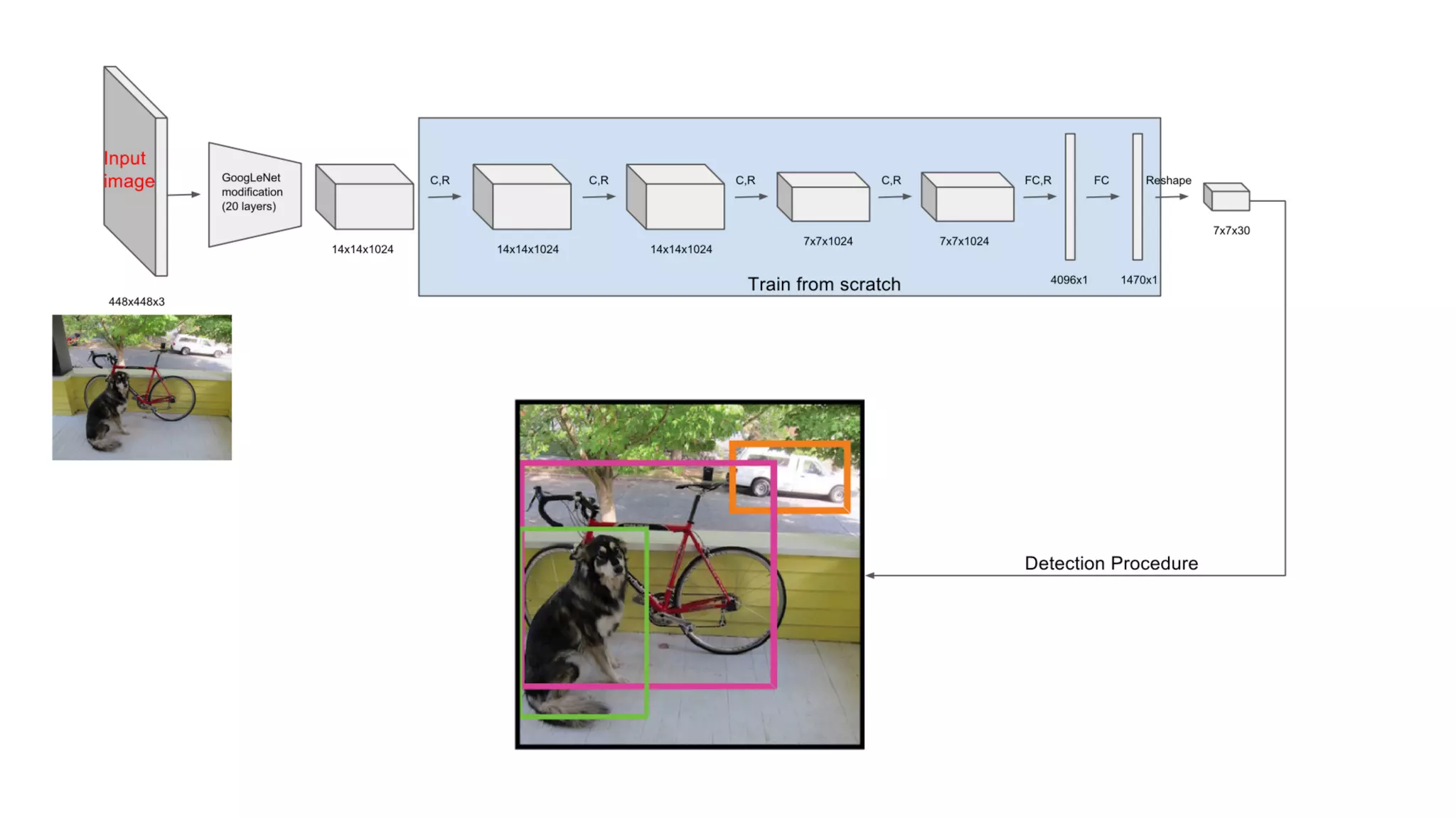
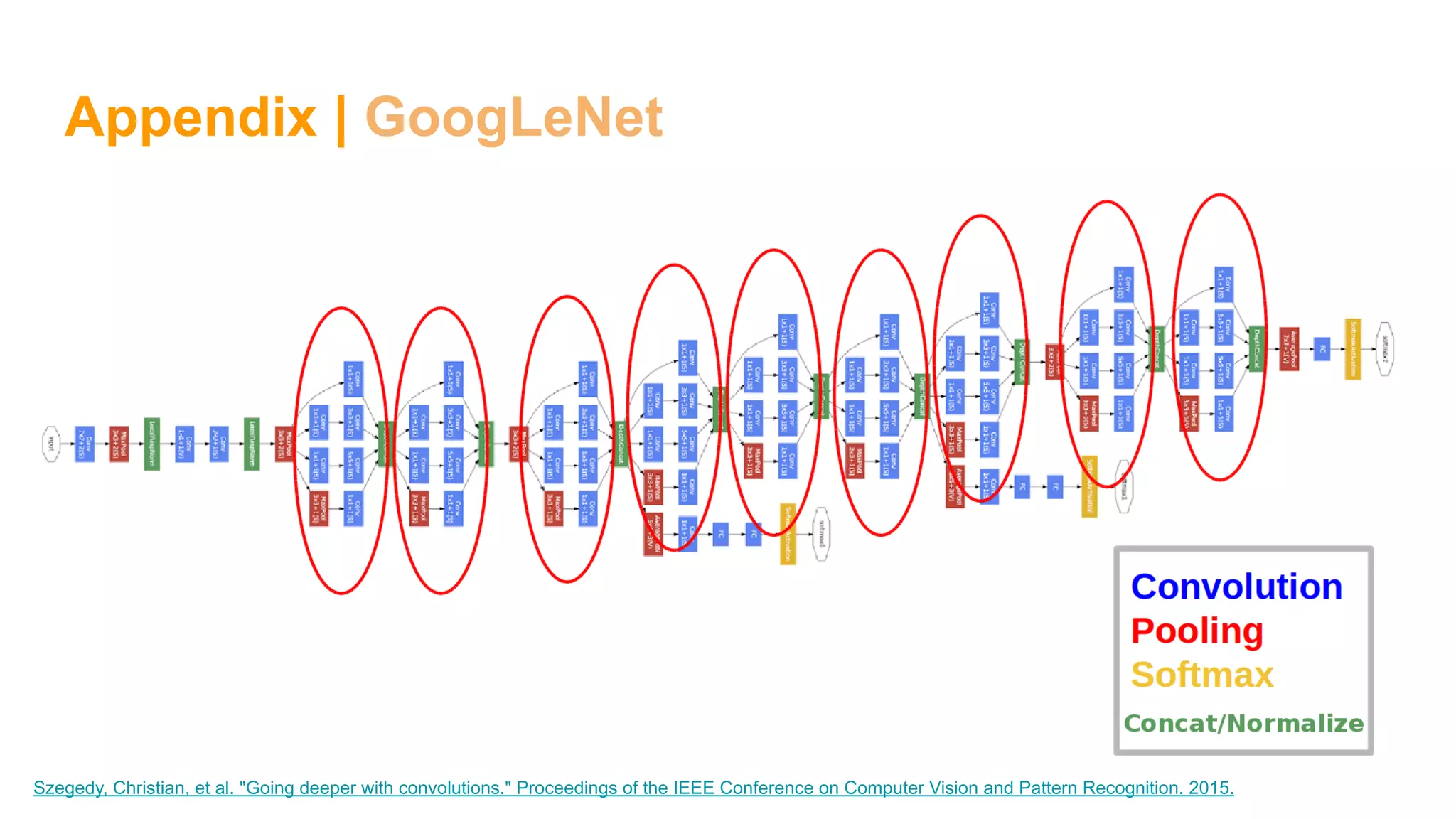
• Modified GoogLeNet
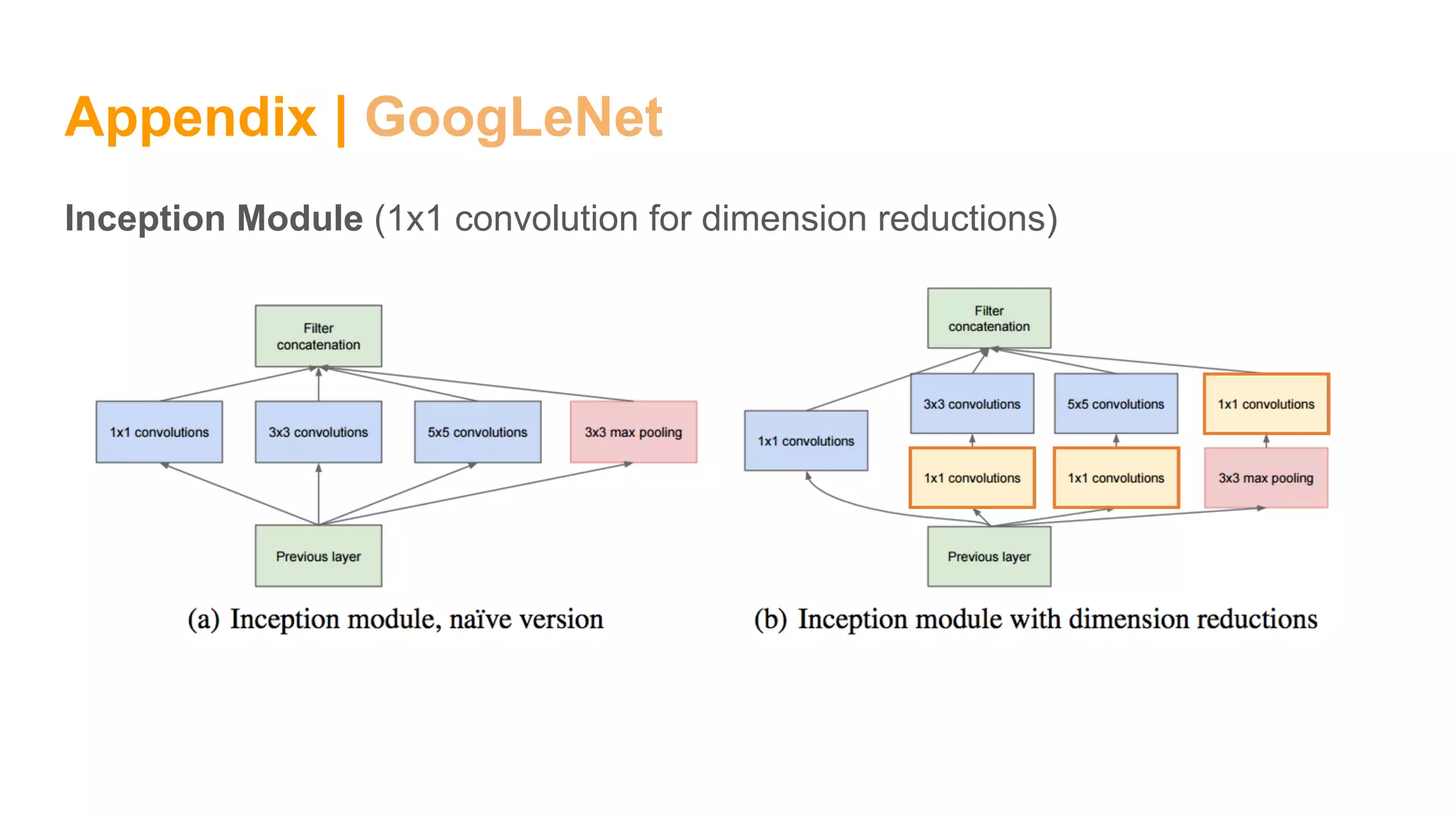
• 1x1 reduction layer (“Network in Network”)
Appendix: GoogLeNet
1 1 4 10 6 2 1 1
24
2
Conv. layer
Fully conn. Layer
Conv. layer
3x3x512
Maxpool Layer
2x2-s-2
Conv. layer
3x3x1024
Maxpool Layer
2x2-s-2
Conv. layer
3x3x1024
Conv. Layer
3x3x1024-s-2
Conv. layer
3x3x1024
Conv. Layer
3x3x1024
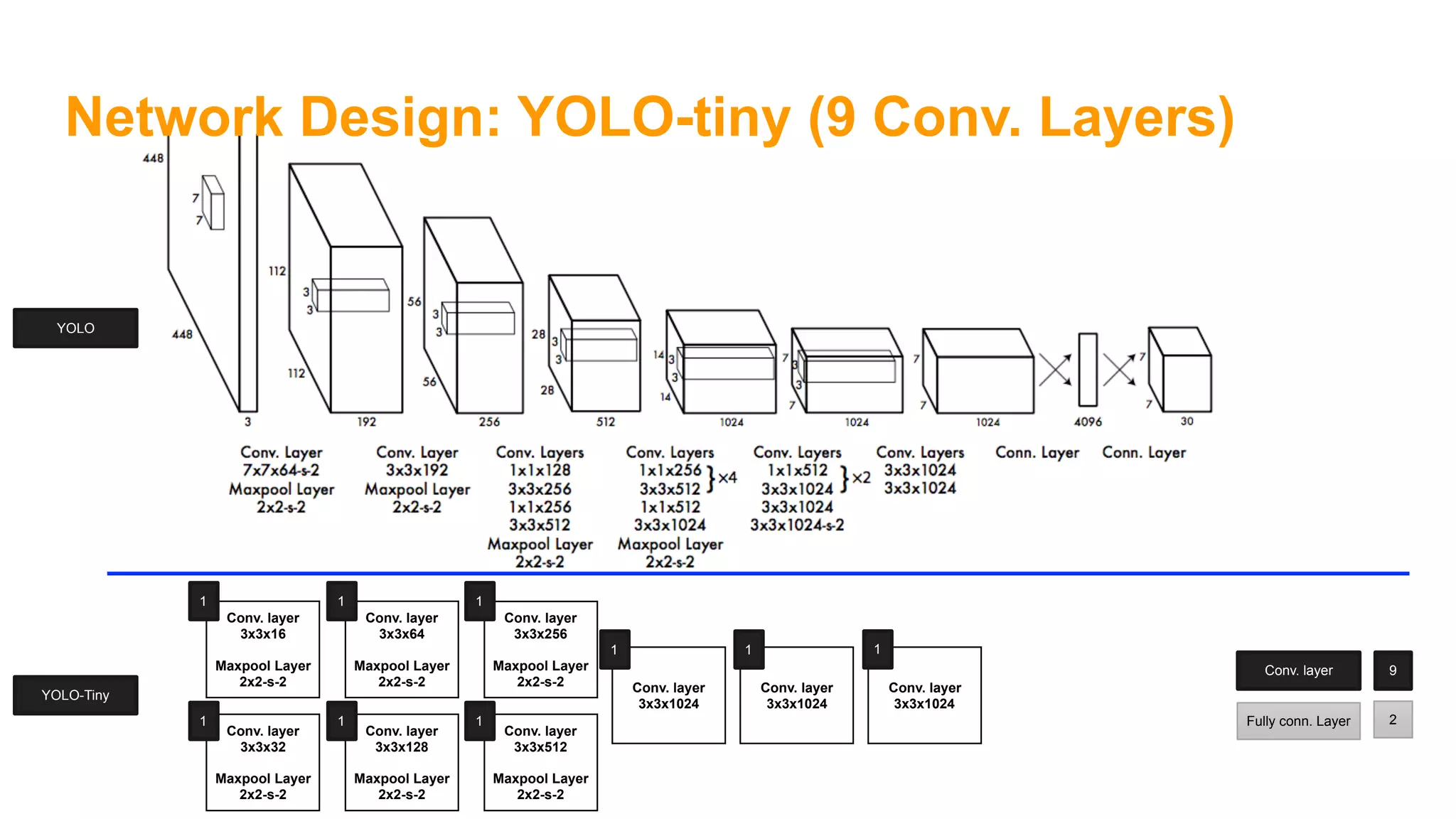
Network Design: YOLO-tiny (9 Conv. Layers)
Conv. layer
3x3x16
Maxpool Layer
2x2-s-2
Conv. layer
3x3x32
Maxpool Layer
2x2-s-2
Conv. layer
3x3x64
Maxpool Layer
2x2-s-2
Conv. layer
3x3x128
Maxpool Layer
2x2-s-2
Conv. layer
3x3x256
Maxpool Layer
2x2-s-2
Conv. layer
3x3x512
Maxpool Layer
2x2-s-2
Conv. layer
3x3x1024
Conv. layer
3x3x1024
Conv. layer
3x3x1024
9
2
Conv. layer
Fully conn. Layer
1
1
1
1
1
1
1 1 1
YOLO-Tiny
YOLO
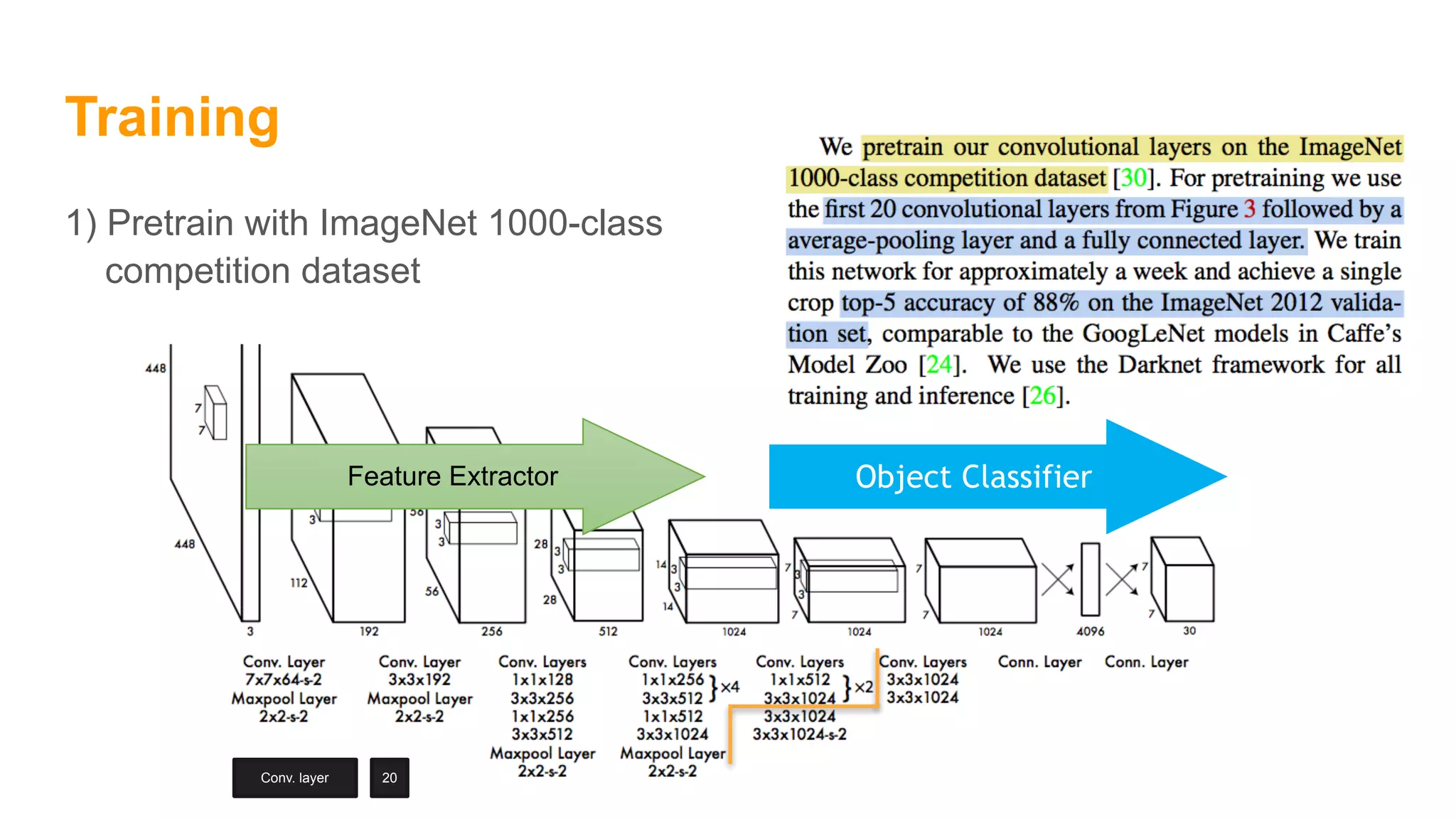
Training
1) Pretrain with ImageNet 1000-class 

competition dataset
20Conv. layer
Feature Extractor Object Classifier
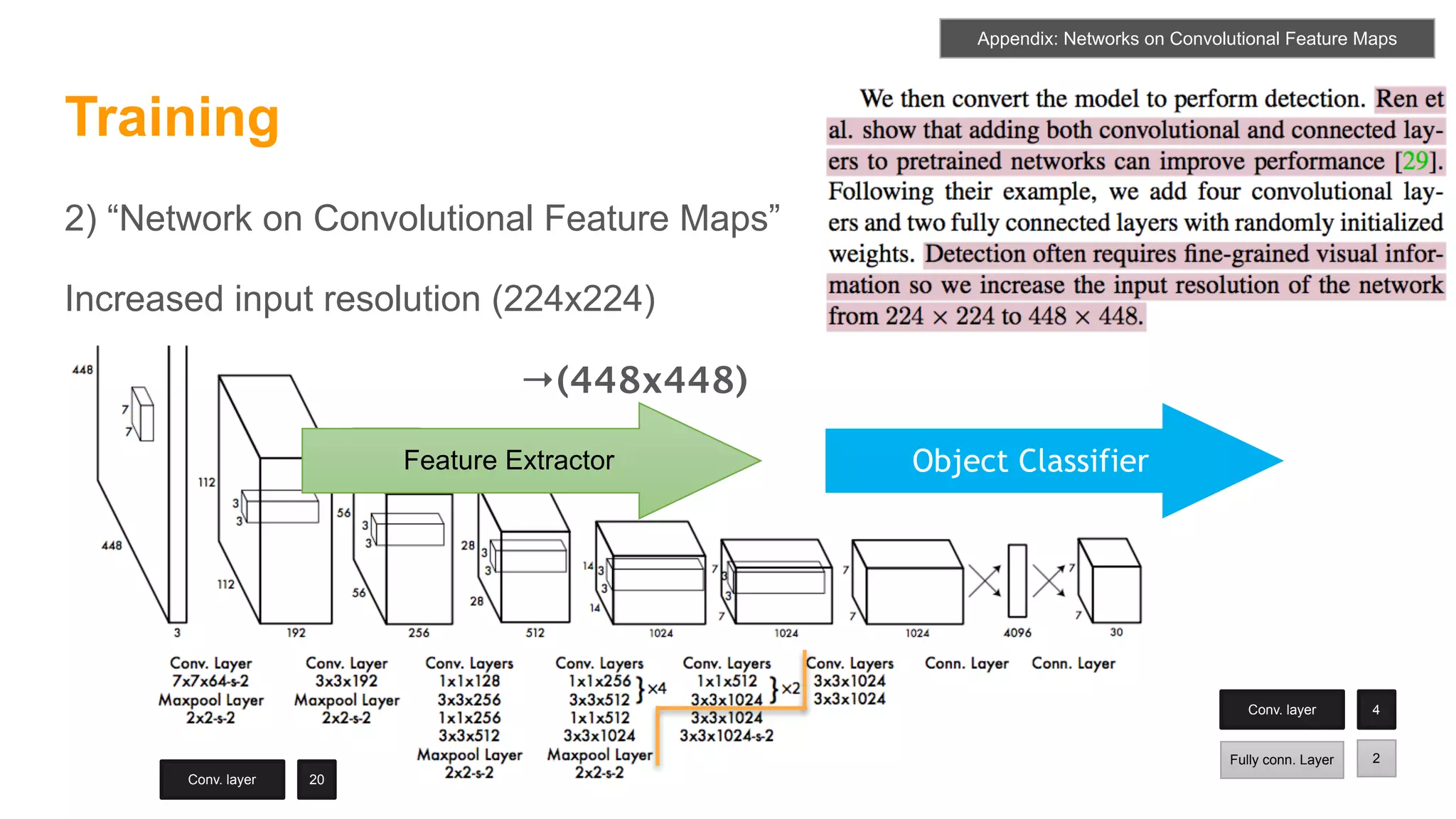
Training
2) “Network on Convolutional Feature Maps”
Increased input resolution (224x224)
→(448x448)
Appendix: Networks on Convolutional Feature Maps
20Conv. layer
4
2
Conv. layer
Fully conn. Layer
Feature Extractor Object Classifier
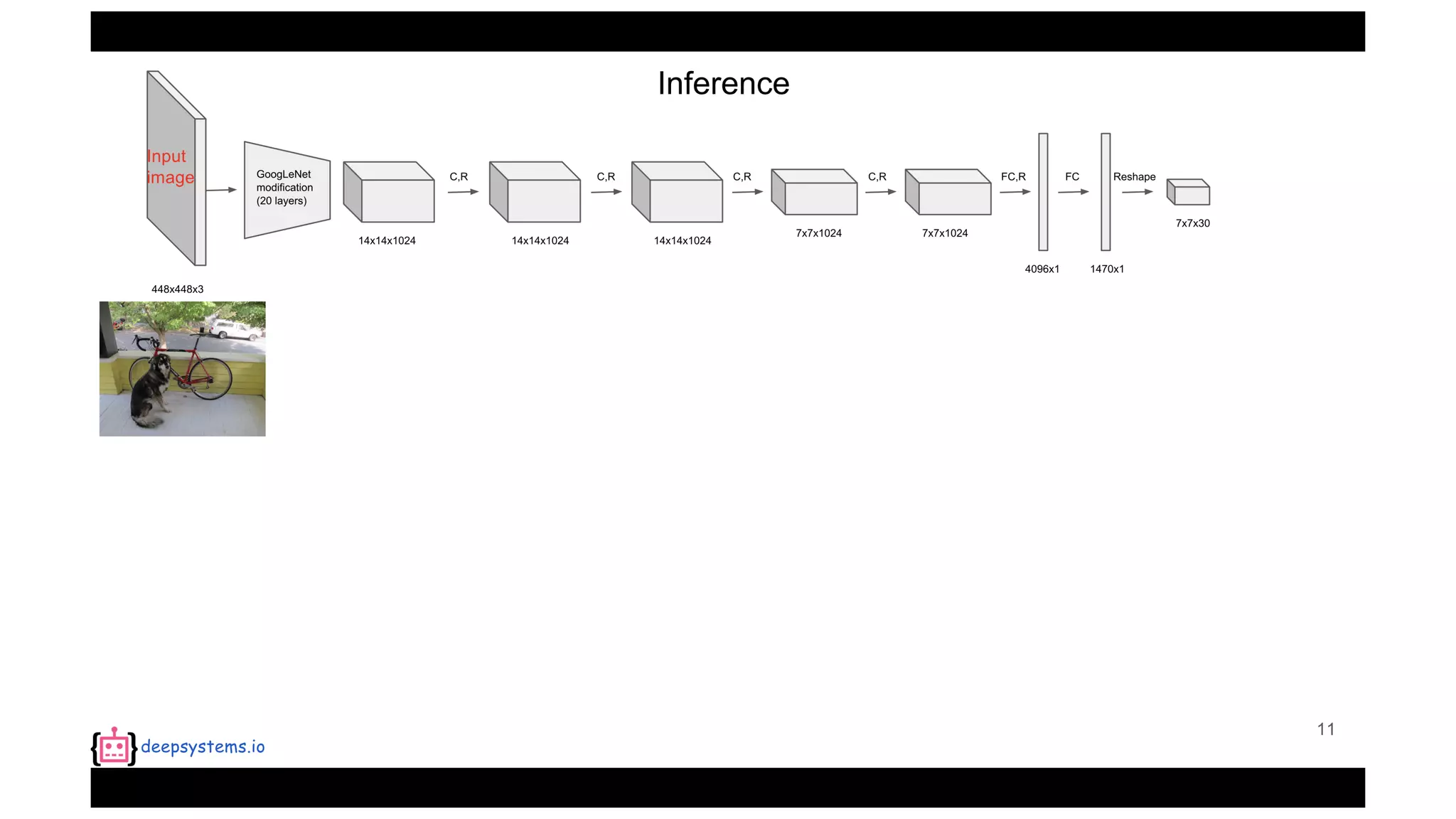
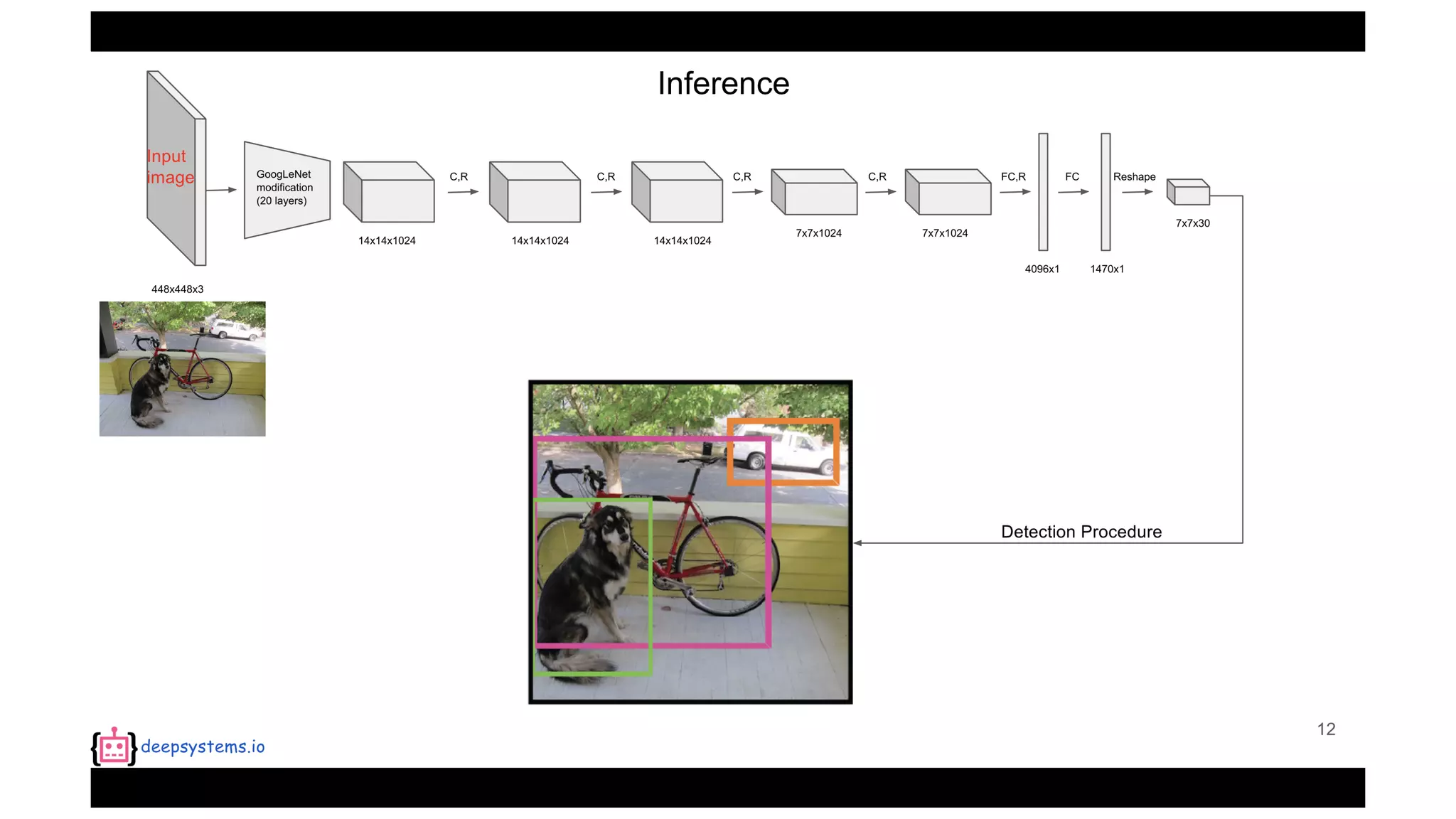
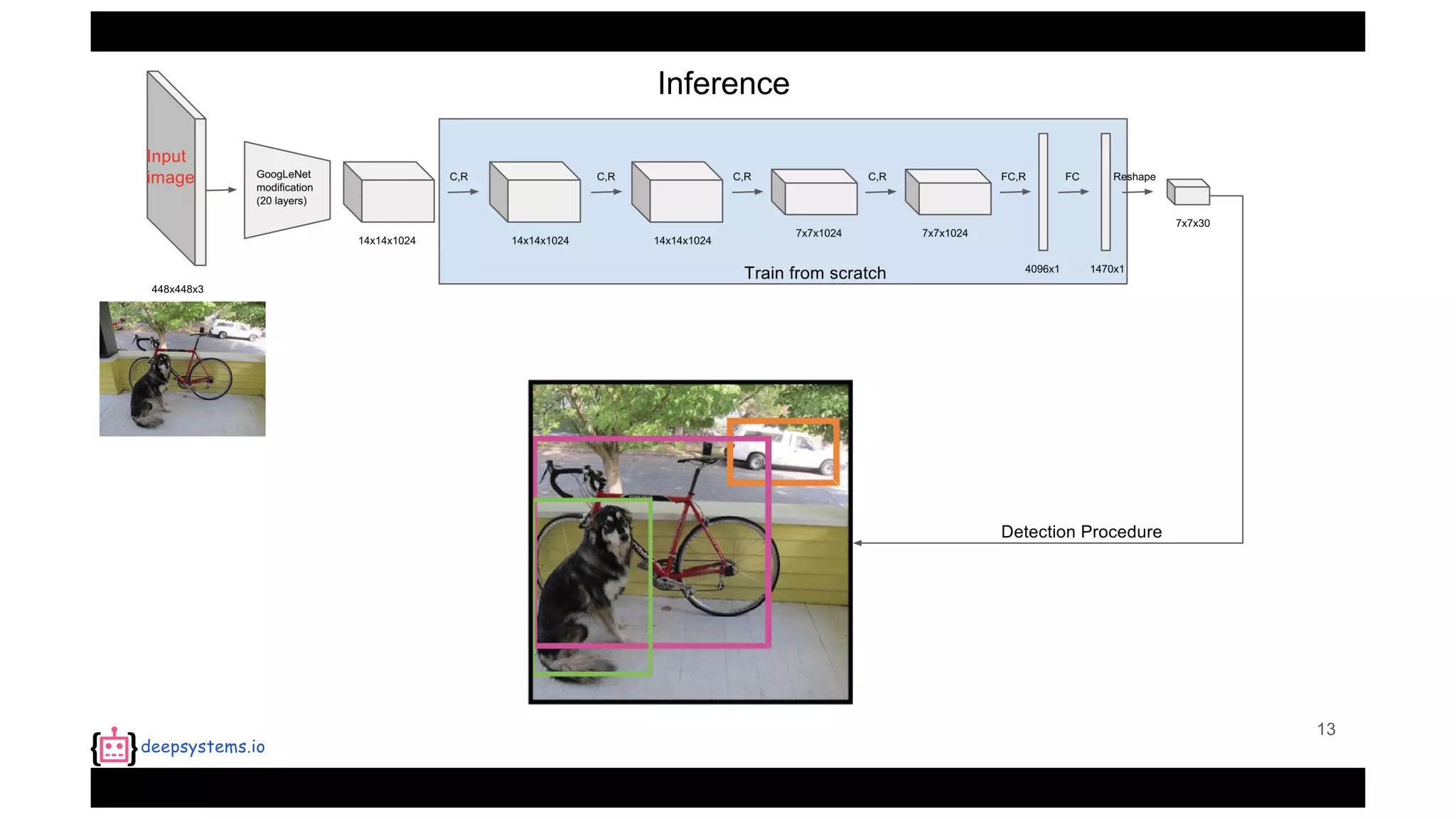
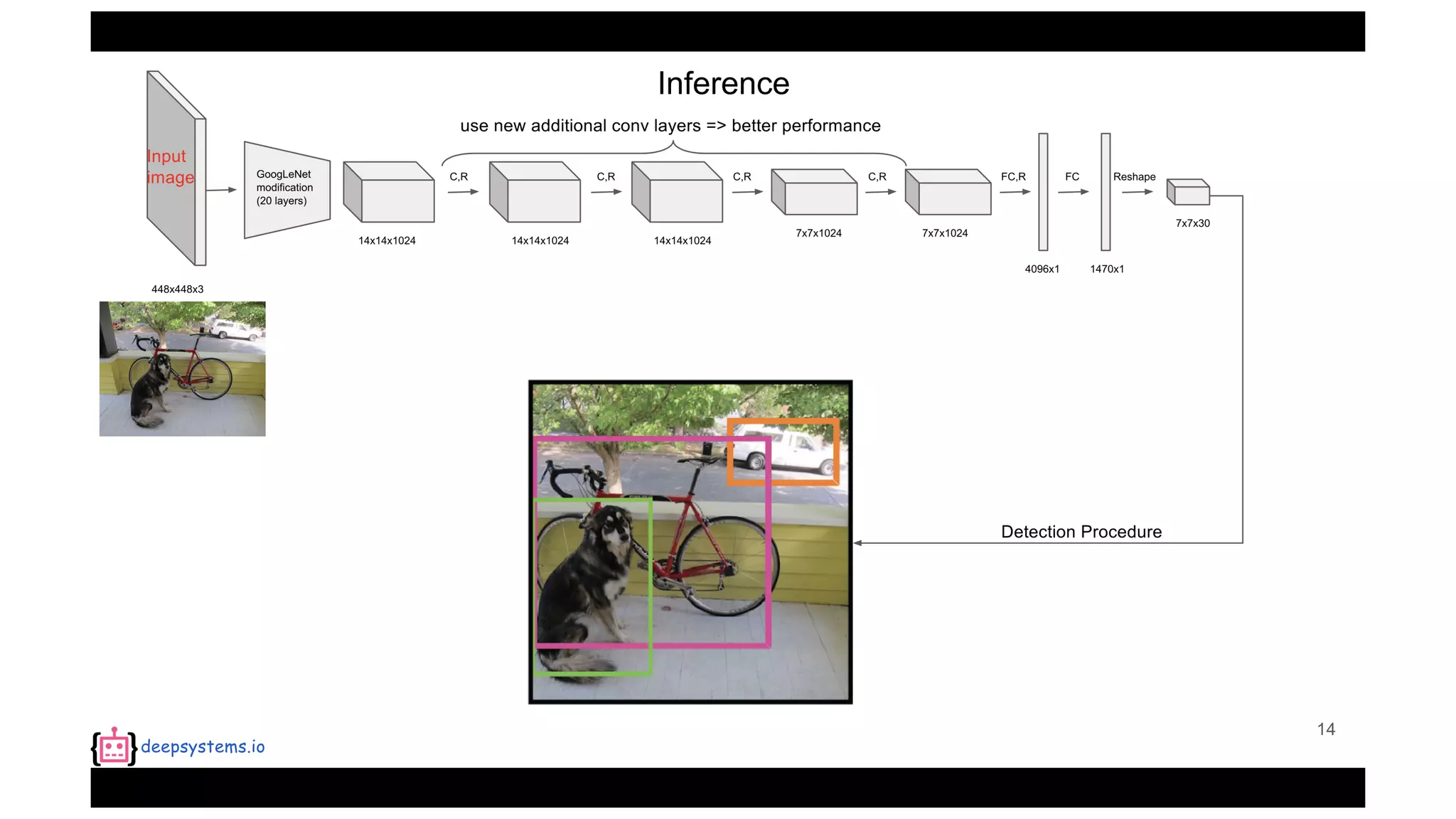
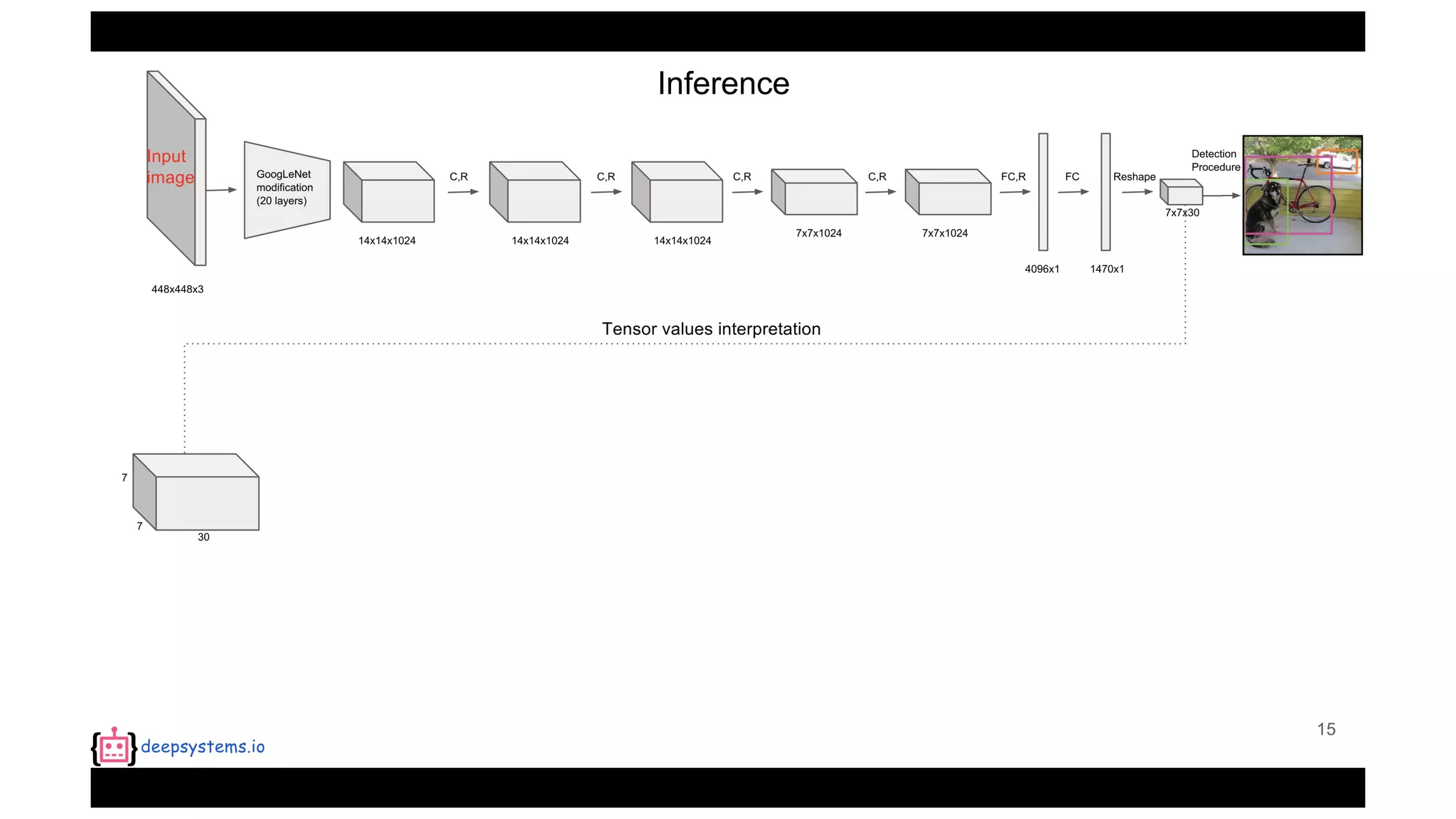
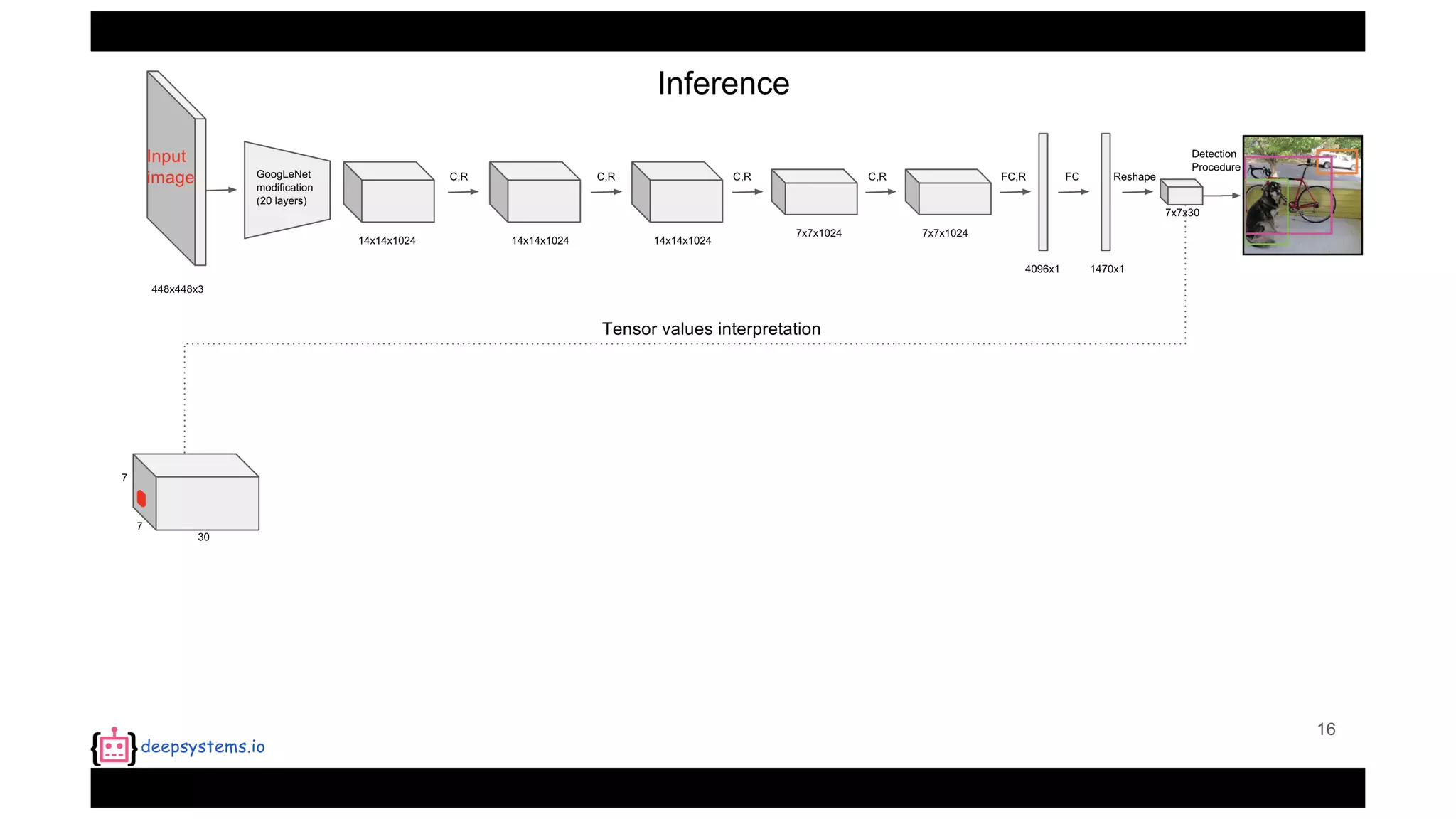
Inference
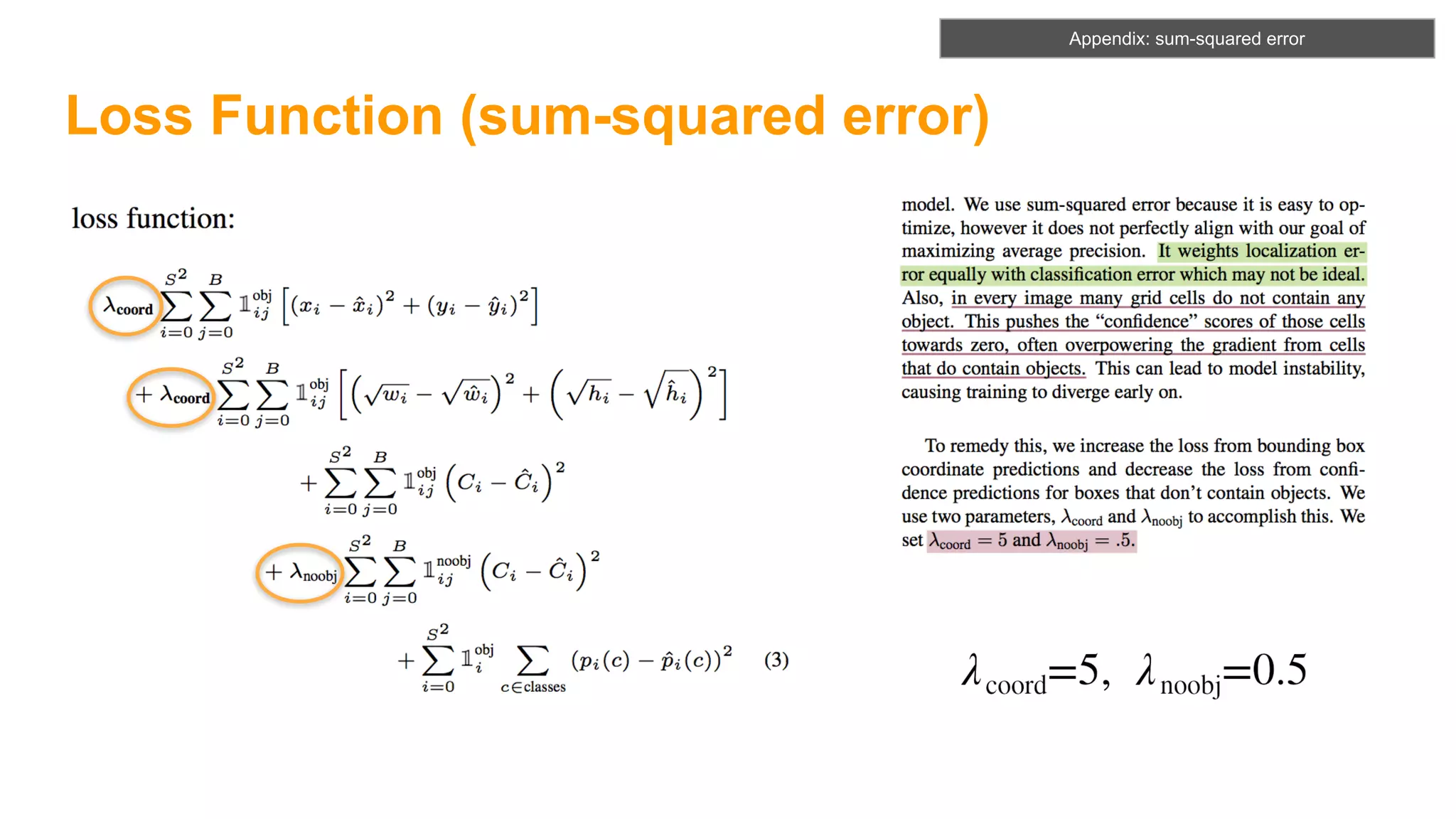
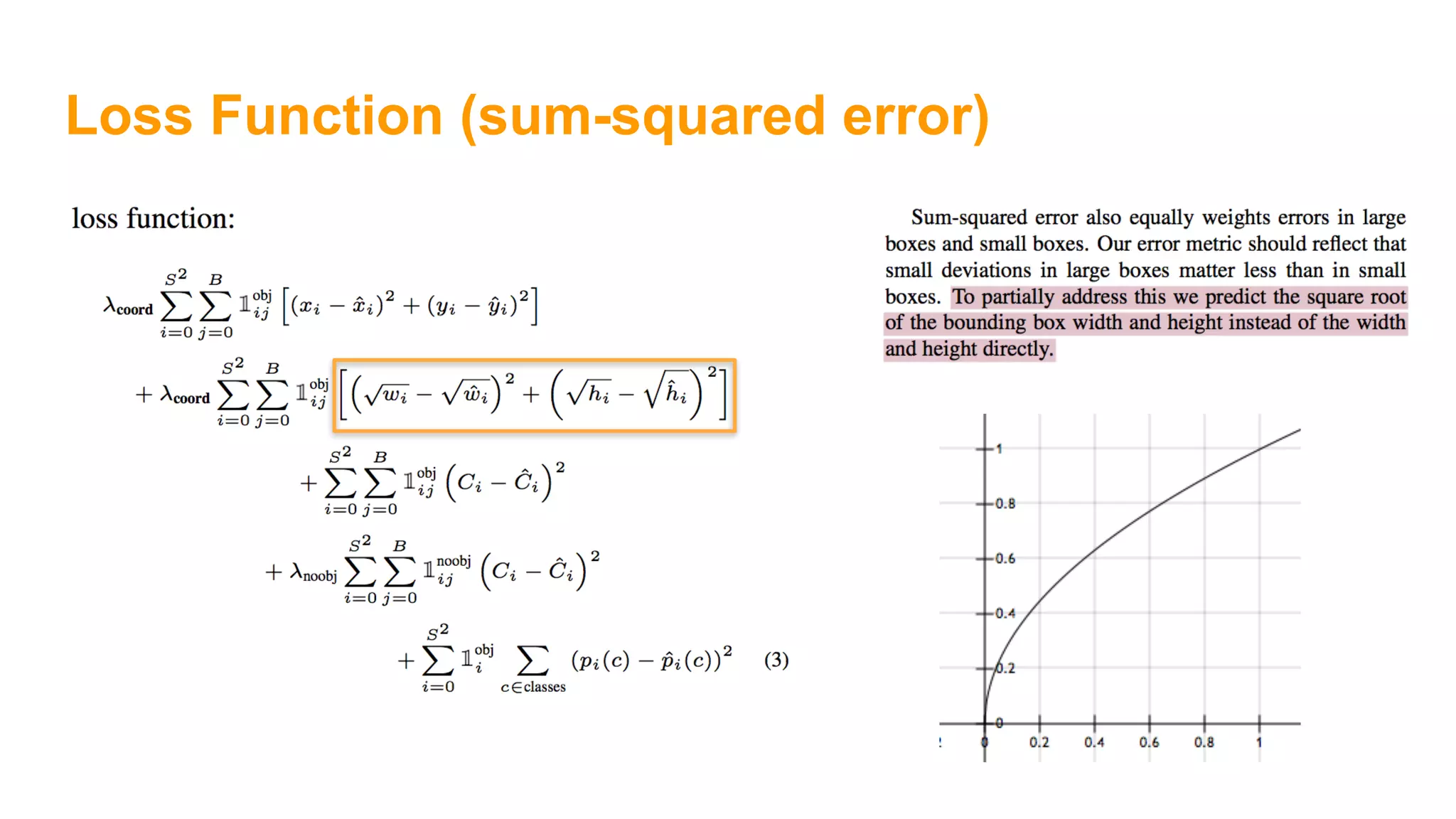
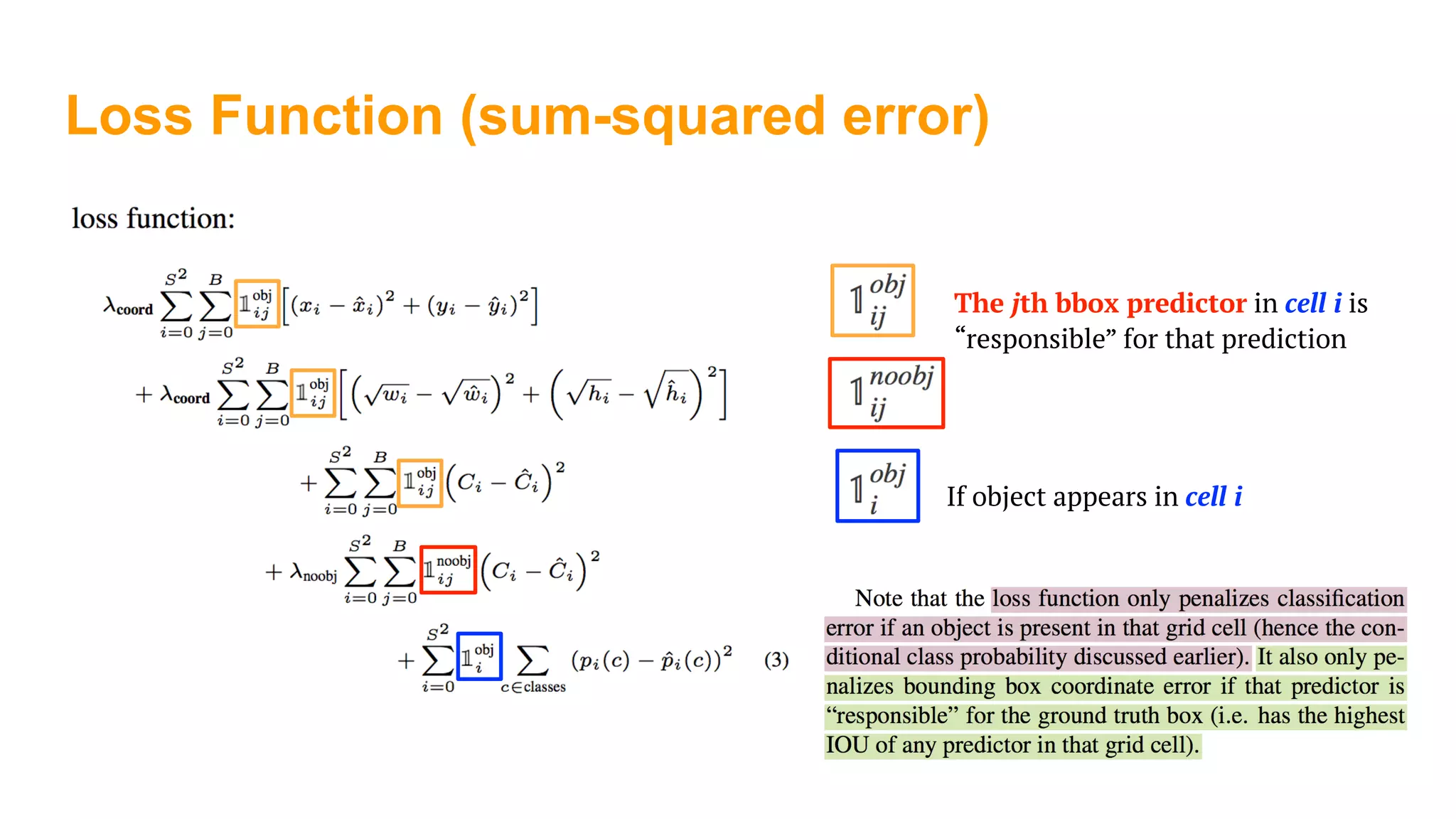
Loss Function (sum-squared error)
Appendix: sum-squared error
Loss Function (sum-squared error)
Re
If object appears in cell i
The jth bbox predictor in cell i is 

“responsible” for that prediction
Train strategy
epochs=135
batch_size=64
momentum_a = 0.9
decay=0.0005
lr=[10-3, 10-2, 10-3, 10-4]
dropout_rate=0.5
augmentation

=[scaling, translation, exposure, saturation]
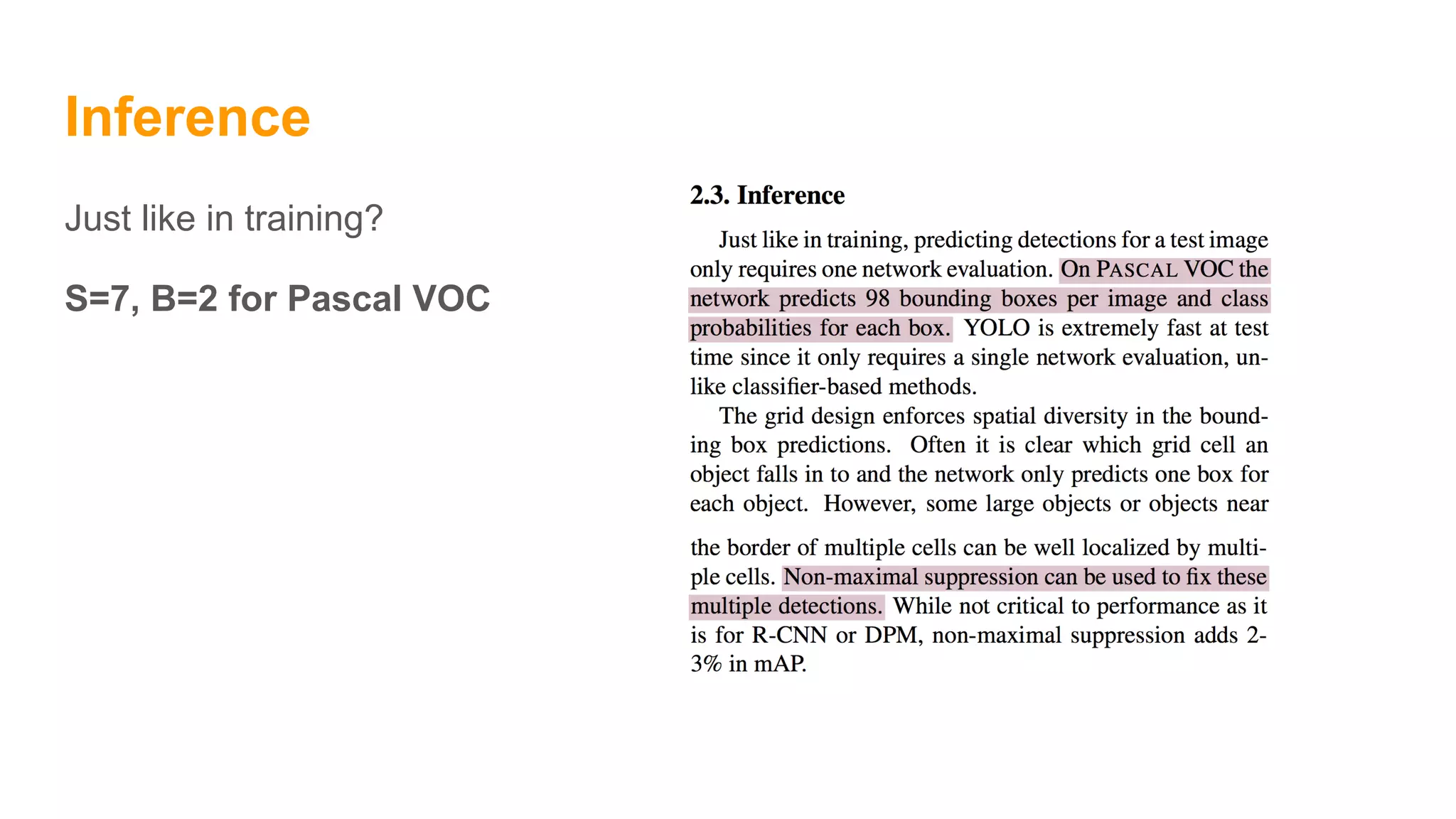
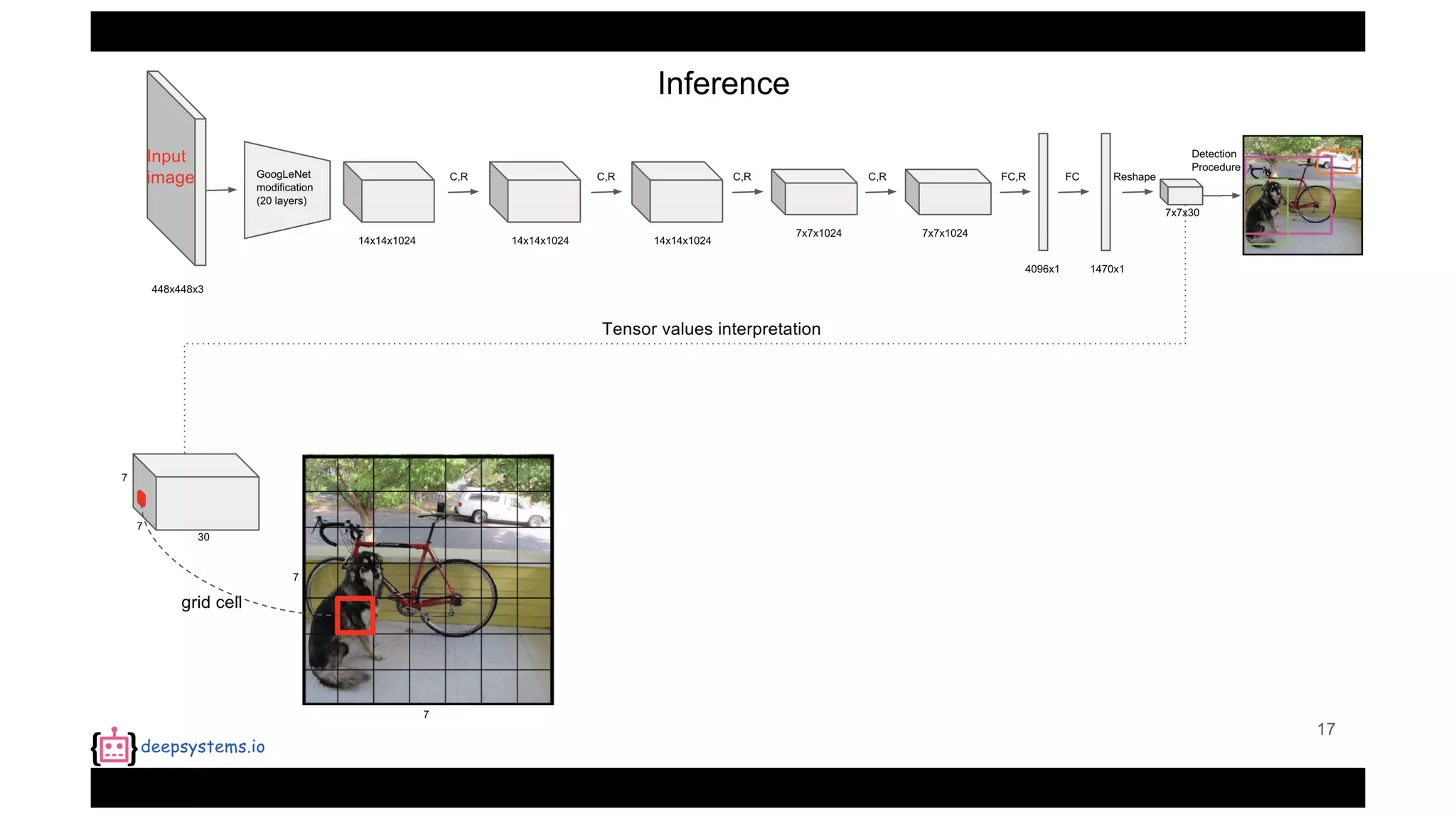
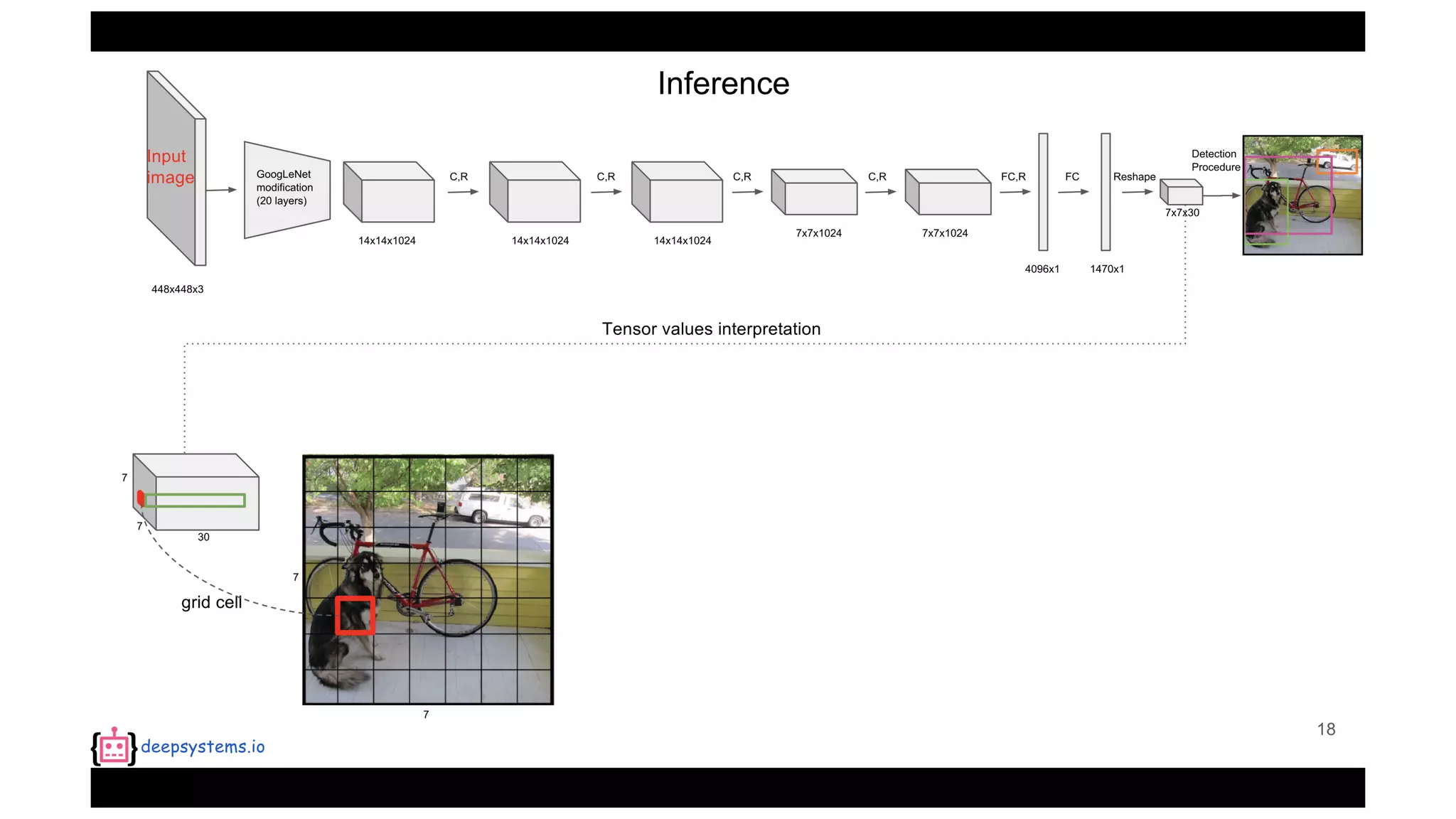
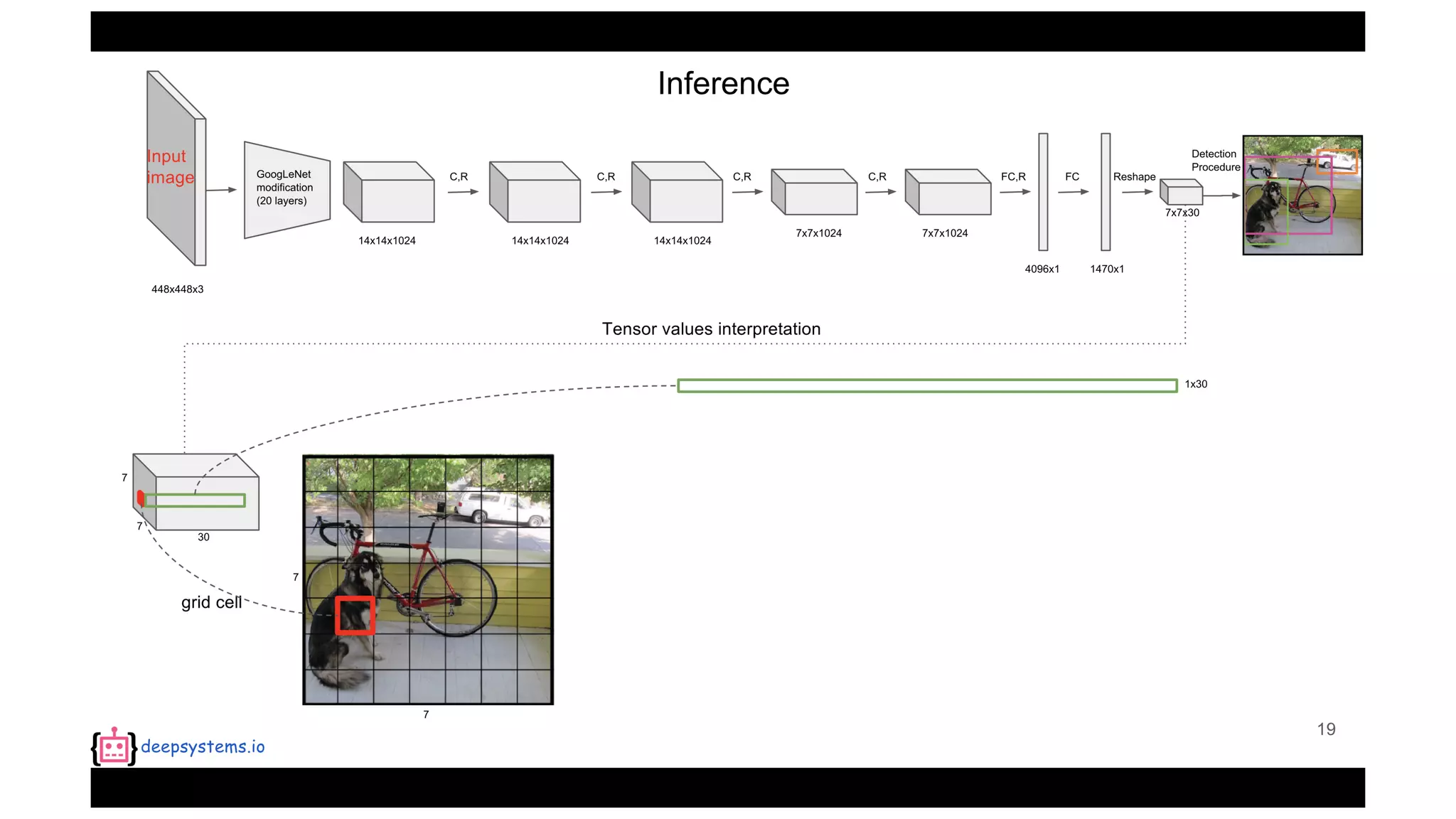
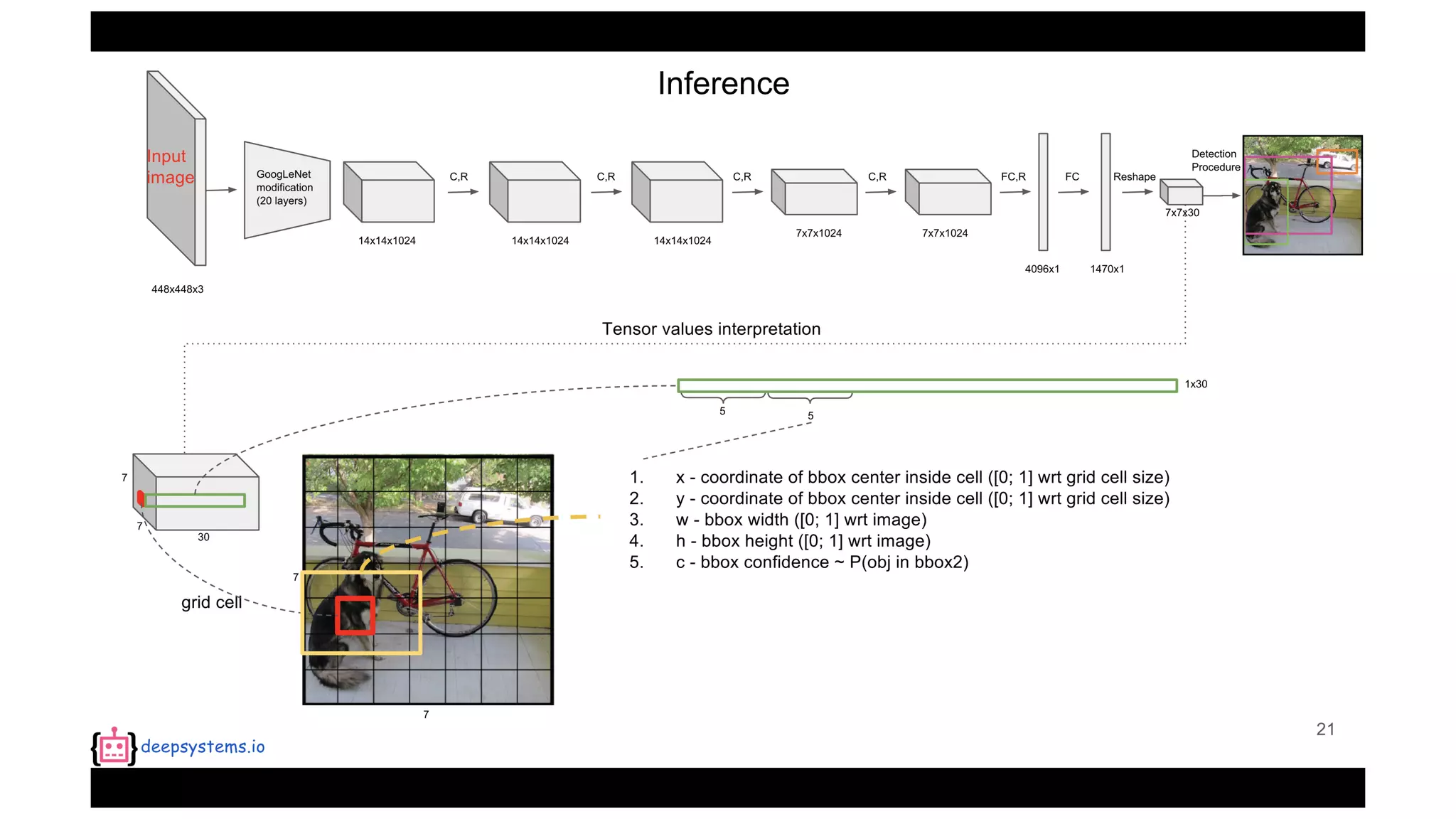
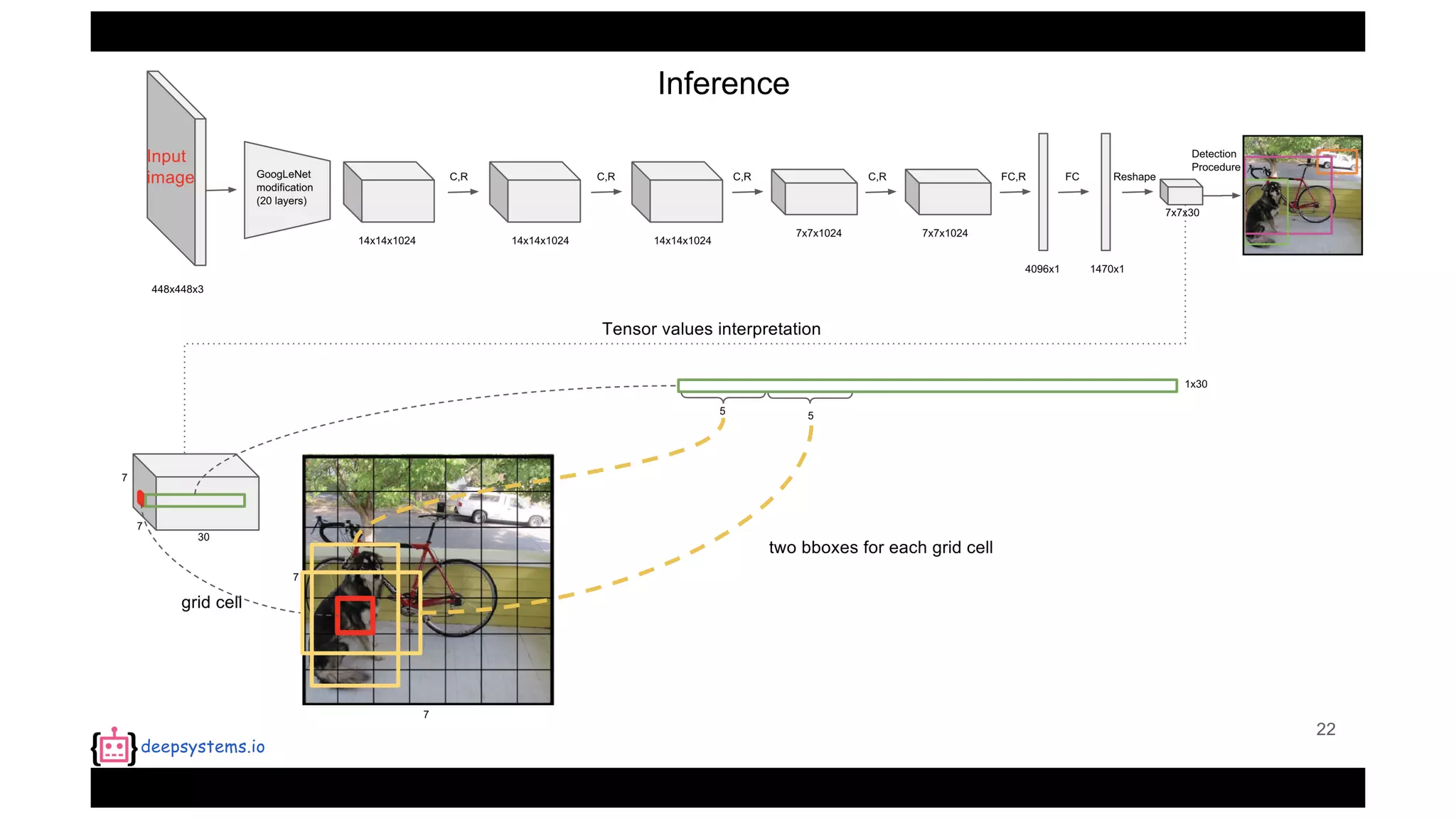
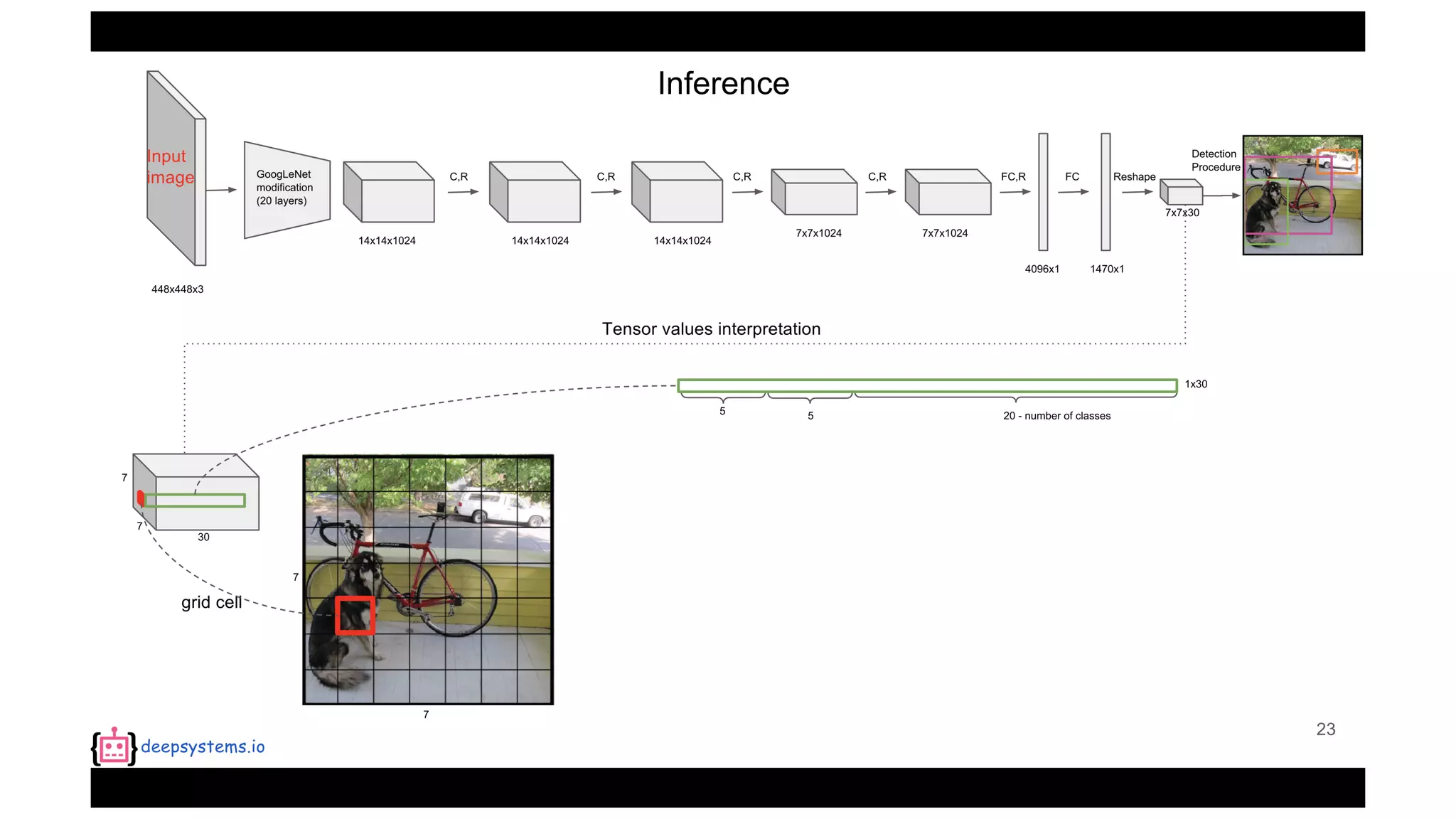
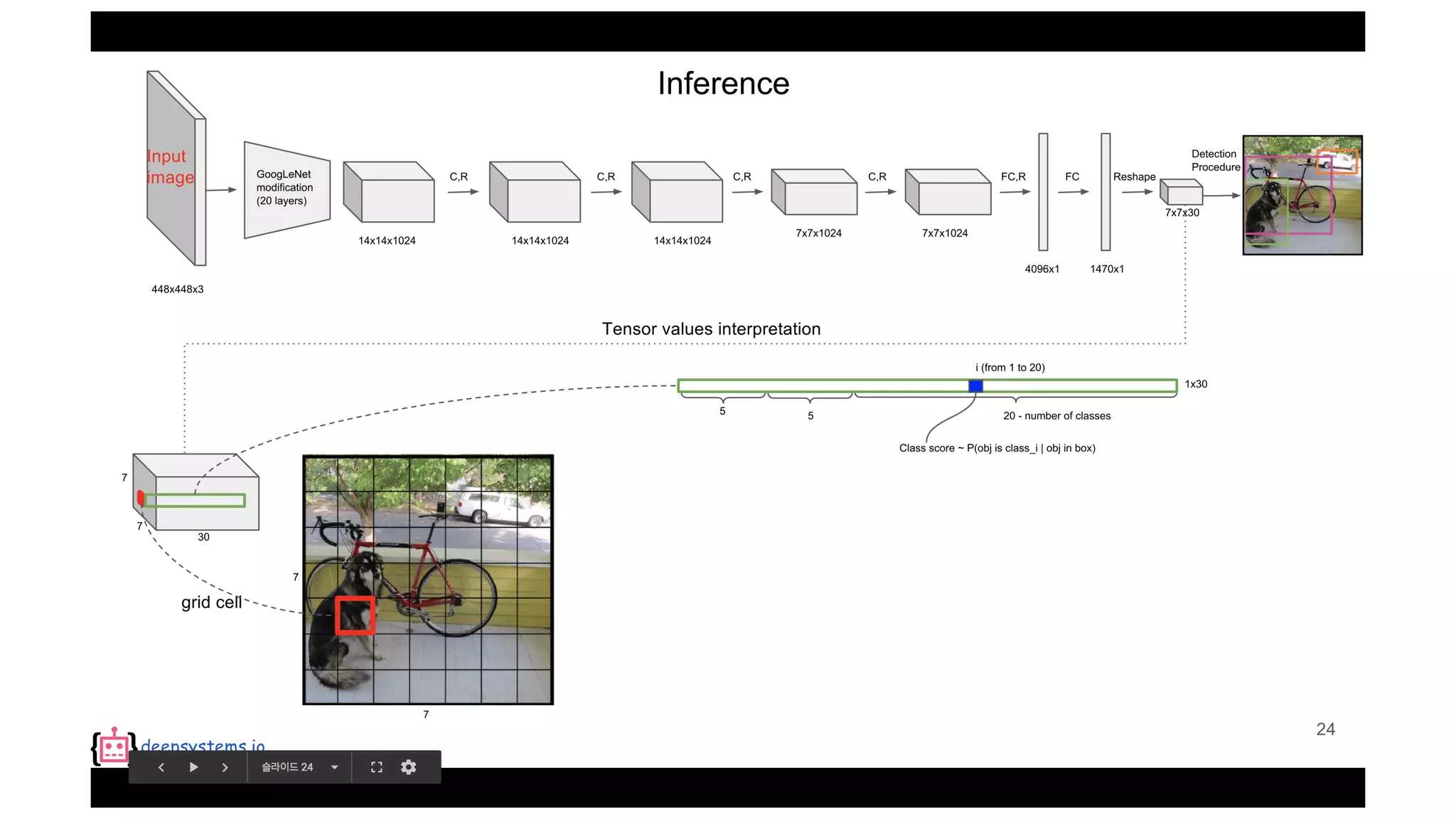
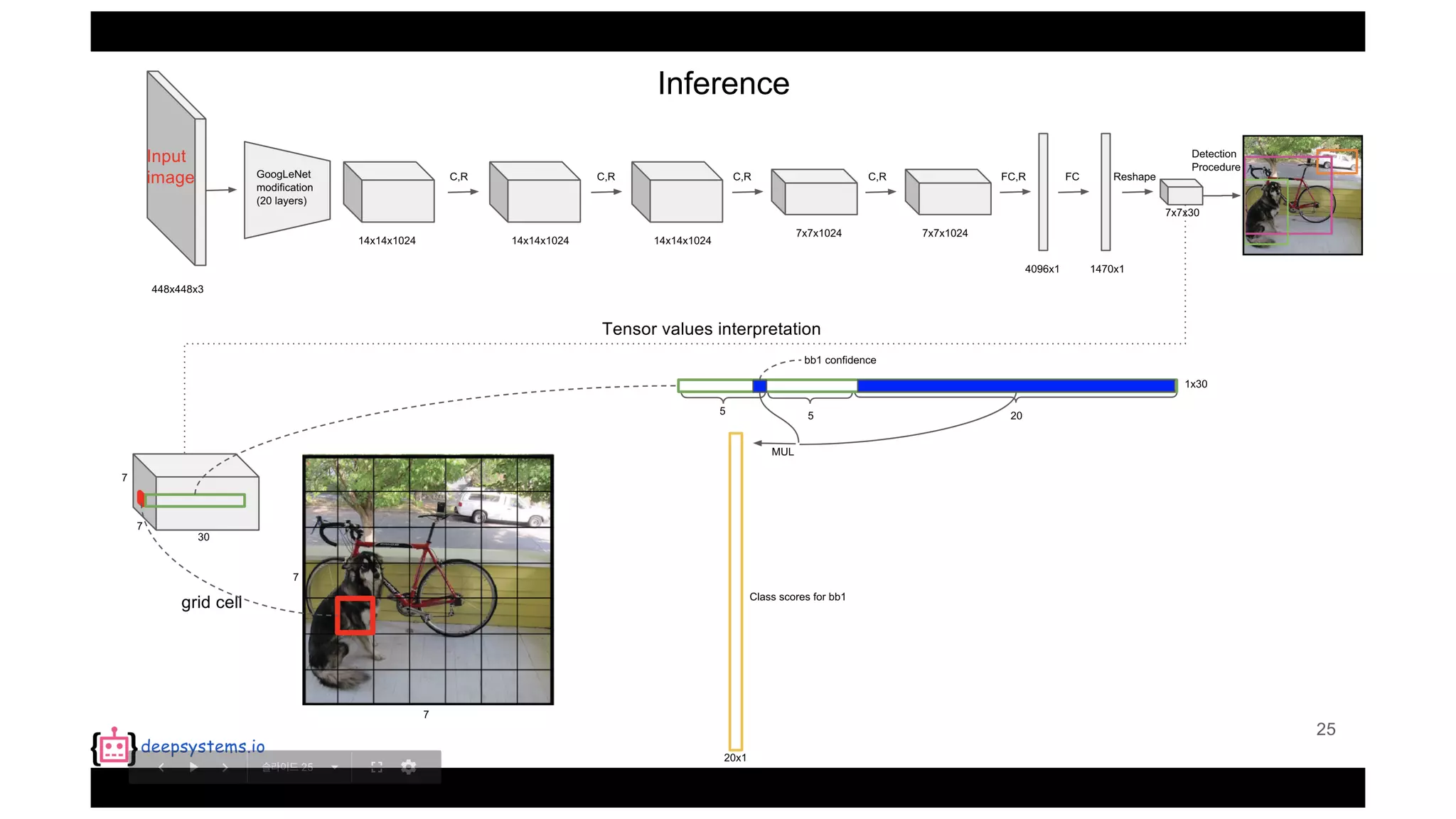
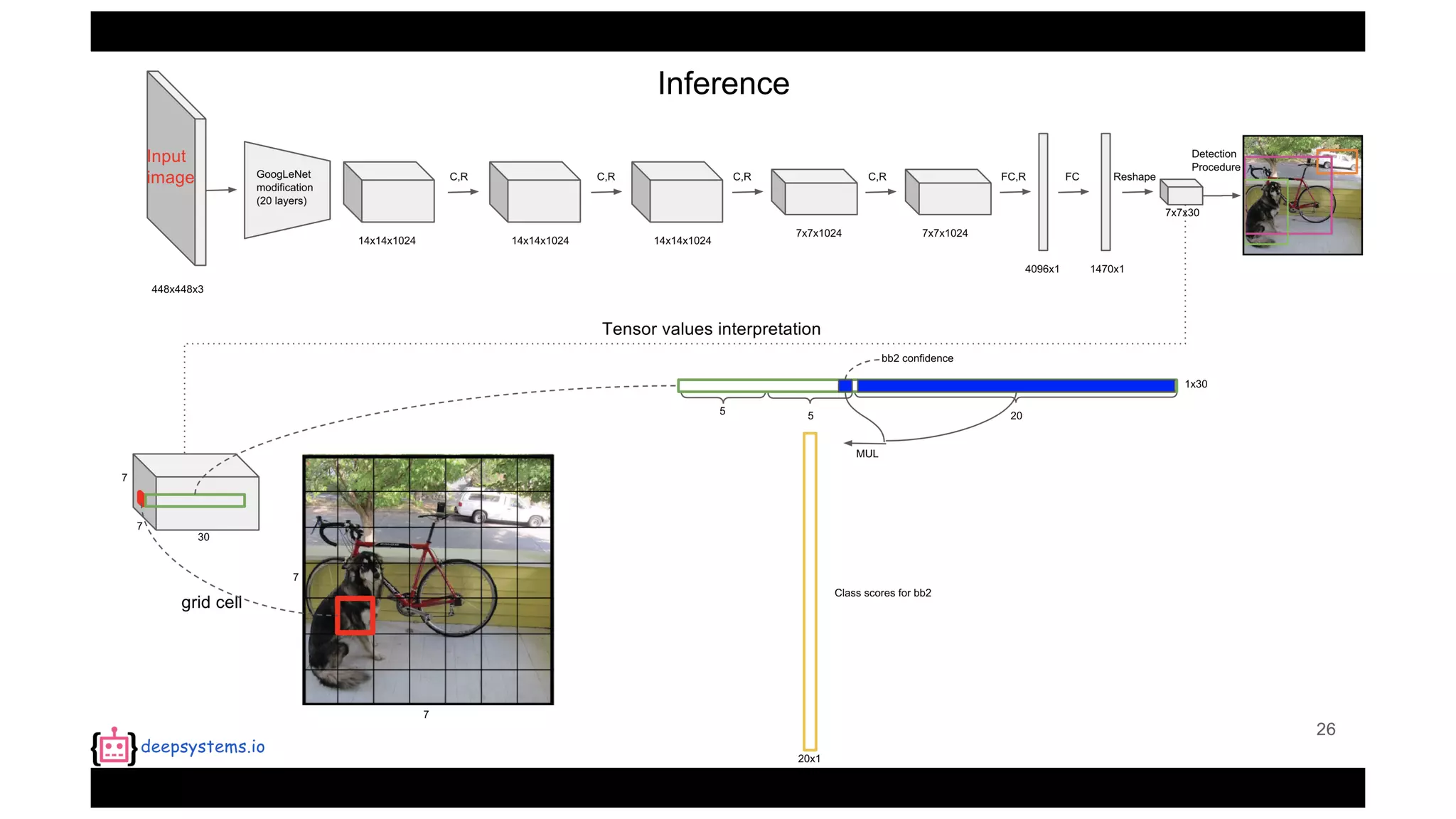
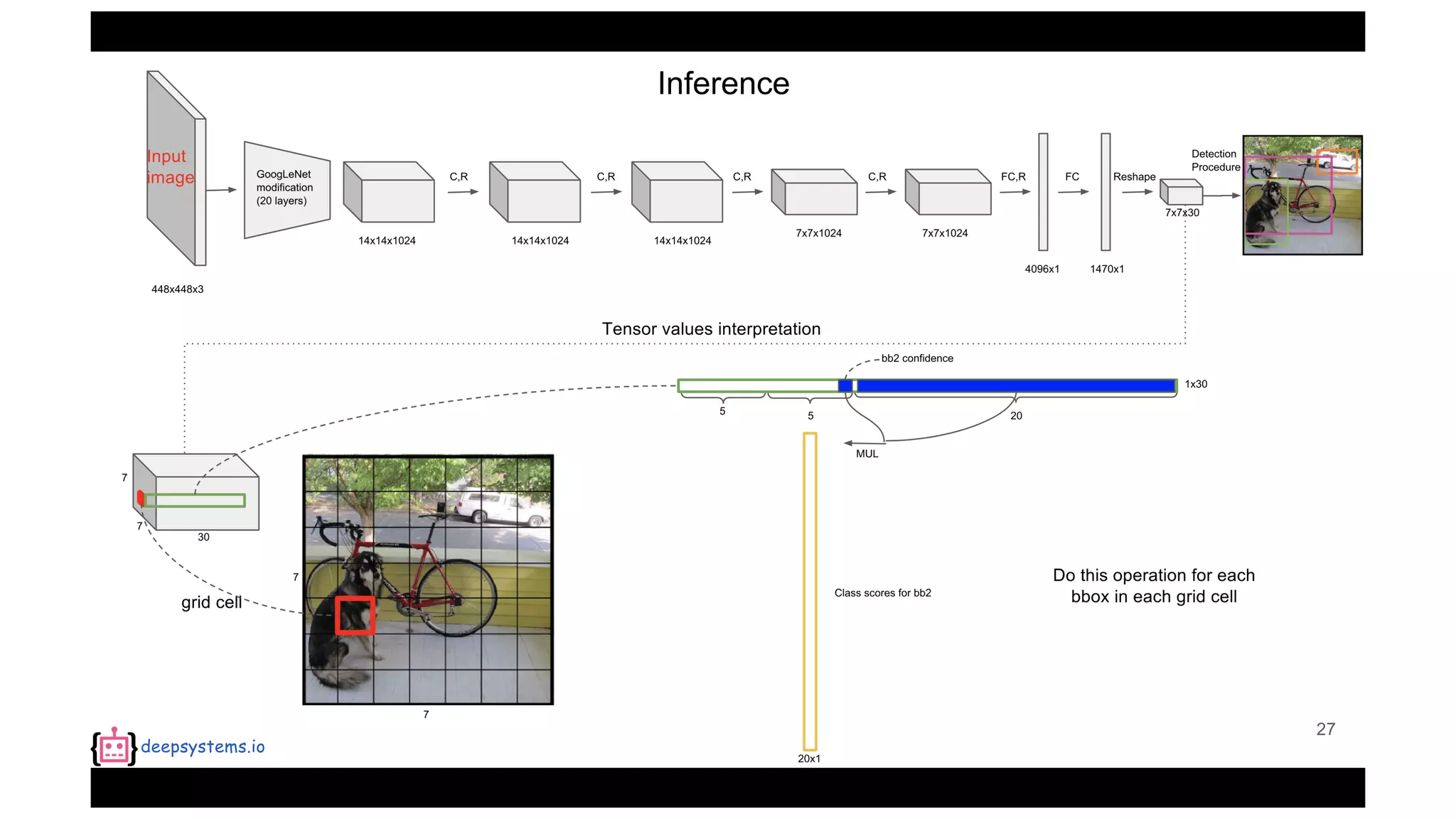
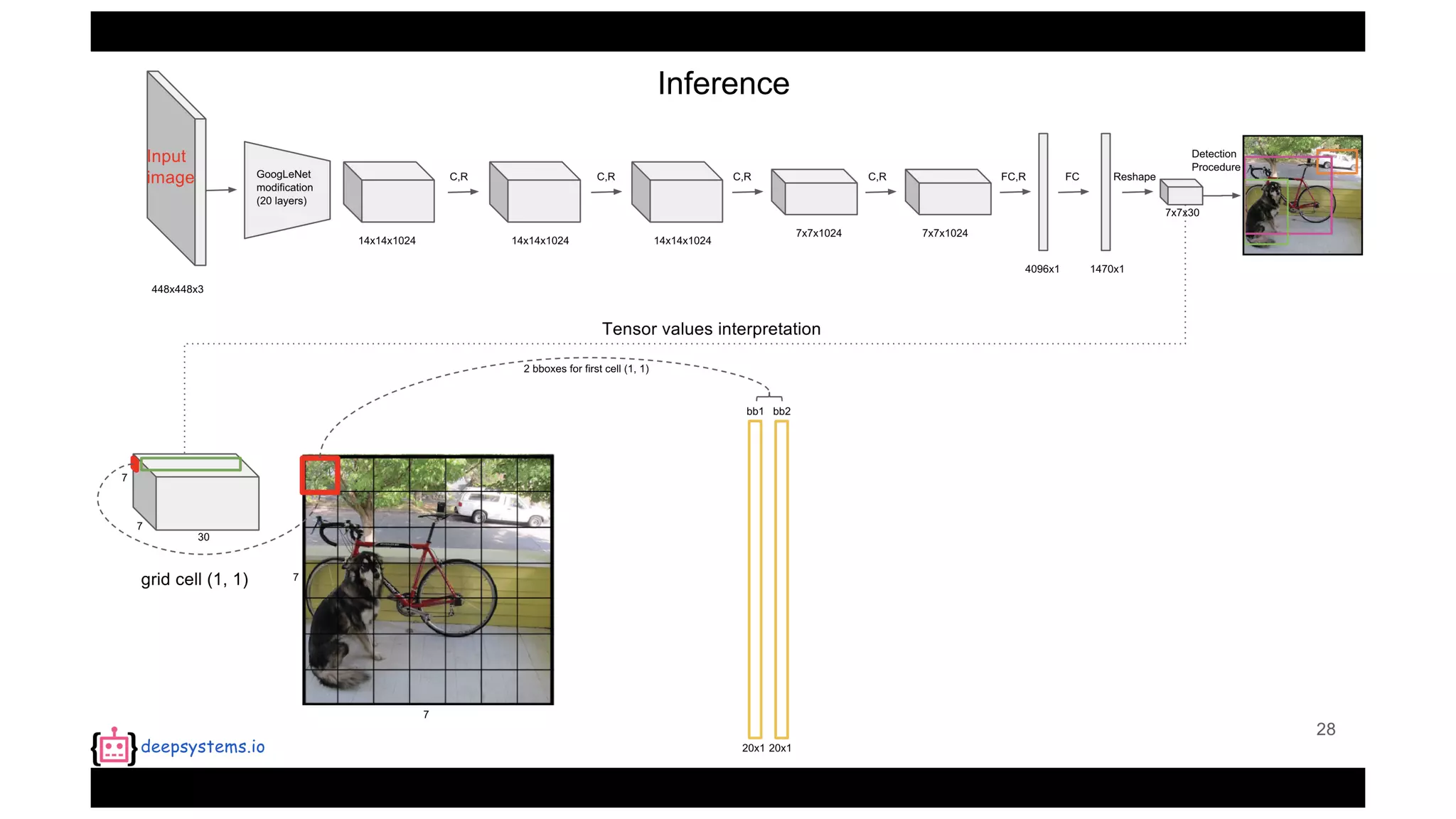
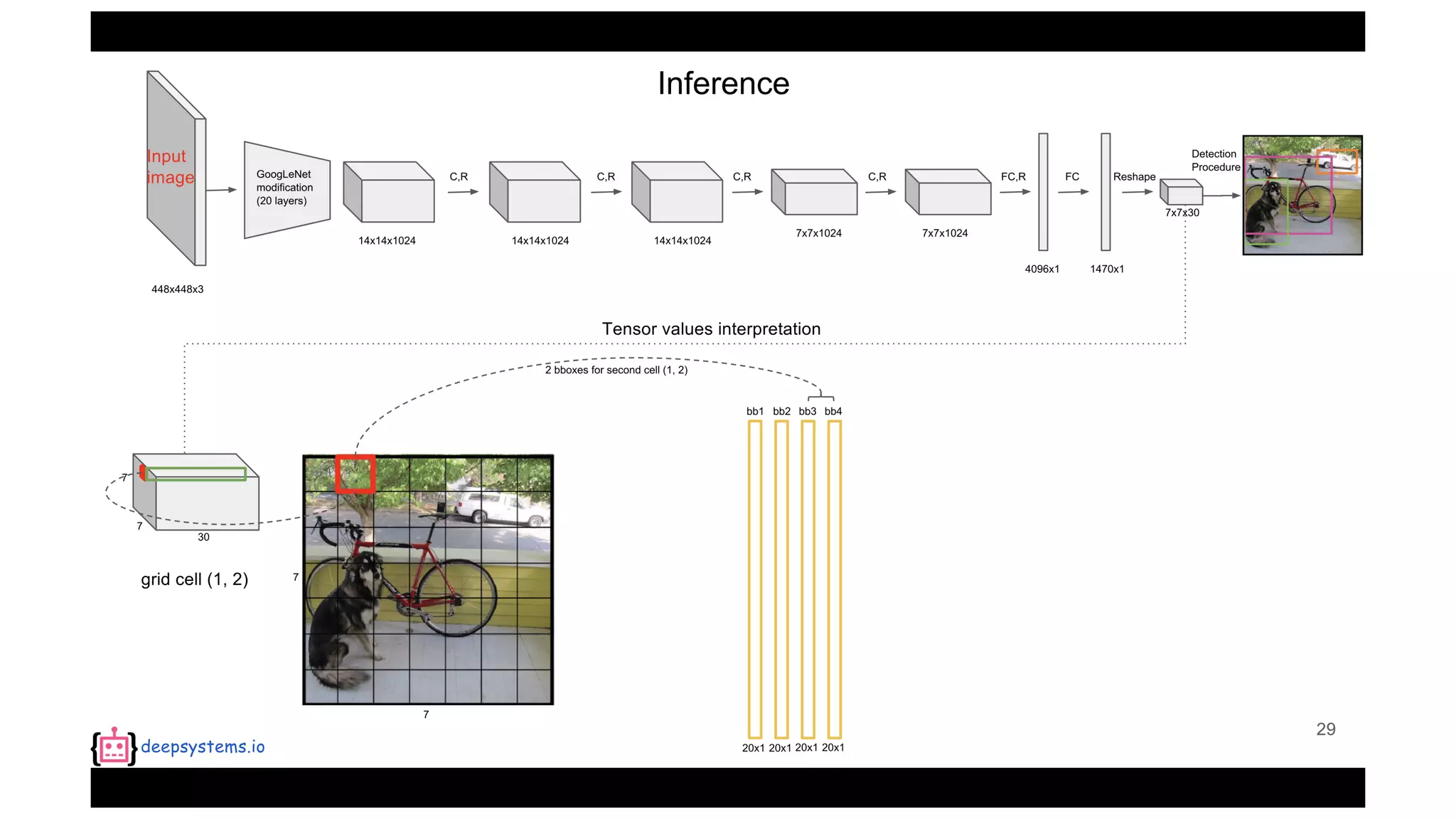
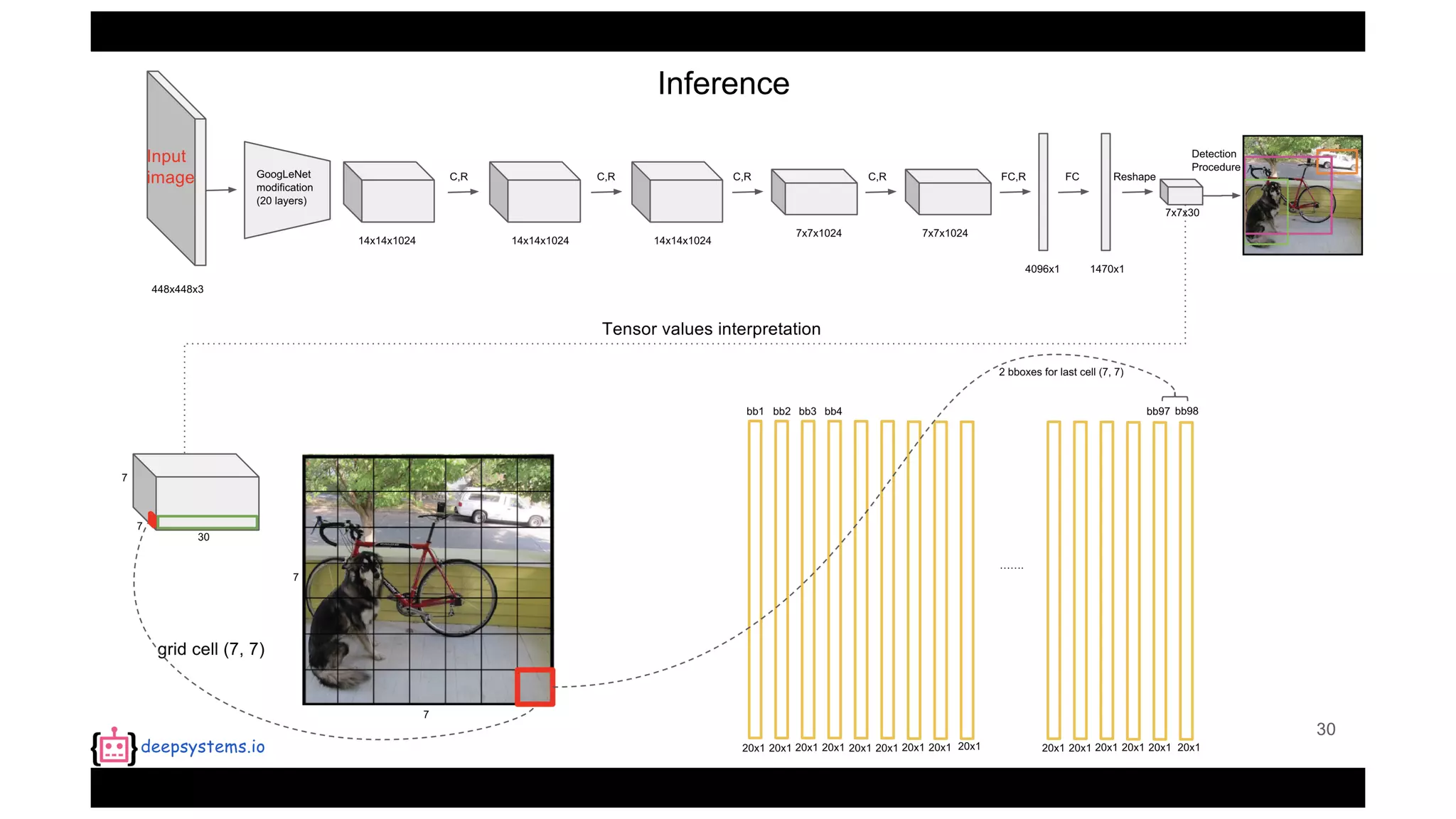
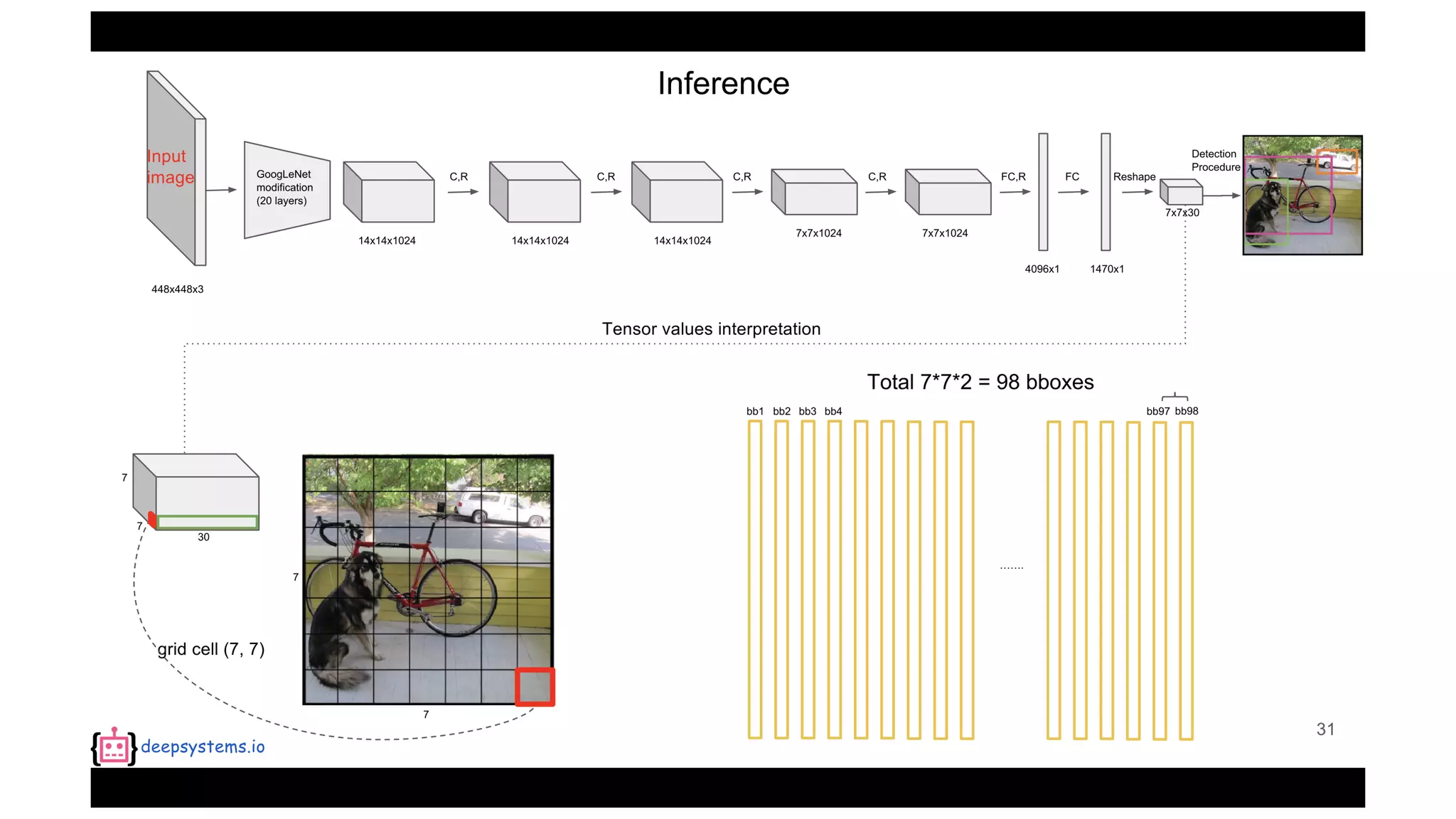
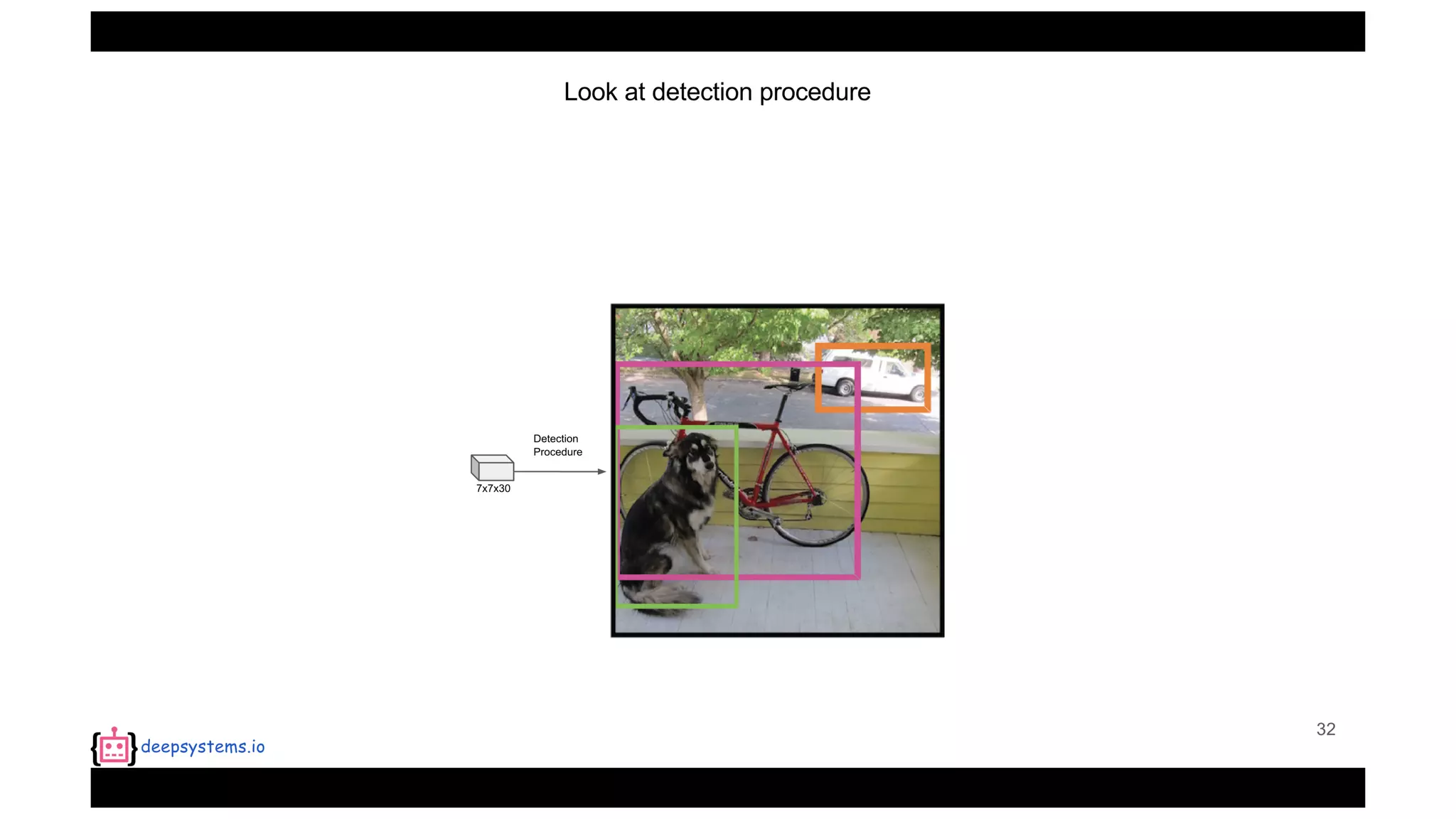
Inference
Just like in training?
S=7, B=2 for Pascal VOC
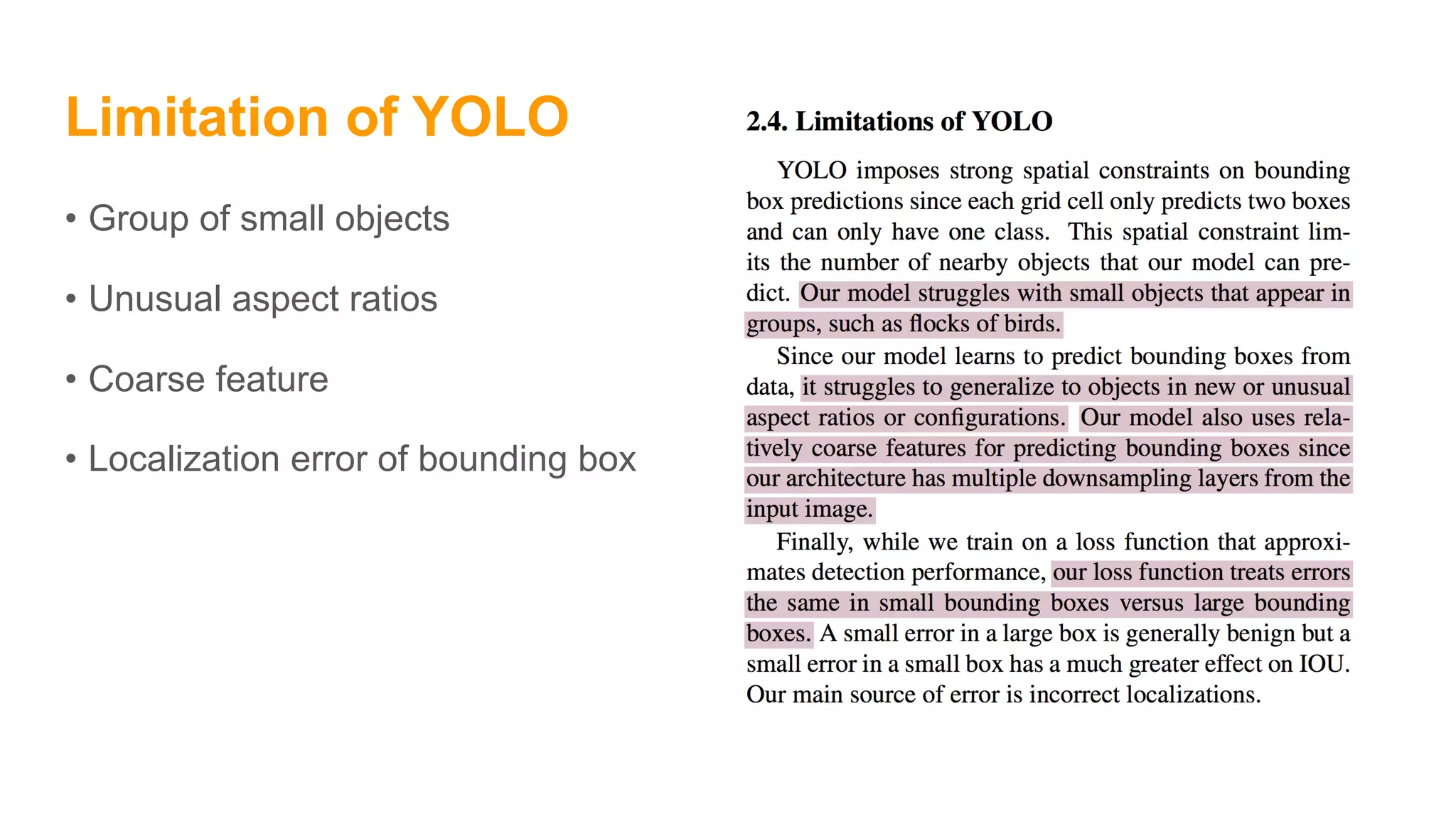
Limitation of YOLO
• Group of small objects
• Unusual aspect ratios
• Coarse feature
• Localization error of bounding box
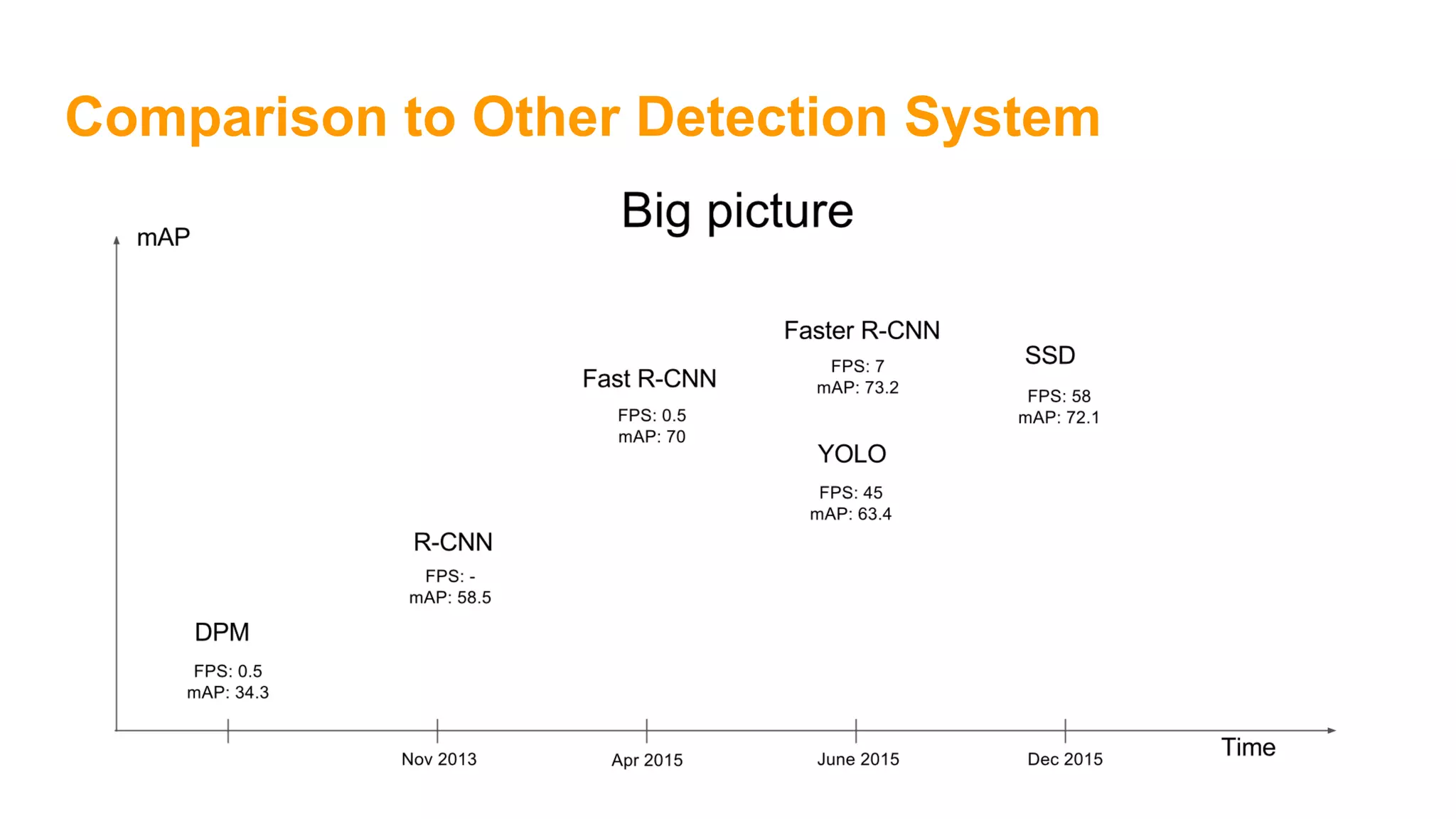
Comparison to Other Detection System
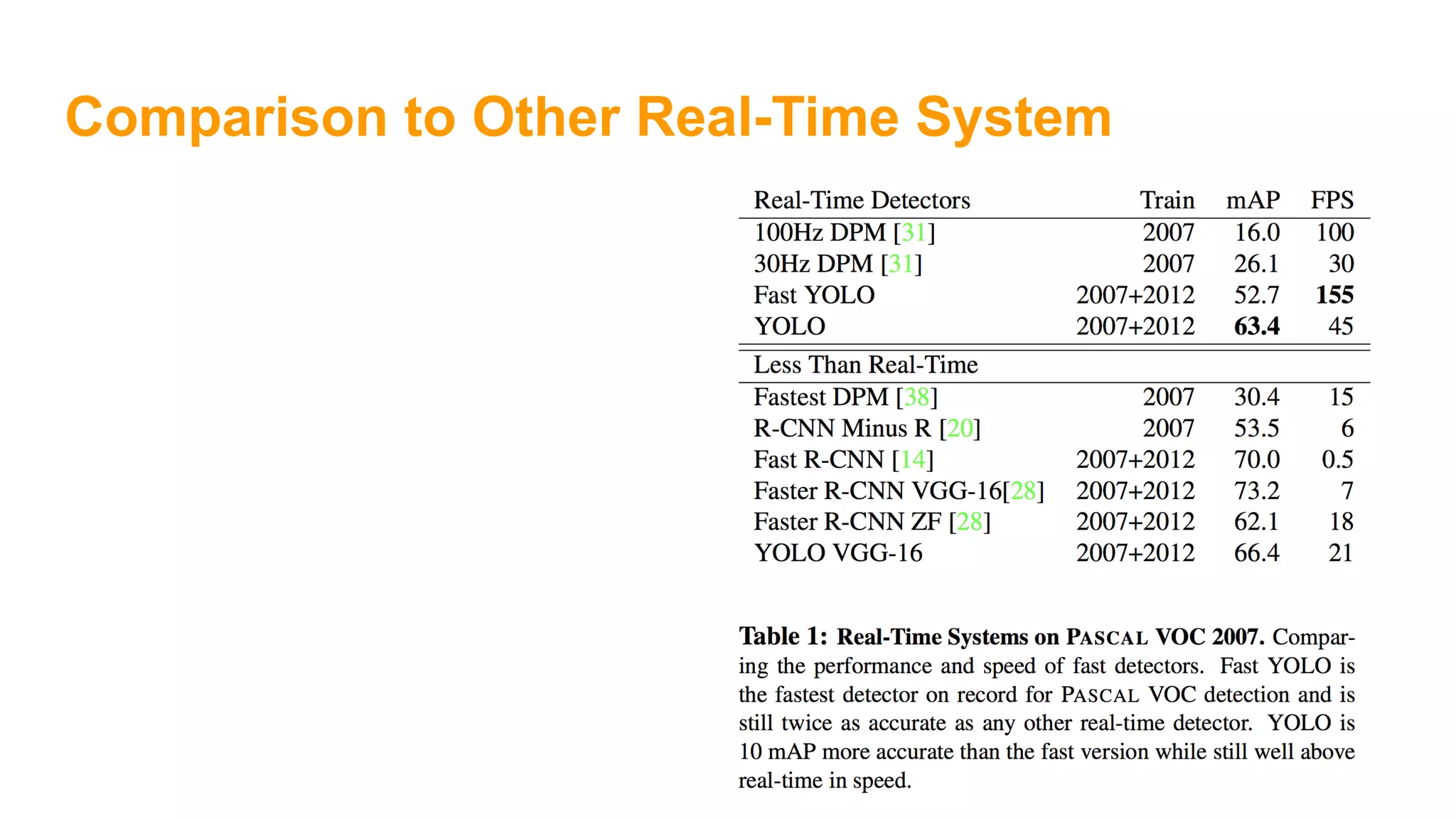
Comparison to Other Real-Time System
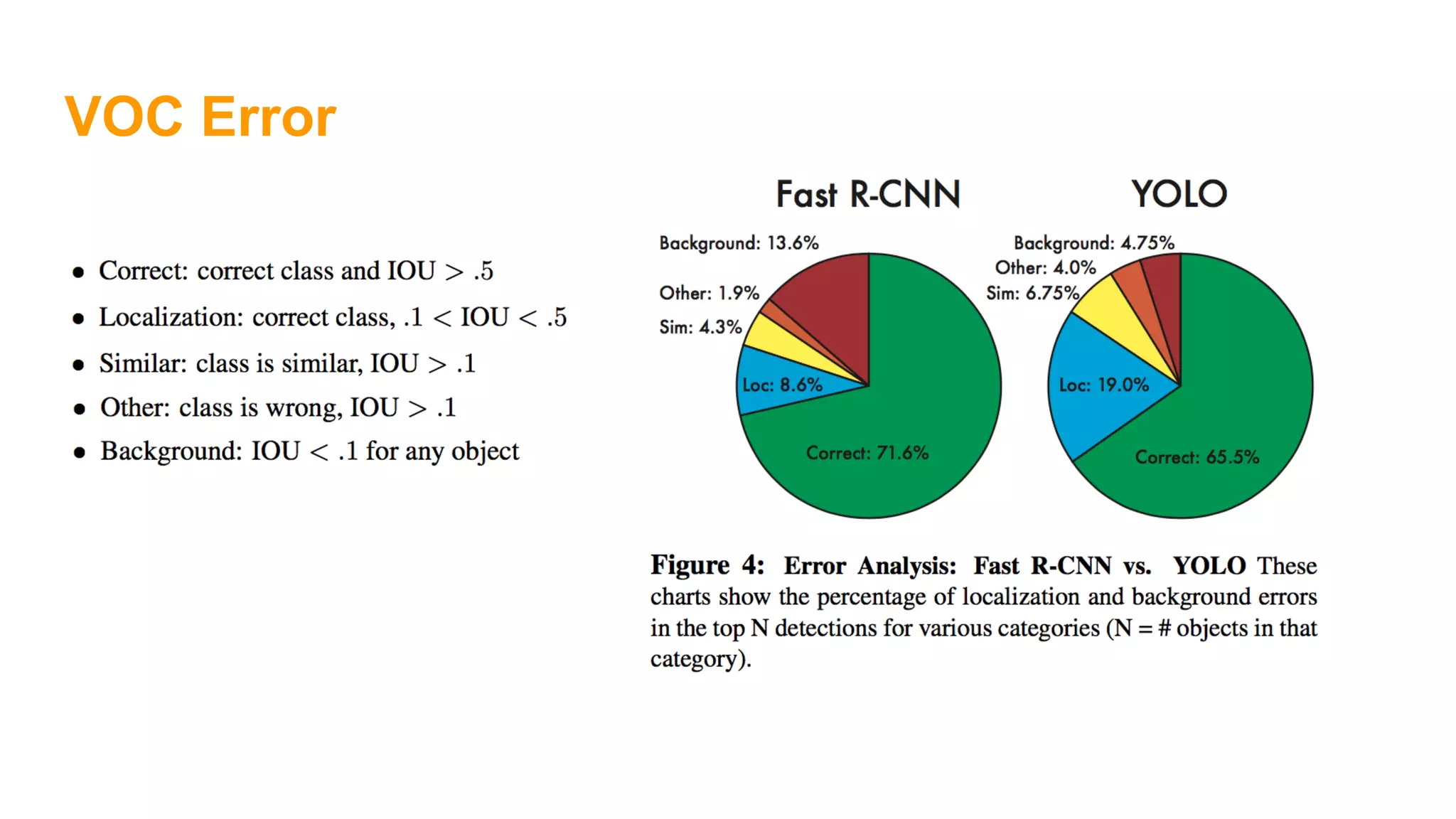
VOC Error
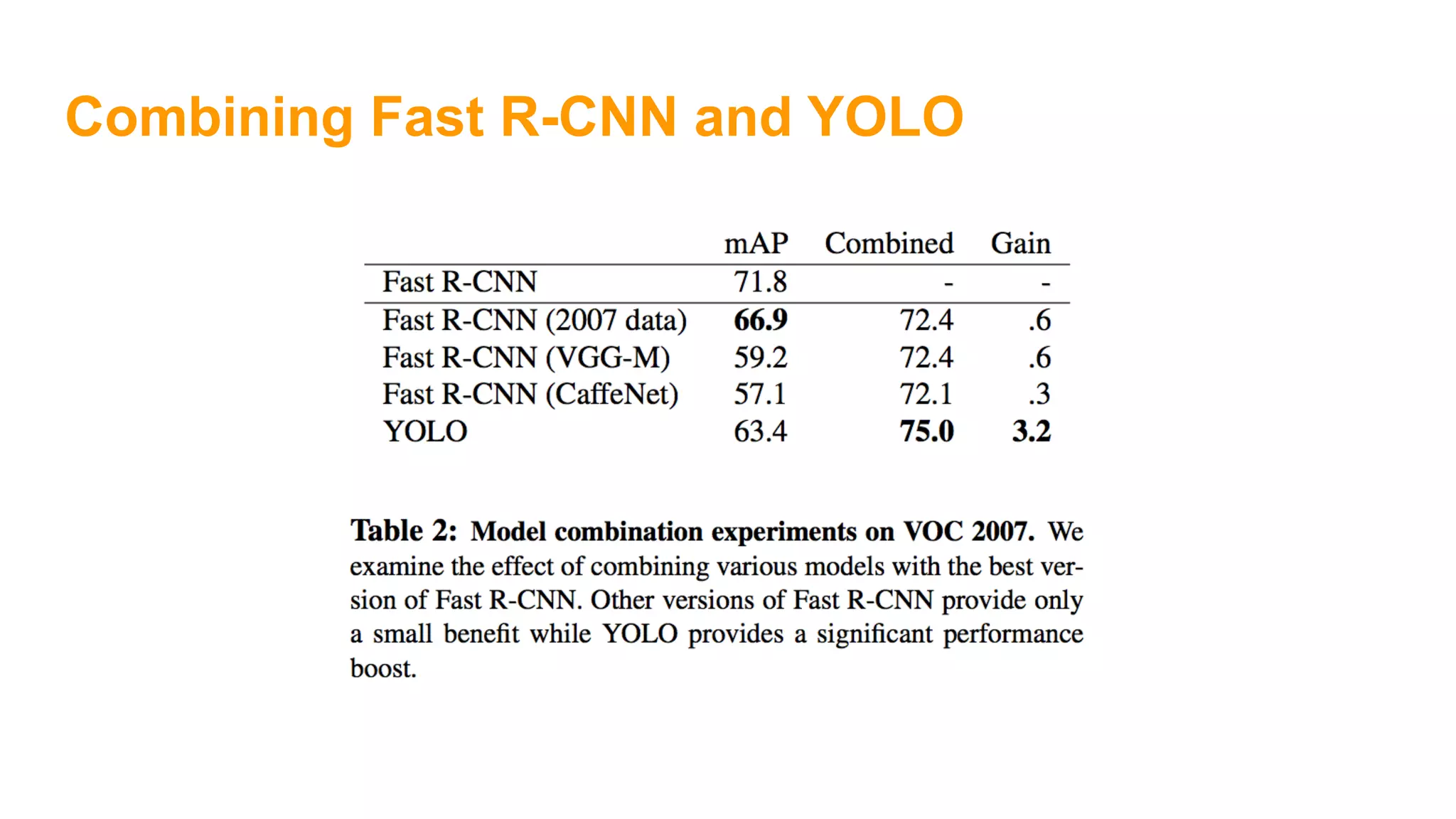
Combining Fast R-CNN and YOLO
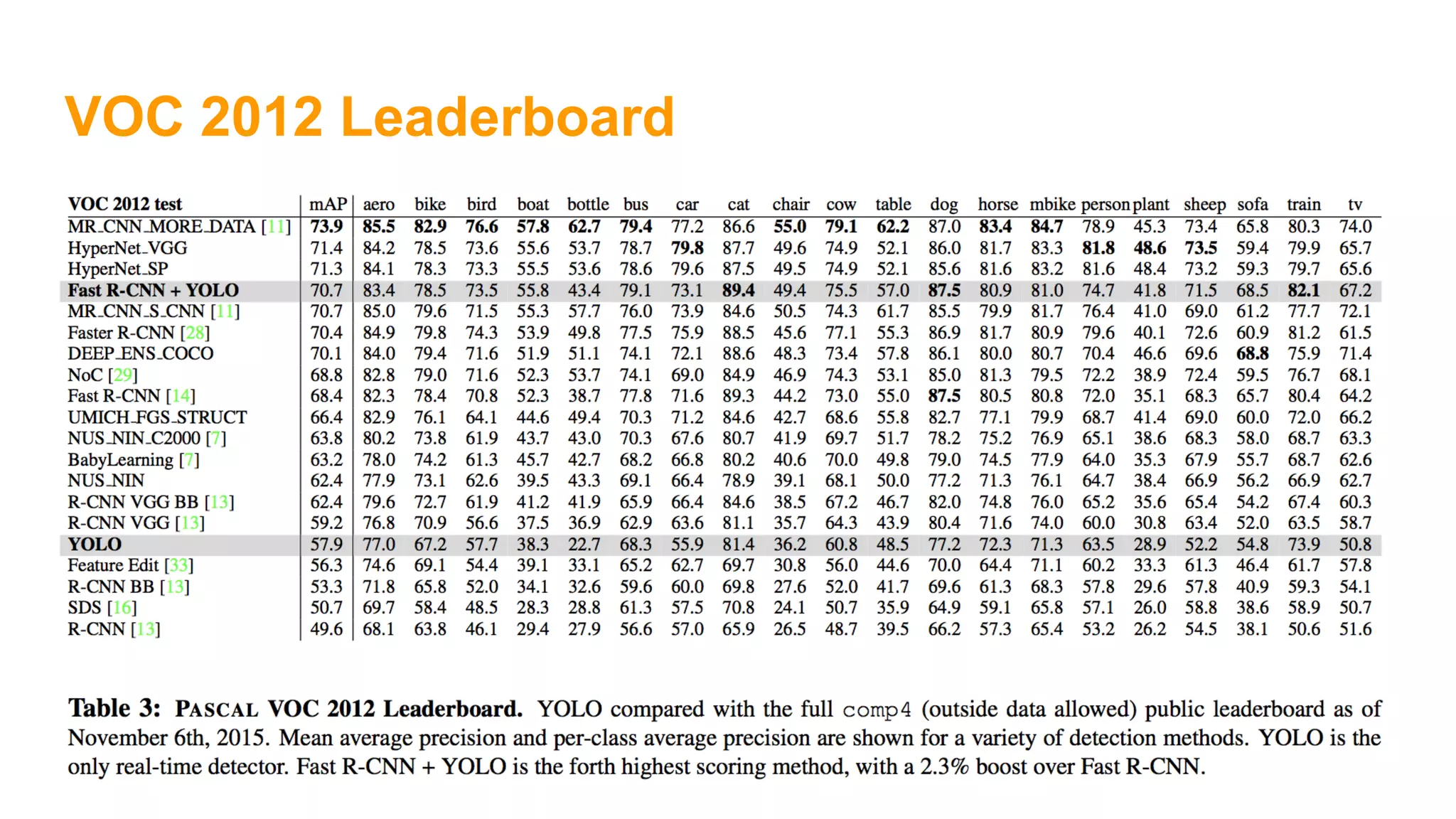
VOC 2012 Leaderboard
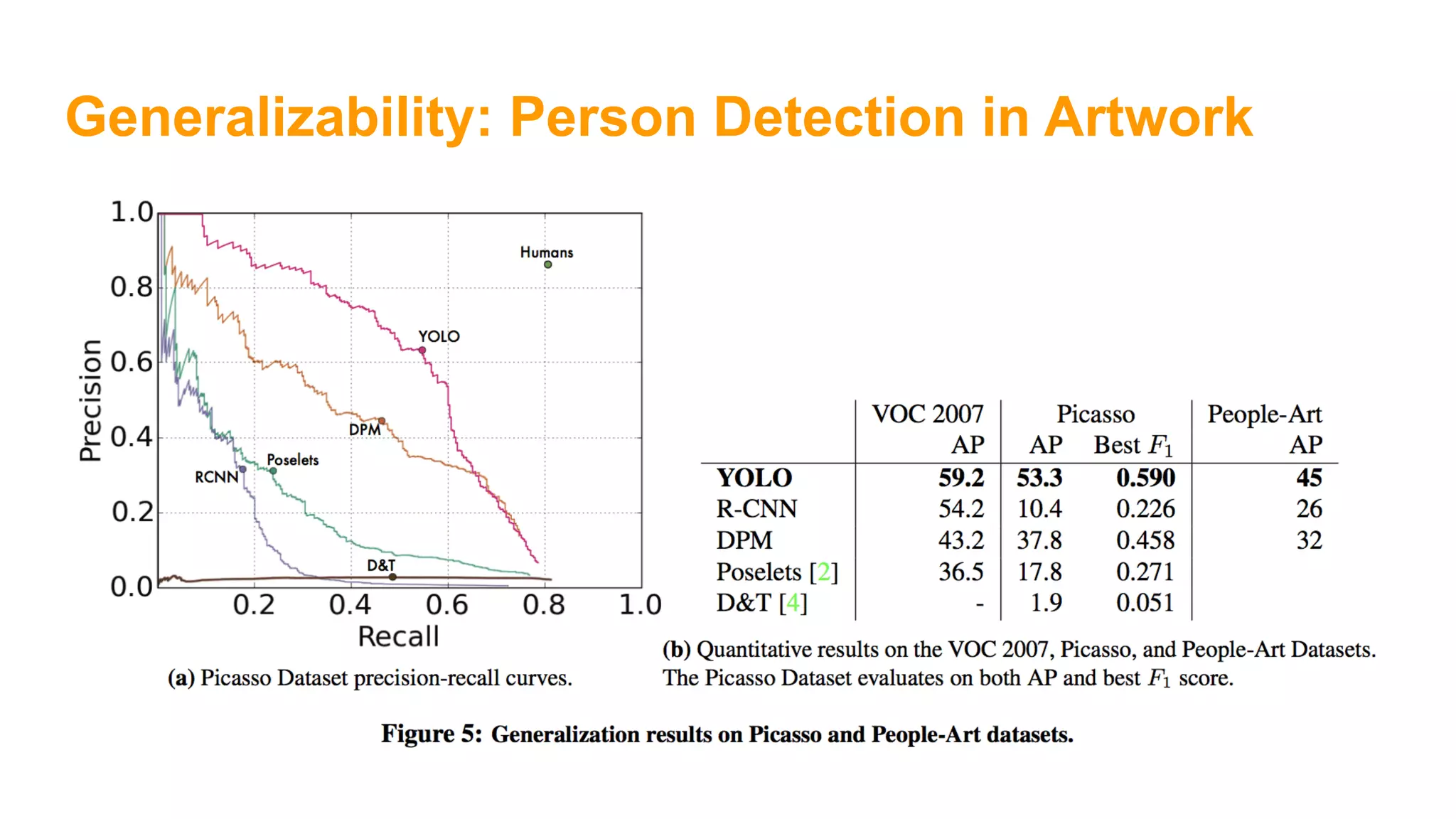
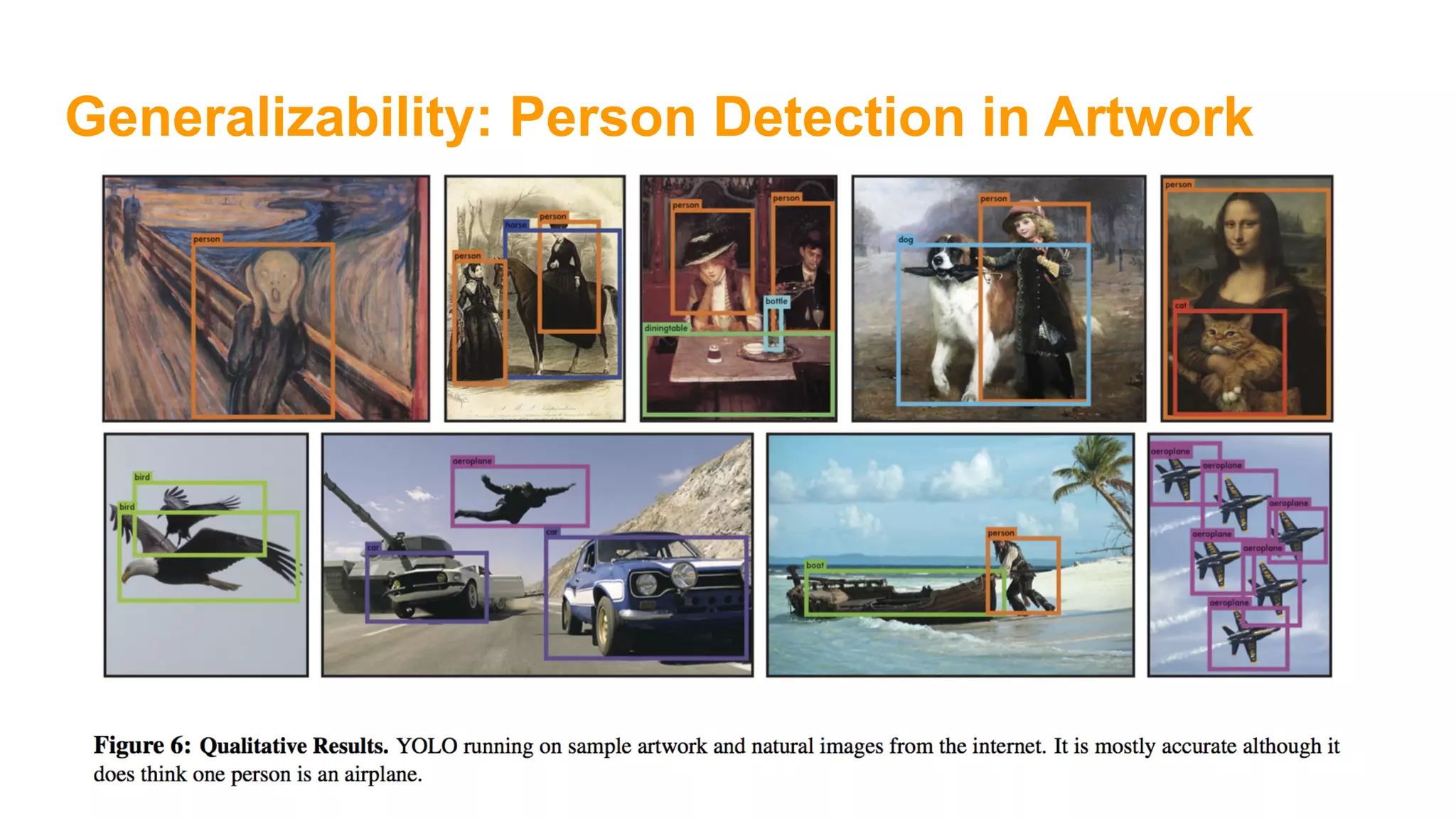
Generalizability: Person Detection in Artwork
Summary
Appendix | Implementation
• YOLO (darknet): https://pjreddie.com/darknet/yolov1/
• YOLOv2 (darknet): https://pjreddie.com/darknet/yolo/
• YOLO (caffe): https://github.com/xingwangsfu/caffe-yolo
• YOLO (TensorFlow: Train+Test): https://github.com/thtrieu/darkflow
• YOLO (TensorFlow: Test): https://github.com/gliese581gg/YOLO_tensorflow
Appendix | Slides
• DeepSense.io (google presentation - "YOLO: Inference")
Thanks
fb.com/taegyun.jeon
github.com/tgjeon
taylor.taegyun.jeon@gmail.com
Paper reviewed by 

Taegyun Jeon
Appendix | Intersection over Union (IoU)
• IoU(pred, truth)=[0, 1]
Appendix | GoogLeNet
Szegedy, Christian, et al. "Going deeper with convolutions." Proceedings of the IEEE Conference on Computer Vision and Pattern Recognition. 2015.
Appendix | GoogLeNet
Inception Module (1x1 convolution for dimension reductions)
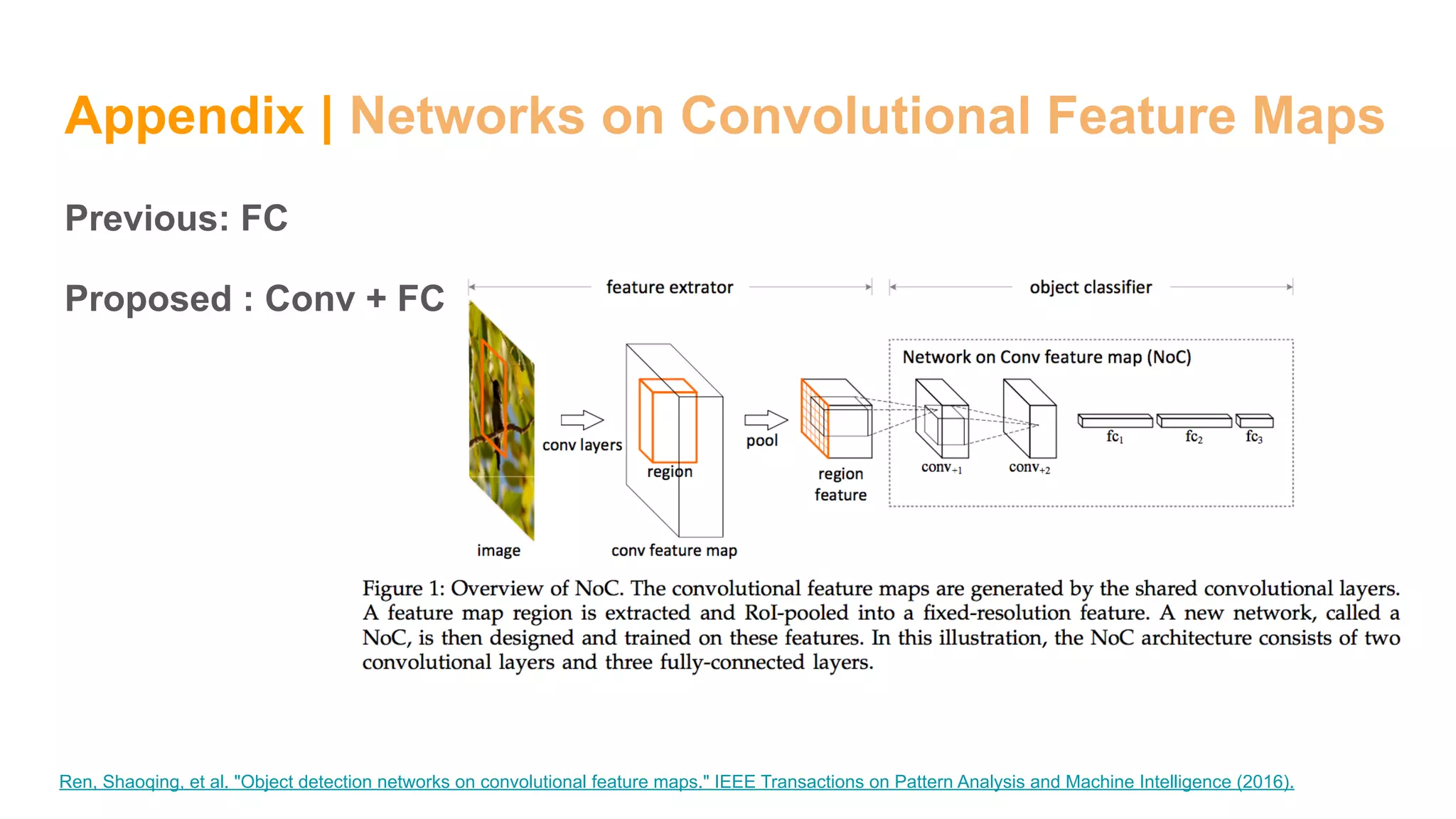
Appendix | Networks on Convolutional Feature Maps
Previous: FC
Proposed : Conv + FC
Ren, Shaoqing, et al. "Object detection networks on convolutional feature maps." IEEE Transactions on Pattern Analysis and Machine Intelligence (2016).
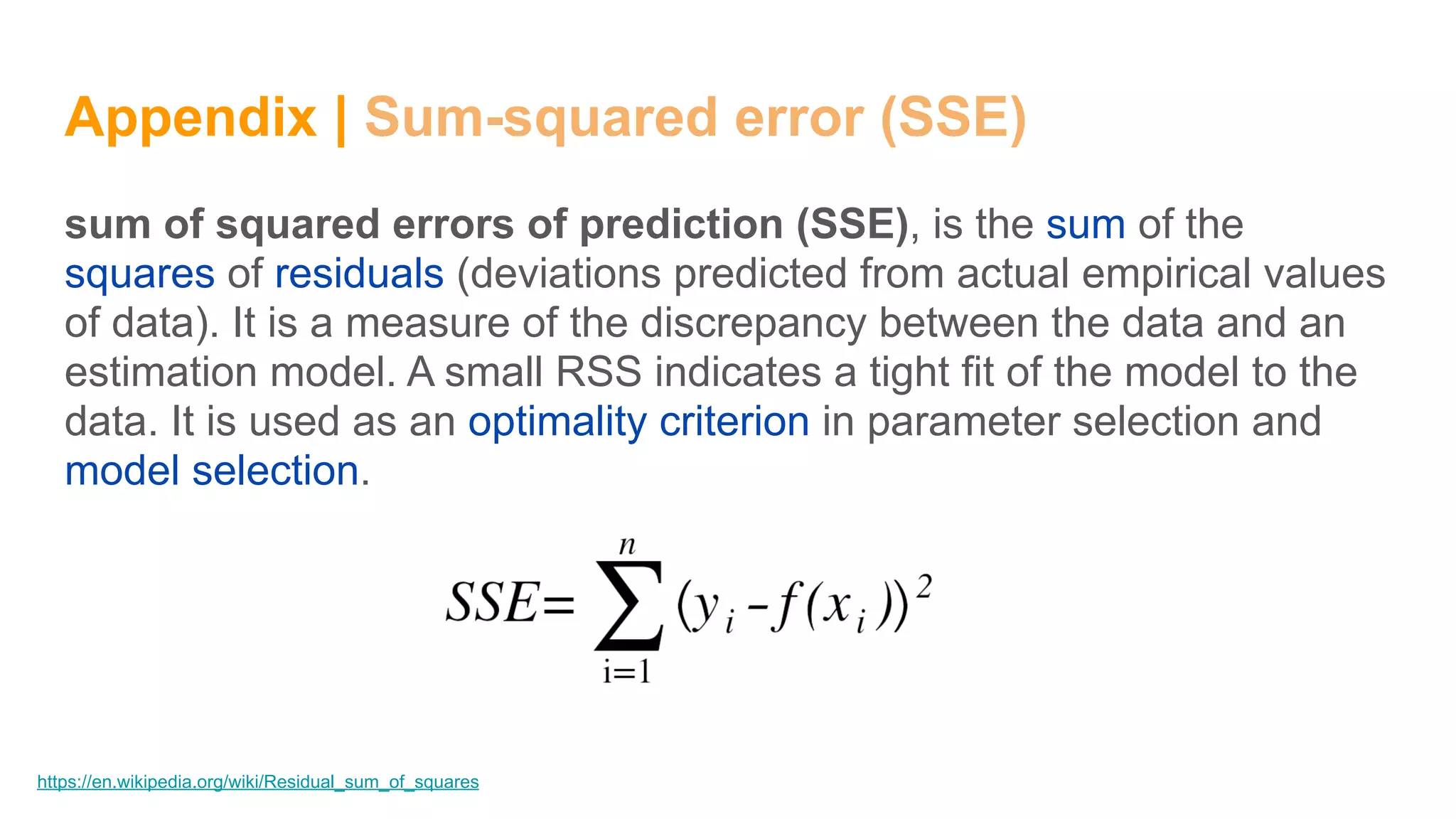
Appendix | Sum-squared error (SSE)
sum of squared errors of prediction (SSE), is the sum of the
squares of residuals (deviations predicted from actual empirical values
of data). It is a measure of the discrepancy between the data and an
estimation model. A small RSS indicates a tight fit of the model to the
data. It is used as an optimality criterion in parameter selection and
model selection.
https://en.wikipedia.org/wiki/Residual_sum_of_squares

[PR12] You Only Look Once (YOLO): Unified Real-Time Object Detection

  • 1.
    You Only LookOnce: Unified, Real-Time Object Detection (2016) Taegyun Jeon Redmon, Joseph, et al. "You only look once: Unified, real-time object detection." 
 Proceedings of the IEEE Conference on Computer Vision and Pattern Recognition. 2016.
  • 2.
    Slide courtesy ofDeepSystem.io “YOLO: You only look once Review” Evaluation on VOC2007
  • 3.
    Main Concept • ObjectDetection • Regression problem • YOLO • Only One Feedforward • Global context • Unified (Real-time detection) • YOLO: 45 FPS • Fast YOLO: 155 FPS • General representation • Robust on various background • Other domain (Real-time system: https://cs.stackexchange.com/questions/56569/what-is-real-time-in-a-computer-vision-context)
  • 4.
    Object Detection asRegression Problem • Previous: Repurpose classifiers to perform detection • Deformable Parts Models (DPM) • Sliding window • R-CNN based methods • 1) generate potential bounding boxes. • 2) run classifiers on these proposed boxes • 3) post-processing (refinement, elimination, rescore)
  • 5.
    Object Detection asRegression Problem • YOLO: Single Regression Problem • Image → bounding box coordinate and class probability. • Extremely Fast • Global reasoning • Generalizable representation
  • 6.
    Unified Detection • AllBBox, All classes 1) Image → S x S grids 2) grid cell 
 → B: BBoxes and Confidence score → C: class probabilities w.r.t #classes x, y, w, h, confidence Appendix: Intersection over Union (IOU)
  • 7.
    Unified Detection • Predictone set of class probabilities 
 per grid cell, regardless of the number 
 of boxes B. • At test time, 
 individual box confidence prediction
  • 8.
    Network Design: YOLO •Modified GoogLeNet • 1x1 reduction layer (“Network in Network”) Appendix: GoogLeNet 1 1 4 10 6 2 1 1 24 2 Conv. layer Fully conn. Layer Conv. layer 3x3x512 Maxpool Layer 2x2-s-2 Conv. layer 3x3x1024 Maxpool Layer 2x2-s-2 Conv. layer 3x3x1024 Conv. Layer 3x3x1024-s-2 Conv. layer 3x3x1024 Conv. Layer 3x3x1024
  • 9.
    Network Design: YOLO-tiny(9 Conv. Layers) Conv. layer 3x3x16 Maxpool Layer 2x2-s-2 Conv. layer 3x3x32 Maxpool Layer 2x2-s-2 Conv. layer 3x3x64 Maxpool Layer 2x2-s-2 Conv. layer 3x3x128 Maxpool Layer 2x2-s-2 Conv. layer 3x3x256 Maxpool Layer 2x2-s-2 Conv. layer 3x3x512 Maxpool Layer 2x2-s-2 Conv. layer 3x3x1024 Conv. layer 3x3x1024 Conv. layer 3x3x1024 9 2 Conv. layer Fully conn. Layer 1 1 1 1 1 1 1 1 1 YOLO-Tiny YOLO
  • 10.
    Training 1) Pretrain withImageNet 1000-class 
 competition dataset 20Conv. layer Feature Extractor Object Classifier
  • 11.
    Training 2) “Network onConvolutional Feature Maps” Increased input resolution (224x224) →(448x448) Appendix: Networks on Convolutional Feature Maps 20Conv. layer 4 2 Conv. layer Fully conn. Layer Feature Extractor Object Classifier
  • 13.
  • 16.
    Loss Function (sum-squarederror) Appendix: sum-squared error
  • 17.
  • 18.
    Loss Function (sum-squarederror) Re If object appears in cell i The jth bbox predictor in cell i is 
 “responsible” for that prediction
  • 19.
    Train strategy epochs=135 batch_size=64 momentum_a =0.9 decay=0.0005 lr=[10-3, 10-2, 10-3, 10-4] dropout_rate=0.5 augmentation
 =[scaling, translation, exposure, saturation]
  • 20.
    Inference Just like intraining? S=7, B=2 for Pascal VOC
  • 81.
    Limitation of YOLO •Group of small objects • Unusual aspect ratios • Coarse feature • Localization error of bounding box
  • 82.
    Comparison to OtherDetection System
  • 83.
    Comparison to OtherReal-Time System
  • 84.
  • 85.
  • 86.
  • 87.
  • 88.
  • 89.
  • 90.
    Appendix | Implementation •YOLO (darknet): https://pjreddie.com/darknet/yolov1/ • YOLOv2 (darknet): https://pjreddie.com/darknet/yolo/ • YOLO (caffe): https://github.com/xingwangsfu/caffe-yolo • YOLO (TensorFlow: Train+Test): https://github.com/thtrieu/darkflow • YOLO (TensorFlow: Test): https://github.com/gliese581gg/YOLO_tensorflow
  • 91.
    Appendix | Slides •DeepSense.io (google presentation - "YOLO: Inference")
  • 92.
  • 93.
    Appendix | Intersectionover Union (IoU) • IoU(pred, truth)=[0, 1]
  • 94.
    Appendix | GoogLeNet Szegedy,Christian, et al. "Going deeper with convolutions." Proceedings of the IEEE Conference on Computer Vision and Pattern Recognition. 2015.
  • 95.
    Appendix | GoogLeNet InceptionModule (1x1 convolution for dimension reductions)
  • 96.
    Appendix | Networkson Convolutional Feature Maps Previous: FC Proposed : Conv + FC Ren, Shaoqing, et al. "Object detection networks on convolutional feature maps." IEEE Transactions on Pattern Analysis and Machine Intelligence (2016).
  • 97.
    Appendix | Sum-squarederror (SSE) sum of squared errors of prediction (SSE), is the sum of the squares of residuals (deviations predicted from actual empirical values of data). It is a measure of the discrepancy between the data and an estimation model. A small RSS indicates a tight fit of the model to the data. It is used as an optimality criterion in parameter selection and model selection. https://en.wikipedia.org/wiki/Residual_sum_of_squares