Graph Neural Networks
Liad Magen
March October 2020
Hello, world!
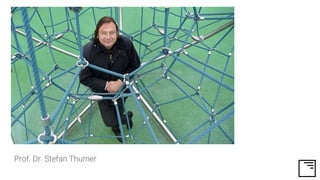
Prof. Dr. Stefan Thurner

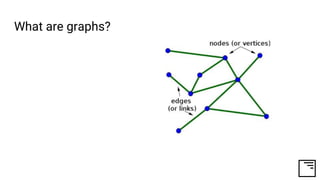
What are graphs?
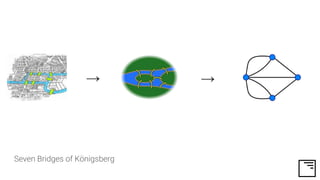
Seven Bridges of Königsberg
→ →
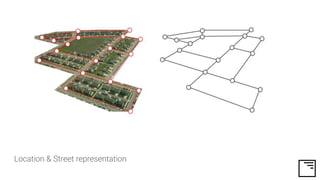
Location & Street representation
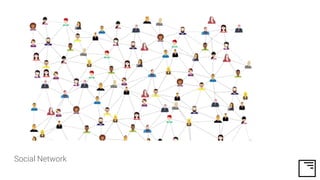
Social Network
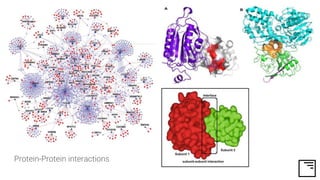
Protein-Protein interactions
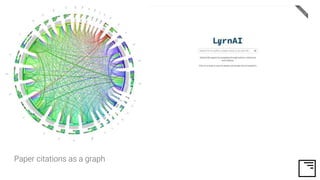
Paper citations as a graph
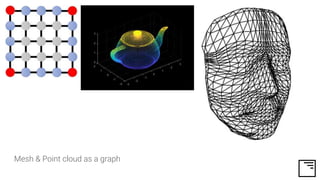
Mesh & Point cloud as a graph
Visually Rich Data
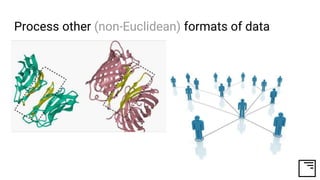
Process other (non-Euclidean) formats of data
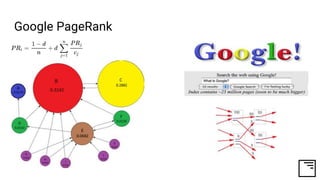
Google PageRank
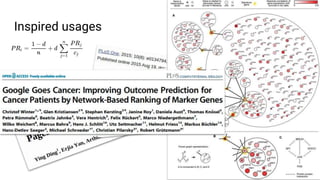
Inspired usages
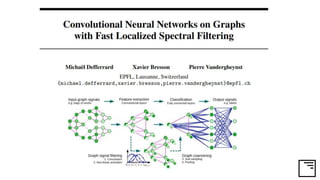
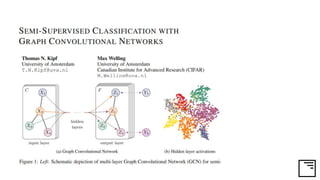
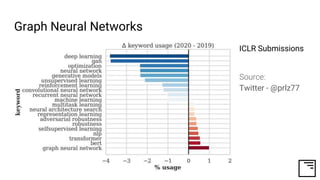
Graph Neural Networks
ICLR Submissions
Source:
Twitter - @prlz77
Back to basics
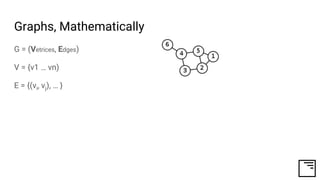
Graphs, Mathematically
G = (Vetrices, Edges)
V = {v1 … vn)
E = {(vi, vj), … }
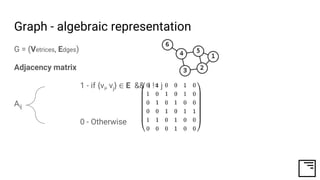
Graph - algebraic representation
G = (Vetrices, Edges)
Adjacency matrix
1 - if {vi, vj} ∈ E && i != j
Aij
0 - Otherwise
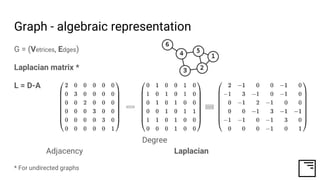
Graph - algebraic representation
G = (Vetrices, Edges)
Laplacian matrix *
L = D-A
Degree
Adjacency Laplacian
* For undirected graphs
GCN - Algorithm
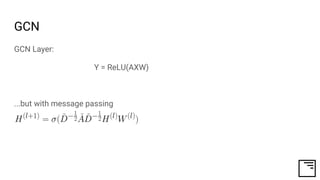
GCN
GCN Layer:
Y = ReLU(AXW)
...but with message passing
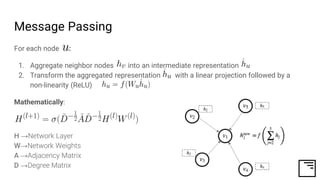
Message Passing
For each node :
1. Aggregate neighbor nodes into an intermediate representation
2. Transform the aggregated representation with a linear projection followed by a
non-linearity (ReLU)
Mathematically:
H →Network Layer
W→Network Weights
A →Adjacency Matrix
D →Degree Matrix
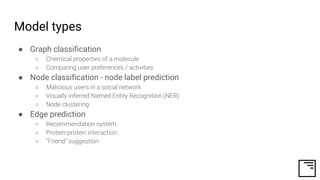
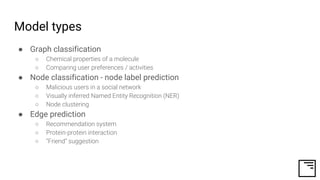
Model types
● Graph classification
○ Chemical properties of a molecule
○ Comparing user preferences / activities
● Node classification - node label prediction
○ Malicious users in a social network
○ Visually inferred Named Entity Recognition (NER)
○ Node clustering
● Edge prediction
○ Recommendation system
○ Protein-protein interaction
○ “Friend” suggestion
Frameworks
NetworkX
● Store and mutate Graphs
● Graph algorithms (Shortest path - Dijkstra, TreeWidth, clustering, centrality)
● Network analysis
● Node / edge data
● Visualization tools
DGL
● Building blocks
● Great tutorials
● Generative graphs
● Great for research and complicated tasks
● An extension library for pyTorch
● Officially part of the pyTorch ecosystem
● Easily extensible
● Papers are implemented directly in it
● Looooooooooooooong list of ready-to-use methods and algorithms:
○ TransformerConf (2020)
○ GCN2Conv (2020)
○ DeeperGCN (2020)
○ Top-K Pooling
○ PairNorm
PyTorch Geometric
Model types
● Graph classification
○ Chemical properties of a molecule
○ Comparing user preferences / activities
● Node classification - node label prediction
○ Malicious users in a social network
○ Visually inferred Named Entity Recognition (NER)
○ Node clustering
● Edge prediction
○ Recommendation system
○ Protein-protein interaction
○ “Friend” suggestion
Practical advices
PyTorch Geometric Example
● DataLoader
● GCN Layers
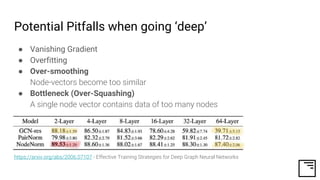
Potential Pitfalls when going ‘deep’
● Vanishing Gradient
● Overfitting
● Over-smoothing
Node-vectors become too similar
● Bottleneck (Over-Squashing)
A single node vector contains data of too many nodes
https://arxiv.org/abs/2006.07107 - Effective Training Strategies for Deep Graph Neural Networks
Scaling
● GraphSAGE
https://arxiv.org/abs/1706.02216
● ClusterGCN
https://arxiv.org/abs/1905.07953
● Graph-BERT
https://arxiv.org/abs/2001.05140
https://github.com/jwzhanggy/Graph-Bert
Additional reading:
https://towardsdatascience.com/simple-scalable-graph-neural-networks-7eb04f366d07
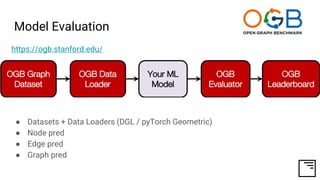
Model Evaluation
https://ogb.stanford.edu/
● Datasets + Data Loaders (DGL / pyTorch Geometric)
● Node pred
● Edge pred
● Graph pred
Please feel free to ask questions ;)
Additional Resources
https://towardsdatascience.com/how-to-do-deep-learning-on-graphs-with-graph-
convolutional-networks-7d2250723780
https://tkipf.github.io/graph-convolutional-networks/
https://github.com/deepmind/graph_nets
https://www.scihive.org/paper/1912.12693#section-13
https://link.springer.com/article/10.1186/s40649-019-0069-y
https://www.youtube.com/watch?v=cWIeTMklzNg
https://www.youtube.com/watch?v=YrhBZUtgG4E

Introduction to Graph neural networks @ Vienna Deep Learning meetup