Scholar
Javed Habib
M. Phil.Mathematics
Supervisor
Dr. Asim Khurshid
Department of Mathematics
National College of Business Administration & Economics Lahore
Sub-campus Bahawalpur
SPECTRUMS AND ENERGIES OF
FRIENDSHIP GRAPHS USING DIFFERENT
PARAMETERS
2.
The Birth ofGraph Theory (History)
• The Königsberg Bridge Problem asked if one could cross all
seven city bridges exactly once.
• Euler turned the land areas into points (vertices) and bridges
into lines (edges), creating the first graph.
• He showed that such a path is only possible if every point
has an even number of bridges — which Königsberg did
not, so it was impossible.
• In the 19th century, Arthur, Cayley used graphs for
chemistry, and Kirchhoff used them for studying electric
circuits.
3.
Graph Fundamentals (Definitions)
Agraph G = (V, E) consists of:
• V: vertices (nodes) representing objects.
• E: edges (links) showing connections between
them.
Key terms:
• Degree: number of edges on a vertex.
• Path: sequence of connected vertices.
• Connected graph: every pair of vertices is linked
by a path.
4.
Graph Fundamentals (Definitions)
Typesof Graphs:
• Undirected Graph: Two-way connections (e.g.,
friendship network).
• Directed Graph: One-way links (e.g., Twitter
followers).
• Complete Graph (Kₙ): Every vertex connects to all
others.
• Bipartite Graph: Vertices split into two sets;
edges connect only between the sets (e.g., people
and projects).
Graph Theory Fundamentals
BasicDefinitions and Connectivity:
• Graph (G): A collection of vertices (nodes) and
edges (connections).
• Trivial/Isolated Graph: A single vertex with no
edges.
• Null Graph: Vertices exist, but no edges are present.
• Connectivity:
• Connected: All vertices have a path between them.
• Disconnected: At least two vertices have no path
between them.
7.
Graph Theory Fundamentals
BasicDefinitions and Connectivity:
• Bridge: An edge whose removal disconnects a
connected graph.
• Simple vs. Non-Simple:
• Simple Graph: No loops (self-edges) and no parallel
edges.
• Pseudograph: A graph that contains loops (self-
edges).
• Multigraph: A graph that contains parallel edges.
8.
Graph Theory Fundamentals
AcyclicStructures (Trees and Forests)
• Acyclic Graph: A graph that contains no cycles (closed
chains).
• Tree Graph: A connected acyclic graph.
• Edges are called branches.
• Vertices of degree 1 are leaves or pendant graphs.
• Forest Graph: A collection of one or more disjoint tree
graphs.
• Caterpillar Graph: A specific type of tree where all
vertices are close to a central path.
9.
Graph Theory Fundamentals
•Complete, Regular, and Bipartite Graphs
• Complete Graph (Kn
): A graph where every vertex is
connected to every other vertex.
• Regular Graph: Every vertex has the exact same
degree (valency).
• Example: Petersen graph is 3-regular.
• Bipartite Graph: Vertices can be divided into two
independent sets, V1and V2
. Edges only exist between
V1and V2
.
• Complete Bipartite Graph (Km,n
): Every vertex in V1is
connected to every vertex in V2
.
10.
Graph Structures:
Special Typesof Graphs:
• Path Graph (Pₙ): Vertices form a straight path; end
vertices have degree 1, others have degree 2.
• Friendship Graph: Made of k triangles (C₃) sharing
one common central vertex.
• Lollipop Graph: A complete graph (Kₘ) connected to
a path graph (Pₙ) by one edge.
• Wheel Graph (Wₙ): A cycle graph with one central
vertex connected to all others.
11.
Introduction to SpectralGraph Theory:
• Spectral Graph Theory (SGT) uses linear algebra
to study graph properties through the
eigenvalues of matrices like adjacency and
Laplacian.
• Bridge: It links discrete graph structures with
continuous analysis, vital in computer science and
applied math.
• Importance: Enables quantitative evaluation of
network stability and supports efficient algorithm
design for large-scale and machine learning
applications.
The Power of Spectra:
• Algebraic Connectivity (Fiedler Value): The
12.
• Largest Eigenvalue:From the adjacency matrix,
showing network density and connection
distribution.
Applications of Spectral Graph Theory:
• Computer & Network Science: Powers Google’s
PageRank for web ranking.
• Network Robustness: Evaluates system resilience
against failures or attacks.
• Community Detection: Spectral clustering
uncovers tightly linked groups in social networks.
• Biological Networks: Analyzes protein and gene
interactions, aiding drug discovery and
bioinformatics research.
13.
• Graph Theorystarted with Euler’s Königsberg
Bridge Problem (1736) and is a key part of
discrete mathematics.
• A graph G = (V, E) has vertices (V) and edges (E)
connecting them.
• Spectral Graph Theory (SGT) uses linear algebra
and eigenvalues (like from the Laplacian matrix)
to study network connectivity and strength.
• It’s used in Google’s PageRank, network design,
community detection, and biological research
to understand complex systems.
14.
Literature Review
• GraphEnergy measures the structural properties
of a graph using its spectral (eigenvalue-based)
characteristics.
• Graph Spectra: The set of eigenvalues obtained
from matrices such as Adjacency, Laplacian,
Signless Laplacian, and Distance matrices.
• Adjacency Energy (E(G)) = Sum of the absolute
values of the eigenvalues of the adjacency matrix
A(G).
15.
Key Energy Types:
•Laplacian Energy: Derived from the Laplacian
matrix spectrum.
• Signless Laplacian Energy: Based on the Q-
spectrum.
• Distance Energy: Uses the distance matrix.
• Skew Energy: Applies to directed graphs
(digraphs)
Purpose: Graph energies quantify algebraic and
combinatorial features, helping analyze network
structure, stability, and complexity.
16.
Phase 1 (2000–2004):Focus on extremal
problems and computational groundwork.
Early studies focused on finding graphs with
maximum energy.
• Koolen & Moulton (2001) [1]: Defined key
extremal constructions and energy inequalities.
• Gutman & Vidović (2001) [2]: Used computational
methods to find high-energy molecular graphs.
• Hou et al. (2002) [3]: Identified extremal
structures for unicyclic graphs.
Trend: Merged computational searches with
spectral inequality analysis.
17.
Phase 2 (2005–2010):Expanding
Definitions and Analytical Tools
Broadening the Horizon:
• New Energies: Gutman & Zhou (2006) [4] –
Laplacian Energy; Indulal et al. (2008) [5] –
Distance Energy; Adiga et al. (2010) [6] – Skew
Energy for directed graphs.
• Analytical Advances: Nikiforov (2007) [7] –
Linked matrix norms with eigenvalue sums.
• Algebraic Symmetry: Haemers (2008) [8] –
Studied energies of strongly regular graphs.
18.
Phase 3 (2011–2015):Consolidation and
Structural Descriptors
Linking Topology and Spectra:
• Structural Perturbations: Das, Gutman & Xu
(2011) [9] – Studied how edge deletions affect graph
energy and stability.
• New Invariants: Huang & Liu (2012) [10] –
Introduced Laplacian-energy-like invariants for trees;
Zhou & Gutman (2014) [11] – Explored Distance
Spectral Radius.
• Equienergetic Transformations: Feng & Yu (2014)
[12] – Created structurally different graphs with
equal energy.
Trend: Integrated energy concepts into total and
complex graph models.
19.
Phase 4 (2016–2020):Theoretical Diversity
and Generalization
Advanced Techniques and Broad Applications:
• Probabilistic Methods: Arizmendi & Juárez-
Romero (2016) [13] – Linked random matrix
theory with graph spectra and energy.
• Structural Partitioning: Shan et al. (2017) [14] –
Analyzed energy changes in multipartite graph
partitions.
• Directed Networks: Ganie et al. (2018) [15] –
Proposed Skew Laplacian Energy for digraphs.
• Generalized Frameworks: Alhevaz et al. (2019)
[16] – Introduced Generalized Distance Energy
to unify distance-based measures.
20.
Phase 5 (2021–2025):Parametric &
Weighted Energies
The Contemporary Landscape:
• Stronger Bounds: Filipovski & Jajcay (2021) [17]
– Proposed improved universal energy bounds.
• Parametric Concepts: Zhang & Zhang (2023)
[18] – Introduced α-adjacency energy, bridging
classical and weighted models.
• Weighted Adjacency: Li & Yang (2024) [19] –
Analyzed edge-weighted adjacency matrices for
advanced network studies.
• Constructive Work: Vaidya & Popat (2021) [20] –
Created methods to generate L-equienergetic
graphs with equal Laplacian energy.
21.
Summary of MethodologicalShifts
Decade Focus Area Key Tool/Concept
2000s Extremal Problems
Computational Search,
Spectral Interlacing
2005–2010 Definition Expansion
Matrix Norms
(Nikiforov) [6],
Laplacian & Skew
Energy
2011–2015 Structural Analysis
Graph Transformations,
Total Graph Energy
2016–2020 Generalization
Probabilistic Methods,
Generalized Distance
Energy
2021–2025 Refinement
α-Parameterization,
Degree-Based Weighting
22.
Methodology: Research Overviewand
Goals
Goal: To study the spectral features and energy of
Friendship Graphs (Fn) using two new adjacency-
based matrices: Status Sum Adjacency (SSA) and
Degree Product Adjacency (DPA).
Objectives:
• Define the structure and spectra of Fn.
• Build the SSA and DPA matrices.
• Find eigenvalues and energy formulas (ESSA,
LESSA, EDPA, LEDPA).
• Significance: Extends spectral graph theory with
new measures linking algebraic properties of Fn to
real-world uses in network science and chemistry.
23.
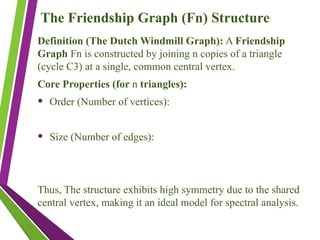
The Friendship Graph(Fn
) Structure
Definition (The Dutch Windmill Graph): A Friendship
Graph Fnis constructed by joining n copies of a triangle
(cycle C3
) at a single, common central vertex.
Core Properties (for n triangles):
• Order (Number of vertices):
• Size (Number of edges):
Thus, The structure exhibits high symmetry due to the shared
central vertex, making it an ideal model for spectral analysis.
24.
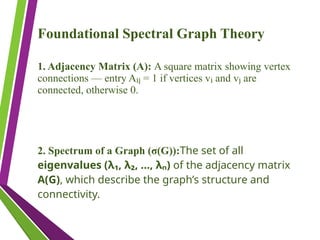
Foundational Spectral GraphTheory
1. Adjacency Matrix (A): A square matrix showing vertex
connections — entry A = 1 if vertices v and v are
ᵢⱼ ᵢ ⱼ
connected, otherwise 0.
2. Spectrum of a Graph (σ(G)):The set of all
eigenvalues (λ₁, λ₂, …, λₙ) of the adjacency matrix
A(G), which describe the graph’s structure and
connectivity.
25.
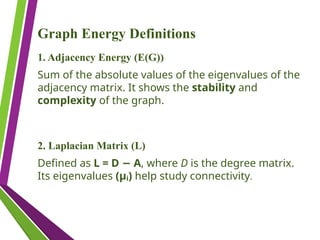
Graph Energy Definitions
1.Adjacency Energy (E(G))
Sum of the absolute values of the eigenvalues of the
adjacency matrix. It shows the stability and
complexity of the graph.
2. Laplacian Matrix (L)
Defined as L = D A
− , where D is the degree matrix.
Its eigenvalues (μᵢ) help study connectivity.
Methodology: Status Sumand Degree
Product Matrices
We introduce two new adjacency-based matrices for
Friendship Graphs (Fn):
• Degree Product Adjacency (DPA): Weights edges
using the product of vertex degrees (local
connectivity).
28.
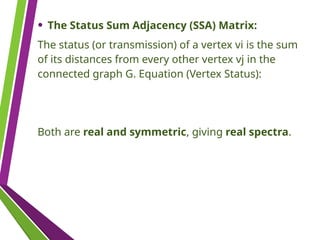
• The StatusSum Adjacency (SSA) Matrix:
The status (or transmission) of a vertex viis the sum
of its distances from every other vertex vjin the
connected graph G. Equation (Vertex Status):
Both are real and symmetric, giving real spectra.
29.
• SSA MatrixDefinition: A square, symmetric matrix
where each entry SSAᵢⱼ equals the sum of the
statuses of adjacent vertices.
• The Degree Product Adjacency (DPA) Matrix:The DPA(G)
is a square symmetric matrix where each non-zero
entry represents a connection between
neighboring vertices, weighted by the square root
of the product of their degrees:
where diand djare the degrees of vertices vi and vj
,
respectively. The energy computed from these matrices are E
DPA(G) and LE DPA(G).
Main Result 4:Laplacian Degree Product
Adjacency Energy (LEDPA
)
35.
Main Focus andGoal
The research examined the
• friendship graph , which is useful for modeling real-
world situations like social groups and hub-based systems.
• The goal was to
• broaden spectral graph theory by using non-standard
matrices to get new perspectives on the graph's structure
and behavior.
36.
Key Matrices Used
Thestudy focused on two particular graph matrices and their
adjacency and Laplacian versions:
• Degree Product Matrix: This matrix emphasizes the
multiplicative contribution of vertex degrees. Using it
showed how degree-based weightings affect the
distribution of eigenvalues and structural differences in
spectral energy.
• Status Sum Matrix: This matrix is distance-aware. Its
entries are based on a vertex's "status," which is the sum of
distances from that vertex to every other vertex.
37.
Conclusion
• The studysystematically analyzed the spectra and energy
using these new matrices.
• The findings show that spectral values change
considerably when alternate weightings are used,
providing insight into the graph's
• global connectedness, vertex centrality, and degree
heterogeneity.
• The thesis demonstrates that looking at graph spectra
outside of the standard matrices (adjacency and Laplacian)
can be insightful for applications in fields like
38.
Future Research
The thesissuggests several directions for future work, including:
• Applying these matrix approaches to other graph classes (like wheel, helm, and star
graphs).
Conducting more detailed
• comparative research between conventional spectra and those from the new matrices.
• Developing
• analytical formulas for broader classes of graphs.
• Exploring
• applications in chemistry related to molecular graphs.
• Investigating the use of these spectra for the
• graph isomorphism problem.
• Developing
• efficient algorithms for computing these modified spectra for large networks.
• Applying the findings to social and communication networks for influence
assessment and community detection
39.
References:
[1] Abreu, N.,Cardoso, D. M., Gutman, I., Martins, E. A., & Robbiano, M. (2011). Bounds for the signless
Laplacian energy. Linear Algebra and Its Applications, 435(10), 2365–2374.
https://doi.org/10.1016/j.laa.2010.10.021
[2] Adiga, C., Balakrishnan, R., & So, W. (2010). The skew energy of a digraph. Linear Algebra and Its
Applications, 432(8), 1825–1835. https://doi.org/10.1016/j.laa.2009.11.034
[3] Akbari, S., & Lin, H. (2023). Improved lower bound on the energy of line graphs. Linear Algebra and Its
Applications, 674, 1–14. https://doi.org/10.1016/j.laa.2023.05.023
[4] Alhevaz, A., Baghipur, M., Ganie, H. A., & Shang, Y. (2019). On the generalized distance energy of graphs.
Mathematics, 8(1), Article 17. https://doi.org/10.3390/math8010017
[5] Andriantiana, E. O. D., & Wagner, S. (2011). Unicyclic graphs with large energy. Linear Algebra and Its
Applications, 435(6), 1399–1414. https://doi.org/10.1016/j.laa.2011.03.013
[6] Balakrishnan, R. (2004). The energy of a graph. Linear Algebra and Its Applications, 387(1–3), 287–295.
https://doi.org/10.1016/j.laa.2004.02.038
[7] Bozkurt, Ş. B., Adiga, C., & Bozkurt, D. (2013). Bounds on the distance energy and the distance Estrada
index of strongly quotient graphs. Journal of Applied Mathematics, 2013, Article ID 681019, 1–6.
https://doi.org/10.1155/2013/681019
[8] Caporossi, G., Čvetković, D., Gutman, I., & Hansen, P. (1999). Variable neighborhood search for extremal
graphs: Finding graphs with extremal energy. Journal of Chemical Information and Computer Sciences, 39(6),
984–996. https://doi.org/10.1021/ci9801419
[9] Chat, B. A., Ganie, H. A., & Pirzada, S. (2021). Bounds for the skew Laplacian energy of weighted digraphs.
Afrika Mathematika, 32, 745–756. https://doi://doi.org/10.1007/s13370-020-00858-2
[10] Chen, X., Li, X., & Lian, H. (2013). The skew energy of random oriented graphs. Linear Algebra and Its
Applications, 438, 4547–4556. https://doi.org/10.1016/j.laa.2013.02.007
40.
References:
[11] Cvetković, D.,Rowlinson, P., & Simić, S. K. (2007). Signless Laplacians of finite graphs. Linear
Algebra and Its Applications, 423(1), 155–171. https://doi.org/10.1016/j.laa.2007.01.009
[12] Das, K. C., Gutman, I., Milovanović, I., Milovanović, E., & Furtula, B. (2018). Degree-based energies
of graphs. Linear Algebra and Its Applications, 554, 185–204. https://doi.org/10.1016/j.laa.2018.05.027
[13] Filipovski, S., & Jajcay, R. (2021). Bounds for the energy of graphs. Mathematics, 9(14), Article 1687.
https://doi.org/10.3390/math9141687
[14] Furtula, B., Radenković, S., & Gutman, I. (2008). Bicyclic molecular graphs with the greatest energy.
Journal of the Serbian Chemical Society, 73(4), 431–433. https://doi.org/10.2298/JSC0804431F
[15] Ganie, H. A., Chat, B. A., & Pirzada, S. (2018). Skew Laplacian energy of digraphs. Afrika
Mathematika, 29(2), 499–507. https://doi.org/10.1007/s13370-018-0556-6
[16] Guo, Haiyan, & Zhou, Bo. (2020). On the distance α-spectral radius of a connected graph. Journal of
Inequalities and Applications, 2020(1). https://doi.org/10.1186/s13660-020-02427-4
[17] Gutman, I., & Vidović, M. (2001). Quest for molecular graphs with maximal energy: A computer
experiment. Journal of Chemical Information and Computer Sciences, 41(5), 1002–1005.
https://doi.org/10.1021/ci010066k
[18] Gutman, I., & Zhou, B. (2006). Laplacian energy of a graph. Linear Algebra and Its Applications,
414(1), 29–37. https://doi.org/10.1016/j.laa.2005.09.008
[19] Haemers, W. H. (2008). Strongly regular graphs with maximal energy. Linear Algebra and Its
Applications, 429(11–12), 2719–2723. https://doi.org/10.1016/j.laa.2008.03.024
[20] Hayat, S., et al. (2024). A novel edge-weighted matrix of a graph and its spectral properties with
potential applications. AIMS Mathematics, 9(9), 24955–24976. https://doi.org/10.3934/math.20241216

![Phase 1 (2000–2004): Focus on extremal
problems and computational groundwork.
Early studies focused on finding graphs with
maximum energy.
• Koolen & Moulton (2001) [1]: Defined key
extremal constructions and energy inequalities.
• Gutman & Vidović (2001) [2]: Used computational
methods to find high-energy molecular graphs.
• Hou et al. (2002) [3]: Identified extremal
structures for unicyclic graphs.
Trend: Merged computational searches with
spectral inequality analysis.](https://image.slidesharecdn.com/1finalpresentationjaved-260128065114-462713cd/85/1_final-presentation-for-mphill-math-pptx-16-320.jpg)
![Phase 2 (2005–2010): Expanding
Definitions and Analytical Tools
Broadening the Horizon:
• New Energies: Gutman & Zhou (2006) [4] –
Laplacian Energy; Indulal et al. (2008) [5] –
Distance Energy; Adiga et al. (2010) [6] – Skew
Energy for directed graphs.
• Analytical Advances: Nikiforov (2007) [7] –
Linked matrix norms with eigenvalue sums.
• Algebraic Symmetry: Haemers (2008) [8] –
Studied energies of strongly regular graphs.](https://image.slidesharecdn.com/1finalpresentationjaved-260128065114-462713cd/85/1_final-presentation-for-mphill-math-pptx-17-320.jpg)
![Phase 3 (2011–2015): Consolidation and
Structural Descriptors
Linking Topology and Spectra:
• Structural Perturbations: Das, Gutman & Xu
(2011) [9] – Studied how edge deletions affect graph
energy and stability.
• New Invariants: Huang & Liu (2012) [10] –
Introduced Laplacian-energy-like invariants for trees;
Zhou & Gutman (2014) [11] – Explored Distance
Spectral Radius.
• Equienergetic Transformations: Feng & Yu (2014)
[12] – Created structurally different graphs with
equal energy.
Trend: Integrated energy concepts into total and
complex graph models.](https://image.slidesharecdn.com/1finalpresentationjaved-260128065114-462713cd/85/1_final-presentation-for-mphill-math-pptx-18-320.jpg)
![Phase 4 (2016–2020): Theoretical Diversity
and Generalization
Advanced Techniques and Broad Applications:
• Probabilistic Methods: Arizmendi & Juárez-
Romero (2016) [13] – Linked random matrix
theory with graph spectra and energy.
• Structural Partitioning: Shan et al. (2017) [14] –
Analyzed energy changes in multipartite graph
partitions.
• Directed Networks: Ganie et al. (2018) [15] –
Proposed Skew Laplacian Energy for digraphs.
• Generalized Frameworks: Alhevaz et al. (2019)
[16] – Introduced Generalized Distance Energy
to unify distance-based measures.](https://image.slidesharecdn.com/1finalpresentationjaved-260128065114-462713cd/85/1_final-presentation-for-mphill-math-pptx-19-320.jpg)
![Phase 5 (2021–2025): Parametric &
Weighted Energies
The Contemporary Landscape:
• Stronger Bounds: Filipovski & Jajcay (2021) [17]
– Proposed improved universal energy bounds.
• Parametric Concepts: Zhang & Zhang (2023)
[18] – Introduced α-adjacency energy, bridging
classical and weighted models.
• Weighted Adjacency: Li & Yang (2024) [19] –
Analyzed edge-weighted adjacency matrices for
advanced network studies.
• Constructive Work: Vaidya & Popat (2021) [20] –
Created methods to generate L-equienergetic
graphs with equal Laplacian energy.](https://image.slidesharecdn.com/1finalpresentationjaved-260128065114-462713cd/85/1_final-presentation-for-mphill-math-pptx-20-320.jpg)
![Summary of Methodological Shifts
Decade Focus Area Key Tool/Concept
2000s Extremal Problems
Computational Search,
Spectral Interlacing
2005–2010 Definition Expansion
Matrix Norms
(Nikiforov) [6],
Laplacian & Skew
Energy
2011–2015 Structural Analysis
Graph Transformations,
Total Graph Energy
2016–2020 Generalization
Probabilistic Methods,
Generalized Distance
Energy
2021–2025 Refinement
α-Parameterization,
Degree-Based Weighting](https://image.slidesharecdn.com/1finalpresentationjaved-260128065114-462713cd/85/1_final-presentation-for-mphill-math-pptx-21-320.jpg)


![References:
[1] Abreu, N., Cardoso, D. M., Gutman, I., Martins, E. A., & Robbiano, M. (2011). Bounds for the signless
Laplacian energy. Linear Algebra and Its Applications, 435(10), 2365–2374.
https://doi.org/10.1016/j.laa.2010.10.021
[2] Adiga, C., Balakrishnan, R., & So, W. (2010). The skew energy of a digraph. Linear Algebra and Its
Applications, 432(8), 1825–1835. https://doi.org/10.1016/j.laa.2009.11.034
[3] Akbari, S., & Lin, H. (2023). Improved lower bound on the energy of line graphs. Linear Algebra and Its
Applications, 674, 1–14. https://doi.org/10.1016/j.laa.2023.05.023
[4] Alhevaz, A., Baghipur, M., Ganie, H. A., & Shang, Y. (2019). On the generalized distance energy of graphs.
Mathematics, 8(1), Article 17. https://doi.org/10.3390/math8010017
[5] Andriantiana, E. O. D., & Wagner, S. (2011). Unicyclic graphs with large energy. Linear Algebra and Its
Applications, 435(6), 1399–1414. https://doi.org/10.1016/j.laa.2011.03.013
[6] Balakrishnan, R. (2004). The energy of a graph. Linear Algebra and Its Applications, 387(1–3), 287–295.
https://doi.org/10.1016/j.laa.2004.02.038
[7] Bozkurt, Ş. B., Adiga, C., & Bozkurt, D. (2013). Bounds on the distance energy and the distance Estrada
index of strongly quotient graphs. Journal of Applied Mathematics, 2013, Article ID 681019, 1–6.
https://doi.org/10.1155/2013/681019
[8] Caporossi, G., Čvetković, D., Gutman, I., & Hansen, P. (1999). Variable neighborhood search for extremal
graphs: Finding graphs with extremal energy. Journal of Chemical Information and Computer Sciences, 39(6),
984–996. https://doi.org/10.1021/ci9801419
[9] Chat, B. A., Ganie, H. A., & Pirzada, S. (2021). Bounds for the skew Laplacian energy of weighted digraphs.
Afrika Mathematika, 32, 745–756. https://doi://doi.org/10.1007/s13370-020-00858-2
[10] Chen, X., Li, X., & Lian, H. (2013). The skew energy of random oriented graphs. Linear Algebra and Its
Applications, 438, 4547–4556. https://doi.org/10.1016/j.laa.2013.02.007](https://image.slidesharecdn.com/1finalpresentationjaved-260128065114-462713cd/85/1_final-presentation-for-mphill-math-pptx-39-320.jpg)
![References:
[11] Cvetković, D., Rowlinson, P., & Simić, S. K. (2007). Signless Laplacians of finite graphs. Linear
Algebra and Its Applications, 423(1), 155–171. https://doi.org/10.1016/j.laa.2007.01.009
[12] Das, K. C., Gutman, I., Milovanović, I., Milovanović, E., & Furtula, B. (2018). Degree-based energies
of graphs. Linear Algebra and Its Applications, 554, 185–204. https://doi.org/10.1016/j.laa.2018.05.027
[13] Filipovski, S., & Jajcay, R. (2021). Bounds for the energy of graphs. Mathematics, 9(14), Article 1687.
https://doi.org/10.3390/math9141687
[14] Furtula, B., Radenković, S., & Gutman, I. (2008). Bicyclic molecular graphs with the greatest energy.
Journal of the Serbian Chemical Society, 73(4), 431–433. https://doi.org/10.2298/JSC0804431F
[15] Ganie, H. A., Chat, B. A., & Pirzada, S. (2018). Skew Laplacian energy of digraphs. Afrika
Mathematika, 29(2), 499–507. https://doi.org/10.1007/s13370-018-0556-6
[16] Guo, Haiyan, & Zhou, Bo. (2020). On the distance α-spectral radius of a connected graph. Journal of
Inequalities and Applications, 2020(1). https://doi.org/10.1186/s13660-020-02427-4
[17] Gutman, I., & Vidović, M. (2001). Quest for molecular graphs with maximal energy: A computer
experiment. Journal of Chemical Information and Computer Sciences, 41(5), 1002–1005.
https://doi.org/10.1021/ci010066k
[18] Gutman, I., & Zhou, B. (2006). Laplacian energy of a graph. Linear Algebra and Its Applications,
414(1), 29–37. https://doi.org/10.1016/j.laa.2005.09.008
[19] Haemers, W. H. (2008). Strongly regular graphs with maximal energy. Linear Algebra and Its
Applications, 429(11–12), 2719–2723. https://doi.org/10.1016/j.laa.2008.03.024
[20] Hayat, S., et al. (2024). A novel edge-weighted matrix of a graph and its spectral properties with
potential applications. AIMS Mathematics, 9(9), 24955–24976. https://doi.org/10.3934/math.20241216](https://image.slidesharecdn.com/1finalpresentationjaved-260128065114-462713cd/85/1_final-presentation-for-mphill-math-pptx-40-320.jpg)