Semi-Supervised Classification with
Graph Convolutional Networks
Jin-Woo Jeong
Network Science Lab
Dept. of Mathematics
The Catholic University of Korea
E-mail: zeus0208b@catholic.ac.kr
Thomas N. Kipf, Max Welling
ICLR 2017
2
 INTRODUCTION
• Motivation
• Introduction
• Contributions
 Fast Approximate Convolutions on Graphs
 Semi-Supervised Node Classification
 Experiments
• Datasets
• Experimental Set-up
• Baselines
• Results
 CONCLUSION
Q/A
3
INTRODUCTION
Motivation
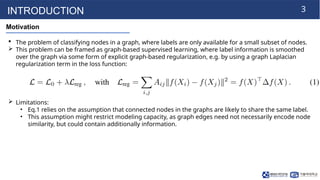
 The problem of classifying nodes in a graph, where labels are only available for a small subset of nodes.
 This problem can be framed as graph-based supervised learning, where label information is smoothed
over the graph via some form of explicit graph-based regularization, e.g. by using a graph Laplacian
regularization term in the loss function:
 Limitations:
• Eq.1 relies on the assumption that connected nodes in the graphs are likely to share the same label.
• This assumption might restrict modeling capacity, as graph edges need not necessarily encode node
similarity, but could contain additionally information.
4
INTRODUCTION
Introduction
 In this paper, they encode the graph structure directly using a neural network model and train on a
supervised target for all nodes with labels, thereby avoiding explicit graph-based regularization in the loss
function().
 Conditioning on the adjacency matrix of the graph will allow the model to distribute gradient information
from the supervised loss and will enable it to learn representations of nodes both with and without labels.
5
INTRODUCTION
Contributions
 Firstly, they introduce a simple and well-behaved layer-wise propagation rule for neural network models
which operate directly on graphs and show how it can be motivated from a first-order approximation of
spectral graph convolutions
 Secondly, they demonstrate how this form of a graph-based neural network model can be used for fast
and scalable semi-supervised classification of nodes in a graph. Experiments on a number of datasets
demonstrate that their model compares favorably both in classification accuracy and efficiency (measured
in wall-clock time) against state-of-the-art methods for semi-supervised learning.
6
Fast Approximate Convolutions on Graphs
Spectral Graph Convolutions
 parameterized by in the Fourier domain
★ (3)
 Where is the matrix of eigenvectors of the normalized Laplacian
 Evaluating Eq. 3 is computationally expensive, as multiplication with the eigenvector matrix is .
Furthermore, computing the eigendecomposition of in the first place might be prohibitively expensive
for large graphs.
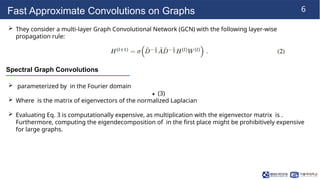
 They consider a multi-layer Graph Convolutional Network (GCN) with the following layer-wise
propagation rule:
7
Fast Approximate Convolutions on Graphs
Spectral Graph Convolutions
 To circumvent this problem, it was suggested in Hammond et al. (2011) that can be well-approximated
by a truncated expansion in terms of Chebyshev polynomials up to order:
 with
 The Chebyshev polynomials are recursively defined as and .
 with ; as can easily be verified by noticing that
 this expression is now K-localized since it is a Kth-order polynomial in the Laplacian, i.e. it depends only on
nodes that are at maximum K steps away from the central node (Kth-order neighborhood).
8
Fast Approximate Convolutions on Graphs
Layer-Wise Linear Model
 Approximate 2
≈
 with a single parameter
 Repeated application of this operator can therefore lead to numerical instabilities and exploding/
vanishing gradients when used in a deep neural network model. To alleviate this problem, they
introduce the following
 where
 This filtering operation has complexity
9
Semi-Supervised Node Classification
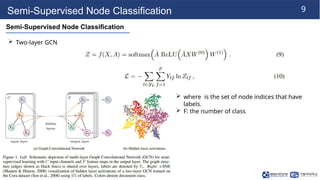
 Two-layer GCN
 where is the set of node indices that have
labels.
 F: the number of class
10
EXPERIMENTS
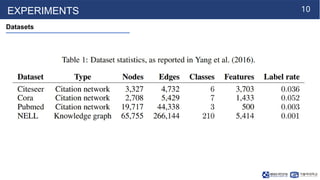
Datasets
11
EXPERIMENTS
Experimental Set-Up
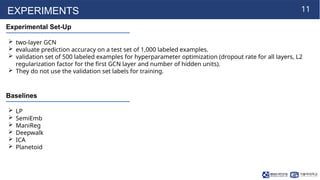
 two-layer GCN
 evaluate prediction accuracy on a test set of 1,000 labeled examples.
 validation set of 500 labeled examples for hyperparameter optimization (dropout rate for all layers, L2
regularization factor for the first GCN layer and number of hidden units).
 They do not use the validation set labels for training.
Baselines
 LP
 SemiEmb
 ManiReg
 Deepwalk
 ICA
 Planetoid
12
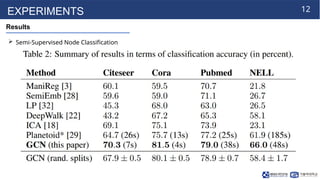
Results
EXPERIMENTS
 Semi-Supervised Node Classification
13
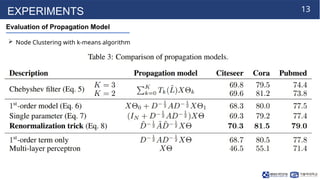
Evaluation of Propagation Model
EXPERIMENTS
 Node Clustering with k-means algorithm
14
Conclusion
Conclusion
 They have introduced a novel approach for semi-supervised classification on graph-structured data.
Their GCN model uses an efficient layer-wise propagation rule that is based on a first-order
approximation of spectral convolutions on graphs.
 Experiments on a number of network datasets suggest that the proposed GCN model is capable of
encoding both graph structure and node features in a way useful for semi-supervised classification. In
this setting, their model outperforms several recently proposed methods by a significant margin, while
being computationally efficient.
15
Q & A
Q / A

240729_JW_labseminar[Semi-Supervised Classification with Graph Convolutional Networks].pptx

  • 1.
    Semi-Supervised Classification with GraphConvolutional Networks Jin-Woo Jeong Network Science Lab Dept. of Mathematics The Catholic University of Korea E-mail: zeus0208b@catholic.ac.kr Thomas N. Kipf, Max Welling ICLR 2017
  • 2.
    2  INTRODUCTION • Motivation •Introduction • Contributions  Fast Approximate Convolutions on Graphs  Semi-Supervised Node Classification  Experiments • Datasets • Experimental Set-up • Baselines • Results  CONCLUSION Q/A
  • 3.
    3 INTRODUCTION Motivation  The problemof classifying nodes in a graph, where labels are only available for a small subset of nodes.  This problem can be framed as graph-based supervised learning, where label information is smoothed over the graph via some form of explicit graph-based regularization, e.g. by using a graph Laplacian regularization term in the loss function:  Limitations: • Eq.1 relies on the assumption that connected nodes in the graphs are likely to share the same label. • This assumption might restrict modeling capacity, as graph edges need not necessarily encode node similarity, but could contain additionally information.
  • 4.
    4 INTRODUCTION Introduction  In thispaper, they encode the graph structure directly using a neural network model and train on a supervised target for all nodes with labels, thereby avoiding explicit graph-based regularization in the loss function().  Conditioning on the adjacency matrix of the graph will allow the model to distribute gradient information from the supervised loss and will enable it to learn representations of nodes both with and without labels.
  • 5.
    5 INTRODUCTION Contributions  Firstly, theyintroduce a simple and well-behaved layer-wise propagation rule for neural network models which operate directly on graphs and show how it can be motivated from a first-order approximation of spectral graph convolutions  Secondly, they demonstrate how this form of a graph-based neural network model can be used for fast and scalable semi-supervised classification of nodes in a graph. Experiments on a number of datasets demonstrate that their model compares favorably both in classification accuracy and efficiency (measured in wall-clock time) against state-of-the-art methods for semi-supervised learning.
  • 6.
    6 Fast Approximate Convolutionson Graphs Spectral Graph Convolutions  parameterized by in the Fourier domain ★ (3)  Where is the matrix of eigenvectors of the normalized Laplacian  Evaluating Eq. 3 is computationally expensive, as multiplication with the eigenvector matrix is . Furthermore, computing the eigendecomposition of in the first place might be prohibitively expensive for large graphs.  They consider a multi-layer Graph Convolutional Network (GCN) with the following layer-wise propagation rule:
  • 7.
    7 Fast Approximate Convolutionson Graphs Spectral Graph Convolutions  To circumvent this problem, it was suggested in Hammond et al. (2011) that can be well-approximated by a truncated expansion in terms of Chebyshev polynomials up to order:  with  The Chebyshev polynomials are recursively defined as and .  with ; as can easily be verified by noticing that  this expression is now K-localized since it is a Kth-order polynomial in the Laplacian, i.e. it depends only on nodes that are at maximum K steps away from the central node (Kth-order neighborhood).
  • 8.
    8 Fast Approximate Convolutionson Graphs Layer-Wise Linear Model  Approximate 2 ≈  with a single parameter  Repeated application of this operator can therefore lead to numerical instabilities and exploding/ vanishing gradients when used in a deep neural network model. To alleviate this problem, they introduce the following  where  This filtering operation has complexity
  • 9.
    9 Semi-Supervised Node Classification Semi-SupervisedNode Classification  Two-layer GCN  where is the set of node indices that have labels.  F: the number of class
  • 10.
  • 11.
    11 EXPERIMENTS Experimental Set-Up  two-layerGCN  evaluate prediction accuracy on a test set of 1,000 labeled examples.  validation set of 500 labeled examples for hyperparameter optimization (dropout rate for all layers, L2 regularization factor for the first GCN layer and number of hidden units).  They do not use the validation set labels for training. Baselines  LP  SemiEmb  ManiReg  Deepwalk  ICA  Planetoid
  • 12.
  • 13.
    13 Evaluation of PropagationModel EXPERIMENTS  Node Clustering with k-means algorithm
  • 14.
    14 Conclusion Conclusion  They haveintroduced a novel approach for semi-supervised classification on graph-structured data. Their GCN model uses an efficient layer-wise propagation rule that is based on a first-order approximation of spectral convolutions on graphs.  Experiments on a number of network datasets suggest that the proposed GCN model is capable of encoding both graph structure and node features in a way useful for semi-supervised classification. In this setting, their model outperforms several recently proposed methods by a significant margin, while being computationally efficient.
  • 15.

Editor's Notes

  • #15 thank you, the presentation is concluded