CONVENTIONAL
ENCRYPTION
Prof. Neeraj Bhargava
Mrs. Shubha Chaturvedi
Department of Computer Science, School of Engineering & System Sciences
MDS University Ajmer, Rajasthan
INTRODUCTION TO CONVENTIONAL
ENCRYPTION
CONVENTIONAL ENCRYPTION ARE CRYPTOGRAPHIC
SYSTEM WHICH USES SAME KEY USED BY SENDER TO
ENCRYPT MESSAGE AND BY RECEIVER TO DECRYPT
MESSAGE. IT WAS ONLY TYPE OF ENCRYPTION IN USE
PRIOR TO DEVELOPMENT OF PUBLIC-KEY ENCRYPTION.
IT IS STILL MUCH PREFERRED OF THE TWO TYPES OF
ENCRYPTION SYSTEMS DUE TO ITS SIMPLICITY. IT IS A
RELATIVELY FAST PROCESS SINCE IT USES A SINGLE KEY
FOR BOTH ENCRYPTION AND DECRYPTION IN THIS
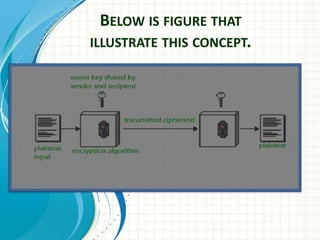
ENCRYPTION MODEL, THE SENDER ENCRYPTS PLAINTEXT
USING RECEIVER’S SECRET KEY, WHICH CAN BE LATER
USED BY RECEIVER TO DECRYPT CIPHERTEXT.
BELOW IS FIGURE THAT
ILLUSTRATE THIS CONCEPT.
EXPLANATION :
SUPPOSE A WANTS TO SEND A MESSAGE TO B, THAT MESSAGE IS CALLED
PLAINTEXT. NOW, TO AVOID HACKERS TO READ PLAINTEXT, PLAINTEXT IS
ENCRYPTED USING ALGORITHM AND A SECRET KEY (AT 1). THIS
ENCRYPTED PLAINTEXT IS CALLED CIPHERTEXT. USING SAME SECRET KEY
AND ENCRYPTION ALGORITHM RUN IN REVERSE(AT 2), B CAN GET
PLAINTEXT OF A AND THUS MESSAGE IS READ AND SECURITY IS
MAINTAINED.
THE IDEA THAT USES IN THIS TECHNIQUE IS VERY OLD AND THAT’S WHY
THIS MODEL IS CALLED CONVENTIONAL ENCRYPTION
A CONVENTIONAL ENCRYPTION HAS MAINLY 5 INGREDIENTS
• Plain text – thus message is read and security is maintained.
• Encryption algorithm –Encryption algorithm performs various
transformations on plain text to convert it into cipher text.
• Secret key –Secret key is also an input to the algorithm. The
encryption algorithm will produce different output based on
the keys used at that time.
• Cipher text –It contains encrypted information because it
contains a form of original plaintext that is unreadable by a
human or computer without proper cipher to decrypt it. It is
output from algorithm.
• Decryption algorithm – This is used to run encryption
algorithm in reverse. Cipher text and Secret key is input here
and it produces plain text as output.
ADVANTAGES OF CONVENTIONAL ENCRYPTION
1. Simple :
This type of encryption is easy to carry out.
2. Uses less computer resources :
Conventional encryption does not require a lot of computer
resources when compared to public key encryption.
3. Fast :
Conventional encryption is much faster than asymmetric
key encryption.
DISADVANTAGES OF CONVENTIONAL ENCRYPTION
1. Origin and authenticity of message cannot be guaranteed,
since both sender and receiver use the same key, messages
cannot be verified to have come from a particular user.
2. It isn’t much secured when compared to public key
encryption. If the receiver lost the key, he/she cant decrypt
the and thus the whole
3. This scheme does not scale well to a large number of users
because both the sender and the receiver to agree on a secret
key before transmission.
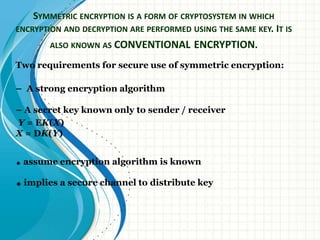
SYMMETRIC ENCRYPTION:
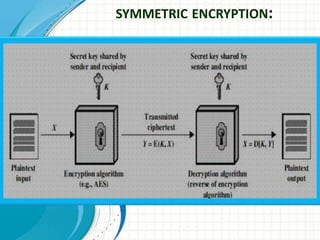
SYMMETRIC ENCRYPTION IS A FORM OF CRYPTOSYSTEM IN WHICH
ENCRYPTION AND DECRYPTION ARE PERFORMED USING THE SAME KEY. IT IS
ALSO KNOWN AS CONVENTIONAL ENCRYPTION.
Two requirements for secure use of symmetric encryption:
– A strong encryption algorithm
– A secret key known only to sender / receiver
Y = EK(X)
X = DK(Y)
.assume encryption algorithm is known
.implies a secure channel to distribute key
A source produces a message in plaintext, X = [X1, X2… XM] where M are the
number of letters in the message. A key of the form K = [K1, K2… KJ] is generated. If
the key is generated at the source, then it must be provided to the destination by
means of some secure channel.
With the message X and the encryption key K as input, the encryption algorithm
forms the cipher text Y = [Y1, Y2, YN]. This can be expressed as
Y = EK(X)
The intended receiver, in possession of the k e y ,is able to invert
the transformation:
X = DK(Y)
An opponent, observing Y but not having access to K or X, may attempt to recover X
or K or both. It is assumed that the opponent knows the encryption and decryption
algorithms If the opponent is interested in only this particular message, then the
focus of effort is to recover by generating a plaintext estimate. Often if the opponent
is interested in being able to read future messages as well, in which case an attempt
is made to recover K by generating an estimate.
ASSIGNMENT
Q1. Explain the Conventional Encryption model in Detail?

CONVENTIONAL ENCRYPTION

  • 1.
    CONVENTIONAL ENCRYPTION Prof. Neeraj Bhargava Mrs.Shubha Chaturvedi Department of Computer Science, School of Engineering & System Sciences MDS University Ajmer, Rajasthan
  • 2.
    INTRODUCTION TO CONVENTIONAL ENCRYPTION CONVENTIONALENCRYPTION ARE CRYPTOGRAPHIC SYSTEM WHICH USES SAME KEY USED BY SENDER TO ENCRYPT MESSAGE AND BY RECEIVER TO DECRYPT MESSAGE. IT WAS ONLY TYPE OF ENCRYPTION IN USE PRIOR TO DEVELOPMENT OF PUBLIC-KEY ENCRYPTION. IT IS STILL MUCH PREFERRED OF THE TWO TYPES OF ENCRYPTION SYSTEMS DUE TO ITS SIMPLICITY. IT IS A RELATIVELY FAST PROCESS SINCE IT USES A SINGLE KEY FOR BOTH ENCRYPTION AND DECRYPTION IN THIS ENCRYPTION MODEL, THE SENDER ENCRYPTS PLAINTEXT USING RECEIVER’S SECRET KEY, WHICH CAN BE LATER USED BY RECEIVER TO DECRYPT CIPHERTEXT.
  • 3.
    BELOW IS FIGURETHAT ILLUSTRATE THIS CONCEPT.
  • 4.
    EXPLANATION : SUPPOSE AWANTS TO SEND A MESSAGE TO B, THAT MESSAGE IS CALLED PLAINTEXT. NOW, TO AVOID HACKERS TO READ PLAINTEXT, PLAINTEXT IS ENCRYPTED USING ALGORITHM AND A SECRET KEY (AT 1). THIS ENCRYPTED PLAINTEXT IS CALLED CIPHERTEXT. USING SAME SECRET KEY AND ENCRYPTION ALGORITHM RUN IN REVERSE(AT 2), B CAN GET PLAINTEXT OF A AND THUS MESSAGE IS READ AND SECURITY IS MAINTAINED. THE IDEA THAT USES IN THIS TECHNIQUE IS VERY OLD AND THAT’S WHY THIS MODEL IS CALLED CONVENTIONAL ENCRYPTION
  • 5.
    A CONVENTIONAL ENCRYPTIONHAS MAINLY 5 INGREDIENTS • Plain text – thus message is read and security is maintained. • Encryption algorithm –Encryption algorithm performs various transformations on plain text to convert it into cipher text. • Secret key –Secret key is also an input to the algorithm. The encryption algorithm will produce different output based on the keys used at that time. • Cipher text –It contains encrypted information because it contains a form of original plaintext that is unreadable by a human or computer without proper cipher to decrypt it. It is output from algorithm. • Decryption algorithm – This is used to run encryption algorithm in reverse. Cipher text and Secret key is input here and it produces plain text as output.
  • 6.
    ADVANTAGES OF CONVENTIONALENCRYPTION 1. Simple : This type of encryption is easy to carry out. 2. Uses less computer resources : Conventional encryption does not require a lot of computer resources when compared to public key encryption. 3. Fast : Conventional encryption is much faster than asymmetric key encryption.
  • 7.
    DISADVANTAGES OF CONVENTIONALENCRYPTION 1. Origin and authenticity of message cannot be guaranteed, since both sender and receiver use the same key, messages cannot be verified to have come from a particular user. 2. It isn’t much secured when compared to public key encryption. If the receiver lost the key, he/she cant decrypt the and thus the whole 3. This scheme does not scale well to a large number of users because both the sender and the receiver to agree on a secret key before transmission.
  • 8.
  • 9.
    SYMMETRIC ENCRYPTION ISA FORM OF CRYPTOSYSTEM IN WHICH ENCRYPTION AND DECRYPTION ARE PERFORMED USING THE SAME KEY. IT IS ALSO KNOWN AS CONVENTIONAL ENCRYPTION. Two requirements for secure use of symmetric encryption: – A strong encryption algorithm – A secret key known only to sender / receiver Y = EK(X) X = DK(Y) .assume encryption algorithm is known .implies a secure channel to distribute key
  • 10.
    A source producesa message in plaintext, X = [X1, X2… XM] where M are the number of letters in the message. A key of the form K = [K1, K2… KJ] is generated. If the key is generated at the source, then it must be provided to the destination by means of some secure channel. With the message X and the encryption key K as input, the encryption algorithm forms the cipher text Y = [Y1, Y2, YN]. This can be expressed as Y = EK(X) The intended receiver, in possession of the k e y ,is able to invert the transformation: X = DK(Y) An opponent, observing Y but not having access to K or X, may attempt to recover X or K or both. It is assumed that the opponent knows the encryption and decryption algorithms If the opponent is interested in only this particular message, then the focus of effort is to recover by generating a plaintext estimate. Often if the opponent is interested in being able to read future messages as well, in which case an attempt is made to recover K by generating an estimate.
  • 11.
    ASSIGNMENT Q1. Explain theConventional Encryption model in Detail?