UNIX AND ITS COMPONENTS
Prof. Neeraj Bhargava
Mrs. Shubha Chaturvedi
Department of Computer Science, School of Engineering & System Science
MDS University Ajmer, Rajasthan
The UNIX System
The UNIX system consists of two components:
• Utilities and Commands
• The Kernel
Utilities
Utilities are programs you can run or execute.
The term utility refers to the name of a
program .
The programs who and date are examples of
utilities.
Commands
• The Linux command is a utility of the Linux operating
system. All basic and advanced tasks can be done by
executing commands.
• The term command refers to the program and any
arguments you specify to that program to change its
behavior.
• The commands are executed on the Linux terminal.
The terminal is a command-line interface to interact
with the system, which is similar to
the command prompt in the Windows OS.
Kernel
• Kernel is heart of Linux O/S. It manages resource
of Linux O/S. Resources means facilities available
in Linux.
• For eg. Facility to store data, print data on printer,
memory, file management etc .
• Kernel decides who will use this resource, for
how long and when. It runs your programs (or set
up to execute binary files).It's Memory resident
portion of Linux.
• It performance following task :-
● I/O management ● Process management
● Device management ● File management
● Memory management
• Kernel provides utilities with a means of
accessing a machine's hardware.
• It also handles the scheduling and execution of
commands. When a machine is turned off, both
the kernel and the utilities are stored on the
machine's hard disks.
• But when the computer is booted, the kernel is
loaded from disk into memory. The kernel
remains in memory until the machine is turned
off.
• Utilities, on the other hand, are stored on disk
and loaded into memory only when they are
executed.
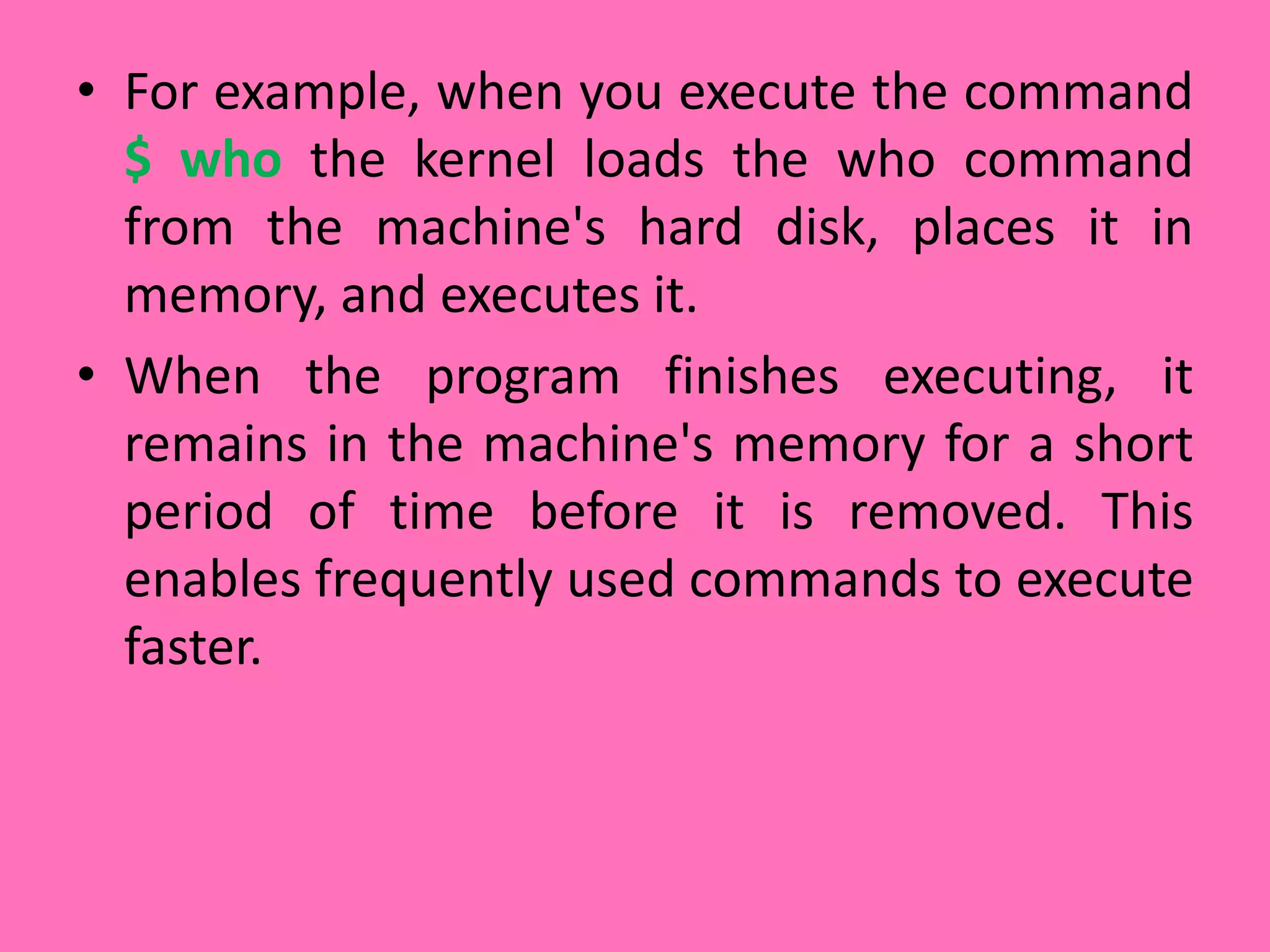
• For example, when you execute the command
$ who the kernel loads the who command
from the machine's hard disk, places it in
memory, and executes it.
• When the program finishes executing, it
remains in the machine's memory for a short
period of time before it is removed. This
enables frequently used commands to execute
faster.
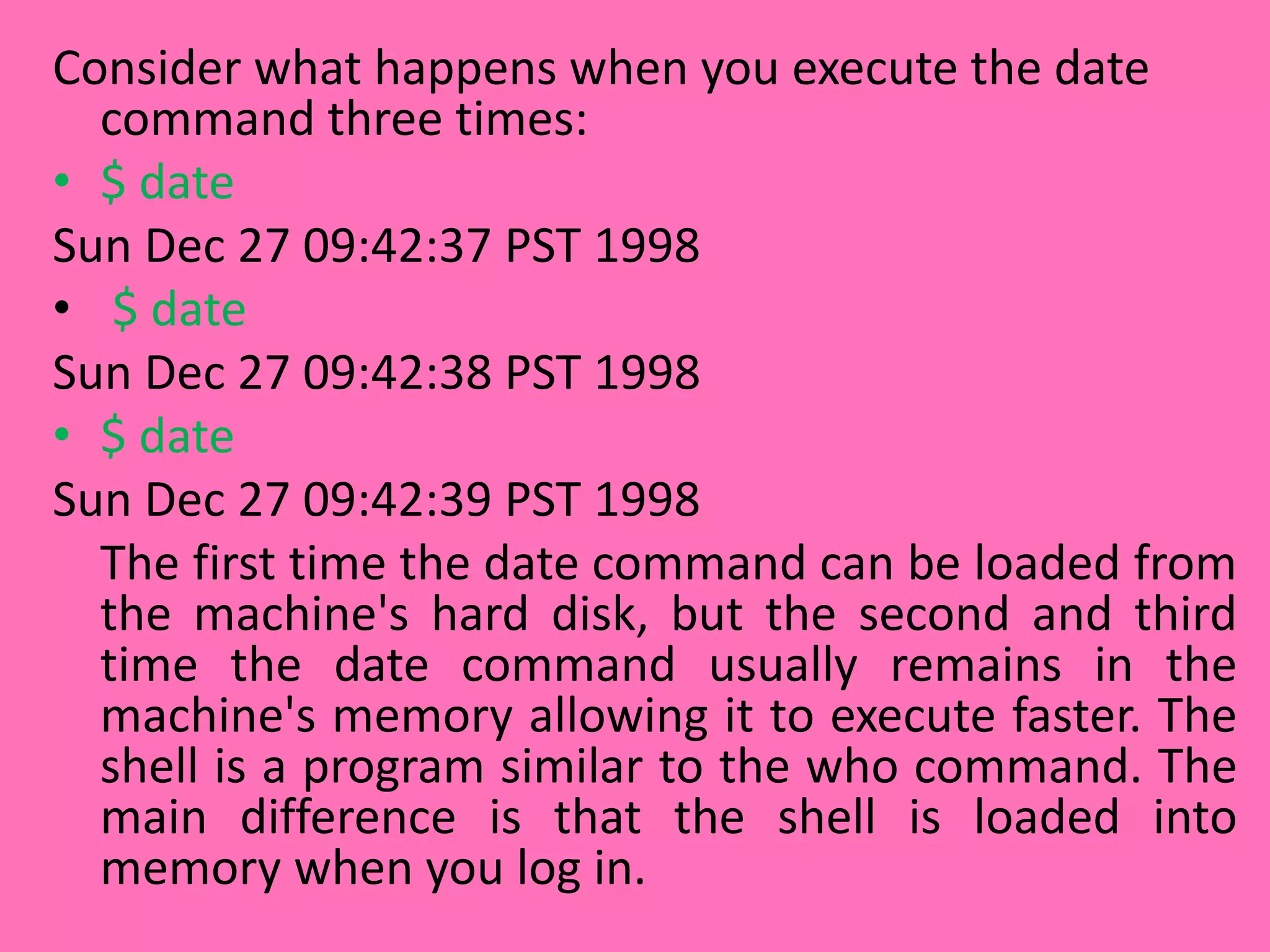
Consider what happens when you execute the date
command three times:
• $ date
Sun Dec 27 09:42:37 PST 1998
• $ date
Sun Dec 27 09:42:38 PST 1998
• $ date
Sun Dec 27 09:42:39 PST 1998
The first time the date command can be loaded from
the machine's hard disk, but the second and third
time the date command usually remains in the
machine's memory allowing it to execute faster. The
shell is a program similar to the who command. The
main difference is that the shell is loaded into
memory when you log in.
Linux Shell
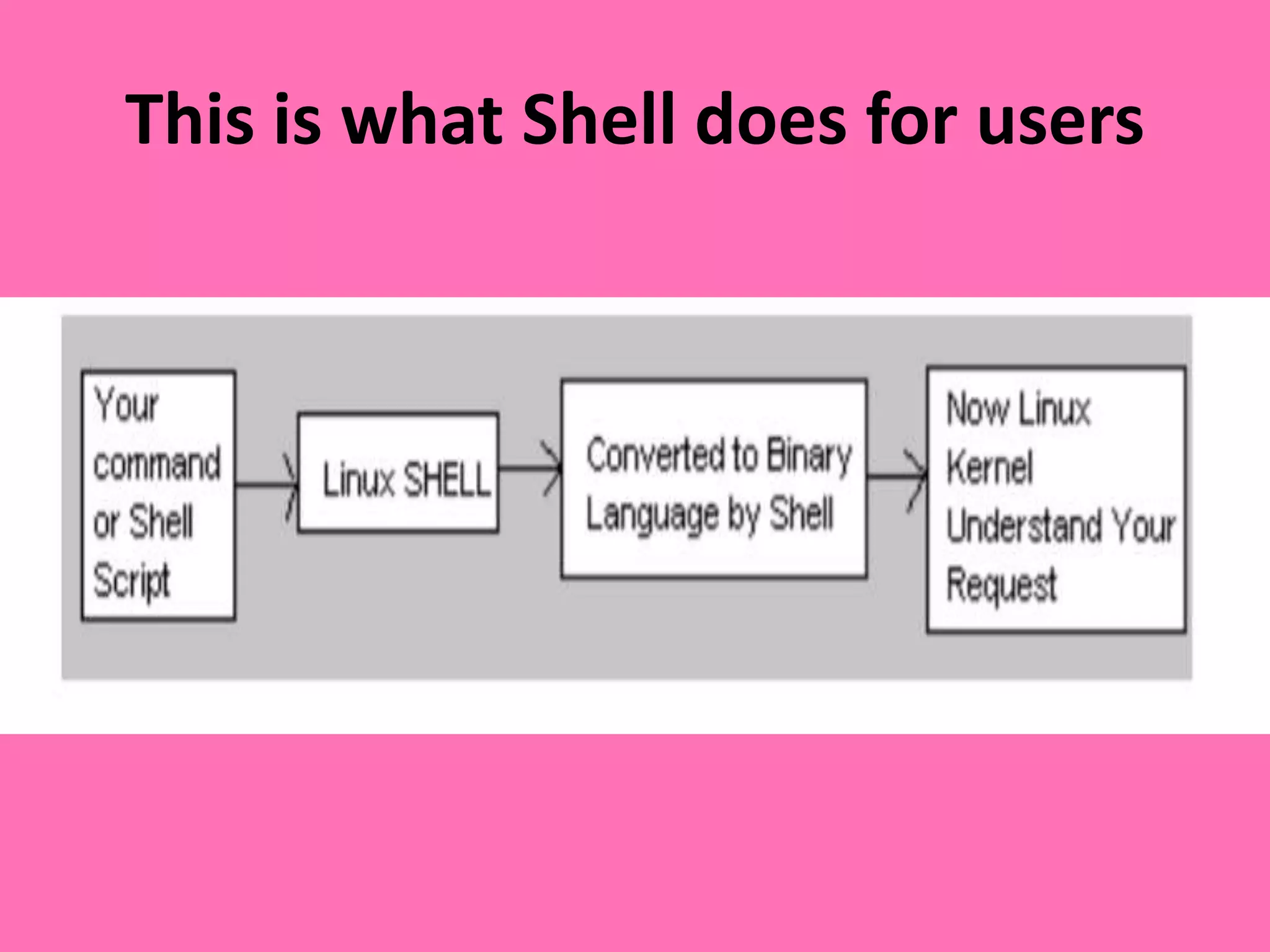
• Computer understand the language of 0's and
1's called binary language.
• In early days of computing, instruction are
provided using binary language, which is
difficult for all of us, to read and write.
• So in O/s there is special program called Shell.
• Shell accepts your instruction or commands in
English and translate it into computers native
binary language.
This is what Shell does for users
• It's environment provided for user interaction.
• Shell is an command language interpreter
that executes commands read from the
standard input device (keyboard) or from a
file.
• Linux may use one of the following most
popular shells (In MS-DOS, Shell name is
COMMAND.COM which is also used for same
purpose, but it's not as powerful as our Linux
Shells are!)

Unix and its Components

  • 1.
    UNIX AND ITSCOMPONENTS Prof. Neeraj Bhargava Mrs. Shubha Chaturvedi Department of Computer Science, School of Engineering & System Science MDS University Ajmer, Rajasthan
  • 2.
    The UNIX System TheUNIX system consists of two components: • Utilities and Commands • The Kernel
  • 3.
    Utilities Utilities are programsyou can run or execute. The term utility refers to the name of a program . The programs who and date are examples of utilities.
  • 4.
    Commands • The Linuxcommand is a utility of the Linux operating system. All basic and advanced tasks can be done by executing commands. • The term command refers to the program and any arguments you specify to that program to change its behavior. • The commands are executed on the Linux terminal. The terminal is a command-line interface to interact with the system, which is similar to the command prompt in the Windows OS.
  • 5.
    Kernel • Kernel isheart of Linux O/S. It manages resource of Linux O/S. Resources means facilities available in Linux. • For eg. Facility to store data, print data on printer, memory, file management etc . • Kernel decides who will use this resource, for how long and when. It runs your programs (or set up to execute binary files).It's Memory resident portion of Linux. • It performance following task :- ● I/O management ● Process management ● Device management ● File management ● Memory management
  • 6.
    • Kernel providesutilities with a means of accessing a machine's hardware. • It also handles the scheduling and execution of commands. When a machine is turned off, both the kernel and the utilities are stored on the machine's hard disks. • But when the computer is booted, the kernel is loaded from disk into memory. The kernel remains in memory until the machine is turned off. • Utilities, on the other hand, are stored on disk and loaded into memory only when they are executed.
  • 7.
    • For example,when you execute the command $ who the kernel loads the who command from the machine's hard disk, places it in memory, and executes it. • When the program finishes executing, it remains in the machine's memory for a short period of time before it is removed. This enables frequently used commands to execute faster.
  • 8.
    Consider what happenswhen you execute the date command three times: • $ date Sun Dec 27 09:42:37 PST 1998 • $ date Sun Dec 27 09:42:38 PST 1998 • $ date Sun Dec 27 09:42:39 PST 1998 The first time the date command can be loaded from the machine's hard disk, but the second and third time the date command usually remains in the machine's memory allowing it to execute faster. The shell is a program similar to the who command. The main difference is that the shell is loaded into memory when you log in.
  • 9.
    Linux Shell • Computerunderstand the language of 0's and 1's called binary language. • In early days of computing, instruction are provided using binary language, which is difficult for all of us, to read and write. • So in O/s there is special program called Shell. • Shell accepts your instruction or commands in English and translate it into computers native binary language.
  • 10.
    This is whatShell does for users
  • 11.
    • It's environmentprovided for user interaction. • Shell is an command language interpreter that executes commands read from the standard input device (keyboard) or from a file. • Linux may use one of the following most popular shells (In MS-DOS, Shell name is COMMAND.COM which is also used for same purpose, but it's not as powerful as our Linux Shells are!)